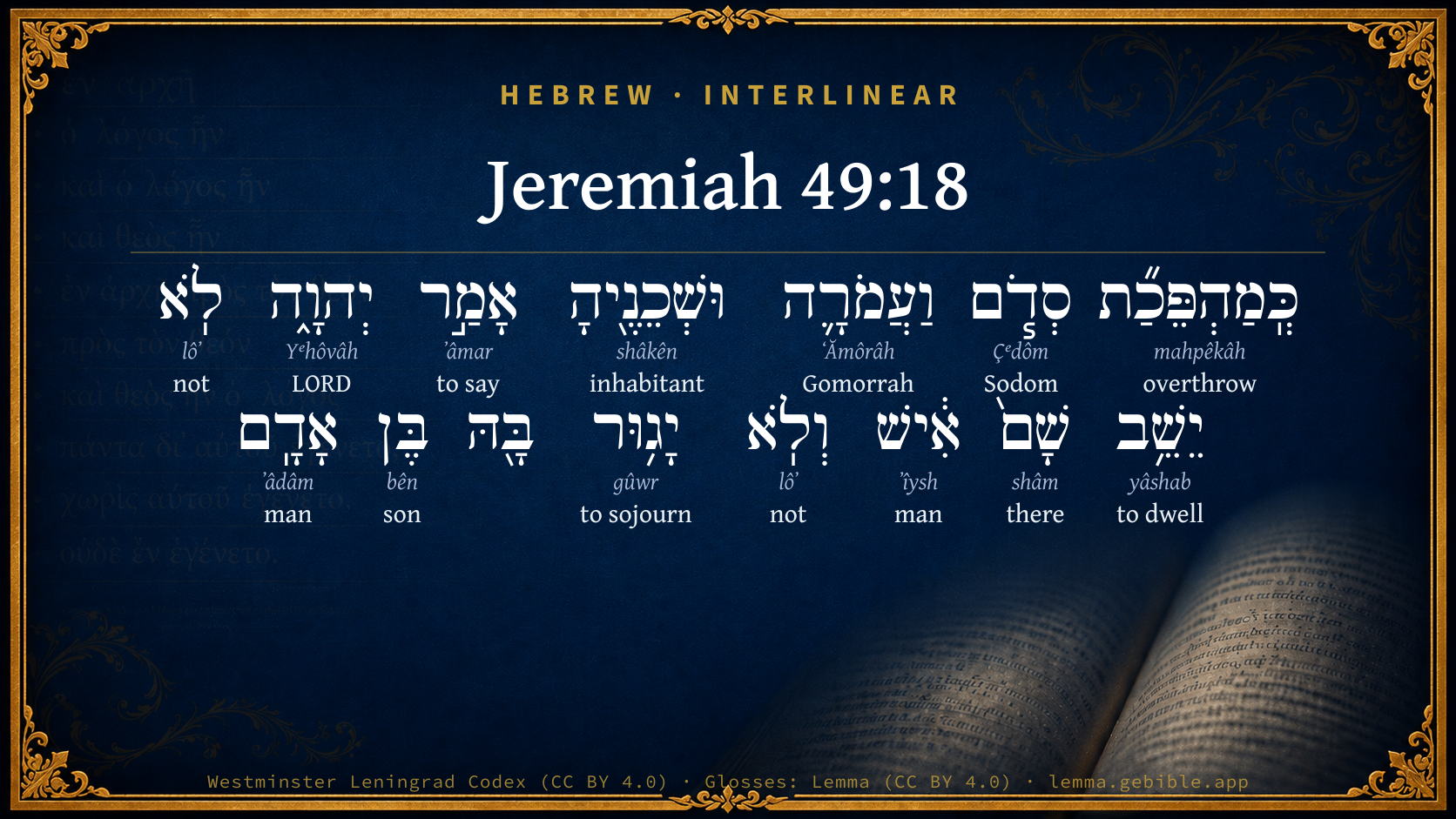
Jeremiah 49:18

Hebrew (Westminster Leningrad Codex) Jeremiah 49:18 appears in the Hebrew Old Testament. The text above is from the Westminster Leningrad Codex. Each word links to its Strong’s number, a concise gloss, and parsing drawn from the Open Scriptures Hebrew Bible morphology. Click any word for its full Brown-Driver-Briggs (BDB) entry.
Download image
Cite this verse

Jeremiah 49:18 (World English Bible). Public Domain. Lemma interlinear Bible study tool, https://lemma.gebible.app/v/jeremiah/49/18.

Show BibTeX & RIS
BibTeX
RIS
English Translation
As in the overthrow of Sodom and Gomorrah and the neighbor cities of it, says Yahweh, no man shall dwell there, neither shall any son of man sojourn therein.
World English Bible · Public Domain
Download a study sheet

One document with this verse’s original text, its word-by-word gloss line, the meaning frame, cross-references with their text, attributed commentary, and full source and license credits — printable, and it pastes into notes with its structure intact.

This verse Autodidact and up

Study sheet (.html) Plain text (.txt)

A passage Seminary Student

Up to 50 verses in one chapter. A passage sheet keeps up to 6 commentary sources and 12 cross-references per verse, in the order this page ranks them, and says so on the sheet whenever that leaves anything out. Ask for a single verse and you get the Autodidact verse sheet above.

Everything on this page stays free to read, with no account — the sheet is a download of what is already on screen, not access to it.

Want to remove ads? Support Godless Engineer
Compare translations 3

The same verse in 3 English versions, stacked beneath the original-language interlinear above. Click any original word for its lexicon entry.

Each is an independent rendering of the whole verse — the interlinear is not word-aligned to these translations.

Highlighted words mark where these versions differ — a whole-verse word diff, not a word-by-word alignment.

  • World English Bible Public Domain
    As in the overthrow of Sodom and Gomorrah and the neighbor cities of it, says Yahweh, no man shall dwell there, neither shall any son of man sojourn therein.
  • King James Version Public Domain
    As in the overthrow of Sodom and Gomorrah and the neighbour cities thereof, saith the LORD, no man shall abide there, neither shall a son of man dwell in it.
  • unfoldingWord Literal Text CC BY-SA 4.0
    Like the overthrow of Sodom and Gomorrah and their neighbors,” says Yahweh, “no one will live there; no person will stay there.

unfoldingWord Literal Text — © unfoldingWord, licensed CC BY-SA 4.0. Word-aligned USFM3 via Door43 (git.door43.org/unfoldingWord/en_ult).

Versions to compare (up to 4)

3 of 4 selected

Show all 18 translations

Every available English version of this verse, each an independent rendering of the whole verse.

  • World English Bible Public Domain
    As in the overthrow of Sodom and Gomorrah and the neighbor cities of it, says Yahweh, no man shall dwell there, neither shall any son of man sojourn therein.
  • Berean Standard Bible Public Domain
    As Sodom and Gomorrah were overthrown along with their neighbors,” says the LORD, “no one will dwell there; no man will abide there.
  • Majority Standard Bible Public Domain
    As Sodom and Gomorrah were overthrown along with their neighbors,” says the LORD, “no one will dwell there; no man will abide there.
  • King James Version Public Domain
    As in the overthrow of Sodom and Gomorrah and the neighbour cities thereof, saith the LORD, no man shall abide there, neither shall a son of man dwell in it.
  • American Standard Version (1901) Public Domain
    As in the overthrow of Sodom and Gomorrah and the neighbor cities thereof, saith Jehovah, no man shall dwell there, neither shall any son of man sojourn therein.
  • Revised Version (1885) Public Domain
    As in the overthrow of Sodom and Gomorrah and the neighbour cities thereof, saith the LORD, no man shall dwell there, neither shall any son of man sojourn therein.
  • Geneva Bible (1599) Public Domain
    As in the ouerthrowe of Sodom, and of Gomorah, and the places thereof neere about, saieth the Lord: no man shall dwell there, neither shall the sonnes of men remaine in it.
  • Douay-Rheims (1899) Public Domain
    As Sodom was overthrown and Gomorrha, and the neighbours thereof, saith the Lord: there shall not a man dwell there, and there shall no son of man inhabit it.
  • Young's Literal Translation Public Domain
    As the overthrow of Sodom and Gomorrah, And its neighbours, said Jehovah, No one doth dwell there, Nor sojourn in her doth a son of man.
  • Literal Standard Version CC BY-SA 4.0
    As the overthrow of Sodom and Gomorrah, || And its neighbors, said YHWH, || No one dwells there, || Nor does a son of man sojourn in her.
  • Unlocked Literal Bible CC BY-SA 4.0
    Like the overthrow of Sodom and Gomorrah and their neighbors,” says Yahweh, “no one will live there; no person will stay there.
  • unfoldingWord Literal Text CC BY-SA 4.0
    Like the overthrow of Sodom and Gomorrah and their neighbors,” says Yahweh, “no one will live there; no person will stay there.
  • Darby Bible Public Domain
    As in the overthrow of Sodom and Gomorrah, and their neighbour cities, saith Jehovah, no one shall dwell there, neither shall a son of man sojourn therein.
  • World Messianic Bible Public Domain
    As in the overthrow of Sodom and Gomorrah and its neighbor cities,” says the LORD, “no man will dwell there, neither will any son of man live therein.
  • Webster's Bible Public Domain
    As in the overthrow of Sodom and Gomorrah and the neighboring cities, saith the LORD, no man shall abide there, neither shall a son of man dwell in it.
  • Free Bible Version CC BY-SA 4.0
    Just as Sodom and Gomorrah were destroyed, along with their neighboring towns, says the Lord, nobody will live there—they will become uninhabited.
  • Bible in Basic English Public Domain
    As at the downfall of Sodom and Gomorrah and their neighbouring towns, says the Lord, no man will be living in it, no son of man will have a resting-place there.
  • JPS Tanakh (1917) Public Domain
    As in the overthrow of Sodom and Gomorrah and the neighbour cities thereof, saith the LORD, no man shall abide there, neither shall any son of man dwell therein.

Literal Standard Version (2020), Covenant Press — licensed CC BY-SA 4.0. Text via the HelloAO Bible API (eBible.org). Unlocked Literal Bible (unfoldingWord) — licensed CC BY-SA 4.0. Text via the HelloAO Bible API (eBible.org). unfoldingWord Literal Text — © unfoldingWord, licensed CC BY-SA 4.0. Word-aligned USFM3 via Door43 (git.door43.org/unfoldingWord/en_ult). Free Bible Version, Dr. Jonathan Gallagher — licensed CC BY-SA 4.0. Text via the HelloAO Bible API (eBible.org).

Word by word

More ways to search: Search by grammar → Find every occurrence → Compare this word →

Practice this passage: Drill this verse → Learn its vocabulary →

כְּֽמַהְפֵּכַ֞ת
mahpêkâh
H4114
“like/as · overthrow of”
Preposition + Noun, Common, Feminine, Singular, Construct
Part of Speech
Preposition + Noun
Type
Common
Gender
Feminine
Number
Singular
State
Construct
Full BDB Definition

Origin: from H2015

TWOT: 512d

overthrow, destruction - always of Sodom and Gomorrah
  1. סְדֹ֧ם Çᵉdôm H5467 “Sodom” Noun, Proper
  2. וַעֲמֹרָ֛ה ʻĂmôrâh H6017 “and · Gomorrah” Conjunction + Noun, Proper
  3. וּשְׁכֵנֶ֖יהָ shâkên H7934 “and · inhabitant · her” Conjunction + Adjective, Adjective, Masculine, Plural, Construct + Suffix, Personal, 3rd Person, Feminine, Singular
  4. אָמַ֣ר ʼâmar H559 “to say” Verb, Qal, Perfect, 3rd Person, Masculine, Singular
  5. יְהוָ֑ה Yᵉhôvâh H3068 “LORD” Noun, Proper
  6. לֹֽא lôʼ H3808 “not” Particle, Negative
  7. יֵשֵׁ֥ב yâshab H3427 “to dwell” Verb, Qal, Imperfect, 3rd Person, Masculine, Singular
  8. שָׁם֙ shâm H8033 “there” Adverb
  9. אִ֔ישׁ ʼîysh H376 “man” Noun, Common, Masculine, Singular, Absolute
  10. וְלֹֽא lôʼ H3808 “and · not” Conjunction + Particle, Negative
  11. יָג֥וּר gûwr H1481 “to sojourn” Verb, Qal, Imperfect, 3rd Person, Masculine, Singular
  12. בֶּן bên H1121 “son of” Noun, Common, Masculine, Singular, Construct
  13. אָדָֽם ʼâdâm H120 “man” Noun, Common, Masculine, Singular, Absolute

About this verse

These counts appear in no published source. They are computed here, from the morphology-tagged text and Lemma’s own curated glosses. What Lemma adds →

15
words
13
distinct lemmas
Prophets
section

Notable vocabulary

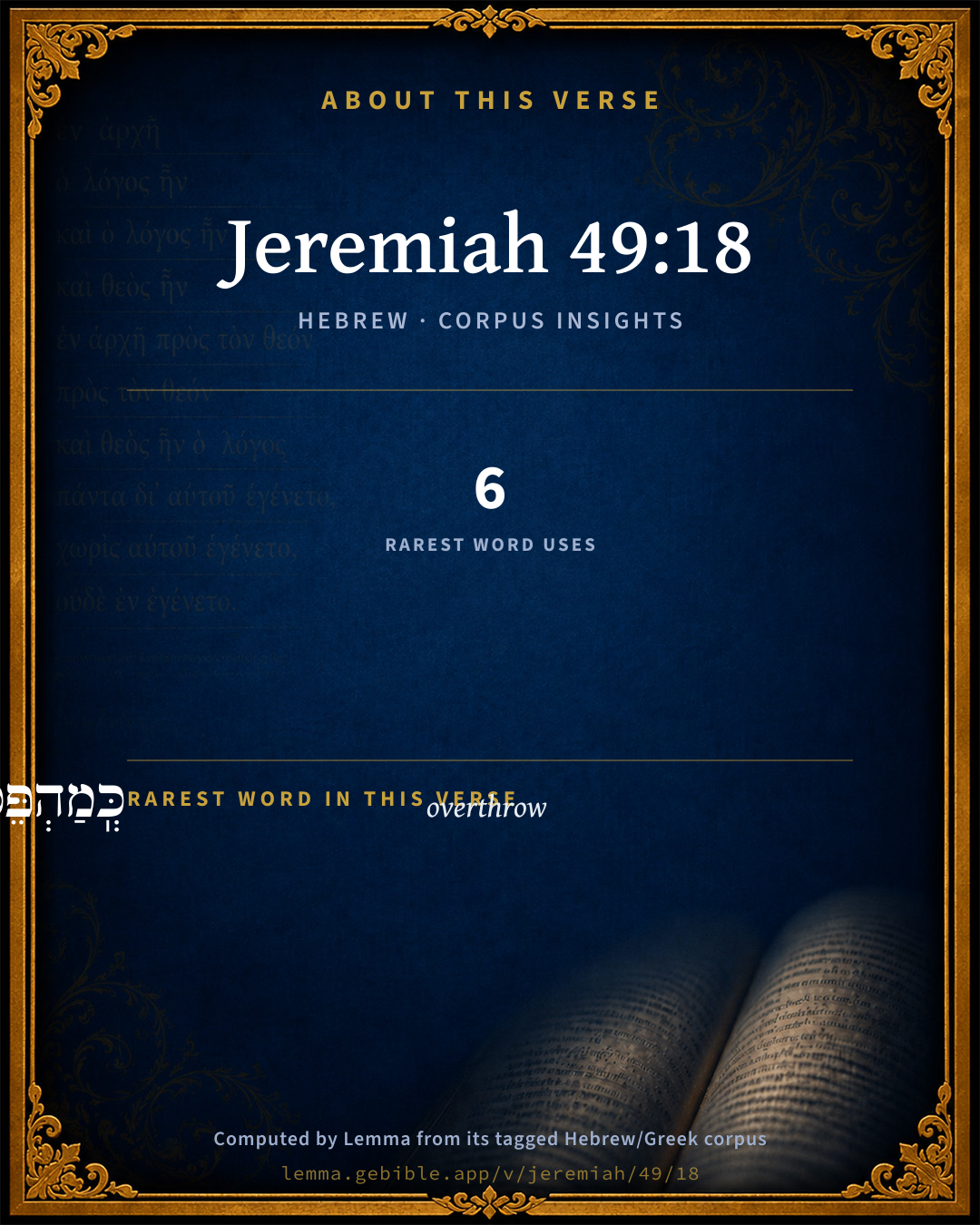
The rarest word here is כְּֽמַהְפֵּכַ֞ת overthrow H4114 — appearing just 6 times in the whole Hebrew Bible.

Shared distinctive vocabulary

כְּֽמַהְפֵּכַ֞ת overthrow H4114 occurs in 6 verses of the Hebrew Bible. Also found in:

Grammatical profile

  • 3 verbs
  • 7 nouns
  • 1 adjective
  • 1 preposition
  • 1 adverb
  • 2 particles

Verb forms

  • אָמַ֣ר Qal · Perfect
  • יֵשֵׁ֥ב Qal · Imperfect
  • יָג֥וּר Qal · Imperfect

Repetition

A word recurs within this verse — often emphatic in Hebrew:

Cross-references

13

Topical passages linked to Jeremiah 49:18 in the Treasury of Scripture Knowledge — connected by theme and wording, ordered by reader-vote popularity; previews shown in the World English Bible.

  • Deuteronomy 29:23 [and that] the whole land of it is sulfur, and salt, [and] a burning, [that] it is not sown, nor bears, nor any grass grows therein, like the overthrow of Sodom and Gomorrah, Admah and Zeboiim, which Yahweh overthrew in his anger, and in his wrath:
  • Jeremiah 49:33 Hazor shall be a dwelling-place of jackals, a desolation forever: no man shall dwell there, neither shall any son of man sojourn therein.
  • Genesis 19:24–25 Then Yahweh rained on Sodom and on Gomorrah sulfur and fire from Yahweh out of the sky.
  • Job 18:15–18 There shall dwell in his tent that which is none of his. Sulfur shall be scattered on his habitation.
  • Jeremiah 50:40 As when God overthrew Sodom and Gomorrah and the neighbor cities of it, says Yahweh, so shall no man dwell there, neither shall any son of man sojourn therein.
  • Amos 4:11 "I have overthrown some of you, As when God overthrew Sodom and Gomorrah, And you were like a burning stick plucked out of the fire; Yet you haven't returned to me," says Yahweh.
  • Zephaniah 2:9 Therefore as I live, says Yahweh of Hosts, the God of Israel, surely Moab will be as Sodom, and the children of Ammon as Gomorrah, a possession of nettles, and salt pits, and a perpetual desolation. The remnant of my people will plunder them, and the survivors of my nation will inherit them.
  • Psalms 11:6 On the wicked he will rain blazing coals; Fire, sulfur, and scorching wind shall be the portion of their cup.
  • Isaiah 13:19–22 Babylon, the glory of kingdoms, the beauty of the Chaldeans' pride, shall be as when God overthrew Sodom and Gomorrah.
  • Isaiah 34:10 It shall not be quenched night nor day; the smoke of it shall go up for ever; from generation to generation it shall lie waste; none shall pass through it forever and ever.
  • 2 Peter 2:6 and turning the cities of Sodom and Gomorrah into ashes, condemned them to destruction, having made them an example to those who would live ungodly;
  • Jude 1:7 Even as Sodom and Gomorrah, and the cities around them, having, in the same way as these, given themselves over to sexual immorality and gone after strange flesh, are set forth as an example, suffering the punishment of eternal fire.
  • Revelation 18:21–23 A mighty angel took up a stone like a great millstone and cast it into the sea, saying, "Thus with violence will Babylon, the great city, be thrown down, and will be found no more at all.

Cross-references courtesy of OpenBible.info (CC BY 4.0).

Hebrew and Greek witnesses Masoretic Hebrew ↔ Greek Septuagint

The same verse in the two great witnesses to the Old Testament, shown verse-for-verse.

These are two independent witnesses, not word-aligned to each other, and the Septuagint is shown in lemma (dictionary) form.

Hebrew Jeremiah 49:18 Masoretic · Westminster Leningrad Codex

כְּֽמַהְפֵּכַ֞ת סְדֹ֧ם וַעֲמֹרָ֛ה וּשְׁכֵנֶ֖יהָ אָמַ֣ר יְהוָ֑ה לֹֽא יֵשֵׁ֥ב שָׁם֙ אִ֔ישׁ וְלֹֽא יָג֥וּר בָּ֖הּ בֶּן אָדָֽם

As in the overthrow of Sodom and Gomorrah and the neighbor cities of it, says Yahweh, no man shall dwell there, neither shall any son of man sojourn therein.

World English Bible · Public Domain

Greek LXX Structure differs

In the Septuagint, Jeremiah is about an eighth shorter than the Hebrew and arranges its material differently — the Oracles Against the Nations (Hebrew chapters 46–51) appear in the middle of the Greek book, after 25:13. Because the chapter and verse boundaries do not line up, a verse-for-verse comparison with the Hebrew is not shown.

A verse-for-verse comparison isn’t shown here because the chapters and verses don’t line up. Switch to the LXX edition with the MT / LXX toggle above to read the Greek directly.

Hebrew: Westminster Leningrad Codex (CC BY 4.0). Greek: Septuagint (public domain); English from a public-domain English Septuagint. How the Septuagint differs from the Hebrew →

Targum (Aramaic paraphrase)

1

The Targum is the ancient Jewish Aramaic paraphrase of the Hebrew Scriptures — an interpretive translation, not the Hebrew text itself. Onkelos (literal) and Pseudo-Jonathan (expansive) render the Torah, and Jonathan the Prophets. Coverage is partial: where no permissively-licensed English translation exists for a verse, only the Aramaic is shown. This is verse-level text, not a word-by-word alignment to the Hebrew.

  1. Targum Jonathan Prophets (Joshua–Malachi)
    כַּהֲפֶכְתָּא דִסְדוֹם וַעֲמוֹרָה וְקָרִיבָהָא אֲמַר יְיָ לָא יְתִיב תַּמָן אֱנַשׁ וְלָא יִתּוֹתַב בָּהּ בַּר אֱנַשׁ:

    (no public-domain English translation for this verse)

    Targum Jonathan — Aramaic: “Mikraot Gedolot” (public domain). English: “Sefaria Community Translation” (CC0 1.0 (public-domain dedication)); “London "Chaldee Paraphrase," 1871” (public domain). Text via Sefaria.

Commentary

Notes on Jeremiah 49:18 from classic Christian and Jewish commentators (each source and its license shown beneath its notes). The classic Christian expositions comment on the surrounding passage and are grouped to its opening verse, so a note may address several verses; the Jewish commentaries on the Tanakh (Rashi and others) are per-verse, so they appear only where the commentator wrote on this verse.

Lemma curates 59 commentaries, every one of them public domain or Creative Commons licensed, each selected and text-cleaned for this edition rather than reprinted as found. About our sources →

Trapp's Complete Commentary

John Trapp

Jer 49:18 As in the overthrow of Sodom and Gomorrah and the neighbour [cities] thereof, saith the LORD, no man shall abide there, neither shall a son of man dwell in it.

Ver. 18. As in the overthrow of Sodom.] See Gen 19:24-25.

And the neighbour cities.] Whereof see Deu 29:23.

No man shall abide there.] As little as in the Dead Sea, where no creature can live.

John Trapp, A Commentary or Exposition upon All the Books of the Old and New Testament (1647–1656) — public domain. Text from a community e-Sword module.

Tyndale Open Study Notes

Tyndale Open Resources

49:18 As had occurred with the destruction of Sodom and Gomorrah, Edom would become uninhabited.

Tyndale Open Study Notes — © Tyndale Open Resources, licensed CC BY-SA 4.0. Text via the HelloAO Bible API.

Jamieson, Fausset & Brown

Robert Jamieson, A. R. Fausset & David Brown

(Jer 50:40; Deu 29:23; Amo 4:11).

no man shall abide there--that is, of the Idumeans. The Romans had a garrison there.

Jamieson, Fausset & Brown — Commentary Critical and Explanatory on the Whole Bible (1871) — public domain (CC PDM 1.0). Text via the HelloAO Bible API.

Adam Clarke's Commentary

Verse 18. As in the overthrow of Sodom] The destruction of Sodom and Gomorrah and the neighbouring cities was so terrible, that, when God denounces judgments against incorrigible sinners, he tells them they shall be like Sodom and Gomorrah.

No man shall abide there] It shall be so desolate as not to be habitable. Travellers may lodge on the ground for a night; but it cannot become a permanent dwelling.

Adam Clarke's Commentary on the Bible (1810–1826) — public domain. Text from a community e-Sword/MySword module.

John Calvin's Commentaries

He expresses more at large what he had briefly included in one word: he had said, that Edom would become a waste; but he now shews what sort of waste it would be, even such as that of Sodom and Gomorrah, and other cities; for God, as it is well known, destroyed the five cities against which he fulminated.

And hence again we learn, that there was no hope left for the Idumeans; as though the Prophet had said, that their final overthrow was inevitable, because God would have them wholly destroyed, and their memory obliterated. It is yet probable that there were some remnant of the nation; but this was not inconsistent with this prophecy, because they who remained alive became so scattered, that they never formed one people, nor had any name. And though God might have chosen some from that nation, yet this favor remained hid, and, as it was unknown to men, it can hardly be taken to the account. However this may have been, we must bear in mind what I have before briefly referred to, — that the Idumeans were so accursed, that their calamity was much severer than that of other nations; and this they had deserved by their unnatural cruelty and many contumelies towards the miserable Israelites, their own relatives. This, then, was the reason why Jeremiah compared the land to, Sodom and Gomorrah, and the other cities; no man shall dwell there, that is, the country shall be desolate.

And yet it appears, from history, that that country was afterwards inhabited, for even the Romans placed there a garrison. But the Prophet, as I have already said, meant that none of the Idumeans would survive to possess the land, so as to become a nation. Though, then, other inhabitants might have afterwards possessed the land, this was nothing to the Idumeans; for that people had perished, and from that time no restoration followed: this was sufficient as a fulfillment of this prophecy. Nay, it was a harder thing, that their land should receive aliens and strangers, than if it had been left desolate.

But we must also bear in mind the common mode of speaking adopted by the Prophets; for when they adduce Sodom and Gomorrah as examples, they speak hyperbolically; and there is no need here to accumulate passages to prove this; for they who are in any tolerable measure acquainted with Scripture, must know that whenever mention is made of Sodom and Gomorrah, all pardon and alleviation of punishment are excluded. Isaiah, extolling God’s mercy towards his chosen people, says,

“Had not God left us a very small seed, we must have been as Sodom and like to Gomorrah.” (Isaiah 1:9)

And this mode of speaking, as I have said, often occurs in Scripture; yea, even our Prophet threatened the Israelites with the destruction of Sodom and Gomorrah, (Jeremiah 23:14.) The words, no doubt, are used hyperbolically; for God had not fulminated against other lands or nations and sunk them in the deep, as he had done to Sodom and Gomorrah. But in comparisons all parts do not correspond.

Now, some one may ask, Why does God thus exceed due limits in speaking? To this I answer, that it is not done without just reason and necessity. We indeed see that men are indifferent to God’s judgments; for such is their sloth and insensibility, that they disregard as a light thing, or deem as nothing, what God threatens. As then men are so brutish, being unmoved by God’s threatenings, it is necessary that such indifference should be roused and awakened. He therefore sets Sodom and Gomorrah before their eyes; and as Jude also says, there an example of all the punishments which await the reprobate has been exhibited. (Jude 7.) God therefore designed to represent once for all, as in a mirror, how dreadful will be his vengeance on all the wicked. Since it is so, to the same end is this threatening, that God would destroy the Idumeans and all like them, as he did Sodom and Gomorrah, so that none would survive, though aliens might come and succeed the Idumeans and occupy their inheritance. I cannot now finish; we shall leave the other comparison.

John Calvin's Commentaries (1540-1563) — public domain. Text from the Calvin Translation Society English edition (1840s-50s) via the Christian Classics Ethereal Library (ccel.org). Calvin's coverage is partial (roughly two-thirds of the Bible); uncommented books and verses are honest gaps, never fabricated. The 19th-century editor's footnotes and remarks are omitted so the notes are faithfully Calvin's own voice.

Ellicott's Commentary for English Readers

(18) Sodom and Gomorrah and the neighbour cities thereof.—The destruction of the two cities named had become proverbial, as in Isa_1:9; Jer_13:19; Amo_4:11. What is noticeable here is the mention of the “neighbour cities.” We may connect it with the fact that they are named as Admah and Zeboim in Deu_29:23.

A Bible Commentary for English Readers, edited by Charles John Ellicott (1878–1897) — public domain. Text from a community e-Sword module.

The Cambridge Bible for Schools and Colleges

gen. ed. J. J. S. Perowne

18. Sodom and Gomorrah] The comparison appears to be taken from Deu_29:23, where the neighbour cities are mentioned by name (Admah and Zeboiim). See Gen_10:19; Gen_14:2; Gen_14:8; Deu_29:23. The v. recurs in Jer_50:40.

The Cambridge Bible for Schools and Colleges (gen. ed. J. J. S. Perowne; Cambridge University Press, 1878–1918) — public domain. Text from a community e-Sword module.

John Gill's Exposition

As in the overthrow of Sodom and Gomorrah,.... Which was so sudden and general, that nothing was left, or any spared; so should it be with Edom:

and the neighbour cities thereof, saith the Lord; the cities that were in the plain, Admah and Zeboim:

no man shall abide there, neither shall a son of man dwell in it; that is, of the race of Edom; no Idumean should inhabit it; otherwise those who conquered it should, and doubtless did. There seems to be some allusion to the Dead sea, these cities became, to which Edom is compared, and so were quite uninhabitable.

John Gill's Exposition of the Whole Bible (1746–1763) — public domain (CC PDM 1.0). Text via the HelloAO Bible API.

Matthew Poole's English Annotations

Sodom and Gomorrah and the neighbour cities were utterly destroyed, and therefore are set down, both here and Jer 50:40, as patterns of an utter ruin and desolation.

Matthew Poole's English Annotations on the Holy Bible (1683–1685) — public domain. Text from a community e-Sword/MySword module.

Whedon's Commentary on the Bible

Daniel D. Whedon

18. As… Sodom and Gomorrah — Not the manner, but the fact, and the utterness of the overthrow is the point of comparison. As Edom was in the immediate neighborhood of Sodom, the comparison was natural.

No man… son of man — This language is universal, and not limited to the Idumeans, as Fausset claims without any warrant.

Daniel D. Whedon (gen. ed.), Commentary on the Old and New Testaments (1874–1909) — public domain. Text from a community e-Sword module.

The Pulpit Commentary

As in the overthrow, etc.; comp. Deu_29:2, which explains the reference in "the neighbour cities" (Admah and Zeboim). The verse is repeated in Jer_50:40; It does not, of course, mean that rite and brimstone should be the agents of destruction, (nor is even Isa_34:9 to be understood literally) but that the desolate appearance of Edom should remind of that of the neighbourhood of the Dead Sea. (comp. Isa_13:19 Amo_4:11)

The Pulpit Commentary (1880–1919), ed. H.D.M. Spence-Jones & Joseph S. Exell — public domain. Text from a community e-Sword module.

Lesson kit

Teaching starters — assembled from the data on this page, not authored interpretation. Every prompt links to the verse data it draws on. Edit before teaching.

Jeremiah, in the Prophets, opens this verse with 15 words (13 distinct Hebrew lemmas). Its most distinctive word is mahpêkâh (“overthrow”). A historical commentator’s framing appears above. Read the whole chapter for the surrounding context.

Discussion questions

  1. What does “overthrow” (mahpêkâh) contribute to the verse as a whole?
  2. How does Deuteronomy 29:23, which shares the word «overthrow», read alongside this verse?
  3. What does the repetition of “not” (2× in this one verse) do in this verse?
  4. These translations render this verse differently; the difference is in the English rendering, not the original. What questions does that raise?
  5. «אָמַ֣ר» is a Qal Perfect verb. How does that grammatical form shape the action described?
  6. Compare how Trapp's Complete Commentary and Tyndale Open Study Notes read this verse. Where do they agree or differ?

Things to notice

Reading settings

Reading text

Shown beneath each verse's original-language words.

Old Testament
Old Testament edition

Read the OT as the Masoretic Hebrew (MT) or the Greek Septuagint (LXX).

English shown for the Greek Septuagint (in the Hebrew ↔ Greek comparison).

Comparing translations? Open the Compare panel on any verse page to stack up to four side by side.