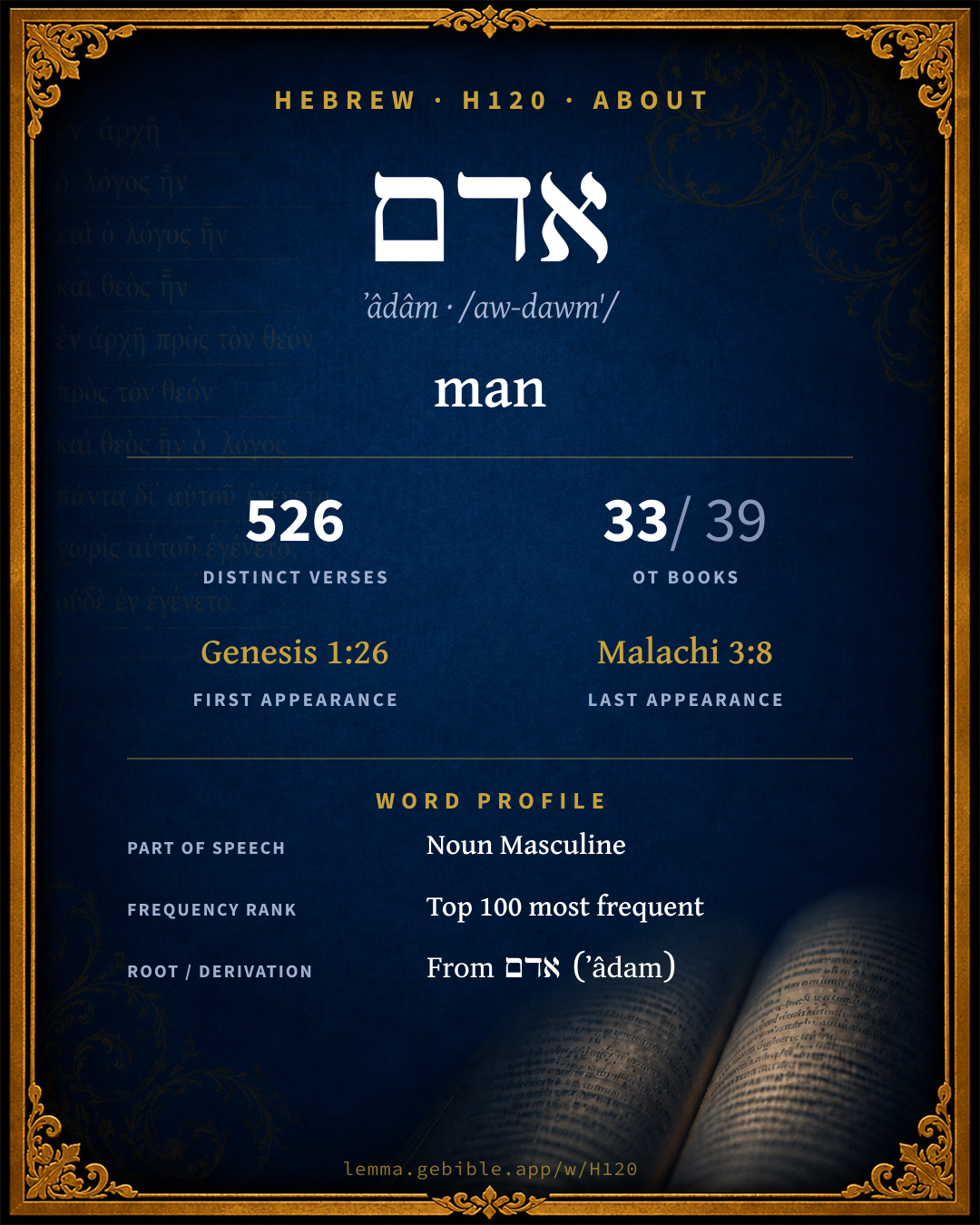
אָדָם
man
‘man’ is one of 5 main senses fuller range ↓
Full lexicon entry — Brown-Driver-Briggs (BDB)
From Brown-Driver-Briggs (BDB)
Where this word appears
Grammar key — what these labels mean
Part of speech
- Noun
- A naming word — a person, place, thing, or idea.
Noun type
- Common
- A common noun — a general class of person, place, or thing (“king,” “city,” “water”), not a specific name.
State
- Absolute
- The independent form of a noun, not bound to a following word.
- Construct
- A noun bound to a following noun in a possessive / “of” relationship (the construct chain).
Gender
- Masculine
- Grammatically masculine.
Number
- Singular
- One.
Every verse where H120 appears in the Book of Jeremiah — 29 distinct verses. Click any verse to open its interlinear word-by-word view. Verse text shown in the World English Bible for context — . Each verse’s Hebrew form is shown with its reference; the English is not keyword-highlighted, since the data carries no word-level English alignment. Use “Compare translations” on any verse to read it across multiple English versions. This concordance covers the Hebrew Bible; Septuagint (Greek Old Testament) occurrences are not indexed here.
Jeremiah
- Jeremiah 2:6 אָדָ֖ם n c ms Neither said they, Where is Yahweh who brought us up out of the land of Egypt, who led us through the wilderness, through a land of deserts and of pits, through a land of drought and of the shadow of death, through a land that none passed through, and where no man lived?
- Jeremiah 4:25 הָ/אָדָ֑ם ptcl def.art + n c ms I saw, and, behold, there was no man, and all the birds of the sky were fled.
- Jeremiah 7:20 הָֽ/אָדָם֙ ptcl def.art + n c ms Therefore thus says the Lord Yahweh: Behold, my anger and my wrath shall be poured out on this place, on man, and on animal, and on the trees of the field, and on the fruit of the ground; and it shall burn, and shall not be quenched.
- Jeremiah 9:22 הָֽ/אָדָ֔ם ptcl def.art + n c ms Speak, Thus says Yahweh, The dead bodies of men shall fall as dung on the open field, and as the handful after the harvester; and none shall gather [them].
- Jeremiah 10:14 אָדָם֙ n c ms Every man is become brutish [and is] without knowledge; every goldsmith is disappointed by his engraved image; for his molten image is falsehood, and there is no breath in them.
- Jeremiah 10:23 לָ/אָדָ֖ם prep det + n c ms Yahweh, I know that the way of man is not in himself: it is not in man who walks to direct his steps.
- Jeremiah 16:20 אָדָ֖ם n c ms Shall a man make to himself gods, which yet are no gods?
- Jeremiah 17:5 בָּֽ/אָדָ֔ם prep det + n c ms Thus says Yahweh: Cursed is the man who trusts in man, and makes flesh his arm, and whose heart departs from Yahweh.
- Jeremiah 21:6 הָ/אָדָ֖ם ptcl def.art + n c ms I will strike the inhabitants of this city, both man and animal: they shall die of a great pestilence.
- Jeremiah 27:5 הָ/אָדָ֤ם ptcl def.art + n c ms I have made the earth, the men and the animals that are on the surface of the earth, by my great power and by my outstretched arm; and I give it to whom it seems right to me.
- Jeremiah 31:27 אָדָ֖ם n c ms Behold, the days come, says Yahweh, that I will sow the house of Israel and the house of Judah with the seed of man, and with the seed of animal.
- Jeremiah 31:30 הָֽ/אָדָ֛ם ptcl def.art + n c ms But everyone shall die for his own iniquity: every man who eats the sour grapes, his teeth shall be set on edge.
- Jeremiah 32:19 אָדָ֔ם n c ms great in counsel, and mighty in work; whose eyes are open on all the ways of the sons of men, to give everyone according to his ways, and according to the fruit of his doings:
- Jeremiah 32:20 וּ/בָֽ/אָדָ֑ם conj + prep det + n c ms who performed signs and wonders in the land of Egypt, even to this day, both in Israel and among [other] men; and made you a name, as in this day;
- Jeremiah 32:43 אָדָם֙ n c ms Fields shall be bought in this land, about which you say, It is desolate, without man or animal; it is given into the hand of the Chaldeans.
- Jeremiah 33:5 הָ/אָדָ֔ם ptcl def.art + n c ms while [men] come to fight with the Chaldeans, and to fill them with the dead bodies of men, whom I have killed in my anger and in my wrath, and for all whose wickedness I have hid my face from this city:
- Jeremiah 33:10 אָדָ֖ם אָדָ֛ם n c ms n c ms Thus says Yahweh: Yet again there shall be heard in this place, about which you say, It is waste, without man and without animal, even in the cities of Judah, and in the streets of Jerusalem, that are desolate, without man and without inhabitant and without animal,
- Jeremiah 33:12 אָדָ֥ם n c ms Thus says Yahweh of Hosts: Yet again shall there be in this place, which is waste, without man and without animal, and in all the cities of it, a habitation of shepherds causing their flocks to lie down.
- Jeremiah 36:29 אָדָ֥ם n c ms Concerning Jehoiakim king of Judah you shall say, Thus says Yahweh: You have burned this scroll, saying, Why have you written therein, saying, The king of Babylon shall certainly come and destroy this land, and shall cause to cease from there man and animal?
- Jeremiah 47:2 הָֽ/אָדָ֔ם ptcl def.art + n c ms Thus says Yahweh: Behold, waters rise up out of the north, and shall become an overflowing stream, and shall overflow the land and all that is therein, the city and those who dwell therein; and the men shall cry, and all the inhabitants of the land shall wail.
- Jeremiah 49:15 בָּ/אָדָֽם prep det + n c ms For, behold, I have made you small among the nations, and despised among men.
- Jeremiah 49:18 אָדָֽם n c ms As in the overthrow of Sodom and Gomorrah and the neighbor cities of it, says Yahweh, no man shall dwell there, neither shall any son of man sojourn therein.
- Jeremiah 49:33 אָדָֽם n c ms Hazor shall be a dwelling-place of jackals, a desolation forever: no man shall dwell there, neither shall any son of man sojourn therein.
- Jeremiah 50:3 מֵ/אָדָ֥ם prep + n c ms For out of the north there comes up a nation against her, which shall make her land desolate, and none shall dwell therein: they are fled, they are gone, both man and animal.
- Jeremiah 50:40 אָדָֽם n c ms As when God overthrew Sodom and Gomorrah and the neighbor cities of it, says Yahweh, so shall no man dwell there, neither shall any son of man sojourn therein.
- Jeremiah 51:14 אָדָם֙ n c ms Yahweh of Hosts has sworn by himself, [saying], Surely I will fill you with men, as with the canker-worm; and they shall lift up a shout against you.
- Jeremiah 51:17 אָדָם֙ n c ms Every man is become brutish [and is] without knowledge; every goldsmith is disappointed by his image; for his molten image is falsehood, and there is no breath in them.
- Jeremiah 51:43 אָדָֽם n c ms Her cities are become a desolation, a dry land, and a desert, a land in which no man dwells, neither does any son of man pass thereby.
- Jeremiah 51:62 לְ/מֵ/אָדָ֖ם prep + prep + n c ms and say, Yahweh, you have spoken concerning this place, to cut it off, that none shall dwell therein, neither man nor animal, but that it shall be desolate forever.
About this entry
At a glance — auto-summarized from this page’s data, not written by a person. Every figure links to its source below. This summary describes the numbers; it doesn’t interpret them.
The Hebrew noun אדם centers on the idea of “man.” Its meaning spans more than one sense — see its full sense range. Spanning 526 verses in 33 books, it ranks among the most common words of the Hebrew Bible. Ezekiel dominates its distribution — 130 of 526 verses. Its earliest occurrence is Genesis 1:26. Each statement above links to its evidence; the full detail follows below.
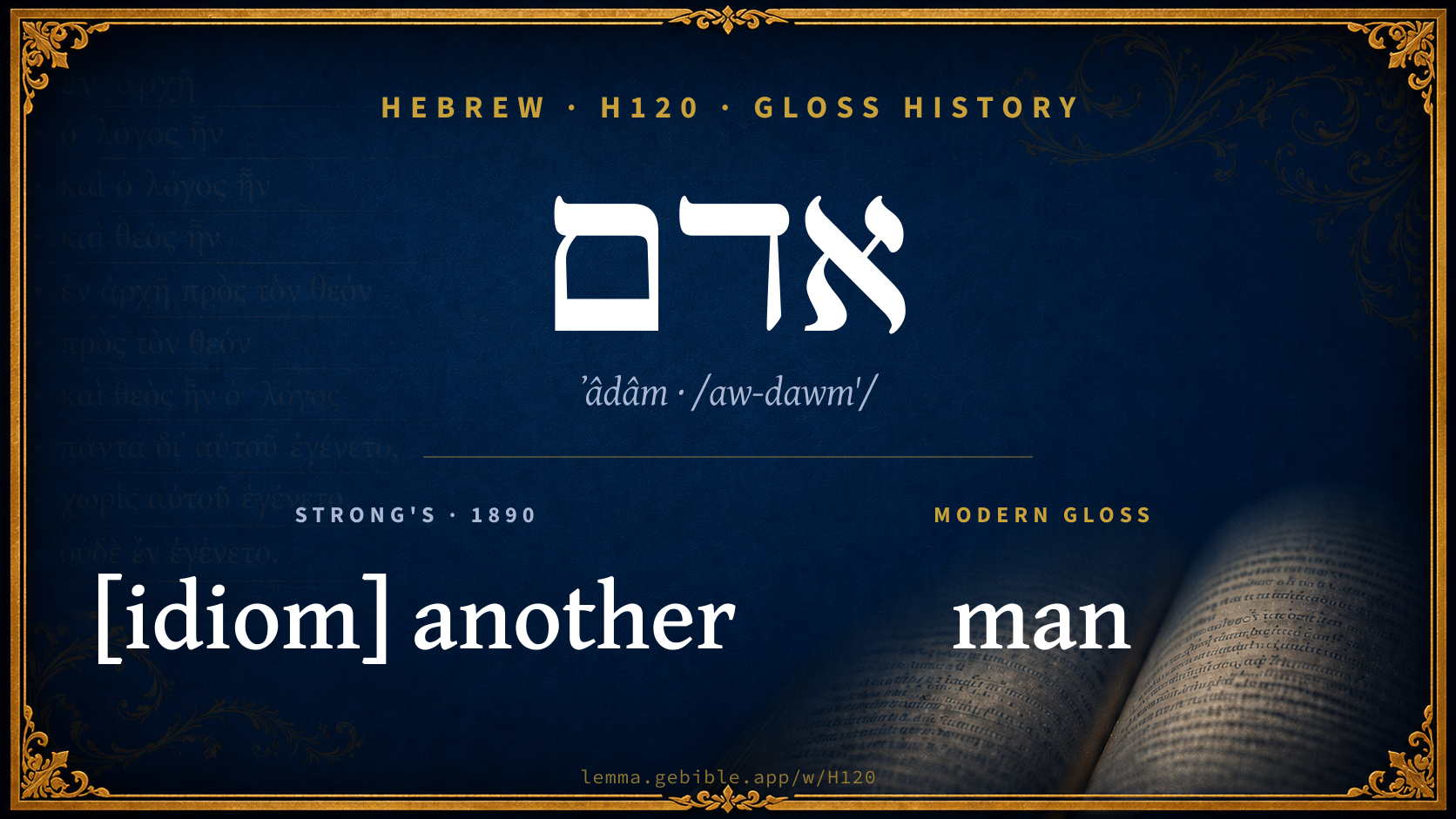
Gloss history
Strong's 1890 vs modern scholarship
About this word
Strong's H120 catalogs a Hebrew word from the Hebrew Old Testament.
These counts are not copied from any lexicon or concordance. They are computed here, from the morphology-tagged Hebrew Old Testament. What Lemma adds →
- 526
- distinct verses
- The word appears in 526 distinct verses.
- 33 / 39
- OT books
- The word appears in 33 of 39 Old Testament books.
- #91
- by frequency
- Top 100 most frequent Hebrew words (rank 91 of 8,640 Hebrew words by occurrence).
View all 526 occurrences in the concordance →
By section of the Old Testament
By traditional corpus
Conventional, traditional groupings — biblical authorship is debated, so this is a traditional corpus grouping, not an authorship claim. Each share is this word’s portion of its verses in that division of the Hebrew canon. Each figure is a share of the word’s 526 distinct verses.
- Prophets (Nevi'im) 238 verses · 45%
- Writings (Ketuvim) 193 verses · 37%
- Torah (Pentateuch) 95 verses · 18%
How translations render this word
Counts come from each version’s own published word-to-Strong’s tagging or interlinear alignment — an approximate guide to how each version renders this word, not a word-level alignment the data otherwise carries. Because each total is that version’s own tagged count, the per-version totals vary from one another and need not match the appearance or distinct-verse counts above. These counts may also differ from a printed concordance because Lemma counts each distinctly tagged rendering and does not collapse phrase taggings into a single head-word total. This is a fixed set of word-tagged versions (KJV, ASV, BSB, ULT) and does not change with the reading translation you choose elsewhere. Each version’s license is shown beside its name below (and on Sources).
- King James Version: Man 297×, Men 73×, Man's 13×
- American Standard Version: Man 235×, Men 85×, Son of man 49×
- Berean Standard Bible: Man 280×, Men 70×, Mankind 20×
- unfoldingWord Literal Text: Man 364×, Humanity 35×, Mankind 30×
King James Version Public Domain
Renders H120 across 545 tagged occurrences — most commonly:
Plus other, less common renderings. Plus 73 renderings that appear only once — usually multi-word phrases or single function words the recovered tagging swept in, not distinct renderings. Not rendered by a distinct English word in 7 further occurrences.
American Standard Version Public Domain
Renders H120 across 545 tagged occurrences — most commonly:
Plus other, less common renderings. Plus 79 renderings that appear only once — usually multi-word phrases or single function words the recovered tagging swept in, not distinct renderings.
Berean Standard Bible Public Domain
Renders H120 across 508 tagged occurrences — most commonly:
Plus other, less common renderings. Plus 46 renderings that appear only once — usually multi-word phrases or single function words the recovered tagging swept in, not distinct renderings. Not rendered by a distinct English word in 39 further occurrences.
unfoldingWord Literal Text CC BY-SA 4.0
Renders H120 across 544 tagged occurrences — most commonly:
Plus other, less common renderings. Plus 31 renderings that appear only once — usually multi-word phrases or single function words the recovered tagging swept in, not distinct renderings.
Senses in the full BDB
What do BDB’s symbols mean?
BDB uses these scholarly abbreviations:
| Symbol | Meaning |
|---|---|
| 𝔊 | the Septuagint (the ancient Greek translation, LXX) |
| 𝔙 | the Vulgate (the Latin translation) |
| 𝔖 | the Syriac version (the Peshitta) |
| 𝔗 | the Targum (the Aramaic translation) |
| ψ | the Psalms |
| √ | root (the underlying root or stem) |
| ‖ | parallel passage (a synonymous or contrasted parallel) |
| † | the dagger: every passage where the word occurs is cited |
The 4 senses and sub-senses the full Brown-Driver-Briggs lexicon distinguishes for this word, in lexicon order (not ranked by frequency), with BDB’s own verbatim wording and sub-sense lettering. Shown in Hebrew script with BDB’s own scholarly abbreviations. The condensed entry is in the Lexicon Entry tab. See also the Forms in the corpus table below.
- 1. a man (= Ger. Mensch) = human being Gn 2:5, 7(×2), 8, 15, 16, 18 +, 16:12 (27 textual J) Lv 5:4 (‖ נֶפֶשׁ) 13:2, 9 (19 textual P) Ne 2:10 Is 13:12 (‖ אֱנוֹשׁ); הָאָ׳ הַגָּדוֹל Jos 14:15 (E); אָ׳ בְּלִיַּעַל Pr 6:12 (‖ אִישׁ אָוֶן cf. 1 S 25:25 & v. בליעל); = any one Lv 1:2 Nu 9:6, 7 Jb 20:29; 27:13 Pr 15:20; 21:16, 20; 24:30 Ec 7:20 + oft. WisdLt, Je 2:6; 4:25 Ne 2:12, cf. נֶפֶשׁ א׳ Nu 19:11, 13 +; seld. man opp. woman Gn 2:22(×2), 23, 25; 3:8, 12, 17, 20, 21 Ec 7:28. e.g. Genesis 2:5
- 2. coll. man, mankind Gn 1:26; 9:5, 6(×3) + (P 28 textual) 6:1, 5, 6, 7 (JE 24 textual) Dt 4:32 (D 6 textual) (on 2 S 7:19 cf. 1 Ch 17:17 v. DrSm); distinctly = men + women Gn 1:27; 5:1 Nu 5:6; given as name Gn 5:2; but = warriors Is 22:6 רֶכֶב א׳ (‖ פּרשׁים); ‖ beasts (41 textual) בְּהֵמָה Gn 6:7; 7:23 (J?) Ex 8:13, 14; 9:9, 10 (P) 9:19, 22, 25; 12:12; 13:2, 13, 15 (all J) +; late proph. Je 21:6; 31:27; 50:3; 51:62 Ez 14:13, 17, 19, 21; 25:13; 29:8, 11; 32:13 (del. Co) 36:11 Jon 3:8 Zp 1:3 Hg 1:11 Zc 2:8; 8:10; ‖ בָּקָר Ez 4:15; ‖ צֹאן, חֲמֹרִים, ב׳ Nu 31:28; ‖ id. + מִכָּל־הַבְּהֵמָה v 30 cf. Jon 3:7; ‖ חַיָּה Gn 9:5 (P) cf. Ez 1:5, 8, 10, 26, & descript. of כְּרוּבִים Ez 10:8, 14, 21 cf. 41:19; ‖ trees Dt 20:19 (rd. הֶאָדָם v. Di); opp. God 1 S 15:29; 16:7(×2) Is 31:3 Ez 28:2, 9 1 Ch 21:13; 29:1 2 Ch 6:18 Mal 3:8 cf. Ex 33:20 Dt 5:21; so בֶּן־א׳ Nu 23:19 (‖ אישׁ Ez 2:1, 3, 6, 8 (87 textual Ez, alw. addressed to proph.); בְּנֵי הָא׳ 1 S 26:19; made in God’s image Gn 1:26, 27; 9:6 cf. Ec 7:29; as feeble, earthly, mortal Nu 16:29(×2) Ps 82:7; 144:3, 4 Jb 5:7; 14:1, 10 cf. 25:6 (בֶּן־א׳) Ec 12:5; as sinful 1 K 8:46 2 Ch 6:36 Je 10:14 cf. Nu 5:6 Jb 31:33 Ho 6:7; of men in general, other men (opp. to particular ones) Ju 16:17 (cf. אַחַד הָא׳ v 7, 11) 18:7, 28 ψ 73:5 Je 32:20 +; ‖ אִישׁ Is 2:9, 11, 17; 5:15 cf. Ez 23:42 (del. Co Vrss); בְּנֵי א׳ 2 S 7:14 (‖ אֲנָשִׁים) Pr 8:4 (‖ אִישִׁים); ψ 49:3; 62:10 (both ‖ בְּנֵי אִישׁ) = men of low opp. men of high degree—so oft. Ph. and = vassal Sab. DHMZMG 1875, 680 cf. 686; נֶפֶשׁ א׳ coll. Nu 31:35, 40, 46 1 Ch 5:21 Ez 27:13. e.g. Genesis 1:26
- 3. n.pr.m. Adam, first man (without art. cf. שָׂטָן 1 Ch 21:1 over ag. הַשּׂ׳ Jb 1:6 etc.) Gn 4:25 (J) 5:1, 3, 4, 5 (P) 1 Ch 1:1. (Gn 2:20; 3:17, 21 rd. לָא׳ v. Di) e.g. 1 Chronicles 21:1
- 4. n.pr.loc. city in Jordan valley (as built? Jos 3:16. e.g. Joshua 3:16
Senses from the full Brown-Driver-Briggs lexicon (Brown, Driver, Briggs; Oxford 1906 — public domain), digitized via Sefaria, supplemented by the OpenScriptures HebrewLexicon (CC BY 4.0). Full attribution on Sources.
Word origin
n.m. Gn 1:27 man, mankind (Ph. אדם, Sab. id., CISiv. 1, 1. 4 al.; cf. As. admu, young (of bird) DlW, but NöZMG 1886, 722 identif. with Ar. أَذَامٌ coll. creatures)—Sg. abs. exc. cstr. Pr 6:12 cf. Thes; (בְּנֵי (הָ)א׳ oft. = pl. of א׳ Gn 11:5 + 39 textual, cf. בְּנוֹת הָא׳ Gn 6:2, 4)—
— Brown-Driver-Briggs (Oxford 1906, public domain), digitized via Sefaria, supplemented by the OpenScriptures HebrewLexicon (CC BY 4.0). See Sources.
Derived from אדם (ʼâdam) (H119) — to be red.
Jastrow Dictionary
A second Hebrew/Aramaic lexicon for comparison, covering Aramaic and post-biblical (Talmudic, Targumic, Midrashic) usage that the biblical-Hebrew BDB does not. Matched by lemma rather than by Strong’s number, so a lemma may carry more than one Jastrow headword (shown separately below), and the entries cover usage well beyond the Bible.
אֲדַם
- , v. הֲדַם. [v. Rabb. D. S. to Ab. Zar. 38ᵇ, Bets. 24ᵇ, note.]
אָדַם
- , v. דמם) [to be viscous, thick, dark] to be red, grow red.
- to redden, make red. Y. Sabb. VII, 10ᶜ top המְאַדֵּם אודם he who produces a red spot (congestion of blood, on a Sabbath).
- 1. (b. h.) (b. h.) to be, grow red. Num. R. s. 9 (p. 231ᵇ ed. Amst.) מַאֲדֶמֶת (היתה) if she was red-faced. Ḥull. 53ᵇ; a. fr.
- 2. to cause to blush, put to shame (usu. הלבין). Num. R. s. 4 (p. 218ᵈ ed. Amst.) (play on עובד אדום).—Part. מַאֲדִים the planet Mars. Sabb. 156ᵃ.—Part. Hof. מְאָדָּם, מְאוּדָּם. Y. Sabb. VII, 10ᶜ top מְאָדָּמִים dyed red.
אָדָם
- m. (b. h.) man, pr. n. m. Adam, frequ. א׳ הראשון (abbr. אה"ר). Gen. R. s. 17; a. fr.—ספרו של, ספרא דאה"ר אה"ר the (allegorical) book of Adam containing all generations and their leaders from beginning to resurrection, i.e. destinies of humanity. Ex. R. s. 40 beg. B. Mets. 85ᵇ bot.
אֲדָם
- (= דָּם, דְּמָא) blood. Targ. I Chron. XXII, 7; a. e.—Y. Maas. Sh. V, 56ᵈ top מגבלא אַדְמֵיה to mix its (the bird’s) blood. Git. 47ᵃ; v. חוּל II. Pl. אַדְמִין. Targ. I Chr. l. c.; a. e.
A Dictionary of the Targumim, the Talmud Babli and Yerushalmi, and the Midrashic Literature (Marcus Jastrow; London, Luzac, 1903) — Public Domain. Digitized via Sefaria. Digitized via Sefaria. Full attribution on Sources.
Forms in the corpus
The 107 distinct written forms H120 takes in the Hebrew Bible, most frequent first — each parse links to that state’s occurrences in the concordance. Hebrew forms include their vowel points and cantillation, so a single lemma takes many written forms.
The 60 most common forms are shown; 47 rarer forms follow in the full concordance.
Same root — word family
Other BDB entries built from the same root as H120, grouped by Strong’s listed origin. These share a root / origin per the lexicon — not necessarily a shared meaning. Each links to that word’s own entry.
Derives from
Shares the same root
- אדם ʼâdôm H122 red
- אדם ʼôdem H124 ruby
- אדמדם ʼădamdâm H125 reddish
- אדמה ʼădâmâh H127 ground
- אדמני ʼadmônîy H132 red
Proper names from this root
People and places named from this root — a name, not an additional meaning of the word.
Compare all same-root words → Showing 4 of 8 — not the complete family. 1 of the same-root words is a proper name (a person or place). They share a root, not necessarily a meaning.
Septuagint verse parallels
This word appears in 498 verses that also exist in the Greek Old Testament (Septuagint), out of the 526 Hebrew verses it occurs in. You can read those verses in Greek by switching the Old Testament edition to the Septuagint.
Read these verses in the Septuagint
- Genesis 1:26
- Exodus 4:11
- Leviticus 1:2
- Numbers 3:13
- Deuteronomy 4:28
- Joshua 11:14
- Judges 16:7
- 1 Samuel 15:29
- 2 Samuel 7:14
- 1 Kings 8:38
- 2 Kings 7:10
- 1 Chronicles 5:21
This is a verse-level parallel only — the same verses exist in both the Hebrew and Greek Old Testaments. No word-level Hebrew↔Greek correspondence is claimed: the data carries no such alignment, so no Greek word is shown as this Hebrew word’s translation. Coverage is not total — the Septuagint omits the deuterocanon and renumbers the Psalms, so some Hebrew verses have no direct Greek parallel.