Joshua 14:15

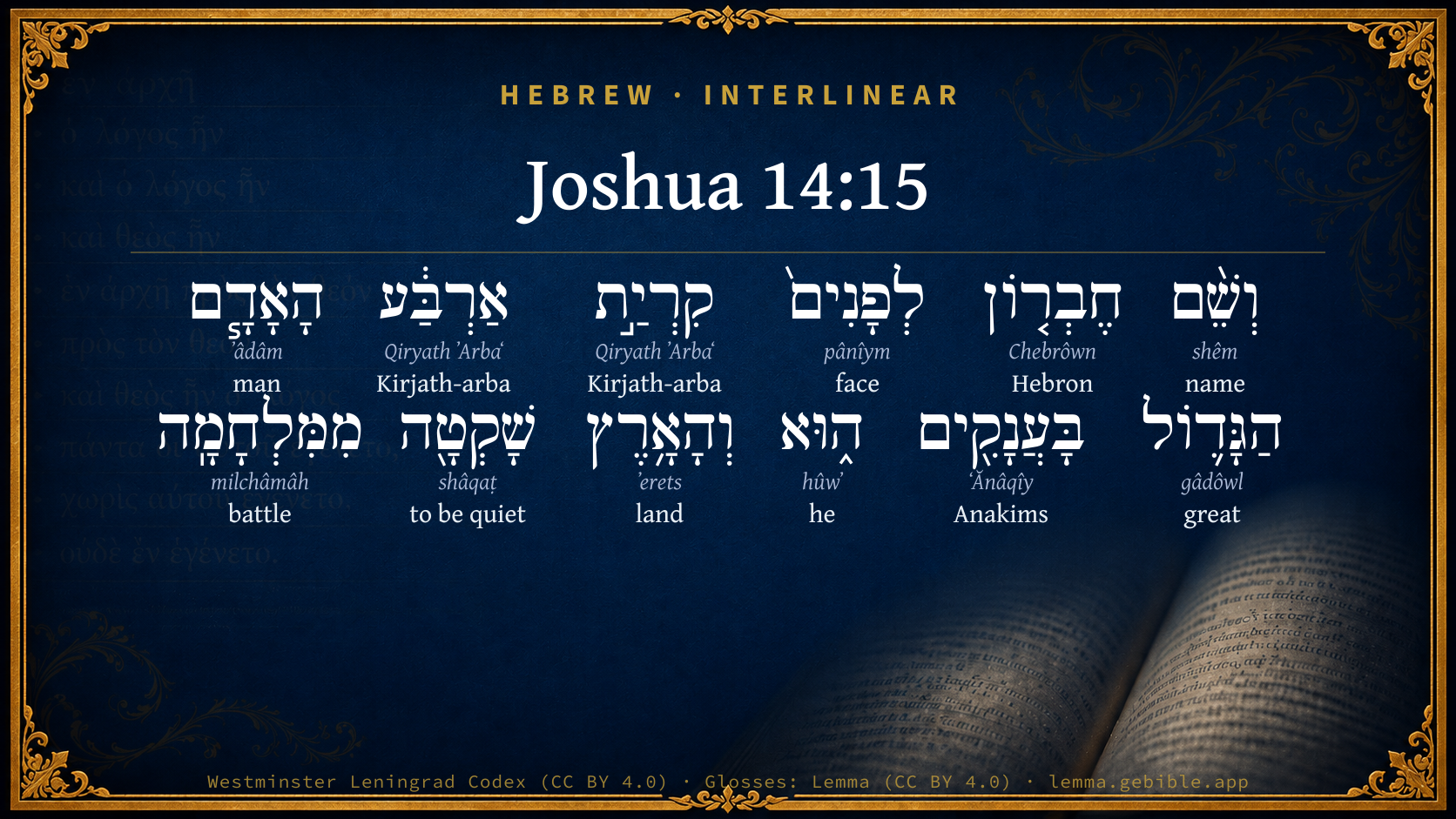
Hebrew (Westminster Leningrad Codex) Joshua 14:15 appears in the Hebrew Old Testament. The text above is from the Westminster Leningrad Codex. Each word links to its Strong’s number, a concise gloss, and parsing drawn from the Open Scriptures Hebrew Bible morphology. Click any word for its full Brown-Driver-Briggs (BDB) entry.
Download image
Cite this verse

Joshua 14:15 (World English Bible). Public Domain. Lemma interlinear Bible study tool, https://lemma.gebible.app/v/joshua/14/15.

Show BibTeX & RIS
BibTeX
RIS
English Translation
Now the name of Hebron before was Kiriath Arba; [which Arba was] the greatest man among the Anakim. The land had rest from war.
World English Bible · Public Domain
Download a study sheet

One document with this verse’s original text, its word-by-word gloss line, the meaning frame, cross-references with their text, attributed commentary, and full source and license credits — printable, and it pastes into notes with its structure intact.

This verse Autodidact and up

Study sheet (.html) Plain text (.txt)

A passage Seminary Student

Up to 50 verses in one chapter. A passage sheet keeps up to 6 commentary sources and 12 cross-references per verse, in the order this page ranks them, and says so on the sheet whenever that leaves anything out. Ask for a single verse and you get the Autodidact verse sheet above.

Everything on this page stays free to read, with no account — the sheet is a download of what is already on screen, not access to it.

Want to remove ads? Support Godless Engineer
Compare translations 3

The same verse in 3 English versions, stacked beneath the original-language interlinear above. Click any original word for its lexicon entry.

Each is an independent rendering of the whole verse — the interlinear is not word-aligned to these translations.

Highlighted words mark where these versions differ — a whole-verse word diff, not a word-by-word alignment.

  • World English Bible Public Domain
    Now the name of Hebron before was Kiriath Arba; [which Arba was] the greatest man among the Anakim. The land had rest from war.
  • King James Version Public Domain
    And the name of Hebron before was Kirjatharba; which Arba was a great man among the Anakims. And the land had rest from war.
  • unfoldingWord Literal Text CC BY-SA 4.0
    (Now the name of Hebron formerly Kiriath Arba. He a great man among the Anakites.) And the land rested from war.

unfoldingWord Literal Text — © unfoldingWord, licensed CC BY-SA 4.0. Word-aligned USFM3 via Door43 (git.door43.org/unfoldingWord/en_ult).

Versions to compare (up to 4)

3 of 4 selected

Show all 18 translations

Every available English version of this verse, each an independent rendering of the whole verse.

  • World English Bible Public Domain
    Now the name of Hebron before was Kiriath Arba; [which Arba was] the greatest man among the Anakim. The land had rest from war.
  • Berean Standard Bible Public Domain
    (Hebron used to be called Kiriath-arba, after Arba, the greatest man among the Anakim.) Then the land had rest from war.
  • Majority Standard Bible Public Domain
    (Hebron used to be called Kiriath-arba, after Arba, the greatest man among the Anakim.) Then the land had rest from war.
  • King James Version Public Domain
    And the name of Hebron before was Kirjatharba; which Arba was a great man among the Anakims. And the land had rest from war.
  • American Standard Version (1901) Public Domain
    Now the name of Hebron beforetime was Kiriath-arba; `which Arba was' the greatest man among the Anakim. And the land had rest from war.
  • Revised Version (1885) Public Domain
    Now the name of Hebron beforetime was Kirjath-arba; which Arba was the greatest man among the Anakim. And the land had rest from war.
  • Geneva Bible (1599) Public Domain
    And the name of Hebron was before time, Kiriath-arba: which Arba was a great man amog the Anakims: thus the land ceassed from warre.
  • Douay-Rheims (1899) Public Domain
    The name of Hebron before was called Cariath-Arbe: Adam the greatest among the Enacims was laid there: and the land rested from wars.
  • Young's Literal Translation Public Domain
    and the name of Hebron formerly `is' Kirjath-Arba (he `is' the great man among the Anakim); and the land hath rest from war.
  • Literal Standard Version CC BY-SA 4.0
    and the name of Hebron [was] formerly Kirjath-Arba (the man [was] the greatest among the Anakim); and the land has rest from war.
  • Unlocked Literal Bible CC BY-SA 4.0
    Now the name of Hebron formerly was Kiriath Arba. (Arba had been the greatest man among the Anakim.) Then the land had rest from war.
  • unfoldingWord Literal Text CC BY-SA 4.0
    (Now the name of Hebron formerly Kiriath Arba. He a great man among the Anakites.) And the land rested from war.
  • Darby Bible Public Domain
    Now the name of Hebron before was Kirjath-Arba; the great man among the Anakim. And the land rested from war.
  • World Messianic Bible Public Domain
    Now the name of Hebron before was Kiriath Arba, after the greatest man among the Anakim. Then the land had rest from war.
  • Webster's Bible Public Domain
    And the name of Hebron before was Kirjath-arba; which Arba was a great man among the Anakims. And the land had rest from war.
  • Free Bible Version CC BY-SA 4.0
    (Hebron was formerly called Kiriath-arba, named after a great leader of the descendants of Anak.) And the land was at peace.
  • Bible in Basic English Public Domain
    In earlier times the name of Hebron had been Kiriath-arba, named after Arba, the greatest of the Anakim. And the land had rest from war.
  • JPS Tanakh (1917) Public Domain
    Now the name of Hebron beforetime was Kiriath-arba, which Arba was the greatest man among the Anakim. And the land had rest from war.

Literal Standard Version (2020), Covenant Press — licensed CC BY-SA 4.0. Text via the HelloAO Bible API (eBible.org). Unlocked Literal Bible (unfoldingWord) — licensed CC BY-SA 4.0. Text via the HelloAO Bible API (eBible.org). unfoldingWord Literal Text — © unfoldingWord, licensed CC BY-SA 4.0. Word-aligned USFM3 via Door43 (git.door43.org/unfoldingWord/en_ult). Free Bible Version, Dr. Jonathan Gallagher — licensed CC BY-SA 4.0. Text via the HelloAO Bible API (eBible.org).

Word by word

More ways to search: Search by grammar → Find every occurrence → Compare this word →

Practice this passage: Drill this verse → Learn its vocabulary →

בָּעֲנָקִ֖ים
ʻĂnâqîy
H6062
“in/at the · Anakims”
Preposition, Determined + Noun, Gentilic, Masculine, Plural, Absolute
Part of Speech
Preposition + Noun
Type
Gentilic
Gender
Masculine
Number
Plural
State
Absolute
Full BDB Definition

Origin: from H6061

TWOT: None

Anakims = "long-necked" - a tribe of giants, descendants of Anak, which dwelled in southern Canaan
  1. וְשֵׁ֨ם shêm H8034 “and · name of” Conjunction + Noun, Common, Masculine, Singular, Construct
  2. חֶבְר֤וֹן Chebrôwn H2275 “Hebron” Noun, Proper
  3. לְפָנִים֙ pânîym H6440 “to/for · face(s)” Preposition + Noun, Common, Both, Plural, Absolute
  4. קִרְיַ֣ת Qiryath ʼArbaʻ H7153 “Kirjath-arba” Noun, Proper
  5. אַרְבַּ֔ע Qiryath ʼArbaʻ H7153 “Kirjath-arba” Adjective, Cardinal number, Feminine, Singular, Absolute
  6. הָאָדָ֧ם ʼâdâm H120 “the · man” Particle, Definite Article + Noun, Common, Masculine, Singular, Absolute
  7. הַגָּד֛וֹל gâdôwl H1419 “the · great” Particle, Definite Article + Adjective, Adjective, Masculine, Singular, Absolute
  8. ה֑וּא hûwʼ H1931 “he” Pronoun, Personal, 3rd Person, Masculine, Singular
  9. וְהָאָ֥רֶץ ʼerets H776 “and · the · land” Conjunction + Particle, Definite Article + Noun, Common, Both, Singular, Absolute
  10. שָׁקְטָ֖ה shâqaṭ H8252 “to be quiet” Verb, Qal, Perfect, 3rd Person, Feminine, Singular
  11. מִמִּלְחָמָֽה milchâmâh H4421 “from · battle” Preposition + Noun, Common, Feminine, Singular, Absolute

About this verse

These counts appear in no published source. They are computed here, from the morphology-tagged text and Lemma’s own curated glosses. What Lemma adds →

12
words
11
distinct lemmas
Historical
section

Notable vocabulary

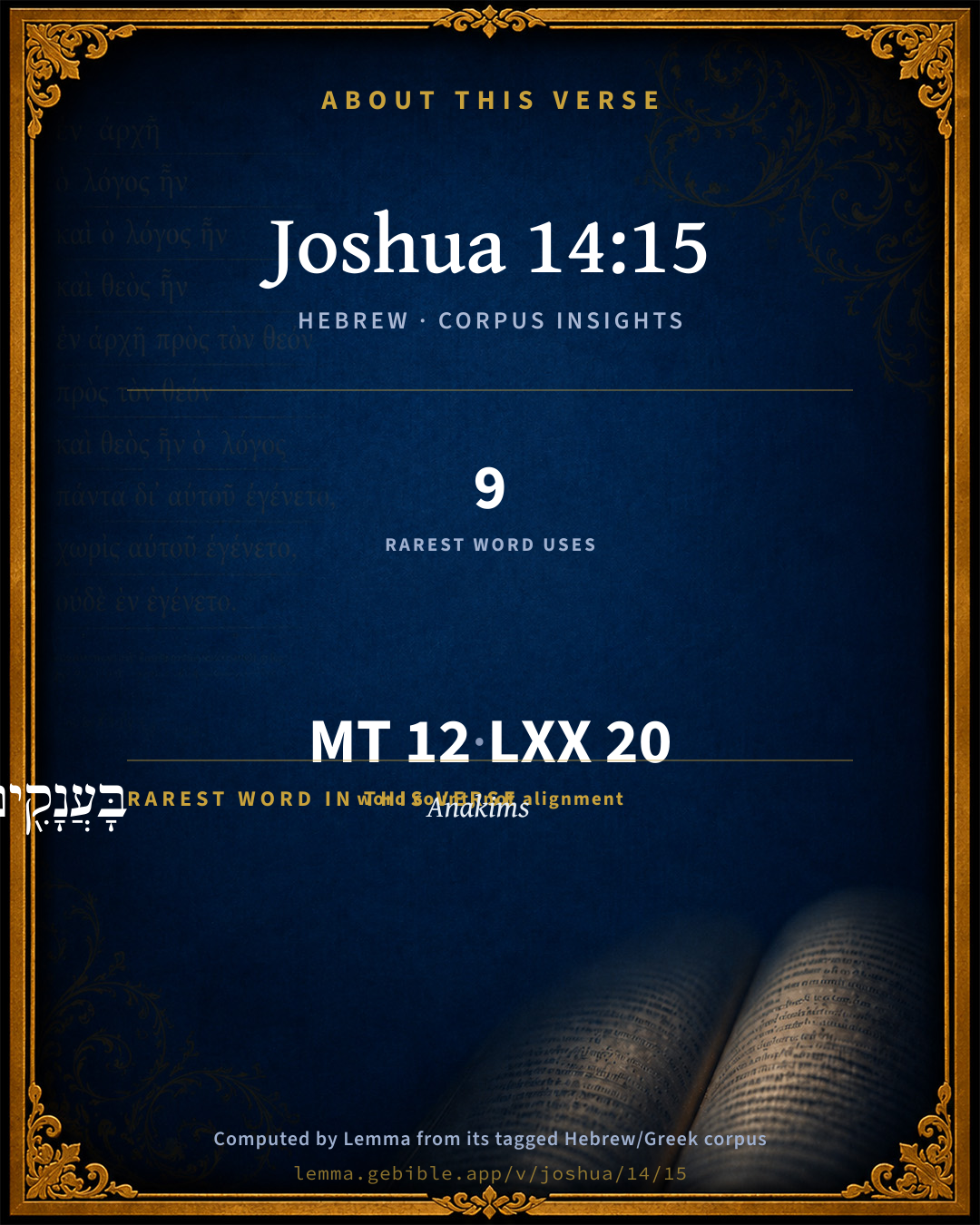
The rarest word here is בָּעֲנָקִ֖ים Anakims H6062 — appearing just 9 times in the whole Hebrew Bible.

Shared distinctive vocabulary

בָּעֲנָקִ֖ים Anakims H6062 occurs in 9 verses of the Hebrew Bible. Also found in:

Grammatical profile

  • 1 verb
  • 8 nouns
  • 2 adjectives
  • 1 pronoun

Verb forms

  • שָׁקְטָ֖ה Qal · Perfect

Repetition

A word recurs within this verse — often emphatic in Hebrew:

  • קִרְיַ֣ת Kirjath-arba H7153 ×2

Hebrew & Septuagint length

In English translation the verse runs 24 words from the Hebrew and 23 from the Septuagint (LXX English) — closely comparable.

A rough comparison of the two English renderings, which tokenize alike — not a word-level alignment.

Word counts can differ between the Hebrew and the Greek without any difference in meaning — e.g. the Hebrew direct-object marker אֵת has no separate Greek word, and Greek often adds the article ὁ.

In the original languages it is 12 Hebrew tokens and 20 Greek tokens — but the two are counted differently (Hebrew bundles its prefixes and suffixes into one token; the Greek is in lemma form), so that isn’t a like-for-like length.

Cross-references

7

Topical passages linked to Joshua 14:15 in the Treasury of Scripture Knowledge — connected by theme and wording, ordered by reader-vote popularity; previews shown in the World English Bible.

  • Joshua 11:23 So Joshua took the whole land, according to all that Yahweh spoke to Moses; and Joshua gave it for an inheritance to Israel according to their divisions by their tribes. The land had rest from war.
  • Genesis 23:2 Sarah died in Kiriath Arba (the same is Hebron), in the land of Canaan. Abraham came to mourn for Sarah, and to weep for her.
  • Joshua 15:13 To Caleb the son of Jephunneh he gave a portion among the children of Judah, according to the commandment of Yahweh to Joshua, even Kiriath Arba, [which Arba was] the father of Anak (the same is Hebron).
  • Judges 3:11 The land had rest forty years. Othniel the son of Kenaz died.
  • Judges 5:31 So let all your enemies perish, Yahweh: But let those who love him be as the sun when he goes forth in his might. The land had rest forty years.
  • Judges 8:28 So Midian was subdued before the children of Israel, and they lifted up their heads no more. The land had rest forty years in the days of Gideon.
  • Judges 3:30 So Moab was subdued that day under the hand of Israel. The land had rest eighty years.

Cross-references courtesy of OpenBible.info (CC BY 4.0).

Hebrew and Greek witnesses Masoretic Hebrew ↔ Greek Septuagint

The same verse in the two great witnesses to the Old Testament, shown verse-for-verse.

These are two independent witnesses, not word-aligned to each other, and the Septuagint is shown in lemma (dictionary) form.

Hebrew Joshua 14:15 Masoretic · Westminster Leningrad Codex

וְשֵׁ֨ם חֶבְר֤וֹן לְפָנִים֙ קִרְיַ֣ת אַרְבַּ֔ע הָאָדָ֧ם הַגָּד֛וֹל בָּעֲנָקִ֖ים ה֑וּא וְהָאָ֥רֶץ שָׁקְטָ֖ה מִמִּלְחָמָֽה

Now the name of Hebron before was Kiriath Arba; [which Arba was] the greatest man among the Anakim. The land had rest from war.

World English Bible · Public Domain

Greek LXX Joshua 14:15 Septuagint · lemma form

ὁ δέ ὄνομα ὁ χεβρων εἰμί ὁ πρότερος πόλις αρβοκ μητρόπολις ὁ ενακιμ οὗτος καί ὁ γῆ κοπάζω ὁ πόλεμος

And the name of Chebron before was the city Argob, it is the metropolis of the Enakim: and the land rested from war.

LXX2012 (modern English Septuagint) · Public Domain

On this verse, Adam Clarke's Commentary discusses the Septuagint’s reading. Read the note in Commentary ↓

Hebrew: Westminster Leningrad Codex (CC BY 4.0). Greek: Septuagint (public domain); English from LXX2012 (modern English Septuagint) (Public Domain). How the Septuagint differs from the Hebrew →

Targum (Aramaic paraphrase)

1

The Targum is the ancient Jewish Aramaic paraphrase of the Hebrew Scriptures — an interpretive translation, not the Hebrew text itself. Onkelos (literal) and Pseudo-Jonathan (expansive) render the Torah, and Jonathan the Prophets. Coverage is partial: where no permissively-licensed English translation exists for a verse, only the Aramaic is shown. This is verse-level text, not a word-by-word alignment to the Hebrew.

  1. Targum Jonathan Prophets (Joshua–Malachi)
    וְשׁוּם חֶבְרוֹן מִלְקָדְמִין קִרְיַת אַרְבַּע אֱנָשׁ רַב בְּגִבָּרַיָא הוּא וְאַרְעָא שְׁדוֹכַת מִלְמֶעְבַּד קְרָבָא:

    (no public-domain English translation for this verse)

    Targum Jonathan — Aramaic: “Mikraot Gedolot” (public domain). English: “Sefaria Community Translation” (CC0 1.0 (public-domain dedication)); “London "Chaldee Paraphrase," 1871” (public domain). Text via Sefaria.

Commentary

Notes on Joshua 14:15 from classic Christian and Jewish commentators (each source and its license shown beneath its notes). The classic Christian expositions comment on the surrounding passage and are grouped to its opening verse, so a note may address several verses; the Jewish commentaries on the Tanakh (Rashi and others) are per-verse, so they appear only where the commentator wrote on this verse.

Lemma curates 59 commentaries, every one of them public domain or Creative Commons licensed, each selected and text-cleaned for this edition rather than reprinted as found. About our sources →

Trapp's Complete Commentary

John Trapp

Jos 14:15 And the name of Hebron before [was] Kirjatharba; [which Arba was] a great man among the Anakims. And the land had rest from war.

Ver. 15. Was a great man.] Both for his person and power; but there is a double greatness: (1.) Belluine; (2.) Genuine. In that, a beast may and doth exceed us. In this, we exceed ourselves and others.

And the land had rest from war.] It had at last, bello confecto. See Jos 10:23, from whence hitherto, is a digression.

John Trapp, A Commentary or Exposition upon All the Books of the Old and New Testament (1647–1656) — public domain. Text from a community e-Sword module.

Joseph Benson's Commentary

Jos 14:15. Arba was a great man, &c. — In stature, and strength, and dignity, and authority, as being the progenitor of Anak, the father of those famous giants called Anakims.

Joseph Benson's Commentary on the Old and New Testaments (1811–1818) — public domain. Text from a community e-Sword module.

Tyndale Open Study Notes

Tyndale Open Resources

14:15 rest from war: See study note on 1:13.

Tyndale Open Study Notes — © Tyndale Open Resources, licensed CC BY-SA 4.0. Text via the HelloAO Bible API.

Geneva Bible (1599)

Geneva Bible translators

Either for his power or person.

Geneva Bible (1599) marginal notes — public domain. Text via Bolls.life.

Jamieson, Fausset & Brown

Robert Jamieson, A. R. Fausset & David Brown

Kirjath-arba--that is, the city of Arba, a warrior among the native race remarkable for strength and stature.

the land had rest from war--Most of the kings having been slain and the natives dispirited, there was no general or systematic attempt to resist the progress and settlement of the Israelites.

Next: Joshua Chapter 15

Jamieson, Fausset & Brown — Commentary Critical and Explanatory on the Whole Bible (1871) — public domain (CC PDM 1.0). Text via the HelloAO Bible API.

Adam Clarke's Commentary

Verse 15. And the name of Hebron before was Kirjath-arba] That is, the city of Arba, or rather, the city of the four, for thus קרית ארבע kiryath arba may be literally translated. It is very likely that this city had its name from four Anakim, gigantic or powerful men, probably brothers, who built or conquered it. This conjecture receives considerable strength from Jos 15:14, where it is said that Caleb drove from Hebron the three sons of Anak, Sheshai, Ahiman, and Talmai: now it is quite possible that Hebron had its former name, Kirjath-arba, the city of the four, from these three sons and their father, who, being men of uncommon stature or abilities, had rendered themselves famous by acts proportioned to their strength and influence in the country. It appears however from Jos 15:13 that Arba was a proper name, as there he is called the father of Anak. The Septuagint call Hebron the metropolis of the Enakim, μητροπολις των Ενακιμ. It was probably the seat of government, being the residence of the above chiefs, from whose conjoint authority and power it might have been called חברון chebron; as the word חבר chabar literally signifies to associate, to join in fellowship, and appears to be used, Job 41:6, for "associated merchants, or merchants' companions, who travelled in the same caravan." Both these names are expressive, and serve to confirm the above conjecture. No notice need be taken of the tradition that this city was called the city of the four because it was the burial-place of Adam, Abraham, Isaac, and Jacob. Such traditions confute themselves.

The land had rest from war.] There were no more general wars; the inhabitants of Canaan collectively could make no longer any head, and when their confederacy was broken by the conquests of Joshua, he thought proper to divide the land, and let each tribe expel the ancient inhabitants that might still remain in its own territories. Hence the wars after this time were particular wars; there were no more general campaigns, as it was no longer necessary for the whole Israelitish body to act against an enemy now disjointed and broken. This appears to be the most rational meaning of the words, The land had rest from war.

THE Jewish economy furnishes, not only a history of God's revelations to man, but also a history of his providence, and an ample, most luminous, and glorious comment on that providence. Is it possible that any man can seriously and considerately sit down to the reading even of this book, without rising up a wiser and a better man? This is the true history which everywhere exhibits God as the first mover and prime agent, and men only as subordinate actors. What a miracle of God's power, wisdom, grace, justice, and providence are the people of Israel in every period of their history, and in every land of their dispersions! If their fall occasioned the salvation of the Gentile world, what shall their restoration produce! Their future inheritance is not left to what men would call the fortuitous decision of a lot; like Caleb's possession it is confirmed by the oath of the Lord; and when the end shall be, this people shall stand in their lot at the end of the days, and shall again be great to the ends of the earth.

Adam Clarke's Commentary on the Bible (1810–1826) — public domain. Text from a community e-Sword/MySword module.

Ellicott's Commentary for English Readers

(15) Kirjath-arba.—“Arba the father of Anak” (Jos_21:11). Arba means four in Hebrew, and therefore some have endeavoured to interpret it as the city of four. Rashi, for example, says it was “the city of Ahiman, and Sheshai, and Talmai, and their father.” Others have tried to make it one of four confederate cities like Gibeon and its allies. But the text of Joshua seems to leave no doubt that Arba was a man’s name, whatever may have been the

occasion of his being so named. Unless the Anakim are of the same date as the Zuzim, and Rephaim, and Emim of Genesis 14 (who are known to be giant races by Deuteronomy 2, 3) Hebron must have been named Hebron before it was Kirjath-arba. But the text of Gen_23:2 seems to make Kirjath-arba the name of the place where Sarah died, at the time of her death; and it is perfectly possible that it was so. (See Note on Num_13:22.)

A great man.—Rather, the great man among the Anakim.

And the land had rest from war.—This clause appears in Jos_11:23, where its position is perfectly natural. It closes the record of the wars of Joshua. It is not so easily accounted for here. If we were quite certain at what period the Anakim were dispossessed and slain, we might connect it with that portion of the story; but see Note on Jos_15:14, and also on the next verse.

A Bible Commentary for English Readers, edited by Charles John Ellicott (1878–1897) — public domain. Text from a community e-Sword module.

The Cambridge Bible for Schools and Colleges

gen. ed. J. J. S. Perowne

15. And the name of Hebron] “Hebron would appear to have been the original name of the city, and it was not till after Abraham’s stay there that it received the name Kirjath-Arba, who was not the founder but the conqueror of the city, having led thither the tribe of the Anakim to which he belonged. It retained this name till it came into the possession of Caleb, when the Israelites restored the original name Hebron.” Keil in loc. “Caleb must have seen the spot, afterwards his own, when with the spies he passed through this very valley.” S. & P. p. 165. The translation of Wyclif here is very curious, “The name of Ebron was clepid bifore Cariatharbe. Adam, moost greet there in the loond of Enachym was set.”

And the land had rest from war] This formula is repeated here to furnish a point of transition to the history of the peaceful distribution of the country.

The Cambridge Bible for Schools and Colleges (gen. ed. J. J. S. Perowne; Cambridge University Press, 1878–1918) — public domain. Text from a community e-Sword module.

John Gill's Exposition

And the name of Hebron before was Kirjatharba,.... According to Jerom (u), it had its name of Hebron from a son or grandson of Caleb of that name, Ch1 2:42; and if so, then it is here, and in some other places, so called by anticipation: Kirjatharba may be rendered "the city of the four"; and had its name, as some think, from the four couple buried there, or near it, Adam and Eve, Abraham and Sarah, Isaac and Rebekah, Jacob and Leah; or from four eminent persons, who formerly dwelt there, Aner, Eshcol, Mamre, and Abraham; or rather from four persons that more lately dwelt there, Anak and his three sons, Sheshai, Ahiman, and Talmai; or Arba is the name of some great man, to whom this city belonged, and so was called the city of Arba, which is the sense of our version, as appears by the following supplement:

which Arba was a great man among the Anakims; both in stature and in dignity, and in authority, which some take to be Anak himself, the father of the Anakims; so Jarchi and Kimchi:

and the land had rest from war; as is observed in Jos 11:23; after Joshua had finished his conquest; and here again it is remarked just before the division of the land, as being now a proper time for it.

(u) De loc. Heb. fol. 87. F.

John Gill's Exposition of the Whole Bible (1746–1763) — public domain (CC PDM 1.0). Text via the HelloAO Bible API.

Albert Barnes' Notes on the Bible

A great man - literally, the great man; i. e. the renowned ancestor of the tribe, regarded as the founder of its greatness Jos 15:13.

Albert Barnes' Notes on the Bible (1834–1885) — public domain. Text from a community e-Sword/MySword module.

Haydock's Catholic Bible Commentary

Cariath Arbe, "the city of Arbe," and ancient giant; or "of four," which the Jews explain of four great patriarchs, who were buried there. --- Adam, &c. St. Jerome seems to favour the opinion that Adam was one of these, whose tomb ennobled Hebron, though many of the Fathers think he was buried on Mount Calvary. Others think that his body, or skull at least, was translated thither. But we cannot depend on any of these traditions. Most commentators explain the Hebrew, "The ancient name of Hebron with Cariath Arbe; (Calmet) he was a man great among the Enacim." (Haydock) --- Adam is often put for a man in general, 2 Kings vii. 19., and Osee xi. 4. (Calmet; Amama) --- Septuagint, "the city of Arbo. This was the metropolis of the Enacim." (Haydock) --- Wars, for a time, particularly from such wars as engaged the attention of all Israel. The different tribes had to encounter and drive out the Chanaanites who might be left in their respective districts. (Calmet)

George Leo Haydock (1774–1849), Haydock's Catholic Family Bible and Commentary, 1859 edition — public domain. Excludes Psalms (Douay-Rheims chapter numbering differs from Protestant) and Deuterocanonical books (Catholic canon only).

Matthew Poole's English Annotations

A great man, in stature, and strength, and dignity, and authority, as being the progenitor of Anak, the father of those famous giants called

Anakims. The land had rest from war; which gave them opportunity for the distribution of the land.

Matthew Poole's English Annotations on the Holy Bible (1683–1685) — public domain. Text from a community e-Sword/MySword module.

Whedon's Commentary on the Bible

Daniel D. Whedon

15. Before was Kirjath-arba — That is, City of Arba. The original name, in Abraham’s day, was Hebron. Afterwards Arba, a giant, one of the Anakim, conquered the city and called it the City of Arba. See Jos_10:3, note.

And the land had rest from war — This is only a repetition of Jos_11:23, to prepare the way for the account of the peaceful allotment of the land. As Caleb’s portion was really “among the children of Judah,” the actual conquest of it is recorded under the head of Judah’s lot. See Jos_15:13-19.

Daniel D. Whedon (gen. ed.), Commentary on the Old and New Testaments (1874–1909) — public domain. Text from a community e-Sword module.

The Pulpit Commentary

And the name of Hebron before was Kirjath-arba. Hengstenberg, according to Keil, has conclusively shown that Hebron was the original name of the city. At the time of Joshua"s invasion, however, it was known as Kirjath (or "the city of") Arba, from a giant named Arba who had conquered the city. Hebron is known as Kirjath-arba in Gen_23:2, but the way in which it is mentioned by Moses seems to bear out Hengstenberg"s theory. The Rabbis translated "the city of four," and assert that the four patriarchs, Adam, Abraham, Isaac, and Jacob, were buried there. The word translated "man" here is Adam. The Vulgate follows this tradition, trans. lating "Adam maximus ibi inter Enacim situs est." And our own Wiclif literally translates the Vulgate "Adam moost greet there in the loond of Enachym was set." Rosenmuller renders the words translated "a great man" by "the greatest man." And certainly the words have the article; and this is also the way in which the superlative is expressed in Hebrew. It also adds to the force of Caleb"s request. He desired the most important city of a warlike race. And the land had rest from war. (see Jos_11:23)

HOMILIES BY W.F. ADENEY Ver. 15. Rest from war.

"And the land had rest from war.

I REST FROM WAR IS ONE OF THE GREATEST EARTHLY BLESSINGS. Even if war be a necessity it is a fearful necessity. Rarely are the advantages of a successful war equal to the cost of it. Rest from war affords occasion

(1) for the undisturbed enjoyment of the fruits of the earth and unbroken social and domestic life;

(2) for the practice of peaceful works the cultivation of science, art, and literature;

(3) for progress in political institutions and the development of civilisation;

(4) for the extension of benevolent efforts and of the missionary work of the Church. Therefore peace should be sought for in prayer and enjoyed with gratitude.

II UNIVERSAL REST FROM WAR WILL BE ONE OF THE CHIEF FRUITS OF THE TRIUMPH OF THE GOSPEL. Christ is the Prince of Peace. The Messianic age is prophetically described as an age of peace. (Isa_11:6-9 Luk_2:14) We must look to Christianity for the means of abolishing war, because this only can conquer

(1) the injustice,

(2) the ambition, and

(3) the unruly passions which are the causes of most wars.

War can only cease when right and justice are respected by nations and the brotherhood of all mankind is universally recognised. These are moral conditions. Education, trade conventions, political schemes will not produce them. They are the highest fruits of Christian principle.

III SPIRITUAL REST FROM INWARD WARFARE IS SECURED TO THE CHRISTIAN BY CHRIST.

(1) The Christian must first fight against indwelling sin, temptation, the evil of the world. (1Ti_6:12) Earth is our battle-field; heaven our Canaan of rest.

(2) The Christian will be aided by Christ fighting for him and in him. Jesus is the New Testament Joshua. He has conquered the great enemy. He is the source of His people"s strength for that inward battle which all must fight.

(3) By the grace of Christ the Christian will ultimately enjoy "rest from war." This is promise

(a) for the individual Christian in heaven, (Heb_4:9)

(b) for the whole human family at the time of the complete triumph of Christ. W.F.A. (Isa_2:4)

The Pulpit Commentary (1880–1919), ed. H.D.M. Spence-Jones & Joseph S. Exell — public domain. Text from a community e-Sword module.

John Wesley's Explanatory Notes

A great man - In stature, and strength, and dignity, and authority, as being the progenitor of Anak, the father of those famous giants called Anakims.

John Wesley, Explanatory Notes Upon the Whole Bible (1754–1765) — public domain. Text via the GEBible commentary corpus.

Rashi

Rabbi Shlomo Yitzchaki (Rashi)

The greatest man among the giants. The father of Achimon, Sheishai, and Talmai was Arba. Another explanation: [It was called Kiryas-arba, the city of four] because of the father and the three sons, for they are referred to as the offspring of the “Anak,” [the giant].

And the land had respite from war. This refers back to the previous subject. After the seven years of conquest, the Emorites were humbled and they no longer gathered for war against them. Therefore they began to be occupied in the division of the land [among the tribes] the Midrash Aggadah comments that the greatest man among giants refers to our father, Avrohom. Because of him, the land [of the Canaanite people,] had respite from war during the forty years [that Bnei Yisroel] lingered in the wilderness. They were so rewarded because they honored the Patriarch in Kiryas-arba, when they said to him, “You are a prince of God in our midst.”

Rashi on the Tanakh — English translations: “The Judaica Press complete Tanach with Rashi, translated by A. J. Rosenberg” (CC BY 4.0); “Pentateuch with Rashi's commentary by M. Rosenbaum and A.M. Silbermann, 1929-1934” (public domain); “The Metsudah Tanach series, Lakewood, N.J” (CC BY 4.0); and “The Book of Joshua, Metsudah Publications, 1997” (CC BY 4.0). Text via Sefaria.

Lesson kit

Teaching starters — assembled from the data on this page, not authored interpretation. Every prompt links to the verse data it draws on. Edit before teaching.

Joshua, in the Historical, opens this verse with 12 words (11 distinct Hebrew lemmas). Its most distinctive word is ʻĂnâqîy (“Anakims”). A historical commentator’s framing appears above. Read the whole chapter for the surrounding context.

Discussion questions

  1. What does “Anakims” (ʻĂnâqîy) contribute to the verse as a whole?
  2. How does Deuteronomy 1:28, which shares the word «Anakims», read alongside this verse?
  3. What does the repetition of “Kirjath-arba” (2× in this one verse) do in this verse?
  4. These translations render this verse differently. What is at stake in choosing one wording over another?
  5. «שָׁקְטָ֖ה» is a Qal Perfect verb. How does that grammatical form shape the action described?
  6. Compare how Trapp's Complete Commentary and Joseph Benson's Commentary read this verse. Where do they agree or differ?

Things to notice

Reading settings

Reading text

Shown beneath each verse's original-language words.

Old Testament
Old Testament edition

Read the OT as the Masoretic Hebrew (MT) or the Greek Septuagint (LXX).

English shown for the Greek Septuagint (in the Hebrew ↔ Greek comparison).

Comparing translations? Open the Compare panel on any verse page to stack up to four side by side.