
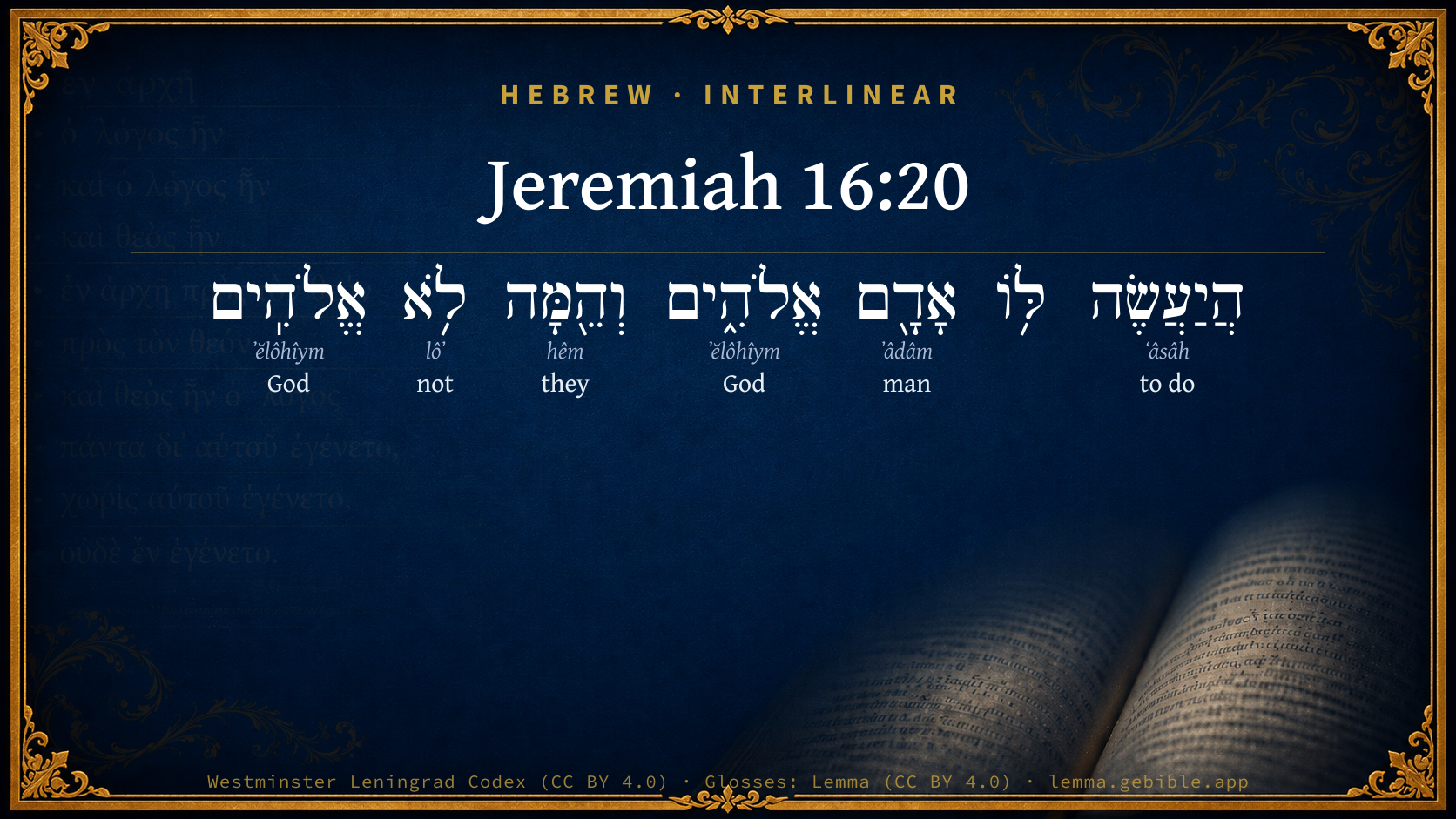
Jeremiah 16:20

Hebrew (Westminster Leningrad Codex) Jeremiah 16:20 appears in the Hebrew Old Testament. The text above is from the Westminster Leningrad Codex. Each word links to its Strong’s number, a concise gloss, and parsing drawn from the Open Scriptures Hebrew Bible morphology. Click any word for its full Brown-Driver-Briggs (BDB) entry.
Download image
Cite this verse

Jeremiah 16:20 (World English Bible). Public Domain. Lemma interlinear Bible study tool, https://lemma.gebible.app/v/jeremiah/16/20.

Show BibTeX & RIS
BibTeX
RIS
English Translation
Shall a man make to himself gods, which yet are no gods?
World English Bible · Public Domain
Download a study sheet

One document with this verse’s original text, its word-by-word gloss line, the meaning frame, cross-references with their text, attributed commentary, and full source and license credits — printable, and it pastes into notes with its structure intact.

This verse Autodidact and up

Study sheet (.html) Plain text (.txt)

A passage Seminary Student

Up to 50 verses in one chapter. A passage sheet keeps up to 6 commentary sources and 12 cross-references per verse, in the order this page ranks them, and says so on the sheet whenever that leaves anything out. Ask for a single verse and you get the Autodidact verse sheet above.

Everything on this page stays free to read, with no account — the sheet is a download of what is already on screen, not access to it.

Want to remove ads? Support Godless Engineer
Compare translations 3

The same verse in 3 English versions, stacked beneath the original-language interlinear above. Click any original word for its lexicon entry.

Each is an independent rendering of the whole verse — the interlinear is not word-aligned to these translations.

Highlighted words mark where these versions differ — a whole-verse word diff, not a word-by-word alignment.

  • World English Bible Public Domain
    Shall a man make to himself gods, which yet are no gods?
  • King James Version Public Domain
    Shall a man make gods unto himself, and they are no gods?
  • unfoldingWord Literal Text CC BY-SA 4.0
    Will a man make for himself gods? But they not gods.

unfoldingWord Literal Text — © unfoldingWord, licensed CC BY-SA 4.0. Word-aligned USFM3 via Door43 (git.door43.org/unfoldingWord/en_ult).

Versions to compare (up to 4)

3 of 4 selected

Show all 18 translations

Every available English version of this verse, each an independent rendering of the whole verse.

  • World English Bible Public Domain
    Shall a man make to himself gods, which yet are no gods?
  • Berean Standard Bible Public Domain
    Can man make gods for himself? Such are not gods!”
  • Majority Standard Bible Public Domain
    Can man make gods for himself? Such are not gods!”
  • King James Version Public Domain
    Shall a man make gods unto himself, and they are no gods?
  • American Standard Version (1901) Public Domain
    Shall a man make unto himself gods, which yet are no gods?
  • Revised Version (1885) Public Domain
    Shall a man make unto himself gods, which yet are no gods?
  • Geneva Bible (1599) Public Domain
    Shall a man make gods vnto himselfe, and they are no gods?
  • Douay-Rheims (1899) Public Domain
    Shall a man make gods unto himself, and there are no gods?
  • Young's Literal Translation Public Domain
    Doth man make for himself gods, And they -- no gods?
  • Literal Standard Version CC BY-SA 4.0
    Does man make gods for himself, || And they—no gods?
  • Unlocked Literal Bible CC BY-SA 4.0
    Do people make gods for themselves? But they are not gods.”
  • unfoldingWord Literal Text CC BY-SA 4.0
    Will a man make for himself gods? But they not gods.
  • Darby Bible Public Domain
    Shall a man make gods unto himself, and they are no-gods?
  • World Messianic Bible Public Domain
    Should a man make to himself gods which yet are no gods?”
  • Webster's Bible Public Domain
    Shall a man make gods to himself, and they are no gods?
  • Free Bible Version CC BY-SA 4.0
    How can people make gods for themselves? These aren't gods!”
  • Bible in Basic English Public Domain
    Will a man make for himself gods which are no gods?
  • JPS Tanakh (1917) Public Domain
    Shall a man make unto himself gods, and they are no gods?

Literal Standard Version (2020), Covenant Press — licensed CC BY-SA 4.0. Text via the HelloAO Bible API (eBible.org). Unlocked Literal Bible (unfoldingWord) — licensed CC BY-SA 4.0. Text via the HelloAO Bible API (eBible.org). unfoldingWord Literal Text — © unfoldingWord, licensed CC BY-SA 4.0. Word-aligned USFM3 via Door43 (git.door43.org/unfoldingWord/en_ult). Free Bible Version, Dr. Jonathan Gallagher — licensed CC BY-SA 4.0. Text via the HelloAO Bible API (eBible.org).

Word by word

More ways to search: Search by grammar → Find every occurrence → Compare this word →

Practice this passage: Drill this verse → Learn its vocabulary →

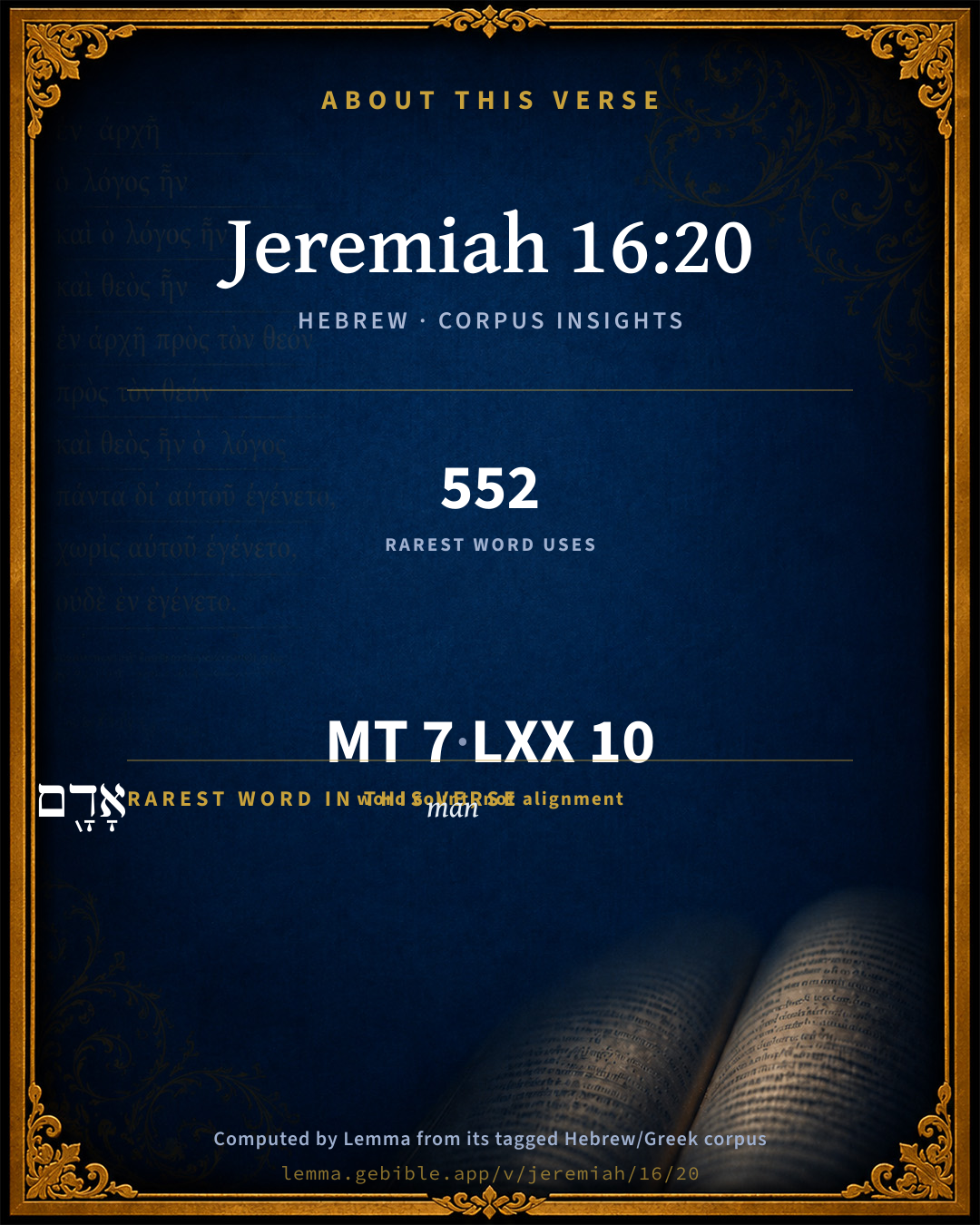
About this verse

These counts appear in no published source. They are computed here, from the morphology-tagged text and Lemma’s own curated glosses. What Lemma adds →

7
words
5
distinct lemmas
Prophets
section

Grammatical profile

  • 1 verb
  • 3 nouns
  • 1 pronoun
  • 1 preposition
  • 1 particle

Verb forms

  • הֲיַעֲשֶׂה Qal · Imperfect

Repetition

A word recurs within this verse — often emphatic in Hebrew:

  • אֱלֹהִ֑ים God H430 ×2

Hebrew & Septuagint length

In the original languages it is 7 Hebrew tokens and 10 Greek tokens — but the two are counted differently (Hebrew bundles its prefixes and suffixes into one token; the Greek is in lemma form), so that isn’t a like-for-like length.

Cross-references

9

Topical passages linked to Jeremiah 16:20 in the Treasury of Scripture Knowledge — connected by theme and wording, ordered by reader-vote popularity; previews shown in the World English Bible.

  • Psalms 115:4–8 Their idols are silver and gold, The work of men's hands.
  • Isaiah 37:19 and have cast their gods into the fire: for they were no gods, but the work of men's hands, wood and stone; therefore they have destroyed them.
  • Galatians 4:8 However at that time, not knowing God, you were in bondage to those who by nature are not gods.
  • Psalms 135:14–18 For Yahweh will judge his people, And have compassion on his servants.
  • Isaiah 36:19 Where are the gods of Hamath and Arpad? where are the gods of Sepharvaim? and have they delivered Samaria out of my hand?
  • Jeremiah 2:11 Has a nation changed [its] gods, which yet are no gods? but my people have changed their glory for that which does not profit.
  • Hosea 8:4–6 They have set up kings, but not by me. They have made princes, and I didn't approve. Of their silver and their gold they have made themselves idols, That they may be cut off.
  • Acts 19:26 You see and hear, that not at Ephesus alone, but almost throughout all Asia, this Paul has persuaded and turned away many people, saying that they are no gods, that are made with hands.
  • Galatians 1:8 But even though we, or an angel from heaven, should preach to you any gospel other than that which we preached to you, let him be cursed.

Cross-references courtesy of OpenBible.info (CC BY 4.0).

Hebrew and Greek witnesses Masoretic Hebrew ↔ Greek Septuagint

The same verse in the two great witnesses to the Old Testament, shown verse-for-verse.

These are two independent witnesses, not word-aligned to each other, and the Septuagint is shown in lemma (dictionary) form.

Hebrew Jeremiah 16:20 Masoretic · Westminster Leningrad Codex

הֲיַעֲשֶׂה לּ֥וֹ אָדָ֖ם אֱלֹהִ֑ים וְהֵ֖מָּה לֹ֥א אֱלֹהִֽים

Shall a man make to himself gods, which yet are no gods?

World English Bible · Public Domain

Greek LXX Structure differs

In the Septuagint, Jeremiah is about an eighth shorter than the Hebrew and arranges its material differently — the Oracles Against the Nations (Hebrew chapters 46–51) appear in the middle of the Greek book, after 25:13. Because the chapter and verse boundaries do not line up, a verse-for-verse comparison with the Hebrew is not shown.

A verse-for-verse comparison isn’t shown here because the chapters and verses don’t line up. Switch to the LXX edition with the MT / LXX toggle above to read the Greek directly.

Hebrew: Westminster Leningrad Codex (CC BY 4.0). Greek: Septuagint (public domain); English from a public-domain English Septuagint. How the Septuagint differs from the Hebrew →

Targum (Aramaic paraphrase)

1

The Targum is the ancient Jewish Aramaic paraphrase of the Hebrew Scriptures — an interpretive translation, not the Hebrew text itself. Onkelos (literal) and Pseudo-Jonathan (expansive) render the Torah, and Jonathan the Prophets. Coverage is partial: where no permissively-licensed English translation exists for a verse, only the Aramaic is shown. This is verse-level text, not a word-by-word alignment to the Hebrew.

  1. Targum Jonathan Prophets (Joshua–Malachi)
    הַאֶפְשַׁר דְיַעְבֵּד לֵיהּ אֱנַשׁ דַחֲלַן וְאִינוּן טַעֲוָן דְלֵית בְּהוֹן צְרוֹךְ:

    (no public-domain English translation for this verse)

    Targum Jonathan — Aramaic: “Mikraot Gedolot” (public domain). English: “Sefaria Community Translation” (CC0 1.0 (public-domain dedication)); “London "Chaldee Paraphrase," 1871” (public domain). Text via Sefaria.

Commentary

Notes on Jeremiah 16:20 from classic Christian and Jewish commentators (each source and its license shown beneath its notes). The classic Christian expositions comment on the surrounding passage and are grouped to its opening verse, so a note may address several verses; the Jewish commentaries on the Tanakh (Rashi and others) are per-verse, so they appear only where the commentator wrote on this verse.

Lemma curates 59 commentaries, every one of them public domain or Creative Commons licensed, each selected and text-cleaned for this edition rather than reprinted as found. About our sources →

Trapp's Complete Commentary

John Trapp

Jer 16:20 Shall a man make gods unto himself, and they [are] no gods?

Ver. 20. Should a man make gods to himself?] Nonne res haec stupore digna? Is not this a strange sottishness? The Gentiles here see it, and yet the Papists will not.

John Trapp, A Commentary or Exposition upon All the Books of the Old and New Testament (1647–1656) — public domain. Text from a community e-Sword module.

Jamieson, Fausset & Brown

Robert Jamieson, A. R. Fausset & David Brown

indignant protest of Jeremiah against idols.

and they (are) no gods-- (Jer 2:11; Isa 37:19; Gal 4:8). "They" refers to the idols. A man (a creature himself) making God is a contradiction in terms. Vulgate takes "they" thus: "Shall man make gods, though men themselves are not gods?"

Jamieson, Fausset & Brown — Commentary Critical and Explanatory on the Whole Bible (1871) — public domain (CC PDM 1.0). Text via the HelloAO Bible API.

Adam Clarke's Commentary

Verse 20. Shall a man make gods unto himself?] Can any be so silly, and so preposterously absurd? Yes, fallen man is capable of any thing that is base, mean, vile, and wicked, till influenced and converted by the grace of Christ.

Adam Clarke's Commentary on the Bible (1810–1826) — public domain. Text from a community e-Sword/MySword module.

John Calvin's Commentaries

Some frigidly explain this verse, as though the Prophet said that men are doubly foolish, who form for themselves gods from wood, stone, gold, or silver, because they cannot change their nature; for whatever men may imagine, the stone remains a stone, the wood remains wood. The sense then they elicit from the Prophet’s words is this — that they are not gods who are devised by the foolish imaginations of men. But the Prophet reasons differently, — “Can he who is not God make a god?” that is, “can he who is created be the creator?” No one can give, according to the common proverb, what he has not; and there is in man no divine power. We indeed see what our condition is; there is nothing more frail and perishable: as man then is all vanity, and has in him nothing solid, can he create a god for himself? This is the Prophet’s argument: it is drawn from what is absurd, in order that men might at length acknowledge, not only their presumption, but their monstrous madness. For when any one is asked as to his condition, he must necessarily confess that he is a creature, and that he is also, as the ancients have said, all ephemeral animal, that his life is like a shadow. Since then men are constrained, by the real state of things, to make such a confession, how comes it that they dare to form gods for themselves? God does not create a god, he creates men; he has created angels, he has created the heavens and the earth, but yet he does not put forth his power to create a new god. Now man, what is he? nothing but vanity; and yet he will create a god though he is no God.

There is no doubt but that the Prophet here, as with new rigor, boldly attacks the Jews. For it seems evident that, when this temptation assailed him — “What can this mean t what will at length happen when God rejects the race of Abraham whom he had chosen?” he turned to God: but now, having recovered confidence, he inveighs against the ungodly, and says, can man create gods for himself while yet he is not a god? The change in the number ought not to be deemed strange; for when there is an indefinite declaration the nmnber is often changed, both in Greek and Latin. If some particular person was intended, the Prophet would not have said, And they themselves are not gods; but as he speaks of mankind generally and indefinitely, the sentence reads better when he says, “Shall man make a god? and they,” that is men, “are not gods.” This remark I have added, because it is probable, that those who consider idols to be intended in the last clause have been led astray by the change that is made in the number. It follows, —

John Calvin's Commentaries (1540-1563) — public domain. Text from the Calvin Translation Society English edition (1840s-50s) via the Christian Classics Ethereal Library (ccel.org). Calvin's coverage is partial (roughly two-thirds of the Bible); uncommented books and verses are honest gaps, never fabricated. The 19th-century editor's footnotes and remarks are omitted so the notes are faithfully Calvin's own voice.

John Gill's Exposition

Therefore, behold, I will this once cause them to know,.... Or, "at this time", as the Targum; when the Gentiles shall be convinced of the idolatry they have been brought up in, and of the vanity and falsehood of their idols; they shall be made to know the true God, God in Christ, Christ himself, whom to know is life eternal, and to know the way of life and salvation by him; and all this through the ministry of the Gospel that should be brought among them, the Spirit of God accompanying it; by means of which they should come to Christ from the ends of the earth, before predicted.

I will cause them to know my hand and my might; to experience the power and efficacy of his grace in conversion; quickening their dead souls, softening their hard hearts, taking away the stony heart, and giving a heart of flesh; and making them willing in the day of his power to be saved by Christ, and to serve him; to relinquish their idols, and turn to and worship the living God in spirit and in truth: though most understand this not as a promise of grace to the Gentiles, but as a threatening of punishment to the idolatrous Jews; that because of their idolatry they should once for all, or by this one and grievous calamity, captivity in Babylon, be made to know what they could not be brought to know by all the instructions and warnings of the prophets; they should now feel the weight of the Lord's hand, the lighting down of his arm with the indignation of his wrath; and so the Targum,

"I will show them my vengeance and the stroke of my power.''

And they shall know that my name is the Lord; the Jehovah, the self-existent Being, the Being of beings, the everlasting and unchangeable I AM; who is able to make good his promises, or perform his threatenings; a name incommunicable to creatures, which do not belong to the idols of the Gentiles, is peculiar to the true God, who is the most High in all the earth; see Psa 83:18.

Next: Jeremiah Chapter 17

John Gill's Exposition of the Whole Bible (1746–1763) — public domain (CC PDM 1.0). Text via the HelloAO Bible API.

Haydock's Catholic Bible Commentary

Make gods. This consideration alone suffices to shew their absurdity. (Calmet) --- "Man must now be merciful to god!" (Tertullian, Apol.) --- No one can make even a man, much less a god. (St. Jerome) (Worthington)

George Leo Haydock (1774–1849), Haydock's Catholic Family Bible and Commentary, 1859 edition — public domain. Excludes Psalms (Douay-Rheims chapter numbering differs from Protestant) and Deuterocanonical books (Catholic canon only).

Matthew Poole's English Annotations

It is doubtful whether these be to be understood as the words of God, showing the unreasonableness of the sin of idolatry, or, as others make them, the continued speech of the Gentiles, who after their conversion should see the unreasonableness of worshipping the works of their own hands. Whoso owneth a God owneth an infinite Being, a First Cause, and Mover, and Creator of all things. Now can any be so sottishly stupid as to think that a finite being should give a being to an infinite Being; that he who is a creature should make his Creator, that he should be a cause to the First Cause? (things which are all contradictions to the common sense of men). A man is no god himself; how can he communicate a divine nature, which himself hath not, to another?

Matthew Poole's English Annotations on the Holy Bible (1683–1685) — public domain. Text from a community e-Sword/MySword module.

The Pulpit Commentary

But the Jews of this generation, in spite of the manifold proofs of the true religion which have been vouchsafed to them, are deserting the real divinity for the unreal. In a tone of surprise the prophet exclaims, Shall a man make gods unto himself, etc.?

The Pulpit Commentary (1880–1919), ed. H.D.M. Spence-Jones & Joseph S. Exell — public domain. Text from a community e-Sword module.

Lesson kit

Teaching starters — assembled from the data on this page, not authored interpretation. Every prompt links to the verse data it draws on. Edit before teaching.

Jeremiah, in the Prophets, opens this verse with 7 words (5 distinct Hebrew lemmas). Its most distinctive word is ʼâdâm (“man”). A historical commentator’s framing appears above. Read the whole chapter for the surrounding context.

Discussion questions

  1. What does “man” (ʼâdâm) contribute to the verse as a whole?
  2. Psalms 115:4–8 shares this passage’s theme. How do the two illuminate each other?
  3. “God” occurs 2× in this one verse. What is the effect of the repetition?
  4. The translations on this page render this verse differently — a whole-verse word diff, not a word-by-word alignment. What might account for the different wordings?
  5. The verb «הֲיַעֲשֶׂה» is Qal Imperfect. How does its form color the action?
  6. Reading how Trapp's Complete Commentary and Jamieson, Fausset & Brown read this verse, where do the two commentators agree and where do they part?

Things to notice

Reading settings

Reading text

Shown beneath each verse's original-language words.

Old Testament
Old Testament edition

Read the OT as the Masoretic Hebrew (MT) or the Greek Septuagint (LXX).

English shown for the Greek Septuagint (in the Hebrew ↔ Greek comparison).

Comparing translations? Open the Compare panel on any verse page to stack up to four side by side.