
Ezekiel 1:10

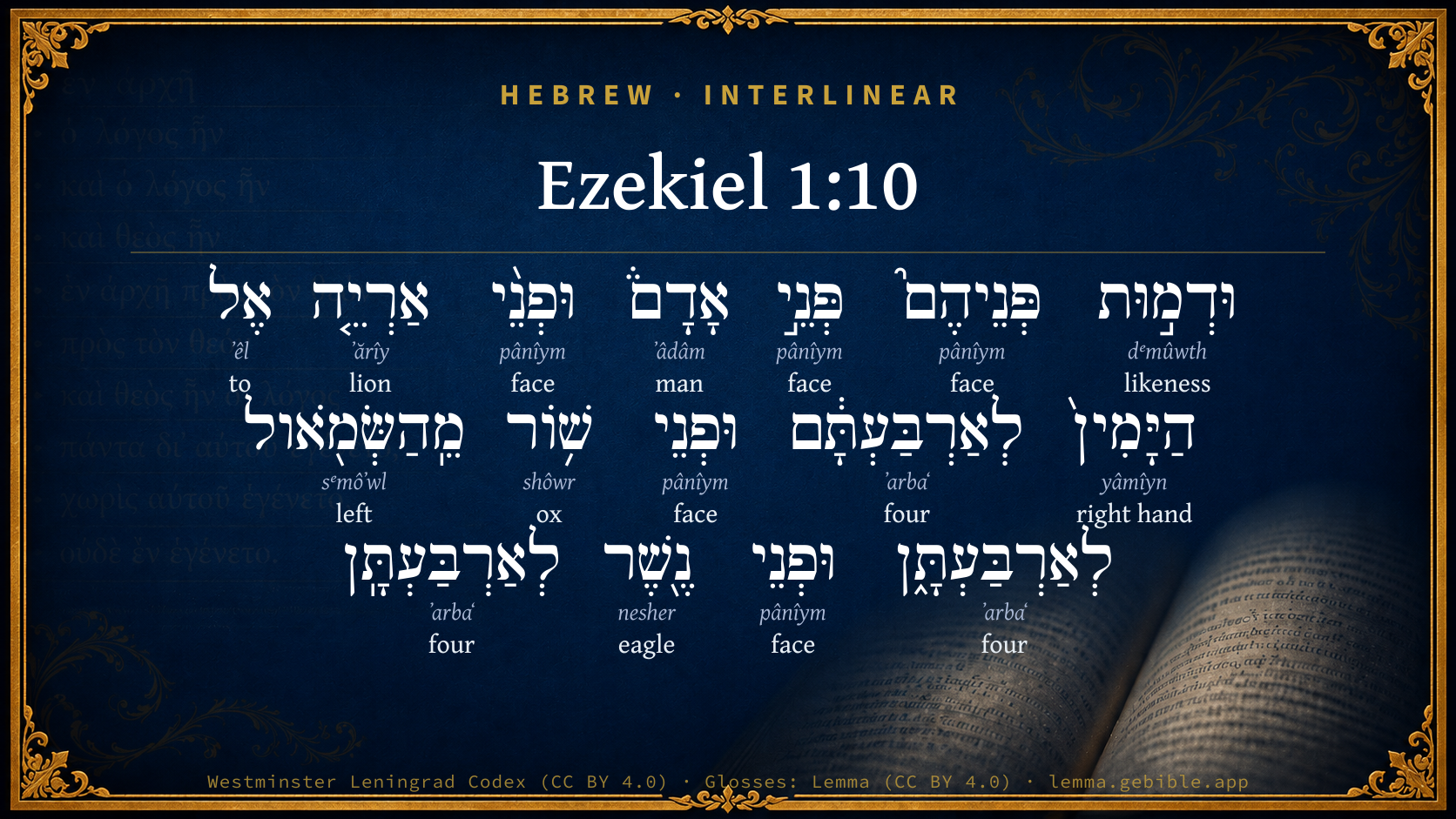
Hebrew (Westminster Leningrad Codex) Ezekiel 1:10 appears in the Hebrew Old Testament. The text above is from the Westminster Leningrad Codex. Each word links to its Strong’s number, a concise gloss, and parsing drawn from the Open Scriptures Hebrew Bible morphology. Click any word for its full Brown-Driver-Briggs (BDB) entry.
Download image
Cite this verse

Ezekiel 1:10 (World English Bible). Public Domain. Lemma interlinear Bible study tool, https://lemma.gebible.app/v/ezekiel/1/10.

Show BibTeX & RIS
BibTeX
RIS
English Translation
As for the likeness of their faces, they had the face of a man; and they four had the face of a lion on the right side; and they four had the face of an ox on the left side; they four had also the face of an eagle.
World English Bible · Public Domain
Download a study sheet

One document with this verse’s original text, its word-by-word gloss line, the meaning frame, cross-references with their text, attributed commentary, and full source and license credits — printable, and it pastes into notes with its structure intact.

This verse Autodidact and up

Study sheet (.html) Plain text (.txt)

A passage Seminary Student

Up to 50 verses in one chapter. A passage sheet keeps up to 6 commentary sources and 12 cross-references per verse, in the order this page ranks them, and says so on the sheet whenever that leaves anything out. Ask for a single verse and you get the Autodidact verse sheet above.

Everything on this page stays free to read, with no account — the sheet is a download of what is already on screen, not access to it.

Want to remove ads? Support Godless Engineer
Compare translations 3

The same verse in 3 English versions, stacked beneath the original-language interlinear above. Click any original word for its lexicon entry.

Each is an independent rendering of the whole verse — the interlinear is not word-aligned to these translations.

Highlighted words mark where these versions differ — a whole-verse word diff, not a word-by-word alignment.

  • World English Bible Public Domain
    As for the likeness of their faces, they had the face of a man; and they four had the face of a lion on the right side; and they four had the face of an ox on the left side; they four had also the face of an eagle.
  • King James Version Public Domain
    As for the likeness of their faces, they four had the face of a man, and the face of a lion, on the right side: and they four had the face of an ox on the left side; they four also had the face of an eagle.
  • unfoldingWord Literal Text CC BY-SA 4.0
    The likeness of their faces was like the face of a man. The four of them had the face of a lion to the right side, and the four of them had the face of an ox on the left side. They four had also the face of an eagle.

unfoldingWord Literal Text — © unfoldingWord, licensed CC BY-SA 4.0. Word-aligned USFM3 via Door43 (git.door43.org/unfoldingWord/en_ult).

Versions to compare (up to 4)

3 of 4 selected

Show all 18 translations

Every available English version of this verse, each an independent rendering of the whole verse.

  • World English Bible Public Domain
    As for the likeness of their faces, they had the face of a man; and they four had the face of a lion on the right side; and they four had the face of an ox on the left side; they four had also the face of an eagle.
  • Berean Standard Bible Public Domain
    The form of their faces was that of a man, and each of the four had the face of a lion on the right side, the face of an ox on the left side, and also the face of an eagle.
  • Majority Standard Bible Public Domain
    The form of their faces was that of a man, and each of the four had the face of a lion on the right side, the face of an ox on the left side, and also the face of an eagle.
  • King James Version Public Domain
    As for the likeness of their faces, they four had the face of a man, and the face of a lion, on the right side: and they four had the face of an ox on the left side; they four also had the face of an eagle.
  • American Standard Version (1901) Public Domain
    As for the likeness of their faces, they had the face of a man; and they four had the face of a lion on the right side; and they four had the face of an ox on the left side; they four had also the face of an eagle.
  • Revised Version (1885) Public Domain
    As for the likeness of their faces, they had the face of a man; and they four had the face of a lion on the right side; and they four had the face of an ox on the left side; they four had also the face of an eagle.
  • Geneva Bible (1599) Public Domain
    And the similitude of their faces was as the face of a man: and they foure had the face of a lyon on the right side, and they foure had the face of a bullocke on the left side: they foure also had the face of an eagle.
  • Douay-Rheims (1899) Public Domain
    And as for the likeness of their faces: there was the face of a man, and the face of a lion on the right side of all the four: and the face of an ox, on the left side of all the four: and the face of an eagle over all the four.
  • Young's Literal Translation Public Domain
    As to the likeness of their faces, the face of a man, and the face of a lion, toward the right `are' to them four, and the face of an ox on the left `are' to them four, and the face of an eagle `are' to them four.
  • Literal Standard Version CC BY-SA 4.0
    As for the likeness of their faces, [each had] the face of a man, and toward the right the four had the face of a lion, and on the left the four had the face of an ox, and the four had the face of an eagle.
  • Unlocked Literal Bible CC BY-SA 4.0
    The likeness of their faces was like the face of a man. The four of them had the face of a lion to the right side, and the four of them had the face of an ox on the left side. They four had also the face of an eagle.
  • unfoldingWord Literal Text CC BY-SA 4.0
    The likeness of their faces was like the face of a man. The four of them had the face of a lion to the right side, and the four of them had the face of an ox on the left side. They four had also the face of an eagle.
  • Darby Bible Public Domain
    And the likeness of their faces was the face of a man; and they four had the face of a lion on the right side; and they four had the face of an ox on the left side; they four had also the face of an eagle.
  • World Messianic Bible Public Domain
    As for the likeness of their faces, they had the face of a man. The four of them had the face of a lion on the right side. The four of them had the face of an ox on the left side. The four of them also had the face of an eagle.
  • Webster's Bible Public Domain
    As for the likeness of their faces, they four had the face of a man and the face of a lion, on the right side: and they four had the face of an ox on the left side; they four also had the face of an eagle.
  • Free Bible Version CC BY-SA 4.0
    This what their faces looked like. They had a human face to the front, a lion's face to the right, a bull's face to the left, and lastly an eagle's face.
  • Bible in Basic English Public Domain
    As for the form of their faces, they had the face of a man, and the four of them had the face of a lion on the right side, and the four of them had the face of an ox on the left side, and the four of them had the face of an eagle.
  • JPS Tanakh (1917) Public Domain
    As for the likeness of their faces, they had the face of a man; and they four had the face of a lion on the right side; and they four had the face of an ox on the left side; they four had also the face of an eagle.

Literal Standard Version (2020), Covenant Press — licensed CC BY-SA 4.0. Text via the HelloAO Bible API (eBible.org). Unlocked Literal Bible (unfoldingWord) — licensed CC BY-SA 4.0. Text via the HelloAO Bible API (eBible.org). unfoldingWord Literal Text — © unfoldingWord, licensed CC BY-SA 4.0. Word-aligned USFM3 via Door43 (git.door43.org/unfoldingWord/en_ult). Free Bible Version, Dr. Jonathan Gallagher — licensed CC BY-SA 4.0. Text via the HelloAO Bible API (eBible.org).

Word by word

More ways to search: Search by grammar → Find every occurrence → Compare this word →

Practice this passage: Drill this verse → Learn its vocabulary →

וּדְמ֣וּת
dᵉmûwth
H1823
“and · likeness of”
Conjunction + Noun, Common, Feminine, Singular, Construct
Part of Speech
Conjunction + Noun
Type
Common
Gender
Feminine
Number
Singular
State
Construct
Full BDB Definition

Origin: from H1819

TWOT: 437a

likeness, similitude (noun feminine) - in the likeness of, like as (adverb)
  1. פְּנֵיהֶם֮ pânîym H6440 “face(s) · their” Noun, Common, Both, Plural, Construct + Suffix, Personal, 3rd Person, Masculine, Plural
  2. פְּנֵ֣י pânîym H6440 “face(s) of” Noun, Common, Both, Plural, Construct
  3. אָדָם֒ ʼâdâm H120 “man” Noun, Common, Masculine, Singular, Absolute
  4. וּפְנֵ֨י pânîym H6440 “and · face(s) of” Conjunction + Noun, Common, Both, Plural, Construct
  5. אַרְיֵ֤ה ʼărîy H738 “lion” Noun, Common, Masculine, Singular, Absolute
  6. אֶל ʼêl H413 “to” Preposition
  7. הַיָּמִין֙ yâmîyn H3225 “the · right hand” Particle, Definite Article + Noun, Common, Feminine, Singular, Absolute
  8. לְאַרְבַּעְתָּ֔ם ʼarbaʻ H702 “to/for · four · their” Preposition + Adjective, Cardinal number, Masculine, Singular, Construct + Suffix, Personal, 3rd Person, Masculine, Plural
  9. וּפְנֵי pânîym H6440 “and · face(s) of” Conjunction + Noun, Common, Both, Plural, Construct
  10. שׁ֥וֹר shôwr H7794 “ox” Noun, Common, Masculine, Singular, Absolute
  11. מֵֽהַשְּׂמֹ֖אול sᵉmôʼwl H8040 “from · the · left” Preposition + Particle, Definite Article + Noun, Common, Masculine, Singular, Absolute
  12. לְאַרְבַּעְתָּ֑ן ʼarbaʻ H702 “to/for · four · their” Preposition + Adjective, Cardinal number, Masculine, Singular, Construct + Suffix, Personal, 3rd Person, Feminine, Plural
  13. וּפְנֵי pânîym H6440 “and · face(s) of” Conjunction + Noun, Common, Both, Plural, Construct
  14. נֶ֖שֶׁר nesher H5404 “eagle” Noun, Common, Masculine, Singular, Absolute
  15. לְאַרְבַּעְתָּֽן ʼarbaʻ H702 “to/for · four · their” Preposition + Adjective, Cardinal number, Masculine, Singular, Construct + Suffix, Personal, 3rd Person, Feminine, Plural

About this verse

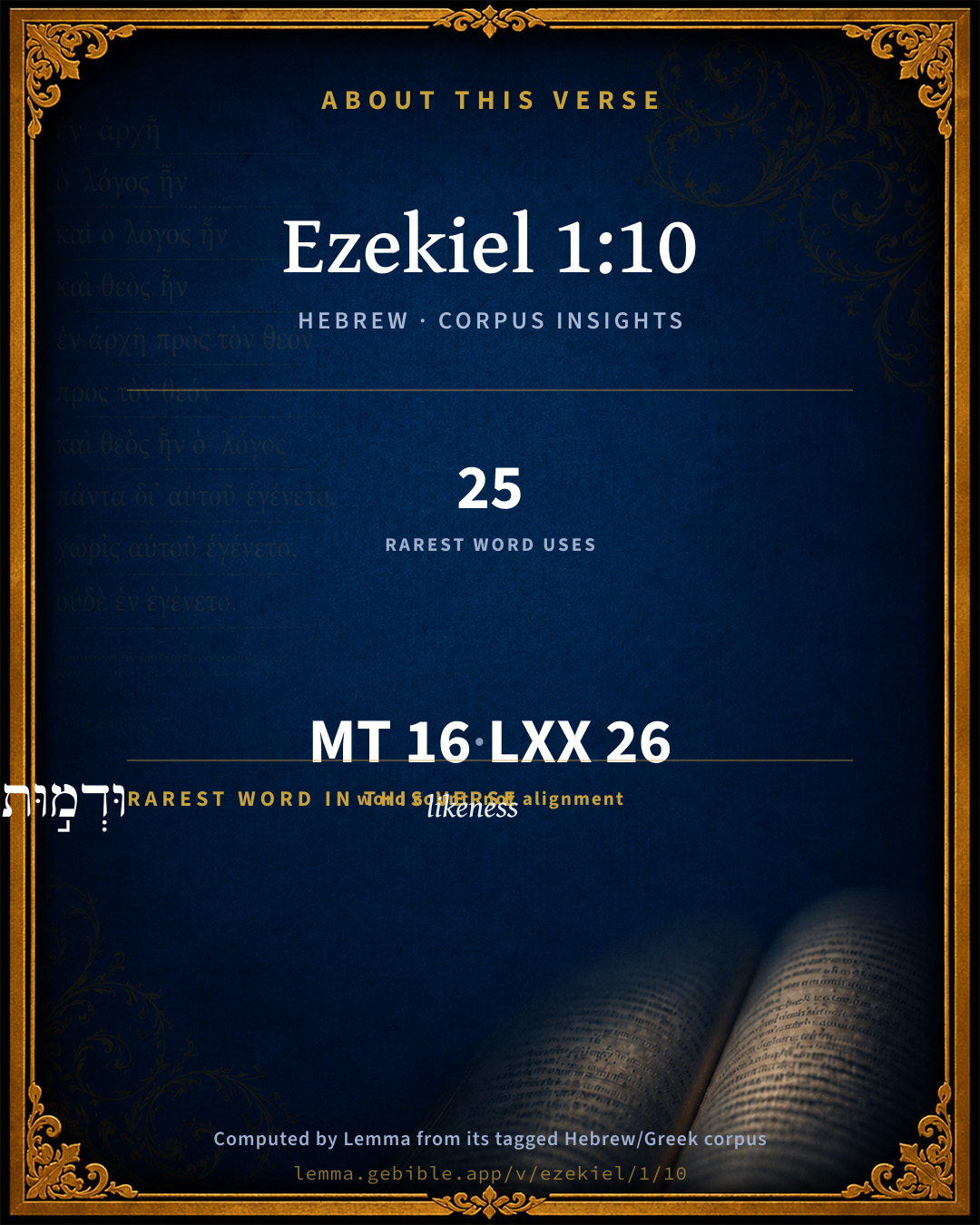
These counts appear in no published source. They are computed here, from the morphology-tagged text and Lemma’s own curated glosses. What Lemma adds →

16
words
10
distinct lemmas
Prophets
section

Notable vocabulary

The rarest word here is וּדְמ֣וּת likeness H1823 — appearing just 25 times in the whole Hebrew Bible.

Shared distinctive vocabulary

וּדְמ֣וּת likeness H1823 occurs in 22 verses of the Hebrew Bible. Also found in:

Grammatical profile

  • 12 nouns
  • 3 adjectives
  • 1 preposition

Repetition

Words recur within this verse — often emphatic in Hebrew:

  • פְּנֵיהֶם֮ face H6440 ×5
  • לְאַרְבַּעְתָּ֔ם four H702 ×3

Hebrew & Septuagint length

In English translation the verse runs 49 words from the Hebrew and 45 from the Septuagint (LXX English) — closely comparable.

A rough comparison of the two English renderings, which tokenize alike — not a word-level alignment.

Word counts can differ between the Hebrew and the Greek without any difference in meaning — e.g. the Hebrew direct-object marker אֵת has no separate Greek word, and Greek often adds the article ὁ.

In the original languages it is 16 Hebrew tokens and 26 Greek tokens — but the two are counted differently (Hebrew bundles its prefixes and suffixes into one token; the Greek is in lemma form), so that isn’t a like-for-like length.

Cross-references

18

Topical passages linked to Ezekiel 1:10 in the Treasury of Scripture Knowledge — connected by theme and wording, ordered by reader-vote popularity; previews shown in the World English Bible.

  • Ezekiel 10:14 Every one had four faces: the first face was the face of the cherub, and the second face was the face of a man, and the third face the face of a lion, and the fourth the face of an eagle.
  • Revelation 4:7 The first creature was like a lion, and the second creature like a calf, and the third creature had a face like a man, and the fourth was like a flying eagle.
  • 1 Corinthians 9:9–10 For it is written in the law of Moses, "You shall not muzzle an ox while it treads out the grain." Is it for the oxen that God cares,
  • Numbers 2:3 Those who encamp on the east side toward the sunrise shall be of the standard of the camp of Judah, according to their divisions: and the prince of the children of Judah shall be Nahshon the son of Amminadab.
  • Numbers 2:10 "On the south side shall be the standard of the camp of Reuben according to their divisions. The prince of the children of Reuben shall be Elizur the son of Shedeur.
  • Numbers 2:18 "On the west side shall be the standard of the camp of Ephraim according to their divisions: and the prince of the children of Ephraim shall be Elishama the son of Ammihud.
  • Numbers 2:25 "On the north side shall be the standard of the camp of Dan according to their divisions: and the prince of the children of Dan shall be Ahiezer the son of Ammishaddai.
  • Deuteronomy 28:49 Yahweh will bring a nation against you from far, from the end of the earth, as the eagle flies; a nation whose language you shall not understand;
  • Judges 14:18 The men of the city said to him on the seventh day before the sun went down, What is sweeter than honey? and what is stronger than a lion? He said to them, If you hadn't plowed with my heifer, You wouldn't have found out my riddle.
  • 1 Chronicles 12:8 Of the Gadites there separated themselves to David to the stronghold in the wilderness, mighty men of valor, men trained for war, that could handle shield and spear; whose faces were like the faces of lions, and they were as swift as the roes on the mountains;
  • Job 39:27 Is it at your command that the eagle mounts up, And makes his nest on high?
  • Proverbs 14:4 Where no oxen are, the crib is clean, But much increase is by the strength of the ox.
  • Isaiah 40:31 but those who wait for Yahweh shall renew their strength; they shall mount up with wings as eagles; they shall run, and not be weary; they shall walk, and not faint.
  • Isaiah 46:8 Remember this, and show yourselves men; bring it again to mind, you transgressors.
  • Daniel 7:4 The first was like a lion, and had eagle's wings: I saw until the wings of it were plucked, and it was lifted up from the earth, and made to stand on two feet as a man; and a man's heart was given to it.
  • Luke 15:10 Even so, I tell you, there is joy in the presence of the angels of God over one sinner repenting."
  • 1 Corinthians 14:20 Brothers, don't be children in thoughts, yet in malice be babies, but in thoughts be mature.
  • Revelation 5:5 One of the elders said to me, "Don't weep. Behold, the Lion who is of the tribe of Judah, the Root of David, has overcome; he who opens the book and its seven seals."

Cross-references courtesy of OpenBible.info (CC BY 4.0).

Hebrew and Greek witnesses Masoretic Hebrew ↔ Greek Septuagint

The same verse in the two great witnesses to the Old Testament, shown verse-for-verse.

These are two independent witnesses, not word-aligned to each other, and the Septuagint is shown in lemma (dictionary) form.

Hebrew Ezekiel 1:10 Masoretic · Westminster Leningrad Codex

וּדְמ֣וּת פְּנֵיהֶם֮ פְּנֵ֣י אָדָם֒ וּפְנֵ֨י אַרְיֵ֤ה אֶל הַיָּמִין֙ לְאַרְבַּעְתָּ֔ם וּפְנֵי שׁ֥וֹר מֵֽהַשְּׂמֹ֖אול לְאַרְבַּעְתָּ֑ן וּפְנֵי נֶ֖שֶׁר לְאַרְבַּעְתָּֽן

As for the likeness of their faces, they had the face of a man; and they four had the face of a lion on the right side; and they four had the face of an ox on the left side; they four had also the face of an eagle.

World English Bible · Public Domain

Greek LXX Ezekiel 1:10 Septuagint · lemma form

καί ὁμοίωσις ὁ πρόσωπον αὐτός πρόσωπον ἄνθρωπος καί πρόσωπον λέων ἐκ δεξιός ὁ τέσσαρες καί πρόσωπον μόσχος ἐκ ἀριστερός ὁ τέσσαρες καί πρόσωπον ἀετός ὁ τέσσαρες

And the likeness of their faces was the face of a man, and the face of a lion on the right of the four; and the face of a calf on the left of the four; and the face of an eagle to the four.

LXX2012 (modern English Septuagint) · Public Domain

On this verse, Haydock's Catholic Bible Commentary discusses the Septuagint’s reading. Read the note in Commentary ↓

Hebrew: Westminster Leningrad Codex (CC BY 4.0). Greek: Septuagint (public domain); English from LXX2012 (modern English Septuagint) (Public Domain). How the Septuagint differs from the Hebrew →

Targum (Aramaic paraphrase)

1

The Targum is the ancient Jewish Aramaic paraphrase of the Hebrew Scriptures — an interpretive translation, not the Hebrew text itself. Onkelos (literal) and Pseudo-Jonathan (expansive) render the Torah, and Jonathan the Prophets. Coverage is partial: where no permissively-licensed English translation exists for a verse, only the Aramaic is shown. This is verse-level text, not a word-by-word alignment to the Hebrew.

  1. Targum Jonathan Prophets (Joshua–Malachi)
    וּדְמוּת אַפֵּיהוֹן אַפֵּי אֱנָשָׁא וְאַפֵּי אַרְיָא עֲבִיד מִימִינָא לְאַרְבַּעְתְּהֵן וְאַפֵּי תוֹרָא עֲבִיד מִסְמָלָא לְאַרְבַּעְתְּהֵן וְאַפֵּי נִשְׁרָא לְאַרְבַּעְתְּהֵן:

    (no public-domain English translation for this verse)

    Targum Jonathan — Aramaic: “Mikraot Gedolot” (public domain). English: “Sefaria Community Translation” (CC0 1.0 (public-domain dedication)); “London "Chaldee Paraphrase," 1871” (public domain). Text via Sefaria.

Commentary

Notes on Ezekiel 1:10 from classic Christian and Jewish commentators (each source and its license shown beneath its notes). The classic Christian expositions comment on the surrounding passage and are grouped to its opening verse, so a note may address several verses; the Jewish commentaries on the Tanakh (Rashi and others) are per-verse, so they appear only where the commentator wrote on this verse.

Lemma curates 59 commentaries, every one of them public domain or Creative Commons licensed, each selected and text-cleaned for this edition rather than reprinted as found. About our sources →

Trapp's Complete Commentary

John Trapp

Eze 1:10 As for the likeness of their faces, they four had the face of a man, and the face of a lion, on the right side: and they four had the face of an ox on the left side; they four also had the face of an eagle.

Ver. 10. They four had the face of a man, and the face of a lion.] Hereby is set forth the wisdom, strength, serviceability, and perspicaciousness of the holy angels for the Church’s good, all things requisite to great undertakings; neither forbear they to serve us, though we have the scent of the earth and hell about, us. Quantumnis eos, proh dolor, foetore peccatorum non raro laedamus, Deumque offendamus, {a} Though, by the stench of our sins, we do frequently annoy them, and offend God.

And they four had the face of an ox.] Angels are obsequious, painful, patient, useful. The ox is of those beasts that are ad esum et ad usum; to consume food and to be useful, and is truly called Iumentum a iuvando, the beast of burden from help.

They four also had the face of an eagle.] Angels are sharp sighted, {2Sa 14:20} vigorous and vivacious, swift beyond belief, {Dan 9:21} and if they be once upon the wing, there is no escaping for any wicked people or person.

{a} Polan. - Would any great prince attend a lowly man full of sores and vermin?

John Trapp, A Commentary or Exposition upon All the Books of the Old and New Testament (1647–1656) — public domain. Text from a community e-Sword module.

Tyndale Open Study Notes

Tyndale Open Resources

1:10 Each had the face of a lion, the greatest of the wild animals; the face of an ox, the greatest of domestic animals; the face of an eagle, the greatest of the birds; and a human face, representing the pinnacle of creation. The guardians of Mesopotamian palaces also combined features of these same four creatures (though not the four faces).

Tyndale Open Study Notes — © Tyndale Open Resources, licensed CC BY-SA 4.0. Text via the HelloAO Bible API.

Geneva Bible (1599)

Geneva Bible translators

Every Cherubim had four faces, the face of a man, and of a lion on the right side, and the face of a bullock and of an Eagle on the left side.

Geneva Bible (1599) marginal notes — public domain. Text via Bolls.life.

Jamieson, Fausset & Brown

Robert Jamieson, A. R. Fausset & David Brown

they . . . had the face of a man--namely, in front. The human face was the primary and prominent one and the fundamental part of the composite whole. On its right was the lion's face; on the left, the ox's (called "cherub," Eze 10:14); at the back from above was the eagle's.

Jamieson, Fausset & Brown — Commentary Critical and Explanatory on the Whole Bible (1871) — public domain (CC PDM 1.0). Text via the HelloAO Bible API.

Adam Clarke's Commentary

Verse 10. As for the likeness of their faces] There was but one body to each of those compound animals: but each body had four faces; the face of a man and of a lion on the right side; the face of an ox and an eagle on the left side. Many of these compound images appear in the Asiatic idols. Many are now before me: some with the head and feet of a monkey, with the body, arms, and legs of a man. Others with the head of the dog; body, arms, and legs human. Some with the head of an ape; all the rest human. Some with one head and eight arms; others with six heads or faces, with twelve arms. The head of a lion and the head of a cock often appear; and some with the head of a cock, the whole body human, and the legs terminating in snakes. All these were symbolical, and each had its own appropriate meaning. Those in the text had theirs also, could we but find it out.

Adam Clarke's Commentary on the Bible (1810–1826) — public domain. Text from a community e-Sword/MySword module.

John Calvin's Commentaries

He now comes down to the faces or countenances of the living creatures themselves. The face is properly used with reference to the whole body, but the Prophet only means the countenance. He says therefore that there was on the right as it were the face of a man and of a lion, and on the left, the face of an ox and of an eagle We explained yesterday why four heads and as many faces are ascribed to the angels of God, because so great was the dullness of the people, that they did not acknowledge the providence of God over all parts of the world. For we know that they were so intoxicated with foolish confidence, that they wished to hold God shut up as it were within a prison: for their temple was as it were God’s prison. Hence the Prophet shows how the providence of God shines over other parts of the world. But since there is vigor in animals, so for brevity’s sake he puts four remarkable species of animals. Yet one question remains, and that a difficult one, for in Ezekiel 10:14, he puts a cherub for an ox. Some think, or at least reply, that it appeared at a distance the face of an ox, but nearer it was that of a cherub. All see that this is a sophistry, and because they cannot otherwise escape the difficulty, they have imagined that fiction, which has no firmness in it. Others think that cherub and ox are identical; but this may be refuted from many places, for cherubim have not the heads of oxen, as all very well know. I therefore have no doubt there was some difference in the second vision, when God appeared to his own Prophet in the Temple. It is called the same vision on account of the likeness, but it does not follow that all particulars were exactly the same. Nor ought this conjecture to be rejected, because when God made himself known to his servant in Chaldea, as I have said before, he wished to reprove the sloth of the people by this multiform image; but when he appeared a second time in the Temple, there it was something more divine. Hence therefore the variety, because each animal then bore the face of a cherub instead of that of an ox. Therefore, besides the stature of the whole body, there was a remarkable feature whence the Prophet could more easily and familiarly recognize these living-creatures to be cherubim or angels. This reason also seems to explain why God showed to his Prophet a form which approached more nearly to that of the sanctuary, and to the two cherubim who surrounded the ark. Besides, some think that the heads were so arranged, that the man’s head should look towards the east, and the opposite head towards the west. But it is scarcely to be doubted that the four faces had the same aspect, and turned their eyes in the same direction, there being on the right the two forms which we have mentioned of a man and a lion, and on the left, those of an ox and an eagle. Afterwards follows —

John Calvin's Commentaries (1540-1563) — public domain. Text from the Calvin Translation Society English edition (1840s-50s) via the Christian Classics Ethereal Library (ccel.org). Calvin's coverage is partial (roughly two-thirds of the Bible); uncommented books and verses are honest gaps, never fabricated. The 19th-century editor's footnotes and remarks are omitted so the notes are faithfully Calvin's own voice.

Ellicott's Commentary for English Readers

(10) On the right side . . . on the left side.—The apparent obscurity of this description is due only to the punctuation in the English Bible. “They four had the face of a man” (viz., in front, as Ezekiel viewed them), “and the face of a lion on the right side; and they four had the face of an ox on the left side; they four also had the face of an eagle” (viz., on the back, or side opposite to Ezekiel). These faces are the same as those given to the living creatures in Rev_4:7, except that there each creature had but one of them.

A Bible Commentary for English Readers, edited by Charles John Ellicott (1878–1897) — public domain. Text from a community e-Sword module.

The Cambridge Bible for Schools and Colleges

gen. ed. J. J. S. Perowne

10. Read as R. V., and as for the likeness of their faces: they had the face of a man; and they four had the face of a lion on the right side, &c. The right side is that of the living creature, not of the beholder.

The Cambridge Bible for Schools and Colleges (gen. ed. J. J. S. Perowne; Cambridge University Press, 1878–1918) — public domain. Text from a community e-Sword module.

John Gill's Exposition

As for the likeness of their faces, they four had the face of a man,.... For these living creatures are men, redeemed from among men by the blood of Christ; their business lies with men, to preach the Gospel to them: and they should be humane, kind, and tender in their behaviour towards them; wounded consciences of weak believers, distressed and disconsolate souls, requiring such usage; and they should be men in understanding, have a large knowledge of the Scriptures, of the truths of the Gospel, and of Jesus Christ, since their work is to feed men with knowledge and understanding; and should act the manly part, quit themselves like men in defence of the Gospel, and the truths of it;

and the face of a lion on the right side; denoting the strength of Gospel ministers, the lion being the strongest among beasts, Pro 30:30; and they have need to be strong in the grace of Christ, and in the power of his might, to do the several parts of their work; to endure hardness as good soldiers of Christ; to wrestle with principalities and powers, and to bear the infirmities of the weak: and also their courage and fortitude of mind; their boldness in preaching the Gospel of Christ, not fearing the faces of men, nor their revilings; see Pro 28:1;

and they four had the face of an ox on the left side; expressive of the patience of Gospel ministers in bearing the yoke that is upon them, not only of the ministry, but of the weaknesses of saints, and the reproaches and indignities of the wicked; and in instructing those that oppose themselves, and in waiting the issue of their ministry: and also of their laboriousness in their ministrations; particularly in treading out the corn of the word, for the subsistence of the saints: see Co1 9:9;

they four also had the face of an eagle; showing their strong and clear sight of the Gospel, and the mysteries of it; the eagle having so strong an eye, that it is able to look full and steadfastly upon the sun; and their diligence in searching into the deep things of God, and particularly to find out where the carcass is, a crucified Christ, to feed upon themselves, and to direct others to it likewise. It seems as if these four living creatures had four distinct heads, as well as faces, and that the position of them was in this manner; the face of a man before; the face of a lion on the right side; the face of an ox on the left; and the face of an eagle behind, These four are the most excellent of creatures. The Talmudists have a saying,

"there are four that are proud (or excel) in the world; the lion among beasts; the ox among cattle; the eagle among birds; and man, whom God has exalted above all, for he rules over all (o).''

(o) Apud Schindler. Lex. Pentaglott, p. 267.

John Gill's Exposition of the Whole Bible (1746–1763) — public domain (CC PDM 1.0). Text via the HelloAO Bible API.

Albert Barnes' Notes on the Bible

Each living creature had four faces, in front the face of a man, that of a lion on the right side, that of an ox on the left side, and that of an eagle behind, and the “chariot” would present to the beholder two faces of a man, of a lion, of an eagle, and of an ox, according to the quarter from which he looked upon it.

Albert Barnes' Notes on the Bible (1834–1885) — public domain. Text from a community e-Sword/MySword module.

Haydock's Catholic Bible Commentary

Over. This is not specified in Hebrew, Chaldean, Septuagint, or St. Jerome. (Calmet) --- "The face of an eagle for all the four." It mist have been above or behind the man, as the situation of the other two faces is here determined, ver. 6. (Haydock)

George Leo Haydock (1774–1849), Haydock's Catholic Family Bible and Commentary, 1859 edition — public domain. Excludes Psalms (Douay-Rheims chapter numbering differs from Protestant) and Deuterocanonical books (Catholic canon only).

Matthew Poole's English Annotations

Here the prophet doth more expressly set forth what was more darkly mentioned in the 6th verse, and describeth their faces both by the proper resemblances, and by their respect to the local differences of east and west, or right and left hand. But since such differences are in themselves of little moment, and undeterminable, unless we were certain what prospect these living creatures stood in, whether looking to the prophet, or to Jerusalem, or toward Babylon, we shall say no more of it; what these signify is more material. Each face is compared to what is most excellent in its kind, man excels in wisdom, the lion in strength, the ox in patience and constancy of labour, the eagle in speed and high flight. So in the ministry of angels, and government of the world by the providence of God, what is most excellent may be observed.

Matthew Poole's English Annotations on the Holy Bible (1683–1685) — public domain. Text from a community e-Sword/MySword module.

Whedon's Commentary on the Bible

Daniel D. Whedon

10. As for the likeness of their faces, they four had the face [“appearance,” Gesenius] of a man, and the face of a lion, on the right side, etc. — Here again is the emphasis of the appearance, human appearance, of this creature of four faces. Ewald well points out that the prophet does not attempt to describe this fourfold unity, but only its likeness. His language constantly shows that he felt the difficulty of understanding the deep reality behind this symbol or “likeness.” (See note Eze_1:26.)

Daniel D. Whedon (gen. ed.), Commentary on the Old and New Testaments (1874–1909) — public domain. Text from a community e-Sword module.

The Pulpit Commentary

As for the likeness, etc. The Revised Version rightly strikes out the comma after "lion." The human face meets the prophet"s gaze. On the right he sees the lion, on the left the ox, while the face of the eagle is behind. What did the symbols mean?

(1) The human face represents the thought that man, as made "after the image of God", (Gen_1:27) is the highest symbol of the Eternal. So long as we remember that it is but a symbol, anthropomorphism is legitimate in thought, and appropriate in visions; though, like theriomorphism, it becomes perilous, and is therefore forbidden (Exo_20:4; Deu_4:17) when it takes concrete form in metal or in stone. So Daniel (Dan_7:9, Dan_7:13) sees the "Ancient of Days" and "one like unto a son of man;" and St. John"s vision (Rev_1:13) represents the same symbolism.

(2) The lion had been the familiar emblem of sovereignty, both in the temple of Solomon (1Ki_7:29) and in his palace. (1Ki_10:20; 2Ch_9:18:19) So, in Gen_49:9, it is the symbol of the kingly power of Judah, and appears with a yet higher application in Rev_5:5; while, on the other hand, it represents one of the great monarchies of the world in Dan_7:4. Its modern heraldic use in the arms of England and elsewhere presents yet another analogue.

(3) The ox had appeared, as here, so also in 1Ki_7:25, 1Ki_7:44, in company with the lion, notably in the twelve oxen that supported the "sea" or "laver" in the temple. Here also we have a kind of sovereignty the natural symbol of a strength made subservient to human uses. Both the lion and the ox, as we have seen, may have become familiar to Ezekiel as a priest ministering in the temple or as an exile.

(4) The eagle was, in like manner, though not taking its place in the symbolism of the temple, the emblem of kingly power, and is so employed by Ezekiel himself in Eze_17:3, Eze_17:7; while in Dan_7:4 the lion has eagle"s wings. (comp. Hos_8:1; Isa_46:11; Oba_1:4; Hab_1:8) In Assyrian sculpture Nisroch (the name is cognate with the Hebrew for "eagle," nesher) appears as an eagle-headed human figure, and is always represented as contending with or conquering the lion and the bull (Layard, "Nineveh," 2:458, 459). The facts suggest the inference

(1) that Ezekiel may have seen this symbol;

(2) that over and above the general thought that all the powers of nature are subject to the government of God, there was also the more specific thought that the great kingdoms of the earth were but servants of his, to do his pleasure? The reproduction of the fourfold form, with the variation already noticed, in Rev_4:7, is every way suggestive, and it is, at least, a natural inference that the symbols had acquired a new significance through the new truths that had been revealed to the seer of Patrons; that the human face may have connected itself with the thought of the Son of man who shared in the glory of the Father; the ox with that of his sacrifice; the lion with that of his sovereignty over Israel, as the Lion of the tribe of; (Rev_5:5) the eagle with that of his bearing his people as on eagles" wings, into the highest heavens. (Exo_19:4; Deu_32:11) The patristic interpretation, which finds in the four living creatures the symbols of the four evangelists (an interpretation by no means constant or unvarying the lion being sometimes identified with St Matthew, and the man with St. Mark, and conversely, while the ox and the eagle are uniformly assigned to St. Luke and St. John respectively), must be considered as the play of a devout imagination, but not as unfolding the meaning of either Ezekiel or St. John. In the later Jewish tradition the four forms are assigned, taking Ezekiel"s order, to the tribes of Reuben, Judah, Ephraim, and Dan, as the "standards". (Num_2:2) which they generally bore when encamped in the wilderness; but this is obviously outside the range of the prophet"s thoughts.

The Pulpit Commentary (1880–1919), ed. H.D.M. Spence-Jones & Joseph S. Exell — public domain. Text from a community e-Sword module.

John Wesley's Explanatory Notes

A man - Each face is compared to what is most excellent in its kind, man excels in wisdom, lions in strength, the ox in patience and constancy of labour, the eagle in speed and high flight.

John Wesley, Explanatory Notes Upon the Whole Bible (1754–1765) — public domain. Text via the GEBible commentary corpus.

unfoldingWord translationNotes

Door43 World Missions Community

Connecting Statement:

Ezekiel continues to describe his vision.

The likeness of their faces was like the face of a man

Ezekiel is describing the faces of the creatures on their front side. The abstract noun "likeness" means that what Ezekiel saw looked like a man's face. The word can be translated with a verbal phrase. AT: "The face of each creature looked like the face of a man" (See: Abstract Nouns)

The four of them had the face of a lion to the right side

"The face on the right side of each one's head looked like the face of a lion"

the four of them had the face of an ox on the left side

"the face on the left side of the head of each one looked like the face of an ox"

They four had also the face of an eagle

"The face on the back of the head of each one looked like the face of an eagle"

their wings were spread out above, so that each creature had a pair of wings that touched another creature's wing

"each creature held up two of his wings so that one wing touched the wing of the creature on one side of him, and the other wing touched the wing of the creature on the other side of him"

and also a pair of wings that covered their bodies

This can be translated as a new sentence: "The other two wings of each creature covered its body"

Each went straight forward

"Each creature moved with a face looking forward"

translationWords

lions

cow

eagle

Holy Spirit

unfoldingWord translationNotes — © Distant Shores Media and the Door43 World Missions Community, licensed CC BY-SA 4.0. Source: git.door43.org/Door43/en_tn.

Lesson kit

Teaching starters — assembled from the data on this page, not authored interpretation. Every prompt links to the verse data it draws on. Edit before teaching.

Ezekiel, in the Prophets, opens this verse with 16 words (10 distinct Hebrew lemmas). Its most distinctive word is dᵉmûwth (“likeness”). A historical commentator’s framing appears above. Read the whole chapter for the surrounding context.

Discussion questions

  1. The word dᵉmûwth carries the sense “likeness.” How does it shape the verse?
  2. How does Genesis 1:26, which shares the word «likeness», read alongside this verse?
  3. What does the repetition of “face” (5× in this one verse) do in this verse?
  4. These translations render this verse differently. What is at stake in choosing one wording over another?
  5. Compare how Trapp's Complete Commentary and Tyndale Open Study Notes read this verse. Where do they agree or differ?

Things to notice

Reading settings

Reading text

Shown beneath each verse's original-language words.

Old Testament
Old Testament edition

Read the OT as the Masoretic Hebrew (MT) or the Greek Septuagint (LXX).

English shown for the Greek Septuagint (in the Hebrew ↔ Greek comparison).

Comparing translations? Open the Compare panel on any verse page to stack up to four side by side.