
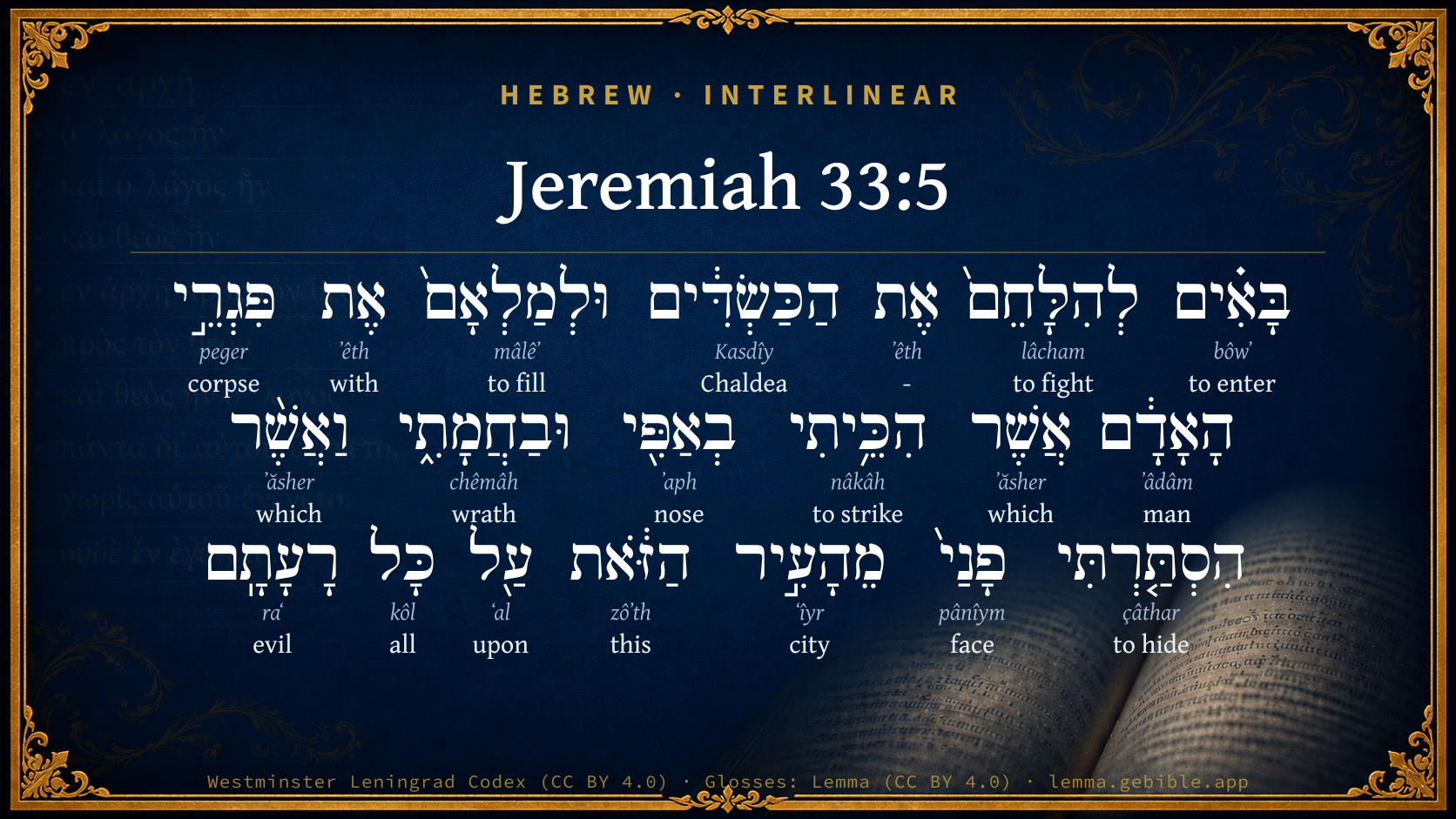
Jeremiah 33:5

Hebrew (Westminster Leningrad Codex) Jeremiah 33:5 appears in the Hebrew Old Testament. The text above is from the Westminster Leningrad Codex. Each word links to its Strong’s number, a concise gloss, and parsing drawn from the Open Scriptures Hebrew Bible morphology. Click any word for its full Brown-Driver-Briggs (BDB) entry.
Download image
Cite this verse

Jeremiah 33:5 (World English Bible). Public Domain. Lemma interlinear Bible study tool, https://lemma.gebible.app/v/jeremiah/33/5.

Show BibTeX & RIS
BibTeX
RIS
English Translation
while [men] come to fight with the Chaldeans, and to fill them with the dead bodies of men, whom I have killed in my anger and in my wrath, and for all whose wickedness I have hid my face from this city:
World English Bible · Public Domain
Download a study sheet

One document with this verse’s original text, its word-by-word gloss line, the meaning frame, cross-references with their text, attributed commentary, and full source and license credits — printable, and it pastes into notes with its structure intact.

This verse Autodidact and up

Study sheet (.html) Plain text (.txt)

A passage Seminary Student

Up to 50 verses in one chapter. A passage sheet keeps up to 6 commentary sources and 12 cross-references per verse, in the order this page ranks them, and says so on the sheet whenever that leaves anything out. Ask for a single verse and you get the Autodidact verse sheet above.

Everything on this page stays free to read, with no account — the sheet is a download of what is already on screen, not access to it.

Want to remove ads? Support Godless Engineer
Compare translations 3

The same verse in 3 English versions, stacked beneath the original-language interlinear above. Click any original word for its lexicon entry.

Each is an independent rendering of the whole verse — the interlinear is not word-aligned to these translations.

Highlighted words mark where these versions differ — a whole-verse word diff, not a word-by-word alignment.

  • World English Bible Public Domain
    while [men] come to fight with the Chaldeans, and to fill them with the dead bodies of men, whom I have killed in my anger and in my wrath, and for all whose wickedness I have hid my face from this city:
  • King James Version Public Domain
    They come to fight with the Chaldeans, but it is to fill them with the dead bodies of men, whom I have slain in mine anger and in my fury, and for all whose wickedness I have hid my face from this city.
  • unfoldingWord Literal Text CC BY-SA 4.0
    ‘The Chaldeans are coming to fight and to fill the houses with corpses of people whom I will kill in my wrath and fury, when I hide my face from this city because of all their wickedness.

unfoldingWord Literal Text — © unfoldingWord, licensed CC BY-SA 4.0. Word-aligned USFM3 via Door43 (git.door43.org/unfoldingWord/en_ult).

Versions to compare (up to 4)

3 of 4 selected

Show all 18 translations

Every available English version of this verse, each an independent rendering of the whole verse.

  • World English Bible Public Domain
    while [men] come to fight with the Chaldeans, and to fill them with the dead bodies of men, whom I have killed in my anger and in my wrath, and for all whose wickedness I have hid my face from this city:
  • Berean Standard Bible Public Domain
    The Chaldeans are coming to fight and to fill those places with the corpses of the men I will strike down in My anger and in My wrath. I have hidden My face from this city because of all its wickedness.
  • Majority Standard Bible Public Domain
    The Chaldeans are coming to fight and to fill those places with the corpses of the men I will strike down in My anger and in My wrath. I have hidden My face from this city because of all its wickedness.
  • King James Version Public Domain
    They come to fight with the Chaldeans, but it is to fill them with the dead bodies of men, whom I have slain in mine anger and in my fury, and for all whose wickedness I have hid my face from this city.
  • American Standard Version (1901) Public Domain
    while `men' come to fight with the Chaldeans, and to fill them with the dead bodies of men, whom I have slain in mine anger and in my wrath, and for all whose wickedness I have hid my face from this city:
  • Revised Version (1885) Public Domain
    they come to fight with the Chaldeans, but it is to fill them with the dead bodies of men, whom I have slain in mine anger and in my fury, and for all whose wickedness I have hid my face from this city.
  • Geneva Bible (1599) Public Domain
    They come to fight with the Caldeans, but it is to fill themselues with the dead bodies of men, whome I haue slaine in mine anger and in my wrath: for I haue hid my face from this citie, because of all their wickednes.
  • Douay-Rheims (1899) Public Domain
    Of them that come to fight with the Chaldeans, and to fill them with the dead bodies of the men whom I have slain in my wrath, and in my indignation, hiding my face from this city because of all their wickedness.
  • Young's Literal Translation Public Domain
    they are coming in to fight with the Chaldeans, and to fill them with the carcases of men, whom I have smitten in Mine anger, and in My fury, and `for' whom I have hidden My face from this city, because of all their evil:
  • Literal Standard Version CC BY-SA 4.0
    they are coming to fight with the Chaldeans, and to fill them with the carcasses of men, whom I have struck in My anger, and in My fury, and [for] whom I have hidden My face from this city, because of all their evil:
  • Unlocked Literal Bible CC BY-SA 4.0
    'The Chaldeans are coming to fight and to fill the houses with corpses of people whom I will kill in my wrath and fury, when I hide my face from this city because of all their wickedness.
  • unfoldingWord Literal Text CC BY-SA 4.0
    ‘The Chaldeans are coming to fight and to fill the houses with corpses of people whom I will kill in my wrath and fury, when I hide my face from this city because of all their wickedness.
  • Darby Bible Public Domain
    They come to fight with the Chaldeans, but to fill them with the dead bodies of the men whom I have slain in mine anger and in my fury, and for all whose wickedness I have hid my face from this city.
  • World Messianic Bible Public Domain
    ‘While men come to fight with the Kasdim, and to fill them with the dead bodies of men, whom I have killed in my anger and in my wrath, and for all whose wickedness I have hidden my face from this city,
  • Webster's Bible Public Domain
    They come to fight with the Chaldeans, but it is to fill them with the dead bodies of men, whom I have slain in my anger and in my fury, and for all whose wickedness I have hid my face from this city.
  • Free Bible Version CC BY-SA 4.0
    They come to fight the Babylonians but will only fill those houses with the dead bodies of those I'm going to kill in my furious anger. I have given up on this city because of all its wickedness.
  • Bible in Basic English Public Domain
    ... and to make them full of the dead bodies of men whom I have put to death in my wrath and in my passion, and because of whose evil-doing I have kept my face covered from this town.
  • JPS Tanakh (1917) Public Domain
    whereon they come to fight with the Chaldeans, even to fill them with the dead bodies of men, whom I have slain in Mine anger and in My fury, and for all whose wickedness I have hid My face from this city:

Literal Standard Version (2020), Covenant Press — licensed CC BY-SA 4.0. Text via the HelloAO Bible API (eBible.org). Unlocked Literal Bible (unfoldingWord) — licensed CC BY-SA 4.0. Text via the HelloAO Bible API (eBible.org). unfoldingWord Literal Text — © unfoldingWord, licensed CC BY-SA 4.0. Word-aligned USFM3 via Door43 (git.door43.org/unfoldingWord/en_ult). Free Bible Version, Dr. Jonathan Gallagher — licensed CC BY-SA 4.0. Text via the HelloAO Bible API (eBible.org).

Word by word

More ways to search: Search by grammar → Find every occurrence → Compare this word →

Practice this passage: Drill this verse → Learn its vocabulary →

פִּגְרֵ֣י
peger
H6297
“corpses of”
Noun, Common, Masculine, Plural, Construct
Part of Speech
Noun
Type
Common
Gender
Masculine
Number
Plural
State
Construct
Full BDB Definition

Origin: from H6296

TWOT: 1732a

corpse, carcass, monument, stela - corpse (of man) - carcass (of animals)
  1. בָּאִ֗ים bôwʼ H935 “entering” Verb, Qal, Participle Active, Masculine, Plural, Absolute
  2. לְהִלָּחֵם֙ lâcham H3898 “to fight” Preposition + Verb, Niphal, Infinitive Construct
  3. אֶת ʼêth H853 “-” Particle, Direct Object
  4. הַכַּשְׂדִּ֔ים Kasdîy H3778 “the · Chaldea” Particle, Definite Article + Noun, Proper
  5. וּלְמַלְאָם֙ mâlêʼ H4390 “and · to fill · them” Conjunction + Preposition + Verb, Piel, Infinitive Construct + Suffix, Personal, 3rd Person, Masculine, Plural
  6. אֶת ʼêth H854 “with” Preposition
  7. הָאָדָ֔ם ʼâdâm H120 “the · man” Particle, Definite Article + Noun, Common, Masculine, Singular, Absolute
  8. אֲשֶׁר ʼăsher H834 “which” Particle, Relative
  9. הִכֵּ֥יתִי nâkâh H5221 “to strike” Verb, Hiphil, Perfect, 1st Person, Common, Singular
  10. בְאַפִּ֖י ʼaph H639 “in/at · nose · my” Preposition + Noun, Common, Masculine, Singular, Construct + Suffix, Personal, 1st Person, Common, Singular
  11. וּבַחֲמָתִ֑י chêmâh H2534 “and · in/at · wrath · my” Conjunction + Preposition + Noun, Common, Feminine, Singular, Construct + Suffix, Personal, 1st Person, Common, Singular
  12. וַאֲשֶׁ֨ר ʼăsher H834 “and · which” Conjunction + Particle, Relative
  13. הִסְתַּ֤רְתִּי çâthar H5641 “to hide” Verb, Hiphil, Perfect, 1st Person, Common, Singular
  14. פָנַי֙ pânîym H6440 “face(s) · my” Noun, Common, Both, Plural, Construct + Suffix, Personal, 1st Person, Common, Singular
  15. מֵהָעִ֣יר ʻîyr H5892 “from · the · city” Preposition + Particle, Definite Article + Noun, Common, Feminine, Singular, Absolute
  16. הַזֹּ֔את zôʼth H2063 “the · this” Particle, Definite Article + Pronoun, Demonstrative, Feminine, Singular
  17. עַ֖ל ʻal H5921 “upon” Preposition
  18. כָּל kôl H3605 “all of” Noun, Common, Masculine, Singular, Construct
  19. רָעָתָֽם raʻ H7451 “evil · their” Noun, Common, Feminine, Singular, Construct + Suffix, Personal, 3rd Person, Masculine, Plural

About this verse

These counts appear in no published source. They are computed here, from the morphology-tagged text and Lemma’s own curated glosses. What Lemma adds →

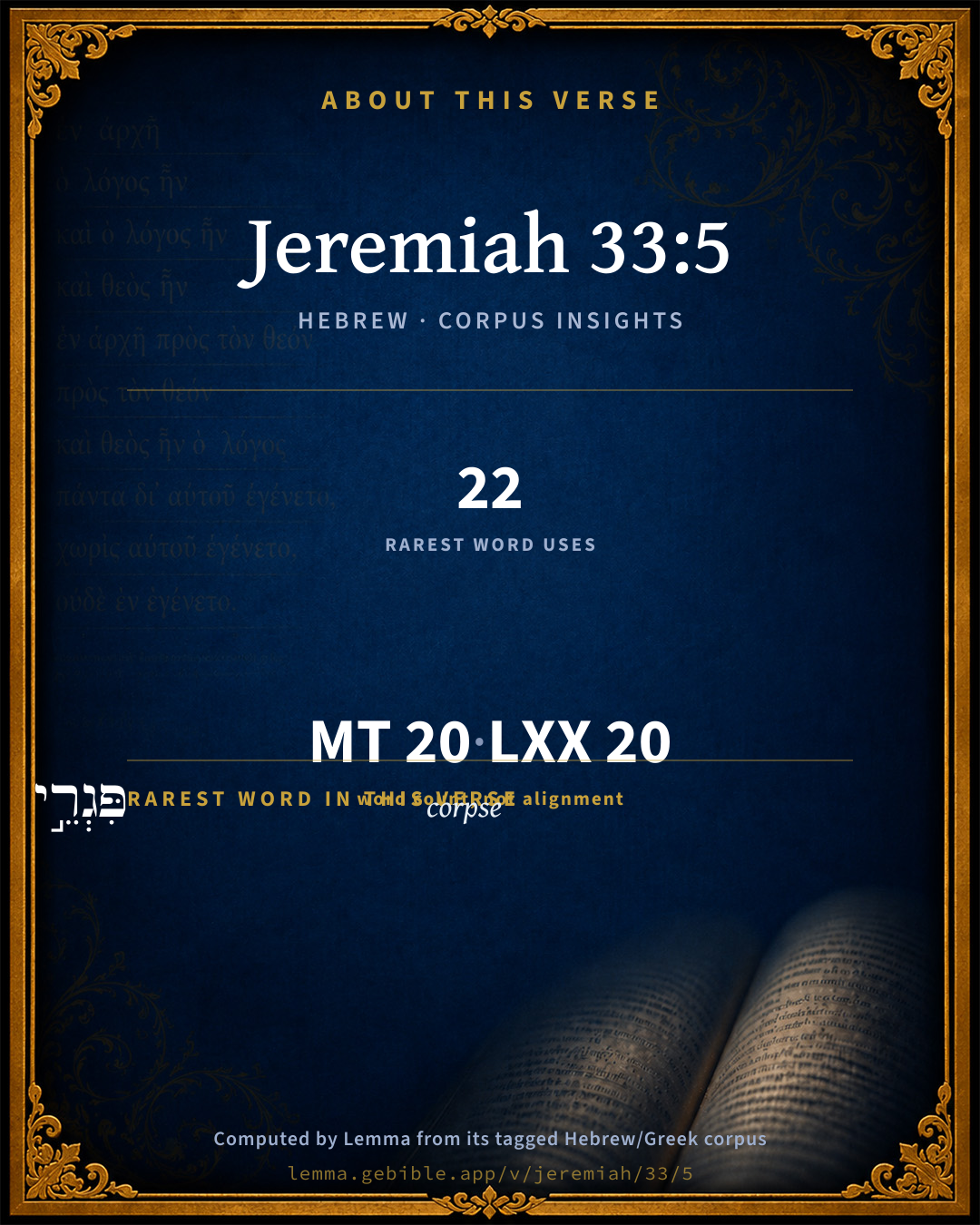
20
words
19
distinct lemmas
Prophets
section

Notable vocabulary

The rarest word here is פִּגְרֵ֣י corpse H6297 — appearing just 22 times in the whole Hebrew Bible.

Shared distinctive vocabulary

פִּגְרֵ֣י corpse H6297 occurs in 21 verses of the Hebrew Bible. Also found in:

Grammatical profile

  • 5 verbs
  • 9 nouns
  • 1 pronoun
  • 2 prepositions
  • 3 particles

Verb forms

  • בָּאִ֗ים Qal · Participle Active
  • לְהִלָּחֵם֙ Niphal · Infinitive Construct
  • וּלְמַלְאָם֙ Piel · Infinitive Construct
  • הִכֵּ֥יתִי Hiphil · Perfect
  • הִסְתַּ֤רְתִּי Hiphil · Perfect

Repetition

A word recurs within this verse — often emphatic in Hebrew:

  • אֲשֶׁר which H834 ×2

Hebrew & Septuagint length

In the original languages it is 20 Hebrew tokens and 20 Greek tokens — but the two are counted differently (Hebrew bundles its prefixes and suffixes into one token; the Greek is in lemma form), so that isn’t a like-for-like length.

Cross-references

13

Topical passages linked to Jeremiah 33:5 in the Treasury of Scripture Knowledge — connected by theme and wording, ordered by reader-vote popularity; previews shown in the World English Bible.

  • Isaiah 8:17 I will wait for Yahweh, who hides his face from the house of Jacob, and I will look for him.
  • Jeremiah 21:4–7 Thus says Yahweh, the God of Israel, Behold, I will turn back the weapons of war that are in your hands, with which you fight against the king of Babylon, and against the Chaldeans who besiege you, without the walls; and I will gather them into the midst of this city.
  • Jeremiah 21:10 For I have set my face on this city for evil, and not for good, says Yahweh: it shall be given into the hand of the king of Babylon, and he shall burn it with fire.
  • Jeremiah 32:5 and he shall bring Zedekiah to Babylon, and there shall he be until I visit him, says Yahweh: though you fight with the Chaldeans, you shall not prosper?
  • Deuteronomy 31:17 Then my anger shall be kindled against them in that day, and I will forsake them, and I will hide my face from them, and they shall be devoured, and many evils and troubles shall come on them; so that they will say in that day, Haven't these evils come on us because our God is not among us?
  • Isaiah 1:15–16 When you spread forth your hands, I will hide my eyes from you; Yes, when you make many prayers, I will not hear. Your hands are full of blood.
  • Isaiah 64:7 There is none who calls on your name, who stirs up himself to take hold of you; for you have hid your face from us, and have consumed us by means of our iniquities.
  • Jeremiah 37:9–10 Thus says Yahweh, Don't deceive yourselves, saying, The Chaldeans shall surely depart from us; for they shall not depart.
  • Micah 3:4 Then they will cry to Yahweh, But he will not answer them. Yes, he will hide his face from them at that time, Because they made their deeds evil."
  • Deuteronomy 32:20 He said, I will hide my face from them, I will see what their end shall be: For they are a very perverse generation, Children in whom is no faithfulness.
  • Jeremiah 18:17 I will scatter them as with an east wind before the enemy; I will show them the back, and not the face, in the day of their calamity.
  • Ezekiel 39:23–24 The nations shall know that the house of Israel went into captivity for their iniquity; because they trespassed against me, and I hid my face from them: so I gave them into the hand of their adversaries, and they fell all of them by the sword.
  • Ezekiel 39:29 neither will I hide my face any more from them; for I have poured out my Spirit on the house of Israel, says the Lord Yahweh.

Cross-references courtesy of OpenBible.info (CC BY 4.0).

Hebrew and Greek witnesses Masoretic Hebrew ↔ Greek Septuagint

The same verse in the two great witnesses to the Old Testament, shown verse-for-verse.

These are two independent witnesses, not word-aligned to each other, and the Septuagint is shown in lemma (dictionary) form.

Hebrew Jeremiah 33:5 Masoretic · Westminster Leningrad Codex

בָּאִ֗ים לְהִלָּחֵם֙ אֶת הַכַּשְׂדִּ֔ים וּלְמַלְאָם֙ אֶת פִּגְרֵ֣י הָאָדָ֔ם אֲשֶׁר הִכֵּ֥יתִי בְאַפִּ֖י וּבַחֲמָתִ֑י וַאֲשֶׁ֨ר הִסְתַּ֤רְתִּי פָנַי֙ מֵהָעִ֣יר הַזֹּ֔את עַ֖ל כָּל רָעָתָֽם

while [men] come to fight with the Chaldeans, and to fill them with the dead bodies of men, whom I have killed in my anger and in my wrath, and for all whose wickedness I have hid my face from this city:

World English Bible · Public Domain

Greek LXX Structure differs

In the Septuagint, Jeremiah is about an eighth shorter than the Hebrew and arranges its material differently — the Oracles Against the Nations (Hebrew chapters 46–51) appear in the middle of the Greek book, after 25:13. Because the chapter and verse boundaries do not line up, a verse-for-verse comparison with the Hebrew is not shown.

A verse-for-verse comparison isn’t shown here because the chapters and verses don’t line up. Switch to the LXX edition with the MT / LXX toggle above to read the Greek directly.

On this verse, The Pulpit Commentary discusses the Septuagint’s reading. Read the note in Commentary ↓

Hebrew: Westminster Leningrad Codex (CC BY 4.0). Greek: Septuagint (public domain); English from a public-domain English Septuagint. How the Septuagint differs from the Hebrew →

Targum (Aramaic paraphrase)

1

The Targum is the ancient Jewish Aramaic paraphrase of the Hebrew Scriptures — an interpretive translation, not the Hebrew text itself. Onkelos (literal) and Pseudo-Jonathan (expansive) render the Torah, and Jonathan the Prophets. Coverage is partial: where no permissively-licensed English translation exists for a verse, only the Aramaic is shown. This is verse-level text, not a word-by-word alignment to the Hebrew.

  1. Targum Jonathan Prophets (Joshua–Malachi)
    אָתָן לְאַגָחָא קְרָבָא עִם כַּסְדָאֵי וּלְמַלְיוּתְהוֹן יַת פִּגְרֵי בְנֵי אֱנָשָׁא דְאַלְקֵיתִי בְרוּגְזִי וּבְחֵימְתִי וּדְסַלְקֵית שְׁכִנְתִּי מִן קַרְתָּא הָדָא עַל כָּל בִישַׁתְהוֹן:

    (no public-domain English translation for this verse)

    Targum Jonathan — Aramaic: “Mikraot Gedolot” (public domain). English: “Sefaria Community Translation” (CC0 1.0 (public-domain dedication)); “London "Chaldee Paraphrase," 1871” (public domain). Text via Sefaria.

Commentary

Notes on Jeremiah 33:5 from classic Christian and Jewish commentators (each source and its license shown beneath its notes). The classic Christian expositions comment on the surrounding passage and are grouped to its opening verse, so a note may address several verses; the Jewish commentaries on the Tanakh (Rashi and others) are per-verse, so they appear only where the commentator wrote on this verse.

Lemma curates 59 commentaries, every one of them public domain or Creative Commons licensed, each selected and text-cleaned for this edition rather than reprinted as found. About our sources →

Trapp's Complete Commentary

John Trapp

Jer 33:5 They come to fight with the Chaldeans, but [it is] to fill them with the dead bodies of men, whom I have slain in mine anger and in my fury, and for all whose wickedness I have hid my face from this city.

Ver. 5. They come to fight with the Chaldeans.] But they fight not in God’s name; for he hath, for all their wickedness, hidden his face from them; therefore they fight with such sorry success; the houses which they would defend are filled with their dead caresses. This whole verse would be hemmed in with a parenthesis.

John Trapp, A Commentary or Exposition upon All the Books of the Old and New Testament (1647–1656) — public domain. Text from a community e-Sword module.

Tyndale Open Study Notes

Tyndale Open Resources

33:5 The men were already as good as dead because the Lord had decreed the destruction of the city.

Tyndale Open Study Notes — © Tyndale Open Resources, licensed CC BY-SA 4.0. Text via the HelloAO Bible API.

Geneva Bible (1599)

Geneva Bible translators

The Jews think to overcome the Chaldeans, but they seek their own destruction.

He showeth that God’s favor is cause of all prosperity, as his anger is of all adversity.

Geneva Bible (1599) marginal notes — public domain. Text via Bolls.life.

Jamieson, Fausset & Brown

Robert Jamieson, A. R. Fausset & David Brown

They--the Jews; the defenders of the "houses" (Jer 33:4), "come forward to fight with the Chaldeans," who burst into the city through the "thrown-down houses," but all the effect that they produce "is, to fill them (the houses) with their own "dead bodies."

Jamieson, Fausset & Brown — Commentary Critical and Explanatory on the Whole Bible (1871) — public domain (CC PDM 1.0). Text via the HelloAO Bible API.

John Calvin's Commentaries

There are two parts to this prophecy, — that the Jews were about to perish through their own fault, — and that they were to be restored through the favor and goodness of God alone. Here, then, in the first place, the Prophet condemns the false confidence of the people, who stoutly resisted the Chaldeans. They came, he says, to fight with the Chaldeans; but what would be the issue of the battle? even to fill, he says, with the carcases of men their very houses When he says that the Jews were come, he speaks of what had already, as it were, taken place. It is indeed a participle in the present tense, coming; but the Prophet here sets before their eyes what was to be, as though he had said, “The Jews will boldly rush forth, and will think themselves equal, and even superior to the Chaldeans; thus they will arm themselves with courage for the battle.” Then he says this, in order to ridicule the audacity of the people. The sad issue of the fight follows, the filling of their own houses with the carcases of men. The copulative is redundant, or it must be taken as explanatory, and rendered, even. They shall come then to fight, evern that they may fill their own houses with carcases, and thus inflame the fury of their enemies. For it hence happened that the Chaldeans shed more blood, and spared not the mass of the people; because we know that when a city is won by force, more cruelty is exercised, and the slaughters become much greater. Had the Jews willingly surrendered, they would have received more humanity at the hand of their conquerors; but the Chaldeans became implacable, because their fury had been kindled by the pertinacity of the people fighting against them. God, at the same time, shews that the Chaldeans would not be victorious through their own valor, but because he himself would smite or slay the Jews. Then he ascribes to his own vengeance the calamity which might have seemed to proceed from the Chaldeans; for Jeremiah could not have exhorted the people to repentance except he shewed that it happened through a righteous judgment, that the Chaldeans so cruelly raged against them. But we must defer the rest until to-morrow.

John Calvin's Commentaries (1540-1563) — public domain. Text from the Calvin Translation Society English edition (1840s-50s) via the Christian Classics Ethereal Library (ccel.org). Calvin's coverage is partial (roughly two-thirds of the Bible); uncommented books and verses are honest gaps, never fabricated. The 19th-century editor's footnotes and remarks are omitted so the notes are faithfully Calvin's own voice.

Ellicott's Commentary for English Readers

(5) They come to fight with the Chaldeans . . .—The Hebrew construction is participial, and has the force expressed in English by “they” used indefinitely. The prophet sees, as it were, a sortie of the besieged, but it is doomed to failure, and the houses of the city are filled with those who were slain by the sword, as well as by the “famine and pestilence” (Jer_32:24).

A Bible Commentary for English Readers, edited by Charles John Ellicott (1878–1897) — public domain. Text from a community e-Sword module.

The Cambridge Bible for Schools and Colleges

gen. ed. J. J. S. Perowne

5. have hid my face] in displeasure. Cp. Deu_31:17 and elsewhere.

The Cambridge Bible for Schools and Colleges (gen. ed. J. J. S. Perowne; Cambridge University Press, 1878–1918) — public domain. Text from a community e-Sword module.

John Gill's Exposition

They come to fight with the Chaldeans,.... Either the Jews out of the country, or their auxiliaries, their neighbours, to oblige them to break up the siege; but all to no purpose: or rather the Jews within; who, from the mounts erected, fight with the Chaldeans; or by sallying out upon them:

but it is to fill them with the dead bodies of men; the mounts, made of their houses, or their houses themselves; it is only to make them graves, and fill them with these carcasses:

whom I have slain in mine anger, and in my fury; that is, suffered to be slain, being wroth and angry with them, for their sins, as follows:

and for all whose wickedness I have hid my face from the city; had no pity for it, showed no mercy to it, gave it no help and assistance, or protection, having withdrawn his presence from it. So the Targum,

"I have caused my Shechinah to depart from this city, because of their wickedness.''

John Gill's Exposition of the Whole Bible (1746–1763) — public domain (CC PDM 1.0). Text via the HelloAO Bible API.

Albert Barnes' Notes on the Bible

Render, They, i. e., the Jews come to fight with the Chaldaeans, and to fill them, i. e., the houses, with the dead bodies etc.

Albert Barnes' Notes on the Bible (1834–1885) — public domain. Text from a community e-Sword/MySword module.

Matthew Poole's English Annotations

It is very difficult to determine whether these words contain an entire sense in themselves, or what connexion they have with the foregoing words: not to repeat men’s diverse apprehensions, of which a large account is given by the author of the English Annotations, I think they judge best who think they have an entire sense in themselves, and judge that the they here mentioned are the Jews, of whom the prophet saith they come, because he knew they would sally out and fight with their enemies; but to no purpose but to fill their houses with their own dead bodies, whom he would cause in his anger to be slain, for their wickedness which they had provoked God by, and caused him to hide his face from that city which had so much of his countenance formerly.

Matthew Poole's English Annotations on the Holy Bible (1683–1685) — public domain. Text from a community e-Sword/MySword module.

Whedon's Commentary on the Bible

Daniel D. Whedon

5. They come to fight, etc. — This sentence is very enigmatical, and has occasioned many conjectural emendations of the text. But all such violent solutions of difficulties are to be rejected. We may take into thought the possibility of textual change, but have no right to postulate such change. The best explanation these puzzling words admit of is, They (the people) come to fight with the Chaldeans, but (the result is,) to fill the houses with the dead bodies of the slain, etc.

Daniel D. Whedon (gen. ed.), Commentary on the Old and New Testaments (1874–1909) — public domain. Text from a community e-Sword module.

The Pulpit Commentary

They come to fight with the Chaldeans, but it is, etc. The passage is obscure, so obscure that we cannot avoid inferring that it is corrupt. "They come" could only refer to the Jews, but these would rather be said to "go out;" the Hebrew writers are particular in distinguishing between to "come" and to "go out." Besides, there is no grammatical connection with the preceding verse. The Septuagint omits "they come," but the passage still remains enigmatical.

The Pulpit Commentary (1880–1919), ed. H.D.M. Spence-Jones & Joseph S. Exell — public domain. Text from a community e-Sword module.

John Wesley's Explanatory Notes

They - The Jews sally out and fight with their enemies, but to no purpose, but to fill their houses with their own dead bodies, whom I will cause in my anger to be slain.

John Wesley, Explanatory Notes Upon the Whole Bible (1754–1765) — public domain. Text via the GEBible commentary corpus.

Rashi

Rabbi Shlomo Yitzchaki (Rashi)

and to fill them with the corpses of the men And the houses that they demolished they make into graves for the corpses of those killed within the city.

and that which I have hidden, etc. So said the Lord: Behold, I will bring it, etc.

Rashi on the Tanakh — English translations: “The Judaica Press complete Tanach with Rashi, translated by A. J. Rosenberg” (CC BY 4.0); “Pentateuch with Rashi's commentary by M. Rosenbaum and A.M. Silbermann, 1929-1934” (public domain); “The Metsudah Tanach series, Lakewood, N.J” (CC BY 4.0); and “The Book of Joshua, Metsudah Publications, 1997” (CC BY 4.0). Text via Sefaria.

Lesson kit

Teaching starters — assembled from the data on this page, not authored interpretation. Every prompt links to the verse data it draws on. Edit before teaching.

Jeremiah, in the Prophets, opens this verse with 20 words (19 distinct Hebrew lemmas). Its most distinctive word is peger (“corpse”). A historical commentator’s framing appears above. Read the whole chapter for the surrounding context.

Discussion questions

  1. The word peger carries the sense “corpse.” How does it shape the verse?
  2. Genesis 15:11 shares the word «corpse» with this verse. How do the two illuminate each other?
  3. “which” occurs 2× in this one verse. What is the effect of the repetition?
  4. These translations render this verse differently. What is at stake in choosing one wording over another?
  5. The verb «בָּאִ֗ים» is Qal Participle Active. How does its form color the action?
  6. Reading how Trapp's Complete Commentary and Tyndale Open Study Notes read this verse, where do the two commentators agree and where do they part?

Things to notice

Reading settings

Reading text

Shown beneath each verse's original-language words.

Old Testament
Old Testament edition

Read the OT as the Masoretic Hebrew (MT) or the Greek Septuagint (LXX).

English shown for the Greek Septuagint (in the Hebrew ↔ Greek comparison).

Comparing translations? Open the Compare panel on any verse page to stack up to four side by side.