
Jeremiah 50:3

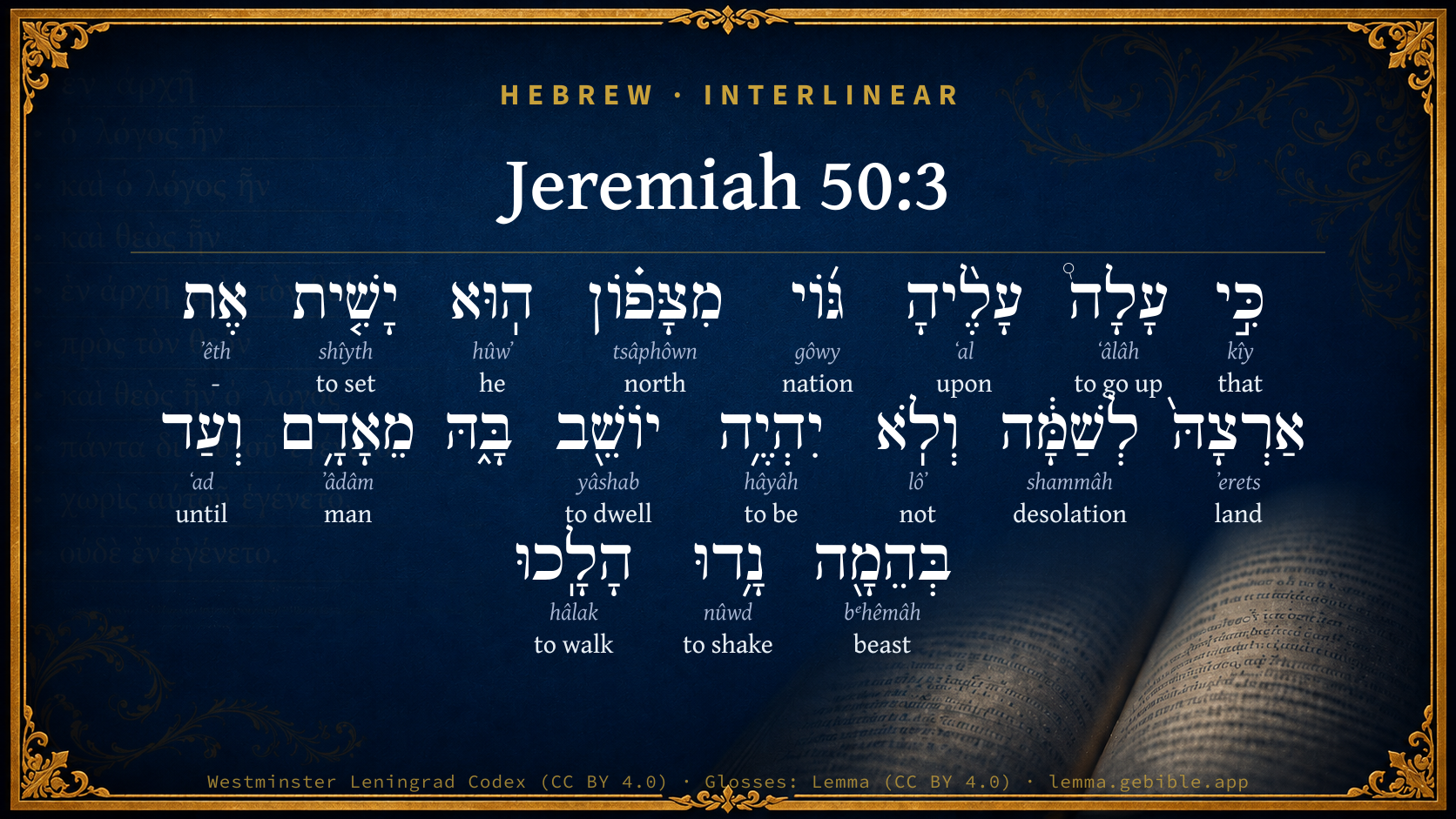
Hebrew (Westminster Leningrad Codex) Jeremiah 50:3 appears in the Hebrew Old Testament. The text above is from the Westminster Leningrad Codex. Each word links to its Strong’s number, a concise gloss, and parsing drawn from the Open Scriptures Hebrew Bible morphology. Click any word for its full Brown-Driver-Briggs (BDB) entry.
Download image
Cite this verse

Jeremiah 50:3 (World English Bible). Public Domain. Lemma interlinear Bible study tool, https://lemma.gebible.app/v/jeremiah/50/3.

Show BibTeX & RIS
BibTeX
RIS
English Translation
For out of the north there comes up a nation against her, which shall make her land desolate, and none shall dwell therein: they are fled, they are gone, both man and animal.
World English Bible · Public Domain
Download a study sheet

One document with this verse’s original text, its word-by-word gloss line, the meaning frame, cross-references with their text, attributed commentary, and full source and license credits — printable, and it pastes into notes with its structure intact.

This verse Autodidact and up

Study sheet (.html) Plain text (.txt)

A passage Seminary Student

Up to 50 verses in one chapter. A passage sheet keeps up to 6 commentary sources and 12 cross-references per verse, in the order this page ranks them, and says so on the sheet whenever that leaves anything out. Ask for a single verse and you get the Autodidact verse sheet above.

Everything on this page stays free to read, with no account — the sheet is a download of what is already on screen, not access to it.

Want to remove ads? Support Godless Engineer
Compare translations 3

The same verse in 3 English versions, stacked beneath the original-language interlinear above. Click any original word for its lexicon entry.

Each is an independent rendering of the whole verse — the interlinear is not word-aligned to these translations.

Highlighted words mark where these versions differ — a whole-verse word diff, not a word-by-word alignment.

  • World English Bible Public Domain
    For out of the north there comes up a nation against her, which shall make her land desolate, and none shall dwell therein: they are fled, they are gone, both man and animal.
  • King James Version Public Domain
    For out of the north there cometh up a nation against her, which shall make her land desolate, and none shall dwell therein: they shall remove, they shall depart, both man and beast.
  • unfoldingWord Literal Text CC BY-SA 4.0
    A nation from the north will arise against it, and make her land a desolation. No one will live in it; both man and beast will flee away.

unfoldingWord Literal Text — © unfoldingWord, licensed CC BY-SA 4.0. Word-aligned USFM3 via Door43 (git.door43.org/unfoldingWord/en_ult).

Versions to compare (up to 4)

3 of 4 selected

Show all 18 translations

Every available English version of this verse, each an independent rendering of the whole verse.

  • World English Bible Public Domain
    For out of the north there comes up a nation against her, which shall make her land desolate, and none shall dwell therein: they are fled, they are gone, both man and animal.
  • Berean Standard Bible Public Domain
    For a nation from the north will come against her; it will make her land a desolation. No one will live in it; both man and beast will flee.”
  • Majority Standard Bible Public Domain
    For a nation from the north will come against her; it will make her land a desolation. No one will live in it; both man and beast will flee.”
  • King James Version Public Domain
    For out of the north there cometh up a nation against her, which shall make her land desolate, and none shall dwell therein: they shall remove, they shall depart, both man and beast.
  • American Standard Version (1901) Public Domain
    For out of the north there cometh up a nation against her, which shall make her land desolate, and none shall dwell therein: they are fled, they are gone, both man and beast.
  • Revised Version (1885) Public Domain
    For out of the north there cometh up a nation against her, which shall make her land desolate, and none shall dwell therein: they are fled, they are gone, both man and beast.
  • Geneva Bible (1599) Public Domain
    For out of the North there commeth vp a nation against her, which shall make her lande waste, and none shall dwel therein: they shall flee, and depart, both man and beast.
  • Douay-Rheims (1899) Public Domain
    For a nation is come up against her out of the north, which shall make her land desolate: and there shall be none to dwell therein, from man even to beast:: yea they are removed, and gone away.
  • Young's Literal Translation Public Domain
    For come up against her hath a nation from the north, It maketh her land become a desolation, And there is not an inhabitant in it. From man even unto beast, They have moved, they have gone.
  • Literal Standard Version CC BY-SA 4.0
    For a nation from the north has come up against her, || It makes her land become a desolation, || And there is not an inhabitant in it. From man even to beast, || They have moved, they have gone.
  • Unlocked Literal Bible CC BY-SA 4.0
    A nation from the north will arise against it, and make her land a desolation. No one will live in it; both man and beast will flee away.
  • unfoldingWord Literal Text CC BY-SA 4.0
    A nation from the north will arise against it, and make her land a desolation. No one will live in it; both man and beast will flee away.
  • Darby Bible Public Domain
    For out of the north there cometh up a nation against her, which shall make her land desolate, and none shall dwell therein: both man and beast are fled; they are gone.
  • World Messianic Bible Public Domain
    For a nation comes up out of the north against her, which will make her land desolate, and no one will dwell in it. They have fled. They are gone, both man and animal.
  • Webster's Bible Public Domain
    For out of the north there cometh a nation against her, which shall make her land desolate, and none shall dwell in it, they shall remove, they shall depart, both man and beast.
  • Free Bible Version CC BY-SA 4.0
    A northern nation will come and attack her and turn the country into a wasteland. No one will live there—both people and animals will desert it.
  • Bible in Basic English Public Domain
    For out of the north a nation is coming up against her, which will make her land waste and unpeopled: they are in flight, man and beast are gone.
  • JPS Tanakh (1917) Public Domain
    For out of the north there cometh up a nation against her, which shall make her land desolate, and none shall dwell therein; they are fled, they are gone, both man and beast.

Literal Standard Version (2020), Covenant Press — licensed CC BY-SA 4.0. Text via the HelloAO Bible API (eBible.org). Unlocked Literal Bible (unfoldingWord) — licensed CC BY-SA 4.0. Text via the HelloAO Bible API (eBible.org). unfoldingWord Literal Text — © unfoldingWord, licensed CC BY-SA 4.0. Word-aligned USFM3 via Door43 (git.door43.org/unfoldingWord/en_ult). Free Bible Version, Dr. Jonathan Gallagher — licensed CC BY-SA 4.0. Text via the HelloAO Bible API (eBible.org).

Word by word

More ways to search: Search by grammar → Find every occurrence → Compare this word →

Practice this passage: Drill this verse → Learn its vocabulary →

נָ֥דוּ
nûwd
H5110
“to shake”
Verb, Qal, Perfect, 3rd Person, Common, Plural
Part of Speech
Verb
Stem
Qal
Form
Perfect
Person
3rd Person
Gender
Common
Number
Plural
Full BDB Definition

Origin: a primitive root

TWOT: 1319

to shake, waver, wander, move to and fro, flutter, show grief, have compassion on - (Qal) - to move to and fro, wander (aimlessly), take flight - to flutter - to waver, wave, shake - to show grief - to lament, condole, show sympathy - (Hiphil) - to cause to wander (aimlessly) - to make a wagging, wag (with the head) - (Hithpolel) - to move oneself to and fro, sway, totter - to shake oneself - to bemoan oneself
  1. כִּ֣י kîy H3588 “that” Conjunction
  2. עָלָה֩ ʻâlâh H5927 “to go up” Verb, Qal, Perfect, 3rd Person, Masculine, Singular
  3. עָלֶ֨יהָ ʻal H5921 “upon · her” Preposition + Suffix, Personal, 3rd Person, Feminine, Singular
  4. גּ֜וֹי gôwy H1471 “nation” Noun, Common, Masculine, Singular, Absolute
  5. מִצָּפ֗וֹן tsâphôwn H6828 “from · north” Preposition + Noun, Common, Feminine, Singular, Absolute
  6. הֽוּא hûwʼ H1931 “he” Pronoun, Personal, 3rd Person, Masculine, Singular
  7. יָשִׁ֤ית shîyth H7896 “to set” Verb, Qal, Imperfect, 3rd Person, Masculine, Singular
  8. אֶת ʼêth H853 “-” Particle, Direct Object
  9. אַרְצָהּ֙ ʼerets H776 “land · her” Noun, Common, Both, Singular, Construct + Suffix, Personal, 3rd Person, Feminine, Singular
  10. לְשַׁמָּ֔ה shammâh H8047 “to/for · desolation” Preposition + Noun, Common, Feminine, Singular, Absolute
  11. וְלֹֽא lôʼ H3808 “and · not” Conjunction + Particle, Negative
  12. יִהְיֶ֥ה hâyâh H1961 “to be” Verb, Qal, Imperfect, 3rd Person, Masculine, Singular
  13. יוֹשֵׁ֖ב yâshab H3427 “dwelling” Verb, Qal, Participle Active, Masculine, Singular, Absolute
  14. מֵאָדָ֥ם ʼâdâm H120 “from · man” Preposition + Noun, Common, Masculine, Singular, Absolute
  15. וְעַד ʻad H5704 “and · until” Conjunction + Preposition
  16. בְּהֵמָ֖ה bᵉhêmâh H929 “beast” Noun, Common, Feminine, Singular, Absolute
  17. הָלָֽכוּ hâlak H1980 “to walk” Verb, Qal, Perfect, 3rd Person, Common, Plural

About this verse

These counts appear in no published source. They are computed here, from the morphology-tagged text and Lemma’s own curated glosses. What Lemma adds →

19
words
18
distinct lemmas
Prophets
section

Notable vocabulary

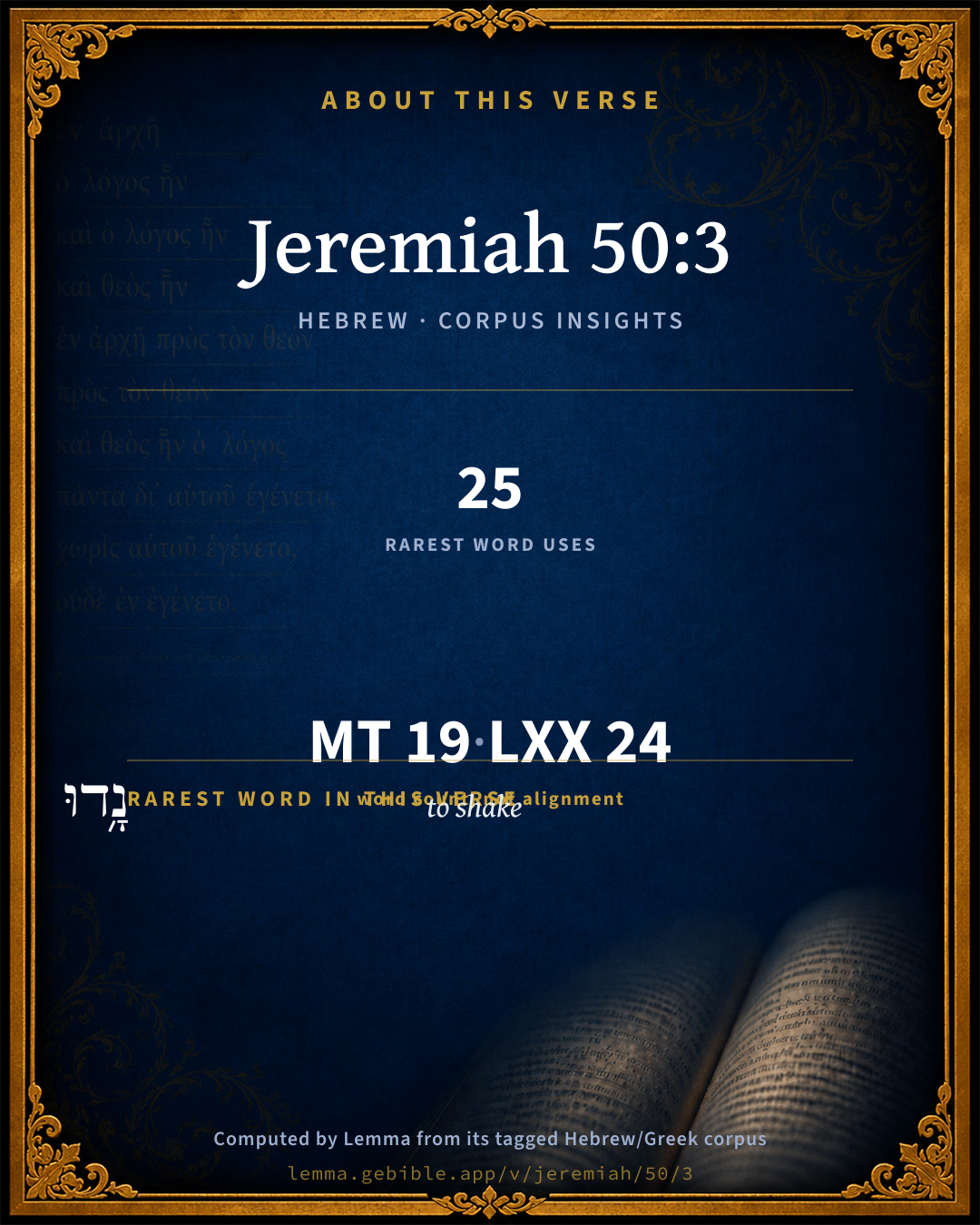
The rarest word here is נָ֥דוּ to shake H5110 — appearing just 25 times in the whole Hebrew Bible.

Shared distinctive vocabulary

נָ֥דוּ to shake H5110 occurs in 24 verses of the Hebrew Bible. Also found in:

Grammatical profile

  • 6 verbs
  • 6 nouns
  • 1 pronoun
  • 3 prepositions
  • 1 conjunction
  • 2 particles

Verb forms

  • עָלָה֩ Qal · Perfect
  • יָשִׁ֤ית Qal · Imperfect
  • יִהְיֶ֥ה Qal · Imperfect
  • יוֹשֵׁ֖ב Qal · Participle Active
  • נָ֥דוּ Qal · Perfect
  • הָלָֽכוּ Qal · Perfect

Hebrew & Septuagint length

In the original languages it is 19 Hebrew tokens and 24 Greek tokens — but the two are counted differently (Hebrew bundles its prefixes and suffixes into one token; the Greek is in lemma form), so that isn’t a like-for-like length.

Cross-references

18

Topical passages linked to Jeremiah 50:3 in the Treasury of Scripture Knowledge — connected by theme and wording, ordered by reader-vote popularity; previews shown in the World English Bible.

  • Jeremiah 51:11 Make sharp the arrows; hold firm the shields: Yahweh has stirred up the spirit of the kings of the Medes; because his purpose is against Babylon, to destroy it: for it is the vengeance of Yahweh, the vengeance of his temple.
  • Zephaniah 1:3 I will sweep away man and animal. I will sweep away the birds of the sky, the fish of the sea, and the heaps of rubble with the wicked. I will cut off man from the surface of the earth, says Yahweh.
  • Jeremiah 50:9 For, behold, I will stir up and cause to come up against Babylon a company of great nations from the north country; and they shall set themselves in array against her; from there she shall be taken: their arrows shall be as of an expert mighty man; none shall return in vain.
  • Jeremiah 51:62 and say, Yahweh, you have spoken concerning this place, to cut it off, that none shall dwell therein, neither man nor animal, but that it shall be desolate forever.
  • Genesis 6:7 Yahweh said, "I will destroy man whom I have created from the surface of the ground; man, along with animals, creeping things, and birds of the sky; for I am sorry that I have made them."
  • Exodus 12:12 For I will go through the land of Egypt in that night, and will strike all the firstborn in the land of Egypt, both man and animal. Against all the gods of Egypt I will execute judgments: I am Yahweh.
  • Isaiah 13:5–10 They come from a far country, from the uttermost part of heaven, even Yahweh, and the weapons of his indignation, to destroy the whole land.
  • Isaiah 13:17–22 Behold, I will stir up the Medes against them, who shall not regard silver, and as for gold, they shall not delight in it.
  • Isaiah 14:22–24 I will rise up against them, says Yahweh of Hosts, and cut off from Babylon name and remnant, and son and son's son, says Yahweh.
  • Jeremiah 7:20 Therefore thus says the Lord Yahweh: Behold, my anger and my wrath shall be poured out on this place, on man, and on animal, and on the trees of the field, and on the fruit of the ground; and it shall burn, and shall not be quenched.
  • Jeremiah 21:6 I will strike the inhabitants of this city, both man and animal: they shall die of a great pestilence.
  • Jeremiah 50:12–13 your mother shall be utterly disappointed; she who bore you shall be confounded: behold, she shall be the least of the nations, a wilderness, a dry land, and a desert.
  • Jeremiah 50:35–41 A sword is on the Chaldeans, says Yahweh, and on the inhabitants of Babylon, and on her princes, and on her wise men.
  • Jeremiah 51:8–9 Babylon is suddenly fallen and destroyed: wail for her; take balm for her pain, if so be she may be healed.
  • Jeremiah 51:25–27 Behold, I am against you, destroying mountain, says Yahweh, which destroy all the earth; and I will stretch out my hand on you, and roll you down from the rocks, and will make you a burnt mountain.
  • Jeremiah 51:37–44 Babylon shall become heaps, a dwelling-place for jackals, an astonishment, and a hissing, without inhabitant.
  • Jeremiah 51:48 Then the heavens and the earth, and all that is therein, shall sing for joy over Babylon; for the destroyers shall come to her from the north, says Yahweh.
  • Revelation 18:21–23 A mighty angel took up a stone like a great millstone and cast it into the sea, saying, "Thus with violence will Babylon, the great city, be thrown down, and will be found no more at all.

Cross-references courtesy of OpenBible.info (CC BY 4.0).

Hebrew and Greek witnesses Masoretic Hebrew ↔ Greek Septuagint

The same verse in the two great witnesses to the Old Testament, shown verse-for-verse.

These are two independent witnesses, not word-aligned to each other, and the Septuagint is shown in lemma (dictionary) form.

Hebrew Jeremiah 50:3 Masoretic · Westminster Leningrad Codex

כִּ֣י עָלָה֩ עָלֶ֨יהָ גּ֜וֹי מִצָּפ֗וֹן הֽוּא יָשִׁ֤ית אֶת אַרְצָהּ֙ לְשַׁמָּ֔ה וְלֹֽא יִהְיֶ֥ה יוֹשֵׁ֖ב בָּ֑הּ מֵאָדָ֥ם וְעַד בְּהֵמָ֖ה נָ֥דוּ הָלָֽכוּ

For out of the north there comes up a nation against her, which shall make her land desolate, and none shall dwell therein: they are fled, they are gone, both man and animal.

World English Bible · Public Domain

Greek LXX Structure differs

In the Septuagint, Jeremiah is about an eighth shorter than the Hebrew and arranges its material differently — the Oracles Against the Nations (Hebrew chapters 46–51) appear in the middle of the Greek book, after 25:13. Because the chapter and verse boundaries do not line up, a verse-for-verse comparison with the Hebrew is not shown.

A verse-for-verse comparison isn’t shown here because the chapters and verses don’t line up. Switch to the LXX edition with the MT / LXX toggle above to read the Greek directly.

Hebrew: Westminster Leningrad Codex (CC BY 4.0). Greek: Septuagint (public domain); English from a public-domain English Septuagint. How the Septuagint differs from the Hebrew →

Targum (Aramaic paraphrase)

1

The Targum is the ancient Jewish Aramaic paraphrase of the Hebrew Scriptures — an interpretive translation, not the Hebrew text itself. Onkelos (literal) and Pseudo-Jonathan (expansive) render the Torah, and Jonathan the Prophets. Coverage is partial: where no permissively-licensed English translation exists for a verse, only the Aramaic is shown. This is verse-level text, not a word-by-word alignment to the Hebrew.

  1. Targum Jonathan Prophets (Joshua–Malachi)
    אֲרֵי סְלִיק עֲלָהּ עַם מֵאַרְעָא צִפוּנָא הוּא יְשַׁוֵי יַת אַרְעָהּ לְצָדוּ וְלָא יְהֵי יָתֵיב בָּהּ מֵאֱנָשָׁא עַד בְּעִירָא אִטַלְטָלוּ גְלוֹ:

    (no public-domain English translation for this verse)

    Targum Jonathan — Aramaic: “Mikraot Gedolot” (public domain). English: “Sefaria Community Translation” (CC0 1.0 (public-domain dedication)); “London "Chaldee Paraphrase," 1871” (public domain). Text via Sefaria.

Commentary

Notes on Jeremiah 50:3 from classic Christian and Jewish commentators (each source and its license shown beneath its notes). The classic Christian expositions comment on the surrounding passage and are grouped to its opening verse, so a note may address several verses; the Jewish commentaries on the Tanakh (Rashi and others) are per-verse, so they appear only where the commentator wrote on this verse.

Lemma curates 59 commentaries, every one of them public domain or Creative Commons licensed, each selected and text-cleaned for this edition rather than reprinted as found. About our sources →

Trapp's Complete Commentary

John Trapp

Jer 50:3 For out of the north there cometh up a nation against her, which shall make her land desolate, and none shall dwell therein: they shall remove, they shall depart, both man and beast.

Ver. 3. For out of the north there cometh up a nation against her,] i.e., Out of Media and Persia, which lay northward from Chaldea. The Jews had their bane out of the north (as had been foretold, Jer 1:14-15), scil., from Babylon. And now Babylon is to be baned from the same quarter. This was some comfort, doubtless, to the poor Jews in captivity.

Which shall make her land desolate.] This was not fulfilled till many years after. Cyrus indeed began it, but Seleucus Nicanor finished it, by building near unto it another great city called Seleucia. {a}

{a} Plin., lib. vi. cap. 26.

John Trapp, A Commentary or Exposition upon All the Books of the Old and New Testament (1647–1656) — public domain. Text from a community e-Sword module.

Tyndale Open Study Notes

Tyndale Open Resources

50:3 The nation . . . from the north was the Persian nation led by Cyrus in 539 BC. Persia was east of Babylon, but it first struck Babylonia in the north and then moved south. The attack destroyed the powerful Babylonian Empire.

Tyndale Open Study Notes — © Tyndale Open Resources, licensed CC BY-SA 4.0. Text via the HelloAO Bible API.

Geneva Bible (1599)

Geneva Bible translators

To wit, the Medes and the Persians.

Geneva Bible (1599) marginal notes — public domain. Text via Bolls.life.

Jamieson, Fausset & Brown

Robert Jamieson, A. R. Fausset & David Brown

a nation--the Medes, north of Babylon (Jer 51:48). The devastation of Babylon here foretold includes not only that by Cyrus, but also that more utter one by Darius, who took Babylon by artifice when it had revolted from Persia, and mercilessly slaughtered the inhabitants, hanging four thousand of the nobles; also the final desertion of Babylon, owing to Seleucia having been built close by under Seleucus Nicanor.

Jamieson, Fausset & Brown — Commentary Critical and Explanatory on the Whole Bible (1871) — public domain (CC PDM 1.0). Text via the HelloAO Bible API.

Adam Clarke's Commentary

Verse 3. Out of the north there cometh up a nation] The Medes, who formed the chief part of the army of Cyrus, lay to the north or north-east of Babylon.

Shall make her land desolate] This war, and the consequent taking of the city, began those disasters that brought Babylon in process of time to complete desolation; so that now it is not known where it stood, the whole country being a total solitude.

Adam Clarke's Commentary on the Bible (1810–1826) — public domain. Text from a community e-Sword/MySword module.

John Calvin's Commentaries

Let what I have before said be borne in mind, that the Prophet makes use of many words in describing the ruin of Babylon; for it was not enough to predict what was to be; but as weak minds vacillated, it was necessary to add a confirmation. After having then spoken of the power of Babylon and its idols, he now points out the way in which it was to be destroyed — a nation would come from the north, that is, with reference to Chaldea. And he means the Medes and Persians, as interpreters commonly think; and this is probable, because he afterwards adds that the Jews would then return. As then Jeremiah connects these two things together, the destruction of Babylon and the restoration of God’s Church, it is probable that he refers here to the Medes and Persians. If, at the same time, we more narrowly view things, there is no doubt but that this prophecy extends further, and this will appear more evident as we proceed.

He simply says now that a nation would come from the north, which would turn the land to a waste This clause shews that this prophecy could not be fitly confined to the time when Babylon was taken by Cyrus; for we know that it was betrayed by two Satraps during a siege; and that it was at a time when a feast was held, as though there was peace and security, as Daniel testifies, with whom heathen writers agree. Now Xenophon testifies that Cyrus exercised great forbearance and humanity, and that he used his victory with such moderation, that Babylon seemed as though it had not been taken. It had, indeed, changed masters, but such was the change that the citizens readily submitted to it. But it was afterwards more hardly dealt with, when Darius recovered it by the aid of Zopyrus; for Babylon had revolted from the Persians, and shook off the yoke. Darius having in vain stormed it, at length recovered it by the help of one man; for Zopyrus, having cut off his nose, and mutilated his ears and his face, pretended, in this deformed manner, to be a fugitive, and complained of the cruelty and barbarity of his king, with whom yet he was most intimate. The city was soon afterwards taken by treachery in the night. Then about four thousand of the Persians were hung in the middle of the Forum, nor did Darius spare the people. The Prophet then seems to include this second destruction when he predicted that the whole land would be made desolate. Nor ought this to be deemed unreasonable, for the Prophets so spoke of God’s judgments, that they extended what they said further than to the commencement, as was the case in the present instance.

When, therefore, Babylon was taken by the Persians, it received the yoke; and she which ruled over all other nations, was reduced to a state of servitude. For the Persians, as it is well known, were very inhuman, and Isaiah describes them so at large. In the meantime, the city, as I have said, retained its external appearance. The citizens were robbed of their gold and silver, and of their precious things, and were under the necessity of serving strangers: this was bitter to them. But when Darius punished their perfidy and hung so many of the chief men, about four thousand, and also shed indiscriminately the blood of the people, and subjected the city itself to the plunder of his soldiers, then doubtless what the Prophet says here was more fully accomplished. It was yet God’s purpose to give only a prelude of his vengeance, when he made the Babylonians subject to the Medes and Persians. It now follows —

John Calvin's Commentaries (1540-1563) — public domain. Text from the Calvin Translation Society English edition (1840s-50s) via the Christian Classics Ethereal Library (ccel.org). Calvin's coverage is partial (roughly two-thirds of the Bible); uncommented books and verses are honest gaps, never fabricated. The 19th-century editor's footnotes and remarks are omitted so the notes are faithfully Calvin's own voice.

Ellicott's Commentary for English Readers

(3) Out of the north there cometh up a nation.—It is significant that the very phrase which had described the danger that threatened Judah from Babylon (Jer_1:10) is now used for the danger that threatened Babylon itself from Media. It is as though the prophet watched that northern quarter of the heavens, and saw storm after storm, torrent after torrent, bursting out upon the south. The nations are named in Jer_51:27-28. We are almost irresistibly reminded of the language in which the historians of the fourth and fifth centuries speak of the Gothic and Teutonic tribes that poured down upon the Roman Empire.

A Bible Commentary for English Readers, edited by Charles John Ellicott (1878–1897) — public domain. Text from a community e-Sword module.

The Cambridge Bible for Schools and Colleges

gen. ed. J. J. S. Perowne

3. out of the north] characteristic of Jeremiah, but meaning with him first the Scythians and then the Babylonians, whereas the Persians are here meant.

they are fled, etc.] Cp. Jer_9:10.

The Cambridge Bible for Schools and Colleges (gen. ed. J. J. S. Perowne; Cambridge University Press, 1878–1918) — public domain. Text from a community e-Sword module.

John Gill's Exposition

For out of the north there cometh up a nation against her,.... The Medes and Persians, which under Cyrus were one nation; and which not only lay north of Judea, where this prophecy came, but of Babylon, against which they were to come; and might lay more north to it, before the enlargement of their dominions; and besides, Cyrus came through Assyria to Babylon, which lay north of it; see Isa 41:25. Thus, as Rome Pagan was sacked and taken by the Goths and Vandals, that came out of the north; so Rome Papal, and the antichristian states, will be destroyed by the Christian princes of the north, or those who have embraced what the Papists call the northern heresy; tidings out of the north shall trouble antichrist, Dan 11:44;

which shall make her land desolate, and none shall dwell therein; that is, in process of time; for this desolation was not made at once; it was begun by Cyrus, made greater by Darius, and completed by Seleucus Nicator;

they shall remove, they shall depart, both man and beast; or, "from man to beast" (d); such as were not slain should either flee away or be carried captive; so that in time none should remain, either of man or beast; see Isa 13:19; and for the accomplishment of it on mystical Babylon see Rev 18:2.

(d) "ab homine et usque ad animal", Pagninus, Montanus; "ad bestiam", Schmidt.

John Gill's Exposition of the Whole Bible (1746–1763) — public domain (CC PDM 1.0). Text via the HelloAO Bible API.

Albert Barnes' Notes on the Bible

Out of the north - Media lay to the northwest of Babylon. This constant use of the north, the quarter where the sun never shines, and therefore the region of darkness, is symbolic of the region from where danger ever comes.

They shall remove ... - Translate it (as in Jer 9:10): “from man even to cattle they are fled, they are gone.”

Albert Barnes' Notes on the Bible (1834–1885) — public domain. Text from a community e-Sword/MySword module.

Haydock's Catholic Bible Commentary

A nation, &c., viz., the Medes, (Challoner) under Darius, (Daniel v. 31.; Theodoret; Grotius) or rather under Cyrus, who came upon Babylon from the north, after conquering Asia; though he was born to the east of that city, Isaias lxi. 2, 25. He was a Mede by his mother, and ruler of that nation. He gave liberty to the Jews, as the prophet inculcates ten times. --- Desolate. Herodotus, Xenophon, &c., say not that Cyrus demolished any part of the city; but Berosus informs us that he took it without opposition, and levelled the outer walls. Hystaspes did more damage. (Herodotus iii. 150.)

George Leo Haydock (1774–1849), Haydock's Catholic Family Bible and Commentary, 1859 edition — public domain. Excludes Psalms (Douay-Rheims chapter numbering differs from Protestant) and Deuterocanonical books (Catholic canon only).

Matthew Poole's English Annotations

From Media, which lay northward to Babylon and Assyria, through which Cyrus’s way to Babylon lay. This prophecy seemeth not to relate only to Cyrus’s first taking of Babylon, who dealt very gently with it, but to a second taking of it by Darius the king of the Medes, who upon their defection from the Persian monarchy came and made a horrible devastation amongst them, hanging up (as some tell us) four thousand of their nobles, and slaying multitudes of the common people; or of the mischief done them afterward by Seleucus Nicanor, who is said to have built a city, which he called Seleucia, within fourscore and ten miles of Babylon, by which means he brought Babylon to an utter desolation.

Matthew Poole's English Annotations on the Holy Bible (1683–1685) — public domain. Text from a community e-Sword/MySword module.

Whedon's Commentary on the Bible

Daniel D. Whedon

3. Out of the north — The Medes were the destroyers of Babylon, and came from the northwest. They shall remove, etc. — Literally, from man to beast they are fled, they are gone.

Daniel D. Whedon (gen. ed.), Commentary on the Old and New Testaments (1874–1909) — public domain. Text from a community e-Sword module.

The Pulpit Commentary

Out of the north. There was a peculiar mystery attaching to the north in the Hebrew mind, as, in fact, the word very for "north" in Hebrew (literally, the hidden) indicates. The burnt offering was to be sacrificed on the north side of the altar, (Lev_1:11) and the four cherubim, in the vision of Ezekiel, are described as coming from the north. (Eze_1:4) The horror with which Babylon was regarded was intensified, apparently, by its northern position, (Jer_1:14) and now the "hidden" north again pours forth its swarms of warriors against Babylon herself. They shall remove, they shall depart; rather, they are fled, they are gone; almost the same clause occurs in Jer_9:10. The prediction is realized as past.

The Pulpit Commentary (1880–1919), ed. H.D.M. Spence-Jones & Joseph S. Exell — public domain. Text from a community e-Sword module.

John Wesley's Explanatory Notes

The north - From Media which lay northward to Babylon and Assyria.

John Wesley, Explanatory Notes Upon the Whole Bible (1754–1765) — public domain. Text via the GEBible commentary corpus.

unfoldingWord translationNotes

Door43 World Missions Community

arise against it ... live in it

Here "it" refers to Babylon in both phrases.

her land

The word "her" refers to Babylon.

make her land a desolation

The abstract noun "desolation" can be translated as a verb. AT: "destroy her land" (See: Abstract Nouns)

In those days and at that time

These phrases mean the same thing and emphasize the importance of that future time. See how you translated this in Jeremiah 33:15. (See: Doublet)

this is Yahweh's declaration

Yahweh speaks of himself by name to express the certainty of what he is declaring. See how you translated this in Jeremiah 1:8. AT: "this is what Yahweh declares" or "this is what I, Yahweh, declare" (See: First, Second, or Third Person)

seek Yahweh their God

Seeking Yahweh their God represents either 1) asking God for help or 2) thinking about God and obeying him. (See: Metaphor)

They will ask

The word "They" refers to the people of Israel or the people of Judah who are returning from Babylon to Jerusalem.

join ourselves to Yahweh

This is figurative language used to explain a spiritual connection to Yahweh. (See: Idiom)

that will not be forgotten

This states that the covenant will be obeyed forever. It can be stated in active form. AT: "that no one will forget" (See: Active or Passive)

translationWords

raise

desolate

beast

life

kingdom of Israel

kingdom of Judah

God

Zion

eternity

covenant

unfoldingWord translationNotes — © Distant Shores Media and the Door43 World Missions Community, licensed CC BY-SA 4.0. Source: git.door43.org/Door43/en_tn.

Rashi

Rabbi Shlomo Yitzchaki (Rashi)

a nation...from the north [viz.] Persia and Media.

Rashi on the Tanakh — English translations: “The Judaica Press complete Tanach with Rashi, translated by A. J. Rosenberg” (CC BY 4.0); “Pentateuch with Rashi's commentary by M. Rosenbaum and A.M. Silbermann, 1929-1934” (public domain); “The Metsudah Tanach series, Lakewood, N.J” (CC BY 4.0); and “The Book of Joshua, Metsudah Publications, 1997” (CC BY 4.0). Text via Sefaria.

Lesson kit

Teaching starters — assembled from the data on this page, not authored interpretation. Every prompt links to the verse data it draws on. Edit before teaching.

Jeremiah, in the Prophets, opens this verse with 19 words (18 distinct Hebrew lemmas). Its most distinctive word is nûwd (“to shake”). A historical commentator’s framing appears above. Read the whole chapter for the surrounding context.

Discussion questions

  1. What does “to shake” (nûwd) contribute to the verse as a whole?
  2. How does Genesis 4:12, which shares the word «to shake», read alongside this verse?
  3. These translations render this verse differently; the difference is in the English rendering, not the original. What questions does that raise?
  4. «עָלָה֩» is a Qal Perfect verb. How does that grammatical form shape the action described?
  5. Compare how Trapp's Complete Commentary and Tyndale Open Study Notes read this verse. Where do they agree or differ?

Things to notice

Reading settings

Reading text

Shown beneath each verse's original-language words.

Old Testament
Old Testament edition

Read the OT as the Masoretic Hebrew (MT) or the Greek Septuagint (LXX).

English shown for the Greek Septuagint (in the Hebrew ↔ Greek comparison).

Comparing translations? Open the Compare panel on any verse page to stack up to four side by side.