Ecclesiastes 3:18

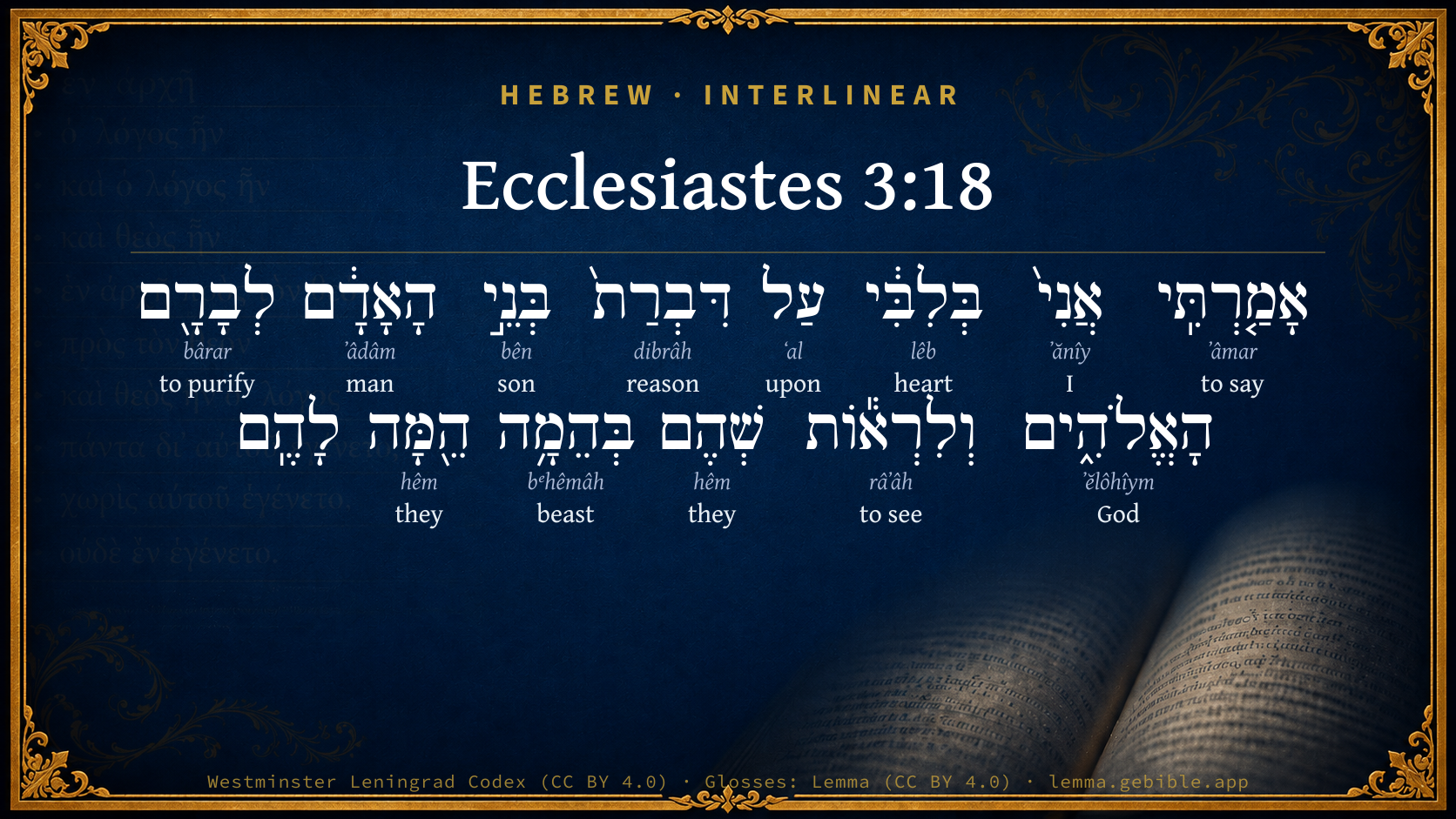
Hebrew (Westminster Leningrad Codex) Ecclesiastes 3:18 appears in the Hebrew Old Testament. The text above is from the Westminster Leningrad Codex. Each word links to its Strong’s number, a concise gloss, and parsing drawn from the Open Scriptures Hebrew Bible morphology. Click any word for its full Brown-Driver-Briggs (BDB) entry.
Download image
Cite this verse

Ecclesiastes 3:18 (World English Bible). Public Domain. Lemma interlinear Bible study tool, https://lemma.gebible.app/v/ecclesiastes/3/18.

Show BibTeX & RIS
BibTeX
RIS
English Translation
I said in my heart, "As for the sons of men, God tests them, so that they may see that they themselves are like animals.
World English Bible · Public Domain
Download a study sheet

One document with this verse’s original text, its word-by-word gloss line, the meaning frame, cross-references with their text, attributed commentary, and full source and license credits — printable, and it pastes into notes with its structure intact.

This verse Autodidact and up

Study sheet (.html) Plain text (.txt)

A passage Seminary Student

Up to 50 verses in one chapter. A passage sheet keeps up to 6 commentary sources and 12 cross-references per verse, in the order this page ranks them, and says so on the sheet whenever that leaves anything out. Ask for a single verse and you get the Autodidact verse sheet above.

Everything on this page stays free to read, with no account — the sheet is a download of what is already on screen, not access to it.

Want to remove ads? Support Godless Engineer
Compare translations 3

The same verse in 3 English versions, stacked beneath the original-language interlinear above. Click any original word for its lexicon entry.

Each is an independent rendering of the whole verse — the interlinear is not word-aligned to these translations.

Highlighted words mark where these versions differ — a whole-verse word diff, not a word-by-word alignment.

  • World English Bible Public Domain
    I said in my heart, "As for the sons of men, God tests them, so that they may see that they themselves are like animals.
  • King James Version Public Domain
    I said in mine heart concerning the estate of the sons of men, that God might manifest them, and that they might see that they themselves are beasts.
  • unfoldingWord Literal Text CC BY-SA 4.0
    I spoke, I with my heart, “For the sake of the sons of humanity, the God to test them to see that animal, they themselves.”

unfoldingWord Literal Text — © unfoldingWord, licensed CC BY-SA 4.0. Word-aligned USFM3 via Door43 (git.door43.org/unfoldingWord/en_ult).

Versions to compare (up to 4)

3 of 4 selected

Show all 18 translations

Every available English version of this verse, each an independent rendering of the whole verse.

  • World English Bible Public Domain
    I said in my heart, "As for the sons of men, God tests them, so that they may see that they themselves are like animals.
  • Berean Standard Bible Public Domain
    I said to myself, “As for the sons of men, God tests them so that they may see for themselves that they are but beasts.”
  • Majority Standard Bible Public Domain
    I said to myself, “As for the sons of men, God tests them so that they may see for themselves that they are but beasts.”
  • King James Version Public Domain
    I said in mine heart concerning the estate of the sons of men, that God might manifest them, and that they might see that they themselves are beasts.
  • American Standard Version (1901) Public Domain
    I said in my heart, `It is' because of the sons of men, that God may prove them, and that they may see that they themselves are `but as' beasts.
  • Revised Version (1885) Public Domain
    I said in mine heart, It is because of the sons of men, that God may prove them, and that they may see that they themselves are but as beasts.
  • Geneva Bible (1599) Public Domain
    I considered in mine heart the state of the children of men that God had purged them: yet to see to, they are in themselues as beastes.
  • Douay-Rheims (1899) Public Domain
    I said in my heart concerning the sons of men, that God would prove them, and shew them to be like beasts.
  • Young's Literal Translation Public Domain
    I said in my heart concerning the matter of the sons of man that God might cleanse them, so as to see that they themselves `are' beasts.
  • Literal Standard Version CC BY-SA 4.0
    I said in my heart concerning the matter of the sons of man that God might cleanse them, so as to see that they themselves [are] beasts.
  • Unlocked Literal Bible CC BY-SA 4.0
    I said in my heart, “God tests human beings to show them that they are like animals.”
  • unfoldingWord Literal Text CC BY-SA 4.0
    I spoke, I with my heart, “For the sake of the sons of humanity, the God to test them to see that animal, they themselves.”
  • Darby Bible Public Domain
    I said in my heart, It is thus with the children of men, that God may prove them, and that they should see that they themselves are but beasts.
  • World Messianic Bible Public Domain
    I said in my heart, “As for the sons of men, God tests them, so that they may see that they themselves are like animals.
  • Webster's Bible Public Domain
    I said in my heart concerning the state of the sons of men, that God might manifest them, and that they might see that they themselves are beasts.
  • Free Bible Version CC BY-SA 4.0
    I also thought to myself, “Regarding what happens to human beings—God proves to us that we're no better than animals.”
  • Bible in Basic English Public Domain
    I said in my heart, It is because of the sons of men, so that God may put them to the test and that they may see themselves as beasts.
  • JPS Tanakh (1917) Public Domain
    I said in my heart: 'It is because of the sons of men, that God may sift them, and that they may see that they themselves are but as beasts.'

Literal Standard Version (2020), Covenant Press — licensed CC BY-SA 4.0. Text via the HelloAO Bible API (eBible.org). Unlocked Literal Bible (unfoldingWord) — licensed CC BY-SA 4.0. Text via the HelloAO Bible API (eBible.org). unfoldingWord Literal Text — © unfoldingWord, licensed CC BY-SA 4.0. Word-aligned USFM3 via Door43 (git.door43.org/unfoldingWord/en_ult). Free Bible Version, Dr. Jonathan Gallagher — licensed CC BY-SA 4.0. Text via the HelloAO Bible API (eBible.org).

Word by word

More ways to search: Search by grammar → Find every occurrence → Compare this word →

Practice this passage: Drill this verse → Learn its vocabulary →

דִּבְרַת֙
dibrâh
H1700
“reason of”
Noun, Common, Feminine, Singular, Construct
Part of Speech
Noun
Type
Common
Gender
Feminine
Number
Singular
State
Construct
Full BDB Definition

Origin: fem. of H1697

TWOT: 399e

cause, manner, reason
  1. אָמַ֤רְתִּֽי ʼâmar H559 “to say” Verb, Qal, Perfect, 1st Person, Common, Singular
  2. אֲנִי֙ ʼănîy H589 “I” Pronoun, Personal, 1st Person, Common, Singular
  3. בְּלִבִּ֔י lêb H3820 “in/at · heart · my” Preposition + Noun, Common, Masculine, Singular, Construct + Suffix, Personal, 1st Person, Common, Singular
  4. עַל ʻal H5921 “upon” Preposition
  5. בְּנֵ֣י bên H1121 “sons of” Noun, Common, Masculine, Plural, Construct
  6. הָאָדָ֔ם ʼâdâm H120 “the · man” Particle, Definite Article + Noun, Common, Masculine, Singular, Absolute
  7. לְבָרָ֖ם bârar H1305 “to purify · them” Preposition + Verb, Qal, Infinitive Construct + Suffix, Personal, 3rd Person, Masculine, Plural
  8. הָאֱלֹהִ֑ים ʼĕlôhîym H430 “the · God(s)” Particle, Definite Article + Noun, Common, Masculine, Plural, Absolute
  9. וְלִרְא֕וֹת râʼâh H7200 “and · to see” Conjunction + Preposition + Verb, Qal, Infinitive Construct
  10. שְׁהֶם hêm H1992 “who/which · they” Particle, Relative + Pronoun, Personal, 3rd Person, Masculine, Plural
  11. בְּהֵמָ֥ה bᵉhêmâh H929 “beast” Noun, Common, Feminine, Singular, Absolute
  12. הֵ֖מָּה hêm H1992 “they” Pronoun, Personal, 3rd Person, Masculine, Plural

About this verse

These counts appear in no published source. They are computed here, from the morphology-tagged text and Lemma’s own curated glosses. What Lemma adds →

14
words
12
distinct lemmas
Wisdom
section

Notable vocabulary

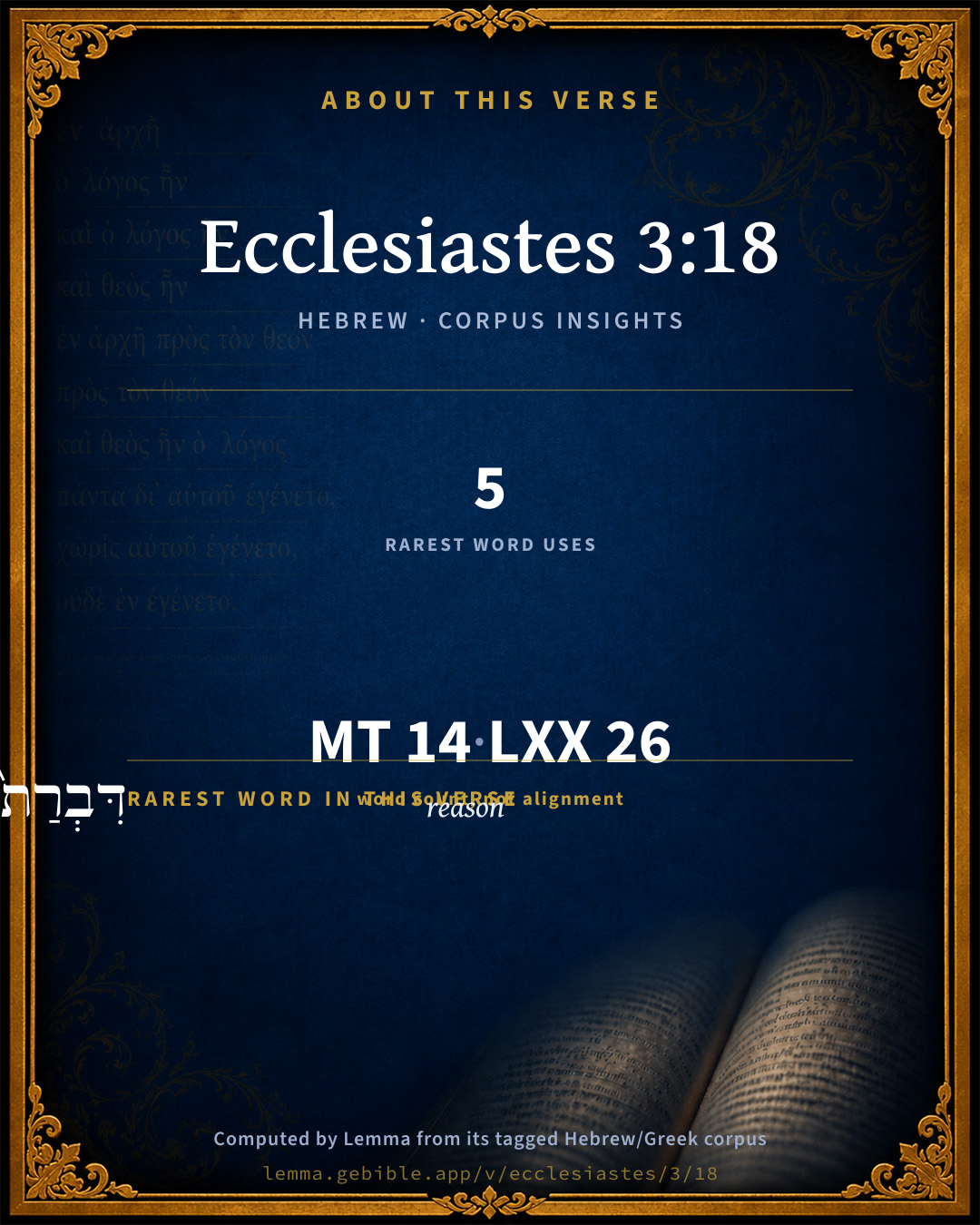
The rarest word here is דִּבְרַת֙ reason H1700 — appearing just 5 times in the whole Hebrew Bible.

Shared distinctive vocabulary

דִּבְרַת֙ reason H1700 occurs in 5 verses of the Hebrew Bible. Also found in:

Grammatical profile

  • 3 verbs
  • 6 nouns
  • 3 pronouns
  • 2 prepositions

Verb forms

  • אָמַ֤רְתִּֽי Qal · Perfect
  • לְבָרָ֖ם Qal · Infinitive Construct
  • וְלִרְא֕וֹת Qal · Infinitive Construct

Repetition

A word recurs within this verse — often emphatic in Hebrew:

  • שְׁהֶם they H1992 ×2

Hebrew & Septuagint length

In English translation the verse runs 25 words from the Hebrew and 25 from the Septuagint (LXX English) — the same length.

A rough comparison of the two English renderings, which tokenize alike — not a word-level alignment.

Word counts can differ between the Hebrew and the Greek without any difference in meaning — e.g. the Hebrew direct-object marker אֵת has no separate Greek word, and Greek often adds the article ὁ.

In the original languages it is 14 Hebrew tokens and 26 Greek tokens — but the two are counted differently (Hebrew bundles its prefixes and suffixes into one token; the Greek is in lemma form), so that isn’t a like-for-like length.

Cross-references

16

Topical passages linked to Ecclesiastes 3:18 in the Treasury of Scripture Knowledge — connected by theme and wording, ordered by reader-vote popularity; previews shown in the World English Bible.

  • Psalms 73:22 I was so senseless and ignorant. I was a brute beast before you.
  • Psalms 49:12 But man, despite his riches, doesn't endure. He is like the animals that perish.
  • Genesis 3:17–19 To Adam he said, "Because you have listened to your wife's voice, and have eaten of the tree, of which I commanded you, saying, 'You shall not eat of it,' cursed is the ground for your sake. In toil you will eat of it all the days of your life.
  • Hebrews 9:27 Inasmuch as it is appointed for men to die once, and after this, judgment,
  • 2 Peter 2:12 But these, as unreasoning creatures, born natural animals to be taken and destroyed, speaking evil in matters about which they are ignorant, will in their destroying surely be destroyed,
  • Romans 9:23 and that he might make known the riches of his glory on vessels of mercy, which he prepared beforehand for glory,
  • 1 Peter 1:24 For, "All flesh is like grass, And all of man's glory like the flower in the grass. The grass withers, and its flower falls;
  • Job 14:1–4 "Man, who is born of a woman, Is of few days, and full of trouble.
  • Job 15:16 How much less one who is abominable and corrupt, A man who drinks iniquity like water!
  • Job 40:8 Will you even annul my judgment? Will you condemn me, that you may be justified?
  • Psalms 49:14 They are appointed as a flock for Sheol. Death shall be their shepherd. The upright shall have dominion over them in the morning. Their beauty shall decay in Sheol, Far from their mansion.
  • Psalms 49:19–20 He shall go to the generation of his fathers. They shall never see the light.
  • Psalms 51:4 Against you, and you only, have I sinned, And done that which is evil in your sight; That you may be proved right when you speak, And justified when you judge.
  • Psalms 73:18–19 Surely you set them in slippery places. You throw them down to destruction.
  • Psalms 90:5–12 You sweep them away as they sleep. In the morning they sprout like new grass.
  • Romans 3:4 May it never be! Yes, let God be found true, but every man a liar. As it is written, "That you might be justified in your words, And might prevail when you come into judgment."

Cross-references courtesy of OpenBible.info (CC BY 4.0).

Hebrew and Greek witnesses Masoretic Hebrew ↔ Greek Septuagint

The same verse in the two great witnesses to the Old Testament, shown verse-for-verse.

These are two independent witnesses, not word-aligned to each other, and the Septuagint is shown in lemma (dictionary) form.

Hebrew Ecclesiastes 3:18 Masoretic · Westminster Leningrad Codex

אָמַ֤רְתִּֽי אֲנִי֙ בְּלִבִּ֔י עַל דִּבְרַת֙ בְּנֵ֣י הָאָדָ֔ם לְבָרָ֖ם הָאֱלֹהִ֑ים וְלִרְא֕וֹת שְׁהֶם בְּהֵמָ֥ה הֵ֖מָּה לָהֶֽם

I said in my heart, "As for the sons of men, God tests them, so that they may see that they themselves are like animals.

World English Bible · Public Domain

Greek LXX Ecclesiastes 3:18 Septuagint · lemma form

ἐκεῖ εἶπον ἐγώ ἐν καρδία ἐγώ περί λαλιά υἱός ὁ ἄνθρωπος ὅτι διακρίνω αὐτός ὁ θεός καί ὁ δεικνύω ὅτι αὐτός κτῆνος εἰμί καί γέ αὐτός

I said in my heart, concerning the speech of the sons of man, God will judge them, and that to show that they are beasts.

LXX2012 (modern English Septuagint) · Public Domain

On this verse, The Pulpit Commentary discusses the Septuagint’s reading. Read the note in Commentary ↓

Hebrew: Westminster Leningrad Codex (CC BY 4.0). Greek: Septuagint (public domain); English from LXX2012 (modern English Septuagint) (Public Domain). How the Septuagint differs from the Hebrew →

Commentary

Notes on Ecclesiastes 3:18 from classic Christian and Jewish commentators (each source and its license shown beneath its notes). The classic Christian expositions comment on the surrounding passage and are grouped to its opening verse, so a note may address several verses; the Jewish commentaries on the Tanakh (Rashi and others) are per-verse, so they appear only where the commentator wrote on this verse.

Lemma curates 59 commentaries, every one of them public domain or Creative Commons licensed, each selected and text-cleaned for this edition rather than reprinted as found. About our sources →

Trapp's Complete Commentary

John Trapp

Ecc 3:18 I said in mine heart concerning the estate of the sons of men, that God might manifest them, and that they might see that they themselves are beasts.

Ver. 18. That they might see that they themselves are beasts.] It is reckoned a great matter that wicked men are made "to know themselves to be but men," and no more. {Psa 9:20} But God will make good men see and say with David, "So foolish was I and ignorant; I was as a beast before thee." Pulchre addidit, "apud te," saith Ambrose upon those words. {a} Elegantly said the Psalmist, "Before thee," because, in respect of God, what is man but an unreasonable beast? He that is wisest among men, said Socrates, who himself was held the wisest of men, if he be compared to God, Simia videbitur, non sapiens, he will seem rather an ape than a wise man. {b} David calls himself not a "beast" only, but "beasts," in the plural, {c} behemoth, or at least a very great beast, not an ape, but an elephant. And this is that which God would have all good men see, hemmah lahem, as this text hath it, themselves to themselves, in their humble account of themselves, as holy Agur did. {Pro 30:2} {See Trapp on "Pro 30:2"}

{a} Ambr. in Ps. lxxxiii,

{b} Socrat. apud Platon.

{c} Eram apud te sicut bestiae. - Mercer.

John Trapp, A Commentary or Exposition upon All the Books of the Old and New Testament (1647–1656) — public domain. Text from a community e-Sword module.

Joseph Benson's Commentary

Ecc 3:18. I said in my heart, &c. — And I further considered concerning their condition in this present world. That God might manifest them — God suffers these disorders among men, that he might discover men to themselves, and show what strange creatures they are, and what vile hearts they have. That they are beasts — That although God made them men, yet they have made themselves beasts by their brutish practices, and that, considered only with respect to the present life, they are as vain and miserable creatures as the beasts themselves.

Joseph Benson's Commentary on the Old and New Testaments (1811–1818) — public domain. Text from a community e-Sword module.

Geneva Bible (1599)

Geneva Bible translators

And made them pure in their first creation.

Geneva Bible (1599) marginal notes — public domain. Text via Bolls.life.

Jamieson, Fausset & Brown

Robert Jamieson, A. R. Fausset & David Brown

estate--The estate of fallen man is so ordered (these wrongs are permitted), that God might "manifest," that is, thereby prove them, and that they might themselves see their mortal frailty, like that of the beasts.

sons of men--rather, "sons of Adam," a phrase used for "fallen men." The toleration of injustice until the judgment is designed to "manifest" men's characters in their fallen state, to see whether the oppressed will bear themselves aright amidst their wrongs, knowing that the time is short, and there is a coming judgment. The oppressed share in death, but the comparison to "beasts" applies especially to the ungodly oppressors (Psa 49:12, Psa 49:20). They too need to be "manifested" ("proved"), whether, considering that they must soon die as the "beasts," and fearing the judgment to come, they will repent (Dan 4:27).

Jamieson, Fausset & Brown — Commentary Critical and Explanatory on the Whole Bible (1871) — public domain (CC PDM 1.0). Text via the HelloAO Bible API.

Adam Clarke's Commentary

Verse 18. That they might see that they themselves are beasts.] The author of Choheleth has given a correct view of this difficult verse, by a proper translation: "I said in my heart, reflecting on the state of the sons of men, O that God would enlighten them, and make them see that even they themselves are like beasts." These words are to be referred to those in authority who abused their power; particularly to the corrupt magistrates mentioned above.

Adam Clarke's Commentary on the Bible (1810–1826) — public domain. Text from a community e-Sword/MySword module.

The Cambridge Bible for Schools and Colleges

gen. ed. J. J. S. Perowne

18. I said in mine heart] The word “estate” expresses fairly the meaning of the Hebrew noun, which may be rendered “word,” “matter,” or “subject.” In the next clause for “that God might manifest them,” we may better read, that God might separate, sift, or try them, i.e. in modern phrase, He leaves the disorders of the world unredressed, as part of man’s probation. This comes into the heart of the seeker as a partial explanation of the disorders noted in Ecc_3:16.

that they might see that they themselves are beasts] The pronoun in the original has, as in the English version, the strong emphasis of iteration, that they are beasts, they by themselves. The thought implied is that without a higher faith of some kind—whether in the Divine Righteousness or in Immortality, is not yet defined—Man stands, as having only an animal life, on the same level as other animals. In the words of an old English poet:

“Unless above himself he can

Erect himself, how poor a thing is man!”

The Cambridge Bible for Schools and Colleges (gen. ed. J. J. S. Perowne; Cambridge University Press, 1878–1918) — public domain. Text from a community e-Sword module.

John Gill's Exposition

I said in mine heart concerning the estate of the sons of men,.... He thought of the condition of the children of men, their sinful and polluted state; he weighed and considered in his mind their actions, conversation, and course of life; and was concerned how it would go with them at the day of judgment on account of the same. Some render it, "I said in mine heart after the speech of the children of men" (r); speaking in their language, and representing the atheist and the epicure, as some think the wise man does in the following verses; though he rather speaks his own real sentiments concerning men, as they are in their present state, and as they will appear in the day of judgment;

that God might manifest them; or "separate them" (s); as the chaff from the wheat, and as goats from the sheep; as will be done at the day of judgment, Mat 3:10; or "that they might clear God" (t); as they will, when he shall judge and condemn them;

and that they might see that they themselves are beasts; as they are through the fall, and the corruption of nature, being born like the wild ass's colt, stupid, senseless, and without understanding of spiritual things; nay, more brutish than the beasts themselves, than the horse and the mule that have no understanding, Psa 32:9; "mulo inscitior", as is Plautus's (u) phrase; see Psa 49:12, Isa 1:3; this is now made manifest to the people of God by the word and Spirit; is seen, known, and acknowledged by them, Psa 73:21; and the wicked themselves will see, know, and own what beasts they are and have been, at the day of judgment; how they have lived and died like beasts; how like brute beasts they have corrupted themselves in things they knew naturally; and that as natural brute beasts, made to be taken and destroyed, spoke evil of things they understood not, and perished in their own corruption, Jde 1:10, Pe2 2:12; and that they have been beasts to themselves, as Jarchi renders and interprets it; made beasts of themselves by their brutish gratifications; have been cruel to themselves, ruining and destroying their own souls; or among themselves, and to one another, "homo lupus homini"; hence wicked men are compared to lions, foxes, evening wolves, vipers, and the like. So Mr. Broughton renders it, "how they are beasts, they to themselves."

(r) "super verbum filiorum Adam", Montanus; "verbis hominum", Arabic and Syriac versions. (s) "ut discernat illos", Cocceius; "quia delegit eos", some in Vatablus; so Aben Ezra and Ben Melech. (t) "Ut ipsi expurgent Deum", Anglic. in Reinbeck; some in Rambachius render it thus, "ut seligant ipsi (homines) Deum"; so Varenius. (u) Cisteilaria, Act. 4.

John Gill's Exposition of the Whole Bible (1746–1763) — public domain (CC PDM 1.0). Text via the HelloAO Bible API.

Haydock's Catholic Bible Commentary

Beasts. Another doubt; or suggestion of infidels. (St. Gregory, Dial. iv. 4.)

George Leo Haydock (1774–1849), Haydock's Catholic Family Bible and Commentary, 1859 edition — public domain. Excludes Psalms (Douay-Rheims chapter numbering differs from Protestant) and Deuterocanonical books (Catholic canon only).

Matthew Poole's English Annotations

I said in my heart; and further I considered with myself.

Concerning the estate of the sons of men; concerning their condition and deportment in this present world.

That God might manifest them; God suffers these horrible disorders among men, expressed Ecc 3:16, that he might discover men to themselves, and by permitting these actions show what strange creatures they are, and what vile hearts they have, which men would not otherwise understand or believe. See 2Ki 8:13,14.

That they themselves are beasts, Heb. that they are beasts to themselves; either,

1. One to another, devouring and destroying one another. Or,

2. In their own judgment, or themselves being judges; that although God made them men or reasonable creatures, yet they have made themselves beasts by their brutish practices; and that men, considered only with respect unto the present life, which is the only thing valued and regarded by most men, and the vanity whereof is the principal subject of this book, are as vain and miserable creatures as the beasts themselves, the great differences between men and beasts being such as respect the other life. For men seem here to be called beasts in both these respects, and the latter he prosecutes more largely in the following verses.

Matthew Poole's English Annotations on the Holy Bible (1683–1685) — public domain. Text from a community e-Sword/MySword module.

Whedon's Commentary on the Bible

Daniel D. Whedon

18. The fact that this verse begins like the preceding indicates that it introduces an additional and independent thought. Yet or also might be inserted to make it plainer.

That God might manifest — Better, That God has made them conspicuous, even that they might see that they are like beasts. As if a beast were unconscious that he is a beast, but man, by his superior intellect, is made to see and feel this concerning himself.

Daniel D. Whedon (gen. ed.), Commentary on the Old and New Testaments (1874–1909) — public domain. Text from a community e-Sword module.

The Pulpit Commentary

The comfort derived from the thought of the future judgment is clouded by the reflection that man is as powerless as the beast to control his destiny. Concerning the estate of the sons of men; rather, it happens on account of the sons of men. God allows events to take place, disorders to continue, etc., for the ultimate profit of men, though the idea that follows is humiliating and dispiriting. The LXX has peri laliav, concerning the speech of the sons of men." So the Syriac. The word dibrah may indeed bear that meaning, as it is also used for word" or matter;" but we cannot conceive that the clause refers solely to words, and the expression in the text signifies merely for the sake, on account of," as in Ecc_8:2. That God might manifest them; rather, that God might test them; Ut probaret eos Dens (Vulgate) God allows these things, endures them patiently, and does not at once redress them, for two reasons. The first of these is that they may serve for the probation of men, giving them opportunity of making good or bad use of them. We see the effect of this forbearance on the wicked in Ecc_8:11; it hardens them in impenitence; while it nourishes the faith of the righteous, and helps them to persevere. (see Dan_11:35 and Rev_22:11) And that they might see that they themselves are beasts. The pronoun is repeated emphatically, "that they themselves are like beasts, they in themselves." This is the second reason. Thus they learn their own powerlessness, if they regard merely their own animal life; apart from their relation to God and hope of the future, they are no better than the lower creatures. Septuagint. "And to show (tou deixai) that they are beasts." So the Vulgate and Syriac. The Masoretic reading adopted in the Anglican Version seems best.

Vers. 18-21.

The common destiny of death.

The double nature of man has been recognized by every student of human nature. The sensationalist and materialist lays stress upon the physical side of our humanity, and endeavors to show that the intellect and the moral sentiments are the outgrowth of the bodily life, the nervous structure and its susceptibilities and its powers of movement. But such efforts fail to convince alike the unsophisticated and the philosophic. It is generally admitted that it would be more reasonable to resolve the physical into the psychical than the psychical into the physical. The author of Ecclesiastes was alive to the animal side of man"s nature; and if some only of his expressions were considered, he might be claimed as a supporter of the baser philosophy. But he himself supplies the counteractive. The attentive reader of the book is convinced that the author traced the human spirit to its Divine original, and looked forward to its immortality.

I THE COMMUNITY OF MEN WITH BEASTS IN THE ANIMAL NATURE AND LIFE. If we look upon one side of our humanity, it appears that we are to be reckoned among the brutes that perish. The similarity is obvious in:

1. The corporeal, fleshly constitution with which man and brute are alike endowed.

2. The brevity of the earthly life appointed for both without distinction.

3. The resolution of the body into dust.

II THE SUPERIORITY OF MEN OVER BEASTS IN THE POSSESSION OF A SPIRITUAL AND IMPERISHABLE NATURE AND LIFE. It is difficult for us to treat this subject without; bringing to bear upon it the knowledge which we have derived from the fuller and more glorious revelation of the new covenant. "Christ has abolished death, and has brought life and immortality to light by the gospel." We cannot possibly think of such themes without taking to their consideration the convictions and the hopes which we have derived from the incarnate Son of God. Nor can we forget the sublime speculations of philosophers of both ancient and modern times.

1. In his spiritual nature man is akin to God. Physical life the Creator imparted to the animal Organisms with which the world was peopled. But a life of quite another order was conferred upon man, who participates in the ...Divine reason, who is able? think the thoughts of God himself, and who has intuitions of moral goodness of which the brute creation is for ever incapable. Instead of man"s mind being a function of organized matter, as a base sensationalism and empiricism is wont to affirm, the truth is that it is only as an expression and vehicle of thought, of reason, that matter has a dependent existence.

2. In his consequent immortality man is distinguished from the inferior animals. The life possessed by these latter is a life of sensation and of movement; the organism is resolved into its constituents, and there is no reason to believe that the sensation and movement are perpetuated. But "the spirit of man goeth upward;" it has used its instrument, the body, and the time comes appointed by God"s inscrutable providence when the connection, local and temporary, which the spirit has maintained with earth, is sundered. In what other scenes and pursuits the conscious being is continued, we cannot tell. But there is not the slightest reason for conceiving the spiritual life to be dependent upon the organism which it uses as its instrument. The spiritual life is the life of God; and the life of God is perishable.

The sun is but a spark of fire, A transient meteor in the sky; The soul, immortal as its Sire, Can never die. T.

Vers. 18-21.

Before and after Christ.

These words have a strange sound in our ears; they evidently do not belong to New Testament times. They bring before us

I MAN"S UNENLIGHTENED CONCEPTION OF HIMSELF. It is evidently possible that, under certain conditions, men may judge themselves to be of no nobler nature than that of "the beasts that perish." It may be

(1) bodily suffering or weakness; or

(2) untoward and disappointing circumstances; or

(3) bewilderment of mind after vain endeavors to solve great spiritual problems; or

(4) the distracted and unnatural state of the society in which we are placed (see Cox"s "Quest of the Chief Good"); but, owing to some one of many possible causes, men may be driven to take the lowest view of human nature; so much so that they may lose all respect for themselves may shut the future life entirely out of view, and live in the narrow circle of the present; may confine their ambition and aspiration to bodily enjoyment and the excitements of present occupation; may practically own themselves to be defeated, and go blindly on, "hoping nothing, believing nothing, and fearing nothing.

Such a melancholy conclusion

(1) does us sad dishonor;

(2) has a demoralizing influence on character and life;

(3) yields a wretched harvest of despair and self-destruction. In most happy contrast with this is

II THE VIEW OF OUR NATURE WHICH CHRIST HAS GIVEN US. He asks us to think how "much a man is better than a sheep," and reminds us that we are "of more value than many sparrows." He bids us realize that one human soul is worth more than "the whole world," and that there is nothing so costly that it will represent its value. He reveals to us the supreme and most blessed fact that each human spirit is the object of Divine solicitude, and may find a home in the Father"s heart of love at once, and in his nearer presence soon. He assures us that there is a glorious future before every man that becomes the subject of his kingdom, and serves faithfully to the end. Under his teaching, instead of seeing that "they themselves are beasts," his disciples find themselves "children of their Father who is in heaven," "kings and priests unto God," "heirs of eternal life." Coming after Christ, and learning of him, we see that we are capable of a noble heritage now, and move toward a still nobler estate a little further on. C.

Vers. 18-22.

The darkness of the grave.

In these words our author reaches the very lowest depth of misery and despair. His observation of the facts of human life leads him to the humiliating conclusion that it is almost hopeless to assign to man a higher nature and a more noble destiny than those which belong to the beasts that perish. The moral inequalities of the world, the injustice that goes unpunished, the hopes by which men are deluded, the uncertainty of life, the doubtfulness of immortality, seem to justify the assertion "that a man hath no pre-eminence over a beast." The special point of comparison on which he dwells is the common mortality of both. Man and beast are possessed of bodies composed of the same elements, nourished by the same food, liable to the same accidents, and destined to return to the kindred dust from which they sprang. Both are ignorant of the period of life assigned to them; a moment before the stroke of death falls on them they may be unconscious that evil is at hand, and when they realize the fact they are equally powerless to avert it. What there is in common between them is manifest to all, while the evidence to be. adduced in favor of the superiority of man is, from its very nature, less convincing. The spiritually minded will attach great weight to arguments against which the natural reason may draw up plausible objections. Let us, then, see the case stated at its very worst, and consider if there are any redeeming circumstances which are calculated to relieve the gloom which a cursory reading of the words calls up.

I The first statement is that MEN, LIKE BEASTS, ARE CREATURES OF ACCIDENT. (Ver. 19a.) Not that they are both the results of blind chance; but that, "being conditioned by circumstances over which there can be no control, they are subject, in respect to their whole being, actions, and sufferings, as far as mere human observation can extend, to the law of chance, and are alike destined to undergo the same fate, i.e. death" (Wright). A parallel to the thought of this verse is to be found in the very striking words of Solon to Croesus (Herodotus, 1:32), "Man is altogether a chance;" and in Psa_49:14, Psa_49:20, "Like sheep they are laid in the grave Man that is in honor, and understandeth not, is like the beasts that perish.

II The second statement is that As IS THE DEATH OF THE ONE, SO IS THE DEATH OF THE OTHER (ver. 19b), for in both is the breath of life, and this departs from them in like manner. So that any superiority on the part of man over the beast is incredible in the face of this fact, that death annuls distinctions between them. One resting-place receives them all at last the earth from which they sprang (ver. 20). A belief in the immortality of the soul of man would at once have relieved the gloom, and convinced the Preacher that the humiliating comparison he institutes only reaches to a certain point, and is based upon the external accidents of human life, and that the true dignity and value of human nature remain unaffected by the mortality of the corporeal part of our being. "Put aside the belief in the prolongation of existence after death, that what has been begun here may be completed, and what has gone wrong here may be set right, and man is but a more highly organized animal, the "cunningest of nature"s clocks," and the high words which men speak as to his greatness are found hollow. They too are "vanity." He differs from the brutes around him only, or chiefly, in having, what they have not, the burden of unsatisfied desires, the longing after an eternity which after all is denied him" (Plumptre).

III The third statement is the saddest of all that of THE UNCERTAINTY OF KNOWLEDGE AS TO WHETHER, AFTER ALL, THERE IS THIS HIGHER ELEMENT IN HUMAN NATURE spirit that at death goeth upward or whether the living principles of both man and beast perish when their bodies are laid in the dust (ver. 21).

It is quite fruitless to deny that it is a skeptical question that is asked If the spirit of the beast goeth downward to the earth, who knows that that of man goeth upward? Attempts have been made to obliterate the skepticism of the passage, as may be seen in the Massoretic punctuation followed in the Authorized Version of our English Bible, but departed from in the Revised Version, "Who knoweth the spirit of mall that. goeth upward," etc.? as though an ascent of the spirit to a higher life were affirmed. The rendering of the four principal versions, and of all the best critics, convinces us that it is indeed a skeptical question as to the immortality of the soul that is here asked. A very similar passage is found in the great poem of Lucretius (1. 113-116)

We know not what the nature of the soul, Or born or entering into men at birth, Or whether with our frame it perisheth, Or treads the gloom and regions vast of death.

It is to be noted, however, about both the question of the Preacher and the words of the heathen poet, that they do not contain a denial of immortality, but a longing after more knowledge resting on sufficient grounds. Sad and depressing as uncertainty on such a point is to a sensitive mind, a denial of immortality would he infinitely worse; it would mean the death of all hope. The very suggestion of a higher life for man, after "this mortal coil has been shuffled off," than for the beast implies that, far from denying the immortality of the soul, the writer seeks fur adequate ground on which to hold it. Arguments in favor of the doctrine of immortality were not wanting to the Preacher. He has just spoken of the desiderium aeternitatis implanted in the heart of man (ver. 11), which, like the instincts of the lower creation, is given by the Creator for our guidance, and not to tantalize and deceive us. The inequalities anti evils of the present life render a final judgment in a world beyond the grave a moral necessity. (Ecc_12:14) But still these are, after all, but indirect arguments, which have not the weight of positive demonstration. It is only faith that can return any certain reply to his doubting question; its weight, thrown into the balance, inclines it to the hopeful side. And this happy conclusion lie reached at last, as he distinctly affirms in Ecc_12:7, "Then shall the dust return to the earth as it was: and- the spirit shall return unto God. who gave it." That the Preacher should ever have doubted this great truth, and spoken as though no certainty concerning it were within the reach of man, need not surprise us. In the revelation given to the Jewish people, the doctrine of rewards and punishments in a future state was not set forth. The rewards and punishments for obedience to the Law, and for transgressions against it, were all temporal. Almost nothing was communicated touching the existence of the soul after death. In the passage quoted by Christ in the Gospels, for the confutation of the Sadducees, who denied the resurrection, the doctrine of immortality is implied rather than stated. (Mat_22:23-32) And in a matter so far beyond the power of the human intellect to search out, the absence of a word of revelation rendered the darkness doubly obscure. It is, however, utterly monstrous for any of us now who believe in Christ to ask the question, "Who knoweth the spirit of man, whether it goeth upward?" The revelation given us by him is full of light on this point. "He hath brought life and immortality to light through the gospel". (2Ti_1:10) His own resurrection from the dead, and ascension to heaven is the proof of a life beyond the grave, and a pledge to all who believe in him of a future and an everlasting life. It was not wonderful that the Preacher, in the then stage of religious knowledge, should have spoken as he does here; but nothing could justify us, to whom so much fresh light has been given, in using his words, as though we were in the same condition with him.

IV The fourth and concluding statement is, strangely enough, that since we know not what will come after death, A CHEERFUL ENJOYMENT OF THE PRESENT is the best course one can take. This is the third time he has given this counsel. (Ecc_2:24 Ecc_3:12, Ecc_3:13) A calm and happy life, healthy labor, and tranquil enjoyment, are to be valued and token advantage of to the full. It is an Epicureanism of a spiritual cast that he commends, and not the coarse and degraded animalism of those who say, "Let us eat and drink; for to-morrow we die." He recognizes the good gifts of the present as a "portion" given by God, and says Rejoice in them, though the future be all unknown. The very gloom out of which his words spring give a dignity to them. "We feel that we are in the presence of one who has the germ given him of some courage, equanimity, and calmness, which may grow into other and better things. His spirit is torn by, suffers with, all the pangs that beset the inquiring human heart. He feels for all the woes of humanity; cannot put them by, and fly to the wine-cup and crown himself with garlands. He has hated life, yet he will not lose his courage. "Be of good cheer," he says, even in his dark hour; "work on, and enjoy the fruits of work; it is thy portion. Do not curse God and die (Bradley). His words are not, as they might seem. at first, frivolous and heartless. It is a calm and peaceful happiness, a life of honest endeavor and of single-hearted enjoyment of innocent pleasures, that he commends; and, after all, it is only by genuine faith in God that such a life is possible a faith that enables one to rise above all that is dark and mysterious and perplexing in the world about us. J.W.

The Pulpit Commentary (1880–1919), ed. H.D.M. Spence-Jones & Joseph S. Exell — public domain. Text from a community e-Sword module.

John Wesley's Explanatory Notes

I said - And further I considered concerning their condition in this present world. That God - God suffers these disorders among men, that he might discover men to themselves, and shew what strange creatures they are, and what vile hearts they have. Beasts - That altho' God made them men, yet they have made themselves beasts by their brutish practices, and that, considered only with respect to the present life, they are as vain and miserable creatures as the beasts themselves.

John Wesley, Explanatory Notes Upon the Whole Bible (1754–1765) — public domain. Text via the GEBible commentary corpus.

Keil & Delitzsch

C. F. Keil & F. Delitzsch

"Thus I said then in mine heart: (it happeneth) for the sake of the children of men that God might sift them, and that they might see that they are like the cattle, they in themselves." Regarding על־דּב for the sake of = on account of as at Ecc 8:2, vid., under Psa 110:4, where it signifies after (κατά) the state of the matter. The infin. לבּ is not derived from בּוּר. - לּבוּר, Ecc 9:1, is only the metaplastic form of לבר or לברר - but only from בּרר, whose infin. may take the form בּר, after the form רד, to tread down, Isa 45:1, שׁך, to bow, Jer 5:26; but nowhere else is this infin. form found connected with a suff.; קחם, Hos 11:3, would be in some measure to be compared, if it could be supposed that this = בּקחתּם, sumendo eos. The root בר proceeds, from the primary idea of cutting, on the one side to the idea of separating, winnowing, choosing out; and, on the other, to that of smoothing, polishing, purifying (vid., under Isa 49:2). Here, by the connection, the meaning of winnowing, i.e., of separating the good from the bad, is intended, with which, however, as in לברר, Dan 11:35, the meaning of making clear, making light, bringing forward into the light, easily connects itself (cf. Shabbath 138a, 74a), of which the meaning to winnow (cf. להבר, Jer 4:11) is only a particular form;

(Note: Not "to sift," for not בּרר but רקּד, means "to sift" (properly, "to make to keep up," "to agitate"); cf. Shebith v. 9.)

cf. Sanhedrin 7b: "when a matter is clear, brwr, to thee (free from ambiguity) as the morning, speak it out; and if not, do not speak it."

In the expression לב האל, the word האל is, without doubt, the subject, according to Gesen. 133. 2. 3; Hitz. regards האל as genit., which, judged according to the Arab., is correct; it is true that for li-imti-ḥânihim allahi (with genit. of the subj.), also allahu (with nominat. of the subj.) may be used; but the former expression is the more regular and more common (vid., Ewald's Gramm. Arab. 649), but not always equally decisive with reference to the Heb. usus loq. That God delays His righteous interference till the time appointed beforehand, is for the sake of the children of men, with the intention, viz., that God may sift them, i.e., that, without breaking in upon the free development of their characters before the time, He may permit the distinction between the good and the bad to become manifest. Men, who are the obj. to לב, are the subject to לראותו to be supplied: et ut videant; it is unnecessary, with the lxx, Syr., and Jerome, to read ולראות (= וּלהר): ut ostenderet. It is a question whether המּה

(Note: המּה שׁהם בּהמה thus accented rightly in F. Cf. Michlol 216a.)

is the expression of the copula: sunt (sint), or whether hēmmah lahěm is a closer definition, co-ordinate with shehem behēmah. The remark of Hitzig, that lahěm throws back the action on the subject, is not clear. Does he suppose that lahem belongs to liroth? That is here impossible. If we look away from lahem, the needlessly circumstantial expression הם ... שה can still be easily understood: hemmah takes up, as an echo, behemah, and completes the comparison (compare the battology in Hos 13:2). This play upon words musically accompanying the thought remains also, when, according to the accentuation שׁה בהם ה לה, we take hemmah along with lahem, and the former as well as the latter of these two words is then better understood. The ל in להם is not that of the pure dat. (Aben Ezra: They are like beasts to themselves, i.e., in their own estimation), but that of reference, as at Gen 17:20, "as for Ishmael;" cf. Psa 3:3; Kg2 5:7; cf. אל, Sa1 1:27, etc. Men shall see that they are cattle (beasts), they in reference to themselves, i.e., either they in reference to themselves mutually (Luther: among themselves), or: they in reference to themselves. To interpret the reference as that of mutual relation, would, in looking back to Ecc 3:16, commend itself, for the condemnation and oppression of the innocent under the appearance of justice is an act of human brutishness. But the reason assigned in Ecc 3:19 does not accord with this reciprocal rendering of lahem. Thus lahem will be meant reflexively, but it is not on that account pleonastic (Knobel), nor does it ironically form a climax: ipsissimi = hchstselbst (Ewald, 315a); but "they in reference to themselves" is = they in and of themselves, i.e., viewed as men (viewed naturally). If one disregards the idea of God's interfering at a future time with the discordant human history, and, in general, if one loses sight of God, the distinction between the life of man and of beast disappears.

Keil & Delitzsch — Biblical Commentary on the Old Testament (1861–1891) — public domain (CC PDM 1.0). Text via the HelloAO Bible API. (Old Testament only.)

unfoldingWord translationNotes

Door43 World Missions Community

I said in my heart

Here the author refers to himself by his "heart" to emphasize his feelings. AT: "I said to myself" (See: Synecdoche)

they are like animals

Here the author says that human beings are like animals. In the next verse the author explains clearly how humans are like animals. (See: Simile)

translationWords

test

unfoldingWord translationNotes — © Distant Shores Media and the Door43 World Missions Community, licensed CC BY-SA 4.0. Source: git.door43.org/Door43/en_tn.

Rashi

Rabbi Shlomo Yitzchaki (Rashi)

I said to myself when I saw all this.

[that this is] because of the children of men who adopted the trait of haughtiness, to exert rulership and superiority over those smaller than they.

[so that God] should clarify for them The Holy One, blessed be He [judges them], to let them know that their rulership is naught, and to show them and also the princes and the kings.

that they are like beasts to themselves like other cattle and beasts they are to themselves.

Rashi on the Tanakh — English translations: “The Judaica Press complete Tanach with Rashi, translated by A. J. Rosenberg” (CC BY 4.0); “Pentateuch with Rashi's commentary by M. Rosenbaum and A.M. Silbermann, 1929-1934” (public domain); “The Metsudah Tanach series, Lakewood, N.J” (CC BY 4.0); and “The Book of Joshua, Metsudah Publications, 1997” (CC BY 4.0). Text via Sefaria.

Lesson kit

Teaching starters — assembled from the data on this page, not authored interpretation. Every prompt links to the verse data it draws on. Edit before teaching.

Ecclesiastes, in the Wisdom, opens this verse with 14 words (12 distinct Hebrew lemmas). Its most distinctive word is dibrâh (“reason”). A historical commentator’s framing appears above. Read the whole chapter for the surrounding context.

Discussion questions

  1. What does “reason” (dibrâh) contribute to the verse as a whole?
  2. Job 5:8 shares the word «reason» with this verse. How do the two illuminate each other?
  3. “they” occurs 2× in this one verse. What is the effect of the repetition?
  4. These translations render this verse differently. What is at stake in choosing one wording over another?
  5. The verb «אָמַ֤רְתִּֽי» is Qal Perfect. How does its form color the action?
  6. Reading how Trapp's Complete Commentary and Joseph Benson's Commentary read this verse, where do the two commentators agree and where do they part?

Things to notice

Reading settings

Reading text

Shown beneath each verse's original-language words.

Old Testament
Old Testament edition

Read the OT as the Masoretic Hebrew (MT) or the Greek Septuagint (LXX).

English shown for the Greek Septuagint (in the Hebrew ↔ Greek comparison).

Comparing translations? Open the Compare panel on any verse page to stack up to four side by side.