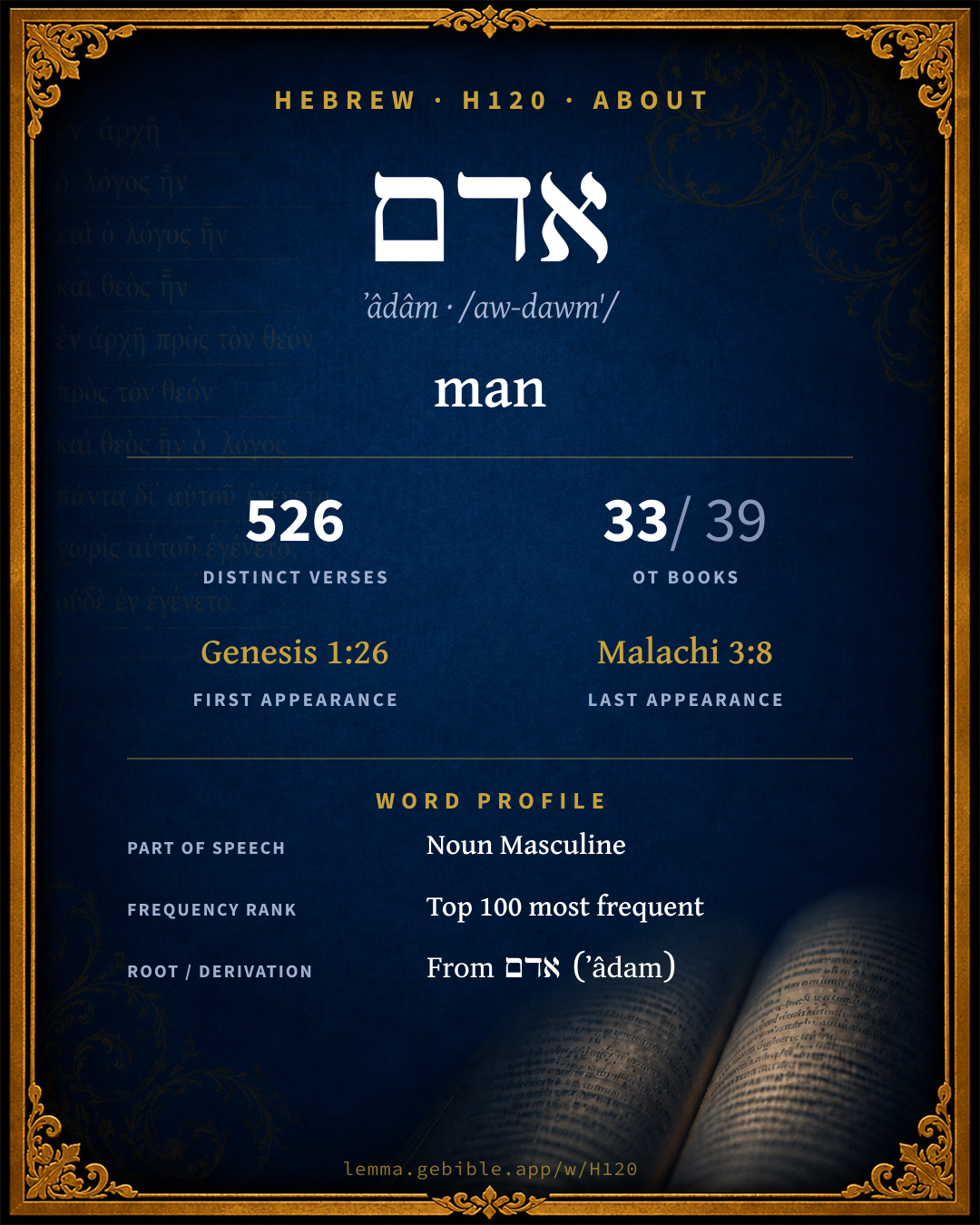
אָדָם
man
‘man’ is one of 5 main senses fuller range ↓
Full lexicon entry — Brown-Driver-Briggs (BDB)
From Brown-Driver-Briggs (BDB)
Where this word appears
See every Absolute-state word in the Hebrew Bible →
Grammar key — what these labels mean
Part of speech
- Noun
- A naming word — a person, place, thing, or idea.
Noun type
- Common
- A common noun — a general class of person, place, or thing (“king,” “city,” “water”), not a specific name.
State
- Absolute
- The independent form of a noun, not bound to a following word.
- Construct
- A noun bound to a following noun in a possessive / “of” relationship (the construct chain).
Gender
- Masculine
- Grammatically masculine.
Number
- Singular
- One.
Every verse where H120 appears in the Book of Proverbs — 43 distinct verses. Click any verse to open its interlinear word-by-word view. Verse text shown in the World English Bible for context — . Each verse’s Hebrew form is shown with its reference; the English is not keyword-highlighted, since the data carries no word-level English alignment. Use “Compare translations” on any verse to read it across multiple English versions. This concordance covers the Hebrew Bible; Septuagint (Greek Old Testament) occurrences are not indexed here.
Proverbs
- Proverbs 3:4 וְ/אָדָֽם conj + n c ms So you will find favor, And good understanding in the sight of God and man.
- Proverbs 3:13 אָ֭דָם וְ֝/אָדָ֗ם n c ms conj + n c ms Happy is the man who finds wisdom, The man who gets understanding.
- Proverbs 3:30 אָדָ֣ם n c ms Don't strive with a man without cause, If he has done you no harm.
- Proverbs 6:12 אָדָ֣ם n c ms cs A worthless person, a man of iniquity, Is he who walks with a perverse mouth;
- Proverbs 8:4 אָדָֽם n c ms "To you men, I call! I send my voice to the sons of mankind.
- Proverbs 8:31 אָדָֽם n c ms Rejoicing in his whole world. My delight was with the sons of men.
- Proverbs 8:34 אָדָם֮ n c ms Blessed is the man who hears me, Watching daily at my gates, Waiting at my door posts.
- Proverbs 11:7 אָדָ֣ם n c ms When a wicked man dies, hope perishes, And expectation of power comes to nothing.
- Proverbs 12:3 אָדָ֣ם n c ms A man shall not be established by wickedness, But the root of the righteous shall not be moved.
- Proverbs 12:14 אָ֝דָ֗ם n c ms A man shall be satisfied with good by the fruit of his mouth. The work of a man's hands shall be rewarded to him.
- Proverbs 12:23 אָדָ֣ם n c ms A prudent man keeps his knowledge, But the hearts of fools proclaim foolishness.
- Proverbs 12:27 אָדָ֖ם n c ms The slothful man doesn't roast his game, But the possessions of diligent men are prized.
- Proverbs 15:11 אָדָֽם n c ms Sheol and Abaddon are before Yahweh-- How much more then the hearts of the children of men!
- Proverbs 15:20 אָ֝דָ֗ם n c ms A wise son makes a father glad, But a foolish man despises his mother.
- Proverbs 16:1 לְ/אָדָ֥ם prep + n c ms The plans of the heart belong to man, But the answer of the tongue is from Yahweh.
- Proverbs 16:9 אָ֭דָם n c ms A man's heart plans his course, But Yahweh directs his steps.
- Proverbs 17:18 אָדָ֣ם n c ms A man void of understanding strikes hands, And becomes collateral in the presence of his neighbor.
- Proverbs 18:16 אָ֭דָם n c ms A man's gift makes room for him, And brings him before great men.
- Proverbs 19:3 אָ֭דָם n c ms The foolishness of man subverts his way; His heart rages against Yahweh.
- Proverbs 19:11 אָ֭דָם n c ms The discretion of a man makes him slow to anger. It is his glory to overlook an offense.
- Proverbs 19:22 אָדָ֣ם n c ms That which makes a man to be desired is his kindness. A poor man is better than a liar.
- Proverbs 20:6 אָדָ֗ם n c ms Many men claim to be men of unfailing love, But who can find a faithful man?
- Proverbs 20:24 וְ֝/אָדָ֗ם conj + n c ms A man's steps are from Yahweh; How then can man understand his way?
- Proverbs 20:25 אָ֭דָם n c ms It is a snare to a man to make a rash dedication, Then later to consider his vows.
- Proverbs 20:27 אָדָ֑ם n c ms The spirit of man is Yahweh's lamp, Searching all his innermost parts.
- Proverbs 21:16 אָדָ֗ם n c ms The man who wanders out of the way of understanding Shall rest in the assembly of the dead.
- Proverbs 21:20 אָדָ֣ם n c ms There is precious treasure and oil in the dwelling of the wise; But a foolish man swallows it up.
- Proverbs 23:28 בְּ/אָדָ֥ם prep + n c ms Yes, she lies in wait like a robber, And increases the unfaithful among men.
- Proverbs 24:9 לְ/אָדָ֣ם prep + n c ms The schemes of folly are sin. The mocker is detested by men.
- Proverbs 24:12 לְ/אָדָ֣ם prep + n c ms If you say, "Behold, we didn't know this;" Doesn't he who weighs the hearts consider it? He who keeps your soul, doesn't he know it? Shall he not render to every man according to his work?
- Proverbs 24:30 אָדָ֥ם n c ms I went by the field of the sluggard, By the vineyard of the man void of understanding;
- Proverbs 27:19 הָ֝/אָדָ֗ם לָ/אָדָֽם ptcl def.art + n c ms prep det + n c ms As water reflects a face, So a man's heart reflects the man.
- Proverbs 27:20 הָ֝/אָדָ֗ם ptcl def.art + n c ms Sheol and Abaddon are never satisfied; And a man's eyes are never satisfied.
- Proverbs 28:2 וּ/בְ/אָדָ֥ם conj + prep + n c ms In rebellion, a land has many rulers, But order is maintained by a man of understanding and knowledge.
- Proverbs 28:12 אָדָֽם n c ms When the righteous triumph, there is great glory; But when the wicked rise, men hide themselves.
- Proverbs 28:14 אָ֭דָם n c ms Blessed is the man who always fears; But one who hardens his heart falls into trouble.
- Proverbs 28:17 אָ֭דָם n c ms A man who is tormented by life blood will be a fugitive until death; No one will support him.
- Proverbs 28:23 אָדָ֣ם n c ms One who rebukes a man will afterward find more favor Than one who flatters with the tongue.
- Proverbs 28:28 אָדָ֑ם n c ms When the wicked rise, men hide themselves; But when they perish, the righteous thrive.
- Proverbs 29:23 אָ֭דָם n c ms A man's pride brings him low, But one of lowly spirit gains honor.
- Proverbs 29:25 אָ֭דָם n c ms The fear of man proves to be a snare, But whoever puts his trust in Yahweh is kept safe.
- Proverbs 30:2 אָדָ֣ם n c ms "Surely I am the most ignorant man, And don't have a man's understanding.
- Proverbs 30:14 מֵ/אָדָֽם prep + n c ms There is a generation whose teeth are like swords, And their jaws like knives, To devour the poor from the earth, and the needy from among men.
About this entry
At a glance — auto-summarized from this page’s data, not written by a person. Every figure links to its source below. This summary describes the numbers; it doesn’t interpret them.
The Hebrew noun אדם centers on the idea of “man.” Its meaning spans more than one sense — see its full sense range. Spanning 526 verses in 33 books, it ranks among the most common words of the Hebrew Bible. Ezekiel dominates its distribution — 130 of 526 verses. Its earliest occurrence is Genesis 1:26. Each statement above links to its evidence; the full detail follows below.
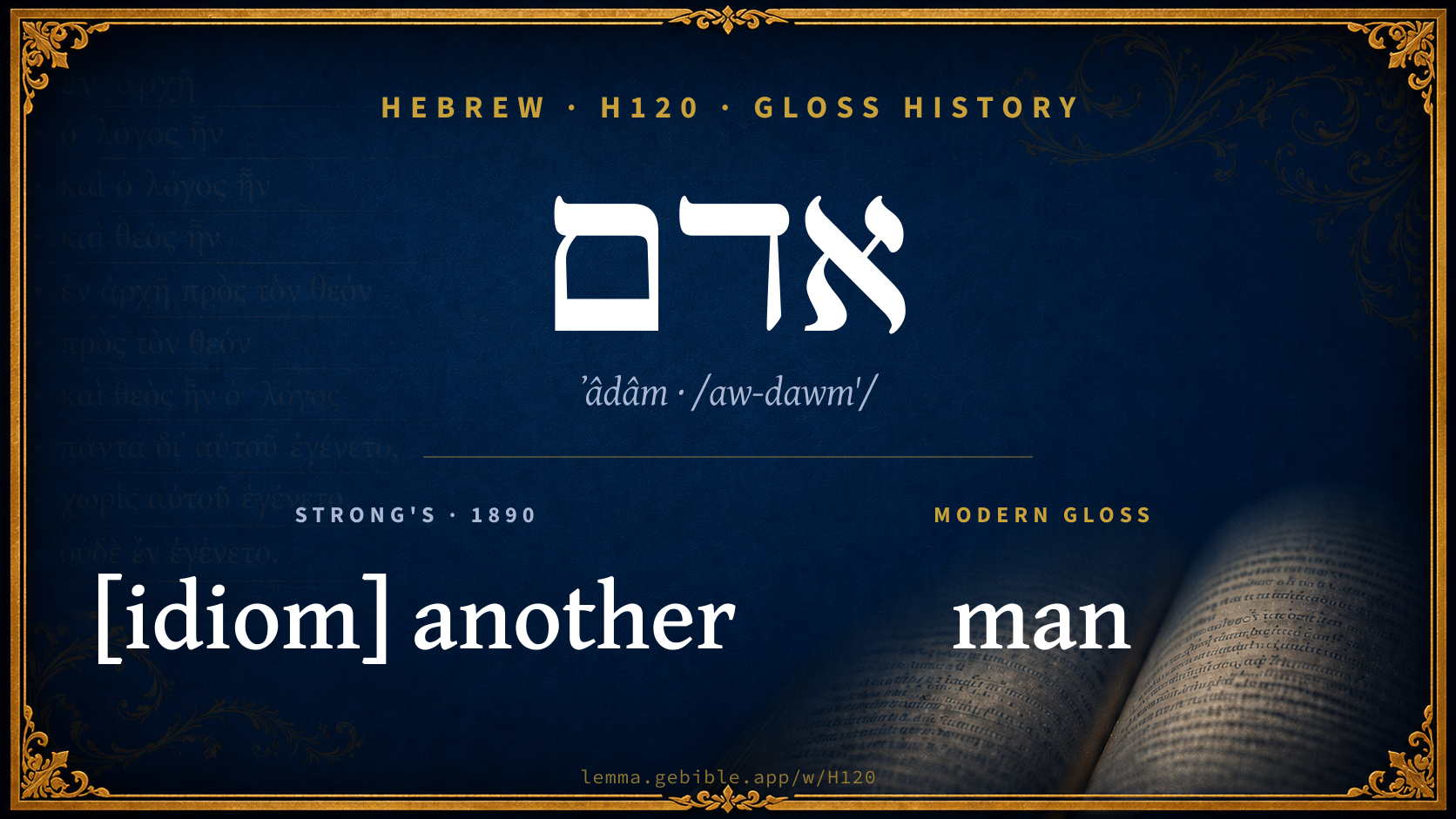
Gloss history
Strong's 1890 vs modern scholarship
About this word
Strong's H120 catalogs a Hebrew word from the Hebrew Old Testament.
These counts are not copied from any lexicon or concordance. They are computed here, from the morphology-tagged Hebrew Old Testament. What Lemma adds →
- 526
- distinct verses
- The word appears in 526 distinct verses.
- 33 / 39
- OT books
- The word appears in 33 of 39 Old Testament books.
- #91
- by frequency
- Top 100 most frequent Hebrew words (rank 91 of 8,640 Hebrew words by occurrence).
View all 526 occurrences in the concordance →
By section of the Old Testament
By traditional corpus
Conventional, traditional groupings — biblical authorship is debated, so this is a traditional corpus grouping, not an authorship claim. Each share is this word’s portion of its verses in that division of the Hebrew canon. Each figure is a share of the word’s 526 distinct verses.
- Prophets (Nevi'im) 238 verses · 45%
- Writings (Ketuvim) 193 verses · 37%
- Torah (Pentateuch) 95 verses · 18%
How translations render this word
Counts come from each version’s own published word-to-Strong’s tagging or interlinear alignment — an approximate guide to how each version renders this word, not a word-level alignment the data otherwise carries. Because each total is that version’s own tagged count, the per-version totals vary from one another and need not match the appearance or distinct-verse counts above. These counts may also differ from a printed concordance because Lemma counts each distinctly tagged rendering and does not collapse phrase taggings into a single head-word total. This is a fixed set of word-tagged versions (KJV, ASV, BSB, ULT) and does not change with the reading translation you choose elsewhere. Each version’s license is shown beside its name below (and on Sources).
- King James Version: Man 297×, Men 73×, Man's 13×
- American Standard Version: Man 235×, Men 85×, Son of man 49×
- Berean Standard Bible: Man 280×, Men 70×, Mankind 20×
- unfoldingWord Literal Text: Man 364×, Humanity 35×, Mankind 30×
King James Version Public Domain
Renders H120 across 545 tagged occurrences — most commonly:
Plus other, less common renderings. Plus 73 renderings that appear only once — usually multi-word phrases or single function words the recovered tagging swept in, not distinct renderings. Not rendered by a distinct English word in 7 further occurrences.
American Standard Version Public Domain
Renders H120 across 545 tagged occurrences — most commonly:
Plus other, less common renderings. Plus 79 renderings that appear only once — usually multi-word phrases or single function words the recovered tagging swept in, not distinct renderings.
Berean Standard Bible Public Domain
Renders H120 across 508 tagged occurrences — most commonly:
Plus other, less common renderings. Plus 46 renderings that appear only once — usually multi-word phrases or single function words the recovered tagging swept in, not distinct renderings. Not rendered by a distinct English word in 39 further occurrences.
unfoldingWord Literal Text CC BY-SA 4.0
Renders H120 across 544 tagged occurrences — most commonly:
Plus other, less common renderings. Plus 31 renderings that appear only once — usually multi-word phrases or single function words the recovered tagging swept in, not distinct renderings.
Senses in the full BDB
What do BDB’s symbols mean?
BDB uses these scholarly abbreviations:
| Symbol | Meaning |
|---|---|
| 𝔊 | the Septuagint (the ancient Greek translation, LXX) |
| 𝔙 | the Vulgate (the Latin translation) |
| 𝔖 | the Syriac version (the Peshitta) |
| 𝔗 | the Targum (the Aramaic translation) |
| ψ | the Psalms |
| √ | root (the underlying root or stem) |
| ‖ | parallel passage (a synonymous or contrasted parallel) |
| † | the dagger: every passage where the word occurs is cited |
The 4 senses and sub-senses the full Brown-Driver-Briggs lexicon distinguishes for this word, in lexicon order (not ranked by frequency), with BDB’s own verbatim wording and sub-sense lettering. Shown in Hebrew script with BDB’s own scholarly abbreviations. The condensed entry is in the Lexicon Entry tab. See also the Forms in the corpus table below.
- 1. a man (= Ger. Mensch) = human being Gn 2:5, 7(×2), 8, 15, 16, 18 +, 16:12 (27 textual J) Lv 5:4 (‖ נֶפֶשׁ) 13:2, 9 (19 textual P) Ne 2:10 Is 13:12 (‖ אֱנוֹשׁ); הָאָ׳ הַגָּדוֹל Jos 14:15 (E); אָ׳ בְּלִיַּעַל Pr 6:12 (‖ אִישׁ אָוֶן cf. 1 S 25:25 & v. בליעל); = any one Lv 1:2 Nu 9:6, 7 Jb 20:29; 27:13 Pr 15:20; 21:16, 20; 24:30 Ec 7:20 + oft. WisdLt, Je 2:6; 4:25 Ne 2:12, cf. נֶפֶשׁ א׳ Nu 19:11, 13 +; seld. man opp. woman Gn 2:22(×2), 23, 25; 3:8, 12, 17, 20, 21 Ec 7:28. e.g. Genesis 2:5
- 2. coll. man, mankind Gn 1:26; 9:5, 6(×3) + (P 28 textual) 6:1, 5, 6, 7 (JE 24 textual) Dt 4:32 (D 6 textual) (on 2 S 7:19 cf. 1 Ch 17:17 v. DrSm); distinctly = men + women Gn 1:27; 5:1 Nu 5:6; given as name Gn 5:2; but = warriors Is 22:6 רֶכֶב א׳ (‖ פּרשׁים); ‖ beasts (41 textual) בְּהֵמָה Gn 6:7; 7:23 (J?) Ex 8:13, 14; 9:9, 10 (P) 9:19, 22, 25; 12:12; 13:2, 13, 15 (all J) +; late proph. Je 21:6; 31:27; 50:3; 51:62 Ez 14:13, 17, 19, 21; 25:13; 29:8, 11; 32:13 (del. Co) 36:11 Jon 3:8 Zp 1:3 Hg 1:11 Zc 2:8; 8:10; ‖ בָּקָר Ez 4:15; ‖ צֹאן, חֲמֹרִים, ב׳ Nu 31:28; ‖ id. + מִכָּל־הַבְּהֵמָה v 30 cf. Jon 3:7; ‖ חַיָּה Gn 9:5 (P) cf. Ez 1:5, 8, 10, 26, & descript. of כְּרוּבִים Ez 10:8, 14, 21 cf. 41:19; ‖ trees Dt 20:19 (rd. הֶאָדָם v. Di); opp. God 1 S 15:29; 16:7(×2) Is 31:3 Ez 28:2, 9 1 Ch 21:13; 29:1 2 Ch 6:18 Mal 3:8 cf. Ex 33:20 Dt 5:21; so בֶּן־א׳ Nu 23:19 (‖ אישׁ Ez 2:1, 3, 6, 8 (87 textual Ez, alw. addressed to proph.); בְּנֵי הָא׳ 1 S 26:19; made in God’s image Gn 1:26, 27; 9:6 cf. Ec 7:29; as feeble, earthly, mortal Nu 16:29(×2) Ps 82:7; 144:3, 4 Jb 5:7; 14:1, 10 cf. 25:6 (בֶּן־א׳) Ec 12:5; as sinful 1 K 8:46 2 Ch 6:36 Je 10:14 cf. Nu 5:6 Jb 31:33 Ho 6:7; of men in general, other men (opp. to particular ones) Ju 16:17 (cf. אַחַד הָא׳ v 7, 11) 18:7, 28 ψ 73:5 Je 32:20 +; ‖ אִישׁ Is 2:9, 11, 17; 5:15 cf. Ez 23:42 (del. Co Vrss); בְּנֵי א׳ 2 S 7:14 (‖ אֲנָשִׁים) Pr 8:4 (‖ אִישִׁים); ψ 49:3; 62:10 (both ‖ בְּנֵי אִישׁ) = men of low opp. men of high degree—so oft. Ph. and = vassal Sab. DHMZMG 1875, 680 cf. 686; נֶפֶשׁ א׳ coll. Nu 31:35, 40, 46 1 Ch 5:21 Ez 27:13. e.g. Genesis 1:26
- 3. n.pr.m. Adam, first man (without art. cf. שָׂטָן 1 Ch 21:1 over ag. הַשּׂ׳ Jb 1:6 etc.) Gn 4:25 (J) 5:1, 3, 4, 5 (P) 1 Ch 1:1. (Gn 2:20; 3:17, 21 rd. לָא׳ v. Di) e.g. 1 Chronicles 21:1
- 4. n.pr.loc. city in Jordan valley (as built? Jos 3:16. e.g. Joshua 3:16
Senses from the full Brown-Driver-Briggs lexicon (Brown, Driver, Briggs; Oxford 1906 — public domain), digitized via Sefaria, supplemented by the OpenScriptures HebrewLexicon (CC BY 4.0). Full attribution on Sources.
Word origin
n.m. Gn 1:27 man, mankind (Ph. אדם, Sab. id., CISiv. 1, 1. 4 al.; cf. As. admu, young (of bird) DlW, but NöZMG 1886, 722 identif. with Ar. أَذَامٌ coll. creatures)—Sg. abs. exc. cstr. Pr 6:12 cf. Thes; (בְּנֵי (הָ)א׳ oft. = pl. of א׳ Gn 11:5 + 39 textual, cf. בְּנוֹת הָא׳ Gn 6:2, 4)—
— Brown-Driver-Briggs (Oxford 1906, public domain), digitized via Sefaria, supplemented by the OpenScriptures HebrewLexicon (CC BY 4.0). See Sources.
Derived from אדם (ʼâdam) (H119) — to be red.
Jastrow Dictionary
A second Hebrew/Aramaic lexicon for comparison, covering Aramaic and post-biblical (Talmudic, Targumic, Midrashic) usage that the biblical-Hebrew BDB does not. Matched by lemma rather than by Strong’s number, so a lemma may carry more than one Jastrow headword (shown separately below), and the entries cover usage well beyond the Bible.
אֲדַם
- , v. הֲדַם. [v. Rabb. D. S. to Ab. Zar. 38ᵇ, Bets. 24ᵇ, note.]
אָדַם
- , v. דמם) [to be viscous, thick, dark] to be red, grow red.
- to redden, make red. Y. Sabb. VII, 10ᶜ top המְאַדֵּם אודם he who produces a red spot (congestion of blood, on a Sabbath).
- 1. (b. h.) (b. h.) to be, grow red. Num. R. s. 9 (p. 231ᵇ ed. Amst.) מַאֲדֶמֶת (היתה) if she was red-faced. Ḥull. 53ᵇ; a. fr.
- 2. to cause to blush, put to shame (usu. הלבין). Num. R. s. 4 (p. 218ᵈ ed. Amst.) (play on עובד אדום).—Part. מַאֲדִים the planet Mars. Sabb. 156ᵃ.—Part. Hof. מְאָדָּם, מְאוּדָּם. Y. Sabb. VII, 10ᶜ top מְאָדָּמִים dyed red.
אָדָם
- m. (b. h.) man, pr. n. m. Adam, frequ. א׳ הראשון (abbr. אה"ר). Gen. R. s. 17; a. fr.—ספרו של, ספרא דאה"ר אה"ר the (allegorical) book of Adam containing all generations and their leaders from beginning to resurrection, i.e. destinies of humanity. Ex. R. s. 40 beg. B. Mets. 85ᵇ bot.
אֲדָם
- (= דָּם, דְּמָא) blood. Targ. I Chron. XXII, 7; a. e.—Y. Maas. Sh. V, 56ᵈ top מגבלא אַדְמֵיה to mix its (the bird’s) blood. Git. 47ᵃ; v. חוּל II. Pl. אַדְמִין. Targ. I Chr. l. c.; a. e.
A Dictionary of the Targumim, the Talmud Babli and Yerushalmi, and the Midrashic Literature (Marcus Jastrow; London, Luzac, 1903) — Public Domain. Digitized via Sefaria. Digitized via Sefaria. Full attribution on Sources.
Forms in the corpus
The 107 distinct written forms H120 takes in the Hebrew Bible, most frequent first — each parse links to that state’s occurrences in the concordance. Hebrew forms include their vowel points and cantillation, so a single lemma takes many written forms.
The 60 most common forms are shown; 47 rarer forms follow in the full concordance.
Same root — word family
Other BDB entries built from the same root as H120, grouped by Strong’s listed origin. These share a root / origin per the lexicon — not necessarily a shared meaning. Each links to that word’s own entry.
Derives from
Shares the same root
- אדם ʼâdôm H122 red
- אדם ʼôdem H124 ruby
- אדמדם ʼădamdâm H125 reddish
- אדמה ʼădâmâh H127 ground
- אדמני ʼadmônîy H132 red
Proper names from this root
People and places named from this root — a name, not an additional meaning of the word.
Compare all same-root words → Showing 4 of 8 — not the complete family. 1 of the same-root words is a proper name (a person or place). They share a root, not necessarily a meaning.
Septuagint verse parallels
This word appears in 498 verses that also exist in the Greek Old Testament (Septuagint), out of the 526 Hebrew verses it occurs in. You can read those verses in Greek by switching the Old Testament edition to the Septuagint.
Read these verses in the Septuagint
- Genesis 1:26
- Exodus 4:11
- Leviticus 1:2
- Numbers 3:13
- Deuteronomy 4:28
- Joshua 11:14
- Judges 16:7
- 1 Samuel 15:29
- 2 Samuel 7:14
- 1 Kings 8:38
- 2 Kings 7:10
- 1 Chronicles 5:21
This is a verse-level parallel only — the same verses exist in both the Hebrew and Greek Old Testaments. No word-level Hebrew↔Greek correspondence is claimed: the data carries no such alignment, so no Greek word is shown as this Hebrew word’s translation. Coverage is not total — the Septuagint omits the deuterocanon and renumbers the Psalms, so some Hebrew verses have no direct Greek parallel.