
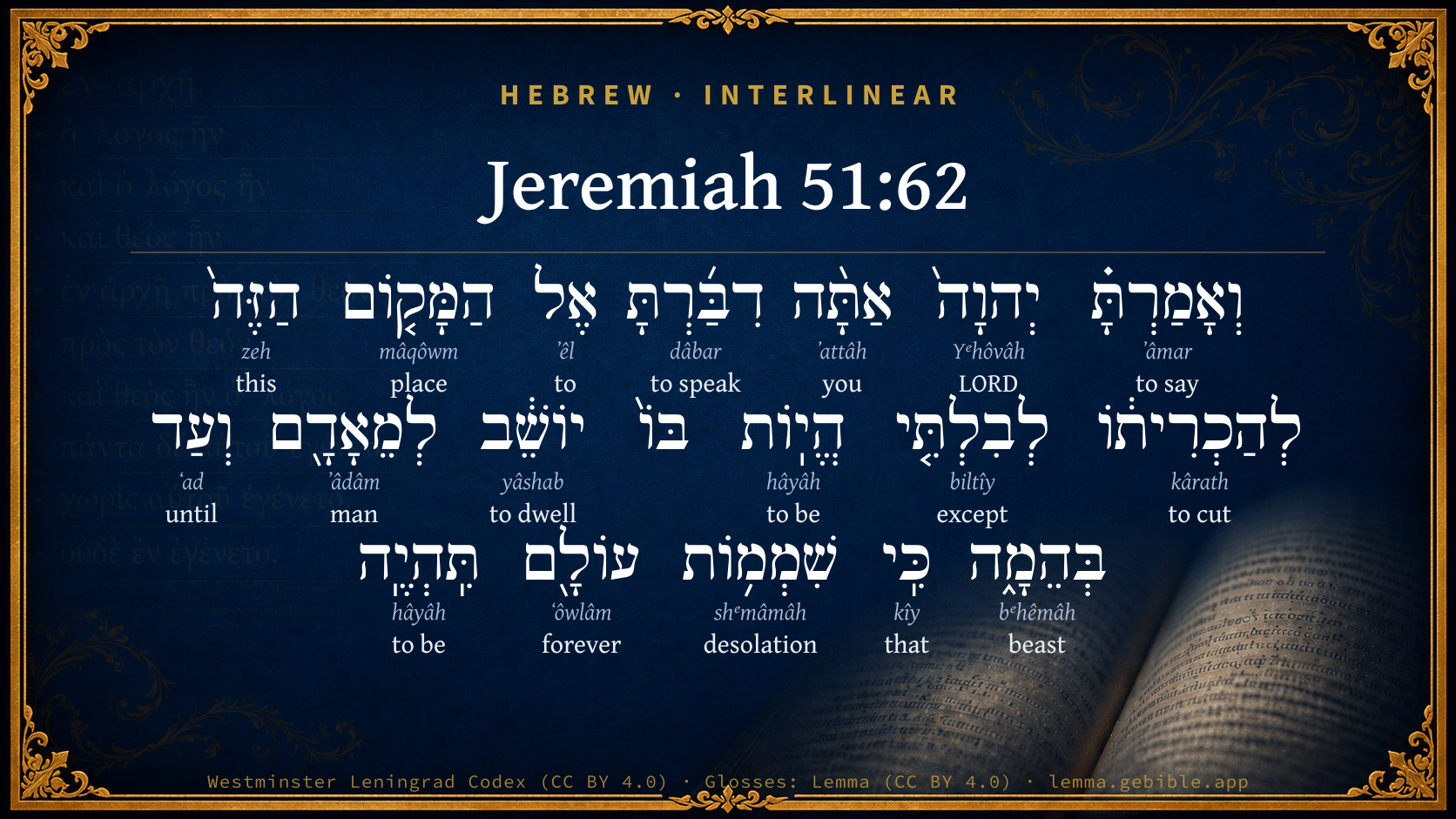
Jeremiah 51:62

Hebrew (Westminster Leningrad Codex) Jeremiah 51:62 appears in the Hebrew Old Testament. The text above is from the Westminster Leningrad Codex. Each word links to its Strong’s number, a concise gloss, and parsing drawn from the Open Scriptures Hebrew Bible morphology. Click any word for its full Brown-Driver-Briggs (BDB) entry.
Download image
Cite this verse

Jeremiah 51:62 (World English Bible). Public Domain. Lemma interlinear Bible study tool, https://lemma.gebible.app/v/jeremiah/51/62.

Show BibTeX & RIS
BibTeX
RIS
English Translation
and say, Yahweh, you have spoken concerning this place, to cut it off, that none shall dwell therein, neither man nor animal, but that it shall be desolate forever.
World English Bible · Public Domain
Download a study sheet

One document with this verse’s original text, its word-by-word gloss line, the meaning frame, cross-references with their text, attributed commentary, and full source and license credits — printable, and it pastes into notes with its structure intact.

This verse Autodidact and up

Study sheet (.html) Plain text (.txt)

A passage Seminary Student

Up to 50 verses in one chapter. A passage sheet keeps up to 6 commentary sources and 12 cross-references per verse, in the order this page ranks them, and says so on the sheet whenever that leaves anything out. Ask for a single verse and you get the Autodidact verse sheet above.

Everything on this page stays free to read, with no account — the sheet is a download of what is already on screen, not access to it.

Want to remove ads? Support Godless Engineer
Compare translations 3

The same verse in 3 English versions, stacked beneath the original-language interlinear above. Click any original word for its lexicon entry.

Each is an independent rendering of the whole verse — the interlinear is not word-aligned to these translations.

Highlighted words mark where these versions differ — a whole-verse word diff, not a word-by-word alignment.

  • World English Bible Public Domain
    and say, Yahweh, you have spoken concerning this place, to cut it off, that none shall dwell therein, neither man nor animal, but that it shall be desolate forever.
  • King James Version Public Domain
    Then shalt thou say, O LORD, thou hast spoken against this place, to cut it off, that none shall remain in it, neither man nor beast, but that it shall be desolate for ever.
  • unfoldingWord Literal Text CC BY-SA 4.0
    Then you will say, ‘Yahweh, you yourself have declared that you would destroy this place, and that no man or animal will live in it, and it will be desolate forever.’

unfoldingWord Literal Text — © unfoldingWord, licensed CC BY-SA 4.0. Word-aligned USFM3 via Door43 (git.door43.org/unfoldingWord/en_ult).

Versions to compare (up to 4)

3 of 4 selected

Show all 18 translations

Every available English version of this verse, each an independent rendering of the whole verse.

  • World English Bible Public Domain
    and say, Yahweh, you have spoken concerning this place, to cut it off, that none shall dwell therein, neither man nor animal, but that it shall be desolate forever.
  • Berean Standard Bible Public Domain
    and say, ‘O LORD, You have promised to cut off this place so that no one will remain—neither man nor beast. Indeed, it will be desolate forever.’
  • Majority Standard Bible Public Domain
    and say, ‘O LORD, You have promised to cut off this place so that no one will remain—neither man nor beast. Indeed, it will be desolate forever.’
  • King James Version Public Domain
    Then shalt thou say, O LORD, thou hast spoken against this place, to cut it off, that none shall remain in it, neither man nor beast, but that it shall be desolate for ever.
  • American Standard Version (1901) Public Domain
    and say, O Jehovah, thou hast spoken concerning this place, to cut it off, that none shall dwell therein, neither man nor beast, but that it shall be desolate for ever.
  • Revised Version (1885) Public Domain
    and say, O LORD, thou hast spoken concerning this place, to cut it off, that none shall dwell therein, neither man nor beast, but that it shall be desolate for ever.
  • Geneva Bible (1599) Public Domain
    Then shalt thou say, O Lord, thou hast spoken against this place, to destroy it, that none should remaine in it, neither man nor beast, but that it should be desolate for euer.
  • Douay-Rheims (1899) Public Domain
    Thou shalt say: O Lord, thou hast spoken against this place to destroy it: so that there should be neither man nor beast to dwell therein, and that it should be desolate for ever.
  • Young's Literal Translation Public Domain
    and hast said: Jehovah, Thou, Thou hast spoken concerning this place, to cut it off, that there is none dwelling in it, from man even unto cattle, for it is a desolation age-during.
  • Literal Standard Version CC BY-SA 4.0
    and have said: YHWH, You have spoken concerning this place, to cut it off, that there is none dwelling in it, from man even to livestock, for it is a continuous desolation.
  • Unlocked Literal Bible CC BY-SA 4.0
    Then you will say, 'Yahweh, you yourself have declared that you would destroy this place, and that no man or animal will live in it, and it will be desolate forever.'
  • unfoldingWord Literal Text CC BY-SA 4.0
    Then you will say, ‘Yahweh, you yourself have declared that you would destroy this place, and that no man or animal will live in it, and it will be desolate forever.’
  • Darby Bible Public Domain
    and say, Jehovah, thou hast spoken concerning this place, that thou wilt cut it off, so that none shall dwell in it, neither man nor beast, but that it shall be desolate for ever.
  • World Messianic Bible Public Domain
    and say, ‘LORD, you have spoken concerning this place, to cut it off, that no one will dwell in it, neither man nor animal, but that it will be desolate forever.’
  • Webster's Bible Public Domain
    Then shalt thou say, O LORD, thou hast spoken against this place, to cut it off, that none shall remain in it, neither man nor beast, but that it shall be desolate for ever.
  • Free Bible Version CC BY-SA 4.0
    and announce, ‘Lord, you have promised to destroy this place so that none will be left—no people or animals. In fact it will be deserted forever.’
  • Bible in Basic English Public Domain
    And after reading them, say, O Lord, you have said about this place that it is to be cut off, so that no one will be living in it, not a man or a beast, but it will be unpeopled for ever.
  • JPS Tanakh (1917) Public Domain
    and say: O LORD, Thou hast spoken concerning this place, to cut it off, that none shall dwell therein, neither man nor beast, but that it shall be desolate for ever.

Literal Standard Version (2020), Covenant Press — licensed CC BY-SA 4.0. Text via the HelloAO Bible API (eBible.org). Unlocked Literal Bible (unfoldingWord) — licensed CC BY-SA 4.0. Text via the HelloAO Bible API (eBible.org). unfoldingWord Literal Text — © unfoldingWord, licensed CC BY-SA 4.0. Word-aligned USFM3 via Door43 (git.door43.org/unfoldingWord/en_ult). Free Bible Version, Dr. Jonathan Gallagher — licensed CC BY-SA 4.0. Text via the HelloAO Bible API (eBible.org).

Word by word

More ways to search: Search by grammar → Find every occurrence → Compare this word →

Practice this passage: Drill this verse → Learn its vocabulary →

שִׁמְמ֥וֹת
shᵉmâmâh
H8077
“desolations of”
Noun, Common, Feminine, Plural, Construct
Part of Speech
Noun
Type
Common
Gender
Feminine
Number
Plural
State
Construct
Full BDB Definition

Origin: from H8076

TWOT: 2409b , 2409c

devastation, waste, desolation
  1. וְאָמַרְתָּ֗ ʼâmar H559 “and · to say” Conjunction + Verb, Qal, Sequential Perfect, 2nd Person, Masculine, Singular
  2. יְהוָה֙ Yᵉhôvâh H3068 “LORD” Noun, Proper
  3. אַתָּ֨ה ʼattâh H859 “you” Pronoun, Personal, 2nd Person, Masculine, Singular
  4. דִבַּ֜רְתָּ dâbar H1696 “to speak” Verb, Piel, Perfect, 2nd Person, Masculine, Singular
  5. אֶל ʼêl H413 “to” Preposition
  6. הַמָּק֤וֹם mâqôwm H4725 “the · place” Particle, Definite Article + Noun, Common, Masculine, Singular, Absolute
  7. הַזֶּה֙ zeh H2088 “the · this” Particle, Definite Article + Pronoun, Demonstrative, Masculine, Singular
  8. לְהַכְרִית֔וֹ kârath H3772 “to cut · him” Preposition + Verb, Hiphil, Infinitive Construct + Suffix, Personal, 3rd Person, Masculine, Singular
  9. לְבִלְתִּ֤י biltîy H1115 “to/for · except” Preposition + Conjunction
  10. הֱיֽוֹת hâyâh H1961 “to be” Verb, Qal, Infinitive Construct
  11. יוֹשֵׁ֔ב yâshab H3427 “dwelling” Verb, Qal, Participle Active, Masculine, Singular, Absolute
  12. לְמֵאָדָ֖ם ʼâdâm H120 “to/for · from · man” Preposition + Preposition + Noun, Common, Masculine, Singular, Absolute
  13. וְעַד ʻad H5704 “and · until” Conjunction + Preposition
  14. בְּהֵמָ֑ה bᵉhêmâh H929 “beast” Noun, Common, Feminine, Singular, Absolute
  15. כִּֽי kîy H3588 “that” Conjunction
  16. עוֹלָ֖ם ʻôwlâm H5769 “forever” Noun, Common, Masculine, Singular, Absolute
  17. תִּֽהְיֶֽה hâyâh H1961 “to be” Verb, Qal, Imperfect, 3rd Person, Feminine, Singular

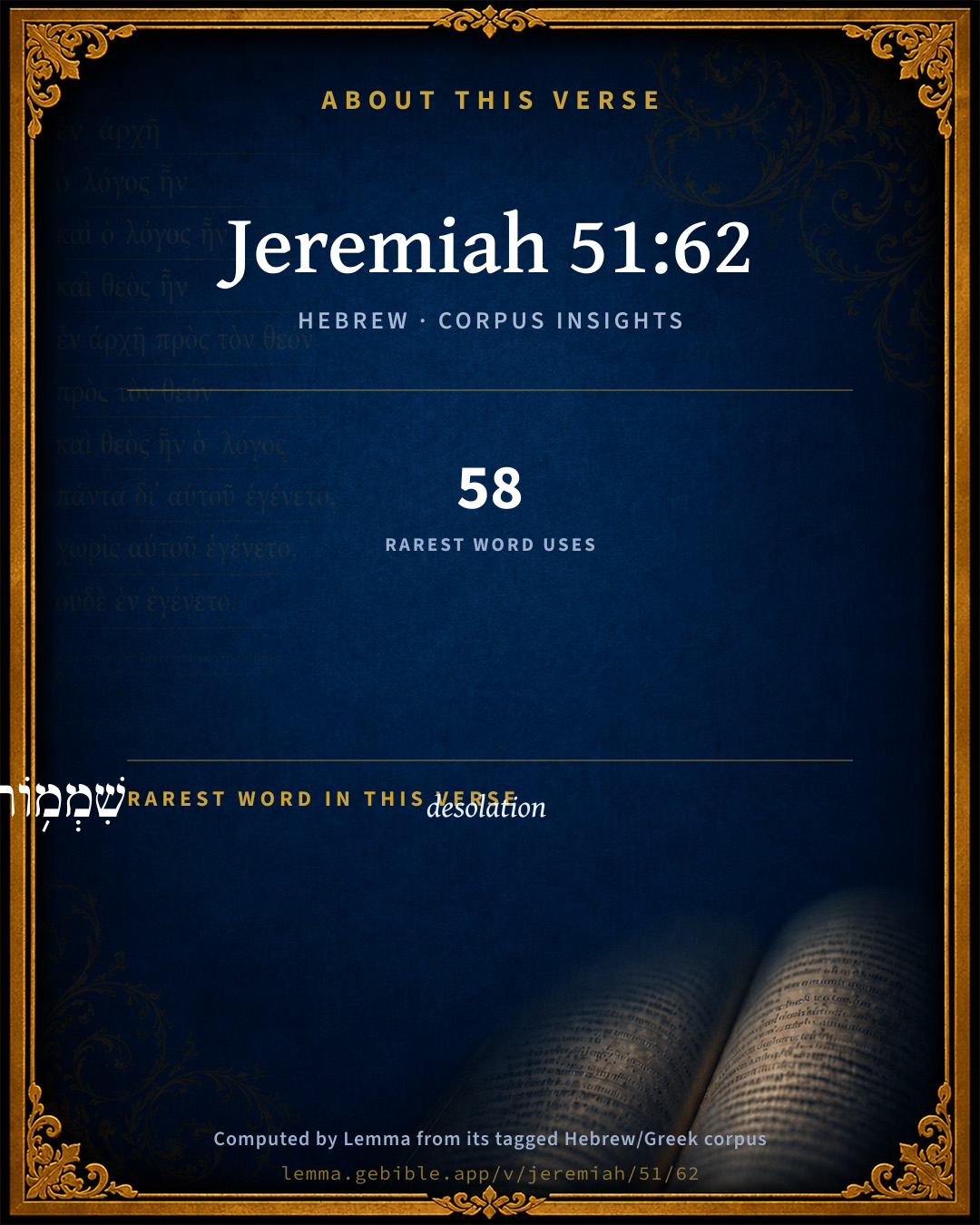
About this verse

These counts appear in no published source. They are computed here, from the morphology-tagged text and Lemma’s own curated glosses. What Lemma adds →

19
words
17
distinct lemmas
Prophets
section

Shared distinctive vocabulary

שִׁמְמ֥וֹת desolation H8077 occurs in 54 verses of the Hebrew Bible. Also found in:

Grammatical profile

  • 6 verbs
  • 6 nouns
  • 2 pronouns
  • 3 prepositions
  • 2 conjunctions

Verb forms

  • וְאָמַרְתָּ֗ Qal · Sequential Perfect
  • דִבַּ֜רְתָּ Piel · Perfect
  • לְהַכְרִית֔וֹ Hiphil · Infinitive Construct
  • הֱיֽוֹת Qal · Infinitive Construct
  • יוֹשֵׁ֔ב Qal · Participle Active
  • תִּֽהְיֶֽה Qal · Imperfect

Repetition

A word recurs within this verse — often emphatic in Hebrew:

  • הֱיֽוֹת to be H1961 ×2

Cross-references

12

Topical passages linked to Jeremiah 51:62 in the Treasury of Scripture Knowledge — connected by theme and wording, ordered by reader-vote popularity; previews shown in the World English Bible.

  • Jeremiah 50:3 For out of the north there comes up a nation against her, which shall make her land desolate, and none shall dwell therein: they are fled, they are gone, both man and animal.
  • Jeremiah 50:13 Because of the wrath of Yahweh she shall not be inhabited, but she shall be wholly desolate: everyone who goes by Babylon shall be astonished, and hiss at all her plagues.
  • Isaiah 13:19–22 Babylon, the glory of kingdoms, the beauty of the Chaldeans' pride, shall be as when God overthrew Sodom and Gomorrah.
  • Isaiah 14:22–23 I will rise up against them, says Yahweh of Hosts, and cut off from Babylon name and remnant, and son and son's son, says Yahweh.
  • Jeremiah 50:39–40 Therefore the wild animals of the desert with the wolves shall dwell there, and the ostriches shall dwell therein: and it shall be no more inhabited forever; neither shall it be lived in from generation to generation.
  • Ezekiel 35:9 I will make you a perpetual desolation, and your cities shall not be inhabited; and you shall know that I am Yahweh.
  • Revelation 18:20–23 Rejoice over her, O heaven, you saints, apostles, and prophets; for God has judged your judgment on her."
  • Jeremiah 25:9 behold, I will send and take all the families of the north, says Yahweh, and [I will send] to Nebuchadrezzar the king of Babylon, my servant, and will bring them against this land, and against the inhabitants of it, and against all these nations round about; and I will utterly destroy them, and make them an astonishment, and a hissing, and perpetual desolations.
  • Jeremiah 25:12 It shall happen, when seventy years are accomplished, that I will punish the king of Babylon, and that nation, says Yahweh, for their iniquity, and the land of the Chaldeans; and I will make it desolate forever.
  • Jeremiah 51:25–26 Behold, I am against you, destroying mountain, says Yahweh, which destroy all the earth; and I will stretch out my hand on you, and roll you down from the rocks, and will make you a burnt mountain.
  • Jeremiah 51:29 The land trembles and is in pain; for the purposes of Yahweh against Babylon do stand, to make the land of Babylon a desolation, without inhabitant.
  • Jeremiah 51:37 Babylon shall become heaps, a dwelling-place for jackals, an astonishment, and a hissing, without inhabitant.

Cross-references courtesy of OpenBible.info (CC BY 4.0).

Hebrew and Greek witnesses Masoretic Hebrew ↔ Greek Septuagint

The same verse in the two great witnesses to the Old Testament, shown verse-for-verse.

These are two independent witnesses, not word-aligned to each other, and the Septuagint is shown in lemma (dictionary) form.

Hebrew Jeremiah 51:62 Masoretic · Westminster Leningrad Codex

וְאָמַרְתָּ֗ יְהוָה֙ אַתָּ֨ה דִבַּ֜רְתָּ אֶל הַמָּק֤וֹם הַזֶּה֙ לְהַכְרִית֔וֹ לְבִלְתִּ֤י הֱיֽוֹת בּוֹ֙ יוֹשֵׁ֔ב לְמֵאָדָ֖ם וְעַד בְּהֵמָ֑ה כִּֽי שִׁמְמ֥וֹת עוֹלָ֖ם תִּֽהְיֶֽה

and say, Yahweh, you have spoken concerning this place, to cut it off, that none shall dwell therein, neither man nor animal, but that it shall be desolate forever.

World English Bible · Public Domain

Greek LXX Structure differs

In the Septuagint, Jeremiah is about an eighth shorter than the Hebrew and arranges its material differently — the Oracles Against the Nations (Hebrew chapters 46–51) appear in the middle of the Greek book, after 25:13. Because the chapter and verse boundaries do not line up, a verse-for-verse comparison with the Hebrew is not shown.

A verse-for-verse comparison isn’t shown here because the chapters and verses don’t line up. Switch to the LXX edition with the MT / LXX toggle above to read the Greek directly.

Hebrew: Westminster Leningrad Codex (CC BY 4.0). Greek: Septuagint (public domain); English from a public-domain English Septuagint. How the Septuagint differs from the Hebrew →

Targum (Aramaic paraphrase)

1

The Targum is the ancient Jewish Aramaic paraphrase of the Hebrew Scriptures — an interpretive translation, not the Hebrew text itself. Onkelos (literal) and Pseudo-Jonathan (expansive) render the Torah, and Jonathan the Prophets. Coverage is partial: where no permissively-licensed English translation exists for a verse, only the Aramaic is shown. This is verse-level text, not a word-by-word alignment to the Hebrew.

  1. Targum Jonathan Prophets (Joshua–Malachi)
    וְתֵימַר יְיָ אַתְּ גָזַרְתְּ עַל אַתְרָא הָדֵין לְשֵׁיצָיוּתֵיהּ בְּדִיל דְלָא לְמֶהֱוֵי בֵּיהּ יָתֵיב לְמֵאֱנָשָׁא וְעַד בְּעִירָא אֲרֵי צָדוּת עֲלַם תְּהֵי:

    (no public-domain English translation for this verse)

    Targum Jonathan — Aramaic: “Mikraot Gedolot” (public domain). English: “Sefaria Community Translation” (CC0 1.0 (public-domain dedication)); “London "Chaldee Paraphrase," 1871” (public domain). Text via Sefaria.

Commentary

Notes on Jeremiah 51:62 from classic Christian and Jewish commentators (each source and its license shown beneath its notes). The classic Christian expositions comment on the surrounding passage and are grouped to its opening verse, so a note may address several verses; the Jewish commentaries on the Tanakh (Rashi and others) are per-verse, so they appear only where the commentator wrote on this verse.

Lemma curates 59 commentaries, every one of them public domain or Creative Commons licensed, each selected and text-cleaned for this edition rather than reprinted as found. About our sources →

Trapp's Complete Commentary

John Trapp

Jer 51:62 Then shalt thou say, O LORD, thou hast spoken against this place, to cut it off, that none shall remain in it, neither man nor beast, but that it shall be desolate for ever.

Ver. 62. Then shalt thou say, O Lord, &c.] The promises are to be prayed over, and then we may expect their accomplishment. Prayer also added to the outward sign, according to God’s holy Word, maketh it a sacramental sign.

John Trapp, A Commentary or Exposition upon All the Books of the Old and New Testament (1647–1656) — public domain. Text from a community e-Sword module.

Jamieson, Fausset & Brown

Robert Jamieson, A. R. Fausset & David Brown

O Lord, thou--and not merely Jeremiah or any man is the author of this prophecy; I therefore here in Thy presence embrace as true all that I read.

Jamieson, Fausset & Brown — Commentary Critical and Explanatory on the Whole Bible (1871) — public domain (CC PDM 1.0). Text via the HelloAO Bible API.

John Calvin's Commentaries

And thou shalt say, Jehovah, thou hast spoken against this place It hence appears that Seraiah was commanded to read the book, not for the benefit of hearers, for they would have been doubly deaf to the words of Seraiah. And it is not probable that the Hebrew language was then familiar to the Chaldeans. There is a great affinity, as it is well known, in the languages, but there is also some difference. But we conclude, from this passage, that the reading was in a chamber, or in some secret place; for Seraiah is bidden to fix all his thoughts on God, and to address his words to him. He did not then undertake the work or office of a preacher, so as openly to proclaim all these things to the Babylonians. But having inspected the city, he was to read the book by himself, that is, what had been written.

And this also deserves to be noticed; for however courageous we may be, yet our constancy and boldness are more apparent when we have to do with men than when we are alone, and God is the only witness; for when no one sees us, we tremble; and though we may have previously appeared to have manly courage, yet when alone, fear lays hold on us. There is hardly one in a hundred who is so bold as he ought to be when God alone is witness. But shame renders us courageous and constrains us to be firm, and the vigor which is almost extinct in private is roused in public. As, then, ambition almost always rules in men, this passage ought to be carefully noticed, where the Prophet commands Seraiah to deal alone with God, and, though no mortal was present, to strengthen himself, by relying on the certain and infallible fidelity of God; Thou shalt then say, Jehovah, etc. And it is doubtless a real experiment of faith, when we consider within ourselves the promises of God, and go not forth before the public to avow our firmness; for when any one in silence acknowledges God to be true, and strengthens himself in his promises, and so disregards the false judgments of all, that were he alone in the world, he would not yet despond, — this is a true and real trial of faith.

Thou shalt then say, Jehovah, thou hast spoken against this place The design of the words was, that Seraiah might feel assured that God was true, and embrace in his presence what he read, and not doubt but that the word, which came from God, would, in due time, be accomplished: how so? because God is true. The word Jehovah, then, ought to be regarded as emphatical; and thou shalt say, Thou, Jehovah, hast spoken against this place; that is, neither Jeremiah, nor any other mortal, is the author of this prophecy; but thou, O Lord, has dictated to thy servant whatever is contained in this volume.

To destroy it, so that there should not be an inhabitant in it, neither man nor beast: how so? because it shall be reduced to desolations, or the particle כי, ki, may be taken adversatively, but it shall be reduced to perpetual desolations

John Calvin's Commentaries (1540-1563) — public domain. Text from the Calvin Translation Society English edition (1840s-50s) via the Christian Classics Ethereal Library (ccel.org). Calvin's coverage is partial (roughly two-thirds of the Bible); uncommented books and verses are honest gaps, never fabricated. The 19th-century editor's footnotes and remarks are omitted so the notes are faithfully Calvin's own voice.

Ellicott's Commentary for English Readers

(62) Then shalt thou say, O Lord . . .—The words which recite the predictions of Jer_50:3; Jer_50:39 are of the nature of an implied prayer, reminding Jehovah of that which He had promised, and entreating him to fulfil it. “Thou hast said” was to be the ground of the suppliant’s prayer for the fulfilment.

A Bible Commentary for English Readers, edited by Charles John Ellicott (1878–1897) — public domain. Text from a community e-Sword module.

John Gill's Exposition

And thou shall say,.... Not only use the above sign and ceremony, but explain the meaning of it to those of his friends who might accompany him; and what he said was in the name of the Lord, as the form and manner in which the following words are delivered show:

thus shall Babylon sink, and shall not rise from the evil that I will bring upon her; as this book, with the stone bound to it, does, and shall no more rise than that can; the evil of punishment brought on Babylon will sink her to such a degree, that she will never be able to bear up under it; but be so depressed by it as never to rise to her former state and grandeur any more:

and they shall be weary; the inhabitants of it, and have no strength to resist their enemies; or, rather, shall be so weak as not to be able to stand up under the weight and pressure upon them, but shall sink under it; or shall weary themselves in vain to preserve their city from ruin, or restore it when ruined; see Jer 51:58;

thus far are the words of Jeremiah; that is, concerning the destruction of Babylon, as is said concerning Moab, Jer 48:47; for what Maimonides (m) says, that though Jeremiah lived some time after, yet ceased to prophesy; or that, when he had finished his prophecy concerning Babylon, he prophesied no more, is not true; for it is certain that many of his prophecies were delivered out after the date of this, though this is recorded last: or the sense may be, thus far are the prophetic words of Jeremiah; and so the Targum,

"hitherto is the prophecy of the words of Jeremiah;''

what follows in the next chapter being historical; for there is no necessity to conclude from hence that that was wrote by any other hand; either, as many have thought, by Ezra; or by the men of the great synagogue, as Abarbinel.

(m) Moreh Nevochim, par. 2. c. 45. Vid. Kimchi in loc.

Next: Jeremiah Chapter 52

John Gill's Exposition of the Whole Bible (1746–1763) — public domain (CC PDM 1.0). Text via the HelloAO Bible API.

Matthew Poole's English Annotations

Thou shalt testify that thou believest what thou hast read to be what shall most certainly come to pass, by speaking words to this sense.

Matthew Poole's English Annotations on the Holy Bible (1683–1685) — public domain. Text from a community e-Sword/MySword module.

John Wesley's Explanatory Notes

Shalt say - Thou shalt testify that thou believest what thou hast read.

John Wesley, Explanatory Notes Upon the Whole Bible (1754–1765) — public domain. Text via the GEBible commentary corpus.

Lesson kit

Teaching starters — assembled from the data on this page, not authored interpretation. Every prompt links to the verse data it draws on. Edit before teaching.

Jeremiah, in the Prophets, opens this verse with 19 words (17 distinct Hebrew lemmas). Its most distinctive word is shᵉmâmâh (“desolation”). A historical commentator’s framing appears above. Read the whole chapter for the surrounding context.

Discussion questions

  1. How does “desolation” (shᵉmâmâh) shape what this verse is saying?
  2. How does Exodus 23:29, which shares the word «desolation», read alongside this verse?
  3. What does the repetition of “to be” (2× in this one verse) do in this verse?
  4. These translations render this verse differently; the difference is in the English rendering, not the original. What questions does that raise?
  5. «וְאָמַרְתָּ֗» is a Qal Sequential Perfect verb. How does that grammatical form shape the action described?
  6. Compare how Trapp's Complete Commentary and Jamieson, Fausset & Brown read this verse. Where do they agree or differ?

Things to notice

Reading settings

Reading text

Shown beneath each verse's original-language words.

Old Testament
Old Testament edition

Read the OT as the Masoretic Hebrew (MT) or the Greek Septuagint (LXX).

English shown for the Greek Septuagint (in the Hebrew ↔ Greek comparison).

Comparing translations? Open the Compare panel on any verse page to stack up to four side by side.