Malachi 3:8

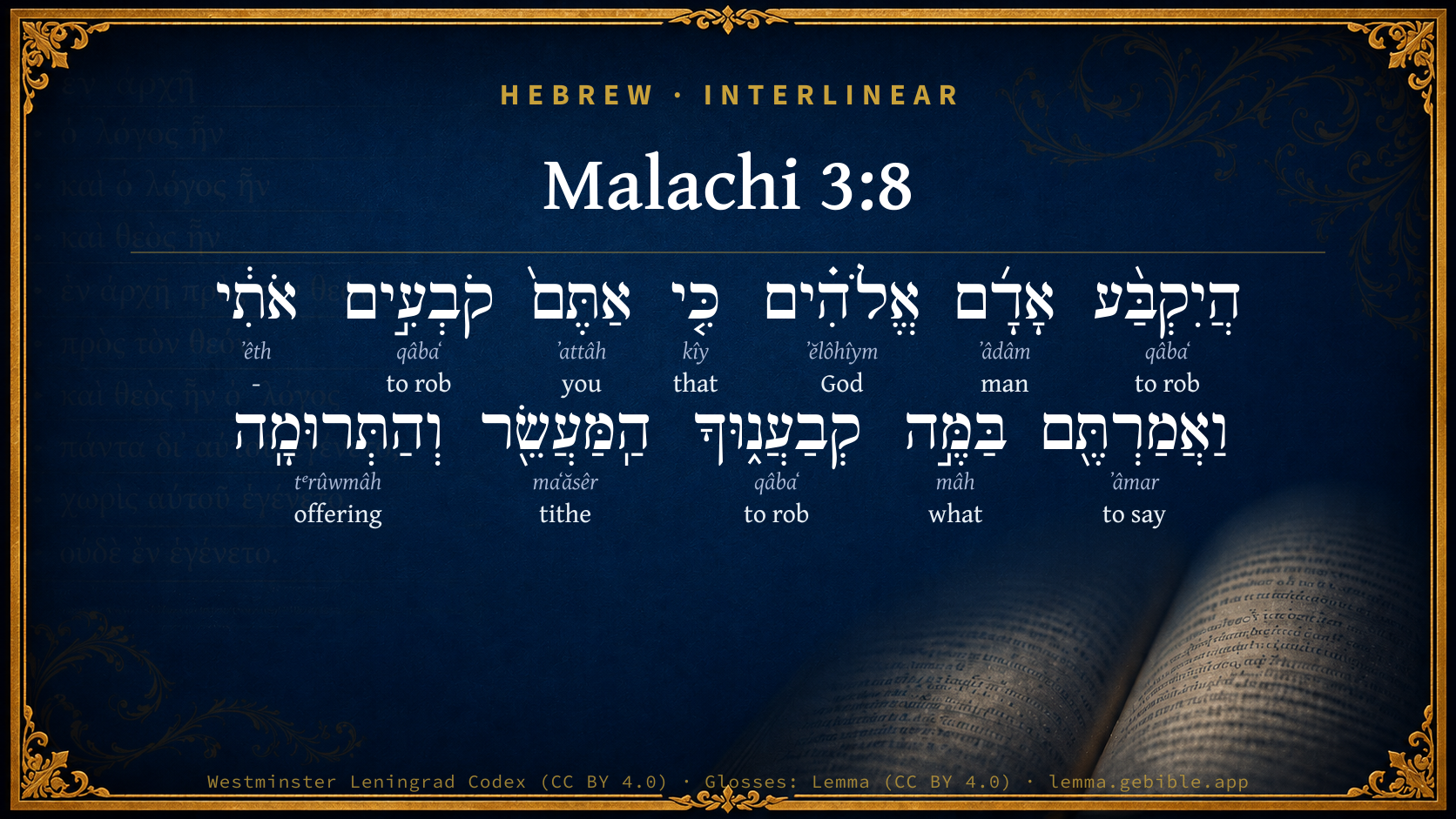
Hebrew (Westminster Leningrad Codex) Malachi 3:8 appears in the Hebrew Old Testament. The text above is from the Westminster Leningrad Codex. Each word links to its Strong’s number, a concise gloss, and parsing drawn from the Open Scriptures Hebrew Bible morphology. Click any word for its full Brown-Driver-Briggs (BDB) entry.
Download image
Cite this verse

Malachi 3:8 (World English Bible). Public Domain. Lemma interlinear Bible study tool, https://lemma.gebible.app/v/malachi/3/8.

Show BibTeX & RIS
BibTeX
RIS
English Translation
Will a man rob God? Yet you rob me! But you say, 'How have we robbed you?' In tithes and offerings.
World English Bible · Public Domain
Download a study sheet

One document with this verse’s original text, its word-by-word gloss line, the meaning frame, cross-references with their text, attributed commentary, and full source and license credits — printable, and it pastes into notes with its structure intact.

This verse Autodidact and up

Study sheet (.html) Plain text (.txt)

A passage Seminary Student

Up to 50 verses in one chapter. A passage sheet keeps up to 6 commentary sources and 12 cross-references per verse, in the order this page ranks them, and says so on the sheet whenever that leaves anything out. Ask for a single verse and you get the Autodidact verse sheet above.

Everything on this page stays free to read, with no account — the sheet is a download of what is already on screen, not access to it.

Want to remove ads? Support Godless Engineer
Compare translations 3

The same verse in 3 English versions, stacked beneath the original-language interlinear above. Click any original word for its lexicon entry.

Each is an independent rendering of the whole verse — the interlinear is not word-aligned to these translations.

Highlighted words mark where these versions differ — a whole-verse word diff, not a word-by-word alignment.

  • World English Bible Public Domain
    Will a man rob God? Yet you rob me! But you say, 'How have we robbed you?' In tithes and offerings.
  • King James Version Public Domain
    Will a man rob God? Yet ye have robbed me. But ye say, Wherein have we robbed thee? In tithes and offerings.
  • unfoldingWord Literal Text CC BY-SA 4.0
    Will a human rob God? Yet you robbing me. But you say, ‘In what have we robbed you?’ the tithe and the contribution.

unfoldingWord Literal Text — © unfoldingWord, licensed CC BY-SA 4.0. Word-aligned USFM3 via Door43 (git.door43.org/unfoldingWord/en_ult).

Versions to compare (up to 4)

3 of 4 selected

Show all 18 translations

Every available English version of this verse, each an independent rendering of the whole verse.

  • World English Bible Public Domain
    Will a man rob God? Yet you rob me! But you say, 'How have we robbed you?' In tithes and offerings.
  • Berean Standard Bible Public Domain
    Will a man rob God? Yet you are robbing Me! But you ask, ‘How do we rob You?’ In tithes and offerings.
  • Majority Standard Bible Public Domain
    Will a man rob God? Yet you are robbing Me! But you ask, ‘How do we rob You?’ In tithes and offerings.
  • King James Version Public Domain
    Will a man rob God? Yet ye have robbed me. But ye say, Wherein have we robbed thee? In tithes and offerings.
  • American Standard Version (1901) Public Domain
    Will a man rob God? yet ye rob me. But ye say, Wherein have we robbed thee? In tithes and offerings.
  • Revised Version (1885) Public Domain
    Will a man rob God? yet ye rob me. But ye say, Wherein have we robbed thee? In tithes and offerings.
  • Geneva Bible (1599) Public Domain
    Will a man spoyle his gods? yet haue ye spoyled me: but ye say, Wherein haue we spoyled thee? In tithes, and offerings.
  • Douay-Rheims (1899) Public Domain
    Shall a man afflict God? for you afflict me. And you have said: Wherein do we afflict thee? in tithes and in firstfruits.
  • Young's Literal Translation Public Domain
    Doth man deceive God? but ye are deceiving Me, And ye have said: `In what have we deceived Thee?' The tithe and the heave-offering!
  • Literal Standard Version CC BY-SA 4.0
    Does man deceive God? But you are deceiving Me, || And you have said, || In what have we deceived You? The tithe and the raised-offering!
  • Unlocked Literal Bible CC BY-SA 4.0
    Would a person rob God? Yet you are robbing me. But you say, 'How have we robbed you?' In tithes and offerings.
  • unfoldingWord Literal Text CC BY-SA 4.0
    Will a human rob God? Yet you robbing me. But you say, ‘In what have we robbed you?’ the tithe and the contribution.
  • Darby Bible Public Domain
    Will a man rob God? But ye rob me. And ye say, Wherein do we rob thee? [In] tithes and heave-offerings.
  • World Messianic Bible Public Domain
    Will a man rob God? Yet you rob me! But you say, ‘How have we robbed you?’ In tithes and offerings.
  • Webster's Bible Public Domain
    Will a man rob God? yet ye have robbed me. But ye say, In what have we robbed thee? In tithes and offerings.
  • Free Bible Version CC BY-SA 4.0
    Should people defraud God? Yet you are defrauding me! But you ask, “How have we defrauded you?” In tithes and offerings.
  • Bible in Basic English Public Domain
    Will a man keep back from God what is right? But you have kept back what is mine. But you say, What have we kept back from you? Tenths and offerings.
  • JPS Tanakh (1917) Public Domain
    Will a man rob God? Yet ye rob Me. But ye say: 'Wherein have we robbed Thee?' In tithes and heave-offerings.

Literal Standard Version (2020), Covenant Press — licensed CC BY-SA 4.0. Text via the HelloAO Bible API (eBible.org). Unlocked Literal Bible (unfoldingWord) — licensed CC BY-SA 4.0. Text via the HelloAO Bible API (eBible.org). unfoldingWord Literal Text — © unfoldingWord, licensed CC BY-SA 4.0. Word-aligned USFM3 via Door43 (git.door43.org/unfoldingWord/en_ult). Free Bible Version, Dr. Jonathan Gallagher — licensed CC BY-SA 4.0. Text via the HelloAO Bible API (eBible.org).

Word by word

More ways to search: Search by grammar → Find every occurrence → Compare this word →

Practice this passage: Drill this verse → Learn its vocabulary →

הֲיִקְבַּ֨ע
qâbaʻ
H6906
“to rob”
Particle, Interrogative + Verb, Qal, Imperfect, 3rd Person, Masculine, Singular
Part of Speech
Particle + Verb
Stem
Qal
Form
Imperfect
Person
3rd Person
Gender
Masculine
Number
Singular
Full BDB Definition

Origin: a primitive root

TWOT: 1981

(Qal) to rob - meaning dubious
  1. אָדָ֜ם ʼâdâm H120 “man” Noun, Common, Masculine, Singular, Absolute
  2. אֱלֹהִ֗ים ʼĕlôhîym H430 “God(s)” Noun, Common, Masculine, Plural, Absolute
  3. כִּ֤י kîy H3588 “that” Conjunction
  4. אַתֶּם֙ ʼattâh H859 “you” Pronoun, Personal, 2nd Person, Masculine, Plural
  5. קֹבְעִ֣ים qâbaʻ H6906 “robbing” Verb, Qal, Participle Active, Masculine, Plural, Absolute
  6. אֹתִ֔י ʼêth H853 “- · me” Particle, Direct Object + Suffix, Personal, 1st Person, Common, Singular
  7. וַאֲמַרְתֶּ֖ם ʼâmar H559 “and · to say” Conjunction + Verb, Qal, Sequential Perfect, 2nd Person, Masculine, Plural
  8. בַּמֶּ֣ה mâh H4100 “in/at · what” Preposition + Particle, Interrogative
  9. קְבַעֲנ֑וּךָ qâbaʻ H6906 “to rob · you” Verb, Qal, Perfect, 1st Person, Common, Plural + Suffix, Personal, 2nd Person, Masculine, Singular
  10. הַֽמַּעֲשֵׂ֖ר maʻăsêr H4643 “the · tithe” Particle, Definite Article + Noun, Common, Masculine, Singular, Absolute
  11. וְהַתְּרוּמָֽה tᵉrûwmâh H8641 “and · the · offering” Conjunction + Particle, Definite Article + Noun, Common, Feminine, Singular, Absolute

About this verse

These counts appear in no published source. They are computed here, from the morphology-tagged text and Lemma’s own curated glosses. What Lemma adds →

12
words
10
distinct lemmas
Prophets
section

Notable vocabulary

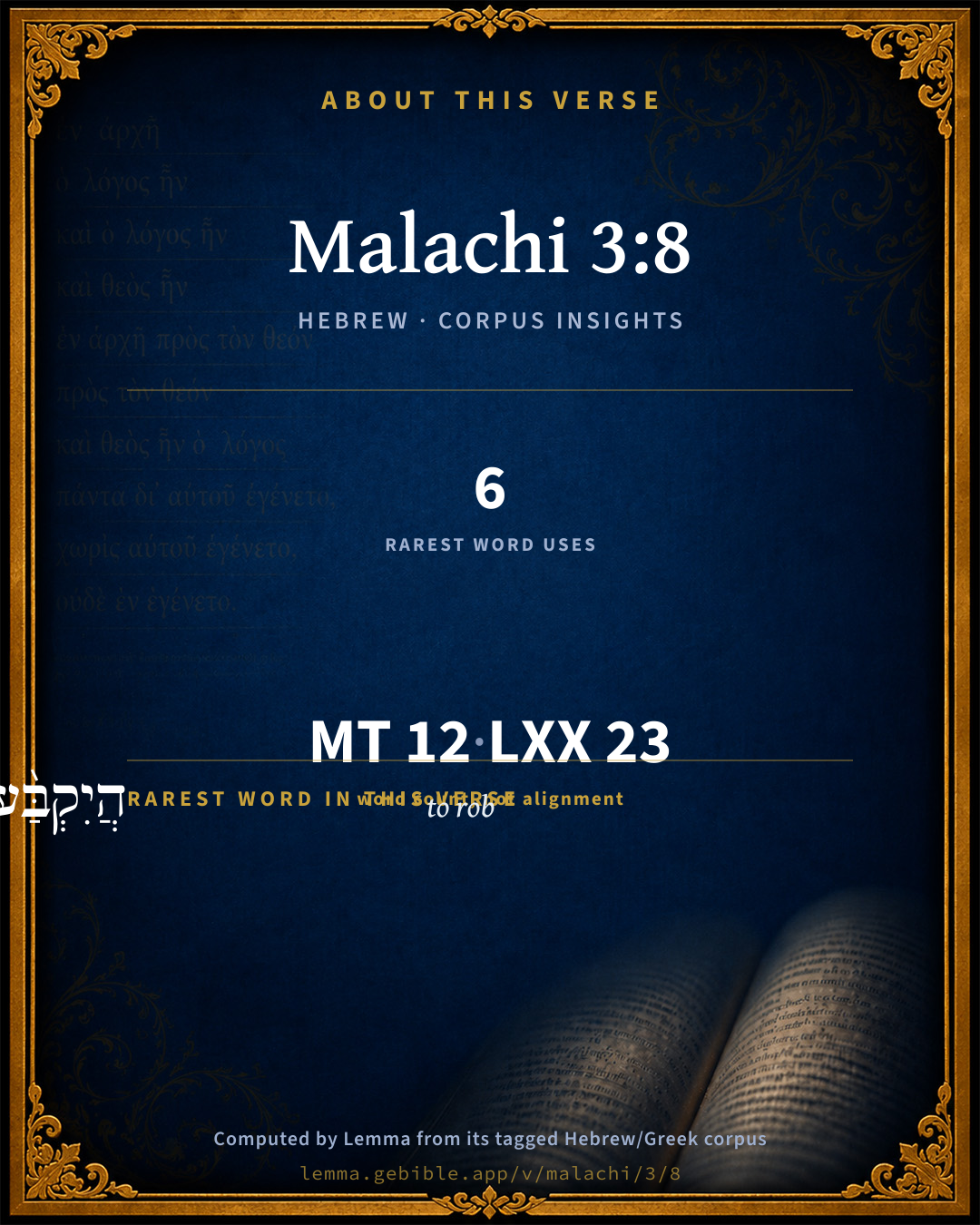
The rarest word here is הֲיִקְבַּ֨ע to rob H6906 — appearing just 6 times in the whole Hebrew Bible.

Shared distinctive vocabulary

הֲיִקְבַּ֨ע to rob H6906 occurs in 3 verses of the Hebrew Bible. Also found in:

Grammatical profile

  • 4 verbs
  • 4 nouns
  • 1 pronoun
  • 1 conjunction
  • 2 particles

Verb forms

  • הֲיִקְבַּ֨ע Qal · Imperfect
  • קֹבְעִ֣ים Qal · Participle Active
  • וַאֲמַרְתֶּ֖ם Qal · Sequential Perfect
  • קְבַעֲנ֑וּךָ Qal · Perfect

Repetition

A word recurs within this verse — often emphatic in Hebrew:

  • הֲיִקְבַּ֨ע to rob H6906 ×3

Hebrew & Septuagint length

In English translation the verse runs 21 words from the Hebrew and 28 from the Septuagint (LXX English) — closely comparable.

A rough comparison of the two English renderings, which tokenize alike — not a word-level alignment.

Word counts can differ between the Hebrew and the Greek without any difference in meaning — e.g. the Hebrew direct-object marker אֵת has no separate Greek word, and Greek often adds the article ὁ.

In the original languages it is 12 Hebrew tokens and 23 Greek tokens — but the two are counted differently (Hebrew bundles its prefixes and suffixes into one token; the Greek is in lemma form), so that isn’t a like-for-like length.

Cross-references

14

Topical passages linked to Malachi 3:8 in the Treasury of Scripture Knowledge — connected by theme and wording, ordered by reader-vote popularity; previews shown in the World English Bible.

  • Proverbs 3:9–10 Honor Yahweh with your substance, With the first fruits of all your increase:
  • Matthew 22:21 They said to him, "Caesar's." Then he said to them, "Give therefore to Caesar the things that are Caesar's, and to God the things that are God's."
  • Mark 12:17 Jesus answered them, "Render to Caesar the things that are Caesar's, and to God the things that are God's." They marveled greatly at him.
  • Psalms 29:2 Ascribe to Yahweh the glory due to his name. Worship Yahweh in holy array.
  • Numbers 18:21–32 To the children of Levi, behold, I have given all the tithe in Israel for an inheritance, in return for their service which they serve, even the service of the tent of meeting.
  • Malachi 1:13 You say also, 'Behold, what a weariness it is!' and you have sniffed at it," says Yahweh of Hosts; "and you have brought that which was taken by violence, the lame, and the sick; thus you bring the offering. Should I accept this at your hand?" says Yahweh.
  • Luke 20:25 He said to them, "Then give to Caesar the things that are Caesar's, and to God the things that are God's."
  • Leviticus 27:2–34 "Speak to the children of Israel, and say to them, 'When a man makes a vow, the persons shall be for Yahweh by your valuation.
  • Joshua 7:11 Israel has sinned; yes, they have even transgressed my covenant which I commanded them: yes, they have even taken of the devoted thing, and have also stolen, and dissembled also; and they have even put it among their own stuff.
  • Romans 2:22 You who say a man shouldn't commit adultery, do you commit adultery? You who abhor idols, do you rob temples?
  • Romans 13:7 Give therefore to everyone what you owe: taxes to whom taxes are due; customs to whom customs; respect to whom respect; honor to whom honor.
  • Nehemiah 13:4–14 Now before this, Eliashib the priest, who was appointed over the chambers of the house of our God, being allied to Tobiah,
  • Malachi 1:8 When you offer the blind for sacrifice, isn't that evil? And when you offer the lame and sick, isn't that evil? Present it now to your governor! Will he be pleased with you? Or will he accept your person?" says Yahweh of Hosts.
  • Leviticus 5:15–16 "If anyone commits a trespass, and sins unwittingly, in the holy things of Yahweh; then he shall bring his trespass offering to Yahweh, a ram without blemish from the flock, according to your estimation in silver by shekels, after the shekel of the sanctuary, for a trespass offering.

Cross-references courtesy of OpenBible.info (CC BY 4.0).

Hebrew and Greek witnesses Masoretic Hebrew ↔ Greek Septuagint

The same verse in the two great witnesses to the Old Testament, shown verse-for-verse.

These are two independent witnesses, not word-aligned to each other, and the Septuagint is shown in lemma (dictionary) form.

Hebrew Malachi 3:8 Masoretic · Westminster Leningrad Codex

הֲיִקְבַּ֨ע אָדָ֜ם אֱלֹהִ֗ים כִּ֤י אַתֶּם֙ קֹבְעִ֣ים אֹתִ֔י וַאֲמַרְתֶּ֖ם בַּמֶּ֣ה קְבַעֲנ֑וּךָ הַֽמַּעֲשֵׂ֖ר וְהַתְּרוּמָֽה

Will a man rob God? Yet you rob me! But you say, 'How have we robbed you?' In tithes and offerings.

World English Bible · Public Domain

Greek LXX Malachi 3:8 Septuagint · lemma form

εἰ πτερνίζω ἄνθρωπος θεός διότι σύ πτερνίζω ἐγώ καί εἶπον ἐν τίς πτερνίζω σύ ὅτι ὁ ἐπιδέκατος καί ὁ ἀπαρχή μετά σύ εἰμί

Will a man insult God? for you⌃ insult me. But you⌃ say, Wherein have we insulted you? In that the tithes and first fruits are with you still.

LXX2012 (modern English Septuagint) · Public Domain

On this verse, Trapp's Complete Commentary discusses the Septuagint’s reading. Read the note in Commentary ↓

Hebrew: Westminster Leningrad Codex (CC BY 4.0). Greek: Septuagint (public domain); English from LXX2012 (modern English Septuagint) (Public Domain). How the Septuagint differs from the Hebrew →

Targum (Aramaic paraphrase)

1

The Targum is the ancient Jewish Aramaic paraphrase of the Hebrew Scriptures — an interpretive translation, not the Hebrew text itself. Onkelos (literal) and Pseudo-Jonathan (expansive) render the Torah, and Jonathan the Prophets. Coverage is partial: where no permissively-licensed English translation exists for a verse, only the Aramaic is shown. This is verse-level text, not a word-by-word alignment to the Hebrew.

  1. Targum Jonathan Prophets (Joshua–Malachi)
    הַיַרְגֵז גְבַר קֳדָם דַיָנָא אֲרֵי אַתּוּן מַרְגְזִין קֳדָמַי וְאִם תֵּימְרוּן בְּמָא אַרְגֵזְנָא קֳדָמָךְ בְּמַעַשְׂרַיָא וּבִתְרוּמָתָא:

    (no public-domain English translation for this verse)

    Targum Jonathan — Aramaic: “Mikraot Gedolot” (public domain). English: “Sefaria Community Translation” (CC0 1.0 (public-domain dedication)); “London "Chaldee Paraphrase," 1871” (public domain). Text via Sefaria.

Commentary

Notes on Malachi 3:8 from classic Christian and Jewish commentators (each source and its license shown beneath its notes). The classic Christian expositions comment on the surrounding passage and are grouped to its opening verse, so a note may address several verses; the Jewish commentaries on the Tanakh (Rashi and others) are per-verse, so they appear only where the commentator wrote on this verse.

Lemma curates 59 commentaries, every one of them public domain or Creative Commons licensed, each selected and text-cleaned for this edition rather than reprinted as found. About our sources →

Trapp's Complete Commentary

John Trapp

Mal 3:8 Will a man rob God? Yet ye have robbed me. But ye say, Wherein have we robbed thee? In tithes and offerings.

Ver. 8. Will a man rob God?] Adam pillage Elohim? frail weak man seek to supplant (so the Septuagint render it) the great and mighty God? Giant-like boldness! Cacus met with his match when he robbed Hercules. Mercury, say the poets, had a mind to steal Jupiter’s thunderbolts, but dared not meddle, lest he should punish as Prometheus for stealing fire; or lest they should burn his fingers. The eagle in the fable, that stole a piece of flesh from the altar, and carried it together with a live coal, that stuck to it, to his nest, set his young and all on fire. Dionysius, that robbed his god, was cast out of his kingdom, though he was wont to boast, that he had it bound to him with chains of adamant. Belshazzar paid dearly for his bousing in the bowels of the sanctuary. Cardinal Wolsey, and five of his servants, employed by him in embezzling consecrated goods, though perhaps to better purposes, came all to fearful ends, as Scultetus noteth, and thereupon wisheth, Utinam his et similibus exemplis edocti discant homines res semel Deo consecratas timide attrectare. "It is a snare to the man that devoureth that which is holy," Pro 20:25. They may be compared to those who, being of a cold and phlegmatic stomach, eat hard and choleric meats; well they may please their palates, but it cannot be for their health: no more can the murdering morsels of such sacrilegious persons, as, devouring holy things, have their meat sauced and their drink spiced with the bitter wrath of God. See Job 20:23. Polanus reads the text thus, Will a man rob his gods? q.d. Will any heathen do so? did not they that worshipped idols abhor sacrilege? Was it not one of the laws of the twelve tables in Rome, Sacrum sacrove commendatum qui clepserit rapseritque, parricida esto, Let every sacrilegious person pass and be punished for a parricide? And doth not Cicero affirm those laws, that they did exceed all the libraries of the philosophers in weight and worth? Did not those old idolaters freely bestow their most precious things upon their idols, Eze 16:16-19 Exo 32:3, yea, their very children in sacrifice to Moloch, or Saturn? 2Ki 16:3; 2Ki 17:17; being as mad upon their idols as ever was any wicked wanton upon his harlot, lavishing out of the bag? &c. And are not our modern idolaters and Papists as bountiful to their he saints and she saints? so that their churches are not able to hold their vowed presents and memories, but that in many places, as at Loretto, Sichem, &c., they are fain to hang their cloisters and churchyards with them? Shall they in their petitions to our parliaments plead for favour and forbearance upon this ground, because their ancestors, they say, bestowed so great cost upon this land for church maintenance; and shall it be said (now that they are worthily cast out), Possidebunt Papistae, possident Rapistte, Wicked Papists had them, ungodly Rapists have them; Improprietaries, I mean, that hold by an improper title, and all others that appropriate that to them and theirs which the Almighty is invested in. This is here instanced as a capital crime, and called robbing God, as well it may; forasmuch as ministers’ maintenance (being tithes) is called the Lord’s, and holy to the Lord, Lev 27:30, because separated from man and man’s use, and therefore might not be altered, Lev 27:28. Or if any had a mind to redeem them, they were bound to add to the price every fifth penny above the true value, Lev 27:31. Let all those look to this, whether impropriators, false patrons ( latrones robbers rather), or others, that, either by force or fraud, rob God of his right ( Nunquid homo fraudabit Deum? sic vertunt Aquila, Symmachus et Theodotion); detaining part of the due at least, as Ananias and Sapphira did; God hath a Quare Impedit against them, which one day they must make answer to.

Yet ye have robbed me] Because ye have robbed my ministers, who are in my stead, 2Co 5:20, and in whom he receiveth tithes, of whom it is witnessed that he liveth, like as did Melchisedec, as a priest and tithe taker, and type of Christ Heb 7:7-9. And as God is sensible of the least courtesy done to a prophet to reward it, even to a cup of cold water, Mat 10:42 (so that he is a niggard to himself that scants his beneficence to a minister), so for those that wrong and rob them, that deny them that double honour of countenance and maintenance that he hath appointed them, and hold them to hard allowance; muzzling the ox, or giving him but straw at the best, for treading out the grain; they will dearly answer it before God, who holds all done to them as done to himself. Surely, as David could not but feel his own cheeks shaven and his own coat cut in his ambassadors; they did but carry his person to Hanun; so here. And as there was never any king so poor and weak but thought himself strong enough to revenge any wrong done or abuse offered to his ambassadors ( Legati quod erant appellati superbius, Corinthum Patres vestri totius Graeciae lumen extinctum esse voluerunt. Cic. pro lege Man.); so the king of heaven will not fail to curse with a curse whole nations that forget God and forsake his Levites, Deu 12:19, it being all one to God to deal in this case against a nation or against a man only, Job 34:29.

In tithes and offerings] He had told them before they had robbed him; or, as some read it, stabbed him as with a daggar. And here they should have confessed the action and craved pardon. But because they did nothing less, standing upon their justification (as before often), God descends to the particular wherein they robbed him, "In tithes and offerings." The original hath it, Tithes and offerings, without the particle (in); and it is as if the Lord should say, you may easily know my meaning without so many words, but that you love to contest. You cannot be ignorant that the Levites, for want of maintenance, are fled every man to his field, and so my work and worship is left undone. Good Nehemiah was sensible of it, Neh 13:10, and because he knew that by this means religion itself would be soon undermined and overturned, he contended with the rulers, and made all the people pay their tithes; and this he worthily reckons among his good deeds, praying God to remember him for it, and not wipe it out Neh 13:14. Hezekiah, that great reformer showed the like zeal in commanding the people that dwelt in Jerusalem to give the portion of the priests and Levites, that they might attend upon the law of the Lord (so the Vulgate), that they might be encouraged in the law of the Lord, so we read, 2Ch 31:4; that is, that they might not follow their callings heavily for want of maintenance, but cheerfully bend themselves wholly to the service of the Lord. And here (as Ferus once wished for the Romish synagogue) I would we had some Moses, said he, to take away the evils of the times; non enim unum tantum vitulum sed multos habemus, for we have not one golden calf, but many; so have we of these times cause to wish we had some zealous Nehemiahs and Hezekiahs to stickle and stand for Christ’s ministers, not defrauded of their due maintenance only (a sign of gasping devotion), but trampled upon by the foul feet of the basest of the people, as the filth of the world and the offscouring of all things. Tithes, they say, are Jewish; but if Melchisedec tithed Abraham by the same right whereby he blessed him, Heb 7:6, and if tithes by all laws of God, nature, nations, have been hallowed to God, as Junius and other modern divines allege and argue; and, lastly, if things consecrated to God’s service may not be alienated, out of case of necessity, Pro 20:25 Gal 3:15; it will appear to be otherwise. Or if tithes be Jewish, and yet ministers must have a maintenance (Christ having so ordained, 1Co 9:14), and that both honourable, 1Ti 5:17-18, and liberal, Gal 6:6, how else shall they be given to hospitality? 1Ti 3:2 (if they be not hospitable they will be despicable); how will men satisfy their consciences in the quota pars, the particular quantity they must bestow upon them? The Scripture speaketh only of the tenth part. Sed manum de tabula. Enough of this, if not more than enough.

John Trapp, A Commentary or Exposition upon All the Books of the Old and New Testament (1647–1656) — public domain. Text from a community e-Sword module.

Joseph Benson's Commentary

Mal 3:8-9. Will a man rob God — Grotius reads, “Would any one dare to rob his judges as ye have robbed me?” the word rendered God sometimes meaning judges or magistrates. Some others render the clause, Is it right that God should be robbed (or defrauded) by man? Here God gives them an answer to their question in the foregoing verse, Wherein shall we return; or, repent and amend? But ye have robbed me — Notwithstanding it is so unjust and presumptuous to defraud God, that men in general are afraid to do it, yet ye have done it. Do you ask, wherein you have robbed me? I answer, In tithes and offerings — By this seems to be meant the first-fruits of their ground and cattle, and other offerings which were allotted to the priests, Deu 18:4, out of which revenue they were to provide the daily sacrifices, and also maintain the Levites, who attended upon the service in the temple. Ye are cursed with a curse — Are greatly cursed, or, you lie under a heavy curse, and are likely still to do so, for the curse shall continue upon you while you continue in this your sinful course. For ye have robbed me, even this whole nation — This has not been the crime of a few only, but ye have in general defrauded me, and evil shall come upon you for it. In a note on Rom 2:22, where the apostle ranks sacrilege with idolatry, Grotius observes, “Non multum distat falsos deos colere et verum spoliare.” There is very little difference between adoring false gods and robbing the true God.

Joseph Benson's Commentary on the Old and New Testaments (1811–1818) — public domain. Text from a community e-Sword module.

Tyndale Open Study Notes

Tyndale Open Resources

3:8-9 Malachi appeals to Judah for a comprehensive renewal of their practice of giving to the Lord. • Tithes, a tenth of the produce of the land, were required offerings (see Deut 12:6, 11, 17). Offerings were additional gifts or contributions made to the Lord or his sanctuary that included produce, material goods (such as construction materials or garments), or personal valuables (such as gold, silver, or precious stones). • Judah’s recent experience resulted from God’s curse (see Deut 28:20, 27). Malachi thus urgently called the community to repent, turn to the Lord, and do what the covenant required.

Tyndale Open Study Notes — © Tyndale Open Resources, licensed CC BY-SA 4.0. Text via the HelloAO Bible API.

Geneva Bible (1599)

Geneva Bible translators

There are none of the heathen so barbarous, that will defraud their gods of their honor, or deal deceitfully with them.

Whereby the service of God should have been maintained, and the Priests and the poor relieved.

Geneva Bible (1599) marginal notes — public domain. Text via Bolls.life.

Jamieson, Fausset & Brown

Robert Jamieson, A. R. Fausset & David Brown

rob--literally, "cover": hence, defraud. Do ye call defrauding God no sin to be "returned" from (Mal 3:7)? Yet ye have done so to Me in respect to the tithes due to Me, namely, the tenth of all the remainder after the first-fruits were paid, which tenth was paid to the Levites for their support (Lev 27:30-33): a tenth paid by the Levites to the priests (Num 18:26-28): a second tenth paid by the people for the entertainment of the Levites, and their own families, at the tabernacle (Deu 12:18): another tithe every third year for the poor, &c. (Deu 14:28-29).

offerings--the first-fruits, not less than one-sixtieth part of the corn, wine, and oil (Deu 18:4; Neh 13:10, Neh 13:12). The priests had this perquisite also, the tenth of the tithes which were the Levites perquisite. But they appropriated all the tithes, robbing the Levites of their due nine-tenths; as they did also, according to JOSEPHUS, before the destruction of Jerusalem by Titus. Thus doubly God was defrauded, the priests not discharging aright their sacrificial duties, and robbing God of the services of the Levites, who were driven away by destitution [GROTIUS].

Jamieson, Fausset & Brown — Commentary Critical and Explanatory on the Whole Bible (1871) — public domain (CC PDM 1.0). Text via the HelloAO Bible API.

Adam Clarke's Commentary

Verse 8. Will a man rob God?] Here is one point on which ye are guilty; ye withhold the tithes and offerings from the temple of God, so that the Divine worship is neglected.

Adam Clarke's Commentary on the Bible (1810–1826) — public domain. Text from a community e-Sword/MySword module.

John Calvin's Commentaries

Will a man defraud the gods? Some give this version, “Will a man defraud God?” But it is strained and remote from the Prophet’s design; and they pervert the meaning. For I do not see what can be elicited from this rendering, “Will a man defraud God?” But there are other two meanings which may be taken. The first is, “Will a man defraud his gods?” The word אלהים, Aleim, though it be in the plural number, is applied, as it is well known, to the true God; but it is applied also to idols; and in this place the Prophet seems to me to compare the Jews to the Gentiles, that their impiety might be made more evident. The same is the object of Jeremiah, when he says,

“Go, and survey the islands, is there a nation which has changed its gods, while yet they are no gods.” (Jeremiah 2:10.)

Since their blindness and obstinacy held fast the Gentiles in darkness, that they continued to worship the gods to whom they had been accustomed, it was an abominable wickedness in the Jews, that having been taught to worship the true God, they were yet continually influenced by ungodly levity, and sought new modes of worship, as though they wished to devise another god for themselves. So also in this place the Prophet seems to bring forward the Gentiles as an example to the Jews; for they discharged their duty towards their gods; but the Jews despised the supreme and the only true God: “Behold,” he says, “go round the world, and ye shall not find among the nations so unbridled a liberty as prevails among you; for they render obedience to their gods, and sacrilege is abominable to them; but ye defraud me. Am I inferior to idols? or is my state worse than theirs?”

Some take the word אלהים, Aleim, for judges, as judges are sometimes so named; but this meaning seems not suitable on account of the word, Adam. As then this word generally means man, the Prophet, I have no doubt, intimates what I have stated, — that unbelievers, though sunk in darkness, are yet restrained by reverence and fear from changing their deity, and that they dare not to show levity when the name only of their god is pronounced. Since then such humility prevailed among unbelievers, could the impiety of that people, who had been trained up in the law, be excusable? a people too, upon whom God had ever made the doctrine of the law to shine.

He afterwards adds, Because ye have defrauded me; and ye have said, Thereby have we defrauded thee? In tenths and in oblations Here the Prophet again proves the people guilty of perverseness: it was indeed hypocrisy, and though gross, it was yet surpassed by impudence; for they asked, whereby they had defrauded God? and yet this was evident even to children: for we know, and we have seen elsewhere, that avarice so ruled among them, that every one, bent on their own profit, neglected the temple and the priests. Since then they were openly sacrilegious, how shameless they must have been to ask whereby they had defrauded God! The thing itself was indeed manifest and commonly known, so that children could see it. God however deemed it enough to convict them by one sentence, — that they defrauded him in the tenths and in the first-fruits; not that any advantage accrued to him from oblations, as he had no need of any such things; but he rightly calls and counts that his own which he had appointed for his own service. Since then he had instituted that order among the Jews, that they might by the tenths support the priests, and a part also was required for the poor, since God designed the firstfruits and other things to be offered to him, that men might thereby be continually reminded, that all things were his, and that whatever they received from his hand was sacred to him, he had previously called the bread laid on the table his own, and had called the sacrifices his own food, as though he did eat and drink. But as I have already said, we ought to regard the object in view, because his will was to be thus worshipped, and at the same time to keep as his own whatever belonged to his service. This then is the reason why he now complains of being defrauded of the tenths.

But we know that other sacrifices are now prescribed to us; and after prayer and praises, he bids us to relieve the poor and needy. God then, no doubt, is deprived by us of his right, when we are unkind to the poor, and refuse them aid in their necessity. We indeed thereby wrong men, and are cruel; but our crime is still more heinous, inasmuch as we are unfaithful stewards; for God deals more liberally with us than with others, for this end — that some portion of our abundance may come to the poor; and as he consecrates to their use what we abound in, we become guilty of sacrilege whenever we give not to our brethren what God commands us; for we know that he engages to repay, according to what is said in Proverbs 19:17, “He who gives to the poor lends to God.”

John Calvin's Commentaries (1540-1563) — public domain. Text from the Calvin Translation Society English edition (1840s-50s) via the Christian Classics Ethereal Library (ccel.org). Calvin's coverage is partial (roughly two-thirds of the Bible); uncommented books and verses are honest gaps, never fabricated. The 19th-century editor's footnotes and remarks are omitted so the notes are faithfully Calvin's own voice.

Ellicott's Commentary for English Readers

(8) Robbed me.—Because the tithes are said to be offered to Jehovah, and then He gives them to the Levites in place of an inheritance (Num_18:24).

In tithes and offerings.—See Notes on Exo_23:19; Lev_27:30-33; Num_18:12; Num_18:21-24; Deu_18:4; Lev_3:1-17; Lev_7:11-21; Lev_7:28-36.

A Bible Commentary for English Readers, edited by Charles John Ellicott (1878–1897) — public domain. Text from a community e-Sword module.

The Cambridge Bible for Schools and Colleges

gen. ed. J. J. S. Perowne

8. ye have robbed] Rather, rob; lit. are robbing: it is still going on.

tithes] By the Law of Moses (1) “the tenth of all produce, as well as of flocks and cattle, belongs to Jehovah and must be offered to Him” (Lev_27:30; Lev_27:32); and (2) this tenth is “assigned to the Levites as the reward of their services” (Num_18:21; Num_18:24). Nehemiah in his day had to deal once and again with the evil here rebuked. Notwithstanding the “sure covenant” into which they had entered (Neh_9:38 with Neh_10:32-39), he had occasion, on his return to Jerusalem after an absence of a few years, to reform them again in this very particular (Neh_13:10-14).

The Cambridge Bible for Schools and Colleges (gen. ed. J. J. S. Perowne; Cambridge University Press, 1878–1918) — public domain. Text from a community e-Sword module.

John Gill's Exposition

Will a man rob God?.... Or "the gods"; the false gods, the idols of the Gentiles; the Heathens will not do that, accounting sacrilege a great sin, and yet this the Jews were guilty of: or "the judges" (c), as the Targum; civil magistrates; will any dare to defraud them of their due? see Mal 1:8.

Yet ye have robbed me; keeping back from the priests and Levites, his ministers, what was due to them; and which, being no other than a spoiling or robbing of them, might be interpreted a robbing of God:

But ye say, wherein have we robbed thee? as not being conscious of any such evil; or, however, impudently standing in it, that they were not guilty: to which is returned the answer,

In tithes and offerings; that is, they robbed God in not giving the tithes, and not offering sacrifices, according as the law required: but it may be objected, that the Jews in Christ's time did pay tithes, even of all things; yea, of more than the law required, Mat 23:23 to which it may be replied, that though they gave tithes, yet it was , "with an evil eye", as Aben Ezra says; grudgingly, and not cheerfully, and with an evil intention; not to show their gratitude to God, and their acknowledgment of him as their Lord, from whom they had their all, but in order to merit at his hands; besides, our Lord suggests that they did not give to God the things that were God's, Mat 22:21 and the apostle charges them with being guilty of sacrilege, Rom 2:22 and, moreover, the priests might not give it to the Levites, as they ought; and which is what they are charged with in Neh 13:10 and Grotius says that they were guilty of this before the destruction by Vespasian, as appears by Josephus.

(c) "deos, vel judices", Calvin, Drusius, Grotius.

John Gill's Exposition of the Whole Bible (1746–1763) — public domain (CC PDM 1.0). Text via the HelloAO Bible API.

Albert Barnes' Notes on the Bible

Shall a man rob or cheat - , defraud God? God answers question by question, but thereby drives it home to the sinner’s soul, and appeals to his conscience. The conscience is steeled, and answers again, “In what?” God specifies two things only, obvious, patent, which, as being material things, they could not deny. “In tithes and offerings.” The offerings included several classes of dues to God:

(a) the first fruits ;

(b) the annual half-shekel Exo 30:13-15;

(c) the offerings made for the tabernacle Exo 25:2-3; Exo 35:5, Exo 35:21, Exo 35:24; Exo 36:3, Exo 36:6 and the second temple Ezr 8:25 at its first erection; it is used of ordinary offerings;

(d) of the tithes of their own tithes, which the Levites paid to the priests Num 18:26, Num 18:28-29;

(e) of the portions of the sacrifice which accrued to the priests Lev 7:14.

Albert Barnes' Notes on the Bible (1834–1885) — public domain. Text from a community e-Sword/MySword module.

Haydock's Catholic Bible Commentary

Afflict. Literally, "pierce." Septuagint, "supplant," (Haydock) or kick at, 1 Kings ii. 29. But the term applied to Heli is different. Here it signifies to nail or irritate. (Calmet) --- Tithes: the payment is most strictly commanded. (Worthington)

George Leo Haydock (1774–1849), Haydock's Catholic Family Bible and Commentary, 1859 edition — public domain. Excludes Psalms (Douay-Rheims chapter numbering differs from Protestant) and Deuterocanonical books (Catholic canon only).

Matthew Poole's English Annotations

Will a man rob God? among the many deviations from God’s law (which they do not, because they will not, see) the prophet chargeth them with this kind of sacrilegious theft; they had detained his tithes, shortened him in that portion which he had reserved to himself and for his service, which is, as our version expresseth it, a robbing of God. And as the words lie in the original, they do, by arguing from the less to the greater, aggravate this sin; as they may be read, Will a man rob a great man, or, a judge? for the word used will bear these notions. Or, Will a man rob the gods? i.e. do not heathens abhor the foulness of such a fault, and fear the punishment of sacrilege, and therefore would not rob their idols? as another prophet asked once the question, Have any of

the nations changed their gods, which yet are no gods? Jer 2:11; so now, Have the nations robbed their gods? Yet ye have robbed me; but blush, ye shameless priests and Jews, you have robbed not a great man, but the great God; not judges, but the Judge of judges; not an idol, but the living God! How great is your crime!

Wherein have we robbed thee? a question just like those Mal 1:7; 2:17; 3:7, which see.

In tithes: the people robbed God not paying the full tenth, which God appointed should be paid to him. The priests robbed God in tithes, while they took too much, or it may be all, for their own particular and family use, and did not distribute them to all that by God’s law had a right to a proportion of them.

And offerings; either first-fruits, or other oblations and gifts, which were appointed to be brought to the temple for the service of God; in all which the people and priests had given him less than his due.

Matthew Poole's English Annotations on the Holy Bible (1683–1685) — public domain. Text from a community e-Sword/MySword module.

Whedon's Commentary on the Bible

Daniel D. Whedon

8. The reply is in the form of a question.

Will a man rob God? — A better translation of the first two clauses would be, “Will a man rob God, that you rob me?” (Compare Amo_6:12.) A question of astonishment that anyone should think of such a preposterous thing; and yet they have done it and are still doing it. The verb is unquestionably used in the sense of “defraud” — they do not pay their just dues; but there seems to be insufficient reason for substituting a different verb in Hebrew. Again an attempt is made to combat the prophet, and again he meets the objection.

In tithes and offerings — These they have withheld, and by doing so they have defrauded Jehovah. The last word means literally peace offering (compare Eze_44:30; Neh_10:39), which belongs to the priests (Eze_44:30); here it includes every offering due to Jehovah. How they are defrauding him is stated in Mal_1:6-14. The regulation of the tithes is found in Deu_14:22 ff.; Lev_27:30 ff.; Num_18:21 ff. (compare Amo_4:4); they also went to those ministering in the sanctuaries. Some portion they may have given, but not the proper percentage (compare Act_5:1 ff.). 9.

You are cursed with a curse — Jehovah has already shown his displeasure, and still they continue in the evil ways. Wherein the curse consisted is not stated, but Mal_3:10-12 imply that it came in the form of drought, poor harvests, and perhaps a plague of locusts. The curse has fallen upon the whole nation, because the whole nation has defrauded him.

In Mal_3:10 the prophet returns to the question asked in Mal_3:7; he informs his hearers wherein they should return.

Bring ye all the tithes — R.V., “the whole tithe.” The emphasis is upon whole; fraud is to cease, and they are to bring to Jehovah his full share.

Storehouse — Connected with the temple and built for the purpose of receiving gifts of this sort (Compare 2Ch_31:11-12; Neh_10:38-39).

Meat — R.V., “food”; both for Jehovah (see on Mal_1:7) and for the ministering priests and Levites.

Prove me — Whether or not he is the God he was in the days when he chose Israel (Mal_3:6), the God of judgment (Mal_2:17), who rewards the good. That he punishes the evil they should have discovered long ago (Mal_3:9; Mal_3:11-12).

Herewith — Giving to Jehovah all his dues.

If I will not — May be translated “surely I will.”

Open… the windows of heaven — A figure denoting abundance of supply; the blessings will come like pouring rain (Gen_7:11; Isa_24:18; compare 2Ki_7:2).

There shall not be room enough — Literally, until there is no need, which means, in superabundance. While the whole of Mal_3:10 may be understood as a promise of blessings of every sort, in view of Mal_3:11-12 it is not improbable that the prophet has in mind a specific blessing, abundant rain, the lack of which has caused the harvests to fail (compare Joe_1:16-20; Joe_2:23; Amo_4:7-8).

Rebuke — The rebuke of Jehovah will cause flight or destruction.

The devourer — The locust, so called because of his destructiveness (see on Joe_1:7; compare Amo_4:9).

For your sakes — Who in those days will deserve the favor of Jehovah.

Your vine cast her fruit before the time — Before it ripens and brings benefit to the owner.

Field — See on Joe_1:11.

Daniel D. Whedon (gen. ed.), Commentary on the Old and New Testaments (1874–1909) — public domain. Text from a community e-Sword module.

The Pulpit Commentary

Will a man rob God? The prophet shows the people how they have departed from God, in not keeping even the outward observances of religion. The word translated "rob," defraud, found also in Pro_22:23, etc., is rendered in the Septuagint, pterniei , "trip up," "supplant;" Vulgate, si affliget homo Deum, or, as St. Jerome first translated, "si affiget homo Deum," and referred the words to the crucifixion of our Lord. In tithes and offerings. These were due to the Lord, and therefore in withholding them they were defrauding not man but God. (For tithe, see Lev_27:30, etc.; Num_18:21. See the complaint of Nehemiah, Neh_13:10-12) The "offering" meant is the heave offering, the breast and shoulder of the peace offering, which were the priests" portion. (Exo_29:27 Lev_7:14, Lev_7:32-34; comp. Neh_10:37-39)

Defrauding God.

The people of Malachi"s days met his reproof in a quibbling and self-justifying spirit. Men who are self-satisfied can resist all appeal. Religious formalities have this as their supreme peril they satisfy men, and prevent them from feeling moral and spiritual anxieties, and from responding to moral and spiritual demands. These men could not see that there was any sense in which they were depriving God of his rights. The prophet puts his finger on one thing. That suffices to prove his accusation. They were withholding and limiting the tithes and offerings due to God"s house. How could citizens be loyal who neglected to pay in those taxes of the king which were the very sign of loyalty? "One might reasonably think such a presumption could not enter into any man"s thoughts, as to rob God of those things which are dedicated to his service; when he considers that he hath received all things from him, and therefore ought in gratitude to set apart some share of his substance for the maintaining of his worship and the public exercises of religion" (Louth). Consider

I WHAT GOD"S CLAIMS ON MEN ARE.

1. His natural claims, as the Author, Designer, Creator, practical Arranger of man"s body, life, relations, and associations. See the rights of a man in the house he builds, the garden he lays out, the machine he makes, the child he rears. Of everything that a man does he expects some appropriate form of return.

2. His revelational claims. Israel was under special obligation because it had received special revelation.

3. His experimental claims. He had gained rights, and reasonably formed expectations, out of his pitiful and gracious dealings through long years.

II ON WHAT BASIS DO GOD"S CLAIMS REST. Not merely the supreme rights of Deity; but here especially man"s own acceptance of his claims. Claims are sterner things when they are both made and accepted.

III HOW GOD"S CLAIMS MAY BE NEGLECTED OR REFUSED.

1. By the delusion that those claims have been relaxed.

2. By the hope that something can be put in place of obedience to them.

3. By sheer listlessness.

4. By persistent wilfulness.

5. But it is more subtle and searching to say God"s claims are now chiefly missed through man"s over occupation.

The world and self fill men up.

IV HOW IS SUCH NEGLECT OF GOD"S CLAIMS TO BE DEALT WITH?

1. Call it by its right name robbing God.

2. Bring discipline to bear upon the neglecters, etc. R.T.

The Pulpit Commentary (1880–1919), ed. H.D.M. Spence-Jones & Joseph S. Exell — public domain. Text from a community e-Sword module.

MacLaren's Expositions of Holy Scripture

Alexander MacLaren

Malachi

THE LAST WORD OF PROPHECY

Mal 3:1 - Mal 3:12.

Deep obscurity surrounds the person of this last of the prophets. It is questioned whether Malachi is a proper name at all. It is the Hebrew word rendered in Mal 3:1 of our passage ‘My messenger,’ and this has led many authorities to contend that the prophecy is in fact anonymous, the name being only a designation of office. Whether this is so or not, the name, if it is a name, is all that we know about him. The tenor of his prophecy shows that he lived after the restoration of the Temple and its worship, and the sins which he castigates are substantially those with which Ezra and Nehemiah had to fight. One ancient Jewish authority asserts that he was Ezra; but the statement has no confirmation, and if it had been correct, we should not have expected that such an author would have been anonymous. This dim figure, then, is the last of the mighty line of prophets, and gives strong utterance to the ‘hope of Israel’! One clear voice, coming from we scarcely know whose lips, proclaims for the last time, ‘He comes! He comes!’ and then all is silence for four hundred years. Modern critics, indeed, hold that the bulk of the Psalter is of later date; but that contention has much to do before it can be regarded as established.

The first point worthy of notice in this passage, then, is the concentration, in this last prophetic utterance, of that element of forward-looking expectancy which marked all the earlier revelation. From the beginning, the selectest spirits in Israel had set their faces and pointed their fingers to a great future, which gathered distinctness as the ages rolled, and culminated in the King from David’s line, of whom many psalms sung, and in the suffering Servant of the Lord, who shines out from the pages of the second part of Isaiah’s prophecy. This Messianic hope runs through all the Old Testament, like a broadening river. ‘They that went before cried, Hosanna! Blessed is He that cometh.’

That hope gives unity to the Old Testament, whatever criticism may have to teach about the process of its production. The most important thing about the book is that one purpose informs it all; and the student who misses the truth that ‘the testimony of Jesus is the spirit of prophecy’ has a less accurate conception of the meaning and inter-relations of the Old Testament than the unlearned who has accepted that great truth. We should be willing to learn all that modern scholarship has to teach about the course of revelation. But we should take care that the new knowledge does not darken the old certainty that the prophets ‘testified beforehand of the sufferings of Christ and of the glory that should follow,’ Here, at the very end, stands Malachi, reiterating the assurance which had come down through the centuries. The prophets, as it were, had lit a beacon which flamed through the darkness. Hand after hand had flung new fuel on it when it burned low. It had lighted up many a stormy night of exile and distress. Now we can dimly see one more, the last of his order, casting his brand on the fire, which leaps up again; and then he too passes into the darkness, but the beacon burns on.

The next point to note is the clear prophecy of a forerunner. ‘My messenger’ is to come, and to ‘prepare the way before Me.’ Isaiah had heard a voice calling, ‘Prepare the way of the Lord,’ and Malachi quotes his words, and ascribes the same office to the ‘messenger.’ In the last verses of his prophecy he calls this messenger ‘Elijah the prophet.’ Here, then, we have a remarkable instance of a historical detail set forth in prophecy. The coming of the Lord is to be immediately preceded by the appearance of a prophet, whose function is to effect a moral and religious reformation, which shall prepare a path for Him. This is no vague ideal, but definite announcement of a definite fact, to be realised in a historical personality. How came this half-anonymous Jew, four hundred years beforehand, to hit upon the fact that the next prophet in Israel would herald the immediate coming of the Lord? There ought to be but one answer possible.

Another point to note is the peculiar relation between Jehovah and Him who comes. Emphatically and broadly it is declared that Jehovah Himself ‘shall suddenly come to His temple’; and then the prophecy immediately passes on to speak of the coming of ‘the Messenger of the covenant,’ and dwells for a time exclusively on his work of purifying; and then again it glides, without conscious breach of continuity or mark of transition, into, ‘And I will come near to you in judgment.’ A mysterious relationship of oneness and yet distinctness is here shadowed, of which the solution is only found in the Christian truth that the Word, which was Grod, and was in the beginning with God, became flesh, and that in Him Jehovah in very deed tabernacled among men. The expression ‘the Messenger {or Angel} of the covenant’ is connected with the remarkable representations in other parts of the Old Testament, of ‘the Angel of Jehovah,’ in whom many commentators recognise a pre-incarnate manifestation of the eternal Word. That ‘Angel’ had redeemed Israel from Egypt, had led them through the desert, had been the ‘Captain of the Lord’s host.’ The name of Jehovah was ‘in Him.’ He it is whose coming is here prophesied, and in His coming Jehovah comes to His temple.

We next note the aspect of the coming which is prominent here. Not the kingly, nor the redemptive, but the judicial, is uppermost. With keen irony the Prophet contrasts the professed eagerness of the people for the appearance of Jehovah and their shrinking terror when He does come. He is ‘the Lord whom ye seek’; the Messenger of the covenant is He ‘whom ye delight in.’ But all that superficial and partially insincere longing will turn into dread and unwillingness to abide His scrutiny. The images of the refiner’s fire and the fullers’ soap imply painful processes, of which the intention is to burn out the dross and beat out the filth. It sounds like a prolongation of Malachi’s voice when John the Baptist peals out his herald cry of one whose ‘fan was in His hand,’ and who should plunge men into a fiery baptism, and consume with fire that destroyed what would not submit to be cast into the fire that cleansed. Nor should we forget that our Lord has said, ‘For judgment am I come into the world.’ He came to ‘purify’; but if men would not let Him do what He came for, He could not but be their bane instead of their blessing.

The stone is laid. If we build on it, it is a sure foundation; if we stumble over it, we are broken. The double aspect and effect of the gospel, which was meant only to have the single operation of blessing, are clearly set forth in this prophecy, which first promises purging from sin, so that not only the ‘sons of Levi’ shall offer in righteousness, but that the ‘offerings of Judah and Jerusalem shall be pleasant,’ and then passes immediately to foretell that God will come in judgment and witness against evil-doers. Judgment is the shadow of salvation, and constantly attends on it. Neither Malachi nor the Baptist gives a complete view of Messiah’s work, but still less do they give an erroneous one; for the central portion of both prophecies is His purifying energy which both liken to cleansing fire.

That real and inward cleansing is the great work of Christ. It was wrought on as many of His contemporaries as believed on Him, and for such as did not He was a swift Witness against them. Nor are we to forget that the prophecy is not exhausted yet; for there remains another ‘day of His coming’ for judgment. The prophets did not see the perspective of the future, and often bring together events widely separated in time, just as, to a spectator on a mountain, distances between points far away towards the horizon are not measurable. We have to allow for foreshortening.

This blending of events historically widely apart is to be kept in view in interpreting Malachi’s prediction that the coming would result in Judah’s and Israel’s offerings being ‘pleasant unto the Lord as in former years.’ That prediction is not yet fulfilled, whether we regard the name of Israel and the relation expressed in it as having passed over to the Christian Church, or whether we look forward to that bringing in of all Israel which Paul says will be as ‘life from the dead.’ But by slow degrees it is being fulfilled, and by Christ men are being led to offer up spiritual sacrifices, acceptable to God.

The more directly Messianic part of this prophecy is closed in Mal 3:6 by a great saying, which at once gives the reason for the coming and for its severe aspect of witness against sin. The unchangeableness of God, which is declared in His very name, guarantees the continued existence of Israel. As Paul says in regard to the same subject, ‘The calling of God is without change of purpose’ {on His part}. But it is as impossible that God should leave them to their sins, which would destroy them, as that He should Himself consume them. Therefore He will surely come; and coming, will deliver from evil. But they who refuse to be so delivered will forfeit that title and the pledge of preservation which it implies.

A new paragraph begins with Mal 3:7, which is not closely connected with the promises preceding. It recurs to the prevailing tone of Malachi, the rebuke of negligence in attending to the legal obligations of worship. That negligence is declared to be a reason for God’s withdrawal from them. But the ‘return,’ which is promised on condition of their renewed obedience, can scarcely be identified with the coming just foretold. That coming was to bring about offerings of righteousness which should be pleasant to the Lord. This section {Mal 3:7 - Mal 3:12} promises blessings as results of such offerings, and a ‘return’ of Jehovah to His people contingent upon their return to Him. If the two sections of this passage are taken as closely connected, this one must describe the consequences of the coming. But, more probably, this accusation of negligence and promise of blessing on a change of conduct are independent of the previous verses. We, however, may fairly take them as exhibiting the obligations of those who have received that great gift of purifying from Jesus Christ, and are thereby consecrated as His priests.

The key-word of the Christian life is ‘sacrifice’-surrender, and that to God. That is to be stamped on the inmost selves, and by the act of the will, on the body as well. ‘Yield yourselves to God, and your members as instruments of righteousness to Him.’ It is to be written on possessions. Malachi necessarily keeps within the limits of the sacrificial system, but his impetuous eloquence hits us no less. It is still possible to ‘rob God.’ We do so when we keep anything as our own, and use it at our own will, for our own purposes. Only when we recognise His ownership of ourselves, and consequently of all that we call ‘ours,’ do we give Him His due. All the slave’s chattels belong to the owner to whom he belongs. Such thorough-going surrender is the secret of thorough possession. The true way to enjoy worldly goods is to give them to God.

The lattices of heaven are opened, not to pour down, as of old, fiery destruction, but to make way for the gentle descent of God’s blessing, which will more than fill every vessel set to receive it. This is the universal law, not always fulfilled in increase of outward goods, but in the better riches of communion and of larger possession in God Himself. He suffers no man to be His creditor, but more than returns our gifts, as legends tell of some peasant who brought his king a poor tribute of fruits of his fields, and went away from the presence-chamber with a jewel in his hand.

Alexander MacLaren, Expositions of Holy Scripture (1904–1910) — public domain. Text from a community e-Sword module.

unfoldingWord translationNotes

Door43 World Missions Community

General Information:

Yahweh continues to speak to the people of Israel.

Would a person rob God?

This question implies that the idea of robbing God is very wicked. This can be expressed as a statement. God speaks of himself in the third person AT: "A man should certainly not rob God." or "No one should ever rob me." (See: Rhetorical Question and First, Second, or Third Person)

How have we robbed you?

This question implies that the people do not think they have robbed God. AT: "We have certainly not robbed you." (See: Rhetorical Question)

In tithes and offerings

This reply from Yahweh implies a fuller answer. AT: "You have robbed me by withholding from me your tithes and offerings" (See: Assumed Knowledge and Implicit Information)

You are cursed with a curse

This can be stated in active form. AT: "I have certainly cursed you" (See: Active or Passive)

you are robbing me, the whole nation

Here "nation" stands for the people to whom Yahweh is speaking. AT: "all of you in the whole nation are robbing me"

translationWords

God

tenth

curse

nation

unfoldingWord translationNotes — © Distant Shores Media and the Door43 World Missions Community, licensed CC BY-SA 4.0. Source: git.door43.org/Door43/en_tn.

Rashi

Rabbi Shlomo Yitzchaki (Rashi)

Will a man rob Our Sages explained this as an expression of robbery, and it is an Aramaism.

With tithes and with the terumah levy The tithes and the terumah - levy that you steal from the priests and the Levites is tantamount to robbing Me.

Rashi on the Tanakh — English translations: “The Judaica Press complete Tanach with Rashi, translated by A. J. Rosenberg” (CC BY 4.0); “Pentateuch with Rashi's commentary by M. Rosenbaum and A.M. Silbermann, 1929-1934” (public domain); “The Metsudah Tanach series, Lakewood, N.J” (CC BY 4.0); and “The Book of Joshua, Metsudah Publications, 1997” (CC BY 4.0). Text via Sefaria.

Lesson kit

Teaching starters — assembled from the data on this page, not authored interpretation. Every prompt links to the verse data it draws on. Edit before teaching.

Malachi, in the Prophets, opens this verse with 12 words (10 distinct Hebrew lemmas). Its most distinctive word is qâbaʻ (“to rob”). A historical commentator’s framing appears above. Read the whole chapter for the surrounding context.

Discussion questions

  1. What does “to rob” (qâbaʻ) contribute to the verse as a whole?
  2. Proverbs 22:23 shares the word «to rob» with this verse. How do the two illuminate each other?
  3. “to rob” occurs 3× in this one verse. What is the effect of the repetition?
  4. These translations render this verse differently. What is at stake in choosing one wording over another?
  5. The verb «הֲיִקְבַּ֨ע» is Qal Imperfect. How does its form color the action?
  6. Reading how Trapp's Complete Commentary and Joseph Benson's Commentary read this verse, where do the two commentators agree and where do they part?

Things to notice

Reading settings

Reading text

Shown beneath each verse's original-language words.

Old Testament
Old Testament edition

Read the OT as the Masoretic Hebrew (MT) or the Greek Septuagint (LXX).

English shown for the Greek Septuagint (in the Hebrew ↔ Greek comparison).

Comparing translations? Open the Compare panel on any verse page to stack up to four side by side.