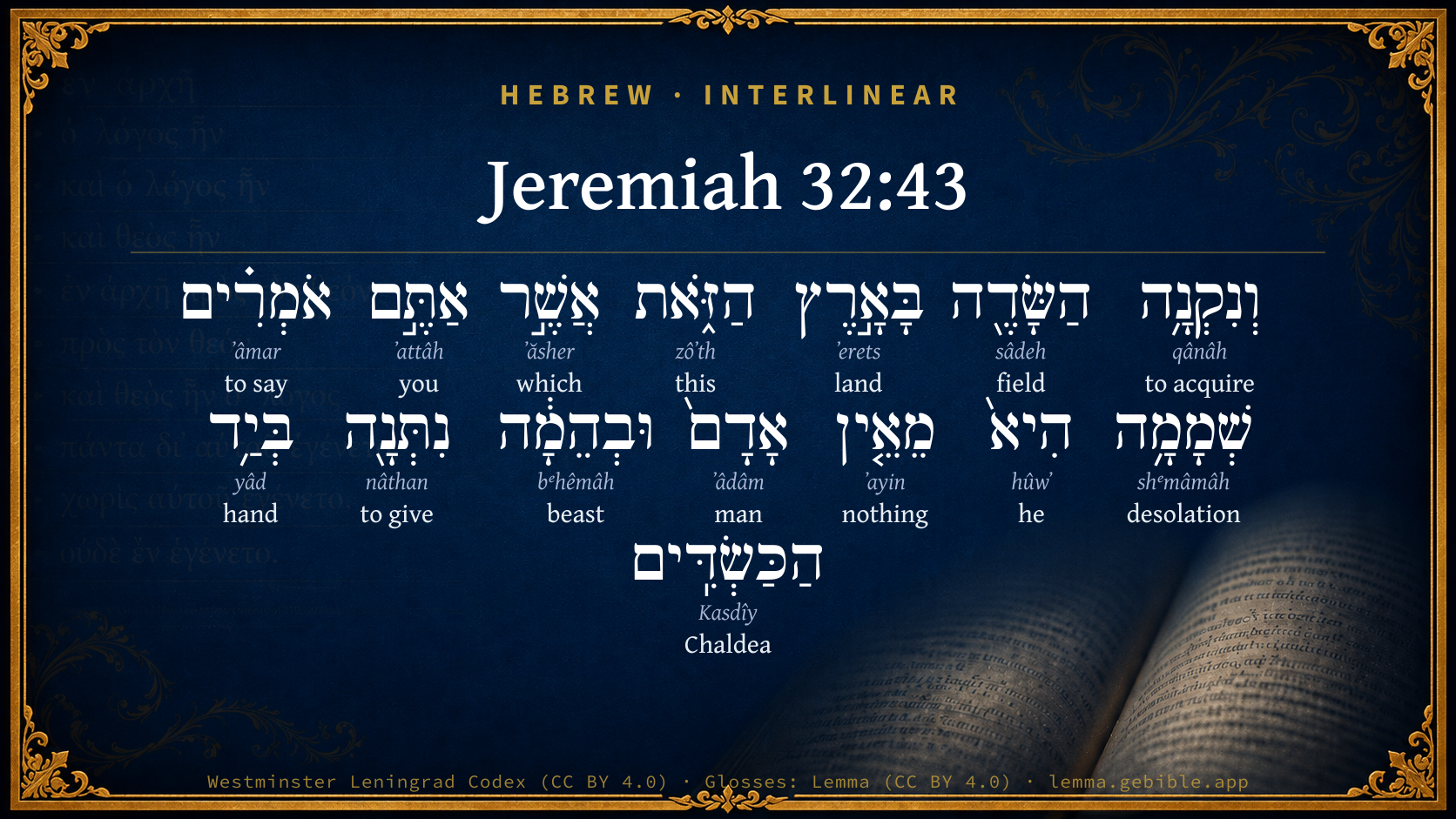
Jeremiah 32:43

Hebrew (Westminster Leningrad Codex) Jeremiah 32:43 appears in the Hebrew Old Testament. The text above is from the Westminster Leningrad Codex. Each word links to its Strong’s number, a concise gloss, and parsing drawn from the Open Scriptures Hebrew Bible morphology. Click any word for its full Brown-Driver-Briggs (BDB) entry.
Download image
Cite this verse

Jeremiah 32:43 (World English Bible). Public Domain. Lemma interlinear Bible study tool, https://lemma.gebible.app/v/jeremiah/32/43.

Show BibTeX & RIS
BibTeX
RIS
English Translation
Fields shall be bought in this land, about which you say, It is desolate, without man or animal; it is given into the hand of the Chaldeans.
World English Bible · Public Domain
Download a study sheet

One document with this verse’s original text, its word-by-word gloss line, the meaning frame, cross-references with their text, attributed commentary, and full source and license credits — printable, and it pastes into notes with its structure intact.

This verse Autodidact and up

Study sheet (.html) Plain text (.txt)

A passage Seminary Student

Up to 50 verses in one chapter. A passage sheet keeps up to 6 commentary sources and 12 cross-references per verse, in the order this page ranks them, and says so on the sheet whenever that leaves anything out. Ask for a single verse and you get the Autodidact verse sheet above.

Everything on this page stays free to read, with no account — the sheet is a download of what is already on screen, not access to it.

Want to remove ads? Support Godless Engineer
Compare translations 3

The same verse in 3 English versions, stacked beneath the original-language interlinear above. Click any original word for its lexicon entry.

Each is an independent rendering of the whole verse — the interlinear is not word-aligned to these translations.

Highlighted words mark where these versions differ — a whole-verse word diff, not a word-by-word alignment.

  • World English Bible Public Domain
    Fields shall be bought in this land, about which you say, It is desolate, without man or animal; it is given into the hand of the Chaldeans.
  • King James Version Public Domain
    And fields shall be bought in this land, whereof ye say, It is desolate without man or beast; it is given into the hand of the Chaldeans.
  • unfoldingWord Literal Text CC BY-SA 4.0
    Then fields will be bought in this land, about which you are saying, “This is a ruined land, which has neither man nor beast. It has been given into the hand of the Chaldeans.”

unfoldingWord Literal Text — © unfoldingWord, licensed CC BY-SA 4.0. Word-aligned USFM3 via Door43 (git.door43.org/unfoldingWord/en_ult).

Versions to compare (up to 4)

3 of 4 selected

Show all 18 translations

Every available English version of this verse, each an independent rendering of the whole verse.

  • World English Bible Public Domain
    Fields shall be bought in this land, about which you say, It is desolate, without man or animal; it is given into the hand of the Chaldeans.
  • Berean Standard Bible Public Domain
    And fields will be bought in this land about which you are saying, ‘It is a desolation, without man or beast; it has been delivered into the hands of the Chaldeans.’
  • Majority Standard Bible Public Domain
    And fields will be bought in this land about which you are saying, ‘It is a desolation, without man or beast; it has been delivered into the hands of the Chaldeans.’
  • King James Version Public Domain
    And fields shall be bought in this land, whereof ye say, It is desolate without man or beast; it is given into the hand of the Chaldeans.
  • American Standard Version (1901) Public Domain
    And fields shall be bought in this land, whereof ye say, It is desolate, without man or beast; it is given into the hand of the Chaldeans.
  • Revised Version (1885) Public Domain
    And fields shall be bought in this land, whereof ye say, It is desolate, without man or beast; it is given into the hand of the Chaldeans;
  • Geneva Bible (1599) Public Domain
    And the fields shalbe possessed in this land, whereof ye say, It is desolate without man or beast, and shalbe giuen into the hand of the Caldeans.
  • Douay-Rheims (1899) Public Domain
    And fields shall be purchased in this land: whereof you say that it is desolate, because there remaineth neither man nor beast, and it is given into the hands of the Chaldeans.
  • Young's Literal Translation Public Domain
    and bought hath been the field in this land of which ye are saying, A desolation it `is', without man and beast, it hath been given into the hand of the Chaldeans.
  • Literal Standard Version CC BY-SA 4.0
    and the field has been bought in this land of which you are saying, It [is] a desolation, without man and beast, it has been given into the hand of the Chaldeans.
  • Unlocked Literal Bible CC BY-SA 4.0
    Then fields will be bought in this land, about which you are saying, “This is a ruined land, which has neither man nor beast. It has been given into the hand of the Chaldeans.”
  • unfoldingWord Literal Text CC BY-SA 4.0
    Then fields will be bought in this land, about which you are saying, “This is a ruined land, which has neither man nor beast. It has been given into the hand of the Chaldeans.”
  • Darby Bible Public Domain
    And fields shall be bought in this land, whereof ye say, It is desolate without man or beast; it is given into the hand of the Chaldeans.
  • World Messianic Bible Public Domain
    Fields will be bought in this land, about which you say, ‘It is desolate, without man or animal. It is given into the hand of the Kasdim.’
  • Webster's Bible Public Domain
    And fields shall be bought in this land, of which ye say, It is desolate without man or beast; it is given into the hand of the Chaldeans.
  • Free Bible Version CC BY-SA 4.0
    Fields will once again be bought in this country that you're describing, saying, “It's been completely destroyed—no people or animals are left. It's been handed over to the Babylonians.”
  • Bible in Basic English Public Domain
    And there will be trading in fields in this land of which you say, It is a waste, without man or beast; it is given into the hands of the Chaldaeans.
  • JPS Tanakh (1917) Public Domain
    And fields shall be bought in this land, whereof ye say: It is desolate, without man or beast; it is given into the hand of the Chaldeans.

Literal Standard Version (2020), Covenant Press — licensed CC BY-SA 4.0. Text via the HelloAO Bible API (eBible.org). Unlocked Literal Bible (unfoldingWord) — licensed CC BY-SA 4.0. Text via the HelloAO Bible API (eBible.org). unfoldingWord Literal Text — © unfoldingWord, licensed CC BY-SA 4.0. Word-aligned USFM3 via Door43 (git.door43.org/unfoldingWord/en_ult). Free Bible Version, Dr. Jonathan Gallagher — licensed CC BY-SA 4.0. Text via the HelloAO Bible API (eBible.org).

Word by word

More ways to search: Search by grammar → Find every occurrence → Compare this word →

Practice this passage: Drill this verse → Learn its vocabulary →

שְׁמָמָ֥ה
shᵉmâmâh
H8077
“desolation”
Noun, Common, Feminine, Singular, Absolute
Part of Speech
Noun
Type
Common
Gender
Feminine
Number
Singular
State
Absolute
Full BDB Definition

Origin: from H8076

TWOT: 2409b , 2409c

devastation, waste, desolation
  1. וְנִקְנָ֥ה qânâh H7069 “and · to acquire” Conjunction + Verb, Niphal, Sequential Perfect, 3rd Person, Masculine, Singular
  2. הַשָּׂדֶ֖ה sâdeh H7704 “the · field” Particle, Definite Article + Noun, Common, Masculine, Singular, Absolute
  3. בָּאָ֣רֶץ ʼerets H776 “in/at the · land” Preposition, Determined + Noun, Common, Both, Singular, Absolute
  4. הַזֹּ֑את zôʼth H2063 “the · this” Particle, Definite Article + Pronoun, Demonstrative, Feminine, Singular
  5. אֲשֶׁ֣ר ʼăsher H834 “which” Particle, Relative
  6. אַתֶּ֣ם ʼattâh H859 “you” Pronoun, Personal, 2nd Person, Masculine, Plural
  7. אֹמְרִ֗ים ʼâmar H559 “saying” Verb, Qal, Participle Active, Masculine, Plural, Absolute
  8. הִיא֙ hûwʼ H1931 “he” Pronoun, Personal, 3rd Person, Feminine, Singular
  9. מֵאֵ֤ין ʼayin H369 “from · nothing” Preposition + Particle, Negative
  10. אָדָם֙ ʼâdâm H120 “man” Noun, Common, Masculine, Singular, Absolute
  11. וּבְהֵמָ֔ה bᵉhêmâh H929 “and · beast” Conjunction + Noun, Common, Feminine, Singular, Absolute
  12. נִתְּנָ֖ה nâthan H5414 “to give” Verb, Niphal, Perfect, 3rd Person, Feminine, Singular
  13. בְּיַ֥ד yâd H3027 “in/at · hand of” Preposition + Noun, Common, Both, Singular, Construct
  14. הַכַּשְׂדִּֽים Kasdîy H3778 “the · Chaldea” Particle, Definite Article + Noun, Proper

About this verse

These counts appear in no published source. They are computed here, from the morphology-tagged text and Lemma’s own curated glosses. What Lemma adds →

15
words
15
distinct lemmas
Prophets
section

Shared distinctive vocabulary

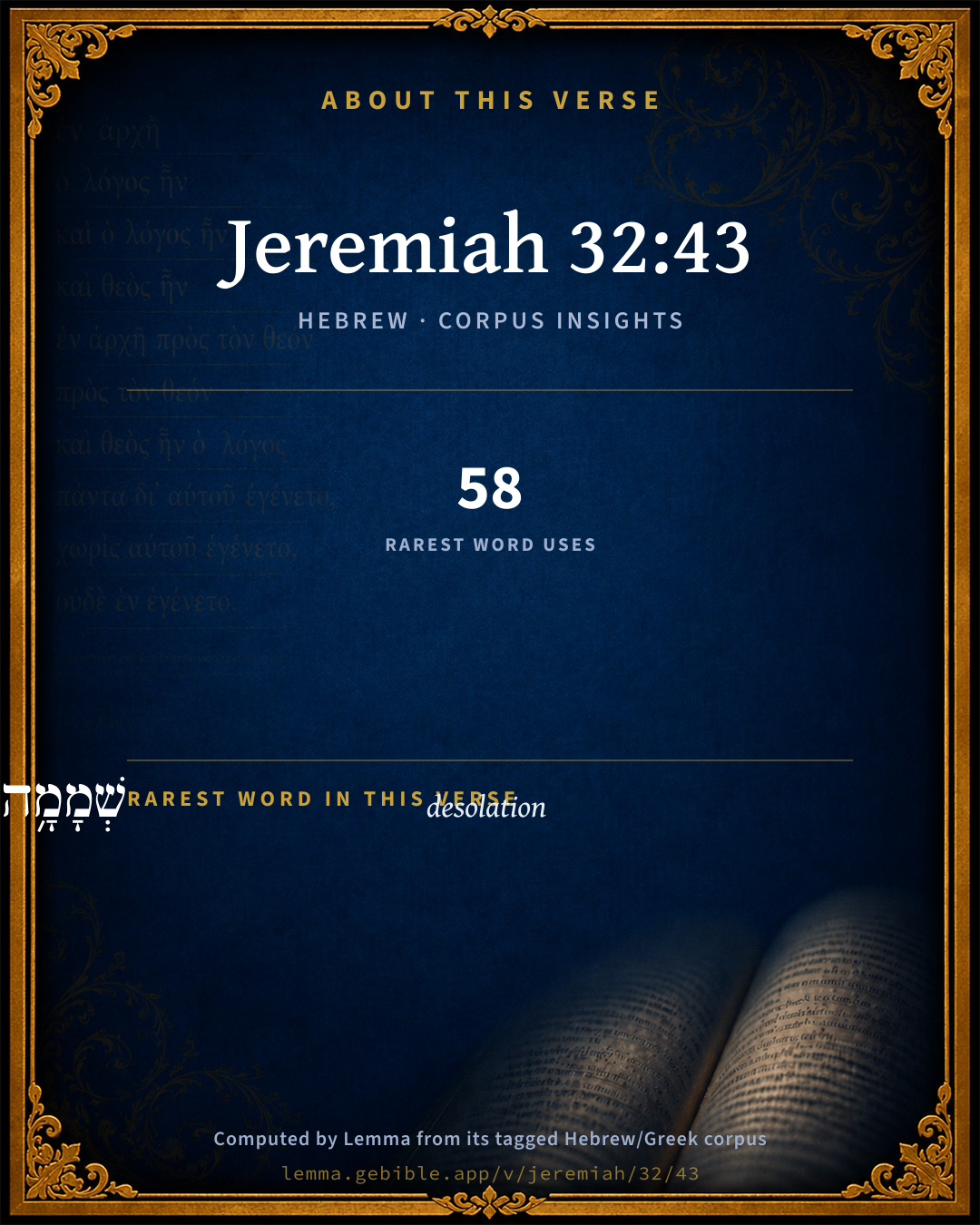
שְׁמָמָ֥ה desolation H8077 occurs in 54 verses of the Hebrew Bible. Also found in:

Grammatical profile

  • 3 verbs
  • 7 nouns
  • 3 pronouns
  • 2 particles

Verb forms

  • וְנִקְנָ֥ה Niphal · Sequential Perfect
  • אֹמְרִ֗ים Qal · Participle Active
  • נִתְּנָ֖ה Niphal · Perfect

Cross-references

4

Topical passages linked to Jeremiah 32:43 in the Treasury of Scripture Knowledge — connected by theme and wording, ordered by reader-vote popularity; previews shown in the World English Bible.

  • Jeremiah 32:15 For thus says Yahweh of Hosts, the God of Israel: Houses and fields and vineyards shall yet again be bought in this land.
  • Ezekiel 37:11–14 Then he said to me, Son of man, these bones are the whole house of Israel: behold, they say, Our bones are dried up, and our hope is lost; we are clean cut off.
  • Jeremiah 32:36 Now therefore thus says Yahweh, the God of Israel, concerning this city, about which you say, It is given into the hand of the king of Babylon by the sword, and by the famine, and by the pestilence:
  • Jeremiah 33:10 Thus says Yahweh: Yet again there shall be heard in this place, about which you say, It is waste, without man and without animal, even in the cities of Judah, and in the streets of Jerusalem, that are desolate, without man and without inhabitant and without animal,

Cross-references courtesy of OpenBible.info (CC BY 4.0).

Hebrew and Greek witnesses Masoretic Hebrew ↔ Greek Septuagint

The same verse in the two great witnesses to the Old Testament, shown verse-for-verse.

These are two independent witnesses, not word-aligned to each other, and the Septuagint is shown in lemma (dictionary) form.

Hebrew Jeremiah 32:43 Masoretic · Westminster Leningrad Codex

וְנִקְנָ֥ה הַשָּׂדֶ֖ה בָּאָ֣רֶץ הַזֹּ֑את אֲשֶׁ֣ר אַתֶּ֣ם אֹמְרִ֗ים שְׁמָמָ֥ה הִיא֙ מֵאֵ֤ין אָדָם֙ וּבְהֵמָ֔ה נִתְּנָ֖ה בְּיַ֥ד הַכַּשְׂדִּֽים

Fields shall be bought in this land, about which you say, It is desolate, without man or animal; it is given into the hand of the Chaldeans.

World English Bible · Public Domain

Greek LXX Structure differs

In the Septuagint, Jeremiah is about an eighth shorter than the Hebrew and arranges its material differently — the Oracles Against the Nations (Hebrew chapters 46–51) appear in the middle of the Greek book, after 25:13. Because the chapter and verse boundaries do not line up, a verse-for-verse comparison with the Hebrew is not shown.

A verse-for-verse comparison isn’t shown here because the chapters and verses don’t line up. Switch to the LXX edition with the MT / LXX toggle above to read the Greek directly.

Hebrew: Westminster Leningrad Codex (CC BY 4.0). Greek: Septuagint (public domain); English from a public-domain English Septuagint. How the Septuagint differs from the Hebrew →

Targum (Aramaic paraphrase)

1

The Targum is the ancient Jewish Aramaic paraphrase of the Hebrew Scriptures — an interpretive translation, not the Hebrew text itself. Onkelos (literal) and Pseudo-Jonathan (expansive) render the Torah, and Jonathan the Prophets. Coverage is partial: where no permissively-licensed English translation exists for a verse, only the Aramaic is shown. This is verse-level text, not a word-by-word alignment to the Hebrew.

  1. Targum Jonathan Prophets (Joshua–Malachi)
    וְיִזְדַבְּנוּן חַקְלִין בְּאַרְעָא הָדָא דְאַתּוּן אָמְרִין צַדְיָא הִיא מִבְּלִי אֱנָשָׁא וּבְעִירָא אִתְמְסָרַת בִּידָא דְכַסְדָאֵי:

    (no public-domain English translation for this verse)

    Targum Jonathan — Aramaic: “Mikraot Gedolot” (public domain). English: “Sefaria Community Translation” (CC0 1.0 (public-domain dedication)); “London "Chaldee Paraphrase," 1871” (public domain). Text via Sefaria.

Commentary

Notes on Jeremiah 32:43 from classic Christian and Jewish commentators (each source and its license shown beneath its notes). The classic Christian expositions comment on the surrounding passage and are grouped to its opening verse, so a note may address several verses; the Jewish commentaries on the Tanakh (Rashi and others) are per-verse, so they appear only where the commentator wrote on this verse.

Lemma curates 59 commentaries, every one of them public domain or Creative Commons licensed, each selected and text-cleaned for this edition rather than reprinted as found. About our sources →

Trapp's Complete Commentary

John Trapp

Jer 32:43 And fields shall be bought in this land, whereof ye say, [It is] desolate without man or beast; it is given into the hand of the Chaldeans.

Ver. 43. And fields shall be bought.] For an assurance whereof I have caused thee to buy this field now.

John Trapp, A Commentary or Exposition upon All the Books of the Old and New Testament (1647–1656) — public domain. Text from a community e-Sword module.

Jamieson, Fausset & Brown

Robert Jamieson, A. R. Fausset & David Brown

(Jer 32:15).

whereof ye say, It is desolate-- (Jer 33:10).

Jamieson, Fausset & Brown — Commentary Critical and Explanatory on the Whole Bible (1871) — public domain (CC PDM 1.0). Text via the HelloAO Bible API.

John Calvin's Commentaries

He confirms the prediction respecting the return of the people, and makes application of the vision which had been presented to the Prophet; for he had been commanded, as we have seen, to buy a field in the land of Benjamin. God now then annects that sign to the prophecy; for the use of signs is to secure faith to doctrine, which yet deserves of itself to be believed, and is fully authentic, and of itself worthy of belief; it is however conceded to our infirmity, that signs are given us, in order that the promises may be more fixed and ratified in our hearts.

This order God now follows, and says, Yet bought shall a field be in this land The verb, קנה kone, means to acquire or to buy and to possess; but as in the next verse he says, Buy shall they with money a field, the meaning ought not to be changed. Bought then shall be a field (the singular for the plural) in this land, of which ye say, Deserted it is by man and beast The chief men did not say this, as we have elsewhere shewn; nay, when Jeremiah declared this to them, he was in treated and cruelly dealt with by them; for it was a thing difficult to be believed that the land, which was as it were the sacred habitation of God, should be laid waste by the Chaldeans. God had indeed called it his rest, and it had been given as a heritage to the children of Abraham. The Jews, then, did not originate this saying; nay, it was God himself. But this question has been solved elsewhere; they did not indeed speak of the desolation of the land in the same sense or manner as God did; for when the Prophets threatened them with the desolation of the land, they always added the hope of deliverance and of a return; but they, when that calamity happened to them, cast aside every hope, and gave themselves up wholly to despair. And it is a usual thing with the ungodly to ridicule all God’s threatenings as long as he spares them or defers their punishment; but when God makes it known that he speaks in earnest, then they are swallowed up with despair, and conclude that nothing remains for them.

This, then, is what Jeremiah upbraids his own nation with, that is, that they cast off from themselves every hope, while yet God had fixed for them the term of seventy years. While God then was stretching forth his hand to them, they chose rather thus to sink in the abyss of despair, so that nothing could alleviate their minds. This ingratitude the Prophet justly condemns; for they considered their land as devoted to perpetual ruin, when yet its restoration had been promised to them; as though he had said, “The mercy of God and his faithfulness will surpass all your wickedness; but ye, as far as you can, extinguish his promises, abolish his grace, and give no place to his promises: nevertheless he will complete what he has promised; for though the land is falsely deemed by you to be given up for ever to destruction, yet the Lord will cause it to be inhabited by its own legitimate heirs, even the children of Abraham.” This is the reason why he intimates that the Jews had regarded the land as given up to perpetual desolation.

John Calvin's Commentaries (1540-1563) — public domain. Text from the Calvin Translation Society English edition (1840s-50s) via the Christian Classics Ethereal Library (ccel.org). Calvin's coverage is partial (roughly two-thirds of the Bible); uncommented books and verses are honest gaps, never fabricated. The 19th-century editor's footnotes and remarks are omitted so the notes are faithfully Calvin's own voice.

Ellicott's Commentary for English Readers

(43, 44) And fields shall be bought in this land . . .—The significance of the whole transaction of the purchase of the field in Anathoth is again solemnly confirmed. Men were desponding, as though the land were to belong to the Chaldæans for ever. They are told that the very region which was now covered with their encampments should once again be possessed freely by its own people. In the “mountains,” the “valleys,” and the south, or negeb district, stretching towards the country of the Philistines, we have, as before in Jer_17:26, the familiar division of the land of Judah, which had been transmitted from what has well been called the Domesday Book of Israel (Jos_15:21; Jos_15:33; Jos_15:48).

A Bible Commentary for English Readers, edited by Charles John Ellicott (1878–1897) — public domain. Text from a community e-Sword module.

Whedon's Commentary on the Bible

Daniel D. Whedon

43. Fields shall be bought — Literally, the field. The term is used generically, and implies a prosperity that brings the country at large into use. Keil, however, understands the article here to look back to the field of Hananeel.

Daniel D. Whedon (gen. ed.), Commentary on the Old and New Testaments (1874–1909) — public domain. Text from a community e-Sword module.

The Pulpit Commentary

Fields; rather, land; the Hebrew has "the field," i.e. the open country. (as Jer_4:17, etc.) We must then continue "in this country," and in ver. 44, "men shall buy lands."

The Pulpit Commentary (1880–1919), ed. H.D.M. Spence-Jones & Joseph S. Exell — public domain. Text from a community e-Sword module.

unfoldingWord translationNotes

Door43 World Missions Community

Then fields will be bought in this land

This can be translated in active form. AT: "Then people will buy fields in this land" (See: Active or Passive)

you are saying

Here "you" refers to the people of Israel. (See: Forms of You)

It has been given into the hand of the Chaldeans

Here "hand" is a metonym for power or control. This can be translated in active form. AT: "Yahweh has given it to the Chaldeans" or "Yahweh has given the Chaldeans power over it" (See: Metonymy and Active or Passive)

write in sealed scrolls. They will assemble witnesses

The "sealed scrolls" are the deeds that a person would sign to purchase land. Other people would be witnesses to confirm the purchase.

I will bring back their fortunes

"I will cause things to go well for them again" or "I will cause them to live well again." See how similar words are translated in Jeremiah 29:14.

this is Yahweh's declaration

Yahweh speaks of himself by name to express the certainty of what he is declaring. See how you translated this in Jeremiah 1:8. AT: "this is what Yahweh has declared" or "this is what I, Yahweh, have declared" (See: First, Second, or Third Person)

translationWords

ruin

beast

Chaldea

silver

scroll

testimony

Benjamin

Jerusalem

kingdom of Judah

Negev

Yahweh

declare

unfoldingWord translationNotes — © Distant Shores Media and the Door43 World Missions Community, licensed CC BY-SA 4.0. Source: git.door43.org/Door43/en_tn.

Lesson kit

Teaching starters — assembled from the data on this page, not authored interpretation. Every prompt links to the verse data it draws on. Edit before teaching.

Jeremiah, in the Prophets, opens this verse with 15 words (15 distinct Hebrew lemmas). Its most distinctive word is shᵉmâmâh (“desolation”). A historical commentator’s framing appears above. Read the whole chapter for the surrounding context.

Discussion questions

  1. What does “desolation” (shᵉmâmâh) contribute to the verse as a whole?
  2. How does Exodus 23:29, which shares the word «desolation», read alongside this verse?
  3. These translations render this verse differently. What is at stake in choosing one wording over another?
  4. «וְנִקְנָ֥ה» is a Niphal Sequential Perfect verb. How does that grammatical form shape the action described?
  5. Compare how Trapp's Complete Commentary and Jamieson, Fausset & Brown read this verse. Where do they agree or differ?

Things to notice

Reading settings

Reading text

Shown beneath each verse's original-language words.

Old Testament
Old Testament edition

Read the OT as the Masoretic Hebrew (MT) or the Greek Septuagint (LXX).

English shown for the Greek Septuagint (in the Hebrew ↔ Greek comparison).

Comparing translations? Open the Compare panel on any verse page to stack up to four side by side.