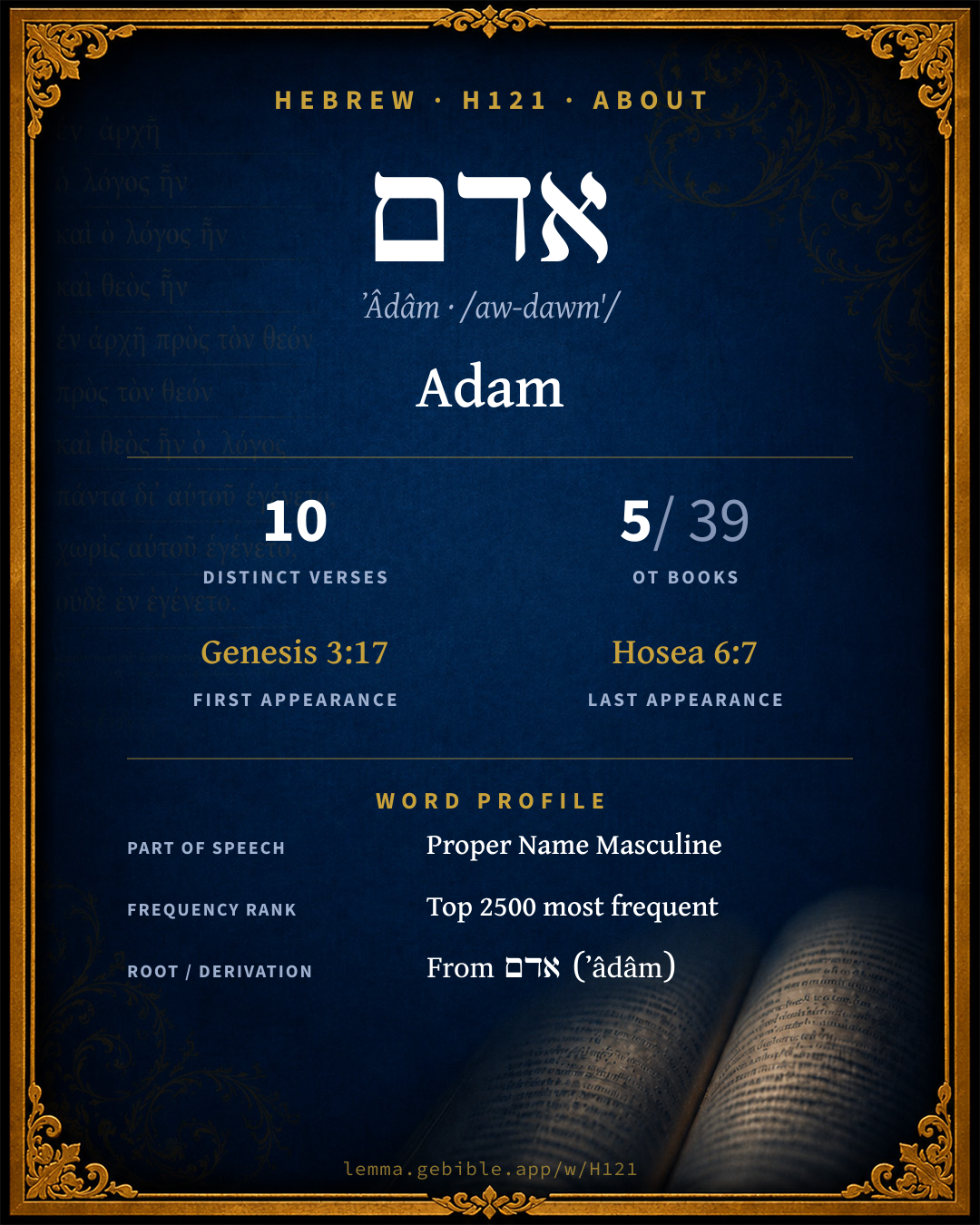
אָדָם
Adam
BDB lists 3 entries for ‘Adam’ fuller range ↓
Full lexicon entry — Brown-Driver-Briggs (BDB)
From Brown-Driver-Briggs (BDB)
Where this word appears
Grammar key — what these labels mean
Part of speech
- Noun
- A naming word — a person, place, thing, or idea.
Noun type
- Proper
- A name of a specific person, place, or people (e.g. Abraham, Zion, Israel).
Every verse where H121 appears — 10 distinct verses across 5 books. Click any verse to open its interlinear word-by-word view. Verse text shown in the World English Bible for context — . Each verse’s Hebrew form is shown with its reference; the English is not keyword-highlighted, since the data carries no word-level English alignment. Use “Compare translations” on any verse to read it across multiple English versions. This concordance covers the Hebrew Bible; Septuagint (Greek Old Testament) occurrences are not indexed here.
Genesis 6 verses
- Genesis 3:17 וּ/לְ/אָדָ֣ם conj + prep + n Proper To Adam he said, "Because you have listened to your wife's voice, and have eaten of the tree, of which I commanded you, saying, 'You shall not eat of it,' cursed is the ground for your sake. In toil you will eat of it all the days of your life.
- Genesis 4:25 אָדָ֥ם n Proper Adam knew his wife again. She gave birth to a son, and named him Seth. For, she said, "God has appointed me another child instead of Abel, for Cain killed him."
- Genesis 5:1 אָדָ֑ם n Proper This is the book of the generations of Adam. In the day that God created man, he made him in God's likeness.
- Genesis 5:3 אָדָ֗ם n Proper Adam lived one hundred thirty years, and became the father of a son in his own likeness, after his image, and named him Seth.
- Genesis 5:4 אָדָ֗ם n Proper The days of Adam after he became the father of Seth were eight hundred years, and he became the father of sons and daughters.
- Genesis 5:5 אָדָם֙ n Proper All the days that Adam lived were nine hundred thirty years, then he died.
Joshua 1 verse
1 Chronicles 1 verse
Job 1 verse
Hosea 1 verse
About this entry
At a glance — auto-summarized from this page’s data, not written by a person. Every figure links to its source below. This summary describes the numbers; it doesn’t interpret them.
The Hebrew name אדם centers on the idea of “Adam.” Genesis dominates its distribution — 6 of 10 verses. The Hebrew Bible uses it across 10 verses — uncommon. Its earliest occurrence is Genesis 3:17. Dig into 10-verse concordance and the renderings breakdown below.
Gloss history
Strong's 1890 vs modern scholarship
About this word
Strong's H121 catalogs a Hebrew word from the Hebrew Old Testament.
These counts are not copied from any lexicon or concordance. They are computed here, from the morphology-tagged Hebrew Old Testament. What Lemma adds →
- 10
- distinct verses
- The word appears in 10 distinct verses.
- 5 / 39
- OT books
- The word appears in 5 of 39 Old Testament books.
- #2,210
- by frequency
- Top 2500 most frequent Hebrew words (rank 2,210 of 8,640 Hebrew words by occurrence).
View all 10 occurrences in the concordance →
Most concentrated in
- Genesis 6 verses 60%
- Joshua 1 verse 10%
- 1 Chronicles 1 verse 10%
By section of the Old Testament
By traditional corpus
Conventional, traditional groupings — biblical authorship is debated, so this is a traditional corpus grouping, not an authorship claim. Each share is this word’s portion of its verses in that division of the Hebrew canon. Each figure is a share of the word’s 10 distinct verses.
- Torah (Pentateuch) 6 verses · 60%
- Prophets (Nevi'im) 2 verses · 20%
- Writings (Ketuvim) 2 verses · 20%
How translations render this word
Counts come from each version’s own published word-to-Strong’s tagging or interlinear alignment — an approximate guide to how each version renders this word, not a word-level alignment the data otherwise carries. Because each total is that version’s own tagged count, the per-version totals vary from one another and need not match the appearance or distinct-verse counts above. These counts may also differ from a printed concordance because Lemma counts each distinctly tagged rendering and does not collapse phrase taggings into a single head-word total. This is a fixed set of word-tagged versions (KJV, ASV, BSB, ULT) and does not change with the reading translation you choose elsewhere. Each version’s license is shown beside its name below (and on Sources).
- King James Version: Adam 9×
- American Standard Version: Adam 7×
- Berean Standard Bible: Adam 10×
- unfoldingWord Literal Text: Adam 7×
King James Version Public Domain
Renders H121 across 9 tagged occurrences — most commonly:
American Standard Version Public Domain
Renders H121 across 9 tagged occurrences — most commonly:
Plus 2 renderings that appear only once — usually multi-word phrases or single function words the recovered tagging swept in, not distinct renderings.
Berean Standard Bible Public Domain
Renders H121 across 11 tagged occurrences — most commonly:
Plus 1 rendering that appears only once — usually multi-word phrases or single function words the recovered tagging swept in, not distinct renderings.
unfoldingWord Literal Text CC BY-SA 4.0
Renders H121 across 10 tagged occurrences — most commonly:
Plus 3 renderings that appear only once — usually multi-word phrases or single function words the recovered tagging swept in, not distinct renderings.
Senses in the full BDB
What do BDB’s symbols mean?
BDB uses these scholarly abbreviations:
| Symbol | Meaning |
|---|---|
| 𝔊 | the Septuagint (the ancient Greek translation, LXX) |
| 𝔙 | the Vulgate (the Latin translation) |
| 𝔖 | the Syriac version (the Peshitta) |
| 𝔗 | the Targum (the Aramaic translation) |
| ψ | the Psalms |
| √ | root (the underlying root or stem) |
| ‖ | parallel passage (a synonymous or contrasted parallel) |
| † | the dagger: every passage where the word occurs is cited |
The 4 senses and sub-senses the full Brown-Driver-Briggs lexicon distinguishes for this word, in lexicon order (not ranked by frequency), with BDB’s own verbatim wording and sub-sense lettering. Shown in Hebrew script with BDB’s own scholarly abbreviations. The condensed entry is in the Lexicon Entry tab. See also the Forms in the corpus table below.
- 1. a man (= Ger. Mensch) = human being Gn 2:5, 7(×2), 8, 15, 16, 18 +, 16:12 (27 textual J) Lv 5:4 (‖ נֶפֶשׁ) 13:2, 9 (19 textual P) Ne 2:10 Is 13:12 (‖ אֱנוֹשׁ); הָאָ׳ הַגָּדוֹל Jos 14:15 (E); אָ׳ בְּלִיַּעַל Pr 6:12 (‖ אִישׁ אָוֶן cf. 1 S 25:25 & v. בליעל); = any one Lv 1:2 Nu 9:6, 7 Jb 20:29; 27:13 Pr 15:20; 21:16, 20; 24:30 Ec 7:20 + oft. WisdLt, Je 2:6; 4:25 Ne 2:12, cf. נֶפֶשׁ א׳ Nu 19:11, 13 +; seld. man opp. woman Gn 2:22(×2), 23, 25; 3:8, 12, 17, 20, 21 Ec 7:28. e.g. Genesis 2:5
- 2. coll. man, mankind Gn 1:26; 9:5, 6(×3) + (P 28 textual) 6:1, 5, 6, 7 (JE 24 textual) Dt 4:32 (D 6 textual) (on 2 S 7:19 cf. 1 Ch 17:17 v. DrSm); distinctly = men + women Gn 1:27; 5:1 Nu 5:6; given as name Gn 5:2; but = warriors Is 22:6 רֶכֶב א׳ (‖ פּרשׁים); ‖ beasts (41 textual) בְּהֵמָה Gn 6:7; 7:23 (J?) Ex 8:13, 14; 9:9, 10 (P) 9:19, 22, 25; 12:12; 13:2, 13, 15 (all J) +; late proph. Je 21:6; 31:27; 50:3; 51:62 Ez 14:13, 17, 19, 21; 25:13; 29:8, 11; 32:13 (del. Co) 36:11 Jon 3:8 Zp 1:3 Hg 1:11 Zc 2:8; 8:10; ‖ בָּקָר Ez 4:15; ‖ צֹאן, חֲמֹרִים, ב׳ Nu 31:28; ‖ id. + מִכָּל־הַבְּהֵמָה v 30 cf. Jon 3:7; ‖ חַיָּה Gn 9:5 (P) cf. Ez 1:5, 8, 10, 26, & descript. of כְּרוּבִים Ez 10:8, 14, 21 cf. 41:19; ‖ trees Dt 20:19 (rd. הֶאָדָם v. Di); opp. God 1 S 15:29; 16:7(×2) Is 31:3 Ez 28:2, 9 1 Ch 21:13; 29:1 2 Ch 6:18 Mal 3:8 cf. Ex 33:20 Dt 5:21; so בֶּן־א׳ Nu 23:19 (‖ אישׁ Ez 2:1, 3, 6, 8 (87 textual Ez, alw. addressed to proph.); בְּנֵי הָא׳ 1 S 26:19; made in God’s image Gn 1:26, 27; 9:6 cf. Ec 7:29; as feeble, earthly, mortal Nu 16:29(×2) Ps 82:7; 144:3, 4 Jb 5:7; 14:1, 10 cf. 25:6 (בֶּן־א׳) Ec 12:5; as sinful 1 K 8:46 2 Ch 6:36 Je 10:14 cf. Nu 5:6 Jb 31:33 Ho 6:7; of men in general, other men (opp. to particular ones) Ju 16:17 (cf. אַחַד הָא׳ v 7, 11) 18:7, 28 ψ 73:5 Je 32:20 +; ‖ אִישׁ Is 2:9, 11, 17; 5:15 cf. Ez 23:42 (del. Co Vrss); בְּנֵי א׳ 2 S 7:14 (‖ אֲנָשִׁים) Pr 8:4 (‖ אִישִׁים); ψ 49:3; 62:10 (both ‖ בְּנֵי אִישׁ) = men of low opp. men of high degree—so oft. Ph. and = vassal Sab. DHMZMG 1875, 680 cf. 686; נֶפֶשׁ א׳ coll. Nu 31:35, 40, 46 1 Ch 5:21 Ez 27:13. e.g. Genesis 1:26
- 3. n.pr.m. Adam, first man (without art. cf. שָׂטָן 1 Ch 21:1 over ag. הַשּׂ׳ Jb 1:6 etc.) Gn 4:25 (J) 5:1, 3, 4, 5 (P) 1 Ch 1:1. (Gn 2:20; 3:17, 21 rd. לָא׳ v. Di) e.g. 1 Chronicles 21:1
- 4. n.pr.loc. city in Jordan valley (as built? Jos 3:16. e.g. Joshua 3:16
Senses from the full Brown-Driver-Briggs lexicon (Brown, Driver, Briggs; Oxford 1906 — public domain), digitized via Sefaria, supplemented by the OpenScriptures HebrewLexicon (CC BY 4.0). Full attribution on Sources.
Word origin
n.m. Gn 1:27 man, mankind (Ph. אדם, Sab. id., CISiv. 1, 1. 4 al.; cf. As. admu, young (of bird) DlW, but NöZMG 1886, 722 identif. with Ar. أَذَامٌ coll. creatures)—Sg. abs. exc. cstr. Pr 6:12 cf. Thes; (בְּנֵי (הָ)א׳ oft. = pl. of א׳ Gn 11:5 + 39 textual, cf. בְּנוֹת הָא׳ Gn 6:2, 4)—
— Brown-Driver-Briggs (Oxford 1906, public domain), digitized via Sefaria, supplemented by the OpenScriptures HebrewLexicon (CC BY 4.0). See Sources.
Derived from אדם (ʼâdâm) (H120) — man.
Jastrow Dictionary
A second Hebrew/Aramaic lexicon for comparison, covering Aramaic and post-biblical (Talmudic, Targumic, Midrashic) usage that the biblical-Hebrew BDB does not. Matched by lemma rather than by Strong’s number, so a lemma may carry more than one Jastrow headword (shown separately below), and the entries cover usage well beyond the Bible.
אֲדַם
- , v. הֲדַם. [v. Rabb. D. S. to Ab. Zar. 38ᵇ, Bets. 24ᵇ, note.]
אָדַם
- , v. דמם) [to be viscous, thick, dark] to be red, grow red.
- to redden, make red. Y. Sabb. VII, 10ᶜ top המְאַדֵּם אודם he who produces a red spot (congestion of blood, on a Sabbath).
- 1. (b. h.) (b. h.) to be, grow red. Num. R. s. 9 (p. 231ᵇ ed. Amst.) מַאֲדֶמֶת (היתה) if she was red-faced. Ḥull. 53ᵇ; a. fr.
- 2. to cause to blush, put to shame (usu. הלבין). Num. R. s. 4 (p. 218ᵈ ed. Amst.) (play on עובד אדום).—Part. מַאֲדִים the planet Mars. Sabb. 156ᵃ.—Part. Hof. מְאָדָּם, מְאוּדָּם. Y. Sabb. VII, 10ᶜ top מְאָדָּמִים dyed red.
אָדָם
- m. (b. h.) man, pr. n. m. Adam, frequ. א׳ הראשון (abbr. אה"ר). Gen. R. s. 17; a. fr.—ספרו של, ספרא דאה"ר אה"ר the (allegorical) book of Adam containing all generations and their leaders from beginning to resurrection, i.e. destinies of humanity. Ex. R. s. 40 beg. B. Mets. 85ᵇ bot.
אֲדָם
- (= דָּם, דְּמָא) blood. Targ. I Chron. XXII, 7; a. e.—Y. Maas. Sh. V, 56ᵈ top מגבלא אַדְמֵיה to mix its (the bird’s) blood. Git. 47ᵃ; v. חוּל II. Pl. אַדְמִין. Targ. I Chr. l. c.; a. e.
A Dictionary of the Targumim, the Talmud Babli and Yerushalmi, and the Midrashic Literature (Marcus Jastrow; London, Luzac, 1903) — Public Domain. Digitized via Sefaria. Digitized via Sefaria. Full attribution on Sources.
Forms in the corpus
The 9 distinct written forms H121 takes in the Hebrew Bible, most frequent first — each parse links to that state’s occurrences in the concordance. Hebrew forms include their vowel points and cantillation, so a single lemma takes many written forms.
| Form | Parsing | Example | Uses |
|---|---|---|---|
| אָדָ֗ם | Noun, Proper | Genesis 5:3 | 2 |
| אָדָ֥ם | Noun, Proper | Genesis 4:25 | 2 |
| אָדָ֑ם | Noun, Proper | Genesis 5:1 | 1 |
| אָדָם֙ | Noun, Proper | Genesis 5:5 | 1 |
| ב/אדם | Noun, Proper | Joshua 3:16 | 1 |
| וּ/לְ/אָדָ֣ם | Noun, Proper | Genesis 3:17 | 1 |
| כְ/אָדָ֣ם | Noun, Proper | Job 31:33 | 1 |
| כְּ/אָדָ֖ם | Noun, Proper | Hosea 6:7 | 1 |
| מֵֽ/אָדָ֤ם | Noun, Proper | Joshua 3:16 | 1 |
Same root — word family
Other BDB entries built from the same root as H121, grouped by Strong’s listed origin. These share a root / origin per the lexicon — not necessarily a shared meaning. Each links to that word’s own entry.
Derives from
Proper names from this root
People and places named from this root — a name, not an additional meaning of the word.
Compare all same-root words → 2 of the same-root words are proper names (people or places). They share a root, not necessarily a meaning.
Bible dictionary
Public-domain dictionary articles matched to this entry by name (Adam). A biblical name can be shared by more than one person or place, so an article may treat several.
Easton's Bible Dictionary · M. G. Easton, 1897
Red, a Babylonian word, the generic name for man, having the same meaning in the Hebrew and the Assyrian languages. It was the name given to the first man, whose creation, fall, and subsequent history and that of his descendants are detailed in the first book of Moses (Gen. 1:27-ch. 5). "God created man [Heb., Adam] in his own image, in the image of God created he him; male and female created he them."
Adam was absolutely the first man whom God created. He was formed out of the dust of the earth (and hence his name), and God breathed into his nostrils the breath of life, and gave him dominion over all the lower creatures (Gen. 1:26; 2:7). He was placed after his creation in the Garden of Eden, to cultivate it, and to enjoy its fruits under this one prohibition: "Of the tree of the knowledge of good and evil thou shalt not eat of it; for in the day that thou eatest thereof thou shalt surely die."
The first recorded act of Adam was his giving names to the beasts of the field and the fowls of the air, which God brought to him for this end. Thereafter the Lord caused a deep sleep to fall upon him, and while in an unconscious state took one of his ribs, and closed up his flesh again; and of this rib he made a woman, whom he presented to him when he awoke. Adam received her as his wife, and said, "This is now bone of my bones, and flesh of my flesh: she shall be called Woman, because she was taken out of Man." He called her Eve, because she was the mother of all living.
Being induced by the tempter in the form of a serpent to eat the forbidden fruit, Eve persuaded Adam, and he also did eat. Thus man fell, and brought upon himself and his posterity all the sad consequences of his transgression. The narrative of the Fall comprehends in it the great promise of a Deliverer (Gen. 3:15), the "first gospel" message to man. They were expelled from Eden, and at the east of the garden God placed a flame, which turned every way, to prevent access to the tree of life (Gen. 3). How long they were in Paradise is matter of mere conjecture.
Shortly after their expulsion Eve brought forth her first-born, and called him Cain. Although we have the names of only three of Adam's sons, viz., Cain, Abel, and Seth, yet it is obvious that he had several sons and daughters (Gen. 5:4). He died aged 930 years.
Adam and Eve were the progenitors of the whole human race. Evidences of varied kinds are abundant in proving the unity of the human race. The investigations of science, altogether independent of historical evidence, lead to the conclusion that God "hath made of one blood all nations of men for to dwell on all the face of the earth" (Acts 17:26. Comp. Rom. 5:12-12; 1 Cor. 15:22-49).
Smith's Bible Dictionary · William Smith, 1863
a city on the Jordan, "beside Zaretan," in the time of Joshua. (Joshua 3:16)
Man, generically, for the name Adam was not confined to the father of the human race, but like homo was applicable to woman as well as to man . (Genesis 5:2)
(red earth), the name given in Scripture to the first man. It apparently has reference to the ground from which he was formed, which is called in Hebrew Adamah . The idea of redness of color seems to be inherent in either word. The creation of man was the work of the sixth day--the last and crowning act of creation. Adam was created (not born) a perfect man in body and spirit, but as innocent and completely inexperienced as a child. The man Adam was placed in a garden which the Lord God had planted "eastward in Eden," for the purpose of dressing it and keeping it. [Eden] Adam was permitted to eat of the fruit of every tree in the garden but one, which was called ("the tree of the knowledge of good and evil," because it was the test of Adam's obedience. By it Adam could know good and evil int he divine way, through obedience; thus knowing good by experience in resisting temptation and forming a strong and holy character, while he knew evil only by observation and inference. Or he could "know good and evil," in Satan's way, be experiencing the evil and knowing good only by contrast. -ED.) The prohibition to taste the fruit of this tree was enforced by the menace of death. There was also another tree which was called "the tree of life." While Adam was in the garden of Eden, the beasts of the field and the fowls of the air were brought to him to be named. After this the Lord God caused a deep sleep to fall upon him, and took one of his ribs from him, which he fashioned into a woman and brought her to the man. At this time they were both described as being naked without the consciousness of shame. By the subtlety of the serpent the woman who was given to be with Adam was beguiled into a violation of the one command which had been imposed upon them. She took of the fruit of the forbidden tree and gave it to her husband. The propriety of its name was immediately shown in the results which followed; self-consciousness was the first-fruits of sin their eyes were opened and they knew that they were naked. Though the curse of Adam's rebellion of necessity fell upon him, yet the very prohibition to eat of the tree of life after his transgression was probably a manifestation of divine mercy, because the greatest malediction of all would have been to have the gift of indestructible life super-added to a state of wretchedness and sin. The divine mercy was also shown in the promise of a deliverer given at the very promise of a deliverer given at the very time the curse was imposed, (Genesis 3:15) and opening a door of hope to Paradise, regained for him and his descendants. Adam is stated to have lived 930 years. His sons mentioned in Scripture are Cain, Abel and Seth; it is implied, however, that he had others.
Hitchcock's Bible Names Dictionary · Roswell D. Hitchcock, 1869
earthy; red
Classic public-domain reference works; full attribution on Sources.
Septuagint verse parallels
This word appears in 10 verses that also exist in the Greek Old Testament (Septuagint), out of the 10 Hebrew verses it occurs in. You can read those verses in Greek by switching the Old Testament edition to the Septuagint.
Read these verses in the Septuagint
This is a verse-level parallel only — the same verses exist in both the Hebrew and Greek Old Testaments. No word-level Hebrew↔Greek correspondence is claimed: the data carries no such alignment, so no Greek word is shown as this Hebrew word’s translation. Coverage is not total — the Septuagint omits the deuterocanon and renumbers the Psalms, so some Hebrew verses have no direct Greek parallel.