
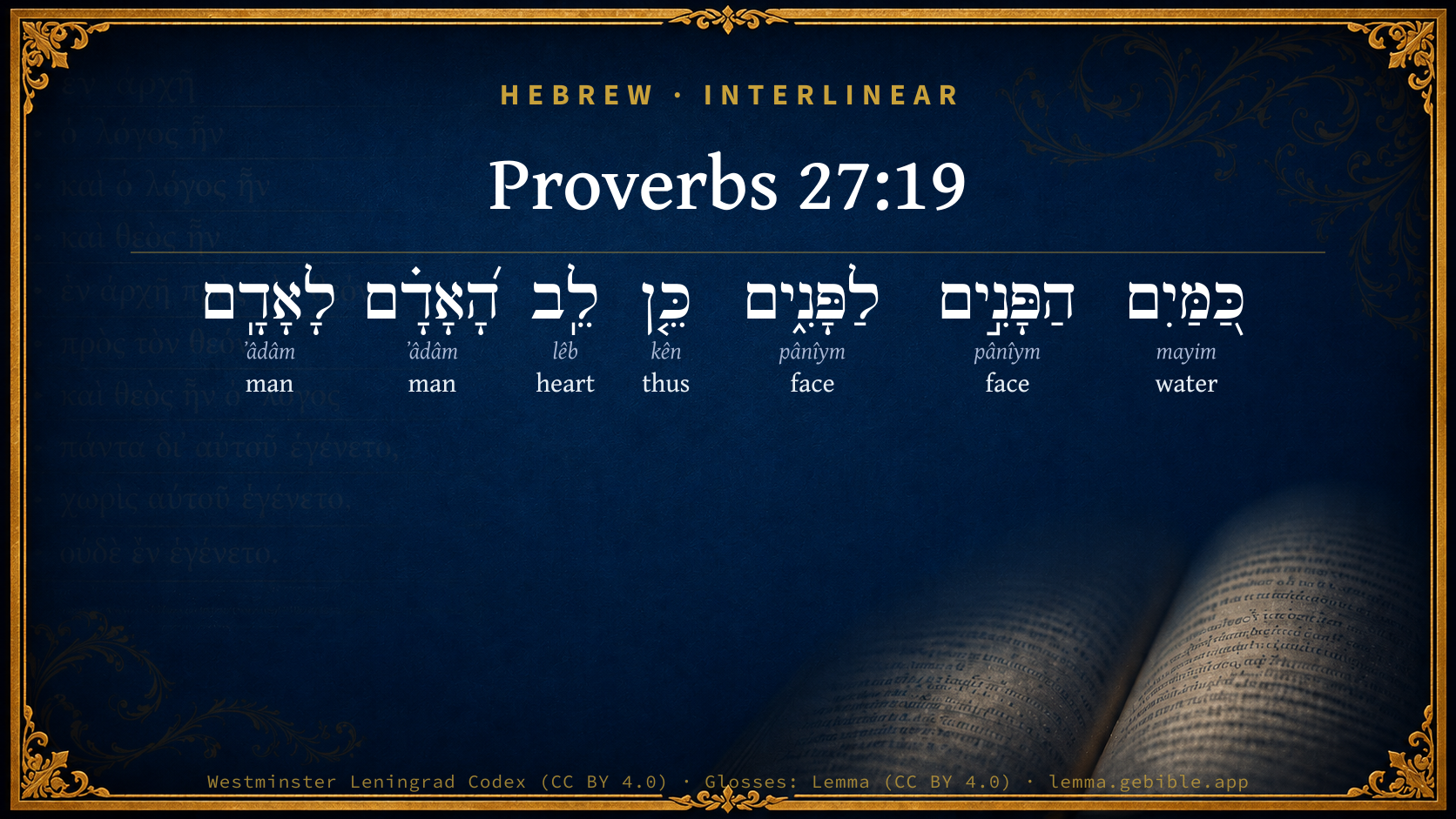
Proverbs 27:19

Hebrew (Westminster Leningrad Codex) Proverbs 27:19 appears in the Hebrew Old Testament. The text above is from the Westminster Leningrad Codex. Each word links to its Strong’s number, a concise gloss, and parsing drawn from the Open Scriptures Hebrew Bible morphology. Click any word for its full Brown-Driver-Briggs (BDB) entry.
Download image
Cite this verse

Proverbs 27:19 (World English Bible). Public Domain. Lemma interlinear Bible study tool, https://lemma.gebible.app/v/proverbs/27/19.

Show BibTeX & RIS
BibTeX
RIS
English Translation
As water reflects a face, So a man's heart reflects the man.
World English Bible · Public Domain
Download a study sheet

One document with this verse’s original text, its word-by-word gloss line, the meaning frame, cross-references with their text, attributed commentary, and full source and license credits — printable, and it pastes into notes with its structure intact.

This verse Autodidact and up

Study sheet (.html) Plain text (.txt)

A passage Seminary Student

Up to 50 verses in one chapter. A passage sheet keeps up to 6 commentary sources and 12 cross-references per verse, in the order this page ranks them, and says so on the sheet whenever that leaves anything out. Ask for a single verse and you get the Autodidact verse sheet above.

Everything on this page stays free to read, with no account — the sheet is a download of what is already on screen, not access to it.

Want to remove ads? Support Godless Engineer
Compare translations 3

The same verse in 3 English versions, stacked beneath the original-language interlinear above. Click any original word for its lexicon entry.

Each is an independent rendering of the whole verse — the interlinear is not word-aligned to these translations.

Highlighted words mark where these versions differ — a whole-verse word diff, not a word-by-word alignment.

  • World English Bible Public Domain
    As water reflects a face, So a man's heart reflects the man.
  • King James Version Public Domain
    As in water face answereth to face, so the heart of man to man.
  • unfoldingWord Literal Text CC BY-SA 4.0
    As the water, the face to the face, so the heart of the man, to the man.

unfoldingWord Literal Text — © unfoldingWord, licensed CC BY-SA 4.0. Word-aligned USFM3 via Door43 (git.door43.org/unfoldingWord/en_ult).

Versions to compare (up to 4)

3 of 4 selected

Show all 18 translations

Every available English version of this verse, each an independent rendering of the whole verse.

  • World English Bible Public Domain
    As water reflects a face, So a man's heart reflects the man.
  • Berean Standard Bible Public Domain
    As water reflects the face, so the heart reflects the true man.
  • Majority Standard Bible Public Domain
    As water reflects the face, so the heart reflects the true man.
  • King James Version Public Domain
    As in water face answereth to face, so the heart of man to man.
  • American Standard Version (1901) Public Domain
    As in water face `answereth' to face, So the heart of man to man.
  • Revised Version (1885) Public Domain
    As in water face answereth to face, so the heart of man to man.
  • Geneva Bible (1599) Public Domain
    As in water face answereth to face, so the heart of man to man.
  • Douay-Rheims (1899) Public Domain
    As the faces of them that look therein, shine in the water, so-the hearts of men are laid open to the wise.
  • Young's Literal Translation Public Domain
    As `in' water the face `is' to face, So the heart of man to man.
  • Literal Standard Version CC BY-SA 4.0
    As [in] water the face [is] to face, || So the heart of man to man.
  • Unlocked Literal Bible CC BY-SA 4.0
    Just as water reflects a person's face, so a person's heart reflects the person.
  • unfoldingWord Literal Text CC BY-SA 4.0
    As the water, the face to the face, so the heart of the man, to the man.
  • Darby Bible Public Domain
    As [in] water face [answereth] to face, so the heart of man to man.
  • World Messianic Bible Public Domain
    Like water reflects a face, so a man’s heart reflects the man.
  • Webster's Bible Public Domain
    As in water face answereth to face, so the heart of man to man.
  • Free Bible Version CC BY-SA 4.0
    Just as water reflects your face, your mind reflects who you really are.
  • Bible in Basic English Public Domain
    Like face looking at face in water, so are the hearts of men to one another.
  • JPS Tanakh (1917) Public Domain
    As in water face answereth to face, so the heart of man to man.

Literal Standard Version (2020), Covenant Press — licensed CC BY-SA 4.0. Text via the HelloAO Bible API (eBible.org). Unlocked Literal Bible (unfoldingWord) — licensed CC BY-SA 4.0. Text via the HelloAO Bible API (eBible.org). unfoldingWord Literal Text — © unfoldingWord, licensed CC BY-SA 4.0. Word-aligned USFM3 via Door43 (git.door43.org/unfoldingWord/en_ult). Free Bible Version, Dr. Jonathan Gallagher — licensed CC BY-SA 4.0. Text via the HelloAO Bible API (eBible.org).

Word by word

More ways to search: Search by grammar → Find every occurrence → Compare this word →

Practice this passage: Drill this verse → Learn its vocabulary →

About this verse

These counts appear in no published source. They are computed here, from the morphology-tagged text and Lemma’s own curated glosses. What Lemma adds →

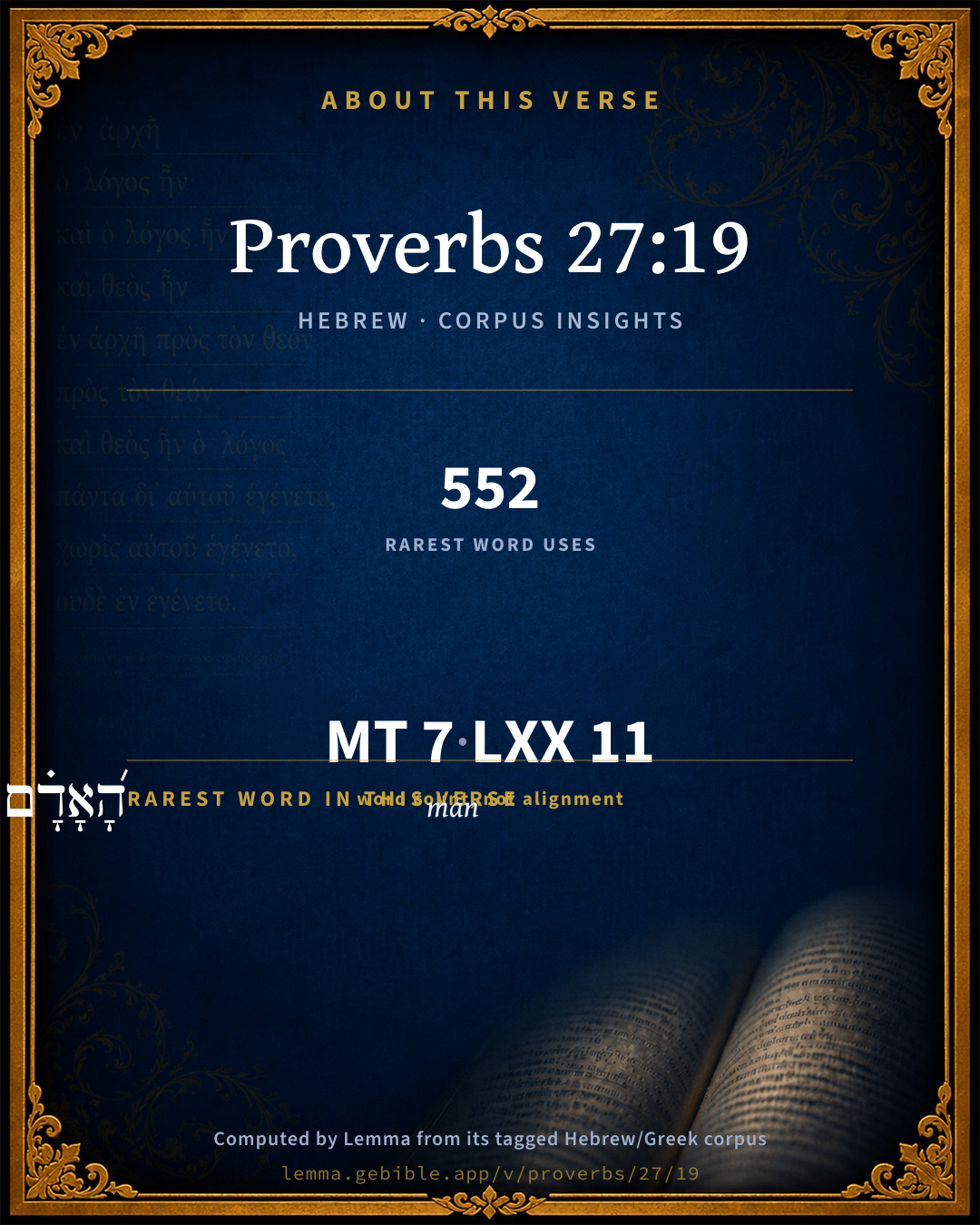
7
words
5
distinct lemmas
Wisdom
section

Grammatical profile

  • 6 nouns
  • 1 particle

Repetition

Words recur within this verse — often emphatic in Hebrew:

  • הַפָּנִ֣ים face H6440 ×2
  • הָ֝אָדָ֗ם man H120 ×2

Hebrew & Septuagint length

In English translation the verse runs 12 words from the Hebrew and 14 from the Septuagint (LXX English) — closely comparable.

A rough comparison of the two English renderings, which tokenize alike — not a word-level alignment.

Word counts can differ between the Hebrew and the Greek without any difference in meaning — e.g. the Hebrew direct-object marker אֵת has no separate Greek word, and Greek often adds the article ὁ.

In the original languages it is 7 Hebrew tokens and 11 Greek tokens — but the two are counted differently (Hebrew bundles its prefixes and suffixes into one token; the Greek is in lemma form), so that isn’t a like-for-like length.

Cross-references

4

Topical passages linked to Proverbs 27:19 in the Treasury of Scripture Knowledge — connected by theme and wording, ordered by reader-vote popularity; previews shown in the World English Bible.

  • James 1:22–25 But be doers of the word, and not only hearers, deluding your own selves.
  • Psalms 33:15 He who fashions all of their hearts; And he considers all of their works.
  • Mark 7:21 For from within, out of the hearts of men, proceed evil thoughts, adulteries, sexual sins, murders, thefts,
  • Genesis 6:5 Yahweh saw that the wickedness of man was great in the earth, and that every imagination of the thoughts of his heart was only evil continually.

Cross-references courtesy of OpenBible.info (CC BY 4.0).

Hebrew and Greek witnesses Masoretic Hebrew ↔ Greek Septuagint

The same verse in the two great witnesses to the Old Testament, shown verse-for-verse.

These are two independent witnesses, not word-aligned to each other, and the Septuagint is shown in lemma (dictionary) form.

Hebrew Proverbs 27:19 Masoretic · Westminster Leningrad Codex

כַּ֭מַּיִם הַפָּנִ֣ים לַפָּנִ֑ים כֵּ֤ן לֵֽב הָ֝אָדָ֗ם לָאָדָֽם

As water reflects a face, So a man's heart reflects the man.

World English Bible · Public Domain

Greek LXX Proverbs 27:19 Septuagint · lemma form

ὥσπερ οὐ ὅμοιος πρόσωπον πρόσωπον οὕτως οὐδέ ὁ καρδία ὁ ἄνθρωπος

As faces are not like other faces, so neither are the thoughts of men.

LXX2012 (modern English Septuagint) · Public Domain

On this verse, John Gill's Exposition discusses the Septuagint’s reading. Read the note in Commentary ↓

Hebrew: Westminster Leningrad Codex (CC BY 4.0). Greek: Septuagint (public domain); English from LXX2012 (modern English Septuagint) (Public Domain). How the Septuagint differs from the Hebrew →

Commentary

Notes on Proverbs 27:19 from classic Christian and Jewish commentators (each source and its license shown beneath its notes). The classic Christian expositions comment on the surrounding passage and are grouped to its opening verse, so a note may address several verses; the Jewish commentaries on the Tanakh (Rashi and others) are per-verse, so they appear only where the commentator wrote on this verse.

Lemma curates 59 commentaries, every one of them public domain or Creative Commons licensed, each selected and text-cleaned for this edition rather than reprinted as found. About our sources →

Trapp's Complete Commentary

John Trapp

Pro 27:19 As in water face [answereth] to face, so the heart of man to man.

Ver. 19. As in water face answereth to face, &c.] Men’s fancies differ as much as their faces: so the Chaldee interprets it. But they do better that give this sense, that in regard of natural corruption, all men look with one countenance, and have one visage; since "whole evil is in man, and whole man in evil," neither by nature is there ever a better of us. In the heart of the vilest person we may see, as in a mirror, our own evil hearts. For as there were many Marii in one Caesar, so are there many Cains and Judases in the best of us. And as that first chaos had the seed of all creatures, and wanted only the Spirit’s motion to bring them forth, {Gen 1:1-2} so there is a πανσπερμια, a common seed plot of sin in us all; there wants but the warmth and watering of Satan’s temptations to make it bud. {Eze 7:10} And though there were no devil, yet our naughty nature would act Satan’s part against itself; it would have a supply of wickedness, as a serpent hath poison, from itself; it hath a spring to feed it. Hence our Saviour chargeth his own disciples to take heed of surfeiting, drunkenness, and distracting carefulness {Luk 21:34} - who would ever have suspected such monsters to lurk in such holy bosoms? And St Paul saw cause to warn so pure a soul as young Timothy to "flee youthly lusts," {2Ti 2:22} and to exhort the younger women "with chastity"; thereby intimating, that while he was exhorting them to chastity, some impure motion might steal upon him unawares. Corruption in the best will have some flurts.

John Trapp, A Commentary or Exposition upon All the Books of the Old and New Testament (1647–1656) — public domain. Text from a community e-Sword module.

The Biblical Illustrator

Joseph S. Exell

Pro_27:19

As in water face answereth to face, so the heart of man to man.

Mirror of human nature

As a man looking into the water (used anciently as a mirror) sees an exact transcript of his own countenance, so every heart has, by nature, precisely the same moral character with every other unsanctified heart. Every child of Adam, till renewed by Divine grace, has, in view of Omnipotence and Omniscience, the same moral aspect. Notice some of the circumstances which have contributed to make men differ in their conduct who have by nature the same moral character. Grace has made a wide difference in men who were by nature alike. Difference in instinctive passions and affections makes men differ in their conduct. Some have not the talents for doing mischief that others have. Others have not the opportunities. One man may achieve less mischief than another because more restrained.

1. That all men have naturally the same moral character might be inferred from the similarity of origin, aspect, and general habits that belong to all ages and all nations of men.

2. We can hardly fix our eye on any individual or community of antiquity but we can find its exact resemblance in some individual or community with whose character we are familiar. Of this take as Scriptural examples the family of Adam and of Jacob; the characters of Balaam, and of Shimei, and of Joab, and of Jezebel.

3. There have prevailed in all ages and nations the same crimes, calling for the restraining influence of the same laws. Men have been at all times inclined to wrong their fellow-men of their property. The descriptions of depravity which applied to Israel, Babylon, Egypt, Syria, Sidon, and even Edom, apply with equal propriety to the men of this land.

4. Argue from the fact that the Bible has never become obsolete. It describes men of other periods, and the description suits the present generation. Remarks:

(1) We see one source of those corruptions of doctrine with which the world is filled. Men have determined that human nature has grown better. Having settled this point, they infer that the same Bible will not suit the different ages and nations.

(2) This subject justifies a kind of preaching as plain and pointed as anything found in the law of God, or in the communications of Christ and His apostles.

(3) The subject furnishes ungodly men with the means of knowing their own characters.

(4) We may argue, from this subject, that men must all pass the same second birth to fit them for the kingdom of God.

(5) We see why there need be but one place of destiny in the coming world for all the unregenerate. The little shades of difference that now appear in the ungodly are too insignificant to mark them out for distinct worlds. (D. A. Clark.)

They who are our associates in this world will most probably be our associates in the next

Bishop Patrick explains this proverb thus: A man may see himself, while he looks upon other men, as well as know other men, by considering his own inclinations. Bishop Hall says: He that looks into his friends heart sees there his own. The most mysterious thing in Gods work is the heart of man. The Eden of the human heart has been transformed into a wilderness of vile passions. Some restrain themselves more than others, and therefore there are different degrees of depravity in the world; and perhaps, by looking around us, we may find what rank we properly belong to, and what chance we have of escaping the wrath of God.

1. Let us ask ourselves who are our intimate friends and associates?

2. Let us compare ourselves with the dying. (John Collinson.)

The Biblical Illustrator, edited by Joseph S. Exell (c. 1880s–1900s) — public domain. Text from a community e-Sword module.

Joseph Benson's Commentary

Pro 27:19. As in water face answereth to face — As the image of a man’s face in the water answers to his natural face who looks into it; or, as in water one man’s face is like another’s, the difference of men’s faces being not there visible; so one man resembles another not only in the regard of the corruption of nature, which is alike in all men, but also with respect to the tempers and dispositions of their minds, wherein likewise they frequently agree. Dr. Grey thinks the verse should be rendered, “As the water showeth the face to the face, so doth the heart the man to the man.” In which sense Castalio seems to have understood it, paraphrasing it thus: “As a man may know what kind of a face he hath if he will look into the water, so he may know what kind of a man he is if he will examine his conscience.” Another interpretation, adopted by some, is, “A man may see himself, while he looks upon other men, as well as know other men, by considering himself, and that as certainly as he can see his own face in the water, or in any other mirror;” there being little or no difference between one man and another by nature, but the difference being made by the grace of God.

Joseph Benson's Commentary on the Old and New Testaments (1811–1818) — public domain. Text from a community e-Sword module.

The Preacher's Complete Homiletical Commentary

Joseph S. Exell (gen. ed.)

MAIN HOMILETICS OF Pro_27:19

A CORRECT LIKENESS

I. A mirror in which we may see the reflection of the hearts of others. All the knowledge that we have of our own personal appearance is gained by means of some reflecting surface. We can only look upon ourselves indirectly, and it is quite possible that every person who looks upon us has a juster conception of our appearance than we ourselves have. If there were no substances which could serve as mirrors, a man must always remain ignorant as to those peculiarities of feature which distinguish him from every other person on the face of the earth. But none are destitute of nature’s looking-glass—the stream or lake, or even a smaller quantity of water, will show a man what he is like as to his exterior. And by means of a medium we can gain much knowledge concerning the inner life of our human brothers and sisters. As we may gain a good idea of our own face by seeing its reflection in water, so we may form a fairly correct estimate of the feelings and hopes and desires of others by studying our own. After making allowance for many differences upon the surface dependent upon differences of temperament, and education, and circumstances, we shall be safe in concluding that in the depths of the human soul there are spots which form a common meeting-ground for all mankind.

II. A means by which we may gain the hearts of others. We cannot plead ignorance of the way to our brother’s heart. We must not conclude, because in outward expression he differs from us, we have therefore nothing in common, no clue to what is passing within his breast. If we call to mind how we felt in like circumstances, or try to imagine how we should feel if we were in his place, we shall hardly fail to form some idea of his feelings, and shall therefore be able so to regulate our behaviour towards him as in some measure to supply his soul needs.

(There are other interpretations of this verse, for which we refer to the Comments.)

OUTLINES AND SUGGESTIVE COMMENTS

Here is one of the foundations on which that rule is built of doing to others as we would be done by (Exo_23:9.) … One corrupt heart is like another, and so is one sanctified heart, for the former bears the same image of the earthy, the latter the same image of the heavenly.—Henry.

The proverb may be regarded as expressing reciprocity of soul. It may mean this: that just as the water will give back to you the exact expression which you gave to it—the frown or the smile, the hideous or the pleasing—so human hearts will treat you as you treat them. “With what measure you mete it shall be measured to you again.” This is true—manifestly true; kindness begets kindness, anger anger, justice justice, fraud fraud, the world through—Dr. David Thomas.

In the world we see our own hearts embowelled; and there we can learn what ourselves are at the cost of other men’s sins.—Bp. Hopkins.

As in the outline water trembles, and is uncertain, so also are hearts. The lesson is: Trust not!—Luther.

No man knoweth or showeth the spirit of a man, but the spirit of a man that is in him. The water, as a certain glass, somewhat dim indeed, but very true, representeth the countenance therein imprinted unto the countenance that beholdeth the same; even so the heart sheweth man to man; that is to say, the mind and the conscience of every man telleth him justly, though not perfectly, what he is, as whether he be good or evil, in God’s favour or out of the same; for the conscience will not lie, but accuse or excuse a man, being instead of a thousand witnesses.… As water that is troubled representeth the visage amiss, so a troubled or polluted mind may sometimes wrongly shew to a man the estate wherein he standeth. But if the soul be not wholly corrupt and the conscience seared as with a hot iron, it will declare to a man his condition rightly, though not peradventure fully in all respects.—Muffet.

The Preacher's Complete Homiletical Commentary (gen. ed. Joseph S. Exell; Funk & Wagnalls, c. 1892) — public domain (pre-1929). A full-Bible homiletical/sermon-outline anthology covering 65 of 66 books (2 John is absent from the source module). Text from a community e-Sword module.

Geneva Bible (1599)

Geneva Bible translators

There is no difference between man and man by nature, but only the grace of God maketh the difference.

Geneva Bible (1599) marginal notes — public domain. Text via Bolls.life.

Matthew Henry's Commentary

This shows us that there is a way, 1. Of knowing ourselves. As the water is a looking-glass in which we may see our faces by reflection, so there are mirrors by which the heart of a man is discovered to a man, that is, to himself. Let a man examine his own conscience, his thoughts, affections, and intentions. Let him behold his natural face in the glass of the divine law (Jam 1:23), and he may discern what kind of man he is and what is his true character, which it will be of great use to every man rightly to know. 2. Of knowing one another by ourselves; for, as there is a similitude between the face of a man and the reflection of it in the water, so there is between one man's heart and another's for God has fashioned men's hearts alike; and in many cases we may judge of others by ourselves, which is one of the foundations on which that rule is built of doing to others as we would be done by, Exo 23:9 Nihil est unum uni tam simile, tam par, quam omnes inter nosmet ipsos sumus. Sui nemo ipse tam similis quam omnes sunt omnium - No one thing is so like another as man is to man. No person is so like himself as each person is to all besides. Cic. de Legib. lib. 1. One corrupt heart is like another, and so is one sanctified heart, for the former bears the same image of the earthy, the latter the same image of the heavenly.

Matthew Henry's Commentary on the Whole Bible (1708–1710) — public domain (CC PDM 1.0). Text via the HelloAO Bible API.

Jamieson, Fausset & Brown

Robert Jamieson, A. R. Fausset & David Brown

We may see our characters in the developed tempers of others.

Jamieson, Fausset & Brown — Commentary Critical and Explanatory on the Whole Bible (1871) — public domain (CC PDM 1.0). Text via the HelloAO Bible API.

Adam Clarke's Commentary

Verse 19. As in water face answereth to face] All men's hearts are pretty nearly alike; water is not more like to water, than one heart is to another. Or, as a man sees his face perfectly reflected by the water, when looking into it; so the wise and penetrating man sees generally what is in the heart of another by considering the general tenor of his words and actions.

"Surely, if each man saw another's heart

There would be no commerce;

All would disperse,

And live apart."

HERBERT.

Adam Clarke's Commentary on the Bible (1810–1826) — public domain. Text from a community e-Sword/MySword module.

Ellicott's Commentary for English Readers

(19) So the heart of man (answereth) to man.—What is in our own hearts we find in others also. Whatever are the distinguishing features of our own characters we discover and elicit the same in others. The merciful, the generous, the devout, the pure, recognise the same qualities in others, and themselves feel and receive sympathy from such persons. So the evil, too, find themselves in harmony with those of like disposition.

A Bible Commentary for English Readers, edited by Charles John Ellicott (1878–1897) — public domain. Text from a community e-Sword module.

The Cambridge Bible for Schools and Colleges

gen. ed. J. J. S. Perowne

19. in water] This rendering of A.V., which is retained in R.V. text, gives a good and pregnant meaning: As truly as the face seen in the water resembles the face of which it is the reflection, so truly does the heart of one man correspond to that of another in all the essential features of our common nature.

There is, however, another rendering, supported by many competent authorities and adopted in R.V. marg., viz.:

As water sheweth face to face,

So the heart sheweth man to man.

The meaning then will be that the heart, like the water, is the medium by which we behold the image of our fellow man, the mirror in which we see his character. He is to us what our heart makes him. We judge of others by ourselves. A sordid nature or ruffled temper, like turbid or unsettled water, will give a broken and distorted image: it cannot conceive the idea of true generosity or genuine worth. On the other hand a pure heart will give to its possessor a true perception not only of man but of God Himself (St Mat_5:8).

The Cambridge Bible for Schools and Colleges (gen. ed. J. J. S. Perowne; Cambridge University Press, 1878–1918) — public domain. Text from a community e-Sword module.

John Gill's Exposition

As the fining pot for silver, and the furnace for gold,.... For the trying, proving, and purifying these metals; see Pro 17:3;

so is a man to his praise; or "according to the mouth of his praise" (p); if his own mouth praises him, as in Pro 27:2;, he is known to be what he is, a foolish and vainglorious person: or "so a man is proved by the mouth of him that praises him", as the Vulgate Latin version; or "of them that praise him", as the Septuagint, Syriac, and Arabic versions; and so the Targum: the meaning is, either a man is known by the persons that praise him, according to what their characters are; if he is praised by good and virtuous men, he may be thought to be so himself; and if by wicked men, he may be concluded to be so likewise; see Pro 28:4; or he is known by the effect that praise has upon him; if it swells him with pride, and makes him haughty, conceited, and overbearing, he will appear to be a weak and foolish man; but if he continues modest and humble, and studious and diligent to answer his character, thankful to God for what he has, and to whom he gives all the glory, he will approve himself a wise and good man.

(p) "ad os laudis suae", Gejerus.

John Gill's Exposition of the Whole Bible (1746–1763) — public domain (CC PDM 1.0). Text via the HelloAO Bible API.

Albert Barnes' Notes on the Bible

As we see our own face when we look on the mirror-like surface of the water, so in every heart of man we may see our own likeness. In spite of all diversities we come upon the common human nature in which we all alike share. Others see in the reference to the reflection in the water the thought that we judge of others by ourselves, find them faithful or the reverse, as we ourselves are.

Albert Barnes' Notes on the Bible (1834–1885) — public domain. Text from a community e-Sword/MySword module.

Haydock's Catholic Bible Commentary

Are. Hebrew, "to men." Our hearts have all something similar. (Calmet) --- Septuagint, "as faces are not like each other, so neither are the hearts of men." They have all come peculiarity. (Haydock) --- But this agrees not with the original.

George Leo Haydock (1774–1849), Haydock's Catholic Family Bible and Commentary, 1859 edition — public domain. Excludes Psalms (Douay-Rheims chapter numbering differs from Protestant) and Deuterocanonical books (Catholic canon only).

Matthew Poole's English Annotations

The sense is either,

1. As the image of a man’s face in the water answers to his natural face who looks into it; or, as in water one man’s face is like another’s, the difference of men’s faces being not there visible: so one man resembles another, either in the temper of his mind or body, in which many men are alike one to another; or in the corruption of his nature, in which all are alike. Or,

2. As a man may see his own face if he look into the water, which is nature’s looking-glass, or into any other looking glass; so a man may discern his own heart, if he look into those glasses whereby it discovers itself; if he examine his thoughts and inclinations, together with the general course of his actions. Or,

3. As the face of a man standing by the waters is visible not only to himself, but to others, by the shadow or image of it in the waters; so the heart of a man is in some measure discernible, not only to himself, but to others also, who observe his disposition and carriage.

Matthew Poole's English Annotations on the Holy Bible (1683–1685) — public domain. Text from a community e-Sword/MySword module.

Whedon's Commentary on the Bible

Daniel D. Whedon

19. As in water face answereth to face — Water was the first mirror, and a basin of pure water is the only reflector used by many in the East to this day.

So the heart of man to man — The properties of human nature are common. We have substantially the same passions, affections, propensities, joys, sorrows, hopes, fears, motives, etc. So a man may reason from his own nature to that of others, and know others by himself. He may also judge himself, to some extent, by others. One heart corresponds to another.

Some find, also, this sense in the words: That as face answers to face in water, so a man ought to expect no other affections from men than those he expresses toward them. Love answers to love, hatred to hatred.

Daniel D. Whedon (gen. ed.), Commentary on the Old and New Testaments (1874–1909) — public domain. Text from a community e-Sword module.

The Pulpit Commentary

As in water face answereth to face, so the heart of man to man; Vulgate, Quomodo in aquis resplendent vultus prospicientium, sic corda hominum manifesta sunt prudentibus. As in clear water the face of the gazer is reflected, so man finds in his fellow man the same feelings, sentiments, passions, which he has himself. He sees in others the likeness of himself; whatever he knows himself to be, he will see others presenting the same character. Self-knowledge, too, leads to insight into others" minds; "for what man knoweth the things of a man, save the spirit of man which is in him?". (1Co_2:11) There is a solidarity in human nature which enables us to judge of others by ourselves. The difficulties in the construction and wording of the sentence do not affect the interpretation. They are, however, best met by rendering, with Delitzsch, "As it is with water, face corresponds to face, so also the heart of man to man." Septuagint, "As faces are not like faces, so neither are the thoughts of men;" which is like the saying of Persius, "Sat.," 5:52"Mille hominum species, et rerum discolor usus; Velle suum cuique est, nec voto vivitur uno.

The Pulpit Commentary (1880–1919), ed. H.D.M. Spence-Jones & Joseph S. Exell — public domain. Text from a community e-Sword module.

John Wesley's Explanatory Notes

So - So one man resembles another in the corruption of his nature.

John Wesley, Explanatory Notes Upon the Whole Bible (1754–1765) — public domain. Text via the GEBible commentary corpus.

Keil & Delitzsch

C. F. Keil & F. Delitzsch

19 As it is with water, face correspondeth to face,

So also the heart of man to man.

Thus the traditional text is to be translated; for on the supposition that כּמּים must be used for כּבמּים, yet it might not be translated: as in waters face corresponds to face (Jerome: quomodo in aquis resplendent vultus respicientium), because כּ (instar) is always only a prep. and never conj. subordinating to itself a whole sentence (vid., under Psa 38:14). But whether כּמּים, "like water," may be an abridgment of a sentence: "like as it is with water," is a question, and the translation of the lxx (Syr., Targ., Arab.), ὥσπερ οὐχ ὅμοια πρόσωπα προσώποις, κ.τ.λ., appears, according to Bttcher's ingenious conjecture, to have supposed כאשר במים, from which the lxx derived כּאין דּמים, sicut non pares. The thought is beautiful: as in the water-mirror each one beholds his own face (Luther: der Scheme = the shadow), so out of the heart of another each sees his own heart, i.e., he finds in another the dispositions and feelings of his own heart (Fleischer) - the face finds in water its reflection, and the heart of a man finds in man its echo; men are ὁμοιοπαθεῖς, and it is a fortunate thing that their heart is capable of the same sympathetic feelings, so that one can pour into the heart of another that which fills and moves his own heart, and can there find agreement with it, and a re-echo. The expression with ל is extensive: one corresponds to another, one belongs to another, is adapted to the other, turns to the other, so that the thought may be rendered in manifold ways: the divinely-ordained mutual relationship is always the ground-thought. This is wholly obliterated by Hitzig's conjecture כּמוּם, "what a mole on the face is to the face, that is man's heart to man," i.e., the heart is the dark spot in man, his partie honteuse. But the Scripture nowhere speaks of the human heart after this manner, at least the Book of Proverbs, in which לב frequently means directly the understanding. Far more intelligible and consistent is the conjecture of Mendel Stern, to which Abrahamsohn drew my attention: כּמּים הפּנים לפנים, like water (viz., flowing water), which directs its course always forward, thus (is turned) the heart of man to man. This conjecture removes the syntactic harshness of the first member without changing the letters, and illustrates by a beautiful and excellent figure the natural impulse moving man to man. It appears, however, to us, in view of the lxx, more probable that כּמּים is abbreviated from the original כאשׁר במים (cf. Pro 24:29).

Keil & Delitzsch — Biblical Commentary on the Old Testament (1861–1891) — public domain (CC PDM 1.0). Text via the HelloAO Bible API. (Old Testament only.)

Bridges on Proverbs

Charles Bridges

This proverb does not confound all in one indiscriminate mass; as if all were alike under an endless diversity of condition. We cannot identify infancy with age, or all the proper individualities of constitution and education. But under the same circumstances, and on the same level, the coincidence is most remarkable and instructive. As in the reflection of the water face answereth to face; so in another heart we see the reflection of our own. (Psa 33:15 .) Human nature has suffered no change since the fall. The picture of man’s corruption, drawn above four thousand years since, is man, as we see and know him now.†1 The Apostle’s graphical delineation of the Christian conflict is as if we had been sitting before him for our own likeness. (Rom 7:14-25 .) This identity of Christian experience is most valuable. ’No one’ — exclaims a tried child of God — ’has ever felt as I do.’ Let him open his case to a brother or sister, compare notes with their exercises, and who will not subscribe their own name to his complaints? Thus, instead of "thinking it strange concerning this fiery trial," he learns that "the same afflictions are accomplished in his brethren that are in the world." (1Pe 4:12 ; 1Pe 5:9 .) The same features and "measures of the stature in Christ," mark the whole family; inasmuch as "all these worketh that one and the self-same Spirit, dividing to every man severally as he will." (1Co 12:11 .)

Scripture history also illustrates this unity. Ishmael’s mocking shews the enmity of the heart in all ages. (Gal 4:29 .) Who of us does not find something answering to Jonah’s evil temper in our own fretfulness, waywardness, or ingratitude? Job shews us our impatience, our mistaken judgments of God’s dealings with us, and the special trial of Satan’s temptations. David’s heart in all its varied exercises answereth to our heart. Else how could we take up his confession, praises, conflicts, and triumphs, and feel that no words of ours could more entirely and accurately express our own selves? It is these Scripture portraits, that make the word of God so "profitable for reproof, correction, and instruction in righteousness." (2Ti 3:16 .)

Hence we learn sympathy with the members of Christ. We share their joys and sorrows, the confidence and temptations. Self-knowledge also instructs us thus to know human nature,†2 and to deal wisely and profitably with our fellow-sinners. The practical lesson of humility and forbearance is also deeply taught. A man observes a face reflected in the water, not thinking that it is his own face which is the actual object of disgust. He exclaims with vain self-preference against the ungodliness of the sinner, or the infirmities of the saint. Why! it is thine own self thou art reviling! Change thy language of scorn for self-abhorrence and shame!

Footnotes:

†1 Gen 6:5. Psa 14:2-3 . Rom 3:10-11 .

†2 Psa 36:1. P.T.

Charles Bridges, An Exposition of the Book of Proverbs (1846) — public domain. Text from a community e-Sword module.

unfoldingWord translationNotes

Door43 World Missions Community

a person's heart

Here this means a person's thoughts. AT: "what a person thinks" (See: Metonymy)

Abaddon

This is a name that means "destroyer." AT: "the Destroyer" (See: How to Translate Names)

are never satisfied

"are never filled up"

a man's eyes

Here the "eyes" represent a man's desires. AT: "a man's desires" (See: Metonymy)

translationWords

face

heart

Hades

unfoldingWord translationNotes — © Distant Shores Media and the Door43 World Missions Community, licensed CC BY-SA 4.0. Source: git.door43.org/Door43/en_tn.

Rashi

Rabbi Shlomo Yitzchaki (Rashi)

As in water the face that you show it, it shows you.

is the heart of a man to a man his friend. According to how much a man knows that his friend loves him, so he will show him his face.

Rashi on the Tanakh — English translations: “The Judaica Press complete Tanach with Rashi, translated by A. J. Rosenberg” (CC BY 4.0); “Pentateuch with Rashi's commentary by M. Rosenbaum and A.M. Silbermann, 1929-1934” (public domain); “The Metsudah Tanach series, Lakewood, N.J” (CC BY 4.0); and “The Book of Joshua, Metsudah Publications, 1997” (CC BY 4.0). Text via Sefaria.

Lesson kit

Teaching starters — assembled from the data on this page, not authored interpretation. Every prompt links to the verse data it draws on. Edit before teaching.

Proverbs, in the Wisdom, opens this verse with 7 words (5 distinct Hebrew lemmas). Its most distinctive word is ʼâdâm (“man”). A historical commentator’s framing appears above. Read the whole chapter for the surrounding context.

Discussion questions

  1. What does “man” (ʼâdâm) contribute to the verse as a whole?
  2. James 1:22–25 shares this passage’s theme. How do the two illuminate each other?
  3. “face” occurs 2× in this one verse. What is the effect of the repetition?
  4. The translations on this page render this verse differently — a whole-verse word diff, not a word-by-word alignment. What might account for the different wordings?
  5. Reading how Trapp's Complete Commentary and The Biblical Illustrator read this verse, where do the two commentators agree and where do they part?

Things to notice

Reading settings

Reading text

Shown beneath each verse's original-language words.

Old Testament
Old Testament edition

Read the OT as the Masoretic Hebrew (MT) or the Greek Septuagint (LXX).

English shown for the Greek Septuagint (in the Hebrew ↔ Greek comparison).

Comparing translations? Open the Compare panel on any verse page to stack up to four side by side.