Psalms 14:2

Hebrew (Westminster Leningrad Codex) Psalms 14:2 appears in the Hebrew Old Testament. The text above is from the Westminster Leningrad Codex. Each word links to its Strong’s number, a concise gloss, and parsing drawn from the Open Scriptures Hebrew Bible morphology. Click any word for its full Brown-Driver-Briggs (BDB) entry.
Download image
Cite this verse

Psalms 14:2 (World English Bible). Public Domain. Lemma interlinear Bible study tool, https://lemma.gebible.app/v/psalms/14/2.

Show BibTeX & RIS
BibTeX
RIS
English Translation
Yahweh looked down from heaven on the children of men, To see if there were any who did understand, Who did seek after God.
World English Bible · Public Domain
Download a study sheet

One document with this verse’s original text, its word-by-word gloss line, the meaning frame, cross-references with their text, attributed commentary, and full source and license credits — printable, and it pastes into notes with its structure intact.

This verse Autodidact and up

Study sheet (.html) Plain text (.txt)

A passage Seminary Student

Up to 50 verses in one chapter. A passage sheet keeps up to 6 commentary sources and 12 cross-references per verse, in the order this page ranks them, and says so on the sheet whenever that leaves anything out. Ask for a single verse and you get the Autodidact verse sheet above.

Everything on this page stays free to read, with no account — the sheet is a download of what is already on screen, not access to it.

Want to remove ads? Support Godless Engineer
Compare translations 3

The same verse in 3 English versions, stacked beneath the original-language interlinear above. Click any original word for its lexicon entry.

Each is an independent rendering of the whole verse — the interlinear is not word-aligned to these translations.

Highlighted words mark where these versions differ — a whole-verse word diff, not a word-by-word alignment.

  • World English Bible Public Domain
    Yahweh looked down from heaven on the children of men, To see if there were any who did understand, Who did seek after God.
  • King James Version Public Domain
    The LORD looked down from heaven upon the children of men, to see if there were any that did understand, and seek God.
  • unfoldingWord Literal Text CC BY-SA 4.0
    Yahweh looks down from the heavens on the sons of man to see whether there is one understanding, one seeking God.

unfoldingWord Literal Text — © unfoldingWord, licensed CC BY-SA 4.0. Word-aligned USFM3 via Door43 (git.door43.org/unfoldingWord/en_ult).

Versions to compare (up to 4)

3 of 4 selected

Show all 18 translations

Every available English version of this verse, each an independent rendering of the whole verse.

  • World English Bible Public Domain
    Yahweh looked down from heaven on the children of men, To see if there were any who did understand, Who did seek after God.
  • Berean Standard Bible Public Domain
    The LORD looks down from heaven upon the sons of men to see if any understand, if any seek God.
  • Majority Standard Bible Public Domain
    The LORD looks down from heaven upon the sons of men to see if any understand, if any seek God.
  • King James Version Public Domain
    The LORD looked down from heaven upon the children of men, to see if there were any that did understand, and seek God.
  • American Standard Version (1901) Public Domain
    Jehovah looked down from heaven upon the children of men, To see if there were any that did understand, That did seek after God.
  • Revised Version (1885) Public Domain
    The LORD looked down from heaven upon the children of men, to see if there were any that did understand, that did seek after God.
  • Geneva Bible (1599) Public Domain
    The Lord looked downe from heauen vpon the children of men, to see if there were any that would vnderstand, and seeke God.
  • Douay-Rheims (1899) Public Domain
    The Lord hath looked down from heaven upon the children of men, to see if there be any that understand and seek God.
  • Young's Literal Translation Public Domain
    Jehovah from the heavens Hath looked on the sons of men, To see if there is a wise one -- seeking God.
  • Literal Standard Version CC BY-SA 4.0
    YHWH has looked from the heavens on the sons of men, || To see if there is a wise one—seeking God.
  • Unlocked Literal Bible CC BY-SA 4.0
    Yahweh looks down from heaven on the children of mankind to see if there are any who understand, who seek after him.
  • unfoldingWord Literal Text CC BY-SA 4.0
    Yahweh looks down from the heavens on the sons of man to see whether there is one understanding, one seeking God.
  • Darby Bible Public Domain
    Jehovah looked down from the heavens upon the children of men, to see if there were any that did understand, that did seek God.
  • World Messianic Bible Public Domain
    The LORD looked down from heaven on the children of men, to see if there were any who understood, who sought after God.
  • Webster's Bible Public Domain
    The LORD looked down from heaven upon the children of men, to see if there were any that did understand, and seek God.
  • Free Bible Version CC BY-SA 4.0
    The Lord watches from heaven to see whether anyone understands—if there's anyone who wants to come to God.
  • Bible in Basic English Public Domain
    The Lord was looking down from heaven on the children of men, to see if there were any who had wisdom, searching after God.
  • JPS Tanakh (1917) Public Domain
    The LORD looked forth from heaven upon the children of men, to see if there were any man of understanding, that did seek after God.

Literal Standard Version (2020), Covenant Press — licensed CC BY-SA 4.0. Text via the HelloAO Bible API (eBible.org). Unlocked Literal Bible (unfoldingWord) — licensed CC BY-SA 4.0. Text via the HelloAO Bible API (eBible.org). unfoldingWord Literal Text — © unfoldingWord, licensed CC BY-SA 4.0. Word-aligned USFM3 via Door43 (git.door43.org/unfoldingWord/en_ult). Free Bible Version, Dr. Jonathan Gallagher — licensed CC BY-SA 4.0. Text via the HelloAO Bible API (eBible.org).

Word by word

More ways to search: Search by grammar → Find every occurrence → Compare this word →

Practice this passage: Drill this verse → Learn its vocabulary →

הִשְׁקִ֪יף
shâqaph
H8259
“to look down”
Verb, Hiphil, Perfect, 3rd Person, Masculine, Singular
Part of Speech
Verb
Stem
Hiphil
Form
Perfect
Person
3rd Person
Gender
Masculine
Number
Singular
Full BDB Definition

Origin: a primitive root

TWOT: 2457

to overlook, look down or out, overhang, look out and down - (Niphal) to lean over (and look), look down - (Hiphil) to look down, look down upon
  1. יְֽהוָ֗ה Yᵉhôvâh H3068 “LORD” Noun, Proper
  2. מִשָּׁמַיִם֮ shâmayim H8064 “from · heaven(s)” Preposition + Noun, Common, Masculine, Plural, Absolute
  3. עַֽל ʻal H5921 “upon” Preposition
  4. בְּנֵי bên H1121 “sons of” Noun, Common, Masculine, Plural, Construct
  5. אָ֫דָ֥ם ʼâdâm H120 “man” Noun, Common, Masculine, Singular, Absolute
  6. לִ֭רְאוֹת râʼâh H7200 “to see” Preposition + Verb, Qal, Infinitive Construct
  7. הֲיֵ֣שׁ yêsh H3426 “there is” Particle, Interrogative + Particle, Demonstrative
  8. מַשְׂכִּ֑יל sâkal H7919 “being prudent” Verb, Hiphil, Participle Active, Masculine, Singular, Absolute
  9. דֹּ֝רֵשׁ dârash H1875 “seeking” Verb, Qal, Participle Active, Masculine, Singular, Absolute
  10. אֶת ʼêth H853 “-” Particle, Direct Object
  11. אֱלֹהִֽים ʼĕlôhîym H430 “God(s)” Noun, Common, Masculine, Plural, Absolute

About this verse

These counts appear in no published source. They are computed here, from the morphology-tagged text and Lemma’s own curated glosses. What Lemma adds →

12
words
12
distinct lemmas
Wisdom
section

Notable vocabulary

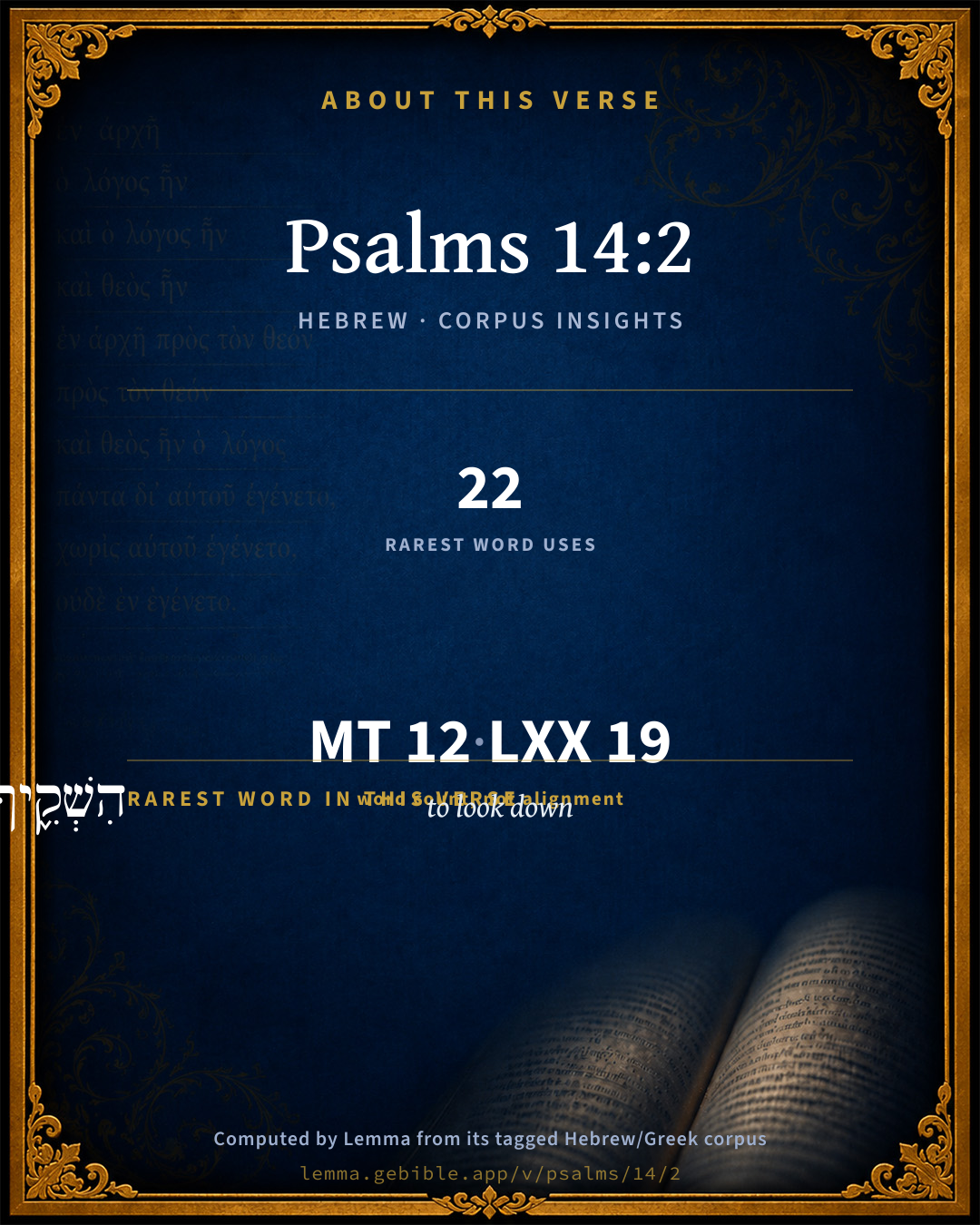
The rarest word here is הִשְׁקִ֪יף to look down H8259 — appearing just 22 times in the whole Hebrew Bible.

Shared distinctive vocabulary

הִשְׁקִ֪יף to look down H8259 occurs in 22 verses of the Hebrew Bible. Also found in:

Grammatical profile

  • 4 verbs
  • 5 nouns
  • 1 preposition
  • 2 particles

Verb forms

  • הִשְׁקִ֪יף Hiphil · Perfect
  • לִ֭רְאוֹת Qal · Infinitive Construct
  • מַשְׂכִּ֑יל Hiphil · Participle Active
  • דֹּ֝רֵשׁ Qal · Participle Active

Hebrew & Septuagint length

In English translation the verse runs 24 words from the Hebrew and 23 from the Septuagint (LXX English) — closely comparable.

A rough comparison of the two English renderings, which tokenize alike — not a word-level alignment.

Word counts can differ between the Hebrew and the Greek without any difference in meaning — e.g. the Hebrew direct-object marker אֵת has no separate Greek word, and Greek often adds the article ὁ.

In the original languages it is 12 Hebrew tokens and 19 Greek tokens — but the two are counted differently (Hebrew bundles its prefixes and suffixes into one token; the Greek is in lemma form), so that isn’t a like-for-like length.

Cross-references

26

Topical passages linked to Psalms 14:2 in the Treasury of Scripture Knowledge — connected by theme and wording, ordered by reader-vote popularity; previews shown in the World English Bible.

  • Romans 3:11 There is no one who understands. There is no one who seeks after God.
  • Psalms 33:13–14 Yahweh looks from heaven. He sees all the sons of men.
  • Hebrews 11:6 Without faith it is impossible to be well pleasing to him, for he who comes to God must believe that he exists, and that he is a rewarder of those who seek him.
  • Psalms 102:19–20 For he has looked down from the height of his sanctuary. From heaven, Yahweh saw the earth;
  • Genesis 6:12 God saw the earth, and saw that it was corrupt, for all flesh had corrupted their way on the earth.
  • Matthew 13:15 For this people's heart has grown callous, Their ears are dull of hearing, They have closed their eyes; Or else perhaps they might perceive with their eyes, Hear with their ears, Understand with their heart, And should turn again; And I would heal them.'
  • 2 Chronicles 19:3 Nevertheless there are good things found in you, in that you have put away the Asheroth out of the land, and have set your heart to seek God.
  • Daniel 12:10 Many shall purify themselves, and make themselves white, and be refined; but the wicked shall do wickedly; and none of the wicked shall understand; but those who are wise shall understand.
  • Psalms 82:5 They don't know, neither do they understand. They walk back and forth in darkness. All the foundations of the earth are shaken.
  • Isaiah 55:6 Seek you Yahweh while he may be found; call you on him while he is near:
  • Psalms 92:6 A senseless man doesn't know, Neither does a fool understand this:
  • Proverbs 2:9 Then you will understand righteousness and justice, Equity and every good path.
  • Proverbs 9:16 "Whoever is simple, let him turn in here." As for him who is void of understanding, she says to him,
  • Isaiah 27:11 When the boughs of it are withered, they shall be broken off; the women shall come, and set them on fire; for it is a people of no understanding: therefore he who made them will not have compassion on them, and he who formed them will show them no favor.
  • Isaiah 63:15 Look down from heaven, and see from the habitation of your holiness and of your glory: where are your zeal and your mighty acts? the yearning of your heart and your compassion is restrained toward me.
  • Jeremiah 4:22 For my people are foolish, they don't know me; they are foolish children, and they have no understanding; they are wise to do evil, but to do good they have no knowledge.
  • Genesis 18:21 I will go down now, and see whether they have done altogether according to the cry of it, which is come to me. If not, I will know."
  • Psalms 107:43 Whoever is wise will pay attention to these things. They will consider the loving kindnesses of Yahweh.
  • Proverbs 8:5 You simple, understand prudence. You fools, be of an understanding heart.
  • Isaiah 8:19 When they shall tell you, "Consult with those who have familiar spirits and with the wizards, who chirp and who mutter:" shouldn't a people consult with their God? on behalf of the living [should they consult] with the dead?
  • Lamentations 3:50 Until Yahweh look down, and see from heaven.
  • Genesis 11:5 Yahweh came down to see the city and the tower, which the children of men built.
  • 2 Chronicles 30:19 who sets his heart to seek God, Yahweh, the God of his fathers, though not [cleansed] according to the purification of the sanctuary.
  • Psalms 69:32 The humble have seen it, and are glad. You who seek after God, let your heart live.
  • Proverbs 9:4 "Whoever is simple, let him turn in here!" As for him who is void of understanding, she says to him,
  • Isaiah 64:1 Oh that you would tear the heavens, that you would come down, that the mountains might quake at your presence,

Cross-references courtesy of OpenBible.info (CC BY 4.0).

Hebrew and Greek witnesses Masoretic Hebrew ↔ Greek Septuagint

The same verse in the two great witnesses to the Old Testament, shown verse-for-verse.

You’re reading Greek Psalm 13 (Hebrew Psalm 14). The Septuagint counts the superscription, so verse numbers can differ from the Hebrew — chapter-level alignment, not verse-by-verse. Numbering follows Rahlfs.

These are two independent witnesses, not word-aligned to each other, and the Septuagint is shown in lemma (dictionary) form.

Hebrew Psalms 14:2 Masoretic · Westminster Leningrad Codex

יְֽהוָ֗ה מִשָּׁמַיִם֮ הִשְׁקִ֪יף עַֽל בְּנֵי אָ֫דָ֥ם לִ֭רְאוֹת הֲיֵ֣שׁ מַשְׂכִּ֑יל דֹּ֝רֵשׁ אֶת אֱלֹהִֽים

Yahweh looked down from heaven on the children of men, To see if there were any who did understand, Who did seek after God.

World English Bible · Public Domain

Greek LXX Greek Psalm 13:2 Septuagint · lemma form

κύριος ἐκ ὁ οὐρανός διακύπτω ἐπί ὁ υἱός ὁ ἄνθρωπος ὁ ὁράω εἰ εἰμί συνἵημι ἤ ἐκζητέω ὁ θεός

The Lord looked down from heaven upon the sons of men, to see if there were any that understood, or sought after god.

LXX2012 (modern English Septuagint) · Public Domain

Hebrew: Westminster Leningrad Codex (CC BY 4.0). Greek: Septuagint (public domain); English from LXX2012 (modern English Septuagint) (Public Domain). How the Septuagint differs from the Hebrew →

Commentary

Notes on Psalms 14:2 from classic Christian and Jewish commentators (each source and its license shown beneath its notes). The classic Christian expositions comment on the surrounding passage and are grouped to its opening verse, so a note may address several verses; the Jewish commentaries on the Tanakh (Rashi and others) are per-verse, so they appear only where the commentator wrote on this verse.

Lemma curates 59 commentaries, every one of them public domain or Creative Commons licensed, each selected and text-cleaned for this edition rather than reprinted as found. About our sources →

Trapp's Complete Commentary

John Trapp

Psa 14:2 The LORD looked down from heaven upon the children of men, to see if there were any that did understand, [and] seek God.

Ver. 2. The Lord looked down from heaven upon the children of men] As opposed to the children of God, so some take it, as Gen 4:26; Gen 6:2. As a judge he looketh down, he vieweth, he taketh cognizance, ere he proceedeth to sentence. Thus he dealt with the old world, with Sodom, with Egypt, &c., to teach us not to be too hasty. No more haste than good speed, saith one. The celestial spheres, the higher they are in situation the slower in their proper motion; and the supreme judge of all useth much forbearance.

And that did understand and seek God] These only are they whom God looketh after; not the rich, but the righteous. And because knowledge is the ground of all goodness, as folly is of wickedness, Psa 14:1, therefore is it here said, "any that did understand and seek God." Lo, these are these precious ones whom God regarded; such as are full of goodness, filled with all knowledge, Rom 15:14. "The Father seeketh such to worship him," Joh 4:23.

John Trapp, A Commentary or Exposition upon All the Books of the Old and New Testament (1647–1656) — public domain. Text from a community e-Sword module.

The Treasury of David

Charles H. Spurgeon

Ver. 2. The Lord looked down from heaven upon the children of men. As from a watchtower, or other elevated place of observation, the Lord is represented as gazing intently upon men. He will not punish blindly, nor like a tyrant command an indiscriminate massacre because a rumour of rebellion has come up to his ears. What condescending interest and impartial justice are here imaged! The case of Sodom, visited before it was overthrown, illustrates the careful manner in which Divine Justice beholds the sin before it avenges it, and searches out the righteous that they perish not with the guilty. Behold then the eyes of Omniscience ransacking the globe, and prying among every people and nation,

to see if there were any that did understand and seek God. He who is looking down knows the good, is quick to discern it, would be delighted to find it; but as he views all the unregenerate children of men his search is fruitless, for of all the race of Adam, no unrenewed soul is other than an enemy to God and goodness. The objects of the Lord's search are not wealthy men, great men, or learned men; these, with all they can offer, cannot meet the demands of the great Governor: at the same time, he is not looking for superlative eminence in virtue, he seeks for any that understand themselves, their state, their duty, their destiny, their happiness; he looks for any that seek God, who, if there be a God, are willing and anxious to find him out. Surely this is not too great a matter to expect; for if men have not yet known God, if they have any right understanding, they will seek him. Alas! even this low degree of good is not to be found even by him who sees all things: but men love the hideous negation of "No God, " and with their backs to their Creator, who is the sun of their life, they journey into the dreary region of unbelief and alienation, which is a land of darkness as darkness itself, and of the shadow of death without any order and where the light is as darkness.

Ver. 2. To see if there were any that did understand... seek God. None seek him aright, and as he ought to be sought, nor can do while they live in sin: for men in seeking God fail in many things: as, First, men seek him not for himself. Secondly, they seek him not alone, but other things with him. Thirdly, they seek other things before him, as worldlings do. Fourthly, they seek him coldly or carelessly. Fifthly, they seek him inconstantly; example of Judas and Demas. Sixthly, they seek him not in his word, as heretics do. Seventhly, they seek him not in all his word, as hypocrites do. Lastly, they seek him not seasonably and timely, as profane, impenitent sinners do; have no care to depend upon God's word, but follow their own lusts and fashions of this world. Thomas Wilson, 1653.

Ver. 2-3. What was the issue of God's so looking upon men? They are all gone aside, that is, from him and his ways; They are altogether become filthy; their practices are such as make them stink; There is none that doeth good, no not one; of so many millions of men as are upon the earth, there is not one that doeth good. There were men of excellent parts then in the world, men of soul, but not one of them did know God, or seek after God: Paul therefore hath laid it down for a universal maxim, that the animal, natural, or intellectual man, receives not the things of the Spirit of God, for they are foolishness unto him, and so are rejected by him. William Greenhill.

Ver. 2.

1. Condescending search.

2. Favoured subjects.

3. Generous intentions.

Ver. 2. What God looks for, and what we should look for. Men usually are quick to see things congruous to their own character.

Ver. 2-3. God's search for a naturally good man; the result; lessons to be learned therefrom.

Psalms 14:3*

Ver. 2-3. See Psalms on "Ps 14:2" for further information.

Ver. 2-3. God's search for a naturally good man; the result; lessons to be learned therefrom.

Charles H. Spurgeon's The Treasury of David (1869–1885) — public domain. Psalms only. Text from a community e-Sword/MySword module.

Joseph Benson's Commentary

Psa 14:2. The Lord looked down from heaven — God knows all things without any inquiry: but he speaks after the manner of men. Upon the children of men — Upon the whole Israelitish nation, and upon all mankind; for he speaks of all except his people, and the righteous ones, who are opposed to these, Psa 14:4-5. If there were any that did understand, &c. — That did truly know God, namely, so as to fear, love, trust in, and obey him, (all which particulars are frequently included in the Scriptures, under the expression of knowing God,) and seek God — Did diligently endeavour to learn his mind and will, that they might do it, and to seek his grace and favour.

Joseph Benson's Commentary on the Old and New Testaments (1811–1818) — public domain. Text from a community e-Sword module.

J. A. Alexander on Psalms

Joseph Addison Alexander

2. (Psa 14:2) Jehovah from heaven has looked down on the sons of man, to see if there were (one) acting wisely, seeking God. While the fool denies the being of a God, Jehovah's eye is on him and his fellow-men. Yet even that omniscient eye can discern no exception to the general depravity and folly. The earnestness of the inspection is suggested by the verb in the first clause, which originally means to lean or bend over, and is peculiarly appropriate to the act of one gazing intently down upon a lower object. The force of the preterite tense is the same as in the preceding verse. The inquiry has been made already, and proved fruitless. It is no longer a doubtful question, but one definitively settled.—Acting wisely, in contrast to the atheistical folly mentioned in Psa 14:1. The test of wisdom is in seeking God, whether in the general religious sense of seeking his favour and communion with him, or in the special sense of seeking proofs of his existence. As if he had said, Even those who think there is no God, if they were wise, would seek one; but these fools take pleasure in the hideous negation. The image presented in this verse may be compared with that in Gen 6:12; Gen 11:5; Gen 18:21. See also Ps. 23:13, 14.

Joseph Addison Alexander, The Psalms Translated and Explained (1850) — public domain. Text from a community e-Sword module.

Tyndale Open Study Notes

Tyndale Open Resources

14:2-3 From heaven (33:13; 80:14; 102:19), the Lord sees the wicked, who stand out as vile sinners (11:3-5). The entire human race lacks wisdom and fails to live up to the glory originally given to them (10:4-11; see Rom 1–3).

Tyndale Open Study Notes — © Tyndale Open Resources, licensed CC BY-SA 4.0. Text via the HelloAO Bible API.

Jamieson, Fausset & Brown

Robert Jamieson, A. R. Fausset & David Brown

looked--in earnest enquiry.

understand--as opposed to "fool" [Psa 14:1].

Jamieson, Fausset & Brown — Commentary Critical and Explanatory on the Whole Bible (1871) — public domain (CC PDM 1.0). Text via the HelloAO Bible API.

Adam Clarke's Commentary

Verse 2. The Lord looked down from heaven] Words spoken after the manner of men. From this glorious eminence God is represented as looking down upon the habitable globe, to see if there were any that did understand that there was a Supreme Being, the governor and judge of men; and, in consequence, seek God for his mercy, support, and defence.

Adam Clarke's Commentary on the Bible (1810–1826) — public domain. Text from a community e-Sword/MySword module.

John Calvin's Commentaries

2. Jehovah looked down from heaven. God himself is here introduced as speaking on the subject of human depravity, and this renders the discourse of David more emphatic than if he had pronounced the sentence in his own person. When God is exhibited to us as sitting on his throne to take cognisance of the conduct of men, unless we are stupified in an extraordinary degree, his majesty must strike us with terror. The effect of the habit of sinning is, that men grow hardened in their sins, and discern nothing, as if they were enveloped in thick darkness. David, therefore, to teach them that they gain nothing by flattering and deceiving themselves as they do, when wickedness reigns in the world with impunity, testifies that God looks down from heaven, and casts his eyes on all sides, for the purpose of knowing what is done among men. God, it is true, has no need to make inquisition or search; but when he compares himself to an earthly judge, it is in adaptation to our limited capacity, and to enable us gradually to form some apprehension of his secret providence, which our reason cannot all at once comprehend. Would to God that this manner of speaking had the effect of teaching us to summon ourselves before his tribunal; and that, while the world are flattering themselves, and the reprobate are trying to bury their sins in forgetfulness by their want of thought, hypocrisy, or shamelessness, and are blinded in their obstinacy as if they were intoxicated, we might be led to shake off all indifference and stupidity by reflecting on this truth, that God, notwithstanding, looks down from his high throne in heaven, and beholds what is going on here below!

To see if there were any that did understand As the whole economy of a good and righteous life depends upon our being governed and directed by the light of understanding, David has justly taught us in the beginning of the psalm, that folly is the root of all wickedness. And in this clause he also very justly declares, that the commencement of integrity and uprightness of life consists in an enlightened and sound mind. But as the greater part misapply their intellectual powers to deceitful purposes, David immediately after defines, in one word, what true understanding is, namely, that it consists in seeking after God; by which he means, that unless men devote themselves wholly to God, their life cannot be well ordered. Some understand the word משכיל, maskil, which we translated, that did understand, in too restricted a sense; whereas David declares that the reprobate are utterly destitute of all reason and judgment.

John Calvin's Commentaries (1540-1563) — public domain. Text from the Calvin Translation Society English edition (1840s-50s) via the Christian Classics Ethereal Library (ccel.org). Calvin's coverage is partial (roughly two-thirds of the Bible); uncommented books and verses are honest gaps, never fabricated. The 19th-century editor's footnotes and remarks are omitted so the notes are faithfully Calvin's own voice.

Ellicott's Commentary for English Readers

(2) Looked down.—Literally, bent forward to look as from a window. (Comp. Son_6:10.)

Did understand.—Better, any man of understanding, in contrast with “fool,” in Psa_14:1, and certainly meaning one who regulates his conduct on the conviction of the existence of a holy and just God.

A Bible Commentary for English Readers, edited by Charles John Ellicott (1878–1897) — public domain. Text from a community e-Sword module.

The Cambridge Bible for Schools and Colleges

gen. ed. J. J. S. Perowne

2. For a while Jehovah as it were overlooked the growing corruption. At length He ‘looked down’ (Psa_33:13-14). So in the yet simpler language of the Pentateuch He is said to have ‘come down to see’ the wickedness of Babel and Sodom (Gen_11:5; Gen_18:21; and note the use of ‘look down’ in the latter narrative though in a different connexion, Psa_18:16). Are not these typical examples of human corruption in the Psalmist’s mind? ‘Jehovah looked down … to see if there were any that did understand (or deal wisely, R.V. marg., for the verb often denotes right action as well as right purpose), that did seek God.’ Cp. Psa_9:10. The use of God, not Jehovah, is significant. It is of mankind in general, not of Israel, that the Psalmist is speaking. God made Himself known through the voice of conscience, and in the works of creation, but men would not follow the light of conscience, or read the book of nature. See Act_14:17; Act_17:27; Rom_1:19 ff.

The Cambridge Bible for Schools and Colleges (gen. ed. J. J. S. Perowne; Cambridge University Press, 1878–1918) — public domain. Text from a community e-Sword module.

John Gill's Exposition

The Lord looked down from heaven upon the children of men,.... As he did when all flesh had corrupted its way, and before he brought a flood upon the world of the ungodly, Gen 6:12. This is said in direct opposition to the atheistic thoughts and reasonings of wicked men, in Psa 14:1. There is a God, and he takes notice of the children of men, and of what is done by them; though his throne is in the heavens, and his dwelling there, yet he looks down from thence, and takes cognizance of all human affairs. This must be understood consistent with the omniscience and omnipresence of God; it is an anthropopathy, or a speaking after the manner of men; and denotes the exact notice which God takes, and distinct observation he makes, and the perfect and accurate knowledge he has of men and their actions; see Gen 11:5;

to see if there were any that did understand: not things natural, civil, and moral, but things spiritual as the Apostle Paul interprets the words, Rom 3:11. For though man has not lost the natural faculty of his understanding, and may have an understanding of the things of nature, yet not of the things of God, until a supernatural light is put into him; not any spiritual experimental knowledge of God in Christ, nor of the way of salvation by Christ, nor of the work of the Spirit of God upon the heart, nor of the doctrines of the Gospel, nor any true sight and sense of his own state and condition;

and seek God; that is, "after God"; as the apostle in the same place explains it; after the knowledge of him and his ways, and communion with him; after the things of God, his interest and his glory: they do not seek after him in prayer, or by an attendance on his worship and ordinances; at least with their whole hearts, earnestly, diligently, constantly, and in the first place; nor do they seek after him in Christ, where he is only to be found; nor under the influence, and with the assistance of the blessed Spirit.

John Gill's Exposition of the Whole Bible (1746–1763) — public domain (CC PDM 1.0). Text via the HelloAO Bible API.

Albert Barnes' Notes on the Bible

The Lord looked down from heaven - The original word here - שׁקף shâqaph - conveys the idea of “bending forward,” and hence, of an intense and anxious looking, as we bend forward when we wish to examine anything with attention, or when we look out for one who is expected to come. The idea is that God looked intently, or so as to secure a close examination, upon the children of men, for the express purpose of ascertaining whether there were any that were good. He looked at all men; he examined all their pretensions to goodness, and he saw none who could be regarded as exempt from the charge of depravity. Nothing could more clearly prove the doctrine of universal depravity than to say that an Omniscient God made “an express examination” on this very point, that he looked over all the world, and that in the multitudes which passed under the notice of his eye not “one” could be found who could be pronounced righteous. If God could not find such an one, assuredly man cannot.

Upon the children of men - Upon mankind; upon the human race. They are called “children,” or “sons” (Hebrew), because they are all the descendants of the man that God created - of Adam. Indeed the original word here is “Adam” - אדם 'âdâm. And it may be questionable whether, since this became in fact a proper name, designating the first man, it would not have been proper to retain the idea in the translation - “the sons of Adam;” that is, all his descendants. The phrase occurs frequently to denote the human race, Deu 32:8; Psa 11:4; Psa 21:10; Psa 31:19; Psa 36:7; Psa 57:4; et soepe.

To see if there were any that did understand - If there were one acting wisely - to wit, in seeking God. “Acting wisely” here stands in contrast with the folly referred to in the first verse. Religion is always represented in the Scriptures as true wisdom.

And seek God - The knowledge of him; his favor and friendship. Wisdom is shown by a “desire” to become acquainted with the being and perfections of God, as well as in the actual possession of that knowledge; and in no way can the true character of man be better determined than by the actual interest which is felt in becoming acquainted with the character of him who made and who governs the universe. It is one of the clearest proofs of human depravity that there is no prevailing desire among people thus to ascertain the character of God.

Albert Barnes' Notes on the Bible (1834–1885) — public domain. Text from a community e-Sword/MySword module.

Matthew Poole's English Annotations

The Lord looked down from heaven, to search out the truth. God knoweth all things without any inquiry; but this is a figure called anthropopathia, whereby Scripture oft speaks of God after the manner of men.

Upon the children of men; upon the whole body of the Israelitish nation, and upon the generality of mankind under heaven; for he speaks of all except his people, and the righteous ones, who are here opposed to these, Psa 14:4,5.

That did understand, and seek God; that did truly know God, to wit, so as to love, and fear, and trust, and obey him, (for all these are frequently signified in Scripture by this expression of knowing God) and that did diligently seek him, i.e. study his mind and will, that they might do it, and seek his grace and favour.

Matthew Poole's English Annotations on the Holy Bible (1683–1685) — public domain. Text from a community e-Sword/MySword module.

Whedon's Commentary on the Bible

Daniel D. Whedon

2, 3. The Lord looked down… to see—An anthropomorphism, simply denoting that he made special judicial inquiry; that is, that he took accurate judicial knowledge of men’s acts, such as we arrive at only by a process of close investigation.

Understand, and seek God—This was the test of character, the issue between God and men. The quotation of this by the apostle applies to the universal race, “both Jews and Gentiles.” Rom_3:9-12. They are all reckoned in sin, and as the argument is addressed to the Jews, it shows that this was the sense in which they understood the text. The same universality is expressed in the text by children of men, (Hebrews sons of Adam,) and in Psa_14:3 by the terms all, together, none, no, not one. The bearing of this upon the historical occasion of the psalm shows that it was such as could not be limited to the dominance of a corrupt Jewish party, but included the Gentile nations as well, who now held sway. As a proof of universal, and hence hereditary, depravity, it is decisive.

Daniel D. Whedon (gen. ed.), Commentary on the Old and New Testaments (1874–1909) — public domain. Text from a community e-Sword module.

The Pulpit Commentary

The Lord looked down from heaven upon the children of men. Corruption having reached such a height as it had, God, is represented as looking down from heaven with a special object to see if there were any that did understand, and seek God. To see, i.e. , if among the crowd of the "abominable" doers spoken of in ver. 1 there were any of a better spirit, and possessed of understanding, and willing to seek after God. But it was in vain. The result of his scrutiny appears in the next verse.

The Pulpit Commentary (1880–1919), ed. H.D.M. Spence-Jones & Joseph S. Exell — public domain. Text from a community e-Sword module.

John Wesley's Explanatory Notes

Looked - God knoweth all things without any enquiry: but he speaks after the manner of men. Upon - Upon the whole Israelitish nation, and upon all mankind for he speaks of all except his people, and the righteous ones, who are opposed to these, ver. 4, 5.

John Wesley, Explanatory Notes Upon the Whole Bible (1754–1765) — public domain. Text via the GEBible commentary corpus.

Keil & Delitzsch

C. F. Keil & F. Delitzsch

The second tristich appeals to the infallible decision of God Himself. The verb השׁקיף means to look forth, by bending one's self forward. It is the proper word for looking out of a window, Kg2 9:30 (cf. Niph. Jdg 5:28, and frequently), and for God's looking down from heaven upon the earth, Psa 102:20, and frequently; and it is cognate and synonymous with השׁגּיח, Psa 33:13, Psa 33:14; cf. moreover, Sol 2:9. The perf. is used in the sense of the perfect only insofar as the divine survey is antecedent to its result as given in Psa 14:3. Just as השׁהיתוּ reminds one of the history of the Flood, so does לראות of the history of the building of the tower of Babel, Gen 11:5, cf. Psa 18:21. God's judgment rests upon a knowledge of the matter of fact, which is represented in such passages after the manner of men. God's all-seeing, all-piercing eyes scrutinise the whole human race. Is there one who shows discernment in thought and act, one to whom fellowship with God is the highest good, and consequently that after which he strives? - this is God's question, and He delights in such persons, and certainly none such would escape His longing search. On את־אלהים, τὸν Θεόν, vid., Ges. 117, 2.

Keil & Delitzsch — Biblical Commentary on the Old Testament (1861–1891) — public domain (CC PDM 1.0). Text via the HelloAO Bible API. (Old Testament only.)

unfoldingWord translationNotes

Door43 World Missions Community

children of mankind

This phrase refers to all humans.

who seek after him

This describes those who desire to know God as if they were actually following him on a path. AT: "who desire to know him" (See: Metaphor)

They have all turned away

This describes people who have rejected God as if they had stopped walking on the right path and had gone in another direction. AT: "They have all turned away from Yahweh" (See: Metaphor)

translationWords

heaven

unfoldingWord translationNotes — © Distant Shores Media and the Door43 World Missions Community, licensed CC BY-SA 4.0. Source: git.door43.org/Door43/en_tn.

Lesson kit

Teaching starters — assembled from the data on this page, not authored interpretation. Every prompt links to the verse data it draws on. Edit before teaching.

Psalms, in the Wisdom, opens this verse with 12 words (12 distinct Hebrew lemmas). Its most distinctive word is shâqaph (“to look down”). A historical commentator’s framing appears above. Read the whole chapter for the surrounding context.

Discussion questions

  1. How does “to look down” (shâqaph) shape what this verse is saying?
  2. How does Genesis 18:16, which shares the word «to look down», read alongside this verse?
  3. The translations on this page render this verse differently — a whole-verse word diff, not a word-by-word alignment. What might account for the different wordings?
  4. «הִשְׁקִ֪יף» is a Hiphil Perfect verb. How does that grammatical form shape the action described?
  5. Compare how Trapp's Complete Commentary and The Treasury of David read this verse. Where do they agree or differ?

Things to notice

Reading settings

Reading text

Shown beneath each verse's original-language words.

Old Testament
Old Testament edition

Read the OT as the Masoretic Hebrew (MT) or the Greek Septuagint (LXX).

English shown for the Greek Septuagint (in the Hebrew ↔ Greek comparison).

Comparing translations? Open the Compare panel on any verse page to stack up to four side by side.