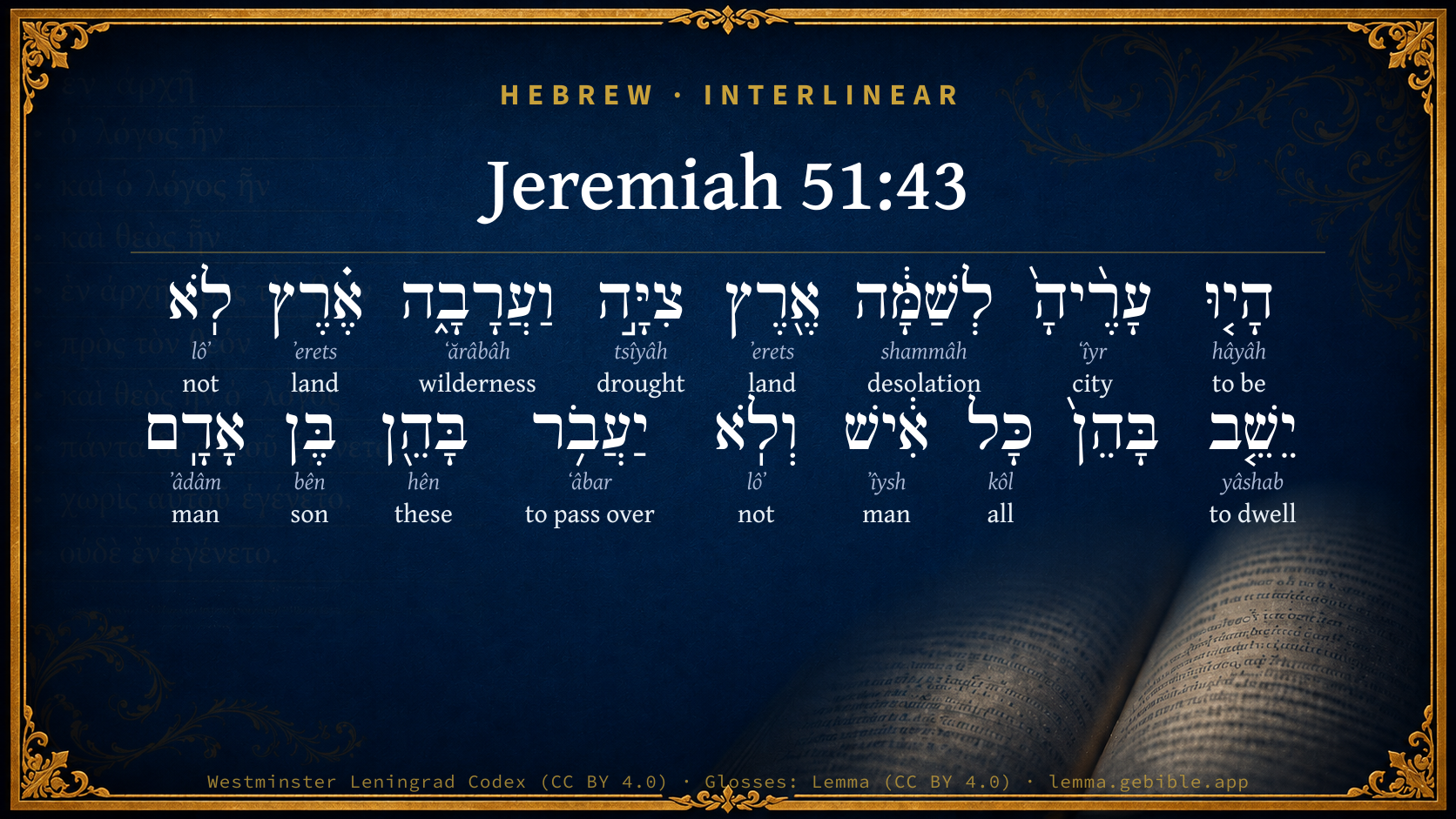
Jeremiah 51:43

Hebrew (Westminster Leningrad Codex) Jeremiah 51:43 appears in the Hebrew Old Testament. The text above is from the Westminster Leningrad Codex. Each word links to its Strong’s number, a concise gloss, and parsing drawn from the Open Scriptures Hebrew Bible morphology. Click any word for its full Brown-Driver-Briggs (BDB) entry.
Download image
Cite this verse

Jeremiah 51:43 (World English Bible). Public Domain. Lemma interlinear Bible study tool, https://lemma.gebible.app/v/jeremiah/51/43.

Show BibTeX & RIS
BibTeX
RIS
English Translation
Her cities are become a desolation, a dry land, and a desert, a land in which no man dwells, neither does any son of man pass thereby.
World English Bible · Public Domain
Download a study sheet

One document with this verse’s original text, its word-by-word gloss line, the meaning frame, cross-references with their text, attributed commentary, and full source and license credits — printable, and it pastes into notes with its structure intact.

This verse Autodidact and up

Study sheet (.html) Plain text (.txt)

A passage Seminary Student

Up to 50 verses in one chapter. A passage sheet keeps up to 6 commentary sources and 12 cross-references per verse, in the order this page ranks them, and says so on the sheet whenever that leaves anything out. Ask for a single verse and you get the Autodidact verse sheet above.

Everything on this page stays free to read, with no account — the sheet is a download of what is already on screen, not access to it.

Want to remove ads? Support Godless Engineer
Compare translations 3

The same verse in 3 English versions, stacked beneath the original-language interlinear above. Click any original word for its lexicon entry.

Each is an independent rendering of the whole verse — the interlinear is not word-aligned to these translations.

Highlighted words mark where these versions differ — a whole-verse word diff, not a word-by-word alignment.

  • World English Bible Public Domain
    Her cities are become a desolation, a dry land, and a desert, a land in which no man dwells, neither does any son of man pass thereby.
  • King James Version Public Domain
    Her cities are a desolation, a dry land, and a wilderness, a land wherein no man dwelleth, neither doth any son of man pass thereby.
  • unfoldingWord Literal Text CC BY-SA 4.0
    Her cities have become a desolation, a dry land and a wilderness, a land that no one inhabits, and no human being passes through.

unfoldingWord Literal Text — © unfoldingWord, licensed CC BY-SA 4.0. Word-aligned USFM3 via Door43 (git.door43.org/unfoldingWord/en_ult).

Versions to compare (up to 4)

3 of 4 selected

Show all 18 translations

Every available English version of this verse, each an independent rendering of the whole verse.

  • World English Bible Public Domain
    Her cities are become a desolation, a dry land, and a desert, a land in which no man dwells, neither does any son of man pass thereby.
  • Berean Standard Bible Public Domain
    Her cities have become a desolation, a dry and arid land, a land where no one lives, where no son of man passes through.
  • Majority Standard Bible Public Domain
    Her cities have become a desolation, a dry and arid land, a land where no one lives, where no son of man passes through.
  • King James Version Public Domain
    Her cities are a desolation, a dry land, and a wilderness, a land wherein no man dwelleth, neither doth any son of man pass thereby.
  • American Standard Version (1901) Public Domain
    Her cities are become a desolation, a dry land, and a desert, a land wherein no man dwelleth, neither doth any son of man pass thereby.
  • Revised Version (1885) Public Domain
    Her cities are become a desolation, a dry land, and a desert, a land wherein no man dwelleth, neither doth any son of man pass thereby.
  • Geneva Bible (1599) Public Domain
    Her cities are desolate: the land is dry and a wildernes, a land wherein no man dwelleth, neither doth the sonne of man passe thereby.
  • Douay-Rheims (1899) Public Domain
    Her cities are become an astonishment, a land uninhabited and desolate, a land wherein none can dwell, nor son of man pass through it.
  • Young's Literal Translation Public Domain
    Its cities have been for a desolation, A dry land, and a wilderness, A land -- none doth dwell in them, Nor pass over into them doth a son of man.
  • Literal Standard Version CC BY-SA 4.0
    Her cities have been for a desolation, || A dry land, and a wilderness, || A land—none dwell in them, || Nor does a son of man pass over into them.
  • Unlocked Literal Bible CC BY-SA 4.0
    Her cities have become a desolation, a dry land and a wilderness, a land that no one inhabits, and no human being passes through.
  • unfoldingWord Literal Text CC BY-SA 4.0
    Her cities have become a desolation, a dry land and a wilderness, a land that no one inhabits, and no human being passes through.
  • Darby Bible Public Domain
    Her cities are become a desolation, a dry land, and a desert, a land wherein no one dwelleth, neither doth a son of man pass thereby.
  • World Messianic Bible Public Domain
    Her cities have become a desolation, a dry land, and a desert, a land in which no man dwells. No son of man passes by it.
  • Webster's Bible Public Domain
    Her cities are a desolation, a dry land, and a wilderness, a land in which no man dwelleth, neither doth any son of man pass by it.
  • Free Bible Version CC BY-SA 4.0
    The towns of Babylonia are in ruins, turned into a dry desert wasteland where no one lives—no one even passes by.
  • Bible in Basic English Public Domain
    Her towns have become a waste, a dry and unwatered land, where no man has his living-place and no son of man goes by.
  • JPS Tanakh (1917) Public Domain
    Her cities are become a desolation, a dry land, and a desert, a land wherein no man dwelleth, neither doth any son of man pass thereby.

Literal Standard Version (2020), Covenant Press — licensed CC BY-SA 4.0. Text via the HelloAO Bible API (eBible.org). Unlocked Literal Bible (unfoldingWord) — licensed CC BY-SA 4.0. Text via the HelloAO Bible API (eBible.org). unfoldingWord Literal Text — © unfoldingWord, licensed CC BY-SA 4.0. Word-aligned USFM3 via Door43 (git.door43.org/unfoldingWord/en_ult). Free Bible Version, Dr. Jonathan Gallagher — licensed CC BY-SA 4.0. Text via the HelloAO Bible API (eBible.org).

Word by word

More ways to search: Search by grammar → Find every occurrence → Compare this word →

Practice this passage: Drill this verse → Learn its vocabulary →

בָּהֵ֖ן
hên
H2004
“in/at · them”
Preposition + Suffix, Personal, 3rd Person, Feminine, Plural
Part of Speech
Preposition
Full BDB Definition

Origin: from H1931

TWOT: 504

they, these, the same, who
  1. הָי֤וּ hâyâh H1961 “to be” Verb, Qal, Perfect, 3rd Person, Common, Plural
  2. עָרֶ֨יהָ֙ ʻîyr H5892 “cities · her” Noun, Common, Feminine, Plural, Construct + Suffix, Personal, 3rd Person, Feminine, Singular
  3. לְשַׁמָּ֔ה shammâh H8047 “to/for · desolation” Preposition + Noun, Common, Feminine, Singular, Absolute
  4. אֶ֖רֶץ ʼerets H776 “land of” Noun, Common, Both, Singular, Construct
  5. צִיָּ֣ה tsîyâh H6723 “drought” Noun, Common, Feminine, Singular, Absolute
  6. וַעֲרָבָ֑ה ʻărâbâh H6160 “and · wilderness” Conjunction + Noun, Common, Feminine, Singular, Absolute
  7. אֶ֗רֶץ ʼerets H776 “land” Noun, Common, Both, Singular, Absolute
  8. לֹֽא lôʼ H3808 “not” Particle, Negative
  9. יֵשֵׁ֤ב yâshab H3427 “to dwell” Verb, Qal, Imperfect, 3rd Person, Masculine, Singular
  10. כָּל kôl H3605 “all of” Noun, Common, Masculine, Singular, Construct
  11. אִ֔ישׁ ʼîysh H376 “man” Noun, Common, Masculine, Singular, Absolute
  12. וְלֹֽא lôʼ H3808 “and · not” Conjunction + Particle, Negative
  13. יַעֲבֹ֥ר ʻâbar H5674 “to pass over” Verb, Qal, Imperfect, 3rd Person, Masculine, Singular
  14. בֶּן bên H1121 “son of” Noun, Common, Masculine, Singular, Construct
  15. אָדָֽם ʼâdâm H120 “man” Noun, Common, Masculine, Singular, Absolute

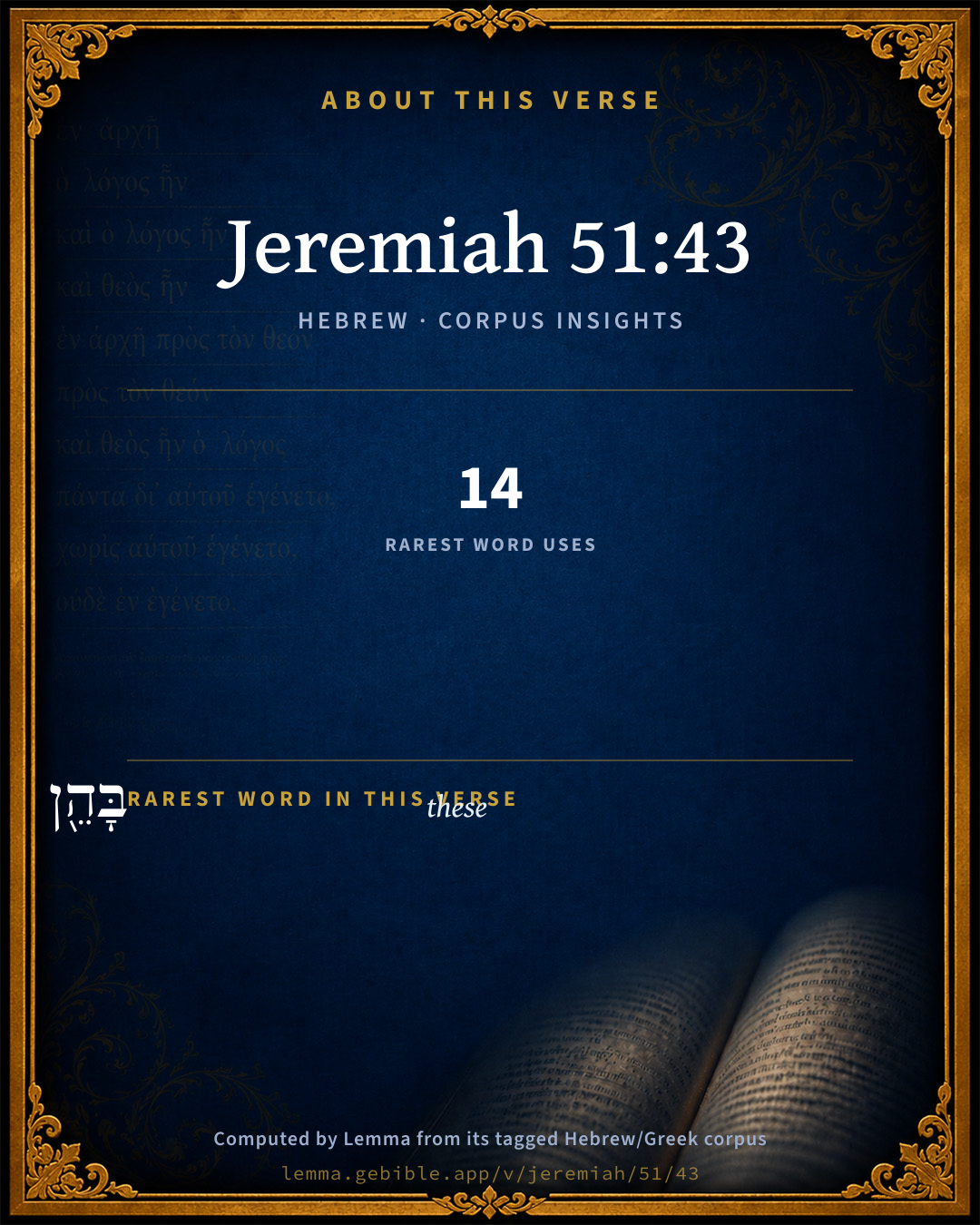
About this verse

These counts appear in no published source. They are computed here, from the morphology-tagged text and Lemma’s own curated glosses. What Lemma adds →

17
words
14
distinct lemmas
Prophets
section

Notable vocabulary

The rarest word here is בָּהֵ֖ן these H2004 — appearing just 14 times in the whole Hebrew Bible.

Shared distinctive vocabulary

בָּהֵ֖ן these H2004 occurs in 14 verses of the Hebrew Bible. Also found in:

Grammatical profile

  • 3 verbs
  • 10 nouns
  • 2 prepositions
  • 2 particles

Verb forms

  • הָי֤וּ Qal · Perfect
  • יֵשֵׁ֤ב Qal · Imperfect
  • יַעֲבֹ֥ר Qal · Imperfect

Repetition

Words recur within this verse — often emphatic in Hebrew:

  • אֶ֖רֶץ land H776 ×2
  • לֹֽא not H3808 ×2

Cross-references

7

Topical passages linked to Jeremiah 51:43 in the Treasury of Scripture Knowledge — connected by theme and wording, ordered by reader-vote popularity; previews shown in the World English Bible.

  • Isaiah 13:20 It shall never be inhabited, neither shall it be lived in from generation to generation: neither shall the Arabian pitch tent there; neither shall shepherds make their flocks to lie down there.
  • Jeremiah 2:6 Neither said they, Where is Yahweh who brought us up out of the land of Egypt, who led us through the wilderness, through a land of deserts and of pits, through a land of drought and of the shadow of death, through a land that none passed through, and where no man lived?
  • Jeremiah 51:29 The land trembles and is in pain; for the purposes of Yahweh against Babylon do stand, to make the land of Babylon a desolation, without inhabitant.
  • Jeremiah 50:12 your mother shall be utterly disappointed; she who bore you shall be confounded: behold, she shall be the least of the nations, a wilderness, a dry land, and a desert.
  • Jeremiah 50:39–40 Therefore the wild animals of the desert with the wolves shall dwell there, and the ostriches shall dwell therein: and it shall be no more inhabited forever; neither shall it be lived in from generation to generation.
  • Jeremiah 51:37 Babylon shall become heaps, a dwelling-place for jackals, an astonishment, and a hissing, without inhabitant.
  • Ezekiel 29:10–11 therefore, behold, I am against you, and against your rivers, and I will make the land of Egypt an utter waste and desolation, from the tower of Seveneh even to the border of Ethiopia.

Cross-references courtesy of OpenBible.info (CC BY 4.0).

Hebrew and Greek witnesses Masoretic Hebrew ↔ Greek Septuagint

The same verse in the two great witnesses to the Old Testament, shown verse-for-verse.

These are two independent witnesses, not word-aligned to each other, and the Septuagint is shown in lemma (dictionary) form.

Hebrew Jeremiah 51:43 Masoretic · Westminster Leningrad Codex

הָי֤וּ עָרֶ֨יהָ֙ לְשַׁמָּ֔ה אֶ֖רֶץ צִיָּ֣ה וַעֲרָבָ֑ה אֶ֗רֶץ לֹֽא יֵשֵׁ֤ב בָּהֵן֙ כָּל אִ֔ישׁ וְלֹֽא יַעֲבֹ֥ר בָּהֵ֖ן בֶּן אָדָֽם

Her cities are become a desolation, a dry land, and a desert, a land in which no man dwells, neither does any son of man pass thereby.

World English Bible · Public Domain

Greek LXX Structure differs

In the Septuagint, Jeremiah is about an eighth shorter than the Hebrew and arranges its material differently — the Oracles Against the Nations (Hebrew chapters 46–51) appear in the middle of the Greek book, after 25:13. Because the chapter and verse boundaries do not line up, a verse-for-verse comparison with the Hebrew is not shown.

A verse-for-verse comparison isn’t shown here because the chapters and verses don’t line up. Switch to the LXX edition with the MT / LXX toggle above to read the Greek directly.

Hebrew: Westminster Leningrad Codex (CC BY 4.0). Greek: Septuagint (public domain); English from a public-domain English Septuagint. How the Septuagint differs from the Hebrew →

Targum (Aramaic paraphrase)

1

The Targum is the ancient Jewish Aramaic paraphrase of the Hebrew Scriptures — an interpretive translation, not the Hebrew text itself. Onkelos (literal) and Pseudo-Jonathan (expansive) render the Torah, and Jonathan the Prophets. Coverage is partial: where no permissively-licensed English translation exists for a verse, only the Aramaic is shown. This is verse-level text, not a word-by-word alignment to the Hebrew.

  1. Targum Jonathan Prophets (Joshua–Malachi)
    הֲוָאָה קִרְוָאָה לְצָדוּ אַרְעָא צַדְיָא וְחָרְבָא אַרְעָא לָא יָתֵיב בָּהּ כָּל אֱנַשׁ וְלָא יֶעְבַר בָּהּ בַּר אֱנַשׁ:

    (no public-domain English translation for this verse)

    Targum Jonathan — Aramaic: “Mikraot Gedolot” (public domain). English: “Sefaria Community Translation” (CC0 1.0 (public-domain dedication)); “London "Chaldee Paraphrase," 1871” (public domain). Text via Sefaria.

Commentary

Notes on Jeremiah 51:43 from classic Christian and Jewish commentators (each source and its license shown beneath its notes). The classic Christian expositions comment on the surrounding passage and are grouped to its opening verse, so a note may address several verses; the Jewish commentaries on the Tanakh (Rashi and others) are per-verse, so they appear only where the commentator wrote on this verse.

Lemma curates 59 commentaries, every one of them public domain or Creative Commons licensed, each selected and text-cleaned for this edition rather than reprinted as found. About our sources →

Trapp's Complete Commentary

John Trapp

Jer 51:43 Her cities are a desolation, a dry land, and a wilderness, a land wherein no man dwelleth, neither doth [any] son of man pass thereby.

Ver. 43. Her cities are a desolation.] See Jer 2:6; Jer 9:12.

John Trapp, A Commentary or Exposition upon All the Books of the Old and New Testament (1647–1656) — public domain. Text from a community e-Sword module.

Jamieson, Fausset & Brown

Robert Jamieson, A. R. Fausset & David Brown

Her cities--the cities, her dependencies. So, "Jerusalem and the cities thereof" (Jer 34:1). Or, the "cities" are the inner and outer cities, the two parts into which Babylon was divided by the Euphrates [GROTIUS].

Jamieson, Fausset & Brown — Commentary Critical and Explanatory on the Whole Bible (1871) — public domain (CC PDM 1.0). Text via the HelloAO Bible API.

John Calvin's Commentaries

He repeats what he had previously said, but we have before reminded you why he speaks so largely on a subject in itself not obscure. For he might have comprehended in a few words all that he had said in the last chapter and also in this; but it was difficult to convince men of what he taught — it was therefore necessary to dwell at large on the subject.

He says now that the cities of Babylon, that is, of that monarchy, would become a desolation. He seems to have hitherto directed his threatenings against the city itself; but now he declares that God’s vengeance would extend to all the cities under the power of the Chaldean nation; and he speaks at large of their desolation, for he says that it would be a land of desert, a land of drought, or of filthiness, so that no one would dwell in it. And though he uses the singular number and repeats it, yet he refers to cities, Pass through it shall no man, dwell in it shall no man He indeed speaks of the whole land, but so that he properly refers to the cities, as though he had said, that so great would be the destruction, that however far and wide the monarchy of Babylon extended, all its cities would be cut off. It afterwards follows, —

John Calvin's Commentaries (1540-1563) — public domain. Text from the Calvin Translation Society English edition (1840s-50s) via the Christian Classics Ethereal Library (ccel.org). Calvin's coverage is partial (roughly two-thirds of the Bible); uncommented books and verses are honest gaps, never fabricated. The 19th-century editor's footnotes and remarks are omitted so the notes are faithfully Calvin's own voice.

Ellicott's Commentary for English Readers

(43) Her cities are a desolation . . .—The word for “wilderness” is Arabah, commonly used of the sandy desert south of the Dead Sea. The prophet seems to dwell with a stern delight on the seeming paradox that the sea with which Babylon is to be oversowed, the floods of invaders and destroyers, shall leave her cities and her plains drier and more sandy than before.

A Bible Commentary for English Readers, edited by Charles John Ellicott (1878–1897) — public domain. Text from a community e-Sword module.

The Cambridge Bible for Schools and Colleges

gen. ed. J. J. S. Perowne

43. a desert] Cp. Jer_50:12; Jer_50:40.

The Cambridge Bible for Schools and Colleges (gen. ed. J. J. S. Perowne; Cambridge University Press, 1878–1918) — public domain. Text from a community e-Sword module.

John Gill's Exposition

My people, go ye out of the midst of her,.... This is a call of the Jews to go out of Babylon, not before the taking of the city by Cyrus; but when he should issue out a proclamation, giving them liberty to return to their own land; which many of them, being well settled in Babylon, would not be ready to accept of, but choose to continue there; wherefore they are urged to depart from thence, because of the danger they would be exposed unto; for though the city was not destroyed by Cyrus upon his taking it, yet it was by Darius Hystaspes some time after. The same call is given to the people of God to come out of mystical Babylon, Rev 18:4;

and deliver ye every man his soul from the fierce anger of the Lord; shown in the destruction of Babylon; See Gill on Jer 51:6.

John Gill's Exposition of the Whole Bible (1746–1763) — public domain (CC PDM 1.0). Text via the HelloAO Bible API.

Albert Barnes' Notes on the Bible

A wilderness - Or, a desert of sand.

A land wherein - Rather, “a land - no man shall dwell in them (i. e., its cities), and no human being shall pass through them.”

Albert Barnes' Notes on the Bible (1834–1885) — public domain. Text from a community e-Sword/MySword module.

Matthew Poole's English Annotations

See Jer 2:6; 9:12; the words are all of them descriptive of an utter desolation, that should not only be the fate of Babylon the head city, but of all the inferior cities, that were as daughters to that mother city.

Matthew Poole's English Annotations on the Holy Bible (1683–1685) — public domain. Text from a community e-Sword/MySword module.

unfoldingWord translationNotes

Door43 World Missions Community

Her cities

"Babylon's cities"

I will punish Bel

Bel was the main god of the Babylonians and represents the whole country and the people that worshiped it. (See: Metonymy)

out from his mouth what he swallowed

Yahweh compares all the sacrifices and offerings to Bel to things he ate. (See: Personification)

the nations will no longer flow

The many nations that come to Babylon to sacrifice to Bel is spoken of as a river that moves along. AT: "the people of other nations will no longer come in large groups" (See: Metaphor)

translationWords

desolate

desert

punish

sacrifice

unfoldingWord translationNotes — © Distant Shores Media and the Door43 World Missions Community, licensed CC BY-SA 4.0. Source: git.door43.org/Door43/en_tn.

Lesson kit

Teaching starters — assembled from the data on this page, not authored interpretation. Every prompt links to the verse data it draws on. Edit before teaching.

Jeremiah, in the Prophets, opens this verse with 17 words (14 distinct Hebrew lemmas). Its most distinctive word is hên (“these”). A historical commentator’s framing appears above. Read the whole chapter for the surrounding context.

Discussion questions

  1. How does “these” (hên) shape what this verse is saying?
  2. Genesis 19:29 shares the word «these» with this verse. How do the two illuminate each other?
  3. “land” occurs 2× in this one verse. What is the effect of the repetition?
  4. The translations on this page render this verse differently — a whole-verse word diff, not a word-by-word alignment. What might account for the different wordings?
  5. The verb «הָי֤וּ» is Qal Perfect. How does its form color the action?
  6. Reading how Trapp's Complete Commentary and Jamieson, Fausset & Brown read this verse, where do the two commentators agree and where do they part?

Things to notice

Reading settings

Reading text

Shown beneath each verse's original-language words.

Old Testament
Old Testament edition

Read the OT as the Masoretic Hebrew (MT) or the Greek Septuagint (LXX).

English shown for the Greek Septuagint (in the Hebrew ↔ Greek comparison).

Comparing translations? Open the Compare panel on any verse page to stack up to four side by side.