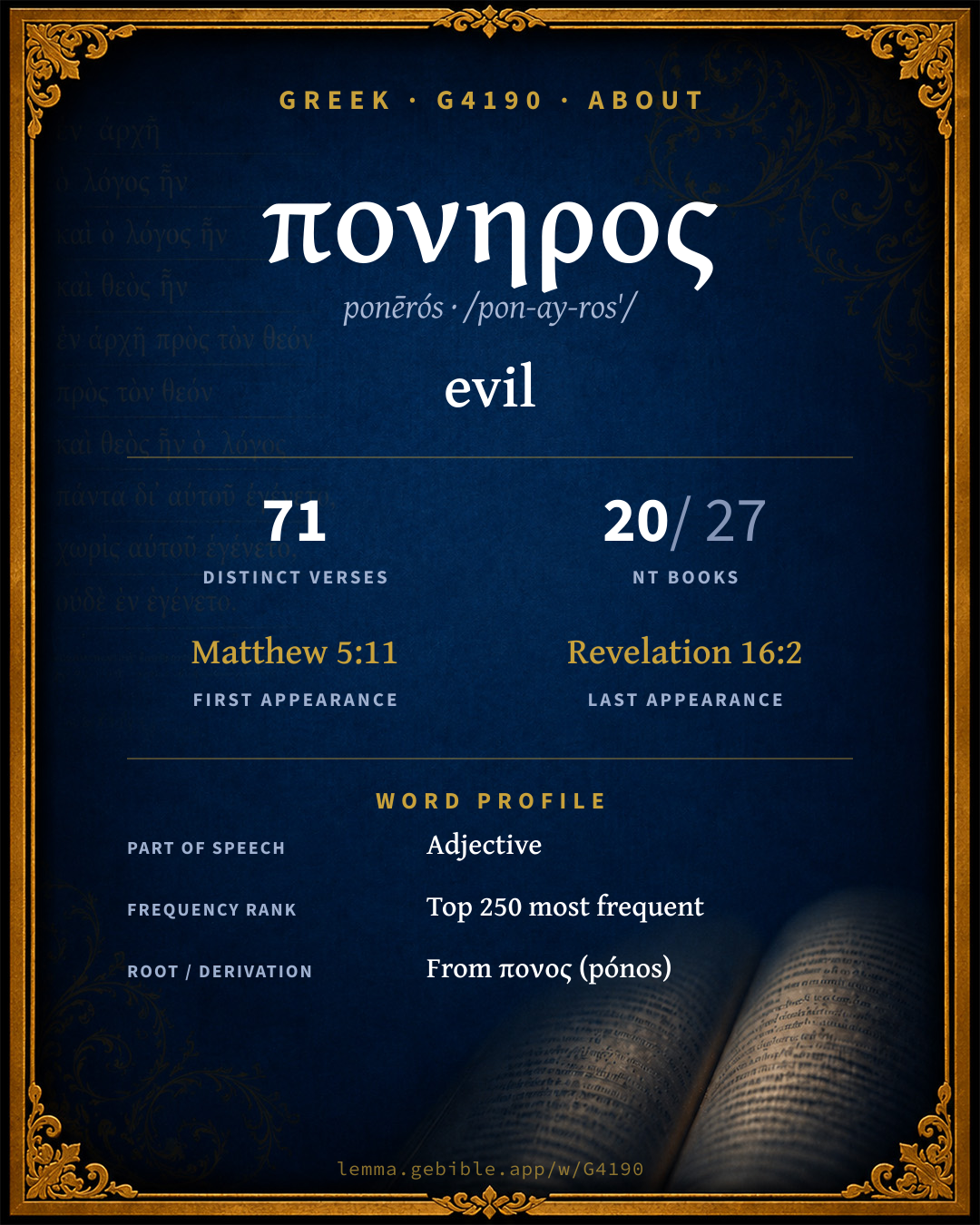
πονηρός
evil
‘evil’ is one of 2 main senses fuller range ↓
Full lexicon entry — Thayer's Greek Lexicon
From Thayer's Greek Lexicon
Where this word appears
See every Nominative-case word in the Greek New Testament →
Grammar key — what these labels mean
Part of speech
- Adjective
- A word that describes or qualifies a noun.
Case
- Genitive
- The case of source, possession, or “of” — answers “whose / from what.”
- Nominative
- The case of the subject (and the predicate nominative).
- Accusative
- The case of the direct object and of extent.
- Vocative
- The case of direct address (“O Lord”).
- Dative
- The case of the indirect object, means, or location — “to / for / with / in.”
Gender
- Masculine
- Grammatically masculine.
- Neuter
- Grammatically neuter.
- Feminine
- Grammatically feminine.
Number
- Singular
- One.
- Plural
- More than one.
Degree
- Comparative
- Expresses a greater degree (“greater,” “more”).
Grammatical forms 22 distinct
- Adjective, Genitive, Singular, Masculine 10 times (13%)
- Adjective, Nominative, Singular, Masculine 8 times (10%)
- Adjective, Accusative, Plural, Masculine 7 times (9%)
- Adjective, Accusative, Singular, Neuter 5 times (6%)
- Adjective, Nominative, Plural, Masculine 5 times (6%)
- Adjective, Nominative, Singular, Feminine 5 times (6%)
- Adjective, Accusative, Plural, Neuter 4 times (5%)
- Adjective, Nominative, Plural, Neuter 4 times (5%)
+14 more forms (29 occurrences)
Parsed forms decoded from the imported morphology (Robinson–Tischendorf, public domain), counted across 77 parsed occurrences — not distinct verses.
Every verse where G4190 appears — 71 distinct verses across 20 books. Click any verse to open its interlinear word-by-word view. Verse text shown in the World English Bible for context — . Each verse’s Greek form is shown with its reference; the English is not keyword-highlighted, since the data carries no word-level English alignment. Use “Compare translations” on any verse to read it across multiple English versions. This concordance covers the Greek New Testament; Septuagint (Greek Old Testament) occurrences of this word are not indexed here.
Matthew 23 verses
- Matthew 5:11 πονηρὸν adj acc sg neut "Blessed are you when people reproach you, persecute you, and say all kinds of evil against you falsely, for my sake.
- Matthew 5:37 πονηροῦ adj gen sg masc But let your 'Yes' be 'Yes' and your 'No' be 'no.' Whatever is more than these is of the evil one.
- Matthew 5:39 πονηρῷ adj dat sg masc But I tell you, don't resist him who is evil; but whoever strikes you on your right cheek, turn to him the other also.
- Matthew 5:45 πονηροὺς adj acc pl masc that you may be children of your Father who is in heaven. For he makes his sun to rise on the evil and the good, and sends rain on the just and the unjust.
- Matthew 6:13 πονηροῦ adj gen sg masc Bring us not into temptation, but deliver us from the evil one. For yours is the Kingdom, the power, and the glory forever. Amen.'
- Matthew 6:23 πονηρὸς adj nom sg masc But if your eye is evil, your whole body will be full of darkness. If therefore the light that is in you is darkness, how great is the darkness!
- Matthew 7:11 πονηροὶ adj nom pl masc If you then, being evil, know how to give good gifts to your children, how much more will your Father who is in heaven give good things to those who ask him!
- Matthew 7:17 πονηροὺς adj acc pl masc Even so, every good tree produces good fruit; but the corrupt tree produces evil fruit.
- Matthew 7:18 πονηροὺς adj acc pl masc A good tree can't produce evil fruit, neither can a corrupt tree produce good fruit.
- Matthew 9:4 πονηρὰ adj acc pl neut Jesus, knowing their thoughts, said, "Why do you think evil in your hearts?
- Matthew 12:34 πονηροὶ adj nom pl masc You offspring of vipers, how can you, being evil, speak good things? For out of the abundance of the heart, the mouth speaks.
- Matthew 12:35 πονηρὸς πονηροῦ πονηρά adj nom sg masc adj gen sg masc adj acc pl neut The good man out of his good treasure brings out good things, and the evil man out of his evil treasure brings out evil things.
- Matthew 12:39 πονηρὰ adj nom sg fem But he answered them, "An evil and adulterous generation seeks after a sign, but no sign will be given it but the sign of Jonah the prophet.
- Matthew 12:45 πονηρότερα πονηρᾷ adj acc pl neut comp adj dat sg fem Then he goes, and takes with himself seven other spirits more evil than he is, and they enter in and dwell there. The last state of that man becomes worse than the first. Even so will it be also to this evil generation."
- Matthew 13:19 πονηρὸς adj nom sg masc When anyone hears the word of the Kingdom, and doesn't understand it, the evil one comes, and snatches away that which has been sown in his heart. This is what was sown by the roadside.
- Matthew 13:38 πονηροῦ adj gen sg masc the field is the world; and the good seed, these are the children of the Kingdom; and the darnel are the children of the evil one.
- Matthew 13:49 πονηροὺς adj acc pl masc So will it be in the end of the world. The angels will come forth, and separate the wicked from among the righteous,
- Matthew 15:19 πονηροί adj nom pl masc For out of the heart come forth evil thoughts, murders, adulteries, sexual sins, thefts, false testimony, and blasphemies.
- Matthew 16:4 πονηρὰ adj nom sg fem An evil and adulterous generation seeks after a sign, and there will be no sign given to it, except the sign of the prophet Jonah." He left them, and departed.
- Matthew 18:32 πονηρέ adj voc sg masc Then his lord called him in, and said to him, 'You wicked servant! I forgave you all that debt, because you begged me.
- Matthew 20:15 πονηρός adj nom sg masc Isn't it lawful for me to do what I want to with what I own? Or is your eye evil, because I am good?'
- Matthew 22:10 πονηρούς adj acc pl masc Those servants went out into the highways, and gathered together as many as they found, both bad and good. The wedding was filled with guests.
- Matthew 25:26 πονηρὲ adj voc sg masc "But his lord answered him, 'You wicked and slothful servant. You knew that I reap where I didn't sow, and gather where I didn't scatter.
Mark 2 verses
Luke 10 verses
- Luke 3:19 πονηρῶν adj gen pl neut but Herod the tetrarch, being reproved by him for Herodias, his brother's wife, and for all the evil things which Herod had done,
- Luke 6:22 πονηρὸν adj acc sg neut Blessed are you when men shall hate you, and when they shall exclude and mock you, and throw out your name as evil, for the Son of Man's sake.
- Luke 6:35 πονηρούς adj acc pl masc But love your enemies, and do good, and lend, expecting nothing back; and your reward will be great, and you will be children of the Most High; for he is kind toward the unthankful and evil.
- Luke 6:45 πονηρὸς πονηροῦ πονηρόν adj nom sg masc adj gen sg masc adj acc sg neut The good man out of the good treasure of his heart brings out that which is good, and the evil man out of the evil treasure of his heart brings out that which is evil, for out of the abundance of the heart, his mouth speaks.
- Luke 7:21 πονηρῶν adj gen pl neut In that hour he cured many of diseases and plagues and evil spirits; and to many who were blind he gave sight.
- Luke 8:2 πονηρῶν adj gen pl neut and certain women who had been healed of evil spirits and infirmities: Mary who was called Magdalene, from whom seven demons had gone out;
- Luke 11:13 πονηροὶ adj nom pl masc If you then, being evil, know how to give good gifts to your children, how much more will your heavenly Father give the Holy Spirit to those who ask him?"
- Luke 11:29 πονηρά adj nom sg fem When the multitudes were gathering together to him, he began to say, "This is an evil generation. It seeks after a sign. No sign will be given to it but the sign of Jonah, the prophet.
- Luke 11:34 πονηρὸς adj nom sg masc The lamp of the body is the eye. Therefore when your eye is good, your whole body is also full of light; but when it is evil, your body also is full of darkness.
- Luke 19:22 πονηρὲ adj voc sg masc "He said to him, 'Out of your own mouth will I judge you, you wicked servant! You knew that I am an exacting man, taking up that which I didn't lay down, and reaping that which I didn't sow.
John 3 verses
- John 3:19 πονηρὰ adj nom pl neut This is the judgment, that the light has come into the world, and men loved the darkness rather than the light; for their works were evil.
- John 7:7 πονηρά adj nom pl neut The world can't hate you, but it hates me, because I testify about it, that its works are evil.
- John 17:15 πονηροῦ adj gen sg masc I pray not that you would take them from the world, but that you would keep them from the evil one.
Acts 8 verses
- Acts 17:5 πονηροὺς adj acc pl masc But the unpersuaded Jews took along some wicked men from the marketplace, and gathering a crowd, set the city in an uproar. Assaulting the house of Jason, they sought to bring them out to the people.
- Acts 18:14 πονηρόν adj nom sg neut But when Paul was about to open his mouth, Gallio said to the Jews, "If indeed it were a matter of wrong or of wicked crime, you Jews, it would be reasonable that I should bear with you;
- Acts 19:12 πονηρὰ adj acc pl neut so that even handkerchiefs or aprons were carried away from his body to the sick, and the evil spirits went out.
- Acts 19:13 πονηρὰ adj acc pl neut But some of the itinerant Jews, exorcists, took on themselves to name over those who had the evil spirits the name of the Lord Jesus, saying, "We adjure you by Jesus whom Paul preaches."
- Acts 19:15 πονηρὸν adj nom sg neut The evil spirit answered, "Jesus I know, and Paul I know, but who are you?"
- Acts 19:16 πονηρὸν adj nom sg neut The man in whom the evil spirit was leaped on them, and overpowered them, and prevailed against them, so that they fled out of that house naked and wounded.
- Acts 25:18 πονηράν adj acc sg fem Concerning whom, when the accusers stood up, they brought no charge of such things as I supposed;
- Acts 28:21 πονηρόν adj acc sg neut They said to him, "We neither received letters from Judea concerning you, nor did any of the brothers come here and report or speak any evil of you.
Romans 1 verse
1 Corinthians 1 verse
Galatians 1 verse
Ephesians 3 verses
- Ephesians 5:16 πονηραί adj nom pl fem redeeming the time, because the days are evil.
- Ephesians 6:13 πονηρᾷ adj dat sg fem Therefore, put on the whole armor of God, that you may be able to withstand in the evil day, and, having done all, to stand.
- Ephesians 6:16 πονηροῦ adj gen sg masc above all, taking up the shield of faith, with which you will be able to quench all the fiery darts of the evil one.
Colossians 1 verse
1 Thessalonians 1 verse
2 Thessalonians 2 verses
1 Timothy 1 verse
2 Timothy 2 verses
- 2 Timothy 3:13 Πονηροὶ adj nom pl masc But evil men and impostors will grow worse and worse, deceiving and being deceived.
- 2 Timothy 4:18 πονηροῦ adj gen sg neut And the Lord will deliver me from every evil work, and will preserve me for his heavenly Kingdom; to whom be the glory forever and ever. Amen.
Hebrews 2 verses
- Hebrews 3:12 πονηρὰ adj nom sg fem Beware, brothers, lest perhaps there be in any one of you an evil heart of unbelief, in falling away from the living God;
- Hebrews 10:22 πονηρᾶς adj gen sg fem let's draw near with a true heart in fullness of faith, having our hearts sprinkled from an evil conscience, and having our body washed with pure water,
James 2 verses
1 John 5 verses
- 1 John 2:13 πονηρόν adj acc sg masc I write to you, fathers, because you know him who is from the beginning. I write to you, young men, because you have overcome the evil one. I write to you, little children, because you know the Father.
- 1 John 2:14 πονηρόν adj acc sg masc I have written to you, fathers, because you know him who is from the beginning. I have written to you, young men, because you are strong, and the word of God remains in you, and you have overcome the evil one.
- 1 John 3:12 πονηροῦ πονηρὰ adj gen sg masc adj nom pl neut unlike Cain, who was of the evil one, and killed his brother. Why did he kill him? Because his works were evil, and his brother's righteous.
- 1 John 5:18 πονηρὸς adj nom sg masc We know that whoever is born of God doesn't sin, but he who was born of God keeps himself, and the evil one doesn't touch him.
- 1 John 5:19 πονηρῷ adj dat sg masc We know that we are of God, and the whole world lies in the power of the evil one.
2 John 1 verse
3 John 1 verse
Revelation 1 verse
About this entry
At a glance — auto-summarized from this page’s data, not written by a person. Every figure links to its source below. This summary describes the numbers; it doesn’t interpret them.
πονηρος — transliterated ponērós — is a Greek adjective carrying the sense “evil.” It first appears in Matthew 5:11. With 71 verses in 20 books, it is a moderately common word in the Greek New Testament. Its uses concentrate in Matthew (32% of all occurrences). Its lexical range runs to 2 senses. Each statement above links to its evidence; the full detail follows below.
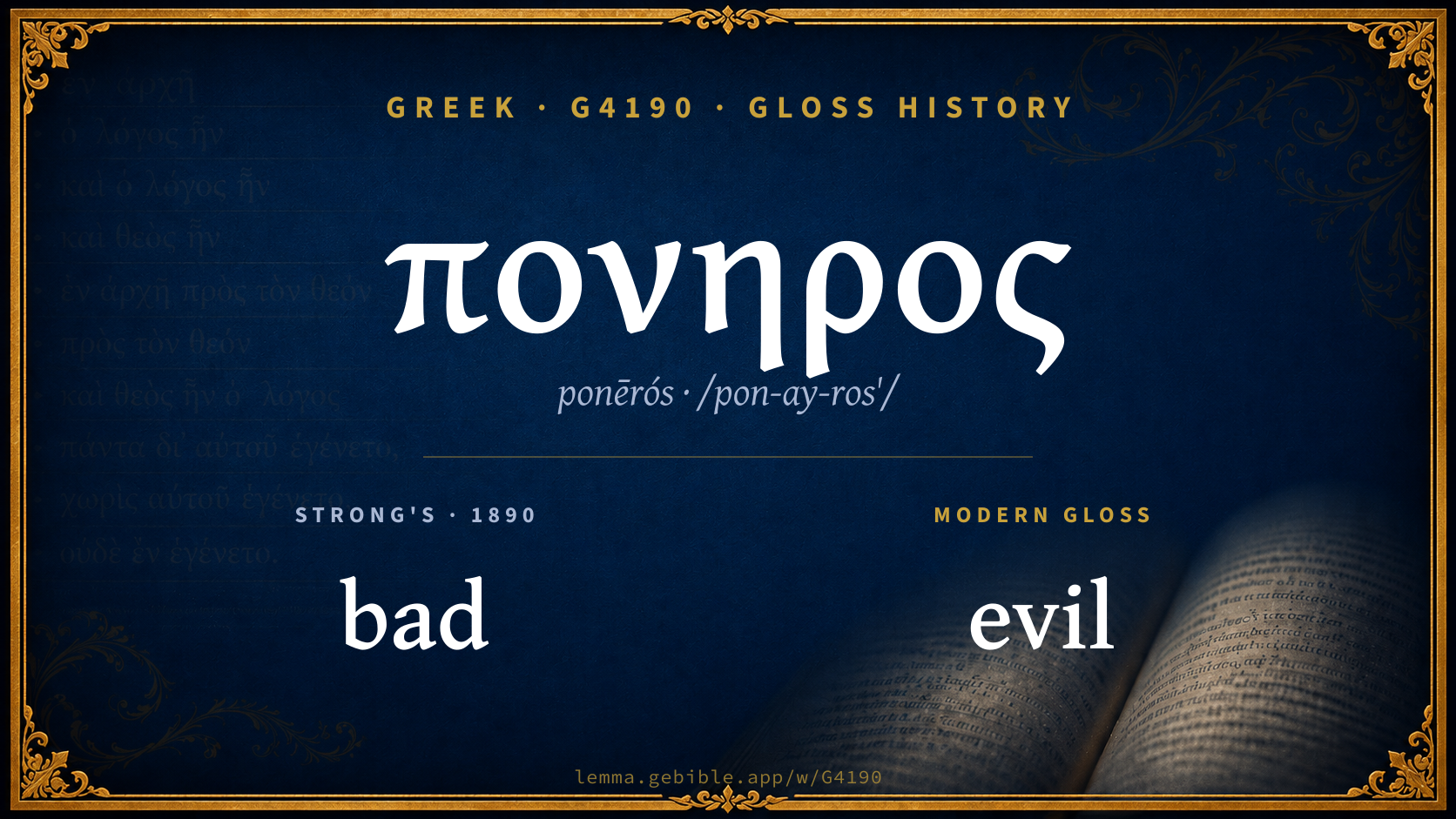
Gloss history
Strong's 1890 vs modern scholarship
About this word
Strong's G4190 catalogs a Greek word from the Greek New Testament.
These counts are not copied from any lexicon or concordance. They are computed here, from the morphology-tagged Greek New Testament. What Lemma adds →
- 71
- distinct verses
- The word appears in 71 distinct verses.
- 20 / 27
- NT books
- The word appears in 20 of 27 New Testament books.
- #220
- by frequency
- Top 250 most frequent Greek words (rank 220 of 5,347 Greek words by occurrence).
View all 71 occurrences in the concordance →
By section of the New Testament
By traditional corpus
Conventional, traditional groupings — biblical authorship is debated, so this is a traditional corpus grouping, not an authorship claim. Some books belong to more than one corpus (Luke is in both the Gospels and the Lukan corpus, and so on), so these shares overlap and need not total 100%. Each figure is a share of the word’s 71 distinct verses.
- Gospels 38 verses · 54%
- Lukan (Luke–Acts) 18 verses · 25%
- Pauline corpus 13 verses · 18%
- Johannine 11 verses · 15%
- General (Catholic) Epistles 9 verses · 13%
- Hebrews 2 verses · 3%
- Revelation 1 verse · 1%
How translations render this word
Counts come from each version’s own published word-to-Strong’s tagging or interlinear alignment — an approximate guide to how each version renders this word, not a word-level alignment the data otherwise carries. Because each total is that version’s own tagged count, the per-version totals vary from one another and need not match the appearance or distinct-verse counts above. These counts may also differ from a printed concordance because Lemma counts each distinctly tagged rendering and does not collapse phrase taggings into a single head-word total. This is a fixed set of word-tagged versions (KJV, ASV, BSB, ULT) and does not change with the reading translation you choose elsewhere. Each version’s license is shown beside its name below (and on Sources).
- King James Version: Evil 48×, Wicked 9×, Wicked one 4×
- American Standard Version: Evil 46×, Evil one 11×, Wicked 4×
- Berean Standard Bible: Evil 46×, Wicked 10×, Bad 5×
- unfoldingWord Literal Text: Evil 46×, Evil one 13×, Wicked 8×
King James Version Public Domain
Renders G4190 across 76 tagged occurrences — most commonly:
Plus 8 renderings that appear only once — usually multi-word phrases or single function words the recovered tagging swept in, not distinct renderings.
American Standard Version Public Domain
Renders G4190 across 76 tagged occurrences — most commonly:
Plus 8 renderings that appear only once — usually multi-word phrases or single function words the recovered tagging swept in, not distinct renderings.
Berean Standard Bible Public Domain
Renders G4190 across 77 tagged occurrences — most commonly:
Plus 10 renderings that appear only once — usually multi-word phrases or single function words the recovered tagging swept in, not distinct renderings. Not rendered by a distinct English word in 1 further occurrence.
unfoldingWord Literal Text CC BY-SA 4.0
Renders G4190 across 76 tagged occurrences — most commonly:
Plus 3 renderings that appear only once — usually multi-word phrases or single function words the recovered tagging swept in, not distinct renderings.
Senses in Thayer's
The 2 senses Thayer's distinguishes for this word, in lexicon order (not ranked by frequency or importance). The full entry — with sub-senses — is in the Lexicon Entry tab.
- full of labours, annoyances, hardships
- bad, of a bad nature or condition
Word origin
Derived from πονος (pónos) (G4192) — intense desire.
From a derivative of G4192 ; hurtful that is evil (properly in effect or influence and thus differing from G2556 which refers rather to essential character as well as from G4550 which indicates degeneracy from original virtue); figuratively calamitous ; also (passively) ill that is diseased ; but especially (morally) culpable that is derelict vicious facinorous ; neuter (singular) mischief malice or (plural) guilt ; masculine (singular) the devil or (plural) sinners : - bad evil grievous harm lewd malicious wicked (-ness). See also G4191 .
— Strong’s Exhaustive Concordance (1890), public domain.
Forms in the corpus
The 22 distinct written forms G4190 takes in the Greek New Testament, most frequent first — each parse links to that case’s occurrences in the concordance.
Same root — word family
Other Thayer's entries built from the same root as G4190, grouped by Strong’s listed origin. These share a root / origin per the lexicon — not necessarily a shared meaning. Each links to that word’s own entry.
Derives from
Derived from this word
Compare all same-root words → They share a root, not necessarily a meaning.
Septuagint usage
The same Greek word πονηρος appears 296 times in the Greek Old Testament (Septuagint), across 284 verses in 31 books.
- 296
- LXX occurrences
- Tagged occurrences of this Greek word in the Septuagint.
- 284
- verses
- Distinct Septuagint verses containing this word.
- 31 / 39
- OT books
- The word appears in 31 of the 39 Old Testament books.
Sample Septuagint occurrences
- Genesis 2:9 πονηρός
- Exodus 33:4 πονηρός
- Leviticus 26:6 πονηρός
- Numbers 11:1 πονηρός
- Deuteronomy 4:25 πονηρός
- Joshua 23:15 πονηρός
- Judges 2:11 πονηρός
- 1 Samuel 3:21 πονηρός
- 2 Samuel 3:39 πονηρός
- 1 Kings 5:18 πονηρός
- 2 Kings 1:18 πονηρός
- 1 Chronicles 2:3 πονηρός
Septuagint occurrences (same lexeme)
Every verse where the same Strong’s number (G4190) appears in the Greek Septuagint — showing the first 50 of 284. Verse text shown in the World English Bible for context; the Greek form is the matched word — the English is not keyword-highlighted.
- Genesis 2:9 πονηρός Out of the ground Yahweh God made every tree to grow that is pleasant to the sight, and good for food; the tree of life also in the midst of the garden, and the tree of the knowledge of good and evil.
- Genesis 2:17 πονηρός but of the tree of the knowledge of good and evil, you shall not eat of it: for in the day that you eat of it you will surely die."
- Genesis 3:5 πονηρός for God knows that in the day you eat it, your eyes will be opened, and you will be like God, knowing good and evil."
- Genesis 3:22 πονηρός Yahweh God said, "Behold, the man has become like one of us, knowing good and evil. Now, lest he put forth his hand, and also take of the tree of life, and eat, and live forever..."
- Genesis 6:5 πονηρός Yahweh saw that the wickedness of man was great in the earth, and that every imagination of the thoughts of his heart was only evil continually.
- Genesis 8:21 πονηρός Yahweh smelled the sweet savor. Yahweh said in his heart, "I will not again curse the ground any more for man's sake, because the imagination of man's heart is evil from his youth; neither will I ever again strike everything living, as I have done.
- Genesis 12:17 πονηρός Yahweh plagued Pharaoh and his house with great plagues because of Sarai, Abram's wife.
- Genesis 13:13 πονηρός Now the men of Sodom were exceedingly wicked and sinners against Yahweh.
- Genesis 28:8 πονηρός Esau saw that the daughters of Canaan didn't please Isaac, his father.
- Genesis 31:24 πονηρός God came to Laban, the Syrian, in a dream of the night, and said to him, "Take heed to yourself that you don't speak to Jacob either good or bad."
- Genesis 31:29 πονηρός It is in the power of my hand to hurt you, but the God of your father spoke to me last night, saying, 'Take heed to yourself that you don't speak to Jacob either good or bad.'
- Genesis 34:30 πονηρός Jacob said to Simeon and Levi, "You have troubled me, to make me odious to the inhabitants of the land, among the Canaanites and the Perizzites. I am few in number. They will gather themselves together against me and strike me, and I will be destroyed, I and my house."
- Genesis 35:22 πονηρός It happened, while Israel lived in that land, that Reuben went and lay with Bilhah, his father's concubine, and Israel heard of it. Now the sons of Jacob were twelve.
- Genesis 37:2 πονηρός This is the history of the generations of Jacob. Joseph, being seventeen years old, was feeding the flock with his brothers. He was a boy with the sons of Bilhah and Zilpah, his father's wives. Joseph brought an evil report of them to their father.
- Genesis 37:20 πονηρός Come now therefore, and let's kill him, and cast him into one of the pits, and we will say, 'An evil animal has devoured him.' We will see what will become of his dreams."
- Genesis 37:33 πονηρός He recognized it, and said, "It is my son's coat. An evil animal has devoured him. Joseph is without doubt torn in pieces."
- Genesis 38:7 πονηρός Er, Judah's firstborn, was wicked in the sight of Yahweh. Yahweh killed him.
- Genesis 38:10 πονηρός The thing which he did was evil in the sight of Yahweh, and he killed him also.
- Genesis 39:9 πονηρός He isn't greater in this house than I, neither has he kept back anything from me but you, because you are his wife. How then can I do this great wickedness, and sin against God?"
- Genesis 41:19 πονηρός and, behold, seven other cattle came up after them, poor and very ill-favored and lean-fleshed, such as I never saw in all the land of Egypt for ugliness.
- Genesis 44:4 πονηρός When they had gone out of the city, and were not yet far off, Joseph said to his steward, "Up, follow after the men. When you overtake them, ask them, 'Why have you rewarded evil for good?
- Genesis 44:5 πονηρός Isn't this that from which my lord drinks, and by which he indeed divines? You have done evil in so doing.'"
- Genesis 47:9 πονηρός Jacob said to Pharaoh, "The days of the years of my pilgrimage are one hundred thirty years. Few and evil have been the days of the years of my life, and they have not attained to the days of the years of the life of my fathers in the days of their pilgrimage."
- Genesis 50:17 πονηρός "So you shall tell Joseph, 'Now please forgive the disobedience of your brothers, and their sin, because they did evil to you.' Now, please forgive the disobedience of the servants of the God of your father." Joseph wept when they spoke to him.
- Genesis 50:20 πονηρός As for you, you meant evil against me, but God meant it for good, to bring to pass, as it is this day, to save many people alive.
- Exodus 33:4 πονηρός When the people heard this evil news, they mourned: and no one put on his jewelry.
- Leviticus 26:6 πονηρός "'I will give peace in the land, and you shall lie down, and no one will make you afraid; and I will remove evil animals out of the land, neither shall the sword go through your land.
- Leviticus 27:10 πονηρός He shall not alter it, nor change it, a good for a bad, or a bad for a good: and if he shall at all change animal for animal, then both it and that for which it is changed shall be holy.
- Leviticus 27:12 πονηρός and the priest shall value it, whether it is good or bad. As you the priest values it, so shall it be.
- Leviticus 27:14 πονηρός "'When a man dedicates his house to be holy to Yahweh, then the priest shall evaluate it, whether it is good or bad: as the priest shall evaluate it, so shall it stand.
- Leviticus 27:33 πονηρός He shall not search whether it is good or bad, neither shall he change it: and if he changes it at all, then both it and that for which it is changed shall be holy. It shall not be redeemed.'"
- Numbers 11:1 πονηρός The people were as murmurers, [speaking] evil in the ears of Yahweh: and when Yahweh heard it, his anger was kindled; and the fire of Yahweh burnt among them, and devoured in the uttermost part of the camp.
- Numbers 11:10 πονηρός Moses heard the people weeping throughout their families, every man at the door of his tent: and the anger of Yahweh was kindled greatly; and Moses was displeased.
- Numbers 13:19 πονηρός and what the land is that they dwell in, whether it is good or bad; and what cities they are that they dwell in, whether in camps, or in strongholds;
- Numbers 14:27 πονηρός How long [shall I bear] with this evil congregation, that murmur against me? I have heard the murmurings of the children of Israel, which they murmur against me.
- Numbers 14:35 πονηρός I, Yahweh, have spoken, surely this will I do to all this evil congregation, who are gathered together against me: in this wilderness they shall be consumed, and there they shall die.
- Numbers 14:36 πονηρός The men, whom Moses sent to spy out the land, who returned, and made all the congregation to murmur against him, by bringing up an evil report against the land,
- Numbers 14:37 πονηρός even those men who did bring up an evil report of the land, died by the plague before Yahweh.
- Numbers 20:5 πονηρός Why have you made us to come up out of Egypt, to bring us in to this evil place? it is no place of seed, or of figs, or of vines, or of pomegranates; neither is there any water to drink.
- Numbers 24:13 πονηρός If Balak would give me his house full of silver and gold, I can't go beyond the word of Yahweh, to do either good or bad of my own mind; what Yahweh speaks, that will I speak?
- Numbers 32:13 πονηρός Yahweh's anger was kindled against Israel, and he made them wander back and forth in the wilderness forty years, until all the generation, who had done evil in the sight of Yahweh, was consumed.
- Deuteronomy 4:25 πονηρός When you shall father children, and children's children, and you shall have been long in the land, and shall corrupt yourselves, and make an engraved image in the form of anything, and shall do that which is evil in the sight of Yahweh your God, to provoke him to anger;
- Deuteronomy 6:22 πονηρός and Yahweh shown signs and wonders, great and sore, on Egypt, on Pharaoh, and on all his house, before our eyes;
- Deuteronomy 7:15 πονηρός Yahweh will take away from you all sickness; and none of the evil diseases of Egypt, which you know, will he put on you, but will lay them on all those who hate you.
- Deuteronomy 9:18 πονηρός I fell down before Yahweh, as at the first, forty days and forty nights; I did neither eat bread nor drink water; because of all your sin which you sinned, in doing that which was evil in the sight of Yahweh, to provoke him to anger.
- Deuteronomy 13:6 πονηρός If your brother, the son of your mother, or your son, or your daughter, or the wife of your bosom, or your friend, who is as your own soul, entice you secretly, saying, Let us go and serve other gods, which you have not known, you, nor your fathers;
- Deuteronomy 13:12 πονηρός If you shall hear tell concerning one of your cities, which Yahweh your God gives you to dwell there, saying,
- Deuteronomy 15:21 πονηρός If it have any blemish, [as if it be] lame or blind, any ill blemish whatever, you shall not sacrifice it to Yahweh your God.
- Deuteronomy 17:1 πονηρός You shall not sacrifice to Yahweh your God an ox, or a sheep, in which is a blemish, [or] anything evil; for that is an abomination to Yahweh your God.
- Deuteronomy 17:2 πονηρός If there be found in the midst of you, within any of your gates which Yahweh your God gives you, man or woman, who does that which is evil in the sight of Yahweh your God, in transgressing his covenant,
These are occurrences of the same Greek lexeme (G4190) in the Septuagint — not a translation of any one Hebrew word. The store carries no word-level Hebrew↔Greek alignment, so no Hebrew original is asserted here. Counts come from the recovered LXX Strong's tagging — high-frequency vocabulary is well covered, while rare or late forms may be untagged — so they reflect tagged occurrences and may slightly undercount.