Genesis 37:33

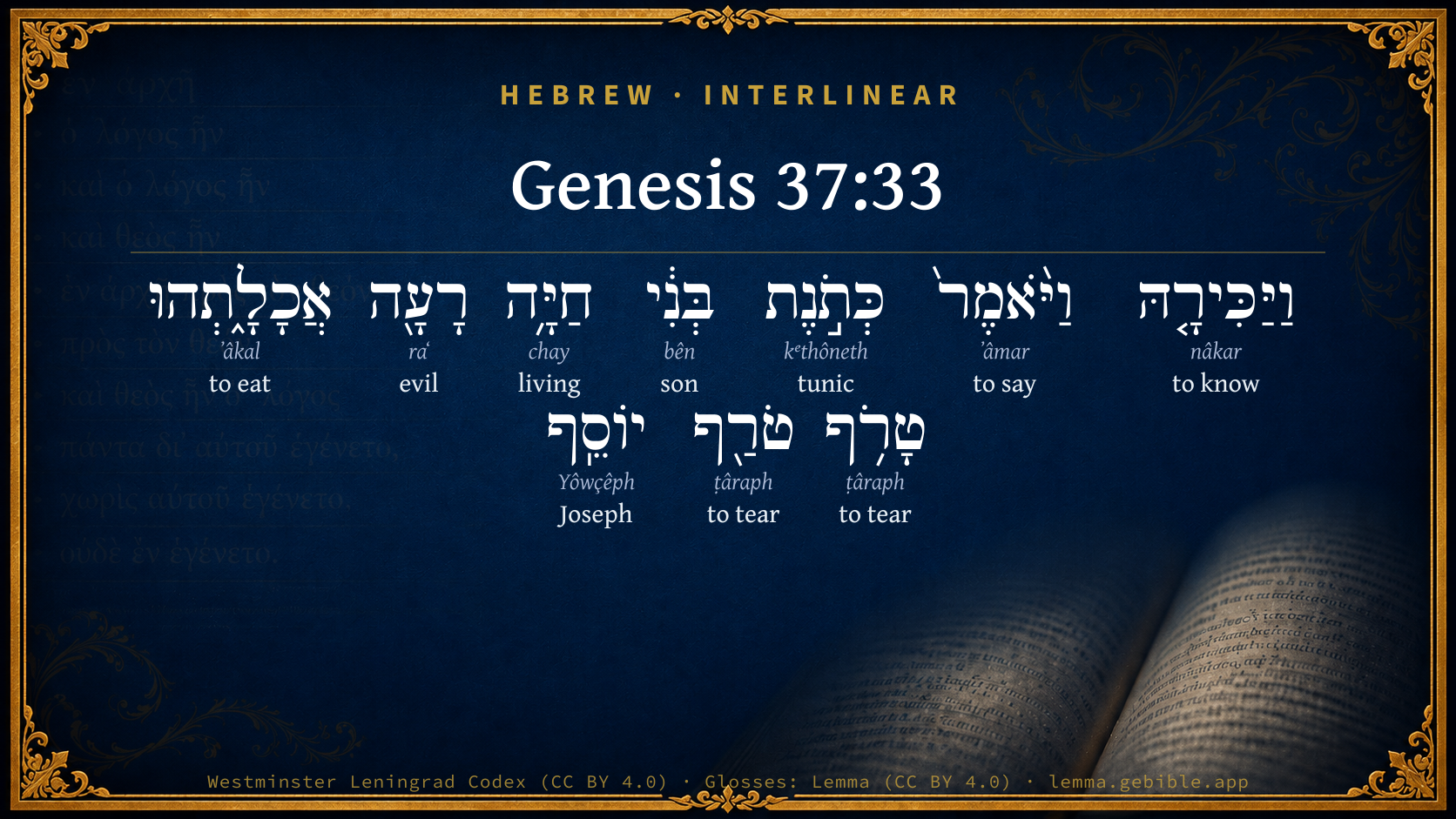
Hebrew (Westminster Leningrad Codex) Genesis 37:33 appears in the Hebrew Old Testament. The text above is from the Westminster Leningrad Codex. Each word links to its Strong’s number, a concise gloss, and parsing drawn from the Open Scriptures Hebrew Bible morphology. Click any word for its full Brown-Driver-Briggs (BDB) entry.
Download image
Cite this verse

Genesis 37:33 (World English Bible). Public Domain. Lemma interlinear Bible study tool, https://lemma.gebible.app/v/genesis/37/33.

Show BibTeX & RIS
BibTeX
RIS
English Translation
He recognized it, and said, "It is my son's coat. An evil animal has devoured him. Joseph is without doubt torn in pieces."
World English Bible · Public Domain
Highlights
  • 1 first appearance in the Hebrew Bible
Full analysis ↓
Download a study sheet

One document with this verse’s original text, its word-by-word gloss line, the meaning frame, cross-references with their text, attributed commentary, and full source and license credits — printable, and it pastes into notes with its structure intact.

This verse Autodidact and up

Study sheet (.html) Plain text (.txt)

A passage Seminary Student

Up to 50 verses in one chapter. A passage sheet keeps up to 6 commentary sources and 12 cross-references per verse, in the order this page ranks them, and says so on the sheet whenever that leaves anything out. Ask for a single verse and you get the Autodidact verse sheet above.

Everything on this page stays free to read, with no account — the sheet is a download of what is already on screen, not access to it.

Want to remove ads? Support Godless Engineer
Compare translations 3

The same verse in 3 English versions, stacked beneath the original-language interlinear above. Click any original word for its lexicon entry.

Each is an independent rendering of the whole verse — the interlinear is not word-aligned to these translations.

Highlighted words mark where these versions differ — a whole-verse word diff, not a word-by-word alignment.

  • World English Bible Public Domain
    He recognized it, and said, "It is my son's coat. An evil animal has devoured him. Joseph is without doubt torn in pieces."
  • King James Version Public Domain
    And he knew it, and said, It is my son's coat; an evil beast hath devoured him; Joseph is without doubt rent in pieces.
  • unfoldingWord Literal Text CC BY-SA 4.0
    And he examined it and said, “ my son’s tunic! An evil animal has devoured him! Surely Joseph was torn to pieces!”

unfoldingWord Literal Text — © unfoldingWord, licensed CC BY-SA 4.0. Word-aligned USFM3 via Door43 (git.door43.org/unfoldingWord/en_ult).

Versions to compare (up to 4)

3 of 4 selected

Show all 18 translations

Every available English version of this verse, each an independent rendering of the whole verse.

  • World English Bible Public Domain
    He recognized it, and said, "It is my son's coat. An evil animal has devoured him. Joseph is without doubt torn in pieces."
  • Berean Standard Bible Public Domain
    His father recognized it and said, “It is my son’s robe! A vicious animal has devoured him. Joseph has surely been torn to pieces!”
  • Majority Standard Bible Public Domain
    His father recognized it and said, “It is my son’s robe! A vicious animal has devoured him. Joseph has surely been torn to pieces!”
  • King James Version Public Domain
    And he knew it, and said, It is my son's coat; an evil beast hath devoured him; Joseph is without doubt rent in pieces.
  • American Standard Version (1901) Public Domain
    And he knew it, and said, It is my son's coat: an evil beast hath devoured him; Joseph is without doubt torn in pieces.
  • Revised Version (1885) Public Domain
    And he knew it, and said, It is my son’s coat; an evil beast hath devoured him; Joseph is without doubt torn in pieces.
  • Geneva Bible (1599) Public Domain
    Then he knewe it and said, It is my sonnes coate: a wicked beast hath deuoured him: Ioseph is surely torne in pieces.
  • Douay-Rheims (1899) Public Domain
    And the father acknowledging it, said: It is my son's coat, an evil wild beast hath eaten him, a beast hath devoured Joseph.
  • Young's Literal Translation Public Domain
    And he discerneth it, and saith, `My son's coat! an evil beast hath devoured him; torn -- torn is Joseph!'
  • Literal Standard Version CC BY-SA 4.0
    And he discerns it and says, “My son’s coat! An evil beast has devoured him; torn—Joseph is torn!”
  • Unlocked Literal Bible CC BY-SA 4.0
    Jacob recognized it and said, “It is my son's clothing. A wild animal has devoured him. Joseph has certainly been torn to pieces.”
  • unfoldingWord Literal Text CC BY-SA 4.0
    And he examined it and said, “ my son’s tunic! An evil animal has devoured him! Surely Joseph was torn to pieces!”
  • Darby Bible Public Domain
    And he discerned it, and said, [It is] my son's vest! an evil beast has devoured him: Joseph is without doubt rent in pieces!
  • World Messianic Bible Public Domain
    He recognized it, and said, “It is my son’s tunic. An evil animal has devoured him. Joseph is without doubt torn in pieces.”
  • Webster's Bible Public Domain
    And he knew it, and said, It is my son's coat; an evil beast hath devoured him: Joseph is without doubt rent in pieces.
  • Free Bible Version CC BY-SA 4.0
    His father recognized it right away and said, “This is my son's robe! Some wild animal must have eaten him. Poor Joseph has been ripped to pieces, no doubt about it!”
  • Bible in Basic English Public Domain
    And he saw that it was, and said, It is my son's coat; an evil beast has put him to death; without doubt Joseph has come to a cruel end.
  • JPS Tanakh (1917) Public Domain
    And he knew it, and said: 'It is my son's coat; an evil beast hath devoured him; Joseph is without doubt torn in pieces.'

Literal Standard Version (2020), Covenant Press — licensed CC BY-SA 4.0. Text via the HelloAO Bible API (eBible.org). Unlocked Literal Bible (unfoldingWord) — licensed CC BY-SA 4.0. Text via the HelloAO Bible API (eBible.org). unfoldingWord Literal Text — © unfoldingWord, licensed CC BY-SA 4.0. Word-aligned USFM3 via Door43 (git.door43.org/unfoldingWord/en_ult). Free Bible Version, Dr. Jonathan Gallagher — licensed CC BY-SA 4.0. Text via the HelloAO Bible API (eBible.org).

Word by word

More ways to search: Search by grammar → Find every occurrence → Compare this word →

Practice this passage: Drill this verse → Learn its vocabulary →

טָרֹ֥ף
ṭâraph
H2963
“to tear”
Verb, Qal, Infinitive Absolute
Part of Speech
Verb
Stem
Qal
Form
Infinitive Absolute
Full BDB Definition

Origin: a primitive root

TWOT: 827

to tear, rend, pluck - (Qal) to tear, rend - (Niphal) to be torn in pieces - (Poal) to be torn in pieces - (Hiphil) to provide food
  1. וַיַּכִּירָ֤הּ nâkar H5234 “and · to know · her” Conjunction + Verb, Hiphil, Sequential Imperfect, 3rd Person, Masculine, Singular + Suffix, Personal, 3rd Person, Feminine, Singular
  2. וַיֹּ֨אמֶר֙ ʼâmar H559 “and · to say” Conjunction + Verb, Qal, Sequential Imperfect, 3rd Person, Masculine, Singular
  3. כְּתֹ֣נֶת kᵉthôneth H3801 “tunic of” Noun, Common, Feminine, Singular, Construct
  4. בְּנִ֔י bên H1121 “son · my” Noun, Common, Masculine, Singular, Construct + Suffix, Personal, 1st Person, Common, Singular
  5. חַיָּ֥ה chay H2416 “living” Noun, Common, Feminine, Singular, Absolute
  6. רָעָ֖ה raʻ H7451 “evil” Adjective, Adjective, Feminine, Singular, Absolute
  7. אֲכָלָ֑תְהוּ ʼâkal H398 “to eat · him” Verb, Qal, Perfect, 3rd Person, Feminine, Singular + Suffix, Personal, 3rd Person, Masculine, Singular
  8. טֹרַ֖ף ṭâraph H2963 “to tear” Verb, Pual, Perfect, 3rd Person, Masculine, Singular
  9. יוֹסֵֽף Yôwçêph H3130 “Joseph” Noun, Proper

About this verse

These counts appear in no published source. They are computed here, from the morphology-tagged text and Lemma’s own curated glosses. What Lemma adds →

10
words
9
distinct lemmas
Pentateuch
section

Notable vocabulary

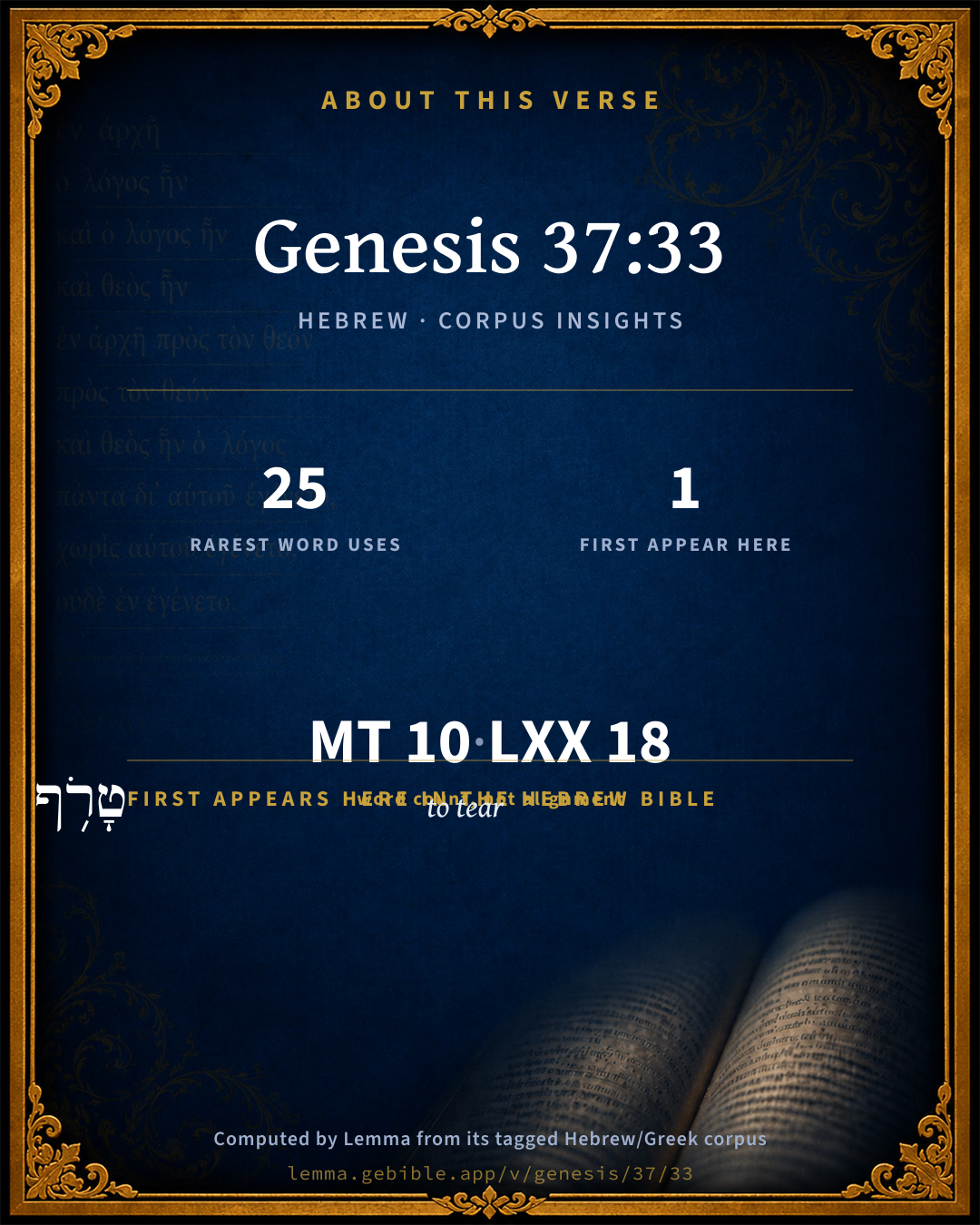
The rarest word here is טָרֹ֥ף to tear H2963 — appearing just 25 times in the whole Hebrew Bible.

First appearance in Scripture

This word makes its first canonical appearance in the Hebrew Bible here:

  • טָרֹ֥ף to tear H2963

Shared distinctive vocabulary

טָרֹ֥ף to tear H2963 occurs in 22 verses of the Hebrew Bible. Also found in:

Grammatical profile

  • 5 verbs
  • 4 nouns
  • 1 adjective

Verb forms

  • וַיַּכִּירָ֤הּ Hiphil · Sequential Imperfect
  • וַיֹּ֨אמֶר֙ Qal · Sequential Imperfect
  • אֲכָלָ֑תְהוּ Qal · Perfect
  • טָרֹ֥ף Qal · Infinitive Absolute
  • טֹרַ֖ף Pual · Perfect

Repetition

A word recurs within this verse — often emphatic in Hebrew:

  • טָרֹ֥ף to tear H2963 ×2

Hebrew & Septuagint length

In English translation the verse runs 23 words from the Hebrew and 18 from the Septuagint (LXX English) — closely comparable.

A rough comparison of the two English renderings, which tokenize alike — not a word-level alignment.

Word counts can differ between the Hebrew and the Greek without any difference in meaning — e.g. the Hebrew direct-object marker אֵת has no separate Greek word, and Greek often adds the article ὁ.

In the original languages it is 10 Hebrew tokens and 18 Greek tokens — but the two are counted differently (Hebrew bundles its prefixes and suffixes into one token; the Greek is in lemma form), so that isn’t a like-for-like length.

Cross-references

6

Topical passages linked to Genesis 37:33 in the Treasury of Scripture Knowledge — connected by theme and wording, ordered by reader-vote popularity; previews shown in the World English Bible.

  • Genesis 37:20 Come now therefore, and let's kill him, and cast him into one of the pits, and we will say, 'An evil animal has devoured him.' We will see what will become of his dreams."
  • Genesis 44:28 and the one went out from me, and I said, "Surely he is torn in pieces;" and I haven't seen him since.
  • 1 Kings 13:24 When he was gone, a lion met him by the way, and killed him: and his body was cast in the way, and the donkey stood by it; the lion also stood by the body.
  • 2 Kings 2:24 He looked behind him and saw them, and cursed them in the name of Yahweh. There came forth two she-bears out of the wood, and mauled forty-two lads of them.
  • Proverbs 14:15 A simple man believes everything, But the prudent man carefully considers his ways.
  • John 13:7 Jesus answered him, "You don't know what I am doing now, but you will understand later."

Cross-references courtesy of OpenBible.info (CC BY 4.0).

Hebrew and Greek witnesses Masoretic Hebrew ↔ Greek Septuagint

The same verse in the two great witnesses to the Old Testament, shown verse-for-verse.

These are two independent witnesses, not word-aligned to each other, and the Septuagint is shown in lemma (dictionary) form.

Hebrew Genesis 37:33 Masoretic · Westminster Leningrad Codex

וַיַּכִּירָ֤הּ וַיֹּ֨אמֶר֙ כְּתֹ֣נֶת בְּנִ֔י חַיָּ֥ה רָעָ֖ה אֲכָלָ֑תְהוּ טָרֹ֥ף טֹרַ֖ף יוֹסֵֽף

He recognized it, and said, "It is my son's coat. An evil animal has devoured him. Joseph is without doubt torn in pieces."

World English Bible · Public Domain

Greek LXX Genesis 37:33 Septuagint · lemma form

καί ἐπιγιγνώσκω αὐτός καί εἶπον χιτών ὁ υἱός ἐγώ εἰμί θηρίον πονηρός καταἐσθίω αὐτός θηρίον ἁρπάζω ὁ ιωσηφ

And Jacob tore his clothes, and put sackcloth on his loins, and mourned for his son many days.

LXX2012 (modern English Septuagint) · Public Domain

Hebrew: Westminster Leningrad Codex (CC BY 4.0). Greek: Septuagint (public domain); English from LXX2012 (modern English Septuagint) (Public Domain). How the Septuagint differs from the Hebrew →

Targum (Aramaic paraphrase)

2

The Targum is the ancient Jewish Aramaic paraphrase of the Hebrew Scriptures — an interpretive translation, not the Hebrew text itself. Onkelos (literal) and Pseudo-Jonathan (expansive) render the Torah, and Jonathan the Prophets. Coverage is partial: where no permissively-licensed English translation exists for a verse, only the Aramaic is shown. This is verse-level text, not a word-by-word alignment to the Hebrew.

  1. Targum Onkelos Torah (Genesis–Deuteronomy)
    וְאִשְׁתְּמוֹדְעַהּ וַאֲמַר כִּתּוּנָא דִבְרִי חַיְתָא בִישְׁתָא אֲכָלְתֵּהּ מִקְטַל קְטִיל יוֹסֵף

    (no public-domain English translation for this verse)

    Targum Onkelos — Aramaic: “Onkelos Genesis” (public domain); “Onkelos Exodus” (public domain); “Onkelos Leviticus” (public domain); “Onkelos Numbers” (public domain); “Onkelos Deuteronomy” (public domain). English: “Sefaria Community Translation” (CC0 1.0 (public-domain dedication)); “J.W. Etheridge. The Targums of Onkelos and Jonathan Ben Uzziel on the Pentateuch. London: Longmans, Green, 1862” (public domain). Text via Sefaria.

  2. Targum Pseudo-Jonathan Torah (Genesis–Deuteronomy)
    וְאִשְתְּמוֹדְעָהּ וַאֲמַר פַּרְגוֹד דִבְרִי הִיא לָא חֵיוַת בָּרָא אֲכַלְתֵּיהּ וְלָא עַל יַד בְּנֵי נְשָׁא אִתְקְטֵיל אֶלָא חָמִי אֲנָא בְּרוּחַ קוּדְשָׁא דְאִיתָּא בִּישְׁתָּא קַיְימָא לְקִבְלֵיהּ

    And he recognised it and said, It is my son's garment: a beast of the wilderness hath not devoured him, neither hath he been slain by the hand of man; but I see by the Holy Spirit, that an evil woman standeth against him.

    Targum Pseudo-Jonathan — Aramaic: “Targum Jonathan on Genesis” (public domain); “Targum Jonathan on Exodus” (public domain); “Targum Jonathan on Leviticus” (public domain); “Targum Jonathan on Numbers” (public domain); “Targum Jonathan on Deuteronomy” (public domain). English: “The Targum of Jonathan ben Uzziel, trans. J. W. Etheridge, London, 1862” (public domain). Text via Sefaria.

Commentary

Notes on Genesis 37:33 from classic Christian and Jewish commentators (each source and its license shown beneath its notes). The classic Christian expositions comment on the surrounding passage and are grouped to its opening verse, so a note may address several verses; the Jewish commentaries on the Tanakh (Rashi and others) are per-verse, so they appear only where the commentator wrote on this verse.

Lemma curates 59 commentaries, every one of them public domain or Creative Commons licensed, each selected and text-cleaned for this edition rather than reprinted as found. About our sources →

Trapp's Complete Commentary

John Trapp

Gen 37:33 And he knew it, and said, [It is] my son’s coat; an evil beast hath devoured him; Joseph is without doubt rent in pieces.

Ver. 33. It is my son’s coat, &c.] The Lord may well say as much of hypocrites: Their outward form of godliness is the garb of my sons and daughters; but some evil spirit hath devoured them, who use it only in hypocrisy. They are fair professors, but foul sinners. And when the filthy stoner goes damned to hell, what shall become of the zealous professor? As the churl said to the Bishop of Cullen, praying in the church like a bishop; but as he was a duke, going guarded like a tyrant: Whither thinkest thou the bishop shall go, when the duke shall be damned?

John Trapp, A Commentary or Exposition upon All the Books of the Old and New Testament (1647–1656) — public domain. Text from a community e-Sword module.

The Biblical Illustrator

Joseph S. Exell

Gen_37:33

Without doubt

Without doubt

While in relation to some things men doubt where they ought to trust, with other matters they will feel quite certain, though they have good cause for questioning.

Consider the habit of taking certain notions without doubt, as it is illustrated in the case of Jacob.

I. THE HABIT IS DEPENDENT ON PREDISPOSITION. The sanguine are without doubt of success, where the cautious are without doubt of disaster. The despondent regard the world through darkened spectacles. It is no wonder that their prospects seem gloomy.

II. THE HABIT IS ENCOURAGED BY APPEARANCES. To Jacob appearances were sadly significant. What more evidence could be wanted? We should remember that all appearances may be against the true facts.

III. THE HABIT LEADS TO GREVIOUS MISTAKES. Jacobs verdict was without doubt. Nevertheless, it was a wrong verdict. We talk of the evil of doubt. There are evils of positiveness.

IV. THE HABIT IS POSITIVELY MISCHIEVOUS. It causes distress when we are needlessly positive of a painful surmise. It does more harm. It paralyses our efforts to better a gloomy state of affairs.

V. THE HABIT MAY BE A PUNISHMENT OF FORMER UNTRUTHFULNESS. In his youth Jacob deceived his father; in his old age Jacob was deceived by his sons. He was cunning and wily. Yet he was over-reached, and suffered from the trickery of others. Worldly acuteness is no security against deception in matters that lie nearest to our heart. The fox may be out witted, while the lamb is spared in its simplicity. Application: See how the coprinciples work in various directions.

1. Domestic anxiety. Parents are often inclined to dread the worst of absent children lost to sight, and perhaps unheard of for years. Yet they may be as safe and prosperous as Joseph became.

2. Prospects for life.

3. Our spiritual condition. (W. F. Adeney, M. A.)

The Biblical Illustrator, edited by Joseph S. Exell (c. 1880s–1900s) — public domain. Text from a community e-Sword module.

Tyndale Open Study Notes

Tyndale Open Resources

37:33 recognized: Cp. 27:23.

Tyndale Open Study Notes — © Tyndale Open Resources, licensed CC BY-SA 4.0. Text via the HelloAO Bible API.

Adam Clarke's Commentary

Verse 33. Joseph is without doubt rent in pieces!] It is likely he inferred this from the lacerated state of the coat, which, in order the better to cover their wickedness, they had not only besmeared with the blood of the goat, but it is probable reduced to tatters. And what must a father's heart have felt in such a case! As this coat is rent, so is the body of my beloved son rent in pieces! and Jacob rent his clothes.

Adam Clarke's Commentary on the Bible (1810–1826) — public domain. Text from a community e-Sword/MySword module.

The Cambridge Bible for Schools and Colleges

gen. ed. J. J. S. Perowne

33. an evil beast] Jacob interprets the message, as they had intended. They never asserted his death, but asked him to draw the inference. The clause is repeated from Gen_37:20.

The Cambridge Bible for Schools and Colleges (gen. ed. J. J. S. Perowne; Cambridge University Press, 1878–1918) — public domain. Text from a community e-Sword module.

John Gill's Exposition

And Jacob rent his clothes,.... As expressive of his grief and mourning for the death of his son, as he supposed:

and put sackcloth upon his loins; put off his usual apparel, and put on a coarse garment on his loins next to his flesh, as another token of his great trouble and affliction for the loss of his son; which though afterwards was frequently done in times of public or private mourning, yet this is the first time we read of it; whether Jacob was the first that used it, whom his posterity and others imitated, is not certain; however it appears that this usage, as well as that of rending clothes on sorrowful occasions, were very ancient:

and mourned for his son many days: or years, as days sometimes signify; twenty two years, according to Jarchi, even until the time he went down to Egypt and saw him alive.

John Gill's Exposition of the Whole Bible (1746–1763) — public domain (CC PDM 1.0). Text via the HelloAO Bible API.

Haydock's Catholic Bible Commentary

A beast. So he might reasonably conclude from the blood, and from the insinuations of the messengers sent by his ten sons, (Haydock) whom he would not suspect of so heinous a crime. Wild beasts infested that country. (Menochius)

George Leo Haydock (1774–1849), Haydock's Catholic Family Bible and Commentary, 1859 edition — public domain. Excludes Psalms (Douay-Rheims chapter numbering differs from Protestant) and Deuterocanonical books (Catholic canon only).

Whedon's Commentary on the Bible

Daniel D. Whedon

33. My son’s coat — Jacob’s words are most touching. Render:

Tunic of my son!

An evil beast has eaten him!

Torn, torn, — Joseph!

Daniel D. Whedon (gen. ed.), Commentary on the Old and New Testaments (1874–1909) — public domain. Text from a community e-Sword module.

The Pulpit Commentary

And he knew it, and said, It is my son"s coat; an evil beast (vide ver. 20) hath devoured him (this was precisely what his sons meant him to infer); Joseph is without doubt rent in pieces prfo prof, the inf. abs. Kal with the Pual expressing undoubted certainty.

The Pulpit Commentary (1880–1919), ed. H.D.M. Spence-Jones & Joseph S. Exell — public domain. Text from a community e-Sword module.

Rashi

Rabbi Shlomo Yitzchaki (Rashi)

ויאמר כתנת בני AND HE SAID, MY SON’S COAT —is this (i.e. supply the words היא זו after בני).

חיה רעה אכלתהו AN EVIL BEAST HATH EATEN HIM — The spirit of prophecy was enkindled within him, for these words may be taken to mean that at some future time Potiphar’s wife would attack him (Genesis Rabbah 84:19). Why did not the Holy One, blessed be He, make known to him (Jacob) that he was still living? Because they had placed under a ban and a curse anyone of them who would make it known, and they made the Holy One, blessed be He, a party with them to this agreement (Midrash Tanchuma, Vayeshev 2) Isaac, however, knew that he was living, but he thought, “How dare I reveal it since the Holy One, blessed be He does not wish to reveal it” (Genesis Rabbah 84:21).

Rashi on the Tanakh — English translations: “The Judaica Press complete Tanach with Rashi, translated by A. J. Rosenberg” (CC BY 4.0); “Pentateuch with Rashi's commentary by M. Rosenbaum and A.M. Silbermann, 1929-1934” (public domain); “The Metsudah Tanach series, Lakewood, N.J” (CC BY 4.0); and “The Book of Joshua, Metsudah Publications, 1997” (CC BY 4.0). Text via Sefaria.

Lesson kit

Teaching starters — assembled from the data on this page, not authored interpretation. Every prompt links to the verse data it draws on. Edit before teaching.

Genesis, in the Pentateuch, opens this verse with 10 words (9 distinct Hebrew lemmas). Its most distinctive word is ṭâraph (“to tear”). A historical commentator’s framing appears above. Read the whole chapter for the surrounding context.

Discussion questions

  1. What does “to tear” (ṭâraph) contribute to the verse as a whole?
  2. The word “to tear” first appears here in Scripture. What is being introduced at this debut?
  3. Genesis 44:28 shares the word «to tear» with this verse. How do the two illuminate each other?
  4. “to tear” occurs 2× in this one verse. What is the effect of the repetition?
  5. These translations render this verse differently; the difference is in the English rendering, not the original. What questions does that raise?
  6. The verb «וַיַּכִּירָ֤הּ» is Hiphil Sequential Imperfect. How does its form color the action?
  7. Reading how Trapp's Complete Commentary and The Biblical Illustrator read this verse, where do the two commentators agree and where do they part?

Things to notice

Reading settings

Reading text

Shown beneath each verse's original-language words.

Old Testament
Old Testament edition

Read the OT as the Masoretic Hebrew (MT) or the Greek Septuagint (LXX).

English shown for the Greek Septuagint (in the Hebrew ↔ Greek comparison).

Comparing translations? Open the Compare panel on any verse page to stack up to four side by side.