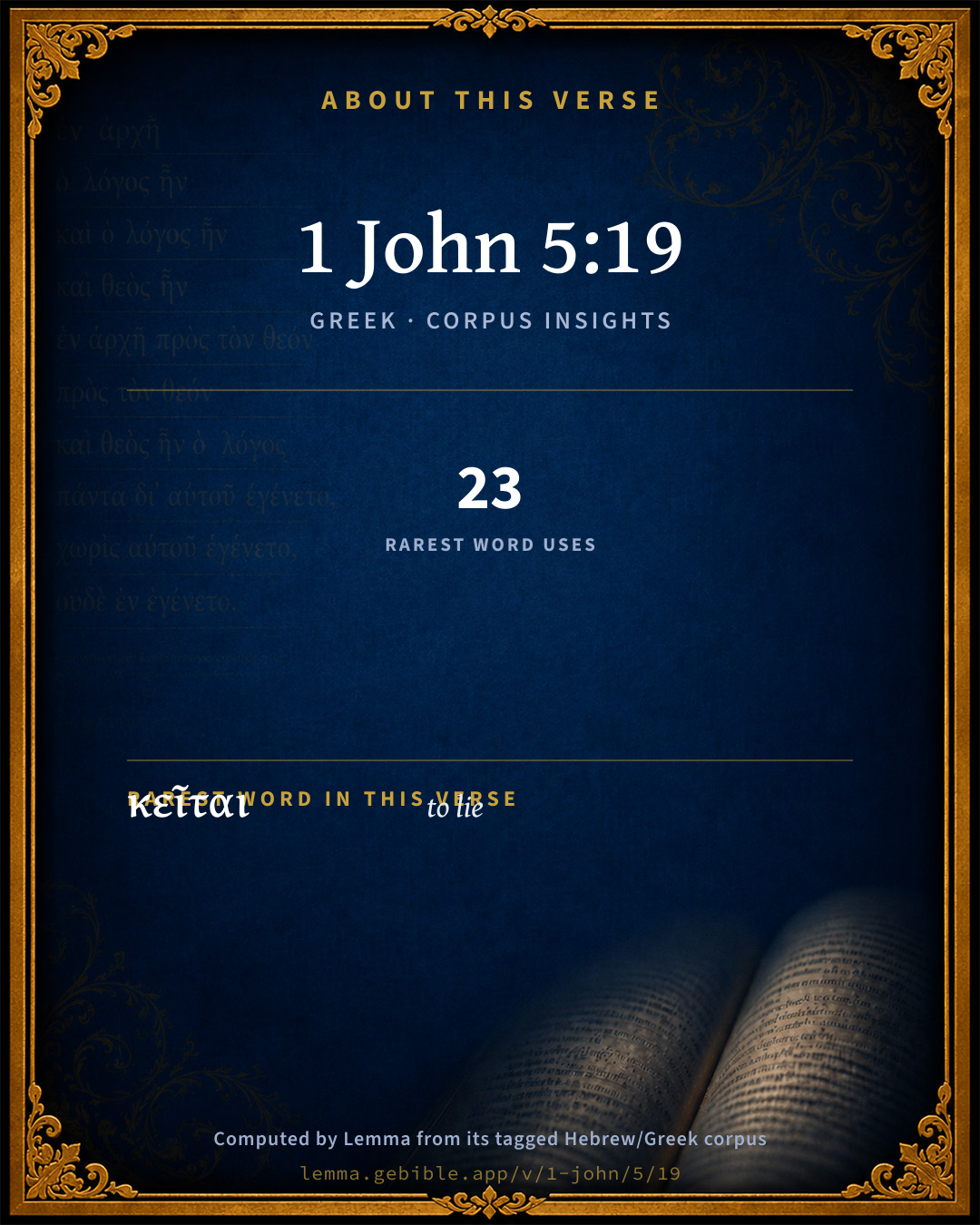
1 John 5:19

Greek (Tischendorf 8th ed.) 1 John 5:19 appears in the Greek New Testament. The text above is from the Tischendorf 8th edition. Each word links to its Strong’s number and a concise gloss. Click any word for its full Thayer’s Greek Lexicon entry.
Download image
Cite this verse

1 John 5:19 (World English Bible). Public Domain. Lemma interlinear Bible study tool, https://lemma.gebible.app/v/1-john/5/19.

Show BibTeX & RIS
BibTeX
RIS
English Translation
We know that we are of God, and the whole world lies in the power of the evil one.
World English Bible · Public Domain
Download a study sheet

One document with this verse’s original text, its word-by-word gloss line, the meaning frame, cross-references with their text, attributed commentary, and full source and license credits — printable, and it pastes into notes with its structure intact.

This verse Autodidact and up

Study sheet (.html) Plain text (.txt)

A passage Seminary Student

Up to 50 verses in one chapter. A passage sheet keeps up to 6 commentary sources and 12 cross-references per verse, in the order this page ranks them, and says so on the sheet whenever that leaves anything out. Ask for a single verse and you get the Autodidact verse sheet above.

Everything on this page stays free to read, with no account — the sheet is a download of what is already on screen, not access to it.

Want to remove ads? Support Godless Engineer
Compare translations 3

The same verse in 3 English versions, stacked beneath the original-language interlinear above. Click any original word for its lexicon entry.

Each is an independent rendering of the whole verse — the interlinear is not word-aligned to these translations.

Highlighted words mark where these versions differ — a whole-verse word diff, not a word-by-word alignment.

  • World English Bible Public Domain
    We know that we are of God, and the whole world lies in the power of the evil one.
  • King James Version Public Domain
    And we know that we are of God, and the whole world lieth in wickedness.
  • unfoldingWord Literal Text CC BY-SA 4.0
    We know that we are from God, and the whole world lies in the evil one.

unfoldingWord Literal Text — © unfoldingWord, licensed CC BY-SA 4.0. Word-aligned USFM3 via Door43 (git.door43.org/unfoldingWord/en_ult).

Versions to compare (up to 4)

3 of 4 selected

Show all 19 translations

Every available English version of this verse, each an independent rendering of the whole verse.

  • World English Bible Public Domain
    We know that we are of God, and the whole world lies in the power of the evil one.
  • Berean Standard Bible Public Domain
    We know that we are of God, and that the whole world is under the power of the evil one.
  • Majority Standard Bible Public Domain
    We know that we are of God, and that the whole world is under the power of the evil one.
  • King James Version Public Domain
    And we know that we are of God, and the whole world lieth in wickedness.
  • American Standard Version (1901) Public Domain
    We know that we are of God, and the whole world lieth in the evil one.
  • Revised Version (1885) Public Domain
    We know that we are of God, and the whole world lieth in the evil one.
  • Geneva Bible (1599) Public Domain
    We knowe that we are of God, and this whole world lieth in wickednesse.
  • Douay-Rheims (1899) Public Domain
    We know that we are of God, and the whole world is seated in wickedness.
  • Young's Literal Translation Public Domain
    we have known that of God we are, and the whole world in the evil doth lie;
  • Literal Standard Version CC BY-SA 4.0
    we have known that we are of God, and the whole world lies [under the power] of the evil [one];
  • Unlocked Literal Bible CC BY-SA 4.0
    We know that we are from God, and we know that the whole world lies in the power of the evil one.
  • unfoldingWord Literal Text CC BY-SA 4.0
    We know that we are from God, and the whole world lies in the evil one.
  • Darby Bible Public Domain
    We know that we are of God, and the whole world lies in the wicked [one].
  • World Messianic Bible Public Domain
    We know that we are of God, and the whole world lies in the power of the evil one.
  • Webster's Bible Public Domain
    And we know that we are of God, and the whole world lieth in wickedness.
  • Free Bible Version CC BY-SA 4.0
    We know that we belong to God, and that the world is under the power of the evil one.
  • Bible in Basic English Public Domain
    We are certain that we are of God, but all the world is in the power of the Evil One.
  • Text-Critical English NT CC BY 4.0
    We know that we are from God, and that the whole world lies in the power of the evil one.
  • Tyndale New Testament (1534) Public Domain
    We knowe that we are of god and that the worlde is altogedder set on wickednes.

Literal Standard Version (2020), Covenant Press — licensed CC BY-SA 4.0. Text via the HelloAO Bible API (eBible.org). Unlocked Literal Bible (unfoldingWord) — licensed CC BY-SA 4.0. Text via the HelloAO Bible API (eBible.org). unfoldingWord Literal Text — © unfoldingWord, licensed CC BY-SA 4.0. Word-aligned USFM3 via Door43 (git.door43.org/unfoldingWord/en_ult). Free Bible Version, Dr. Jonathan Gallagher — licensed CC BY-SA 4.0. Text via the HelloAO Bible API (eBible.org).

Word by word

More ways to search: Search by grammar → Find every occurrence → Compare this word →

Practice this passage: Drill this verse → Learn its vocabulary →

κεῖται
keîmai
G2749
“to lie”
Verb, Present, Middle or Passive deponent, Indicative, 3rd person, Singular
Part of Speech
Verb
Tense
Present
Voice
Middle or Passive deponent
Mood
Indicative
Person
3rd person
Number
Singular
Full Thayer's Definition

Origin: middle voice of a primary verb

TDNT: 13:54,4

1. to lie a. of an infant b. of one buried c. of things that quietly cover some spot 1. of a city situated on a hill d. of things put or set in any place, in ref. to which we often use "to stand" 1. of vessels, of a throne, of the site of a city, of grain and other things laid up together, of a foundation 2. metaph. a. to be (by God's intent) set, i.e. destined, appointed b. of laws, to be made, laid down c. lies in the power of the evil one, i.e. is held in subjection by the devil
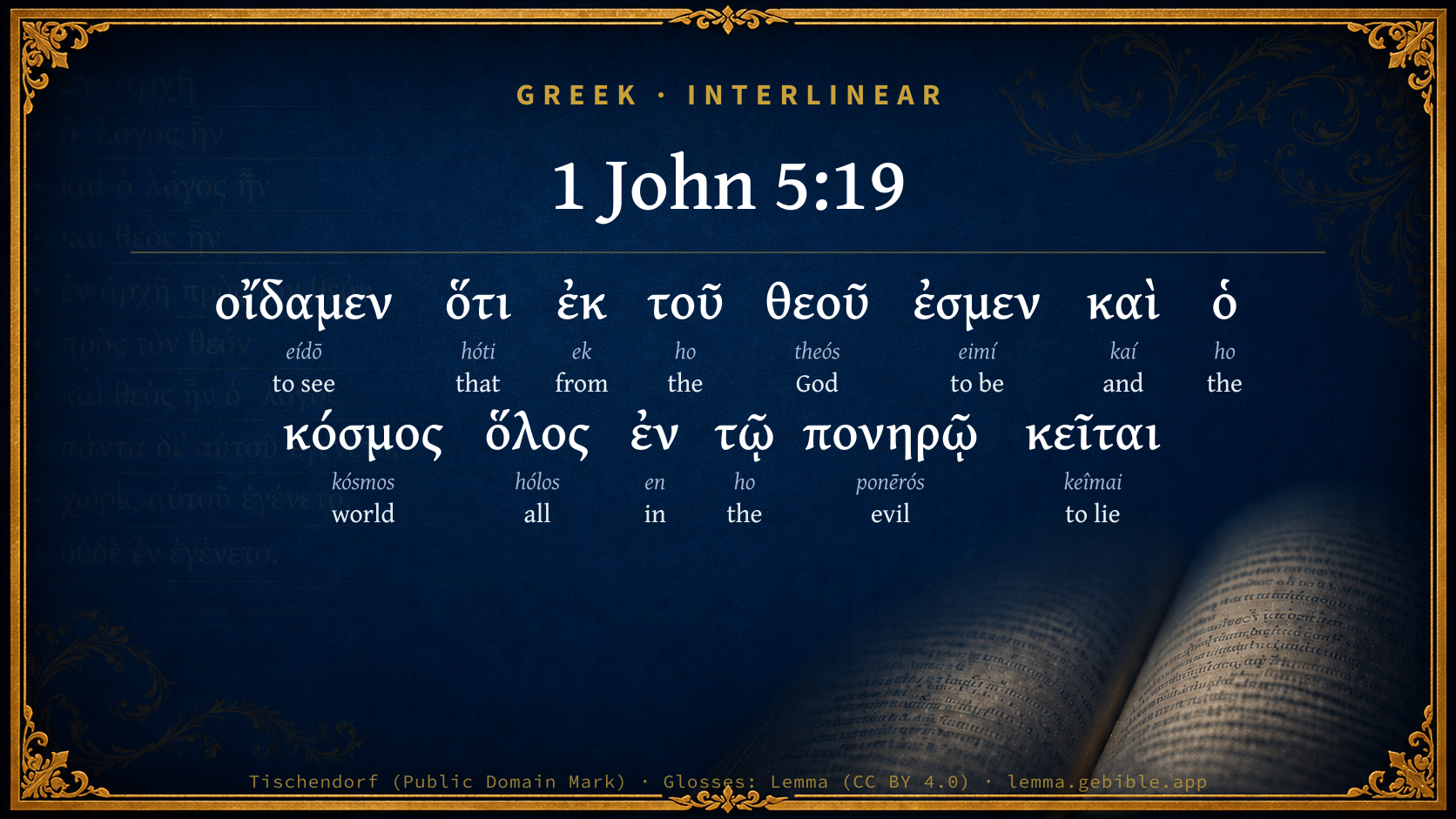
  1. οἴδαμεν eídō G1492 “to see” Verb, Perfect, Active, Indicative, 1st person, Plural
  2. ὅτι hóti G3754 “that” Conjunction
  3. ἐκ ek G1537 “from” Preposition
  4. τοῦ ho G3588 “the” Article, Genitive, Singular, Masculine
  5. θεοῦ theós G2316 “God” Noun, Genitive, Singular, Masculine
  6. ἐσμεν eimí G1510 “to be” Verb, Present, Active, Indicative, 1st person, Plural
  7. καὶ kaí G2532 “and” Conjunction
  8. ὁ ho G3588 “the” Article, Nominative, Singular, Masculine
  9. κόσμος kósmos G2889 “world” Noun, Nominative, Singular, Masculine
  10. ὅλος hólos G3650 “all” Adjective, Nominative, Singular, Masculine
  11. ἐν en G1722 “in” Preposition
  12. τῷ ho G3588 “the” Article, Dative, Singular, Masculine
  13. πονηρῷ ponērós G4190 “evil” Adjective, Dative, Singular, Masculine

About this verse

These counts appear in no published source. They are computed here, from the morphology-tagged text and Lemma’s own curated glosses. What Lemma adds →

14
words
12
distinct lemmas
General Epistles
section

Notable vocabulary

The rarest word here is κεῖται to lie G2749 — appearing just 23 times in the whole Greek New Testament.

Shared distinctive vocabulary

κεῖται to lie G2749 occurs in 23 verses of the Greek New Testament. Also found in:

Repetition

A word recurs within this verse:

Cross-references

26

Topical passages linked to 1 John 5:19 in the Treasury of Scripture Knowledge — connected by theme and wording, ordered by reader-vote popularity; previews shown in the World English Bible.

  • 2 Corinthians 4:4 in whom the god of this world has blinded the minds of the unbelieving, that the light of the Gospel of the glory of Christ, who is the image of God, should not dawn on them.
  • Ephesians 2:2 in which you once walked according to the course of this world, according to the prince of the powers of the air, the spirit who now works in the children of disobedience;
  • 1 John 4:4–6 You are of God, little children, and have overcome them; because greater is he who is in you than he who is in the world.
  • Galatians 1:4 who gave himself for our sins, that he might deliver us out of this present evil age, according to the will of our God and Father--
  • Revelation 12:9 The great dragon was thrown down, the old serpent, he who is called the devil and Satan, the deceiver of the whole world. He was thrown down to the earth, and his angels were thrown down with him.
  • John 12:31 Now is the judgment of this world. Now the prince of this world will be cast out.
  • John 16:11 about judgment, because the prince of this world has been judged.
  • 1 John 5:20 We know that the Son of God has come, and has given us an understanding, that we know him who is true, and we are in him who is true, in his Son Jesus Christ. This is the true God, and eternal life.
  • John 15:18–19 If the world hates you, you know that it has hated me before it hated you.
  • Revelation 13:7–8 It was given to him to make war with the saints, and to overcome them. Authority over every tribe, people, language, and nation was given to him.
  • Romans 1:28–32 Even as they refused to have God in their knowledge, God gave them up to a reprobate mind, to do those things which are not fitting;
  • John 14:30 I will no more speak much with you, for the prince of the world comes, and he has nothing in me.
  • 1 John 5:10 He who believes in the Son of God has the testimony in himself. He who doesn't believe God has made him a liar, because he has not believed in the testimony that God has given concerning his Son.
  • 1 John 5:13 These things I have written to you who believe in the name of the Son of God, that you may know that you have eternal life, and that you may continue to believe in the name of the Son of God.
  • 1 John 3:24 He who keeps his commandments remains in him, and he in him. By this we know that he remains in us, by the Spirit which he gave us.
  • 1 John 5:18 We know that whoever is born of God doesn't sin, but he who was born of God keeps himself, and the evil one doesn't touch him.
  • Romans 8:16 The Spirit himself testifies with our spirit that we are children of God;
  • 2 Corinthians 5:1 For we know that if the earthly house of our tent is dissolved, we have a building from God, a house not made with hands, eternal, in the heavens.
  • 2 Timothy 1:12 For this cause I suffer also these things. Yet I am not ashamed, for I know him whom I have believed, and I am persuaded that he is able to guard that which I have committed to him against that day.
  • James 4:4 You adulterers and adulteresses, don't you know that friendship with the world is enmity with God? Whoever therefore wants to be a friend of the world makes himself an enemy of God.
  • Revelation 20:3 and cast him into the abyss, and shut it, and sealed it over him, that he should deceive the nations no more, until the thousand years were finished. After this, he must be freed for a short time.
  • Revelation 20:7–8 And after the thousand years, Satan will be released from his prison,
  • 2 Corinthians 1:12 For our boasting is this: the testimony of our conscience, that in holiness and sincerity of God, not in fleshly wisdom but in the grace of God we behaved ourselves in the world, and more abundantly toward you.
  • Romans 3:9–18 What then? Are we better than they? No, in no way. For we previously charged both Jews and Greeks, that they are all under sin.
  • Titus 3:3 For we were also once foolish, disobedient, deceived, serving various lusts and pleasures, living in malice and envy, hateful, and hating one another.
  • 1 John 3:14 We know that we have passed out of death into life, because we love the brothers. He who doesn't love his brother remains in death.

Cross-references courtesy of OpenBible.info (CC BY 4.0).

Commentary

Notes on 1 John 5:19 from classic Christian and Jewish commentators (each source and its license shown beneath its notes). The classic Christian expositions comment on the surrounding passage and are grouped to its opening verse, so a note may address several verses; the Jewish commentaries on the Tanakh (Rashi and others) are per-verse, so they appear only where the commentator wrote on this verse.

Lemma curates 59 commentaries, every one of them public domain or Creative Commons licensed, each selected and text-cleaned for this edition rather than reprinted as found. About our sources →

The Biblical Illustrator

Joseph S. Exell

1Jn_5:19

We know that we are of God

All true believers are of God, and so separated from the world lying in wickedness

I.

How true believers are of God.

1. By creation; and so all things are of God (Rom_11:36). Thus the devils themselves are of God as their Creator, and so is the world. But this is not the being of God here meant.

2. By generation, as a son is of the father.

3. The work of regeneration is held forth under a double notion, showing the regenerate to be of God.

(1) It is a being begotten of God (1Jn_5:18). God Himself is the Father of the new creature: it is of no lower original (Jam_1:18; 1Pe_1:23; 1Pe_1:25).

(2) It is a being born of God (1Jn_5:18). By His Spirit alone the new creature is formed in all its parts, and brought forth into the new world of grace (Joh_3:5).

II. How believers, as they are of God, regenerate persons, are separated from the world lying in wickedness.

1. Negatively.

(1) Not in respect of place (1Co_5:9-10).

(2) Not in respect of gathering them into pure unmixed societies for worship. There are no such visible Church societies in the world (Mat_13:28-30).

2. But positively, the regenerate as such are separated from the world--

(1) In respect of their being broken off from that corrupt mass, and become a part of a new lump. They are become members of Christs mystical body, of the invisible Church, a distinct though invisible society.

(2) Their being delivered from under the power of the god of this world, viz., Satan (Act_26:18).

(3) Their having a Spirit, even the Spirit of God dwelling in them, which the world have not (Rom_8:9; Jud_1:19).

(4) Their having a disposition, and cast of heart and soul, opposite to that of the world; so that they are as much separated from the world as enemies are one from another (Gen_3:15). From this doctrine we may learn the following things.

1. This speaks the dignity of believers. They are the truly honourable ones, as being of God; they are the excellent of the earth.

2. It speaks the privilege of believers. Everyone will care and provide for his own: be sure God will then take special concern about believers (Mat_6:31-32).

3. It speaks the duty of believers. Carry yourselves as becomes your dignity and privilege, as those that are of God.

4. It shows the self-deceit of unbelievers, pretenders to a saving interest in God, while in the meantime they are lying together with the world in wickedness. (T. Boston, D. D.)

Peoples being of God may be knower to themselves

I. Men may know themselves to be of God, by giving diligence to make their calling and election sure (2Pe_1:10). Spiritual discerning, a spiritual sight, taste, or feeling of the things of God, in ourselves or others (1Co_2:14). Spiritual reasoning on Scripture grounds (1Jn_5:13).

1. One may know that others are of God, and separated from the world, discerning the image of God shining forth in them.

2. A true believer may know himself to belong to God, and not to the world. We should not be rash in giving or refusing that judgment, but hold pace with the appearance or non-appearance of the grace of God in them. The love bestowed on hypocrites is not all lost, and therefore it is safest erring on the charitable side. Let us carry our judgment of others no farther than that of charity, and not pretend to a certainty, which is net competent to us in that case, but to God only. In our own case, we may have by rational evidence a judgment of certainty, without extraordinary revelation. What moves ourselves so to walk, we can assuredly know; but what moves others, we cannot know that. A true child of God may assuredly know his relative state in the favour of God.

II. I exhort you to be concerned to know whether ye are of God, separated from the world or not. To press you thereto, consider--

1. We are all of us naturally, and by our first birth, of the world lying in wickedness (Eph_2:2-3).

2. The world lying in wickedness is the society appointed to destruction, as in a state and course of enmity against God (Eph_2:3). Therefore all that are to be saved are delivered and gathered out of it (Gal_1:4).

3. Many deceive themselves in this mutter, as the foolish virgins (Mat_25:1-46). Christs flock is certainly a little flock (Luk_12:32; Mat_5:13-14).

4. Death is approaching; and if it were come, there will be no separating more from the world.

5. It is uncertain when death comes to us, and hew (Mat_24:42). At best it is hardly the fit time of being new born, when a-dying.

6. It is an excellent and useful thing to know our state in this point. For if we find that we are not of God, but of the world, we are awakened to see to it in time. (T. Boston, D. D.)

The triumphant Christian certainties

I. I ask you, then, to look first at the Christian certainty of belonging to God. We know that we are of God. Where did John get that form of expression? He got it where he got most of his terminology, from the lips of the Master. For, if you remember, our Lord Himself speaks more than once of men being of God. As, for instance, when He says, He that is of God heareth Gods words. Ye therefore hear them not because ye are not of God. The first conception in the phrase is that of life derived, communicated from God Himself. Fathers of flesh communicate the life, and it is thenceforth independent. But the life of the Spirit, which we draw from God, is only sustained by the continual repetition of the same gift by which it was originated. The better life in the Christian soul is as certain to fade and die if the supply from heaven is cut off or dammed back, as is the bed of a stream, to become parched and glistering in the fierce sunshine if the headwaters flow into it no more. You can no more have the life of the Spirit in the spirit of a man without continual communication from Him than a sunbeam can subsist if it be cut off from the central source. Divine preservation is as necessary in grace as in nature. If that life is thus derived and dependent, there follows the last idea in our pregnant phrase--viz., that it is correspondent with its source. Ye are of God, kindred with Him and developing a life which, in its measure, is cognate with, and assimilated to, His own. Then there is another step to be taken. The man that has that life knows it. We know, says the apostle, that we are of God. That word know has been usurped by certain forms of knowledge. But surely the inward facts of my own consciousness are as much reliable as are facts in other regions which are attested by the senses, or arrived at by reasoning. Christian people have the same right to lay hold of that great word we know, and to apply it to the facts of their spiritual experience, as any scientist in the world has to apply it to the facts of his science. How do you know that you are at all? The only answer is, I feel that I am. And precisely the same evidence applies in regard to these lofty thoughts of a Divine kindred and a spiritual life. But that is not all. For the condition of being born of God is laid plainly down in this very chapter by the apostle as being the simple act of faith in Jesus Christ. So, then, if any man is sure that he believes, he knows that he is born of God, and is of God. Ah! But you say, Do you not know how men deceive themselves by a profession of being Christians, and how many of us estimate their professions at a very different rate of genuineness from what they estimate them at? Yes! I know that. And this whole letter of John goes to guard us against the presumption of entertaining inflated thoughts about ourselves. You remember how continually in this Epistle there crops up by the side of the most thoroughgoing mysticism, as people call it, the plainest, homespun, practical morality. Let no man deceive you; he that doeth not righteousness is not of God; neither he that loveth not his brother. There is another test which the Master laid down in the words, He that is of God heareth Gods words. Ye, therefore, hear them not because ye are not of God. Christian people, take these two plain tests--first, righteousness of life, common practical morality; and, second, an ear attuned and attent to catch Gods voice. It is a shame, and a weakening of any Christian life, that this triumphant confidence should not be clear in it. We know that we are of God. Can you and I echo that with calm confidence? I sometimes half hope that I am. I am almost afraid to say it. I do not know whether I am or not. I trust I may be. That is the kind of creeping attitude in which hosts of Christian people are contented to live. Why should our skies be as grey and sunless as those of this northern winters day when all the while, away down on the sunny seas, to which we may voyage if we will, there is unbroken sunshine, ethereal blue, and a perpetual blaze of light?

II. We have here the Christian view of the surrounding world. I need not, I suppose, remind you that John learned from Jesus to use that phrase the world, not as meaning the aggregate of material things, but as meaning the aggregate of godless men. Now, the more a man is conscious that he himself, by faith in Jesus Christ, has passed into the family of God, and possesses the life that comes from Him, the more keen will be his sense of the evil that lies round him. Just as a native of Central Africa brought to England for a while, when he gets back to his kraal, will see its foulnesses as he did not before, the measure of our conscious belonging to God is the measure of our perception of the contrast between us and the ways of the men about us. I am not concerned for a moment to deny, rather, I most thankfully recognise the truth, that a great deal of the world has been ransomed by the Cross, and the Christian way of looking at things has passed into the general atmosphere in which we live. But the world is a world still, and the antagonism is there. The only way by which the antagonism can be ended is for the kingdoms of this world to become the kingdoms of our God and of His Christ.

III. Lastly, consider the consequent Christian duty. Let me put two or three plain exhortations. I beseech you, Christian people, cultivate the sense of belonging to a higher order than that in which you dwell. A man in a heathen land loses his sense of home, and of its ways; and it needs a perpetual effort in order that we should not forget our true affinities. So I say, cultivate the sense of belonging to God. Again, I say, be careful to avoid infection. Go as men do in a plague-stricken city. Go as our soldiers in that Ashanti expedition had to go, on your guard against malaria, the pestilence that walketh in darkness. Go as these same soldiers did, on the watch for ambuscades and lurking enemies behind the trees. And remember that the only safety is keeping hold of Christs hand. Look on the world as Christ looked on it. There must be no contempt; there must be no self-righteousness. There must be sorrow caught from Him, and tenderness of pity. Work for the deliverance of your brethren from the alien tyrant. The solemn alternative opens before everyone of us--Either I am of God, or I am in the wicked one. (A. Maclaren, D. D.)

Certainties

This has been called the Epistle of Love, and it well deserves that title, but it might be almost more appropriately called the Epistle of Certainties; there is the ring of absolute assurance from the opening words to the finish.

I. The strength and prevailing power of the early disciples were in their certainties; they went forth with decision upon their lips, with the fire of intense conviction in their hearts, and it made their testimony irresistible, and gave them their victory over the world. It was the age of the sceptic, a period of almost universal uncertainty. Agnosticism was bringing forth its inevitable fruit of pessimism and despair. Man hungers for the spiritual food which he has cast away. That was the secret sigh and groan of all the world in the days of the apostles. And then these men appeared, declaring in tones to which the world had long been unaccustomed that they had found the Truth, and the Eternal Life. It was the one clear beacon light in a waste of darkness. No wonder that men gathered around them. This is the victory which overcometh the world, even our faith.

II. It was the certainties of the Apostolic Church that made it a Missionary Church. Each illumined soul passed on the light to another. Each convert was as good as two, for each one made a second. Prisoners whispered the glad news to their gaolers, soldiers to their comrades, slaves to their masters, women to everyone who would listen. Nor could it be otherwise. They were swayed by the force of a mighty conviction. There was no hesitation because there was no doubt.

III. The measure of our certainty is the measure of our power. We cannot lift others on the rock unless our own feet are there. No man ever wrought conviction in his fellow men until conviction had first swept hesitation out of him like a whirlwind, and cleansed his heart from doubt like a fire. No man believes the witness who only half believes himself. If there be no certainty there will be no fervour, no enthusiasm, no pathos in the voice, no pity in the eyes, no thrill of sympathy. There will only be cold words falling on cold hearts, and returning, as they went out, void. The whole Church is beginning to feel and rejoice in a powerful reaction towards positive beliefs. Those who talk somewhat boastfully of their advanced thought are being left behind, though they do not know it, by advance of a nobler kind. The Church sweeps past them in the impatience of a renewed assurance. Missions can only march to the music of the words We know. If the steps are taken with dubious feet and trembling misgivings in the heart there will be perpetual haltings and paralysing weariness. If we are not sure that our Bible is the very Word of God, and our Christ the only possible Saviour of the world, shall we expend treasure and blood and send men out to solitude and danger, and often into the very grip of death, to make them known? There will be an end of all our missionary zeal if we are to believe or be influenced by that talk about the heathen systems which students of comparative religion have recently made current. Many hands have been busy of late whitewashing the darkness and laying gilt upon corruption. It has become fashionable in certain quarters to extol Buddha and Confucius and Mahomet, and by implication to depreciate Christ; to hold up to admiration the light of Asia, and by implication to bedim the Light of the World. And the levelling down of the Bible and the levelling up of the heathen writings have gone on together until the two are made to meet almost on common ground. If we had nothing more to carry to the heathen world than our moral precepts, who would waste the least effort or treasure on that task? Christ did not come so much to teach men what they ought to be and do, not to mock them by a revelation of their own impotence, but to give them that which is more than human, and to enable them to ascend to the heights which He showed.

IV. We come back, then, ever to this confession of the apostle, for to question it is to make missionary enterprise, if not a laughing stock, at least a much ado about nothing. We are of God, and the whole world lieth in wickedness. Perhaps in Christian lands we cannot draw the line so clearly as it was drawn of old. The darkness shades into the light where Christian influences are working in all societies, and permeating all thought. And the measure of assurance is the measure of obligation. The more absolutely we know these things the heavier is our burden of responsibility. (J. G. Greenhough, M. A.)

The regenerate and the unregenerate

I. The regenerate.

1. Their relation to God.

(1) Of His family.

(2) Of His school.

(3) His willing servants.

2. Their consciousness of this relation.

II. The unregenerate. Lieth in the wicked one--in his power, dominion, influence. Some lie there as a sow in the mire; they are satisfied with their filth, they luxuriate in the pollution. Some as sufferers in a hospital; they writhe in agony, and long to get away. What a condition to be in! Better lie on the deck of a vessel about going down, or on the bosom of a volcanic hill about to break into flame. (Homilist.)

The whole world lieth in wickedness--

The unregenerate world described

That world is (as it were two hemispheres) two-fold.

1. The lower world lying in wickedness. That is the region of eternal death; the lake of fire.

2. The upper world lying in wickedness. That is the land of the living, this present evil world.

(1) The lower and upper unregenerate world are indeed one world, one kingdom of Satan, one family of his.

(2) But they are in different circumstances.

(a) The state of the one is alterable, as of those who are upon a trial; of the other unalterable, as those on whom a definite sentence is passed.

(b) So the case of the one is not without hope, but that of the other absolutely hopeless.

(c) Here they lie in wickedness with some ease and pleasure; there they lie in it with none at all. Their pleasurable sins are there at an end (Rev_18:14).

I. The parts of the unregenerate world.

1. The religious part of it. Wonder not that we speak of the religious part of the world lying in wickedness; for there is some religion, but of the wrong stamp.

(1) A natural conscience, which dictates that there is a God, a difference betwixt good and evil, rewards and punishments after this life (Rom_2:15).

(2) Interest, which sways the men of the world to it several ways. In some times and places religion is fashionable, gains men credit.

2. The moral part of it. Some such there have been among heathens, and some among Christians. Two things, besides natural conscience and interest, bring in morality into the world lying in wickedness.

(1) Civil society, by which means men may live at peace in the world, and be protected from injuries.

(2) Natural modesty and temper, in respect of which there is a great difference among even worldly men.

3. The immoral part of it. This is the far greatest part of that world (1Co_6:9; Gal_5:19-21; Tit_3:3).

(1) The corruption of human nature, the natural bent of which lies to all enormities. This was the spring of the flood of wickedness, and of water, that overflowed the old world (Gen_6:5).

(2) Occasions of sin and temptations thereto, which offer themselves thick in this evil world; because the multitude is of that sort (Mat_18:7).

(a) The wealth of the rich makes immorality abound among them. It swells the heart in pride, and fills them with admiration of themselves; it ministers much fuel to their lusts, and affords them occasions of fulfilling them.

(b) The poor, those who are in extreme poverty. Their condition deprives them of many advantages others have.

4. If we compare the immoral part of the world lying in wickedness with the other two, though it is true they are all of the same world, and will perish if they be not separated from it; yet the religious and moral have the advantage of the immoral.

(1) In this life, in many respects. They walk more agreeable to the dignity of human nature than the immoral. They are more useful and beneficial to mankind. They have more inward quiet, and are not put on the rack that immorality brings on men. And so they have more outward safety, their regular lives being a fence to them, both from danger without and within.

2. In the life to come. Though the world, the unregenerate worlds religion and morality will not bring them to heaven, yet it will make them a softer hell than the immoral shall have (Rev_20:12-13).

II. The state of the unregenerate world.

1. I am to confirm and evince the truth of the doctrine in the general.

(1) Satan is the god of the whole unregenerate world; how can it miss then to be wholly lying in wickedness? (2Co_4:4).

(2) Spiritual darkness, thick darkness, is over the whole of that world (Eph_5:8), how can anything but works of darkness be found in it? The sun went down on all mankind in Adams transgressing the covenant; the light of Gods countenance was then withdrawn.

(3) They are all lying under the curse (Gal_3:10). For not being in Christ, they are under the law as a covenant of works (Rom_3:19). The curse always implies wickedness.

(4) They are all destitute of every principle of holiness, and there cannot be an effect without a cause of it; there can be no acts of holiness without a principle to proceed from. They are destitute of the Spirit of God; He dwells not in them (Jud_1:19; comp. 1Co_2:14).

II. Explain this state of the unregenerate world, there lying in wickedness.

1. What of wickedness they lie in.

(1) In a state of sin and wickedness (Act_8:23). They are all over sinful and wicked, as over head and ears in the mire (Rev_3:17).

(a) Their nature is wholly corrupted with sin and wickedness (Mat_7:18).

(b) Their lives and conversations are wholly corrupted (Psa_14:3). For the fountain being poisoned, no pure streams can come forth from thence (Mat_12:34).

(2) The whole unregenerate world lies under the dominion and reigning power of sin and wickedness (Rom_6:17)

(a) Sin is in them in its full strength and vigour, and therefore rules and commands all.

(b) It possesses them alone without an opposite principle.

(3) They lie in the habitual practice of sin and wickedness (Psa_14:1). The best things they do are sin, unapproved, unaccepted of God (Pro_15:8; Isa_66:3).

2. How the unregenerate world lies in wickedness. They lie in it in the most hopeless case; which we may take up in three things.

(1) Bound in it (Act_8:1-40), bound in it like prisoners (Isa_61:1). They are in chains of guilt, which they cannot break off; there are fetters of strong lusts upon them, which hold them fast.

(2) Asleep in it (Eph_5:14). They have drunk of the intoxicating cup, and are fast asleep, though within the sea mark of vengeance.

(3) Dead in it (Eph_2:1). A natural life, through the union of a soul with their body, they have; but their spiritual life is gone, the union of their souls with God being quite broken (Eph_4:18).

Use 1. Of information. See here--

1. The spring and fountain of the abounding sin in our day. The whole world lies in wickedness; and wickedness proceedeth from the wicked (1Sa_24:13). Hence--

(1) The apostacy in principles, men departing from the faith.

(2) Apostacy in practice. There is a deluge of profanity gone over the land.

2. The spring of all the miseries that are lying on us, and we are threatened with. The world is lying in wickedness, and therefore lies in misery; for God is a sin hating and sin revenging God. Men will carry themselves agreeable to their state of regeneracy or irregeneracy; and to find unregenerate men lying in this and the other wickedness, is no more strange than to find fish swimming in the water, and birds flying in the air; it is their element.

4. The world must be an infectious society; it must be a pestilential air that is breathed in it, and wickedness in it must be of a growing and spreading nature.

5. This accounts for the uneasy life that the serious godly have in the world. For unto them--

(1) It is a loathsome world, where their eyes must behold abominations that they cannot help (Hab_1:3).

(2) It is a vexatious world; the temper of the parties is so different, so opposite, that they can never hit it, but must needs be heavy one to another.

(3) It is an ensnaring world, wherein snares of all sorts are going, and they are many times caught in the trap ere they are aware (2Ti_3:1-2).

(4) It is a world wherein wickedness thrives apace as in its native soil, but any good has much ado to get up its head (Jer_4:22).

6. This accounts for the frightful end this visible world will make, by the general conflagration (2Pe_3:10).

7. This shows the dangerous state of the unregenerate world; they lie in wickedness.

(1) They now lie under wrath, hanging in the threatening and curse which is over their heads (Eph_2:8).

(2) They will perish under that wrath, whoever continue and come not out from among them (Mat_25:1-46; Rev_20:14-15).

Use 2. Of exhortation.

1. To all I would say, Search and try what society ye belong to, whether ye are still of, or separated from, the world lying in wickedness.

2. To saints separated from the world, I would say--

(1) Do not much wonder at the harsh entertainment ye meet with in it.

(2) Watch against it while ye are in it, as being in hazard of sins and snares in a world lying in wickedness.

(3) Look homeward, and long to be with Christ, where you shall be forever out of the reach of all evil, and enjoy such peace and freedom as your enemies can disturb no more.

3. To sinners of the world lying in wickedness, I would say, Come out from among them, and be separated, as ye would not be ruined with them, and perish eternally in their destruction. (T. Boston, D. D.)

The Biblical Illustrator, edited by Joseph S. Exell (c. 1880s–1900s) — public domain. Text from a community e-Sword module.

MacLaren's Expositions of Holy Scripture

Alexander MacLaren

1 John

II.-TRIUMPHANT CERTAINTIES

1Jn 5:19.

This is the second of the triumphant certainties which John supposes to be the property of every Christian. I spoke about the first of them in my last sermon. It reads,’ We know that whosoever is born of God sinneth not.’ Now, there is a distinct connection and advance, as between these two statements. The former of them is entirely general. It is particularized in my text; the ‘whosoever’ there is pointed into ‘ we’ here. The individuals who have the right to claim these prerogatives are none other than the body of Christian people.

Then there is another connection and advance. ‘Born of God’ refers to an act; ‘of God’ to a state. The point is produced into a line. There is still another connection and advance. ‘Whosoever is born of God sinneth not, ‘and that wicked one toucheth him not.’ That glance at a dark surrounding, from which he that is born of God is protected, is deepened in my text into a vision of the whole world as ‘lying in the wicked one.’

Now, I know that sayings like this of my text, which put into the forefront the Christian prerogative, and which regard mankind, apart from the members of Christ’s body, as in a dark condition of subjection under an alien power, have often been spoken of as if they were presumptuous, on the one hand, and narrow, uncharitable, and gloomy on the other. I am not concerned to deny that, on the lips of some professing Christian, they have had a very ugly sound, and have ministered to distinctly un-Christlike sentiments. But, on the other hand, I do believe that there are few things which the average Christianity of to-day wants more than a participation in that joyous confidence and buoyant energy which throb in the Apostle’s words; and that for lack of this triumphant certitude many a soul has been lamed, its joy clouded, its power trammeled, and its work in the world thwarted. So I wish to try to catch some of that solemn and joyous confidence which the Apostle peals forth in these triumphant words.

I. I ask you, then, to look first at the Christian certainty of belonging to God.

‘We know that we are of God.’ Where did John get that form of expression, which crops up over and over again in his letter P He got it where he got most of his terminology, from the lips of the Master. For, if you remember, our Lord Himself speaks more than once of men being ‘of God.’ As, for instance, when He says, ‘He that is of God heareth God’s words. Ye therefore hear them not because ye are not of God.’ And then He goes on to give the primary idea that is conveyed in the phrase when He says, in strong contrast to that expression, ‘Ye are of your father, and the lusts of your father ye will do.’ So, then, plainly, as I said, what was a point in the previous certitude, is here prolonged into a line, and expresses a permanent state.

The first conception in the phrase is that of life derived, communicated from God Himself. Fathers of the flesh communicate life, and it is thenceforth independent. But the life of the Spirit, which we draw from God, is only sustained by the continual repetition of the same gift by which it was originated. So the second idea that lies in the expression is that of a life dependent upon Him from whom it originally comes. The better life in the Christian soul is as certain to fade and die if the supply from Heaven is cut off or dammed back, as is the bed of a stream to become parched and glistering in the fierce sunshine, if the head-waters flow into it no more. You can no more have the life of the Spirit in the spirit of a man without continual communication from Him than a sunbeam can subsist if it be cut off from the central source. Therefore, the second of the ideas in this expression is the continual dependence of that derived life upon God. Christian people are ‘ of God,’ in so far as they partake of that new life, in an altogether special sense, which has a feeble analogy in the dependence of all creation upon the continual effluence of the Divine power. Preservation is a continual creation, and unless God operated in all physical phenomena and change there would neither be phenomena, nor change, nor substance, which could show them forth. But high above all that is the dependence of the renewed soul upon Him for the continual communication of His gifts and life.

If that life is thus derived and dependent, there follows the last idea in our pregnant phrase, viz., that it is correspondent with its source. ‘Ye are of God,’ kindred with Him and developing a life which, in its measure, being derived and dependent, is cognate with, and assimilated to, His own. This is the prerogative of every Christian soul.

Then there is another step to be taken. The man that has that life knows it. ‘We know,’ says the Apostle, ‘that we are of God.’ That word ‘know’ has been usurped, or at all events illegitimately monopolized by certain forms of knowledge. But surely the inward facts of my own consciousness are as much facts, and are certified to me as validly and reliably as are facts in other regions which are attested by the senses, or arrived at by reasoning. Christian people have the same right to lay hold of that great word, ‘we know,’ and to apply it to the facts of their spiritual experience, as any scientist in the world has to apply it to the facts of his science. I do not for a moment forget the differences between the two kinds of knowledge, but I do feel that in regard of certitude the advantage is at least shared, and some of us would say that we are surer of ourselves than we are of anything besides. How do you know that you are at all? The only answer is,’ I feel that I am.’ And precisely the same evidence applies in regard to these lofty thoughts of a Divine kindred and a spiritual life. I know that I am of God. I have passed through experiences, and I am aware of consciousness which certify that to me.

But that is not all. For, as I tried to show in my last sermon, the condition of being ‘born of God’ is laid plainly down in this very chapter by the Apostle, as being the simple act of faith in Jesus Christ. So, then, if any man is sure that he believes, he knows that he is born of God, and is of God.

But you say, ‘Do you not know that men deceive themselves by a profession of being Christians, and that many of us estimate their professions at a very different rate of genuineness from what they estimate them at?’ Yes, I know that. And this whole letter of John goes to guard us against the presumption of entertaining inflated thoughts about ourselves as being kindred with God, unless we verify the consciousness by certain plain facts. You remember how continually in this epistle there crops up by the side of the most thorough-going mysticism, as people call it, the plainest, home-spun practical morality, and how all these lofty, towering thoughts are brought down to this sharp test, ‘Let no man deceive you; he that doeth not righteousness is not of God; neither he that loveth not his brother.’ That is a test which, applied to many a fanatical dream, shrivels it up.

There is another test which the Master laid down in the words that I have quoted already for another purpose, when He said, ‘He that is of God heareth God’s words. Te, therefore, hear them not because ye are not of God.’ Christian people, take these two plain tests-first, righteousness of life, common practical morality, the doing and the loving to do, the things that all the world recognizes to be right and true; and, second, an ear attuned and attend to catch God’s voice-and control your consciousness of being God’s son by these, and you will not go far wrong.

And now, before I go further, one word. It is a shame, and a laming and a weakening of any Christian life, that this triumphant confidence should not be clear in it. ‘We know that we are of God.’ Can you and I echo that with calm confidence? ‘I sometimes half hope that I am.’ ‘I am almost afraid to say it.’ ‘I do not know whether I am or not.’ ‘I trust I may be.’ That is the kind of creeping attitude in which hosts of Christian people are contented to live; and they stare at a man as if he was presumptuous, and soaring up into a region that they do not know anything about, when he humbly echoes the Apostle, and says, ‘We know that we are God’s.’ Why should our skies be as grey and sunless as those of a northern winter’s day when all the while, away down on the sunny seas, to which we may voyage if we will, there are unbroken sunshine, ethereal blue, and a perpetual blaze of light? Christian men and women it concerns the power of your lives, their progress in holiness, and their possession of peace, that you should be far more able than, alas! Many of us are, to say, and that without presumption, ‘ We know that we are of God.’

II. We have here the Christian view of the surrounding world.

I need not, I suppose, remind you that John learned from Jesus to use that phrase ‘the world,’ not as meaning the aggregate of material things, but as meaning the aggregate of godless men. If you want a modern translation of the word, it comes very near a familiar one with us nowadays, and that is ‘Society’; the mass of people that are not of God.

Now, the more a man is conscious that he himself, by faith in Jesus Christ, has passed into the family of God, and possesses the life that comes from Him, the more keen will be his sense of the evil that lies round him, and of the contrast between the maxims and prevalent practices and institutions and ways of the world, and those which belong to Christ and Christ’s people. Just as a native of Central Africa, brought to England for a while, when he gets back to his kraal, will see its foulnesses and its sordidnesses as he did not before, or as, according to old stories, those that were carried away into fairyland for a little while came back to the work-a-day life of the world, and felt themselves alien from it, and had visions of what they had seen ever floating before them; so the measure of our conscious belonging to God is the measure of our perception of the contrast between us and the ways of the men about us.

I am not concerned for a moment to deny, rather, I most thankfully recognize the truth, that a great deal of ‘the world’ has been ransomed by the Cross, by which its prince has been cast out, and that much of Christian morality, and of the Christian way of looking at things, has passed into the general atmosphere in which we live, so as that, between the true Christian community and the surrounding world in which it is plunged, there is less antagonism than there was when John in Ephesus wrote these words beneath the shadow of Diana’s temple. But the world is a world still, and the antagonism is there; and if a man will live true to the life of God that is in him, he will find out soon enough that the gulf is not bridged over. It never will be bridged. The only way by which the antagonism can be ended is for the kingdoms of this world to become the kingdoms of our God and of His Christ. Society is not of God, and the institutions of every nation upon earth have still in them much of the evil one. Christian people are set down in the midst of these, and the antagonism is perennial.

III. Lastly, consider the consequent Christian duty.

Let me put two or three plain exhortations. I beseech you, Christian people; cultivate the sense of belonging to a higher order than that in which you dwell. A man in a heathen land loses his sense of home, and of its ways; and it needs a perpetual effort in order that we should not forget our true affinities. ‘We are of God’ may be so said as to be the parent of all manner of un-Christlike sentiments, as I have already remarked. It may be the mother of contempt and self-righteousness, and a hundred other vices; but, rightly said, it has no such tendency. But unless we are ever and anon seeking to renew that consciousness, it will fade and become dim, and we shall forget the imperial palace whence we came, and be content to live in the barren fields of the citizens of that country, and even to feed upon the husks that are in the swine’s trough. So I say, cultivate the sense of belonging to God.

Again, I say, be careful to avoid infection. Go as men do in a plague-stricken city. Go as our soldiers in that Ashanti expedition had to go, on your guard against malaria, the ‘pestilence that walketh in darkness,’ and smites ere we are aware, bringing down our notions, our views of life, our thoughts of duty, to the low level of the people around us. Go as these same soldiers did, on the watch for ambuscades and lurking enemies behind the trees. And remember that the only safety is keeping hold of Christ’s hand.

Look on the world as Christ looked on it. There must be no contempt; there must be no self-righteousness; there must be no pluming ourselves on our own prerogatives. There must no sorrow caught from Him, and tenderness of pity, like that which forced itself to His eyes as He gazed across the valley at the city sparkling in the sunshine, or such as wrung His heart when He looked upon the multitude as sheep without a shepherd.

Work for the deliverance of your brethren from the alien tyrant. Notice the difference between the two clauses in the text. ‘We are of God’; that is a permanent relation. ‘The world lieth in the wicked one’; that is not necessarily a permanent relation. The world is not of the wicked one; it is ‘in’ him, and that may be altered. It is in the sphere of that dark influence. As in the old stories, knights hung their dishonored arms upon trees, and laid their heads in the lap of an enchantress, so men have departed from God, and surrendered themselves to the fascinations and the control of an alien power. But the world may be taken out of the sphere of influence in which it lies. And that is what you are here for. ‘For this purpose the Son of God was manifested, that He might destroy the works of the devil’; and for that purpose He has called us to be His servants. So the more we feel the sharp contrast between the blessedness of the Divine life which we believe ourselves to possess, and the darkness and evils of the world that lies around us, the more should sorrow, and the more should sympathy, and the more should succour be ours. Brethren, for ourselves let us remember that we cannot better help the world to get away from the alien tyrant that rules it than by walking in the midst of men, with the aureola of this joyful confidence and certitude around us. The solemn alternative opens before every one of us-Either I am ‘of God,’ or I am ‘ in the wicked one.’ Dear friends, let us lay our hearts and hands in Christ’s care, and then that will be true of us which this Apostle declares for the whole body of believers: ‘Ye are of God, little children, and have overcome, because greater is He that is in you than he that is in the world.’

Alexander MacLaren, Expositions of Holy Scripture (1904–1910) — public domain. Text from a community e-Sword module.

Bengel's Gnomon

Johann Albrecht Bengel

1Jn 5:19. Ἐκ, from) An abbreviated form of expression: We are from God, and we abide in God; but the world is from the wicked one, and lies wholly in the wicked one.—ἐν τῷ πονηρῷ κεῖται, lies in the wicked one) [Therefore the world can no more touch the sons of God, than the wicked one, in whom it lieth.—V. g.] The wicked one, comp. 1Jn 5:18, is opposed to Him that is true, 1Jn 5:20. The whole world [and this universally, comprehending the learned, the respectable, and all others, excepting those alone who have claimed themselves for God and for Christ.—V. g.] is not only touched by the wicked one, but altogether lies (Germ. bleibt liegen, lies motionless), by means of idolatry, blindness, deceit, violence, lasciviousness, impiety, and all wickedness, in the evil one, destitute both of life from God and of διανοίας, understanding: see 1Co 5:10; 1Co 11:32. The dreadful condition of the world is most vividly portrayed in this brief summary. No other commentary is needed than the world itself, and the actions, discourses, contracts, strifes, brotherhoods, etc., of worldly men. [That men of the world do not perpetrate worse things than the worst, is rather to be wondered at, than that they act in the worst way. They esteem themselves happy in their own wretchedness, and the sons of God as destitute of what is for their welfare.—V. g.] There is an antithesis in abides, as applied to God and the saints. Ye that are regenerate have what ye pray for: ch. 1Jn 2:2. [Ye have reason to desire to fly forth from the world to God.—V. g.]

Bengel's Gnomon of the New Testament — English translation (T&T Clark, Edinburgh, 1860) — public domain. Text from a community e-Sword module.

Meyer's Critical & Exegetical Commentary

Heinrich August Wilhelm Meyer

marks the antithesis between believers as being born of God, and the κόσμος, as belonging in its whole extent (ὅλος) to the πονηρός; and this is done by the apostle vindicating for himself and his readerswho are united with him in faiththe εἶναι ἐκ τοῦ Θεοῦ

1Jn_5:19 marks the antithesis between believers as being born of God, and the κόσμος, as belonging in its whole extent (ὅλος) to the πονηρός; and this is done by the apostle vindicating for himself and his readerswho are united with him in faiththe εἶναι ἐκ τοῦ Θεοῦ.

ἐκ τοῦ Θεοῦ ἐσμεν finds its explanation in the preceding: ὁ γεννηθεὶς ἐκ τοῦ Θεοῦ. Socinus incorrectly: a Deo pendemus.

καὶ ὁ κόσμος ὅλος κ.τ.λ.] probably as an independent sentence, not depending on ὅτι (Düsterdieck); καί is not = δέ; it is just the connecting καί that brings out the antithesis which exists between the two parts of the verse, still more clearly than if this had been done by an adversative particle. ὁ κόσμος is here used in the ethical meaning of the word, which is peculiar to John.

ἐν τῷ πονηρῷ κεῖται] τῷ πονηρῷ is not neuter (Socinus, Episcopius, Rickli, Erdmann), but masculine, as is clear both from ὁ πονηρός in 1Jn_5:18, as also from the antithesis to ὁ Θεός.

By the preceding ἐκ τ. Θεοῦ and Luthers translation of Isa_46:3, some commentators have been led erroneously to refer the expression ἐν … κεῖται to the relation of the child to its mother (Spener: as a child in its mothers womb); by ἐν it is expressed that the κόσμος is as it were surrounded by the devil, i.e. is quite in his power; κεῖται, stronger than ἐστί, indicates, if not, as Lücke thinks, the permanent, yet certainly the passive state (so also Braune), and hence the complete domination of the devil, which is in the most pronounced contrast with the preceding: καὶ ὁ πονηρὸς οὐχ ἅπτεται αὐτοῦ.

Meyer — Critical and Exegetical Commentary on the New Testament — English translation by Peter Christie, edited by Frederick Crombie (T&T Clark, 1880) — public domain. Text from a community e-Sword module.

Expositor's Greek Testament

ed. W. Robertson Nicoll

1Jn 5:19 . Our Security in God’s Embrace. ὁ κόσμος : “Non creatura sed seculares nomines et secundum concupiscentias viventes” (Clem. Alex.). See note on 1Jn 2:15 . τῷ πονηρῷ , masc. as in previous verse κεῖται , in antithesis to οὐχ ἅπτεται . On the child of God the Evil One does not so much as lay his hand, the world lies in his arms. On the other hand, the child of God lies in God’s arms. Cf. Deut. 23:27. Penn, Fruits of Solitude : “If our Hairs fall not to the Ground, less do we or our Substance without God’s Providence. Nor can we fall below the arms of God, how low soever it be we fall.”

The Expositor's Greek Testament, edited by W. Robertson Nicoll (1897–1910) — public domain. Text from a community e-Sword module.

Geneva Bible (1599)

Geneva Bible translators

Every man must particularly apply to himself the general promises, that we may certainly persuade ourselves, that whereas all the world is by nature lost, we are freely made the sons of God, by the sending of Jesus Christ his Son unto us, of whom we are lightened with the knowledge of the true God, and everlasting life.

Geneva Bible (1599) marginal notes — public domain. Text via Bolls.life.

Jamieson, Fausset & Brown

Robert Jamieson, A. R. Fausset & David Brown

world lieth in wickedness--rather, "lieth in the wicked one," as the Greek is translated in Jo1 5:18; Jo1 2:13-14; compare Jo1 4:4; Joh 17:14-15. The world lieth in the power of, and abiding in, the wicked one, as the resting-place and lord of his slaves; compare "abideth in death," Jo1 3:14; contrast Jo1 5:20, "we are in Him that is true." While the believer has been delivered out of his power, the whole world lieth helpless and motionless still in it, just as it was; including the wise, great, respectable, and all who are not by vital union in Christ.

Jamieson, Fausset & Brown — Commentary Critical and Explanatory on the Whole Bible (1871) — public domain (CC PDM 1.0). Text via the HelloAO Bible API.

Adam Clarke's Commentary

Verse 19. We know that we are of God] Have the fullest proof of the truth of Christianity, and of our own reconciliation to God through the death of his Son.

The whole world lieth in wickedness.] Εν τῳ πονηρῳ κειται· Lieth in the wicked one-is embraced in the arms of the devil, where it lies fast asleep and carnally secure, deriving its heat and power from its infernal fosterer. What a truly awful state! And do not the actions, tempers, propensities, opinions and maxims of all worldly men prove and illustrate this? "In this short expression," says Mr. Wesley, "the horrible state of the world is painted in the most lively colours; a comment on which we have in the actions, conversations, contracts, quarrels and friendships of worldly men." Yes, their ACTIONS are opposed to the law of God; their CONVERSATIONS shallow, simulous, and false; their CONTRACTS forced, interested, and deceitful; their QUARRELS puerile, ridiculous, and ferocious; and their FRIENDSHIPS hollow, insincere, capricious, and fickle:-all, all the effect of their lying in the arms of the wicked one; for thus they become instinct with his own spirit: and because they are of their father the devil, therefore his lusts they will do.

Adam Clarke's Commentary on the Bible (1810–1826) — public domain. Text from a community e-Sword/MySword module.

John Calvin's Commentaries

19 We are of God He deduces an exhortation from his previous doctrine; for what he had declared in common as to the children of God, he now applies to those he was writing to; and this he did, to stimulate them to beware of sin, and to encourage them to repel the onsets of Satan.

Let readers observe, that it is only true faith, that applies to us, so to speak, the grace of God; for the Apostle acknowledges none as faithful, but those who have the dignity of being God’s children. Nor does he indeed put probable conjecture, as the Sophists speak, for confidence; for he says that we know. The meaning is, that as we have been born of God, we ought to strive to prove by our separation from the world, and by the sanctity of our life, that we have not been in vain called to so great all honor.

Now, this is an admonition very necessary for all the godly; for wherever they turn their eyes, Satan has his allurements prepared, by which he seeks to draw them away from God. It would then be difficult for them to hold on in their course, were they not so to value their calling as to disregard all the hindrances of the world. Then, in order to be well prepared for the contest, these two things must be borne in mind, that the world is wicked, and that our calling is from God.

Under the term world, the Apostle no doubt includes the whole human race. By saying that it lieth in the wicked one, he represents it as being under the dominion of Satan. There is then no reason why we should hesitate to shun the world, which condemns God and delivers up itself into the bondage of Satan: nor is there a reason why we should fear its enmity, because it is alienated from God. In short, since corruption pervades all nature, the faithful ought to study self-denial; and since nothing is seen in the world but wickedness and corruption, they must necessarily disregard flesh and blood that they may follow God. At the same time the other thing ought to be added, that God is he who has called them, that under this protection they may oppose all the machinations of the world and Satan.

John Calvin's Commentaries (1540-1563) — public domain. Text from the Calvin Translation Society English edition (1840s-50s) via the Christian Classics Ethereal Library (ccel.org). Calvin's coverage is partial (roughly two-thirds of the Bible); uncommented books and verses are honest gaps, never fabricated. The 19th-century editor's footnotes and remarks are omitted so the notes are faithfully Calvin's own voice.

The Cambridge Bible for Schools and Colleges

gen. ed. J. J. S. Perowne

19. And we know] The conjunction must be omitted on abundant authority. This introduces the second great fact of which the believer has sure knowledge. And, as so often, S. John’s divisions are not sharp, but the parts intermingle. The second fact is partly anticipated in the first; the first is partly repeated in the second. Christians know that as children of God they are preserved by His Son from the devil. Then what do they know about the world, and their relation to the world? They know that they are of God and the whole world lieth in the evil one. It remains in his power. It has not passed over, as they have done, out of death into life; but it abides in the evil one, who is its ruler (Joh_12:31; Joh_14:30; Joh_16:11), as the Christian abides in Christ. It is clear therefore that the severance between the Church and the world ought to be, and tends to be, as total as that between God and the evil one. The preceding verse and the antithesis to God, to say nothing of 1Jn_2:13-14, 1Jn_4:4, make it quite clear that ‘the evil’ (τῷ πονηρῷ) is here masculine and not neuter. The Vulgate has in maligno, not in malo. Tyndale and Cranmer have ‘is altogether set on wickedness,’ which is doubly or trebly wrong. Note once more that the opposition is not exact, but goes beyond what precedes. The evil one doth not obtain hold of the child of God: he not only obtains hold over the world, but has it wholly within his embrace. No similar use of ‘to lie in’ occurs in N. T. Comp. Sophocles Oed. Col. 248.

The Cambridge Bible for Schools and Colleges (gen. ed. J. J. S. Perowne; Cambridge University Press, 1878–1918) — public domain. Text from a community e-Sword module.

John Gill's Exposition

And we know that we are of God,.... The sons of God, and regenerated by him; this is known by the Spirit of God, which witnesses to the spirits of the saints that they are the children of God; and by the fruits and effects of regenerating grace, as love to the brethren, and the like:

and the whole world lies in wickedness; that is, the men of the world, the greater part of the inhabitants of it, who are as they were when they came into it, not being born of God; these are addicted to sin and, wickedness; the bias of their minds is to it, they are set upon it, and give themselves up to it, are immersed in it, and are under the power of it: or "in the wicked one"; Satan, the god of this world; they are under his influence, and led according to his will, and they are governed by him, and are at his beck and command; and this is known, by sad experience, it is easy of observation;

"And cannot comprehend the things that are promised to the righteous in time to come: for this world is full of unrighteousness and infirmities.'' (2 Esdras 4:27)

John Gill's Exposition of the Whole Bible (1746–1763) — public domain (CC PDM 1.0). Text via the HelloAO Bible API.

Trapp's Complete Commentary

John Trapp

19 And we know that we are of God, and the whole world lieth in wickedness.

Ver. 19. Lieth in wickedness] As a lubber in a lake, as a carcase in its slime. In fermento tota iacet uxor, My wife lies down entirely drunk, saith he in Plautus. "This people is wholly set upon wickedness," said Aaron, Exo 32:22, is under the power and vassalage of the devil; Nil mundum in mundo. Nihil aliud est totus mundus ante conversionem, nisi aut hara porcorum, aut colluvies rabidorum canum, saith Austin. The whole world, before conversion, is not better than a filthy hog sty, or a kennel of mad dogs.

John Trapp, A Commentary or Exposition upon All the Books of the Old and New Testament (1647–1656) — public domain. Text from a community e-Sword module.

Albert Barnes' Notes on the Bible

And we know that we are of God - We who are Christians. The apostle supposed that true Christians might have so clear evidence on that subject as to leave no doubt on their own minds that they were the children of God. Compare 1Jo 3:14; 2Ti 1:12.

And the whole world - The term “world” here evidently means not the material world, but the people who dwell on the earth, including all idolaters, and all sinners of every grade and kind.

Lieth in wickedness - “In the wicked one,” or under the power of the wicked one - ἐν τῷ πονηρῷ en tō ponērō. It is true that the word πονηρῷ ponērō may be used here in the neuter gender, as our translators have rendered it, meaning “in that which is evil,” or in “wickedness;” but it may be in the masculine gender, meaning “the wicked one;” and then the sense would be that the whole world is under his control or dominion. That this is the meaning of the apostle seems to be clear, because:

(1) The corresponding phrase, 1Jo 5:20, ἐν τῷ ἀληθινῷ en tō alēthinō, “in him that is true,” is evidently to be construed in the masculine, referring to God the Saviour, and meaning “him that is true,” and not that we are “in truth.”

(2) It makes better sense to say that the world lies under the control of the wicked one, than to say that it lies “in wickedness.”

(3) This accords better with the other representations in the Bible, and the usuage of the word elsewhere. Compare 1Jo 2:13, “Ye have overcome the “wicked” one;” 1Jo 5:14, “ye have overcome the “wicked” one;” 1Jo 3:12, “who was of that “wicked” one.” See also the notes at 2Co 4:4, on the expression “the god of this world;” Joh 12:31, where he is called “the prince of this world;” and Eph 2:2, where he is called “the prince of the power of the air.” In all these passages it is supposed that Satan has control over the world, especially the pagan world. Compare Eph 6:12; 1Co 10:20. In regard to the fact that the pagan world was pervaded by wickedness, see the notes at Rom 1:21-32.

(4) It may be added, that this interpretation is adopted by the most eminent critics and commentators. It is that of Calvin, Beza, Benson, Macknight, Bloomfield, Piscator, Lucke, etc. The word “lieth” here (κεῖται keitai) means, properly, to lie; to be laid; to recline; to be situated, etc. It seems here to refer to the “passive” and “torpid” state of a wicked world under the dominion of the prince of evil, as acquiescing in his reign; making no resistance; not even struggling to be free. It lies thus as a beast that is subdued, a body that is dead, or anything that is wholly passive, quiet, and inert. There is no energy; no effort to throw off the reign; no resistance; no struggling. The dominion is complete, and body and soul, individuals and nations, are entirely subject to his will. This striking expression will not unaptly now describe the condition of the pagan world, or of sinners in general. There would seem to be no government under which people are so little restive, and against which they have so little disposition to rebel, as that of Satan. Compare 2Ti 2:26.

Albert Barnes' Notes on the Bible (1834–1885) — public domain. Text from a community e-Sword/MySword module.

Haydock's Catholic Bible Commentary

And the whole world is seated in wickedness;[6] i.e. a great part of the world. It may also signify, is under the wicked one; meaning the devil, who is elsewhere called the prince of this world, that is, of all the wicked. (John xii. 31.) (Witham)

===============================

[BIBLIOGRAPHY]

In maligno positus est, Greek: en to ponero keitai.

George Leo Haydock (1774–1849), Haydock's Catholic Family Bible and Commentary, 1859 edition — public domain. Excludes Psalms (Douay-Rheims chapter numbering differs from Protestant) and Deuterocanonical books (Catholic canon only).

Matthew Poole's English Annotations

And this he doth not exclusively assume to himself, but expresses his charitable confidence of them to whom he writes, that it was their privilege, in common with him, to be thus of God, or born of him; notwithstanding the generality of men were under the power of that before-mentioned wicked one, (as that phrase may be read), or in the midst of all impurity and malignity.

Matthew Poole's English Annotations on the Holy Bible (1683–1685) — public domain. Text from a community e-Sword/MySword module.

Whedon's Commentary on the Bible

Daniel D. Whedon

19. We know—Six times has the apostle pronounced this know. His religion is not a guess so, or a hope so, but a know so. And this know so arises from the witness in himself, (1Jn_5:10;) namely, the divine witness of the divine three of 1Jn_5:8. There is no uncertainty about it, though the world deny it; for the testimony of God is greater than that of men, 1Jn_5:9; and the testifier is the divine Spirit, who is the very truth itself, 1Jn_5:6.

In wickedness—Rather, in the wicked one, as it is translated, the very same Greek word, in 1Jn_5:18. So the regenerate are said to be in Christ; so in the next verse they are said to be in the true One. The Church is Christ’s mystical body, and into him every regenerate member is mystically embodied. And so in fearful contrast the unregenerate world lieth in the antichrist, Satan. Note on 1Jn_2:15.

Daniel D. Whedon (gen. ed.), Commentary on the Old and New Testaments (1874–1909) — public domain. Text from a community e-Sword module.

The Pulpit Commentary

Omit the "and" before "we know." There is no kai or de in the true text; and the asyndeton is impressive. The whole world lieth in the evil one. This is the second great fact of which Christians have certainty. They, as children of God, and preserved from the evil one by his Son, have nothing to do with the world, which still lies in the power of the evil one. That "the evil" tw ponhrw is here not neuter but masculine is evident from the context, as well as from 1Jn_2:13, 14 4:4. "By saying that it lieth in the evil one (in maligno) he represents it as being under the dominion of Satan. There is, therefore, no reason why we should hesitate to shun the world, which contemns God and delivers up itself into the bondage of Satan; nor is there any reason why we should fear its enmity, because it is alienated from God" (Calvin).

The Pulpit Commentary (1880–1919), ed. H.D.M. Spence-Jones & Joseph S. Exell — public domain. Text from a community e-Sword module.

John Wesley's Explanatory Notes

We know that we are children of God - By the witness and the fruit of his Spirit, chap. iii, 24. But the whole world - All who have not his Spirit, not only is "touched" by him, but by idolatry, fraud, violence lasciviousness, impiety, all manner of wickedness. Lieth in the wicked one - Void of life, void of sense. In this short expression the horrible state of the world is painted in the most lively colours; a comment on which we have in the actions, conversations, contracts, quarrels, and friendships of worldly men.

John Wesley, Explanatory Notes Upon the Whole Bible (1754–1765) — public domain. Text via the GEBible commentary corpus.

Burkitt's Expository Notes on the New Testament

William Burkitt

That is, the far greater part of the world are under the dominion of that wicked one, being sunk into idolatry, and become worshippers of the devil, continuing in the midst of their impurity and malignity, and wholly set upon mischief and wickednes.

See here the darkness and horror of an unregenerate and unconverted state. Persons in it are under the dominion of Satan, that wicked one. But behold the blessed change that Christianity makes, not in the profession, but in the practice of it, it delivers from the power of darkness, and from the power of Satan, the prince of darkness, and translates us into the kingdom of God’s dear Son.

William Burkitt's Expository Notes on the New Testament (1700–1703) — public domain. Text from a community e-Sword module.

The People's New Testament

B. W. Johnson

19. We know that we are of God. The church is God's temple in which he dwells, and around it the world of wickedness.

B. W. Johnson's The People's New Testament with Notes (1889–1891) — public domain. Electronic text from the Christian Classics Ethereal Library (CCEL) ThML edition.

Cambridge Greek Testament for Schools and Colleges

19. οἴδαμεν. The conjunction must be omitted on abundant authority. This introduces the second great fact of which the believer has sure knowledge. And, as so often, S. John’s divisions are not sharp, but the parts intermingle. The second fact is partly anticipated in the first; the first is partly repeated in the second. Christians know that as children of God they are preserved by His Son from the devil. Then what do they know about the world, and their relation to the world? They know that they are of God and the whole world lieth in the evil one. It remains in his power. It has not passed over, as they have done, out of death into life; but it abides in the evil one, who is its ruler (Joh 12:31; Joh 14:30; Joh 16:11), as the Christian abides in Christ. It is clear therefore that the severance between the Church and the world ought to be, and tends to be, as total as that between God and the evil one. The preceding verse and the antithesis to God, to say nothing of 1Jn 2:13-14; 1Jn 4:4, make it quite clear that ‘the evil’ (τῷ πονηρῷ) is here masculine and not neuter. The Vulgate has in maligno, not in malo. Tyndale and Cranmer have ‘is altogether set on wickedness’, which is doubly or trebly wrong. Note once more that the opposition is not exact, but goes beyond what precedes. The evil one doth not obtain hold of the child of God: he not only obtains hold over the world, but has it wholly within his embrace. No similar use of κεῖσθαι ἐν occurs in N.T. Comp. Sophocles Oed. Col. 248.

Cambridge Greek Testament for Schools and Colleges (Cambridge University Press, 1896; 21 vols, various authors incl. Carr, Maclear, Plummer, Farrar, Lumby, Moule, M. R. James, Simcox) — public domain. Text from a community e-Sword module.

Alford’s Greek Testament

Henry Alford

19.] Application of that which is said ver. 18, to the Apostle and his readers; and that, in entire separation from ὁ πονηρός, the ruling spirit of this present world. We know (see summary above) that we (not emphatic: no ἡμεῖς as set over against ὁ κόσμος. It is not the object now to bring out a contrast, but to reassert solemnly these great axioms of the Christian life) are of God (i. e. born of God: identifying us with those spoken of ver. 18), and the whole world lieth in the wicked one (this second member of the sentence does not depend on the preceding ὅτι, but like those of vv. 18, 20, is an independent proposition. τῷ πονηρῷ, by the analogy of St. John’s diction, is masculine, not neuter, as Lyra (“in maligno, i. e. in malo igne concupiscentiæ”), Socinus, Schlichting, Episcopius (“in peccandi consuetudine tenentur”), Grotius (but with an allusion to ὁ πονηρός), al., and E. V. (“lieth in wickedness”). This neuter sense can hardly stand after comparing ch. 2:13, 14, 3:8, 10, 14, 4:4: Joh 17:14 f., and above all after the preceding verse here. For κεῖσθαι ἐν in this sense, there is, as in reff., no other example. That in Polybius, vi. 14. 6, ἐν τῇ συγκλήτῳ κεῖται, “lies in the power or determination of the Senate,” is an approximation, but not quite the same sense. θεῶν ἐν γούνασι κεῖται, so common in Homer, is another. The idea in the power of, and the local idea, seem to be combined. ὁ πονηρός is as it were the inclusive abiding-place and representative of all his, as, in the expressions ἐν κυρίῳ, ἐν χριστῷ, ἐν χριστῷ Ἰησοῦ, ἐσμὲν ἐν τῷ ἀληθινῷ, ver. 20, the Lord is of His. And while we are ἐκ τοῦ θεοῦ, implying a birth and a proceeding forth and a change of state, the κόσμος, all the rest of mankind, κεῖται ἐν τ. π., remains where it was, in, and in the power of, ὁ πονηρός. Some Commentators have been anxious to avoid inconsistency with such passages as ch. 2:2, 4:14, and would therefore give κόσμος a different meaning here. But there is no inconsistency whatever. Had not Christ become a propitiation for the sins of the whole world, were He not the Saviour of the whole world, none could ever come out of the world and believe on Him; but as it is, they who do believe on Him, come out and are separated from the world: so that our proposition here remains strictly true: the κόσμος is the negation of faith in Him, and as such lies in the wicked one, His adversary).

Henry Alford, The Greek Testament (1849–1861) — public domain. Text from a community e-Sword module.

International Critical Commentary

19. οἴδαμεν] Cf. the notes on ver. 18. What has been stated generally (πᾶς ὁ γεγεννημένος κ.τ.λ.) is now applied to the readers themselves, with whom the writer identifies himself (οἴδαμεν).

Εἶναι ἐκ τοῦ θεοῦ denotes, as elsewhere in the Johannine writings, the state which is the consequence of the γεννηθῆναι ἐκ τοῦ θεοῦ. Cf. Joh 8:47; 1Jn 4:4-6.

καί] The clause is probably to be regarded as added independently, and not as subordinate to the ὅτι.

ὁ κόσμος ὅλος] The world as a whole, in its entirety, if the expression is to be distinguished from ὅλου τοῦ κόσμου (2:2), “the whole world.”

ἐν τῷ πονηρῷ] The preceding ὁ πονηρός determines that this is masculine and not neuter, as Rothe suggests. For the construction, cf. Soph. O. C. 247, ἐν ὑμῖν ὡς θεῷ κείμεθα τλάμονες. Christians are conscious, immediately and intuitively, of the difference between the power which dominates their life and that which controls absolutely the life, intellectual and moral, of the world, i.e. of the world of men so far as they remain estranged from God.

οιδαμεν] + δε 104 cscr boh-ed. | ολος] om. boh-cod. | εν] επι 31.

International Critical Commentary — older volumes (1896–1929), various authors — public domain. Text from a community e-Sword module.

Vincent's Word Studies in the New Testament

Marvin R. Vincent

We are of God [εκ του θεου εσμεν] . For the phrase ei=nai ejk to be from, see on Joh 1:46. For ejsmen we are, see on 3 1. John expresses the relation of believers to God by the following phrases : To be born or begotten of God, gennhqhnai ejk tou Qeou (v. 1; 1Jo 2:29; 1Jo 4:7) : denoting the initial communication of the new life. To be of God, ei=nai ejk tou Qeou (Joh 8:47; 1Jo 3:10; 1Jo 4:6) : denoting the essential connection in virtue of the new life. Child of God, teknon Qeou (Joh 1:12; 1Jo 3:1, 10) : denoting the relation established by the new life.

World [κοσμος] . See on Joh 1:9.

Lieth [κειται] . The word is stronger than ejsti is, indicating the passive, unprogressive state in the sphere of Satan 's influence. "While we are from God, implying a birth and a proceeding forth, and a change of state, the kosmov the world, all the rest of mankind, remains in the hand of the evil one" (Alford).

In wickedness [εν τω πονηρω] . Rev., better, in the evil one. The expression to lie in has a parallel in Sophocles' "Anti - gone :" ejn uJmin gar wJv Qew keimeqa tlamonev "Wretched we lie in you as in a God" (247).

Marvin R. Vincent, Word Studies in the New Testament (1887–1900) — public domain. Text from a community e-Sword/MySword module.

Lesson kit

Teaching starters — assembled from the data on this page, not authored interpretation. Every prompt links to the verse data it draws on. Edit before teaching.

1 John, in the General Epistles, opens this verse with 14 words (12 distinct Greek lemmas). Its most distinctive word is keîmai (“to lie”). A historical commentator’s framing appears above. Read the whole chapter for the surrounding context.

Discussion questions

  1. What does “to lie” (keîmai) contribute to the verse as a whole?
  2. How does Matthew 3:10, which shares the word «to lie», read alongside this verse?
  3. What does the repetition of “the” (3× in this one verse) do in this verse?
  4. The translations on this page render this verse differently — a whole-verse word diff, not a word-by-word alignment. What might account for the different wordings?
  5. Compare how The Biblical Illustrator and MacLaren's Expositions of Holy Scripture read this verse. Where do they agree or differ?

Things to notice

Reading settings

Reading text

Shown beneath each verse's original-language words.

Old Testament
Old Testament edition

Read the OT as the Masoretic Hebrew (MT) or the Greek Septuagint (LXX).

English shown for the Greek Septuagint (in the Hebrew ↔ Greek comparison).

Comparing translations? Open the Compare panel on any verse page to stack up to four side by side.