
Numbers 14:36

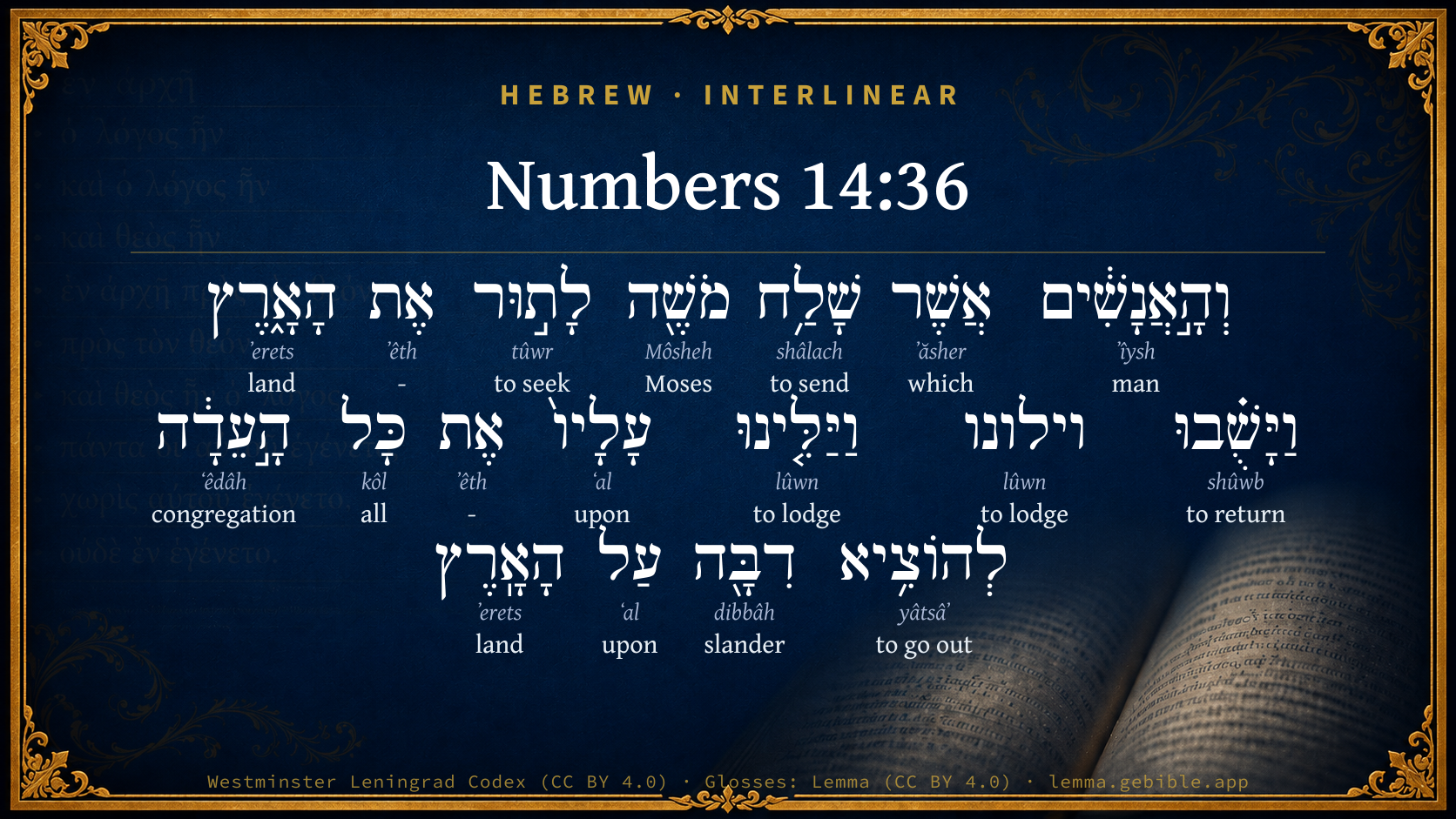
Hebrew (Westminster Leningrad Codex) Numbers 14:36 appears in the Hebrew Old Testament. The text above is from the Westminster Leningrad Codex. Each word links to its Strong’s number, a concise gloss, and parsing drawn from the Open Scriptures Hebrew Bible morphology. Click any word for its full Brown-Driver-Briggs (BDB) entry.
Download image
Cite this verse

Numbers 14:36 (World English Bible). Public Domain. Lemma interlinear Bible study tool, https://lemma.gebible.app/v/numbers/14/36.

Show BibTeX & RIS
BibTeX
RIS
English Translation
The men, whom Moses sent to spy out the land, who returned, and made all the congregation to murmur against him, by bringing up an evil report against the land,
World English Bible · Public Domain
Download a study sheet

One document with this verse’s original text, its word-by-word gloss line, the meaning frame, cross-references with their text, attributed commentary, and full source and license credits — printable, and it pastes into notes with its structure intact.

This verse Autodidact and up

Study sheet (.html) Plain text (.txt)

A passage Seminary Student

Up to 50 verses in one chapter. A passage sheet keeps up to 6 commentary sources and 12 cross-references per verse, in the order this page ranks them, and says so on the sheet whenever that leaves anything out. Ask for a single verse and you get the Autodidact verse sheet above.

Everything on this page stays free to read, with no account — the sheet is a download of what is already on screen, not access to it.

Want to remove ads? Support Godless Engineer
Compare translations 3

The same verse in 3 English versions, stacked beneath the original-language interlinear above. Click any original word for its lexicon entry.

Each is an independent rendering of the whole verse — the interlinear is not word-aligned to these translations.

Highlighted words mark where these versions differ — a whole-verse word diff, not a word-by-word alignment.

  • World English Bible Public Domain
    The men, whom Moses sent to spy out the land, who returned, and made all the congregation to murmur against him, by bringing up an evil report against the land,
  • King James Version Public Domain
    And the men, which Moses sent to search the land, who returned, and made all the congregation to murmur against him, by bringing up a slander upon the land,
  • unfoldingWord Literal Text CC BY-SA 4.0
    And the men whom Moses sent to explore the land and returned and made all the congregation murmur against him by bringing out a bad report against the land,

unfoldingWord Literal Text — © unfoldingWord, licensed CC BY-SA 4.0. Word-aligned USFM3 via Door43 (git.door43.org/unfoldingWord/en_ult).

Versions to compare (up to 4)

3 of 4 selected

Show all 18 translations

Every available English version of this verse, each an independent rendering of the whole verse.

  • World English Bible Public Domain
    The men, whom Moses sent to spy out the land, who returned, and made all the congregation to murmur against him, by bringing up an evil report against the land,
  • Berean Standard Bible Public Domain
    So the men Moses had sent to spy out the land, who had returned and made the whole congregation grumble against him by bringing out a bad report about the land—
  • Majority Standard Bible Public Domain
    So the men Moses had sent to spy out the land, who had returned and made the whole congregation grumble against him by bringing out a bad report about the land—
  • King James Version Public Domain
    And the men, which Moses sent to search the land, who returned, and made all the congregation to murmur against him, by bringing up a slander upon the land,
  • American Standard Version (1901) Public Domain
    And the men, whom Moses sent to spy out the land, who returned, and made all the congregation to murmur against him, by bringing up an evil report against the land,
  • Revised Version (1885) Public Domain
    And the men, which Moses sent to spy out the land, who returned, and made all the congregation to murmur against him, by bringing up an evil report against the land,
  • Geneva Bible (1599) Public Domain
    And the men which Moses had sent to search the land (which, when they came againe, made all the people to murmure against him, and brought vp a slander vpon the lande)
  • Douay-Rheims (1899) Public Domain
    Therefore all the men, whom Moses had sent to view the land, and who at their return had made the whole multitude to murmur against him, speaking ill of the land that it was naught,
  • Young's Literal Translation Public Domain
    And the men whom Moses hath sent to spy the land, and they turn back and cause all the company to murmur against him, by bringing out an evil account concerning the land,
  • Literal Standard Version CC BY-SA 4.0
    Then the men whom Moses has sent to spy out the land, [who] then return and cause all the congregation to murmur against him by bringing out an evil account concerning the land,
  • Unlocked Literal Bible CC BY-SA 4.0
    So the men Moses sent to spy out the land, who returned and made the entire community grumble against Moses by spreading a bad report about the land—
  • unfoldingWord Literal Text CC BY-SA 4.0
    And the men whom Moses sent to explore the land and returned and made all the congregation murmur against him by bringing out a bad report against the land,
  • Darby Bible Public Domain
    And the men whom Moses had sent to search out the land, who returned, and made the whole assembly to murmur against him, by bringing up an evil report upon the land,
  • World Messianic Bible Public Domain
    The men whom Moses sent to spy out the land, who returned and made all the congregation to murmur against him by bringing up an evil report against the land,
  • Webster's Bible Public Domain
    And the men whom Moses sent to search the land, who returned, and made all the congregation to murmur against him, by bringing a slander upon the land,
  • Free Bible Version CC BY-SA 4.0
    The men that Moses had sent to explore the country—those who came back and because they gave a bad report they made all the Israelites complain against the Lord—
  • Bible in Basic English Public Domain
    And the men whom Moses sent to see the land, and who, by the bad account they gave of the land, were the cause of the outcry the people made against Moses,
  • JPS Tanakh (1917) Public Domain
    And the men, whom Moses sent to spy out the land, and who, when they returned, made all the congregation to murmur against him, by bringing up an evil report against the land,

Literal Standard Version (2020), Covenant Press — licensed CC BY-SA 4.0. Text via the HelloAO Bible API (eBible.org). Unlocked Literal Bible (unfoldingWord) — licensed CC BY-SA 4.0. Text via the HelloAO Bible API (eBible.org). unfoldingWord Literal Text — © unfoldingWord, licensed CC BY-SA 4.0. Word-aligned USFM3 via Door43 (git.door43.org/unfoldingWord/en_ult). Free Bible Version, Dr. Jonathan Gallagher — licensed CC BY-SA 4.0. Text via the HelloAO Bible API (eBible.org).

Word by word

More ways to search: Search by grammar → Find every occurrence → Compare this word →

Practice this passage: Drill this verse → Learn its vocabulary →

דִבָּ֖ה
dibbâh
H1681
“slander”
Noun, Common, Feminine, Singular, Absolute
Part of Speech
Noun
Type
Common
Gender
Feminine
Number
Singular
State
Absolute
Full BDB Definition

Origin: from H1680 (in the sense of furtive motion)

TWOT: 396b

whispering, defamation, evil report - whispering - defamation, defaming - evil report, unfavourable saying
  1. וְהָ֣אֲנָשִׁ֔ים ʼîysh H376 “and · the · men” Conjunction + Particle, Definite Article + Noun, Common, Masculine, Plural, Absolute
  2. אֲשֶׁר ʼăsher H834 “which” Particle, Relative
  3. שָׁלַ֥ח shâlach H7971 “to send” Verb, Qal, Perfect, 3rd Person, Masculine, Singular
  4. מֹשֶׁ֖ה Môsheh H4872 “Moses” Noun, Proper
  5. לָת֣וּר tûwr H8446 “to seek” Preposition + Verb, Qal, Infinitive Construct
  6. אֶת ʼêth H853 “-” Particle, Direct Object
  7. הָאָ֑רֶץ ʼerets H776 “the · land” Particle, Definite Article + Noun, Common, Both, Singular, Absolute
  8. וַיָּשֻׁ֗בוּ shûwb H7725 “and · to return” Conjunction + Verb, Qal, Sequential Imperfect, 3rd Person, Masculine, Plural
  9. וילונו lûwn H3885 “and · to lodge” Conjunction + Verb, Niphal, Sequential Imperfect, 3rd Person, Masculine, Plural
  10. וַיַּלִּ֤ינוּ lûwn H3885 “and · to lodge” Conjunction + Verb, Hiphil, Sequential Imperfect, 3rd Person, Masculine, Plural
  11. עָלָיו֙ ʻal H5921 “upon · him” Preposition + Suffix, Personal, 3rd Person, Masculine, Singular
  12. אֶת ʼêth H853 “-” Particle, Direct Object
  13. כָּל kôl H3605 “all of” Noun, Common, Masculine, Singular, Construct
  14. הָ֣עֵדָ֔ה ʻêdâh H5712 “the · congregation” Particle, Definite Article + Noun, Common, Feminine, Singular, Absolute
  15. לְהוֹצִ֥יא yâtsâʼ H3318 “to go out” Preposition + Verb, Hiphil, Infinitive Construct
  16. עַל ʻal H5921 “upon” Preposition
  17. הָאָֽרֶץ ʼerets H776 “the · land” Particle, Definite Article + Noun, Common, Both, Singular, Absolute

About this verse

These counts appear in no published source. They are computed here, from the morphology-tagged text and Lemma’s own curated glosses. What Lemma adds →

18
words
14
distinct lemmas
Pentateuch
section

Notable vocabulary

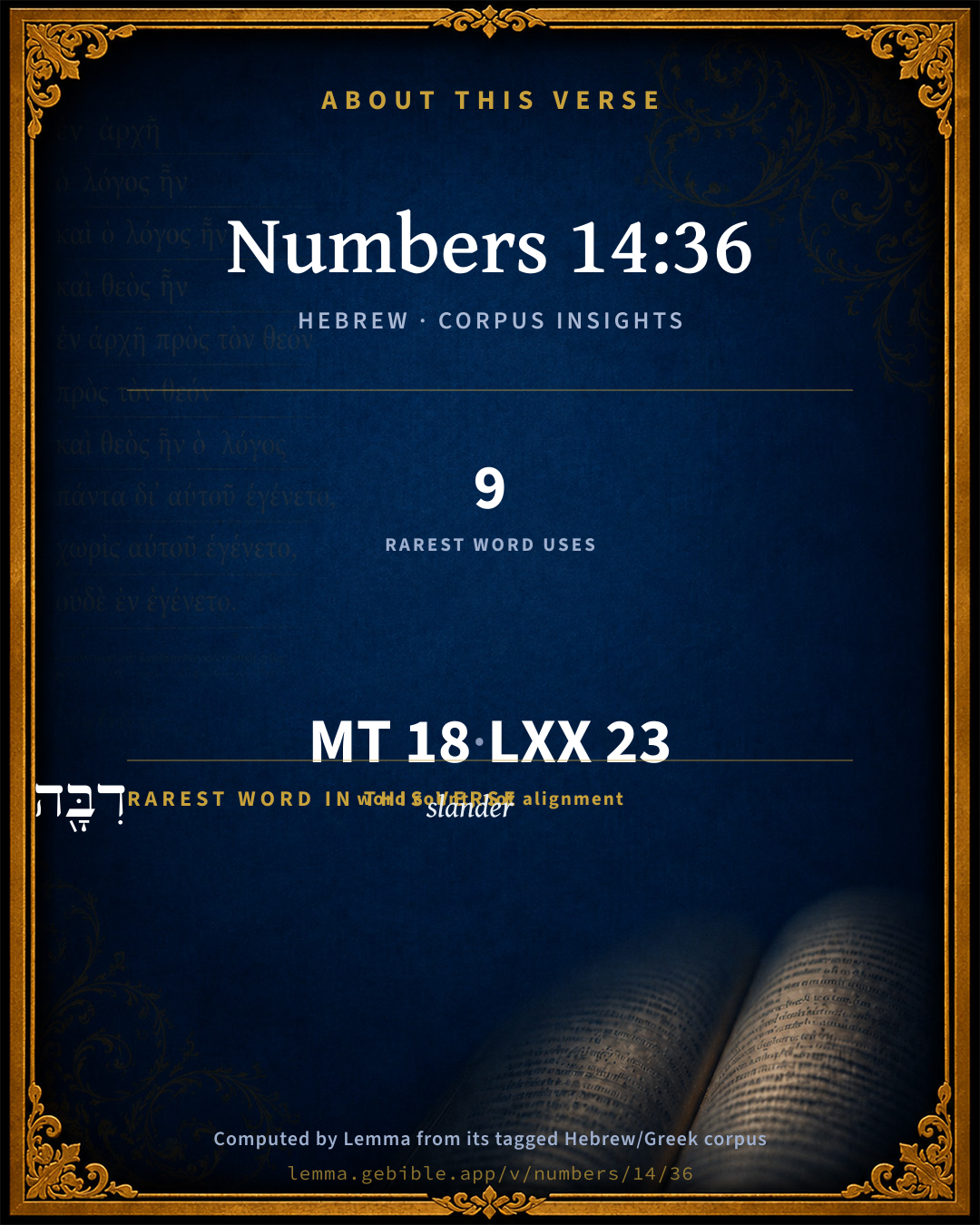
The rarest word here is דִבָּ֖ה slander H1681 — appearing just 9 times in the whole Hebrew Bible.

Shared distinctive vocabulary

דִבָּ֖ה slander H1681 occurs in 9 verses of the Hebrew Bible. Also found in:

Grammatical profile

  • 6 verbs
  • 7 nouns
  • 2 prepositions
  • 3 particles

Verb forms

  • שָׁלַ֥ח Qal · Perfect
  • לָת֣וּר Qal · Infinitive Construct
  • וַיָּשֻׁ֗בוּ Qal · Sequential Imperfect
  • וילונו Niphal · Sequential Imperfect
  • וַיַּלִּ֤ינוּ Hiphil · Sequential Imperfect
  • לְהוֹצִ֥יא Hiphil · Infinitive Construct

Repetition

Words recur within this verse — often emphatic in Hebrew:

  • הָאָ֑רֶץ land H776 ×2
  • וילונו to lodge H3885 ×2
  • עָלָיו֙ upon H5921 ×2

Hebrew & Septuagint length

In English translation the verse runs 30 words from the Hebrew and 32 from the Septuagint (LXX English) — closely comparable.

A rough comparison of the two English renderings, which tokenize alike — not a word-level alignment.

Word counts can differ between the Hebrew and the Greek without any difference in meaning — e.g. the Hebrew direct-object marker אֵת has no separate Greek word, and Greek often adds the article ὁ.

In the original languages it is 18 Hebrew tokens and 23 Greek tokens — but the two are counted differently (Hebrew bundles its prefixes and suffixes into one token; the Greek is in lemma form), so that isn’t a like-for-like length.

Cross-references

2

Topical passages linked to Numbers 14:36 in the Treasury of Scripture Knowledge — connected by theme and wording, ordered by reader-vote popularity; previews shown in the World English Bible.

  • Numbers 13:31–33 But the men who went up with him said, We aren't able to go up against the people; for they are stronger than we.
  • Numbers 13:4–16 These were their names: Of the tribe of Reuben, Shammua the son of Zaccur.

Cross-references courtesy of OpenBible.info (CC BY 4.0).

Hebrew and Greek witnesses Masoretic Hebrew ↔ Greek Septuagint

The same verse in the two great witnesses to the Old Testament, shown verse-for-verse.

These are two independent witnesses, not word-aligned to each other, and the Septuagint is shown in lemma (dictionary) form.

Hebrew Numbers 14:36 Masoretic · Westminster Leningrad Codex

וְהָ֣אֲנָשִׁ֔ים אֲשֶׁר שָׁלַ֥ח מֹשֶׁ֖ה לָת֣וּר אֶת הָאָ֑רֶץ וַיָּשֻׁ֗בוּ וילונו וַיַּלִּ֤ינוּ עָלָיו֙ אֶת כָּל הָ֣עֵדָ֔ה לְהוֹצִ֥יא דִבָּ֖ה עַל הָאָֽרֶץ

The men, whom Moses sent to spy out the land, who returned, and made all the congregation to murmur against him, by bringing up an evil report against the land,

World English Bible · Public Domain

Greek LXX Numbers 14:36 Septuagint · lemma form

καί ὁ ἄνθρωπος ὅς ἀποστέλλω μωυσῆς κατασκέπτομαι ὁ γῆ καί παραγίγνομαι διαγογγύζω κατά αὐτός πρός ὁ συναγωγή ἐκφέρω ῥῆμα πονηρός περί ὁ γῆ

And the men whom Moses sent to spy out the land, and who came and murmured against it to the assembly so as to bring out evil words concerning the land, —

LXX2012 (modern English Septuagint) · Public Domain

Hebrew: Westminster Leningrad Codex (CC BY 4.0). Greek: Septuagint (public domain); English from LXX2012 (modern English Septuagint) (Public Domain). How the Septuagint differs from the Hebrew →

Targum (Aramaic paraphrase)

2

The Targum is the ancient Jewish Aramaic paraphrase of the Hebrew Scriptures — an interpretive translation, not the Hebrew text itself. Onkelos (literal) and Pseudo-Jonathan (expansive) render the Torah, and Jonathan the Prophets. Coverage is partial: where no permissively-licensed English translation exists for a verse, only the Aramaic is shown. This is verse-level text, not a word-by-word alignment to the Hebrew.

  1. Targum Onkelos Torah (Genesis–Deuteronomy)
    וְגֻבְרַיָא דִי שְׁלַח משֶׁה לְאַלָלָא יָת אַרְעָא וְתָבוּ וְאַרְעִימוּ עֲלוֹהִי יָת כָּל כְּנִשְׁתָּא לְאַפָּקָא שׁוּם בִּישׁ עַל אַרְעָא

    (no public-domain English translation for this verse)

    Targum Onkelos — Aramaic: “Onkelos Genesis” (public domain); “Onkelos Exodus” (public domain); “Onkelos Leviticus” (public domain); “Onkelos Numbers” (public domain); “Onkelos Deuteronomy” (public domain). English: “Sefaria Community Translation” (CC0 1.0 (public-domain dedication)); “J.W. Etheridge. The Targums of Onkelos and Jonathan Ben Uzziel on the Pentateuch. London: Longmans, Green, 1862” (public domain). Text via Sefaria.

  2. Targum Pseudo-Jonathan Torah (Genesis–Deuteronomy)
    וְגוּבְרַיָא דִי שְׁדַר משֶׁה לְאַלְלָא יַת אַרְעָא וְתָבוּ וְאַרְעִימוּ עֲלוֹהִי יַת כָּל כְּנִישְׁתָּא לְאַפָּקָא טִיב בִּישׁ עַל אַרְעָא

    But the men whom Mosheh had sent to explore the land, and who returning had made the whole congregation murmur against him, by bringing forth an evil report of the land,

    Targum Pseudo-Jonathan — Aramaic: “Targum Jonathan on Genesis” (public domain); “Targum Jonathan on Exodus” (public domain); “Targum Jonathan on Leviticus” (public domain); “Targum Jonathan on Numbers” (public domain); “Targum Jonathan on Deuteronomy” (public domain). English: “The Targum of Jonathan ben Uzziel, trans. J. W. Etheridge, London, 1862” (public domain). Text via Sefaria.

Commentary

Notes on Numbers 14:36 from classic Christian and Jewish commentators (each source and its license shown beneath its notes). The classic Christian expositions comment on the surrounding passage and are grouped to its opening verse, so a note may address several verses; the Jewish commentaries on the Tanakh (Rashi and others) are per-verse, so they appear only where the commentator wrote on this verse.

Lemma curates 59 commentaries, every one of them public domain or Creative Commons licensed, each selected and text-cleaned for this edition rather than reprinted as found. About our sources →

Matthew Henry's Commentary

Here is, I. The sudden death of the ten evil spies. While the sentence was passing upon the people, before it was published, they died of the plague before the Lord, Num 14:36, Num 14:37. Now,

1. God hereby showed his particular displeasure against those who sinned and made Israel to sin. (1.) They sinned themselves, in bringing up a slander upon the land of promise. Note, Those greatly provoke God who misrepresent religion, cast reproach upon it, and raise prejudices in men's minds against it, or give occasion to those to do so who seek occasion. Those that represent the service of God as mean and despicable, melancholy and uncomfortable, hard and impracticable, needless and unprofitable, bring up an evil report upon the good land, pervert the right ways of the Lord, and in effect give him the lie. (2.) They made Israel to sin. They designedly made all the congregation murmur against God. Note, Ring-leaders in sin may expect to fall under particular marks of the wrath of God, who will severely reckon for the blood of souls, which is thus spilt.

2. God hereby showed what he could have done with the whole congregation, and gave an earnest of the execution of the sentence now passed upon them. He that thus cut off one of a tribe could have cut off their whole tribes suddenly, and would do it gradually. Note, The remarkable deaths of notorious sinners are earnests of the final perdition of ungodly men, Pe2 2:5, Pe2 2:6. Thus the wrath of God is revealed, that sinners may hear and fear.

II. The special preservation of Caleb and Joshua: They lived still, Num 14:38. It is probable that all the twelve spies stood together, for the eyes of all Israel were now upon them; and therefore it is taken notice of as very remarkable, and which could not but be affecting to the whole congregation, that when the ten evil spies fell down dead of the plague, a malignant infectious distemper, yet these two that stood among them lived, and were well. God hereby confirmed their testimony, and put those to confusion that spoke of stoning them. He likewise gave them an assurance of their continued preservation in the wilderness, when thousands should fall on their right hand and on their left, Psa 91:7. Death never misses his mark, nor takes any by oversight that were designed for life, though in the midst of those that were to die.

III. The publication of the sentence to all the people, Num 14:36. He told them all what the decree was which had gone forth concerning them, and which could not be reversed, that they must all die in the wilderness, and Canaan must be reserved for the next generation. It was a very great disappointment, we may well think, to Moses himself, who longed to be in Canaan, as well as to all the people; yet he acquiesced, but they wept and mourned greatly. The assurance which Moses had of God's being glorified by this sentence gave him satisfaction, while the consciousness of their own guilt, and their having procured it to themselves, gave them the greatest vexation. They wept for nothing (Num 14:1), and now they have cause given them to weep; so justly are murmurers made mourners. If they had mourned for the sin when they were faithfully reproved for it (Num 14:9), the sentence would have been prevented; but now that they mourned for the judgment only their grief came too late, and did them no service; they found no place for repentance, though they sought it carefully with tears, Heb 12:17. Such mourning as this there is in hell, but the tears will not quench the flames, no, nor cool the tongue.

IV. The foolish fruitless attempts of some of the Israelites to enter Canaan, notwithstanding the sentence.

1. They were now eager to go forward towards Canaan, Num 14:40. They were up early, mustered all their force, got together in a body, and begged of Moses to lead them on against the enemy, and now there is no more talk among them of making a captain to return into Egypt. They confess their fault: We have sinned; they profess reformation: Lo, we be here, and will go up. They now desire the land which they had despised, and put a confidence in the promise which they had distrusted. Thus when God judges he will overcome, and, first or last, will convince sinners of the evil of all their ungodly deeds, and hard speeches, and force them to recall their own words. But, though God was glorified by this recantation of theirs, they were not benefited by it, because it came too late. The decree had gone forth, the consumption was determined; they did not seek the Lord while he might be found, and now he would not be found. O, if men would but be as earnest for heaven while their day of grace lasts as they will be when it is over, would be as solicitous to provide themselves with oil while the bridegroom tarries as they will be when the bridegroom comes, how well were it for them!

2. Moses utterly disallows their motion, and forbids the expedition they were meditating: Go not up, Num 14:41-43. (1.) He gives them warning of the sin; it is transgressing the commandment of the Lord, who had expressly ordered them, when they did move, to move back towards the Red Sea. Note, That which has been duty, in its season, when it comes to be mistimed may be turned into sin. It is true the command he refers to was in the nature of a punishment, but he that has not obeyed the law is obliged to submit to the penalty, for the Lord is our Judge as well as Lawgiver. (2.) He gives them this warning of the danger: "It shall not prosper, never expect it." Note, It is folly to promise ourselves success in that which we undertake contrary to the mind of God. "The Canaanites are before you to attack you, and the Lord is not among you to protect you and fight for you, and therefore look to yourselves that you be not smitten before your enemies." Those that are out of the way of their duty are from under God's protection, and go at their peril. It is dangerous going where we cannot expect God should go along with us. Nay, he plainly foresees and foretels their defeat: You shall fall by the sword of the Amalekites and Canaanites (who were to have fallen by their sword); Because you are turned away from the Lord, from following the guidance of his precept and promise, therefore the Lord will not be with you. Note, God will certainly leave those that leave him; and those that are left of him lie exposed to all misery.

3. They venture notwithstanding. Never was people so perverse and so desperately resolved in every thing to walk contrary to God. God bade them go, and they would not; he forbade them, and they would. Thus is the carnal mind enmity to God: They presumed to go up unto the hill-top, Num 14:44. Here, (1.) They struggled against the sentence of divine justice, and would press on in defiance of it. (2.) They slighted the tokens of God's presence, for they would go though they left Moses and the ark of the covenant behind them. They had distrusted God's strength, and now they presume upon their own without his.

4. The expedition speeds accordingly, Num 14:45. The enemy had posted themselves upon the top of the hill, to make good that pass against the invaders, and, being informed by their scouts of their approach, sallied out upon them, and defeated them, and it is probable that many of the Israelites were killed. Now the sentence began to be executed that their carcases should fall in the wilderness. Note, That affair can never end well that begins with sin. The way to obtain peace with our friends, and success against our enemies, is to make God our friend, and keep ourselves in his love. The Jews, like these their ancestors, when they had rejected Christ's righteousness, attempted to establish their own, and it sped as this.

Matthew Henry's Commentary on the Whole Bible (1708–1710) — public domain (CC PDM 1.0). Text via the HelloAO Bible API.

Whedon's Commentary on the Bible

Daniel D. Whedon

THE FATE OF THE SPIES, Num_14:36-39.

After the general sentence of the nation a particular condemnation must be passed upon the cowardly ten spies, who are specially culpable, inasmuch as they afforded the occasion of the national sin. At the same time the faithful two are commended and rewarded.

36. Made all… to murmur — While the people, as free agents, were culpable for their free act, of which their own unbelief was the cause, yet the spies who made the unfavourable report were guilty, not so much because they furnished the occasion for the unbelief to manifest itself in action, but because they contributed to that unbelief. He who undermines his fellow’s faith in God, by his words, his writings, or his influence, assumes a tremendous responsibility.

A slander — “Evil report,” R.V. This consisted chiefly in the declaration that the land was unconquerable. See Num_13:32, note.

Daniel D. Whedon (gen. ed.), Commentary on the Old and New Testaments (1874–1909) — public domain. Text from a community e-Sword module.

Jamieson, Fausset & Brown

Robert Jamieson, A. R. Fausset & David Brown

those men that did bring up the evil report upon the land, died by the plague before the Lord--Ten of the spies struck dead on the spot--either by the pestilence or some other judgment. This great and appalling mortality clearly betokened the hand of the Lord.

Jamieson, Fausset & Brown — Commentary Critical and Explanatory on the Whole Bible (1871) — public domain (CC PDM 1.0). Text via the HelloAO Bible API.

John Gill's Exposition

Even those men that did bring up the evil report upon the land,.... They, and they only at this time:

died by the plague before the Lord; either by the pestilence immediately sent upon them by the Lord, or by a flash of lightning from him, or in some other way; however, by the immediate hand of God, and in his presence, being in the tabernacle of the congregation, Num 14:10; though the Jews differently relate the manner of their death; some say worms came out of their navels, and up to their jaws, and ate them and their tongues; and others that they came out of their tongues, and entered their navels, which they take to be a just retaliation for sinning with their tongues: and the time of their death they differ about; some say, as the Targum of Jonathan, that it was upon the seventh, and others that it was on the seventeenth of Elul or August they died (d).

(d) Schulchan Aruch, par. 1. c. 580. sect. 2. Shalshalet Hakabala, fol. 7. 2.

John Gill's Exposition of the Whole Bible (1746–1763) — public domain (CC PDM 1.0). Text via the HelloAO Bible API.

unfoldingWord translationNotes

Door43 World Missions Community

these men who had brought out a bad report about the land were struck down, and they died of a plague before Yahweh

The phrase "plague before Yahweh" shows that Yahweh struck them down. This can be stated in active form. AT: "Yahweh struck down these men who had brought out a bad report about the land, and they died" (See: Assumed Knowledge and Implicit Information)

translationWords

Moses

plague

report

Caleb

unfoldingWord translationNotes — © Distant Shores Media and the Door43 World Missions Community, licensed CC BY-SA 4.0. Source: git.door43.org/Door43/en_tn.

Rashi

Rabbi Shlomo Yitzchaki (Rashi)

וישבו וילינו עליו [AND THE MEN WHOM MOSES SENT TO SEARCH THE LAND] RETURNED AND MADE THE WHOLE CONGREGATION MURMUR AGAINST HIM — This meant: “the men whom Moses sent and who, when they returned (וישבו) from searching the Land, made the whole congregation murmur against him by making them utter an evil report, — those men died. Wherever the phrase הוציא דבה occurs it denotes instructing to speak — that people teach their way of speaking to a person that he may speak it (cf. Rashi on 23:31). Similar is, (Song 7:10) “causing the lips of those who are asleep to speak." (דובב) There may be one (a דבה, “an utterance”) for good, or there may be one for evil: and it is for this reason that it states here, “[even those men] that made the people utter evil speech about the Land”, because, as I have stated, there is a דבה which may be termed good.

דבה is parlerie in O. F.; (Engl = utterance).

Rashi on the Tanakh — English translations: “The Judaica Press complete Tanach with Rashi, translated by A. J. Rosenberg” (CC BY 4.0); “Pentateuch with Rashi's commentary by M. Rosenbaum and A.M. Silbermann, 1929-1934” (public domain); “The Metsudah Tanach series, Lakewood, N.J” (CC BY 4.0); and “The Book of Joshua, Metsudah Publications, 1997” (CC BY 4.0). Text via Sefaria.

Lesson kit

Teaching starters — assembled from the data on this page, not authored interpretation. Every prompt links to the verse data it draws on. Edit before teaching.

Numbers, in the Pentateuch, opens this verse with 18 words (14 distinct Hebrew lemmas). Its most distinctive word is dibbâh (“slander”). A historical commentator’s framing appears above. Read the whole chapter for the surrounding context.

Discussion questions

  1. What does “slander” (dibbâh) contribute to the verse as a whole?
  2. Genesis 37:2 shares the word «slander» with this verse. How do the two illuminate each other?
  3. “land” occurs 2× in this one verse. What is the effect of the repetition?
  4. These translations render this verse differently; the difference is in the English rendering, not the original. What questions does that raise?
  5. The verb «שָׁלַ֥ח» is Qal Perfect. How does its form color the action?
  6. Reading how Matthew Henry's Commentary and Whedon's Commentary on the Bible read this verse, where do the two commentators agree and where do they part?

Things to notice

Reading settings

Reading text

Shown beneath each verse's original-language words.

Old Testament
Old Testament edition

Read the OT as the Masoretic Hebrew (MT) or the Greek Septuagint (LXX).

English shown for the Greek Septuagint (in the Hebrew ↔ Greek comparison).

Comparing translations? Open the Compare panel on any verse page to stack up to four side by side.