Deuteronomy 13:12

Hebrew (Westminster Leningrad Codex) Deuteronomy 13:12 appears in the Hebrew Old Testament. The text above is from the Westminster Leningrad Codex. Each word links to its Strong’s number, a concise gloss, and parsing drawn from the Open Scriptures Hebrew Bible morphology. Click any word for its full Brown-Driver-Briggs (BDB) entry.
Download image
Cite this verse

Deuteronomy 13:12 (World English Bible). Public Domain. Lemma interlinear Bible study tool, https://lemma.gebible.app/v/deuteronomy/13/12.

Show BibTeX & RIS
BibTeX
RIS
English Translation
If you shall hear tell concerning one of your cities, which Yahweh your God gives you to dwell there, saying,
World English Bible · Public Domain
Download a study sheet

One document with this verse’s original text, its word-by-word gloss line, the meaning frame, cross-references with their text, attributed commentary, and full source and license credits — printable, and it pastes into notes with its structure intact.

This verse Autodidact and up

Study sheet (.html) Plain text (.txt)

A passage Seminary Student

Up to 50 verses in one chapter. A passage sheet keeps up to 6 commentary sources and 12 cross-references per verse, in the order this page ranks them, and says so on the sheet whenever that leaves anything out. Ask for a single verse and you get the Autodidact verse sheet above.

Everything on this page stays free to read, with no account — the sheet is a download of what is already on screen, not access to it.

Want to remove ads? Support Godless Engineer
Compare translations 3

The same verse in 3 English versions, stacked beneath the original-language interlinear above. Click any original word for its lexicon entry.

Each is an independent rendering of the whole verse — the interlinear is not word-aligned to these translations.

Highlighted words mark where these versions differ — a whole-verse word diff, not a word-by-word alignment.

  • World English Bible Public Domain
    If you shall hear tell concerning one of your cities, which Yahweh your God gives you to dwell there, saying,
  • King James Version Public Domain
    If thou shalt hear say in one of thy cities, which the LORD thy God hath given thee to dwell there, saying,
  • unfoldingWord Literal Text CC BY-SA 4.0
    If you hear in one of your cities that Yahweh your God gives to you to live there, saying,

unfoldingWord Literal Text — © unfoldingWord, licensed CC BY-SA 4.0. Word-aligned USFM3 via Door43 (git.door43.org/unfoldingWord/en_ult).

Versions to compare (up to 4)

3 of 4 selected

Show all 18 translations

Every available English version of this verse, each an independent rendering of the whole verse.

  • World English Bible Public Domain
    If you shall hear tell concerning one of your cities, which Yahweh your God gives you to dwell there, saying,
  • Berean Standard Bible Public Domain
    If, regarding one of the cities the LORD your God is giving you to inhabit, you hear it said
  • Majority Standard Bible Public Domain
    If, regarding one of the cities the LORD your God is giving you to inhabit, you hear it said
  • King James Version Public Domain
    If thou shalt hear say in one of thy cities, which the LORD thy God hath given thee to dwell there, saying,
  • American Standard Version (1901) Public Domain
    If thou shalt hear tell concerning one of thy cities, which Jehovah thy God giveth thee to dwell there, saying,
  • Revised Version (1885) Public Domain
    If thou shalt hear tell concerning one of thy cities, which the LORD thy God giveth thee to dwell there, saying,
  • Geneva Bible (1599) Public Domain
    If thou shalt heare say (concerning any of thy cities which the Lord thy God hath giuen thee to dwell in)
  • Douay-Rheims (1899) Public Domain
    If in one of thy cities, which the Lord thy God shall give thee to dwell in, thou hear some say:
  • Young's Literal Translation Public Domain
    `When thou hearest, in one of thy cities which Jehovah thy God is giving to thee to dwell there, `one' saying,
  • Literal Standard Version CC BY-SA 4.0
    When you hear [someone] in one of your cities, which your God YHWH is giving to you to dwell there, saying,
  • Unlocked Literal Bible CC BY-SA 4.0
    If you hear anyone say about one of your cities, that Yahweh your God gives you to live in:
  • unfoldingWord Literal Text CC BY-SA 4.0
    If you hear in one of your cities that Yahweh your God gives to you to live there, saying,
  • Darby Bible Public Domain
    If in one of thy cities, which Jehovah thy God hath given thee to dwell there, thou hearest, saying,
  • World Messianic Bible Public Domain
    If you hear about one of your cities, which the LORD your God gives you to dwell there, that
  • Webster's Bible Public Domain
    If thou shalt hear, in one of thy cities, which the LORD thy God hath given thee to dwell there, saying,
  • Free Bible Version CC BY-SA 4.0
    It may happen that once you're living in the towns the Lord your God is giving you, you hear
  • Bible in Basic English Public Domain
    And if word comes to you, in one of the towns which the Lord your God is giving you for your resting-place,
  • JPS Tanakh (1917) Public Domain
    (13-13) If thou shalt hear tell concerning one of thy cities, which the LORD thy God giveth thee to dwell there, saying:

Literal Standard Version (2020), Covenant Press — licensed CC BY-SA 4.0. Text via the HelloAO Bible API (eBible.org). Unlocked Literal Bible (unfoldingWord) — licensed CC BY-SA 4.0. Text via the HelloAO Bible API (eBible.org). unfoldingWord Literal Text — © unfoldingWord, licensed CC BY-SA 4.0. Word-aligned USFM3 via Door43 (git.door43.org/unfoldingWord/en_ult). Free Bible Version, Dr. Jonathan Gallagher — licensed CC BY-SA 4.0. Text via the HelloAO Bible API (eBible.org).

Word by word

More ways to search: Search by grammar → Find every occurrence → Compare this word →

Practice this passage: Drill this verse → Learn its vocabulary →

שָׁ֖ם
shâm
H8033
“there”
Adverb
Part of Speech
Adverb
Full BDB Definition

Origin: a primitive particle [rather from the relative pronoun, H834 ]; there (transferring to time) then

TWOT: 2404

there, thither - there - thither (after verbs of motion) - from there, thence - then (as an adverb of time)
  1. כִּֽי kîy H3588 “that” Conjunction
  2. תִשְׁמַ֞ע shâmaʻ H8085 “to hear” Verb, Qal, Imperfect, 2nd Person, Masculine, Singular
  3. בְּאַחַ֣ת ʼechâd H259 “in/at · one” Preposition + Adjective, Cardinal number, Feminine, Singular, Construct
  4. עָרֶ֗יךָ ʻîyr H5892 “cities · your” Noun, Common, Feminine, Plural, Construct + Suffix, Personal, 2nd Person, Masculine, Singular
  5. אֲשֶׁר֩ ʼăsher H834 “which” Particle, Relative
  6. יְהוָ֨ה Yᵉhôvâh H3068 “LORD” Noun, Proper
  7. אֱלֹהֶ֜יךָ ʼĕlôhîym H430 “God(s) · your” Noun, Common, Masculine, Plural, Construct + Suffix, Personal, 2nd Person, Masculine, Singular
  8. נֹתֵ֥ן nâthan H5414 “giving” Verb, Qal, Participle Active, Masculine, Singular, Absolute
  9. לָשֶׁ֥בֶת yâshab H3427 “to dwell” Preposition + Verb, Qal, Infinitive Construct
  10. לֵאמֹֽר ʼâmar H559 “to say” Preposition + Verb, Qal, Infinitive Construct

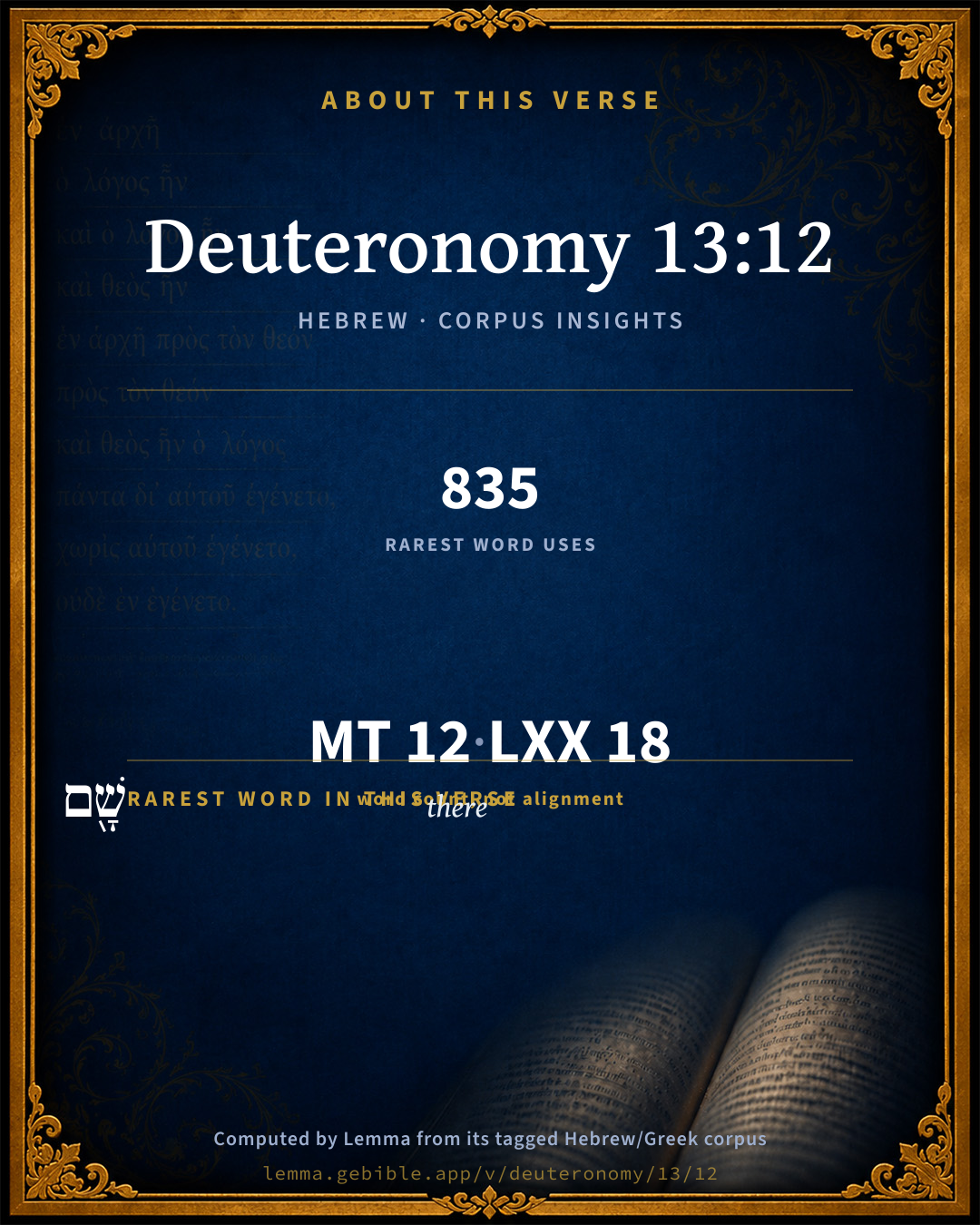
About this verse

These counts appear in no published source. They are computed here, from the morphology-tagged text and Lemma’s own curated glosses. What Lemma adds →

12
words
11
distinct lemmas
Pentateuch
section

Grammatical profile

  • 4 verbs
  • 3 nouns
  • 1 adjective
  • 1 preposition
  • 1 conjunction
  • 1 adverb
  • 1 particle

Verb forms

  • תִשְׁמַ֞ע Qal · Imperfect
  • נֹתֵ֥ן Qal · Participle Active
  • לָשֶׁ֥בֶת Qal · Infinitive Construct
  • לֵאמֹֽר Qal · Infinitive Construct

Hebrew & Septuagint length

In English translation the verse runs 20 words from the Hebrew and 21 from the Septuagint (LXX English) — closely comparable.

A rough comparison of the two English renderings, which tokenize alike — not a word-level alignment.

Word counts can differ between the Hebrew and the Greek without any difference in meaning — e.g. the Hebrew direct-object marker אֵת has no separate Greek word, and Greek often adds the article ὁ.

In the original languages it is 12 Hebrew tokens and 18 Greek tokens — but the two are counted differently (Hebrew bundles its prefixes and suffixes into one token; the Greek is in lemma form), so that isn’t a like-for-like length.

Cross-references

2

Topical passages linked to Deuteronomy 13:12 in the Treasury of Scripture Knowledge — connected by theme and wording, ordered by reader-vote popularity; previews shown in the World English Bible.

  • Joshua 22:11–34 The children of Israel heard say, Behold, the children of Reuben and the children of Gad and the half-tribe of Manasseh have built an altar in the forefront of the land of Canaan, in the region about the Jordan, on the side that pertains to the children of Israel.
  • Judges 20:1–17 Then all the children of Israel went out, and the congregation was assembled as one man, from Dan even to Beersheba, with the land of Gilead, to Yahweh at Mizpah.

Cross-references courtesy of OpenBible.info (CC BY 4.0).

Hebrew and Greek witnesses Masoretic Hebrew ↔ Greek Septuagint

The same verse in the two great witnesses to the Old Testament, shown verse-for-verse.

These are two independent witnesses, not word-aligned to each other, and the Septuagint is shown in lemma (dictionary) form.

Hebrew Deuteronomy 13:12 Masoretic · Westminster Leningrad Codex

כִּֽי תִשְׁמַ֞ע בְּאַחַ֣ת עָרֶ֗יךָ אֲשֶׁר֩ יְהוָ֨ה אֱלֹהֶ֜יךָ נֹתֵ֥ן לְךָ֛ לָשֶׁ֥בֶת שָׁ֖ם לֵאמֹֽר

If you shall hear tell concerning one of your cities, which Yahweh your God gives you to dwell there, saying,

World English Bible · Public Domain

Greek LXX Deuteronomy 13:12 Septuagint · lemma form

καί πᾶς ἰσραήλ ἀκούω φοβέω καί οὐ προςτίθημι ἔτι ποιέω κατά ὁ ῥῆμα ὁ πονηρός οὗτος ἐν σύ

And if in one of your cities which the Lord God gives you to dwell therein, you shall hear men saying,

LXX2012 (modern English Septuagint) · Public Domain

On this verse, The Cambridge Bible for Schools and Colleges discusses the Septuagint’s reading. Read the note in Commentary ↓

Hebrew: Westminster Leningrad Codex (CC BY 4.0). Greek: Septuagint (public domain); English from LXX2012 (modern English Septuagint) (Public Domain). How the Septuagint differs from the Hebrew →

Targum (Aramaic paraphrase)

2

The Targum is the ancient Jewish Aramaic paraphrase of the Hebrew Scriptures — an interpretive translation, not the Hebrew text itself. Onkelos (literal) and Pseudo-Jonathan (expansive) render the Torah, and Jonathan the Prophets. Coverage is partial: where no permissively-licensed English translation exists for a verse, only the Aramaic is shown. This is verse-level text, not a word-by-word alignment to the Hebrew.

  1. Targum Onkelos Torah (Genesis–Deuteronomy)
    וְכָל יִשְׂרָאֵל יִשְׁמְעוּן וְיִדְחֲלוּן וְלָא יוֹסְפוּן לְמֶעְבַּד כְּפִתְגָמָא בִישָׁא הָדֵין בֵּינָךְ

    (no public-domain English translation for this verse)

    Targum Onkelos — Aramaic: “Onkelos Genesis” (public domain); “Onkelos Exodus” (public domain); “Onkelos Leviticus” (public domain); “Onkelos Numbers” (public domain); “Onkelos Deuteronomy” (public domain). English: “Sefaria Community Translation” (CC0 1.0 (public-domain dedication)); “J.W. Etheridge. The Targums of Onkelos and Jonathan Ben Uzziel on the Pentateuch. London: Longmans, Green, 1862” (public domain). Text via Sefaria.

  2. Targum Pseudo-Jonathan Torah (Genesis–Deuteronomy)
    וְכָל יִשְרָאֵל יִשְׁמְעוּן וִידַחֲלוּן וְלָא יוֹסְפוּן לְמֶעֱבַד כְּפִתְגָמָא בִּישָׁא הָדֵין בֵּינֵיכוֹן

    And all Israel will hear and be afraid, and never more do according to that evil thing among you.

    Targum Pseudo-Jonathan — Aramaic: “Targum Jonathan on Genesis” (public domain); “Targum Jonathan on Exodus” (public domain); “Targum Jonathan on Leviticus” (public domain); “Targum Jonathan on Numbers” (public domain); “Targum Jonathan on Deuteronomy” (public domain). English: “The Targum of Jonathan ben Uzziel, trans. J. W. Etheridge, London, 1862” (public domain). Text via Sefaria.

Commentary

Notes on Deuteronomy 13:12 from classic Christian and Jewish commentators (each source and its license shown beneath its notes). The classic Christian expositions comment on the surrounding passage and are grouped to its opening verse, so a note may address several verses; the Jewish commentaries on the Tanakh (Rashi and others) are per-verse, so they appear only where the commentator wrote on this verse.

Lemma curates 59 commentaries, every one of them public domain or Creative Commons licensed, each selected and text-cleaned for this edition rather than reprinted as found. About our sources →

The Cambridge Bible for Schools and Colleges

gen. ed. J. J. S. Perowne

12–18 (13–19 in Heb.). Against a City seduced to Other Gods

Deu_13:12. in one of thy cities] So Hebrew. R. V. concerning is hardly possible (though cp. Psa_92:12). As the words define not the place where the report has been heard, but the subject of the report, the guilty city itself; therefore either saying has been carelessly misplaced and should follow hear (tell) (cp. Jos_22:11) or more probably the writer has designedly but awkwardly brought up the object of the law from the subordinate to the principal clause so as to make it prominent from the first: cp. Deu_31:29 (Dillm., Driv.). Translate: if thou shalt hear tell, that, in one of the cities, which … certain base fellows have gone out, etc.

cities] or towns; these social forms in Israel are much more frequent in D than tribes which under the settled conditions of the people towns gradually displaced; nearly always (exceptions Deu_19:1, Deu_20:16 and LXX of Deu_12:5) in these laws they are units of judiciary: here, Deu_19:1-13 (on the cities of refuge), Deu_21:2 ff. (with criminal responsibility for murders committed near them), Deu_21:19 ff., Deu_22:15 ff., Deu_22:24, Deu_25:8 : their representatives being their elders. The other phrase within thy gates is used of judiciary matters in Deu_16:18, Deu_17:2; Deu_17:8 (otherwise it is reserved for religious and charitable directions: see on Deu_12:12; Deu_12:21). But judges and officers are to be chosen according to thy tribes, Deu_16:18 (for tribes see also Deu_12:5; Deu_12:14).

giveth] is about to give.

Deu_13:13. Certain base fellows] Hebrew, men, sons of belial usually but doubtfully taken as worthlessness (as if a compound = no use), good-for-nothing fellows, Scot. ‘ne’er-do-weels.’ In early writings of the churlish, foul-mouthed, violent, drunken, unchaste, perjurers and abandoned criminals, but also of rebels against authority and religion as here (Jdg_19:22; Jdg_20:13; 1Sa_1:16; 1Sa_2:12; 1Sa_10:27; 1Sa_25:17; 1Sa_25:25; 2Sa_16:7; 2Sa_20:1; 1Ki_21:10; 1Ki_21:13). In D only here and Deu_15:9 (of a base word or thought), and nowhere else in Hexateuch.

are gone out] The vb. is used of going forth of set purpose to do something (Jdg_9:8; 1Sa_23:15) or, along with coming in, of all kinds of business (Deu_28:6, Deu_31:2). So here it might just mean deliberately and (of course) in public (opp. secretly, Deu_13:6); but the addition from the midst of thee conveys the suggestion of apostasy from Israel: they went out from us but they were not of us (1Jn_2:19).

drawn away] Deu_13:5 : draw thee aside (q.v.).

Let us go and worship, etc.] See Deu_13:2; Deu_13:6.

Deu_13:14. inquire] See Deu_11:12, Deu_12:30, Deu_17:4; Deu_17:9, Deu_19:18; in this sense or a similar darash is used elsewhere in the Pent. only in Lev_10:16. Make search, ḥaḳar, investigate, in D only here; elsewhere of exploring a land and of examining a case (Job_29:16). Ask diligently, well, or thoroughly; ask, sha’al, like darash, to make inquest.

and the thing certain] or the story established or substantiated (Deu_17:4), or the case well-founded.

abomination] See on Deu_7:25.

Deu_13:15. thou shalt surely] i.e. the whole nation.

with the edge of] Hebrew, mouth of.

destroying it utterly] devoting or putting it to the ban or ḥerem. On this see Deu_2:34; it is the hardest form of the ḥerem which is here pronounced upon an apostate city of Israel.

and the cattle, etc.] Not in LXX; probably a later addition to the law and if so illustrative of the ease with which its varied forms and degrees of stringency (see on Deu_2:34) arose (but see Driver’s note here).

Deu_13:16. street] broad or open place. So far as they have been unearthed the streets of ancient Canaanite towns were as narrow as those of the villages of modern Palestine. But there was always a broad place, just inside the gate, where local courts and consultations were held.

every whit] a whole offering, holocaust. Hebrew kalîl usually synonymous with ‘olah (see Deu_12:6), but here used of the ḥerem; so in Jdg_20:40 of a city set on fire and its smoke: the whole offering of the city went up to heaven.

an heap] or mound. Heb., as Ar., tel (tell), in both languages also applied to the mounds on which living cities stand, their dead selves; the remains of their previous gradual decay or overthrow: all the cities standing on their mounds (Jos_11:13, etc.).

Deu_13:17. devoted thing] The thing banned, as well as the banning, was called ḥerem. See on Deu_2:34, Deu_7:26, and cp. Jos_6:18.

turn from the fierceness of his anger] So Jos_7:26, after the ḥerem was fulfilled on Achan.

and shew thee mercy, etc.] Jer_42:12.

multiply thee] Again this promise! Deu_1:10, Deu_6:3 (q.v.), Deu_7:13, etc.

Deu_13:18. The usual condition attached to promises in Deut.: possibly editorial.

right] Sam., LXX add and good.

The Cambridge Bible for Schools and Colleges (gen. ed. J. J. S. Perowne; Cambridge University Press, 1878–1918) — public domain. Text from a community e-Sword module.

Trapp's Complete Commentary

John Trapp

Deu 13:12 If thou shalt hear [say] in one of thy cities, which the LORD thy God hath given thee to dwell there, saying,

Ver. 12. If thou shalt hear say.] Rumours are not always to be credited, nor always to be contemned.

John Trapp, A Commentary or Exposition upon All the Books of the Old and New Testament (1647–1656) — public domain. Text from a community e-Sword module.

Matthew Henry's Commentary

Here the case is put of a city revolting from its allegiance to the God of Israel, and serving other gods.

I. The crime is supposed to be committed, 1. By one of the cities of Israel, that lay within the jurisdiction of their courts. The church then judged those only that were within, Co1 5:12, Co1 5:13. And, even when they were ordered to preserve their religion in the first principles of it by fire and sword to propagate it. Those that are born within the allegiance of a prince, if they take up arms against him, are dealt with as traitors, but foreign invaders are not so. The city that is here supposed to have become idolatrous is one that formerly worshipped the true God, but had now withdrawn to other gods, which intimates how great the crime is, and how sore the punishment will be, of those that, after they have known the way of righteousness, turn aside from it, Pe2 2:21. 2. It is supposed to be committed by the generality of the inhabitants of the city, for we may conclude that, if a considerable number did retain their integrity, those only that were guilty were to be destroyed, and the city was to be spared for the sake of the righteous in it; for will not the Judge of all the earth do right? No doubt he will. 3. They are supposed to be drawn to idolatry by certain men, the children of Belial, men that would endure no yoke (so it signifies), that neither fear God nor regard man, but shake off all restraints of law and conscience, and are perfectly lost to all manner of virtue; these are those that say, "Let us serve other gods," that will not only allow, but will countenance and encourage, our immoralities. Belial is put for the devil (Co2 6:15), and the children of Belial are his children. These withdraw the inhabitants of the city; for a little of this old leaven, when it is entertained, soon leavens the whole lump.

II. The cause is ordered to be tried with a great deal of care (Deu 13:14): Thou shalt enquire and make search. They must not proceed upon common fame, or take the information by hearsay, but must examine the proofs, and not give judgment against them unless the evidence was clear and the charge fully made out. God himself, before he destroyed Sodom, is said to have come down to see whether its crimes were according to the clamour, Gen 18:21. In judicial processes it is requisite that time, and care, and pains, be taken to find out the truth, and that search be made without any passion, prejudice, or partiality. The Jewish writers say that, though particular persons who were idolaters might be judged by the inferior courts, the defection of a city was to be tried by the great Sanhedrim; and, if it appeared that they were thrust away to idolatry, two learned men were sent to them to admonish and reclaim them. If they repented, all would be well; if not, then all Israel must go up to war against them, to testify their indignation against idolatry and to stop the spreading of the contagion.

III. If the crime were proved, and the criminals were incorrigible, the city was to be wholly destroyed. If there were a few righteous men in it, no doubt they would remove themselves and their families out of such a dangerous place, and then all the inhabitants, men, women, and children, must be put to the sword (Deu 13:15), all the spoil of the city, both shop-goods and the furniture of houses, must be brought into the marketplace and burned, and the city itself must be laid in ashes and never built again, Deu 13:16. The soldiers are forbidden, upon pain of death, to convert any of the plunder to their own use, Deu 13:17. It was a devoted thing, and dangerous to meddle with, as we find in the case of Achan. Now, 1. God enjoins this severity of show what a jealous God he is in the matters of his worship, and how great a crime it is to serve other gods. Let men know that God will not give his glory to another, nor his praise to graven images. 2. He expects that magistrates, having their honour and power from him, should be concerned for his honour, and use their power for terror to evil doers, else they bear the sword in vain. 3. The faithful worshippers of the true God must take all occasions to show their just indignation against idolatry, much more against atheism, infidelity, and irreligion. 4. It is here intimated that the best expedient for the turning away of God's anger from a land is to execute justice upon the wicked of the land (Deu 13:17), that the Lord may turn from the fierceness of his anger, which was ready to break out against the whole nation, for the wickedness of that one apostate city. It is promised that, if they would thus root wickedness out of their land, God would multiply them. They might think it impolitic, and against the interest of their nation, to ruin a whole city for a crime relating purely to religion, and that they should be more sparing of the blood of Israelites: "Fear not the" (says Moses), "God will multiply you the more; the body of your nation will lose nothing by the letting out of this corrupt blood." Lastly, Though we do not find this law put in execution in all the history of the Jewish church (Gibeah was destroyed, not for idolatry, but immorality), yet for the neglect of the execution of it upon the inferior cities that served idols God himself, by the army of the Chaldeans, put it in execution upon Jerusalem, the head city, which, for is apostasy from God, was utterly destroyed and laid waste, and lay in ruins seventy years. Though idolaters may escape punishment from men (nor is this law in the letter of it binding now, under the gospel), yet the Lord our God will not suffer them to escape his righteous judgements. The New Testament speaks of communion with idolaters as a sin which, above any other, provokes the Lord to jealousy, and dares him as if we were stronger than he, Co1 10:21, Co1 10:22.

Matthew Henry's Commentary on the Whole Bible (1708–1710) — public domain (CC PDM 1.0). Text via the HelloAO Bible API.

Jamieson, Fausset & Brown

Robert Jamieson, A. R. Fausset & David Brown

Certain men, the children of Belial--lawless, designing demagogues (Jdg 19:22; Sa1 1:16; Sa1 25:25), who abused their influence to withdraw the inhabitants of the city to idol-worship.

Jamieson, Fausset & Brown — Commentary Critical and Explanatory on the Whole Bible (1871) — public domain (CC PDM 1.0). Text via the HelloAO Bible API.

Ellicott's Commentary for English Readers

(12) If thou shalt hear say in one of thy cities.—The only case of this kind is the case of Gibeah. We may fairly assume the abominations done there to have been connected with idolatry, from the allusions in Hos_9:9; Hos_10:9. But the outrage rather than the idolatry seems to have excited the indignation of Israel (see Judges 20, 21). It is noticeable that in the remonstrance with the Benjamites at Gibeah—(Jdg_20:13): “Now therefore deliver us the men, the children of Belial, which are in Gibeah, that we may put them to death, and put away evil from Israel”—there seems to be an allusion to the language of this chapter in Deu_13:5; Deu_13:11.

A Bible Commentary for English Readers, edited by Charles John Ellicott (1878–1897) — public domain. Text from a community e-Sword module.

John Gill's Exposition

If thou shalt hear say in one of thy cities,.... A report concerning them, anyone of them:

which the Lord thy God had given thee to dwell there; which he had not only given them, but had put them into the possession of, and it was become their dwelling place, or was inhabited by Israelites; otherwise they were already given unto them, but did not inherit and inhabit them, and it might be possible that there might be some city or cities, at least for a time, which, though given them, were not inhabited by them, but by the Canaanites, and such cities this law did not concern: saying; as follows.

John Gill's Exposition of the Whole Bible (1746–1763) — public domain (CC PDM 1.0). Text via the HelloAO Bible API.

Albert Barnes' Notes on the Bible

City was to keep jealous watch over city, as man over man. The clause “which the Lord thy God hath given thee to dwell in” significantly reminds them that the real ownership of their dwellings rested in the Lord (compare Lev 25:23), and that they, the mere tenants, must not allow His property to become a center of rebellion against His just authority.

Albert Barnes' Notes on the Bible (1834–1885) — public domain. Text from a community e-Sword/MySword module.

Haydock's Catholic Bible Commentary

Cities. If the inhabitants agreed, in general, to introduce the worship of idols, they were to be first admonished, (Calmet) and if incorrigible, to be utterly destroyed. (Haydock) --- The obligation of seeing that this was executed was left to the magistrates. (Du Hamel)

George Leo Haydock (1774–1849), Haydock's Catholic Family Bible and Commentary, 1859 edition — public domain. Excludes Psalms (Douay-Rheims chapter numbering differs from Protestant) and Deuterocanonical books (Catholic canon only).

The Pulpit Commentary

Vers. 12-18. A third ease supposed is that of the inhabitants of a city being seduced by wicked men into idolatry. In this case inquiry was to be made as to the fact; and if it was found to be so, the inhabitants of that city were to be put to the sword, all their property was to be burnt, and the city itself reduced to a heap; so should the anger of the Lord be averted from Israel, and he would do them good.

Hear in one of thy cities. The Hebrew phrase, "to hear in" (B mv). has sometimes the meaning of to overhear, as in Gen_27:5; 1Sa_17:28 Job_15:8; sometimes it means simply to hear, as in 2Sa_19:35; in Job_26:14, it has the force of to hear of orconcerning, though some think this questionable. This latter is apparently the meaning here: If thou hear concerning any of thy cities, etc. Baying. This introduces what is heard.

Vers. 12-18. A city under ban.

The case here supposed is even more appalling than the former one, for it is the inhabitants of a whole city who, with all that they have, are to be destroyed. Yet, as it is certain that godly persons, dreading the execution of this sentence, would leave this city as soon as they found out what was going on being very possibly the bearers of the tidings to others the curse would practically take effect only on those who were in league with the idolaters. Searching investigation was to precede the infliction of doom (ver. 14).

I EVIL-DISPOSED PERSONS CAN DO MUCH HARM. A few men of Belial perhaps, at first, but one or two, succeed in seducing, and ultimately in destroying, a whole city. Their cancerous influence speedily infected the mass. Like fire breaking out in a little corner of a building, it soon involved the whole place in ruin. "One sinner destroyeth, much good". (Ecc_9:18) "Evil communications corrupt good manners. (1Co_15:33) Evil is not to be thought lightly of, because at first confined to a few individuals, and circumscribed in its range of operations. It will spread faster than good.

II THE SPIRITUAL CONDITION OF EACH CITY IS OF INTEREST TO THE WHOLE COMMUNITY. Disease in one part of the social organism will speedily communicate itself to the other parts.

III IMMEDIATE ACTION SHOULD BE TAKEN TO REDUCE EVIL IN ITS CHOSEN SEATS. No longer, indeed, with carnal weapons. We have no warrant to proceed by fire and sword. A better way is open to us of reducing evil than by judicial slaughter. The wickedness of a city is doubtless a token of God"s wrath resting upon it. If it repent not, his judgments will fall upon it with all the old severity. But it does not lie with us to give effect to these judgments; God keeps them in his own hand. Our work, meanwhile, is the happier one of seeking the reduction of evil by spiritual means by reasoning, by persuasion, by preaching of the truth, by substituting good influences for bad ones. These weapons are adequate to the work for which they are given, and ought to be plied to the utmost. Places differ in spiritual character. There are those of which it may be said as of Pergamos, "where Satan"s seat is" (Rev_2:13) that in them evil has a kind of stronghold. Against these, by preference, the assaults of God"s servants should be directed. The apostles chose for their attacks the leading centers of pagan influence. One stronghold gained is worth a dozen outposts, J.O.

The Pulpit Commentary (1880–1919), ed. H.D.M. Spence-Jones & Joseph S. Exell — public domain. Text from a community e-Sword module.

Keil & Delitzsch

C. F. Keil & F. Delitzsch

This was to be done, and all Israel was to hear it and fear, that no such wickedness should be performed any more in the congregation. The fear of punishment, which is given here as the ultimate end of the punishment itself, is not to be regarded as the principle lying at the foundation of the law, but simply, as Calvin expresses it, as "the utility and fruit of severity," one reason for carrying out the law, which is not to be confounded with the so-called deterrent theory, i.e., the attempt to deter from crime by the mode of punishing (see my Archologie, ii. p. 262).

Keil & Delitzsch — Biblical Commentary on the Old Testament (1861–1891) — public domain (CC PDM 1.0). Text via the HelloAO Bible API. (Old Testament only.)

Kretzmann's Popular Commentary

Paul E. Kretzmann

Seducers Among Fellow-Citizens. —

v. 12. If thou shalt hear say in one of thy cities which the Lord, thy God, hath given thee to dwell there, saying,

v. 13. Certain men, the children of Belial, literally, "sons of worthlessness," vain, profitless people, are gone out from among you, denying their allegiance to the people of God and their obligations to the Lord, and have withdrawn (seduced) the inhabitants of their city, saying, let us go and serve other gods which ye have not known, if this rumor or report should reach the ears of any member of Israel,

v. 14. then shalt thou enquire, make an investigation through the proper officers, and make search, and ask diligently; and, behold, if it be truth and the thing certain, that such an abomination is wrought among you, if the guilt of the people is established beyond a doubt,

v. 15. thou shalt surely smite the inhabitants of that city with the edge of the sword, destroying it utterly, as having fallen under the ban of Jehovah, Deuteronomy 7, and all that is therein, and the cattle thereof, with the edge of the sword. The ban should be carried out upon such a city with a severity which would cause the complete extermination of all living things.

v. 16. And thou shalt gather all the spoil of it, in the form of dresses, furniture, jewelry, and the like, in the midst of the street thereof, the broad, open place just inside the gate, and shalt burn with fire the city and all the spoil thereof, every whit, for the Lord, thy God, namely, as being devoted to Him through this destruction; and it shall be an heap forever; it shall not be built again.

v. 17. And there shall cleave naught of the cursed thing to thine hand, no individual should presume to keep any of the material found among the spoil, that the Lord may turn from the fierceness of His anger, and show thee mercy, and have compassion upon thee, not visit the sin of that one city upon the entire nation, and multiply thee, as he hath sworn unto thy fathers, Gen 22:17;

v. 18. when thou shalt hearken to the voice of the Lord, thy God, to keep all His commandments which I command thee this day, including these, which enjoined the utmost severity upon the false prophets and seducers of every kind, to do that which is right in the eyes of the Lord, thy God. The command of God. as it concerns Christian congregations in our days, plainly states that they must have no fellowship with unbelievers and with false believers. Only in this way is it possible to hinder the corruption and the defection of the people of God. Cf 2Co 6:14-18.

Paul E. Kretzmann, Popular Commentary of the Bible (1921–1924) — public domain. Text from a community e-Sword module.

unfoldingWord translationNotes

Door43 World Missions Community

General Information:

Moses continues speaking to the people of Israel.

Some wicked fellows have gone out from among you

The phrase "from among you" means that these wicked men were Israelites who lived in their communities.

have drawn away the inhabitants of their city and said, 'Let us go and worship other gods that you have not known.'

This can be translated as an indirect quotation. AT: "have persuaded those who live in their city to go and worship other gods that they have not known." (See: Direct and Indirect Quotations)

have drawn away the inhabitants of their city

A person causing someone else to stop obeying Yahweh is spoken of as if the person has caused the other person to physically turn and leave Yahweh. (See: Metaphor)

examine the evidence, make search, and investigate it thoroughly

All of these phrases mean basically the same thing. Moses is emphasizing that they must carefully find out what truly happened at the city. (See: Doublet)

that such an abominable thing has been done among you

This can be stated in active form. AT: "that the people of the city have done such a terrible thing" (See: Active or Passive)

translationWords

Yahweh

God

life

worship

false god

true

unfoldingWord translationNotes — © Distant Shores Media and the Door43 World Missions Community, licensed CC BY-SA 4.0. Source: git.door43.org/Door43/en_tn.

Lesson kit

Teaching starters — assembled from the data on this page, not authored interpretation. Every prompt links to the verse data it draws on. Edit before teaching.

Deuteronomy, in the Pentateuch, opens this verse with 12 words (11 distinct Hebrew lemmas). Its most distinctive word is shâm (“there”). A historical commentator’s framing appears above. Read the whole chapter for the surrounding context.

Discussion questions

  1. How does “there” (shâm) shape what this verse is saying?
  2. Joshua 22:11–34 shares this passage’s theme. How do the two illuminate each other?
  3. The translations on this page render this verse differently — a whole-verse word diff, not a word-by-word alignment. What might account for the different wordings?
  4. The verb «תִשְׁמַ֞ע» is Qal Imperfect. How does its form color the action?
  5. Reading how The Cambridge Bible for Schools and Colleges and Trapp's Complete Commentary read this verse, where do the two commentators agree and where do they part?

Things to notice

Reading settings

Reading text

Shown beneath each verse's original-language words.

Old Testament
Old Testament edition

Read the OT as the Masoretic Hebrew (MT) or the Greek Septuagint (LXX).

English shown for the Greek Septuagint (in the Hebrew ↔ Greek comparison).

Comparing translations? Open the Compare panel on any verse page to stack up to four side by side.