

Mark 7:22
Greek (Tischendorf 8th ed.) Mark 7:22 appears in the Greek New Testament. The text above is from the Tischendorf 8th edition. Each word links to its Strong’s number and a concise gloss. Click any word for its full Thayer’s Greek Lexicon entry.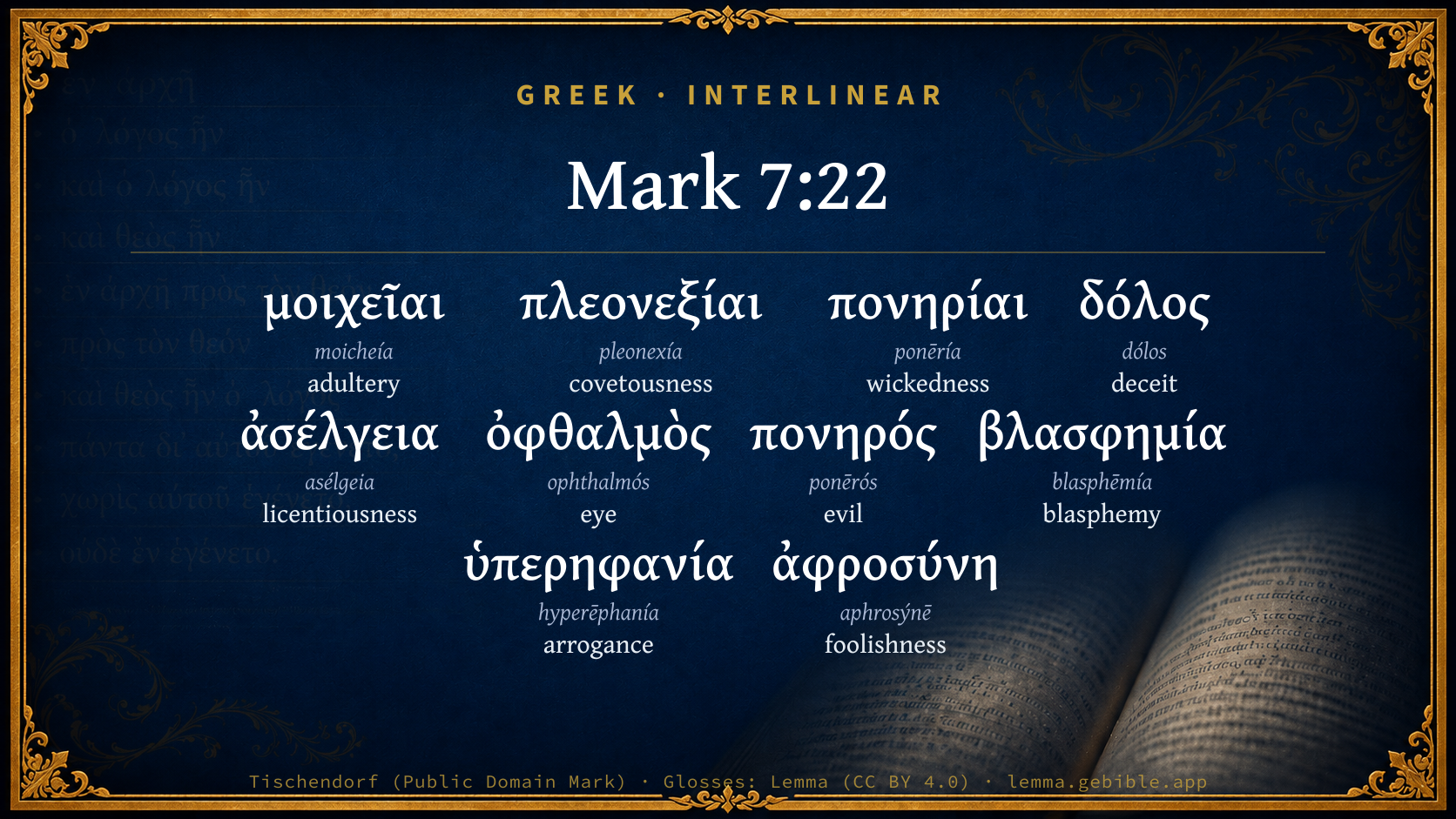
covetings, wickedness, deceit, lustful desires, an evil eye, blasphemy, pride, and foolishness.
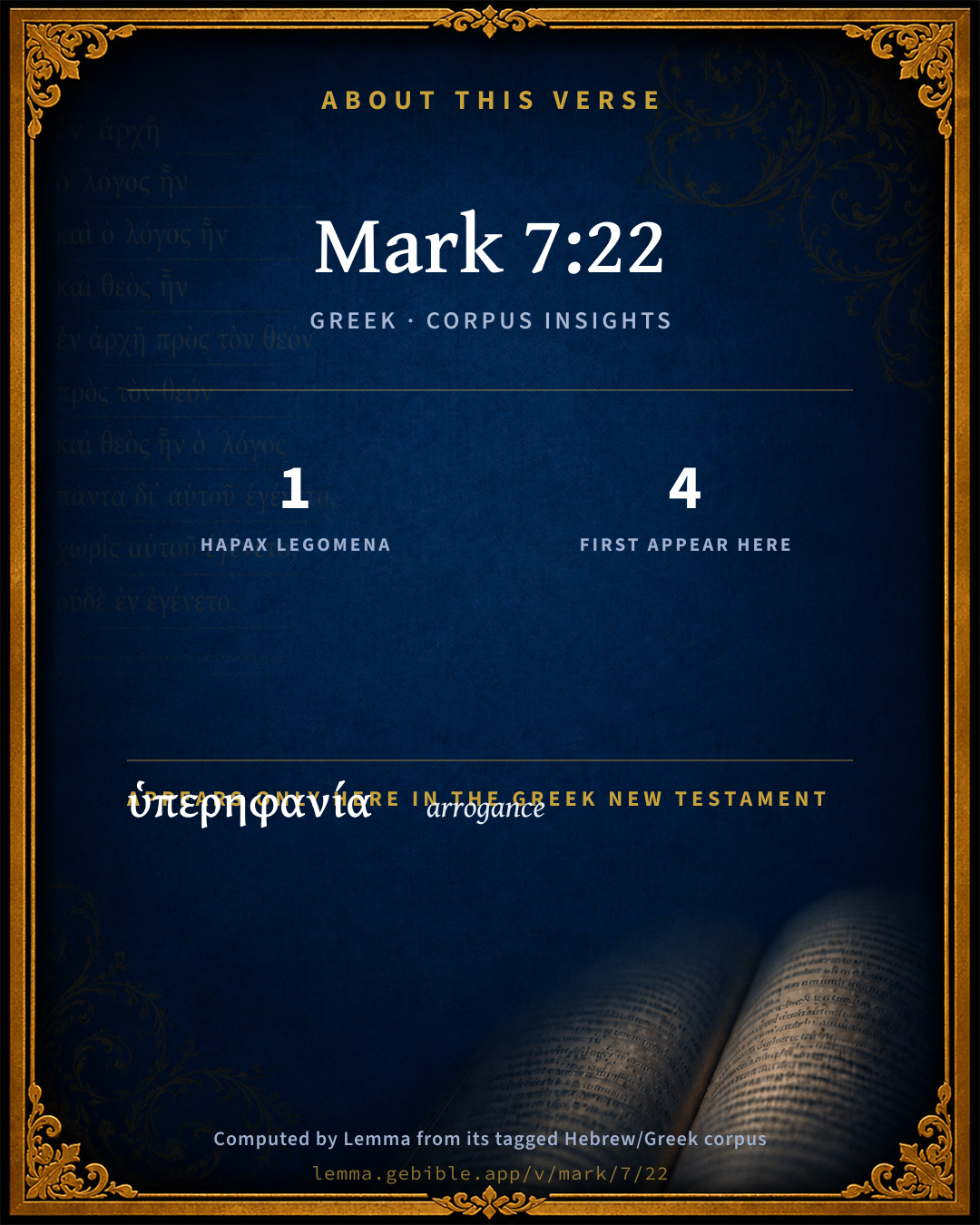
- 1 hapax legomenon — only here in the Greek New Testament
- 4 first appearances in the Greek New Testament
Download a study sheet
One document with this verse’s original text, its word-by-word gloss line, the meaning frame, cross-references with their text, attributed commentary, and full source and license credits — printable, and it pastes into notes with its structure intact.
This verse Autodidact and up
A passage Seminary Student
Up to 50 verses in one chapter. A passage sheet keeps up to 6 commentary sources and 12 cross-references per verse, in the order this page ranks them, and says so on the sheet whenever that leaves anything out. Ask for a single verse and you get the Autodidact verse sheet above.
Everything on this page stays free to read, with no account — the sheet is a download of what is already on screen, not access to it.
Compare translations 3
The same verse in 3 English versions, stacked beneath the original-language interlinear above. Click any original word for its lexicon entry.
Each is an independent rendering of the whole verse — the interlinear is not word-aligned to these translations.
Highlighted words mark where these versions differ — a whole-verse word diff, not a word-by-word alignment.
-
World English Bible Public Domain
covetings, wickedness, deceit, lustful desires, an evil eye, blasphemy, pride, and foolishness.
-
King James Version Public Domain
Thefts, covetousness, wickedness, deceit, lasciviousness, an evil eye, blasphemy, pride, foolishness:
-
unfoldingWord Literal Text CC BY-SA 4.0
adultery, coveting, wickedness, deceit, sensuality, an evil eye, blasphemy, pride, folly.
unfoldingWord Literal Text — © unfoldingWord, licensed CC BY-SA 4.0. Word-aligned USFM3 via Door43 (git.door43.org/unfoldingWord/en_ult).
Show all 19 translations
Every available English version of this verse, each an independent rendering of the whole verse.
-
World English Bible Public Domain
covetings, wickedness, deceit, lustful desires, an evil eye, blasphemy, pride, and foolishness.
-
Berean Standard Bible Public Domain
greed, wickedness, deceit, debauchery, envy, slander, arrogance, and foolishness.
-
Majority Standard Bible Public Domain
greed, wickedness, deceit, debauchery, envy, slander, arrogance, and foolishness.
-
King James Version Public Domain
Thefts, covetousness, wickedness, deceit, lasciviousness, an evil eye, blasphemy, pride, foolishness:
-
American Standard Version (1901) Public Domain
covetings, wickednesses, deceit, lasciviousness, an evil eye, railing, pride, foolishness:
-
Revised Version (1885) Public Domain
covetings, wickednesses, deceit, lasciviousness, an evil eye, railing, pride, foolishness:
-
Geneva Bible (1599) Public Domain
Theftes, couetousnes, wickednes, deceite, vncleannes, a wicked eye, backbiting, pride, foolishnesse.
-
Douay-Rheims (1899) Public Domain
Thefts, covetousness, wickedness, deceit, lasciviousness, an evil eye, blasphemy, pride, foolishness.
-
Young's Literal Translation Public Domain
thefts, covetous desires, wickedness, deceit, arrogance, an evil eye, evil speaking, pride, foolishness;
-
Literal Standard Version CC BY-SA 4.0
thefts, covetous desires, wickedness, deceit, arrogance, an evil eye, slander, pride, foolishness;
-
Unlocked Literal Bible CC BY-SA 4.0
adultery, coveting, wickedness, deceit, sensuality, envy, slander, pride, folly.
-
unfoldingWord Literal Text CC BY-SA 4.0
adultery, coveting, wickedness, deceit, sensuality, an evil eye, blasphemy, pride, folly.
-
Darby Bible Public Domain
thefts, covetousness, wickednesses, deceit, licentiousness, a wicked eye, injurious language, haughtiness, folly;
-
World Messianic Bible Public Domain
covetings, wickedness, deceit, lustful desires, an evil eye, blasphemy, pride, and foolishness.
-
Webster's Bible Public Domain
Thefts, covetousness, wickedness, deceit, lasciviousness, an evil eye, blasphemy, pride, foolishness;
-
Free Bible Version CC BY-SA 4.0
greed, malice, deceit, indecency, envy, slander, pride, thoughtlessness—
-
Bible in Basic English Public Domain
The taking of goods and of life, broken faith between husband and wife, the desire of wealth, wrongdoing, deceit, sins of the flesh, an evil eye, angry words, pride, foolish acts:
-
Text-Critical English NT CC BY 4.0
theft, covetousness, wickedness, deceit, sensuality, envy, slander, pride, and foolishness.
-
Tyndale New Testament (1534) Public Domain
theeft coveteousnes wickednes diceyte vnclennes and a wicked eye blasphemy pryde folysshnes:
Literal Standard Version (2020), Covenant Press — licensed CC BY-SA 4.0. Text via the HelloAO Bible API (eBible.org). Unlocked Literal Bible (unfoldingWord) — licensed CC BY-SA 4.0. Text via the HelloAO Bible API (eBible.org). unfoldingWord Literal Text — © unfoldingWord, licensed CC BY-SA 4.0. Word-aligned USFM3 via Door43 (git.door43.org/unfoldingWord/en_ult). Free Bible Version, Dr. Jonathan Gallagher — licensed CC BY-SA 4.0. Text via the HelloAO Bible API (eBible.org).
Word by word
More ways to search: Search by grammar → Find every occurrence → Compare this word →
Practice this passage: Drill this verse → Learn its vocabulary →
- Appears 1× in the Greek New Testament
- First appears here
- Part of Speech
- Noun
- Case
- Nominative
- Number
- Singular
- Gender
- Feminine
Full Thayer's Definition
- μοιχεῖαι moicheía G3430 “adultery” Noun, Nominative, Plural, Feminine
- πλεονεξίαι pleonexía G4124 “covetousness” Noun, Nominative, Plural, Feminine
- πονηρίαι ponēría G4189 “wickedness” Noun, Nominative, Plural, Feminine
- δόλος dólos G1388 “deceit” Noun, Nominative, Singular, Masculine
- ἀσέλγεια asélgeia G766 “licentiousness” Noun, Nominative, Singular, Feminine
- ὀφθαλμὸς ophthalmós G3788 “eye” Noun, Nominative, Singular, Masculine
- πονηρός ponērós G4190 “evil” Adjective, Nominative, Singular, Masculine
- βλασφημία blasphēmía G988 “blasphemy” Noun, Nominative, Singular, Feminine
- ὑπερηφανία hyperēphanía G5243 “arrogance” Noun, Nominative, Singular, Feminine
- ἀφροσύνη aphrosýnē G877 “foolishness” Noun, Nominative, Singular, Feminine
About this verse
These counts appear in no published source. They are computed here, from the morphology-tagged text and Lemma’s own curated glosses. What Lemma adds →
- 10
- words
- 10
- distinct lemmas
- Gospels
- section
Notable vocabulary
1 hapax legomenon — a word that appears only here in the entire Greek New Testament:
- ὑπερηφανία arrogance G5243
First appearance in Scripture
These words make their first canonical appearance in the Greek New Testament here:
Shared distinctive vocabulary
μοιχεῖαι adultery G3430 occurs in 3 verses of the Greek New Testament. Also found in:
Cross-references
20Topical passages linked to Mark 7:22 in the Treasury of Scripture Knowledge — connected by theme and wording, ordered by reader-vote popularity; previews shown in the World English Bible.
- Matthew 20:15 Isn't it lawful for me to do what I want to with what I own? Or is your eye evil, because I am good?'
- Ecclesiastes 7:25 I turned around, and my heart sought to know and to search out, and to seek wisdom and the scheme of things, and to know that wickedness is stupidity, and that foolishness is madness.
- Obadiah 1:3–4 The pride of your heart has deceived you, you who dwell in the clefts of the rock, whose habitation is high, who says in his heart, 'Who will bring me down to the ground?'
- Matthew 6:23 But if your eye is evil, your whole body will be full of darkness. If therefore the light that is in you is darkness, how great is the darkness!
- 2 Corinthians 10:5 throwing down imaginations and every high thing that is exalted against the knowledge of God, and bringing every thought into captivity to the obedience of Christ;
- 1 Peter 2:15 For this is the will of God, that by well-doing you should put to silence the ignorance of foolish men:
- 1 Peter 5:5 Likewise, you younger ones, be subject to the elder. Yes, all of you gird yourselves with humility, to subject yourselves to one another; for "God resists the proud, but gives grace to the humble."
- Deuteronomy 15:9 Beware that there not be a base thought in your heart, saying, The seventh year, the year of release, is at hand; and your eye be evil against your poor brother, and you give him nothing; and he cry to Yahweh against you, and it be sin to you.
- Deuteronomy 28:54 The man who is tender among you, and very delicate, his eye shall be evil toward his brother, and toward the wife of his bosom, and toward the remnant of his children whom he has remaining;
- Deuteronomy 28:56 The tender and delicate woman among you, who would not adventure to set the sole of her foot on the ground for delicateness and tenderness, her eye shall be evil toward the husband of her bosom, and toward her son, and toward her daughter,
- 1 Samuel 18:8–9 Saul was very angry, and this saying displeased him; and he said, They have ascribed to David ten thousands, and to me they have ascribed but thousands: and what can he have more but the kingdom?
- 2 Chronicles 32:25–26 But Hezekiah didn't render again according to the benefit done to him; for his heart was lifted up: therefore there was wrath on him, and on Judah and Jerusalem.
- 2 Chronicles 32:31 However in [the business of] the ambassadors of the princes of Babylon, who sent to him to inquire of the wonder that was done in the land, God left him, to try him, that he might know all that was in his heart.
- Psalms 10:4 The wicked, in the pride of his face, Has no room in his thoughts for God.
- Proverbs 12:23 A prudent man keeps his knowledge, But the hearts of fools proclaim foolishness.
- Proverbs 22:15 Folly is bound up in the heart of a child: The rod of discipline drives it far from him.
- Proverbs 23:6 Don't eat the food of him who has a stingy eye, And don't crave his delicacies:
- Proverbs 24:9 The schemes of folly are sin. The mocker is detested by men.
- Proverbs 27:22 Though you grind a fool in a mortar with a pestle along with grain, Yet his foolishness will not be removed from him.
- Proverbs 28:22 A stingy man hurries after riches, And doesn't know that poverty waits for him.
Cross-references courtesy of OpenBible.info (CC BY 4.0).
Lesson kit
Teaching starters — assembled from the data on this page, not authored interpretation. Every prompt links to the verse data it draws on. Edit before teaching.
Mark, in the Gospels, opens this verse with 10 words (10 distinct Greek lemmas). Its most distinctive word is hyperēphanía (“arrogance”). A historical commentator’s framing appears above. Read the whole chapter for the surrounding context.
Discussion questions
- What does “arrogance” (hyperēphanía) contribute to the verse as a whole?
- This verse holds 1 word here found nowhere else in the Greek New Testament. What might the rare word draw attention to?
- 4 words here appear for the first time in Scripture. What is being introduced at this debut?
- Matthew 15:19 shares the word «adultery» with this verse. How do the two illuminate each other?
- The translations on this page render this verse differently — a whole-verse word diff, not a word-by-word alignment. What might account for the different wordings?
- Reading how Bengel's Gnomon and Geneva Bible (1599) read this verse, where do the two commentators agree and where do they part?
Things to notice
- 1 word in this verse appears nowhere else in the Greek New Testament.
- 4 words make their first canonical appearance in Scripture here.
- These translations choose different wording for 11 words in this verse.
- 10 distinct Greek lemmas span 10 words in this verse.
Commentary
Notes on Mark 7:22 from classic Christian and Jewish commentators (each source and its license shown beneath its notes). The classic Christian expositions comment on the surrounding passage and are grouped to its opening verse, so a note may address several verses; the Jewish commentaries on the Tanakh (Rashi and others) are per-verse, so they appear only where the commentator wrote on this verse.
Lemma curates 59 commentaries, every one of them public domain or Creative Commons licensed, each selected and text-cleaned for this edition rather than reprinted as found. About our sources →
Bengel's Gnomon
Johann Albrecht Bengel
Bengel's Gnomon of the New Testament — English translation (T&T Clark, Edinburgh, 1860) — public domain. Text from a community e-Sword module.
Geneva Bible (1599)
Geneva Bible translators
Geneva Bible (1599) marginal notes — public domain. Text via Bolls.life.
Ellicott's Commentary for English Readers
A Bible Commentary for English Readers, edited by Charles John Ellicott (1878–1897) — public domain. Text from a community e-Sword module.
The Cambridge Bible for Schools and Colleges
gen. ed. J. J. S. Perowne
The Cambridge Bible for Schools and Colleges (gen. ed. J. J. S. Perowne; Cambridge University Press, 1878–1918) — public domain. Text from a community e-Sword module.
John Gill's Exposition
John Gill's Exposition of the Whole Bible (1746–1763) — public domain (CC PDM 1.0). Text via the HelloAO Bible API.
Trapp's Complete Commentary
John Trapp
John Trapp, A Commentary or Exposition upon All the Books of the Old and New Testament (1647–1656) — public domain. Text from a community e-Sword module.
Whedon's Commentary on the Bible
Daniel D. Whedon
Daniel D. Whedon (gen. ed.), Commentary on the Old and New Testaments (1874–1909) — public domain. Text from a community e-Sword module.
John Wesley's Explanatory Notes
John Wesley, Explanatory Notes Upon the Whole Bible (1754–1765) — public domain. Text via the GEBible commentary corpus.
Cambridge Greek Testament for Schools and Colleges
Cambridge Greek Testament for Schools and Colleges (Cambridge University Press, 1896; 21 vols, various authors incl. Carr, Maclear, Plummer, Farrar, Lumby, Moule, M. R. James, Simcox) — public domain. Text from a community e-Sword module.
Alford’s Greek Testament
Henry Alford
Henry Alford, The Greek Testament (1849–1861) — public domain. Text from a community e-Sword module.
International Critical Commentary
International Critical Commentary — older volumes (1896–1929), various authors — public domain. Text from a community e-Sword module.
Vincent's Word Studies in the New Testament
Marvin R. Vincent
Marvin R. Vincent, Word Studies in the New Testament (1887–1900) — public domain. Text from a community e-Sword/MySword module.