2 Thessalonians 3:2

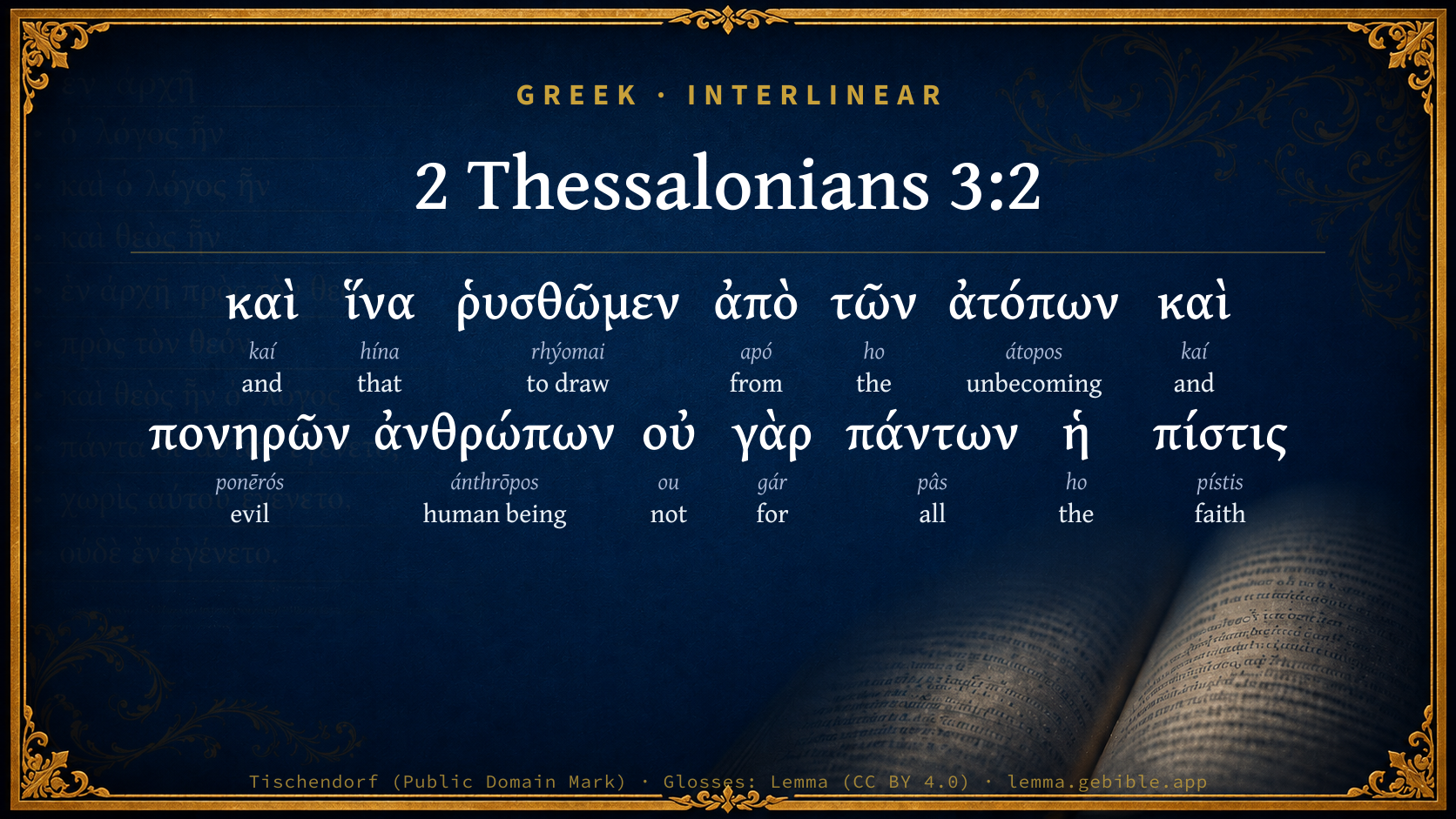
Greek (Tischendorf 8th ed.) 2 Thessalonians 3:2 appears in the Greek New Testament. The text above is from the Tischendorf 8th edition. Each word links to its Strong’s number and a concise gloss. Click any word for its full Thayer’s Greek Lexicon entry.
Download image
Cite this verse

2 Thessalonians 3:2 (World English Bible). Public Domain. Lemma interlinear Bible study tool, https://lemma.gebible.app/v/2-thessalonians/3/2.

Show BibTeX & RIS
BibTeX
RIS
English Translation
and that we may be delivered from unreasonable and evil men; for not all have faith.
World English Bible · Public Domain
Download a study sheet

One document with this verse’s original text, its word-by-word gloss line, the meaning frame, cross-references with their text, attributed commentary, and full source and license credits — printable, and it pastes into notes with its structure intact.

This verse Autodidact and up

Study sheet (.html) Plain text (.txt)

A passage Seminary Student

Up to 50 verses in one chapter. A passage sheet keeps up to 6 commentary sources and 12 cross-references per verse, in the order this page ranks them, and says so on the sheet whenever that leaves anything out. Ask for a single verse and you get the Autodidact verse sheet above.

Everything on this page stays free to read, with no account — the sheet is a download of what is already on screen, not access to it.

Want to remove ads? Support Godless Engineer
Compare translations 3

The same verse in 3 English versions, stacked beneath the original-language interlinear above. Click any original word for its lexicon entry.

Each is an independent rendering of the whole verse — the interlinear is not word-aligned to these translations.

Highlighted words mark where these versions differ — a whole-verse word diff, not a word-by-word alignment.

  • World English Bible Public Domain
    and that we may be delivered from unreasonable and evil men; for not all have faith.
  • King James Version Public Domain
    And that we may be delivered from unreasonable and wicked men: for all men have not faith.
  • unfoldingWord Literal Text CC BY-SA 4.0
    and so that we might be rescued from the perverse and evil men, for not everyone the faith.

unfoldingWord Literal Text — © unfoldingWord, licensed CC BY-SA 4.0. Word-aligned USFM3 via Door43 (git.door43.org/unfoldingWord/en_ult).

Versions to compare (up to 4)

3 of 4 selected

Show all 19 translations

Every available English version of this verse, each an independent rendering of the whole verse.

  • World English Bible Public Domain
    and that we may be delivered from unreasonable and evil men; for not all have faith.
  • Berean Standard Bible Public Domain
    And pray that we may be delivered from wicked and evil men; for not everyone holds to the faith.
  • Majority Standard Bible Public Domain
    And pray that we may be delivered from wicked and evil men; for not everyone holds to the faith.
  • King James Version Public Domain
    And that we may be delivered from unreasonable and wicked men: for all men have not faith.
  • American Standard Version (1901) Public Domain
    and that we may be delivered from unreasonable and evil men; for all have not faith.
  • Revised Version (1885) Public Domain
    and that we may be delivered from unreasonable and evil men; for all have not faith.
  • Geneva Bible (1599) Public Domain
    And that we may be deliuered from vnreasonable and euill men: for all men haue not fayth.
  • Douay-Rheims (1899) Public Domain
    And that we may be delivered from importunate and evil men; for all men have not faith.
  • Young's Literal Translation Public Domain
    and that we may be delivered from the unreasonable and evil men, for the faith `is' not of all;
  • Literal Standard Version CC BY-SA 4.0
    and that we may be delivered from the unreasonable and evil men, for not all [are] of the faith;
  • Unlocked Literal Bible CC BY-SA 4.0
    Pray that we may be delivered from wicked and evil people, for not all have faith.
  • unfoldingWord Literal Text CC BY-SA 4.0
    and so that we might be rescued from the perverse and evil men, for not everyone the faith.
  • Darby Bible Public Domain
    and that we may be delivered from bad and evil men, for faith [is] not [the portion] of all.
  • World Messianic Bible Public Domain
    and that we may be delivered from unreasonable and evil men; for not all have faith.
  • Webster's Bible Public Domain
    And that we may be delivered from unreasonable and wicked men: for all men have not faith.
  • Free Bible Version CC BY-SA 4.0
    and that we may be kept safe from immoral and evil men, because not everyone trusts in God.
  • Bible in Basic English Public Domain
    And that we may be made free from foolish and evil men; for not all have faith.
  • Text-Critical English NT CC BY 4.0
    And pray that we may be rescued from deviant and evil men, for not all have faith.
  • Tyndale New Testament (1534) Public Domain
    and that we maye be delivered from vnresonable and evyll men. For all men have not fayth:

Literal Standard Version (2020), Covenant Press — licensed CC BY-SA 4.0. Text via the HelloAO Bible API (eBible.org). Unlocked Literal Bible (unfoldingWord) — licensed CC BY-SA 4.0. Text via the HelloAO Bible API (eBible.org). unfoldingWord Literal Text — © unfoldingWord, licensed CC BY-SA 4.0. Word-aligned USFM3 via Door43 (git.door43.org/unfoldingWord/en_ult). Free Bible Version, Dr. Jonathan Gallagher — licensed CC BY-SA 4.0. Text via the HelloAO Bible API (eBible.org).

Word by word

More ways to search: Search by grammar → Find every occurrence → Compare this word →

Practice this passage: Drill this verse → Learn its vocabulary →

About this verse

These counts appear in no published source. They are computed here, from the morphology-tagged text and Lemma’s own curated glosses. What Lemma adds →

14
words
12
distinct lemmas
Pauline Epistles
section

Notable vocabulary

The rarest word here is ἀτόπων unbecoming G824 — appearing just 4 times in the whole Greek New Testament.

Shared distinctive vocabulary

ἀτόπων unbecoming G824 occurs in 4 verses of the Greek New Testament. Also found in:

Repetition

Words recur within this verse:

Cross-references

16

Topical passages linked to 2 Thessalonians 3:2 in the Treasury of Scripture Knowledge — connected by theme and wording, ordered by reader-vote popularity; previews shown in the World English Bible.

  • 2 Corinthians 4:3–4 Even if our Gospel is veiled, it is veiled in those who perish;
  • Romans 15:31 that I may be delivered from those who are disobedient in Judea, and that my service which I have for Jerusalem may be acceptable to the saints;
  • Deuteronomy 32:20 He said, I will hide my face from them, I will see what their end shall be: For they are a very perverse generation, Children in whom is no faithfulness.
  • Luke 18:8 I tell you that he will avenge them quickly. Nevertheless, when the Son of Man comes, will he find faith on the earth?"
  • Romans 10:16 But they didn't all listen to the glad news. For Isaiah says, "Lord, who has believed our report?"
  • 2 Corinthians 1:8–10 For we don't desire to have you uninformed, brothers, concerning our affliction which happened to us in Asia, that we were weighed down exceedingly, beyond our power, so much that we despaired even of life.
  • Matthew 23:23 "Woe to you, scribes and Pharisees, hypocrites! For you tithe mint, dill, and cumin, and have left undone the weightier matters of the law: justice, mercy, and faith. But you ought to have done these, and not to have left the other undone.
  • Acts 13:45 But when the Jews saw the multitudes, they were filled with jealousy, and contradicted the things which were spoken by Paul, and blasphemed.
  • Acts 28:24 Some believed the things which were spoken, and some disbelieved.
  • Matthew 17:17 Jesus answered, "Faithless and perverse generation! How long will I be with you? How long will I bear with you? Bring him here to me."
  • Acts 13:50 But the Jews stirred up the devout and prominent women and the chief men of the city, and stirred up a persecution against Paul and Barnabas, and threw them out of their borders.
  • Acts 14:2 But the disbelieving Jews stirred up and embittered the souls of the Gentiles against the brothers.
  • 1 Thessalonians 2:18 because we wanted to come to you--indeed, I, Paul, once and again-- but Satan hindered us.
  • John 2:23–25 Now when he was in Jerusalem at the Passover, during the feast, many believed in his name, observing his signs which he did.
  • Acts 17:5 But the unpersuaded Jews took along some wicked men from the marketplace, and gathering a crowd, set the city in an uproar. Assaulting the house of Jason, they sought to bring them out to the people.
  • 1 Corinthians 15:32 If I fought with animals at Ephesus for human purposes, what does it profit me? If the dead are not raised, then "let us eat and drink, for tomorrow we die."

Cross-references courtesy of OpenBible.info (CC BY 4.0).

Commentary

Notes on 2 Thessalonians 3:2 from classic Christian and Jewish commentators (each source and its license shown beneath its notes). The classic Christian expositions comment on the surrounding passage and are grouped to its opening verse, so a note may address several verses; the Jewish commentaries on the Tanakh (Rashi and others) are per-verse, so they appear only where the commentator wrote on this verse.

Lemma curates 59 commentaries, every one of them public domain or Creative Commons licensed, each selected and text-cleaned for this edition rather than reprinted as found. About our sources →

The Biblical Illustrator

Joseph S. Exell

2Th_3:2

That we may be delivered from unreasonable and wicked men--The curious word rendered unreasonable is rendered amiss in Luk_23:41, wickedness in Act_25:5, harm in Act_28:6, occurring nowhere else in the New Testament.

It properly means something misplaced, hence extravagant, monstrous. Thus the dying robber says that our Lord has done nothing so monstrous as to deserve crucifixon; Festus ironically invites the priests to a serious journey to St. Pauls trial, if there be something so monstrous in him; the Maltese say that nothing so monstrous happened to him after all. So St. Paul wishes the Thessalonians to pray for his deliverance from those monstrous and depraved people. He is evidently meaning some particular foes whom he fears, for the original has the definite article. Who, then are those monstrous persons? If we turn to Act_18:6; Act_18:9; Act_18:12, and observe the circumstances under which the letter was written, we can hardly doubt that they are the unbelieving Jews of Corinth. From these Jews he was narrowly delivered. It was perhaps in direct answer to the prayers for which St. Paul here asks that he received the vision and assurances of our Lord, and that Gallio was moved to quash so abruptly the proceedings of the Jews. (Canon Mason.)

A marvellous deliverance

A worthy servant of God, pastor in one of the cantons of Switzerland, took a lively interest in a prisoner condemned to death. On the evening before the execution the pastor could not account for a strange repugnance to perform a duty that he had hitherto discharged without hesitation. A voice within him seemed to say, Do not go. Fearing to neglect a duty, he ran to the prison. Arrived at the gate, the same irresistible voice seemed to say to him, Do not enter. The pastor returned to his study, assured that he was obeying the will of Him whom he desired to serve. He afterwards learned that the prisoner had resolved to make a desperate effort to escape, and as soon as the pastor entered that day, to attack him, and then escape to some place of concealment. The unhappy prisoner, exasperated by disappointment, roared with anger. The gaoler, hearing an unaccountable noise, suddenly entered the cell. The condemned man, supposing this was his intended victim, threw himself, with the fury of despair, on the gaoler, and struck him on the head with his irons. The gaoler fell dead, while the prisoner ran towards the gate to escape, and was only secured after a terrible conflict. (J. L. Nye.)

God a protector

Some years ago, a band of missionaries in the Fiji Islands found their home surrounded by a troop of savages armed for battle. Being both unable and unwilling to fight, they shut their door and began to pray. Presently the howling of the savages ceased. Then one of the missionaries went out, and found only one savage there. Said the missionary: Where are your chiefs? They are gone. They heard you praying to your God; and they know yours is a strong God, and they are gone. The savages were right at last. God is a strong God; strong to help those who love Him--strong to punish His enemies.

All men have not faith--

Lacking the essential

I. What faith is.

1. It is taking God at His word. Noah did it about a thing unknown (Heb_11:7); Abraham did it about a thing unlikely (Heb_11:17-19); Moses did it about a thing untried (Heb_11:28).

2. It is trusting Jesus at His invitation. The Jews who had no faith, had no profit (Heb_4:2); Peter who had little faith, had little comfort (Mat_14:28; Mat_14:30-31); the woman of Canaan, who had great faith, had a great blessing (Mat_15:28); the centurion, who had most faith, had most honour (Mat_8:10). Trust your souls to Christs care (Act_7:59); trust your sins to Christs cleansing (1Pe_1:18-19); trust your life to Christs keeping (Col_3:3-4).

II. Whence faith comes.

1. From Gods grace (Eph_2:8; Rom_12:3).

2. From Gods Word (Rom_10:17; 2Ti_3:15).

3. From Gods working (1Jn_5:1; Col_2:12).

4. From mans heart (Rom_10:10; Rom_6:17).

III. How faith works.

1. It overcometh the world (1Jn_5:4).

2. It purifieth the heart (Act_15:8-9).

3. It worketh by love (Gal_5:6). Two great benefits come from faiths.

(1) the preciousness of Christ (1Pe_2:7);

(2) the blessedness of Christ (1Pe_1:8). (Archdeacon Richardson, M. A.)

The Biblical Illustrator, edited by Joseph S. Exell (c. 1880s–1900s) — public domain. Text from a community e-Sword module.

Tyndale Open Study Notes

Tyndale Open Resources

3:2 Paul, too, suffered for the Good News (2 Cor 6:5; 11:23-26; 1 Thes 2:2). His prayer to be rescued echoes Isa 25:4.

Tyndale Open Study Notes — © Tyndale Open Resources, licensed CC BY-SA 4.0. Text via the HelloAO Bible API.

Bengel's Gnomon

Johann Albrecht Bengel

2Th 3:2. Ἀτόπων) ἄτοπος, inept [liter, out of place], unreasonable.—οὐ πάντων, does not belong to all) Tapeinosis,[24] i.e. of fear. The Thessalonians, who had believed with great readiness, might easily suppose that all would be equally ready. Paul declares, from his own experience of the very reverse, that it was quite otherwise.—ἡ πίστις; faith) viz. in God through Christ. It is this alone that takes away τὸ ἄτοπον καὶ πονηρόν, what is inept [unreasonable] and wicked.

[24] Less said, than is to be understood. Append.—ED.

Bengel's Gnomon of the New Testament — English translation (T&T Clark, Edinburgh, 1860) — public domain. Text from a community e-Sword module.

Meyer's Critical & Exegetical Commentary

Heinrich August Wilhelm Meyer

2Th_3:2. In deliverance from his adversaries lay the condition that he, the apostle, could work the more effectively for the diffusion of the gospel. Theodoret: Διπλῆ μὲν ἡ αἴτησις εἶναι δοκεῖ, μία δὲ ὅμως ἐστίν· τῶν γὰρ πονηρῶν ἀνθρώπων ἡττωμένων, ἀκωλύτως καὶ ὁ τοῦ κηρύγματος συντρέχει λόγος.

ἄτοπος] is used of that which is not in its right place. Used of persons, it denotes one who does or says that which is inappropriate under the circumstances. Thus it is equivalent to ineptus (Cic. de orat. ii. 4). From propriety it passes to its wider ethical meaning, and is used of men who act contrary to human or divine laws. Thus it receives the general signification of bad or godless. See examples in Kypke, Observ. II. p. 145 f.; Loesner, and Wetstein.

But the Thessalonian Jews are not to be understood by the ἄτοποι καὶ πονηροὶ ἄνθρωποι, from whose persecution the apostle had already, at an earlier period, frequently suffered (so, as it would seem, Pelt), for their influence hardly extended to Corinth. Persons must be meant who were then present in Corinth itself. But we are not to think on Christians who were only so in name (Zwingli, Musculus, Hemming, Flatt, Schrader, and others), and particularly on false teachers among the Jewish Christians (Schott), but on fanatical Jews.[70] Comp. Act_18:6; Act_18:12 ff. That the adversaries of the apostle could not have been already Christians, follows from the inferential clause setting forth the naturalness of the existence of such people, οὐ γὰρ πάντων ἡ πίστις, for faith is not an affair of all, i.e. it finds not a place among all, all have not a susceptible heart for it. On the form of the expression, compare the well-known proverb: Οὐ παντὸς ἀνδρὸς ἐς Κόρινθόν ἐσθʼ ὁ πλοῦς (Strabo, viii. 6. 20, ed. Siebenk.; Suidas, T. 2, p. 739.)

ἡ πίστις] on account of the article, can only denote the Christian faith simply and generally. To understand the expression of fidelity or honesty, with Schoettgen, Moldenhauer, Koppe, Bolten, Krause, Flatt, and others, is as incorrect as to interpret it of true faith, with Schott. For in the first case οὐ γὰρ πάντες πιστοί would require to have been written, and in the second case οὐ γὰρ πάντων ἡ πίστις ἀληθής.

[70] Hammond also finds here another reference to the Gnostics!

Meyer — Critical and Exegetical Commentary on the New Testament — English translation by Peter Christie, edited by Frederick Crombie (T&T Clark, 1880) — public domain. Text from a community e-Sword module.

Geneva Bible (1599)

Geneva Bible translators

Which have no care of their duty.

It is no marvel that the Gospel is hated of so many, seeing that faith is a rare gift of God. Notwithstanding, the Church shall never be destroyed by the multitude of the wicked, because it is grounded and stayed upon the faithful promise of God.

Geneva Bible (1599) marginal notes — public domain. Text via Bolls.life.

Jamieson, Fausset & Brown

Robert Jamieson, A. R. Fausset & David Brown

that we . . . be delivered from unreasonable . . . men--literally, men out of place, inept, unseemly: out of the way bad: more than ordinarily bad. An undesigned coincidence with Act 18:5-9. Paul was now at Corinth, where the JEWS "opposed themselves" to his preaching: in answer to his prayers and those of his converts at Thessalonica and elsewhere, "the Lord, in vision," assured him of exemption from "the hurt," and of success in bringing in "much people." On the unreasonable, out-of-the way perversity of the Jews, as known to the Thessalonians, see Th1 2:15-16.

have not faith--or as Greek, "the faith" of the Christian: the only antidote to what is "unreasonable and wicked." The Thessalonians, from their ready acceptance of the Gospel (Th1 1:5-6), might think "all" would similarly receive it; but the Jews were far from having such a readiness to believe the truth.

Jamieson, Fausset & Brown — Commentary Critical and Explanatory on the Whole Bible (1871) — public domain (CC PDM 1.0). Text via the HelloAO Bible API.

Adam Clarke's Commentary

Verse 2. Unreasonable and wicked men] The word ατοπων, which we translate unreasonable, signifies rather disorderly, unmanageable; persons out of their place-under no discipline, regardless of law and restraint, and ever acting agreeably to the disorderly and unreasonable impulse of their own minds.

For all men have not faith.] The word πιστις is without doubt, to be taken here for fidelity or trustworthiness, and not for faith; and this is agreeable to the meaning given to it in the very next verse: But the Lord is faithful, πιστος δε εστιν ὁ Κυριος.

There are many, even of those who have received a measure of the Divine light, in whom we cannot confide; they are irregular, disorderly, and cannot be brought under regular discipline: to these we cannot trust either ourselves or any thing that concerns the cause of God. But the Lord is worthy of your whole confidence; doubt him not; he will establish you, and keep you from any evil to which you may be exposed by these or such like persons.

Adam Clarke's Commentary on the Bible (1810–1826) — public domain. Text from a community e-Sword/MySword module.

John Calvin's Commentaries

2 That we may be delivered. The old interpreter has rendered it, not unhappily, in my opinion — unreasonable Now, by this term, as also by that which immediately follows, (τῶν πονηρῶν,) evil, Paul means wicked and treacherous men, who lurked in the Church, under the name of Christians, or at least Jews, who with a mad zeal for the law furiously persecuted the gospel. He knew, however, how much danger impended over them from both these classes. Chrysostom, however, thinks that those only are meant who maliciously oppose the gospel by base doctrines, — not by weapons of violence, as for example, Alexander, Hymeneus, and the like; but for my part, I extend it generally to all kinds of dangers and enemies. He was at that time proceeding towards Jerusalem, and wrote in the midst of his journeyings. Now, he had already been divinely forewarned that imprisonments and persecutions awaited him there. (Acts 20:23.) He means, however, deliverance, so that he may come off victorious, whether by life or by death.

All have not faith. This might be explained to mean, “Faith is not in all.” This expression, however, were both ambiguous and more obscure. Let us therefore retain Paul’s words, by which he intimates that faith is a gift of God that is too rare to be found in all. God, therefore, calls many who do not come to him by faith. Many pretend to come to him, who have their heart at the farthest distance from him. Farther, he does not speak of all indiscriminately, but merely animadverts upon those that belong to the Church: for the Thessalonians saw that very many held faith in abhorrence; nay, they saw how small was the number of believers. Hence it would have been unnecessary to say this as to strangers; but Paul simply says that all that make a profession of faith are not such in reality. Should you take in all Jews, they appeared to have nearness to Christ, for they ought to have recognized him by means of the law and the prophets. Paul, there can be no question specially marks out those with whom he would have to do. Now, it is probable that they were those who, while they had the appearance and honorary title of piety, were nevertheless very far from the reality. From this came the conflict.

With the view of shewing, therefore, that it was not groundlessly, or without good reason, that he dreaded contests with wicked and perverse men, he says that faith is not common to all, because the wicked and reprobate are always mixed with the good, as tares are with the good wheat. (Matthew 13:25.) And this ought to be remembered by us whenever we have annoyance given us by wicked persons, who nevertheless desire to be reckoned as belonging to the society of Christians — that all men have not faith. Nay more, when we hear in some instances that the Church is disturbed by base factions, let this be a shield to us against offenses of this nature; for we shall not merely inflict injury upon pious teachers, if we have doubts as to their fidelity, whenever domestic enemies do them harm, but our faith will from time to time waver, unless we keep in mind that among those who boast of the name of Christians there are many that are treacherous.

John Calvin's Commentaries (1540-1563) — public domain. Text from the Calvin Translation Society English edition (1840s-50s) via the Christian Classics Ethereal Library (ccel.org). Calvin's coverage is partial (roughly two-thirds of the Bible); uncommented books and verses are honest gaps, never fabricated. The 19th-century editor's footnotes and remarks are omitted so the notes are faithfully Calvin's own voice.

Ellicott's Commentary for English Readers

(2) And that we may be delivered.—Compare Rom_15:31. This clause is an amplification of the word “may run along:” the impediments to the gospel progress were (except that all were overruled for good) such persecutions as these. St. Paul gives thanks for such deliverances in 2Co_1:10; 2Ti_3:11; 2Ti_4:17. Perhaps (as St. Chrysostom suggests) one reason for here inviting their prayers for himself was to nerve the Thessalonians by the sense that they were not the only people in the world in danger.

From unreasonable and wicked men.—The curious word rendered “unreasonable” is rendered “amiss” in Luk_23:41, “wickedness” in Act_25:5, “harm” in Act_28:6, occurring nowhere else in the New Testament. It properly means something “misplaced” hence “extravagant,” “monstrous.” Thus the dying robber says that our Lord had done “nothing so monstrous” as to deserve crucifixion; Festus ironically invites the priests to a serious journey to St. Paul’s trial, “if there be something so monstrous in him;” the Maltese barbarians “saw that nothing so monstrous happened to him after all.” So St. Paul wishes the Thessalonians to pray for his deliverance “from these monstrous and depraved people.” He is evidently meaning some particular foes whom he fears, for the original has the definite article. Who, then, are “these monstrous persons?” If we turn to Act_18:6; Act_18:9; Act_18:12, and observe the circumstances in which the letter was written, we can hardly doubt that they are the unbelieving Jews of Corinth. From these Jews he was, though narrowly, delivered. It was, perhaps, in direct answer to the prayers for which St. Paul here asks that he received the vision and assurances of our Lord, and that Gallio was moved to quash so abruptly the proceedings of the Jews.

For all men have not faith.—This clause gives the reason for the alarm implied in the last clause: “Do not be surprised at my needing help against bad men; for you know that it is not every one that believes.” There is something a little scornful and embittered in the expression (recalling the invective against the same people in 1Th_2:15-16), for it suggests the thought that nothing better was to be expected from such a set of unconverted Jews. Tacitly, also, the unbelieving Corinthians are contrasted with the Thessalonians who had so readily embraced the truth. It may, however, be doubted whether this sentence is not an instance of a common Hebrew idiom, occurring more than twenty times in the Greek Testament, by which the combination of “all” and “not” amounts to “not any.” Thus, “all flesh shall not be justified,” in Rom_3:20, is rendered “no flesh shall be justified;” “they are not all of us,” in 1Jn_2:19, means “not one of them is of us.” So here it may be, “for there is not one of them that believes;” and so also, again speaking of the Jews, in Rom_10:16, “they did not all obey” may mean “none of them obeyed”—a rhetorical exaggeration, which the writer proceeds to justify by the exhaustive question from Isaiah.

A Bible Commentary for English Readers, edited by Charles John Ellicott (1878–1897) — public domain. Text from a community e-Sword module.

The Cambridge Bible for Schools and Colleges

gen. ed. J. J. S. Perowne

2. and (pray) that we may be delivered from unreasonable and wicked men] Better, perverse and evil men. The Apostle is thinking, no doubt, of the fanatical Jews at Corinth (see Act_18:5-17), who stood in the way of the Gospel; when Gallio’s judgement removed this obstacle, Christianity appears to have spread rapidly in this city. Comp. Rom_15:31, “that I may be delivered from the disobedient in Judæa.” From Ephesus four years later he writes (1Co_16:9), “A great and effectual door is opened” to me, notwithstanding “many adversaries.” Through this open door the word gloriously ran; at Corinth it was not so as yet.

For “wicked” (or “evil”), see notes on 1Th_5:22, and also 2Th_3:3 below. For “delivered” (or rescued) comp. 1Th_1:10 (note), where the same word is used. It points to enemies who seemed to have the writer in their power. Read 2Co_11:23-33 for a graphic description of the Apostle’s perils.

for all men have not faith] Or, not to all does the faith belong. There are those, alas, with “no part nor lot in the matter” (Act_8:21). The Apostle puts his meaning in a pathetically veiled and softened way (see note on “not pleasing,” 1Th_2:15). “It is not all who share our faith: many are its enemies, and bear us on its account a deadly hatred. Will you pray that we may be delivered from their power?” Their unbelief in Christ made the Corinthian opposers “perverse and evil.” Not being for Him, they came to be furiously against Him (Mat_12:30). This is enough, in the Apostle’s view, to explain their conduct; comp. 2Th_3:10, “they received not the love of the truth, that they might be saved.”

With relief he turns from these perverse unbelievers to think of the safety and confidence that abide within the Church of Christ:—

The Cambridge Bible for Schools and Colleges (gen. ed. J. J. S. Perowne; Cambridge University Press, 1878–1918) — public domain. Text from a community e-Sword module.

John Gill's Exposition

And that we may be delivered from unreasonable and wicked men,.... Either from the unbelieving Jews, see Rom 15:30 who were the avowed enemies of the Gospel, and did all they could to hinder the spread of it; and who were the implacable and constant adversaries of the apostle; who often lay in wait for him, and opposed him, and gave him trouble in all places, stirring up the people against him: or from the false teachers, and those of their party, who are the false brethren by whom he often was in perils; who were enemies of the cross of Christ, and great hindrances to the spread of the Gospel; being men of absurd principles, and of wicked lives and conversations, whereby they perverted the Gospel of Christ, brought a reproach upon it, stumbled some, and overthrew the faith of others; and from these the apostle desires to be delivered:

for all men have not faith: no man has faith of himself, it is the gift of God, and the operation of his Spirit; and it is only given to the elect of God, who are ordained unto eternal life, and therefore it is called the faith of God's elect; all mankind have it not, none but Christ's sheep; and the reason why others have it not is, because they are not of his sheep. This is a truth; but rather the true sense of the words is, that all that are professors of religion, and members of churches, and even all that are preachers of the word, have not faith. They may have an historical and temporary faith and the faith of miracles, and even all faith but the true faith; they may profess to believe, and yet not believe, as Simon Magus, and his followers seem to be intended here; for this is given as a reason why the apostle desired to be delivered from the above men. The Jews say (o), that

"he that studies not in the law, , "there is no faith in him"--and it is forbidden to come near him, or to trade with him, or to walk with him, "because there is no faith in him".''

The apostle seems to allude to this custom.

(o) Zohar in Lev. fol. 33. 2.

John Gill's Exposition of the Whole Bible (1746–1763) — public domain (CC PDM 1.0). Text via the HelloAO Bible API.

Trapp's Complete Commentary

John Trapp

2 And that we may be delivered from unreasonable and wicked men: for all men have not faith.

Ver. 2. From unreasonable] ατοπων, men compact of mere incongruities, solecising in opinion, speeches, actions.

For all men have not faith] And are therefore unreasonable; nothing is more irrational than irreligion. An unbeliever is no better (but in some respects worse) than a beast; a brutish person skilful to destroy, Eze 21:31.

John Trapp, A Commentary or Exposition upon All the Books of the Old and New Testament (1647–1656) — public domain. Text from a community e-Sword module.

Albert Barnes' Notes on the Bible

And that we may be delivered from unreasonable and wicked men - That is, from opposition in their endeavors to spread the gospel. Paul encountered such men everywhere, as all do who labor to diffuse the knowledge of the truth, but it is probable that there is particular reference here to the opposition which he encountered when in Corinth. This opposition arose mainly from the Jews; see Act 18:5-6, Act 18:12-13. The word “unreasonable” is rendered in the margin as “absurd.” The Greek word (ἀτόπος atopos) means, properly, “out of place;” then “absurd, unusual, strange; then improper, unreasonable, wicked.” It is rendered in Luk 23:41 as “amiss;” in Act 28:6 as “harm.” It does not occur elsewhere in the New Testament. It refers here to people who acted amiss or improperly; people who were not found in the right place, or who did not have the right views of things; and probably does not refer so much to their being positively wicked or malicious, as “to their putting things out of their proper place.”

They gave an undue prominence to certain things, and less importance to others than they deserved. They had a distorted vision of the value of objects, and in tenacious adherence to their own views, and prosecuting their own objects to the exclusion of all others, they presented a constant obstruction to the true gospel. This word would apply, and probably was designed to be applied, to Jewish teachers (see Act 18:5-6), who gave an undue prominence to the laws of Moses; but it will apply well to all who entertain distorted views of the relative importance of objects, and who put things out of their place. People often have a hobby. They give more importance to some object than it deserves. They, therefore, undervalue other objects; press their own with improper zeal; denounce others who do not feel the same interest in them which they do; withdraw from those who will not go with them in their views; form separate parties, and thus throw themselves in the way of all who are endeavoring to do good in some other method. It was from people who thus put themselves out of place, that the apostle prayed to be delivered.

And wicked men - Men with bad aims and purposes. It is not always true that those who would come under the appellation of what the apostle here calls “unreasonable,” are wicked. They are sometimes well-meaning, but misguided people. But in this case, it seems, they were men of bad character, who were at heart opposed to what was good, as well as inclined to put things out of their place.

For all men have not faith - Of the truth of this, no one can doubt. The only question is, as to its bearing on the case before us. Some suppose it means, “there are few men whom we can safely trust;” others, that it means that they have not that “upright and candid disposition which would engage men to receive the testimony of the apostles” (Doddridge); others, that “all men do not embrace the Christian faith, but many oppose it” (Benson); and others, that “all men do not believe, but the worthy only” - Bloomfield. The connection seems to require us to understand it as meaning that all people are not prepared to embrace the gospel. Hence, they set themselves against it, and from such people Paul prayed that he might be delivered; compare 2Ti 3:8. The state of mind in which the apostle was when he wrote this, seems to have been this: He recollected the readiness with which the Thessalonians had embraced the gospel, and the firmness with which they held it, and seems to suppose that they would imagine the same thing must be found true everywhere. But he says all people have not the same faith; all were not prepared cordially and fully to embrace the gospel. There were unreasonable and wicked people whom he had encountered, from whom he prayed that he might be delivered.

Albert Barnes' Notes on the Bible (1834–1885) — public domain. Text from a community e-Sword/MySword module.

Haydock's Catholic Bible Commentary

From troublesome, or importunate men. In the Greek, is signified men who act unreasonably, absurdly, &c. (Witham) --- For all men have not faith. Faith is a gift of God, which he is not obliged to give but to whom he will. St. Paul here assures us that he finds nothing but obstacles in his great work, nothing but enemies of the truth, and nothing but men who resist the inspirations and calls of God, opposing the preaching of the gospel. He exhorts them not to be scandalized at what they see him suffer, but to return thanks to God, who has vouchsafed to call them, giving them an understanding and docile heart. (Calmet)

George Leo Haydock (1774–1849), Haydock's Catholic Family Bible and Commentary, 1859 edition — public domain. Excludes Psalms (Douay-Rheims chapter numbering differs from Protestant) and Deuterocanonical books (Catholic canon only).

Matthew Poole's English Annotations

Their prayers are here desired by the apostle with respect to their persons, which relates to the prayer desired before with respect to the word; for the apostle and his fellow labourers met with such men that did oppose them, and by that means were hindered in their work of the ministry, and the free course of the word obstructed. What were these men? Were they the persecuting Gentiles? They met with such: or the envious, malicious Jews? They met with such also; and here at Thessalonica in particular, and which followed Paul to Berea, Act 17:1-34. Or were they false brethren crept into the church? As he complains of his perils by them, 2Co 11:26; which some think most probable, by what he adds, for all men have not faith, even of those that make profession. Why may not we take in all these? But whoever they were, he styles them, first,

unreasonable men, men out of place, as the word imports; taken either literally, for vagrants, wanderers, not keepers at home; or such as follow the apostle from place to place, to hinder his ministry. Or logically, for men that argued absurdly, and kept to no sound topics in reasoning; either false teachers among the Jews, or the heathen philosophers, such as he met with at Athens, whom he disputed with Act 17:1-34. Or morally, for men that had corrupt principles and practices, that kept not to the duty of their place and station, (desordonnez, French translation), and wandered out of the path of righteousness. We render it unreasonble men; men transported with fury and passion against all reason, as we read of the Jews, Act 17:5. Or such as acted contrary to reason, as the apostle speaks of such Jews in the former Epistle, who were contrary to all men, foridding them to preach to the Gentiles, that they might be saved, 1Th 2:15,16. Or men of sensual lives, living more like brutes than reasonable creatures. Secondly,

wicked men; so that whoever they were, whether Jews or Gentiles, teachers or the common people, learned or unlearned, they were wicked; and whatever was meant by the former word, yet this is plain; and the word imports either men that are laborious in wickedness, or that by their wickedness create labour and trouble to others. And such the apostle met with at Thessalonica, Jews who took to them certain lewd fellows of the baser sort, and drew Jason and others before the rulers, assaulting his house, Act 17:5,6; and indeed wherever they came, they met with such kind of men. Through the lusts of men’s hearts, and the enmity and malice of the devil, faithful ministers will meet with opposition, and such as will hinder what they can the free course of the word. And therefore the apostle desires prayer to be delivered from them, ινα ρυσθωμεν, the word signifies a rescue by strength from some impending or incumbent evil, oft used, Luk 1:74; Col 1:13; 1Th 1:10. And he desires deliverance rather for the gospel’s sake than his own. And though it is honourable to suffer for the gospel, yet it is desirable to be kept out of the hands of such men as these. The apostle subjoins the reason why men are thus,

for all men have not faith. He needed not say this of infidels, which all men know to be without it, and therefore it is thought the apostle here means professors. There may be true faith wanting where faith is professed. Faith is sometimes taken for fidelity, a moral virtue, and some think is meant here, because it follows in the next verse by way of antithesis: But the Lord is faithful. But rather, I take it for a theological grace; for that true evangelical faith which purifies the heart, and worketh by love, and brings forth the acts of obedience to all God’s commandments. Had they this faith they would not be unreasonable and wicked. But can we suppose such to be in the church? As well as those, 2Ti 3:5, whom the apostle describes to have a form of godliness under all that wickedness he there mentions. But let men have civility, sobriety, external devotion, and profession, yet if they oppose the gospel, in the power, purity, and progress of it, they may be styled unreasonable and wicked men; and from such men we may pray, as the apostle desired here: Good Lord, deliver us. And it is the duty of people with respect to their faithful ministers, and the work of the gospel in their hands, to pray that they may be delivered from such men.

Matthew Poole's English Annotations on the Holy Bible (1683–1685) — public domain. Text from a community e-Sword/MySword module.

Whedon's Commentary on the Bible

Daniel D. Whedon

2. Delivered from—The great impediment to the free course of the word.

Unreasonable—The word means, etymologically, out of place; and hence, as an adjective signifies, unsuitable, unfitting. In Luk_23:41 it is rendered “amiss;” in Act_28:6 it is rendered “harm,” meaning harmful. At this time of writing at Corinth, probably St. Paul was being harassed by the unbelieving Jews, who raised an “insurrection,” and arraigned him before Gallic, (Act_18:12-17,) and it is very possible that it is to them he here alluded.

All… not faith—Why state so obvious a fact as that all men are not Christians in faith? To obviate this difficulty some commentators understand by faith, fidelity, good faith, sincerity. And such meaning it has in Mat_23:23, and Tit_2:10. This is strongly favoured by the apparently antithetic word faithful in next verse, and in have confidence, in 2Th_3:4. Let us suppose that the unsuitable and evil men were unreliable professors of Christianity, “false brethren,” who were out of place in Christian communion, and we get a very consistent train of thought. Pray deliverance from untrusty adherents, (who prevent the gospel’s being glorified,) for not all prove faithful; yet faithful is the Lord, and we have faith through him in you. This seems better than Lunemann’s (followed by Alford) interpretation of faith as receptive predisposition. Every other interpretation than ours reduces the antithesis between faith and faithful to one of “sound,” (Alford,) and does not notice the confidence of 2Th_3:4 at all.

Daniel D. Whedon (gen. ed.), Commentary on the Old and New Testaments (1874–1909) — public domain. Text from a community e-Sword module.

The Pulpit Commentary

And that; a further addition to the prayer. We; either I Paul, or else Paul and Silas and Timothy. May be delivered; not may "come off victorious whether by life or death" (Calvin), but may be rescued from our enemies. Jowett observes that we have here the shrinking of the flesh from the dangers which awaited the apostle. But there is no trace of cowardice in these words; the apostle desires deliverance, not for his own sake, but for the sake of the free diffusion of the gospel. From unreasonable; a word whose original meaning is "out of place;" then used in an ethical sense, "wicked," "absurd," "unreasonable;" perhaps here applied to persons who will not listen to arguments. And wicked men. By these unreasonable and wicked men are not to be understood the Jews of Thessalonica, from whom Paul formerly suffered, for their influence would hardly extend to Corinth; nor Christians who were only so in name (Calvin), and specially the Judaizing Christians, for there is no allusion as vet to their attacks upon the apostle; but the fanatical and unbelieving Jews at Corinth. (see Act_18:12) For all men have not faith; or, the faith; the faith is not the possession of all. Faith here is the Christian faith: all men have not received it obviously alluding to the unbelieving Jews. The words cannot mean, all men have not the true faith referring to pretended Christians false brethren, but secret enemies (Calvin). Nor is it to be rendered "all men have not the capacity of faith." Others understand by faith that upright and candid disposition which would engage men to receive the testimony of the apostle; and others fidelity, as if the apostle meant, "There are few men whom we can trust."

The Pulpit Commentary (1880–1919), ed. H.D.M. Spence-Jones & Joseph S. Exell — public domain. Text from a community e-Sword module.

John Wesley's Explanatory Notes

All men have not faith - And all men who have not are more or less unreasonable and wicked men.

John Wesley, Explanatory Notes Upon the Whole Bible (1754–1765) — public domain. Text via the GEBible commentary corpus.

Burkitt's Expository Notes on the New Testament

William Burkitt

In the former verse, St. Paul desired the Thessalonians’ prayers with reference to the word; here he requests it with relation to himself, that his person might be preserved, as well as his preaching prosper; that so long as God had any work for him to do, he might be preserved from the rage and fury of the unbelieving Jews, and persecuting Gentiles, who followed him from place to place, to give him trouble: That we may be delivered from unreasonable and wicked men.

Where note, The odious character with which the apostle brands the enemies of his ministry; he calls them unreasonable men, whom no reason or argument could convince and satisfy; and wicked men, of vicious lives and debauched practices: they are usually the vilest and worst of men, the very dregs of mankind, who set themselves to persecute the preachers, and oppose the preaching of the gospel.

Next, he subjoins a reason why he did so earnestly desire their prayers for deliverance from dangers: because all men have not faith, neither fidelity, nor faithfulness, much less sincere faith in our Lord Jesus Christ; for then they would not oppose his gospel, nor persecute us from place to place, for the plain and persuasive preaching of it.

Where note, That what profession soever a person makes of godliness and religion, and how high soever his pretences are of external devotion, yet if he opposes the gospel, in the power, purity, and progress of it, he is and may be deservedly styled, an unreasonable and wicked man, who wants fidelity, moral honesty, and real virtue; and acts only for his own interest, and to please a party.

William Burkitt's Expository Notes on the New Testament (1700–1703) — public domain. Text from a community e-Sword module.

McGarvey & Pendleton's Commentaries

J. W. McGarvey

and that we may be delivered from unreasonable and evil men; for all have not faith . [i. e., all professed Christians are not really such. A phrase answering to that at Rom_9:6 ]

J. W. McGarvey (with Philip Y. Pendleton), Commentaries on the New Testament (The Fourfold Gospel, 1914; Acts; and the epistles) — public domain. Text from a community e-Sword/MySword module.

The People's New Testament

B. W. Johnson

2. That we may be delivered. That the wicked may not have power to prevent us from spreading the gospel. He is not moved by a desire to escape such hardships or dangers as these may cause, but by a desire that his work may move right on. All have not faith. In all ages the preaching of the gospel divides those who hear it into two classes, the believers and unbelievers.

B. W. Johnson's The People's New Testament with Notes (1889–1891) — public domain. Electronic text from the Christian Classics Ethereal Library (CCEL) ThML edition.

Cambridge Greek Testament for Schools and Colleges

2. καὶ ἵνα ῥυσθῶμεν ἀπὸ τῶν ἀτόπων καὶ πονηρῶν ἀνθρώπων, and that we may be delivered from the perverse and wicked men: the second object of the prayers solicited; διπλῆ μὲν ἡ αἴτησις εἶναι δοκεῖ, μία δὲ ὅμως ἐστίν· τῶν γὰρ πονηρῶν ἀνθρώπων ἡττωμένων, ἀκωλύτως καὶ ὁ τοῦ κηρύγματος συντρέχει λόγος (Chrysostom) Cf. Rom 15:31, ἵνα ῥυσθῶ ἀπὸ τῶν ἀπειθούντων κ.τ.λ., both passages recalling Isa 25:4, ἀπὸ ἀνθρώπων πονηρῶν ῥύσῃ αὐτούς. Τῶν points to a definite body, or class, of such men: these were, in chief, the Jewish enemies of the Gospel in Corinth, from the outset violent opponents of St Paul’s work (Act 18:6; Act 18:12-17), from whom the Apostles were in fact “delivered” by the sentence of the Proconsul Gallio. Of the same breed were the adversaries who in vain combated the progress of the Gospel in Macedonia (Act 17:5; Act 17:13; cf. 1Th 2:14-16, and notes).

Ἄ-τοπος is hap. leg. in N.T. as applied to persons; of things, Luk 23:41; Act 25:5; Act 28:6: it signifies place-less, out-of-the-way, out of court; and so eccentric, absurd, ineptus; then, in a moral sense, ill-bred or ill-conditioned, stupid, perverse, importunus (Vulg.)—the common meaning of ἄτοπος in later Greek (Lightfoot): cf. Demosthenes 439. 26, ἄτοποι καὶ δυσχερεῖς. For πονηρός, see note on 1Th 5:22; πονηροὶ ἄνθρωποι appear in 2Ti 3:13 in company with γόητες; see also note on ὁ πονηρός in next verse.

For ῥύομαι, see 1Th 1:10, and note; the word points to enemies who seemed to have the Apostles in their grasp: cf. also 2Ti 4:17; and the catalogue of perils in 2Co 11:23-33.

οὐ γὰρ πάντων ἡ πίστις, for not to all does the faith belong. Cf., for the form of the sentence, the proverb, Οὐ παντὸς ἀνδρὸς ἐς Κόρινθόν ἐσθʼ ὁ πλοῦς. This expression does not refer, like the similar denunciation of Act 8:21 ff., to pretended Christian believers, but to those “who do not obey the Gospel” and have become in consequence its bitter, unscrupulous opponents (2Th 1:6-10),—the ἄπιστοι of Corinth (2Co 4:4; 2Co 6:14 f.; 1Ti 5:8), and such as the ἀπειθοῦντες of Rom 15:31. Ἡ πίστις, in this context, signifies not the moral quality of faithfulness, fidelity (a very questionable sense for πίστις in the N.T.: cf. note on 2Th 1:4), but “the (Christian, true) faith”; cf. ἡ ἀλήθεια in 2Th 2:10, and the πίστις ἀληθείας of 2Th 2:13. The Apostles put their meaning in a pathetically softened way (cf. note on “not pleasing,” 1Th 2:15): “Alas, all do not share our faith (cf. Act 26:29); many are its enemies and bear us a fierce hatred on its account. Will you pray that we may be delivered from their power?” There is a like sad litotes in Rom 10:16: οὐ πάντες ὑπήκουσαν τῷ εὐαγγελίῳ. Their unbelief in Christ brought out the ἀτοπία and πονηρία of the Corinthian opposers, who “loved the darkness rather than the light, for their deeds were evil” (Joh 3:19): hence the explicative γάρ clause. Schmiedel gives a different explanation: “Only deliverance from them is to be prayed for, since their conversion is hopeless.” For the genitive of the possessor, with similar subject, cf. Act 1:7; Heb 5:14.

2Th 2:1-12.

A full account of the exegesis of 2Th 2:1-12 would embrace the history of the critical epochs and decisive conflicts of Christendom. This prophecy has constantly recurred to the mind of the Church and its meaning has been anxiously scanned in hours of trial. To such seasons, indeed, we should look for its interpretation. History is the expositor of prophecy. The seeds of the future lie in the past; and not the seeds alone, its buddings and forthputtings are there; for “that which is hath been already, and that which is to be hath already been.” “First the blade,” said Jesus, “then the ear, then the full corn in the ear.” The development of God’s kingdom, and of Satan’s, is in either case continuous until full ripeness. “Let both grow together until the harvest.”

It may be worth our while, therefore, to trace in its historical outline the development of the doctrine of Antichrist—as it appears in Scripture, and as it has been unfolded in the belief of the Church.

2. THE MESSIANIC TIMES AND JEWISH APOCALYPTIC

Antiochus Epiphanes[2], it is agreed, was the primary subject of the Visions of judgement on the great enemy of Israel contained in the Book of Daniel. In his overthrow, and in the Maccabean resurrection of the Jewish nationality, this Apocalypse received its proximate fulfilment. But when the period of the Maccabees was past and the nation fell again under a foreign yoke, while no further sign appeared of the Messiah, it was plain to believing readers that the revelation had some further import. In this faith the sufferings of the people of God under the Herodian and Roman oppression were endured, as “birthpangs of the Messiah”; it was felt that Israel’s hope was even at the doors.

[2] Antiochus IV., or Antiochus Epiphanes—i.e. the Illustrious or Manifest (scil. θεὸς ἐπιφανής), nicknamed Epimanes, the Madman—was the seventh king of the Græco-Syrian dynasty of the Seleucids, and reigned from 175 to 164 B.C. His father was Antiuochus III. (the Great), after whose defeat by the Romans in the year 188 he was given to them as a hostage, and brought up at Rome. He returned to take his father’s throne, full of wild ambition and of reckless impiety and prodigality. On the career of Antiochus IV., see Stanley’s History of the Jewsih Church, vol. III., Ewald’s History of Israel, vol. V. (Eng. Trans.); Smith’s, and Hastings’, Dict. of the Bible; Driver’s Daniel, Introd. § 2.

In this expectation the patriotism of Israel lived and glowed; it is vividly expressed in the extant Apocryphal literature of the pre-Christian times,—in the Sibylline Oracles; the Book of Enoch, ch. xc.; the Psalms of Solomon, especially 17, 18. Of less importance in this respect are the Assumption of Moses and the Book of Jubilees, contemporaneous with the Christian era. The 2nd (Latin 4th) Book of Esdras, and the kindred Apocalypse of Baruch, though dating probably from the close of the first century A.D., reflect the eschatology of Jewish nationalists during the struggle with Rome[3]. These witnesses confirm and illustrate the indications of the Gospels as to the keenness and intensity of the Messianic outlook at the time of the appearance of Jesus, and as to the political and materialistic nature of the popular ideal, which was animated by antipathy to Rome on the one side, and to sceptical or heretical movements within Judaism upon the other. Our Lord in assuming the title Son of Man appealed to, while He corrected, the anticipation of those who “looked for Israel’s redemption”—an expectation largely founded upon the Apocalypse of Daniel and coloured by its imagery. Before long, as He foretold, “the abomination of desolation, spoken of by Daniel the prophet,” would again “stand in the Holy Place”(Mat 24:15); thereafter “the sign of the Son of Man” would be “seen in heaven,” and at last the Son of Man Himself was destined to “come with the clouds of heaven” (Mat 24:30; Mat 26:64).

[3] See, on the whole subject, Schürer’s The Jewsih People in the Time of Christ (Eng. Tr.), Div. II. Vol. II. pp. 128 ff., The Messianic Hope.

The Messianic forecasts of our Lord’s time, being drawn from the above Danielic source, could not fail to bring along with them as their counterpart, and in their shadow, the image of Daniel’s Antichrist; it may be seen in the παράνομος-Βελίαρ of the Sibylline Oracles (cf. St Paul’s ὁ ἄνομος, and the Βελίαρ-Antichrist of 2Co 6:15). The direct evidence of this fact is only slight; the existence of the Jewish doctrine of Antichrist anterior to the Christian era depends for proof, as appears in M. Friedländer’s recent monograph on the subject (Der Antichrist in den vorchristlichen jüdischen Quellen), upon the data of the Midrash and Talmud, from which one has to argue back to antecedent times (see also Weber’s Jüdische Theologie, 4te Abtheilung). Bousset has however shown, by the researches summarized in his Essay on Antichrist,[4] that the roots of this conception run far back into esoteric pre-Christian Jewish teaching; and Gunkel, in his striking work, Schöpfung und Chaos in Urzeit und Endzeit, has even attempted to find its origin in primitive Babylonian cosmogony. This last theory would carry us into very distant and speculative regions. In later Judaism—certainly before the eighth century—Antichrist became a familiar figure under the name Armillus (?=Romulus: the designation is aimed at Rome, which was also cryptically known as Edom). Under this name he figures in the Jewish fables of the Middle Ages, in a variety of forms partly analogous and partly hostile to the Christian doctrine. “Armillus” appears in the Targum of Jonathan upon Isa 11:4, the passage quoted by the Apostle in 2Th 2:8: “With the breath of his lips shall he (Messiah) slay Armillus, the wicked one.” The currency of an archaic Jewish doctrine, or legend, of Antichrist makes it easier to understand the rapid development which this conception received in the New Testament, and the force with which it appealed to the mind of the Apostolic Church.

[4] Der Antichrisrt in der Ueberlieferung des Judentums, des neuen Testaments, und der alten Kirche (Göttingen, 1895). Following Gunkel, Bousset writes (p. 93): “In the literature of the O. T., and in some passages of the New, we find abundant traces of a primeval Dragon myth, which in later times took the form of an eschatological anticipation. There subsisted in popular Jewish belief the expectation, which can be recognized in the Apocalypse, of an uprising at the end of the days of the old Sea-monster with whom God strove in the creation, who will assault heaven in his war with God … the legend of Antichrist appears to me to be no more than an anthropomorphic recasting of this myth … The Dragon is replaced by the Man, armed with miraculous powers, who deifies himself. For the Jews, this personality was necessarily identical with the Pseudo-Messias.” See also Gunkel, op. cit., pp. 221 f.: “It is well known that Judaism expected a great and general apostasy in the last times. After the age of Daniel it was understood that this consummation of wickedness would incorporate itself in a man, who would want only assail everything holy, and even the temple of God in Jerudalem … The ἄνομος proclaims himself God, in the temple of God; and this deification of a man is the crowning sin which Judaism imputes to the kings of the Gentiles … The ἄνομος-prophecy of 2 Thessalonians is no arbitrary invention of an individual; it gives expression to a belief which had behind it a long historical development, and was at that time universally diffused.”

The words of Christ fixed the attention of His disciples upon the prophecies of Daniel, and supplied the ἀφορμή from which proceeded the revival of Old Testament Apocalypse in the prophecies of St Paul and St John, where this movement took a direction and an ethical character very different from that of non-Christian Judaism. Beside His express citations of Daniel, there were other traits in our Lord’s pictures of the Last Things—the predictions of national conflict, of persecutions from without and defections within His Church (Mat 24:3-13)—which reproduced the general characteristics of this prophet’s visions, and which lent emphasis to His specific and deliberate references thereto. The use made by Jesus Christ of this obscure and suspected Book of Scripture has raised it to high honour in the esteem of the Church.

Cambridge Greek Testament for Schools and Colleges (Cambridge University Press, 1896; 21 vols, various authors incl. Carr, Maclear, Plummer, Farrar, Lumby, Moule, M. R. James, Simcox) — public domain. Text from a community e-Sword module.

Alford’s Greek Testament

Henry Alford

2.] And in order for that to be the case,—that we may be free to preach it. On ἄτοπος, Lünem. says, “it is properly used of that which is not in its right place. When of persons, it designates one who does or says that which is inappropriate under the circumstances. Thus it answers to ineptus in Latin (Cic. de Orat. ii. 4). From ‘aptitude,’ it passes to its wider ethical meaning, and is used of men who act contrary to divine or human laws. Thus it gets the general signification of bad or ungodly. See examples in Kypke, Obss. ii. p. 145,—in Lösner and Wetst.” Who are these men? It is obvious that the key to the answer will be found in Act_18. They were the Jews at Corinth, who were at that time the especial adversaries of the Apostle and his preaching. And this is confirmed by the clause which he has added to account for their ἀτοπία and πονηρία:

οὐ γὰρ πάντων ἡ πίστις—for to all men the (Christian) faith does not belong—all men do not receive it—have no receptivity for it—obviously pointing at Jews by this description. It is more natural to understand the article here as definite, the faith, than as abstract: for faith, as such, would not bear much meaning here.

Henry Alford, The Greek Testament (1849–1861) — public domain. Text from a community e-Sword module.

International Critical Commentary

2. καὶ ἵνα ῥυσθῶμε. The ἵν (parallel to ἵν in v. 1) introduces the second object of προσεύχεσθ: “that we may be delivered.” The aorist (contrast the present tenses in v. 1) regards the action of deliverance simply as an event in the past without reference to progress. As in 2Co 1:11 where the prayer requested is for deliverance (ῥύεσθα) from the danger of death, and as in Rom 15:30 ff. where it is for deliverance from those that are disobedient in Judæa (ἵνα ῥυσθῶ ἀπὸ τῶν ἀπειθούντω), so here person and cause are inseparable.

τῶν ἀτόπων καὶ πονηρῶν ἀνθρώπω. “From those unrighteous and evil men.” The τῶ points to a definite class of adversaries (cf. Rom 15:31) and well known to the readers. That persecutions in Corinth are here referred to is likewise suggested by καὶ πάσχετ in 1:4; and that the Jews are the instigators of persecution is the natural inference both from οὐ γὰρ πάντων ἡ πίστι when compared with I 2:15-16, and from the typical instances recorded in Act 18:5 ff.

οὐ γὰρ πάντων ἡ πίστι. “For not for all is the faith”; “it is not everybody who is attracted by the faith” (Rutherford). “The faith” (Gal 1:23) is not “the word of the Lord” (v. 1), “the truth” (2:10, 12), or “the gospel” (cf. 2:14), but the faith which the gospel demands, the faith without which the gospel is not effective as the power of God unto salvation. The γά explains not the prayer for deliverance, as if “only deliverance from them is to be requested since their conversion is hopeless” (Schmiedel), but the reason why those unrighteous and evil men exist. The explanation is set forth not in terms of historical fact, “for not all have believed” (cf. Rom 10:16 οὐ πάντες ὑπήκουσαν τῷ εὐαγγελίῳ), but in terms of a general principle based on observation (ἐστί), which GF, et al., read, is to be supplied here as often elsewhere in Paul), “for not for all is the faith” (πάντω being either an objective or a possessive genitive; cf. Act 1:7, 2Co 2:3 Heb 5:14). In view of the fact that under similar circumstances Paul had expressed himself similarly as regards the conversion of the Jews (I 2:15-16) it is quite likely that here too, in spite of πάντω, he has in mind the obstinacy of the Jews. It was their rejection of Jesus as the Messiah that raised a serious problem not only for Paul (Rom. 9-11) but for others (Mar 4:10-12, Act 28:26 ff., Joh 12:37 ff.). Here, however, the mystery alone, not its solution, is stated.

ἄτοπο is used of persons only here in the Gk. Bib.; elsewhere, chiefly in Lk. Acts, Job, it is neuter; e. g. πράσσειν ἄτοπ (Job 27:6, Job 36:21) or ἄτοπο (Pr. 24:55, Pro 24:2 Mac. 14:23; cf. Luk 23:41) and ποιεῖν ἄτοπ (Job 34:12; cf. Polyc. Phil. 5:3). “From its original meaning ‘out of place,’ unbecoming,’ ἄτοπο came in late Greek to be used ethically = ‘improper,’ ‘unrighteous’; and it is in this sense that, with the exception of Act 28:6, it is always used in the Lxx and N. T.” (Milligan, Greek Papyri, 72). For other instances of the word, see Wetstein and Loesner, ad loc., and on Luk 23:41, and the former on Act 28:6. The prevailing ethical meaning makes unlikely the rendering “unbelieving” which the context might suggest (cf. I 2:16 θεῷ μὴ ἀρεσκόντω). For a conspectus of proposed translations such as “unreasonable,” “perverse,” “unrighteous” (Thayer), etc., see Lillie’s note; compare also Hatch-Redpath, Concordance, where under ἄτοπο in Job 36:21 both ἄδικ, and ἄνομ are noted as variants of ἄτοπ—On πονηρό see I 5:22; D in Luk 23:41 reads πονηρό for ἄτοπο On ῥύεσθαι ἀπο, see I 1:10.—Born (533), whom Wrede follows, finds an almost verbal dependence on Isa 25:4: ἀπὸ ἀνθρώπων ῥύσῃ αὐτού But Psa 139:1 would serve as well: ἐξελοῦ με κύριε ἐξ ἀνθρώπον πονηροῦ, ἀπὸ ἀνδρὸς ἀδίκου ῥῦσαί μ Dob. (cf. Harnack, op.cit.) sees a reference to 1 Mac. 14:14 where Simon ἑξῆρεν πάντα ἄνομον καὶ πονηρό; cf. Isa 9:17 πάντες ἄνομοι καὶ πονηροι However this may be, it is evident both that Paul read the Lxx and that the collocation ἄτοπος καὶ πονηρό is not found elsewhere in the Gk. Bib.

International Critical Commentary — older volumes (1896–1929), various authors — public domain. Text from a community e-Sword module.

Vincent's Word Studies in the New Testament

Marvin R. Vincent

Unreasonable [ατοπων] . See on Luk 23:41, and comp. Act 25:5; Act 28:6. In LXX in a moral sense, iniquitous, Job 4:8; Job 11:11; Job 34:12. The word originally means out of place.

All men have not faith. See on Act 6:7; Gal 1:28.

Marvin R. Vincent, Word Studies in the New Testament (1887–1900) — public domain. Text from a community e-Sword/MySword module.

Lesson kit

Teaching starters — assembled from the data on this page, not authored interpretation. Every prompt links to the verse data it draws on. Edit before teaching.

2 Thessalonians, in the Pauline Epistles, opens this verse with 14 words (12 distinct Greek lemmas). Its most distinctive word is átopos (“unbecoming”). A historical commentator’s framing appears above. Read the whole chapter for the surrounding context.

Discussion questions

  1. How does “unbecoming” (átopos) shape what this verse is saying?
  2. How does Luke 23:41, which shares the word «unbecoming», read alongside this verse?
  3. What does the repetition of “and” (2× in this one verse) do in this verse?
  4. These translations render this verse differently; the difference is in the English rendering, not the original. What questions does that raise?
  5. Compare how The Biblical Illustrator and Tyndale Open Study Notes read this verse. Where do they agree or differ?

Things to notice

Reading settings

Reading text

Shown beneath each verse's original-language words.

Old Testament
Old Testament edition

Read the OT as the Masoretic Hebrew (MT) or the Greek Septuagint (LXX).

English shown for the Greek Septuagint (in the Hebrew ↔ Greek comparison).

Comparing translations? Open the Compare panel on any verse page to stack up to four side by side.