Revelation 16:2

Greek (Tischendorf 8th ed.) Revelation 16:2 appears in the Greek New Testament. The text above is from the Tischendorf 8th edition. Each word links to its Strong’s number and a concise gloss. Click any word for its full Thayer’s Greek Lexicon entry.
Download image
Cite this verse

Revelation 16:2 (World English Bible). Public Domain. Lemma interlinear Bible study tool, https://lemma.gebible.app/v/revelation/16/2.

Show BibTeX & RIS
BibTeX
RIS
English Translation
The first went, and poured out his bowl into the earth, and it became a harmful and evil sore on the people who had the mark of the beast, and who worshiped his image.
World English Bible · Public Domain
Download a study sheet

One document with this verse’s original text, its word-by-word gloss line, the meaning frame, cross-references with their text, attributed commentary, and full source and license credits — printable, and it pastes into notes with its structure intact.

This verse Autodidact and up

Study sheet (.html) Plain text (.txt)

A passage Seminary Student

Up to 50 verses in one chapter. A passage sheet keeps up to 6 commentary sources and 12 cross-references per verse, in the order this page ranks them, and says so on the sheet whenever that leaves anything out. Ask for a single verse and you get the Autodidact verse sheet above.

Everything on this page stays free to read, with no account — the sheet is a download of what is already on screen, not access to it.

Want to remove ads? Support Godless Engineer
Compare translations 3

The same verse in 3 English versions, stacked beneath the original-language interlinear above. Click any original word for its lexicon entry.

Each is an independent rendering of the whole verse — the interlinear is not word-aligned to these translations.

Highlighted words mark where these versions differ — a whole-verse word diff, not a word-by-word alignment.

  • World English Bible Public Domain
    The first went, and poured out his bowl into the earth, and it became a harmful and evil sore on the people who had the mark of the beast, and who worshiped his image.
  • King James Version Public Domain
    And the first went, and poured out his vial upon the earth; and there fell a noisome and grievous sore upon the men which had the mark of the beast, and upon them which worshipped his image.
  • unfoldingWord Literal Text CC BY-SA 4.0
    And the first went and poured out his bowl on the earth, and a bad and harmful sore happened on the men having the mark of the beast and the ones worshiping its image.

unfoldingWord Literal Text — © unfoldingWord, licensed CC BY-SA 4.0. Word-aligned USFM3 via Door43 (git.door43.org/unfoldingWord/en_ult).

Versions to compare (up to 4)

3 of 4 selected

Show all 19 translations

Every available English version of this verse, each an independent rendering of the whole verse.

  • World English Bible Public Domain
    The first went, and poured out his bowl into the earth, and it became a harmful and evil sore on the people who had the mark of the beast, and who worshiped his image.
  • Berean Standard Bible Public Domain
    So the first angel went and poured out his bowl on the earth, and loathsome, malignant sores broke out on those who had the mark of the beast and worshiped its image.
  • Majority Standard Bible Public Domain
    So the first angel went and poured out his bowl on the earth, and loathsome, malignant sores broke out on those who had the mark of the beast and worshiped its image.
  • King James Version Public Domain
    And the first went, and poured out his vial upon the earth; and there fell a noisome and grievous sore upon the men which had the mark of the beast, and upon them which worshipped his image.
  • American Standard Version (1901) Public Domain
    And the first went, and poured out his bowl into the earth; and it became a noisome and grievous sore upon the men that had the mark of the beast, and that worshipped his image.
  • Revised Version (1885) Public Domain
    And the first went, and poured out his bowl into the earth; and it became a noisome and grievous sore upon the men which had the mark of the beast, and which worshipped his image.
  • Geneva Bible (1599) Public Domain
    And the first went and powred out his viall vpon the earth: and there fell a noysome, and a grieuous sore vpon the men, which had the marke of ye beast, and vpon them which worshipped his image.
  • Douay-Rheims (1899) Public Domain
    And the first went, and poured out his vial upon the earth, and there fell a sore and grievous wound upon men, who had the character of the beast; and upon them that adored the image thereof.
  • Young's Literal Translation Public Domain
    and the first did go away, and did pour out his vial upon the land, and there came a sore -- bad and grievous -- to men, those having the mark of the beast, and those bowing to his image.
  • Literal Standard Version CC BY-SA 4.0
    and the first went away, and poured out his bowl into the earth, and there came a sore—bad and grievous—to men, those having the mark of the beast, and those worshiping his image.
  • Unlocked Literal Bible CC BY-SA 4.0
    The first angel went and poured out his bowl on the earth; ugly and painful sores came on the people who had the mark of the beast, those who worshiped his image.
  • unfoldingWord Literal Text CC BY-SA 4.0
    And the first went and poured out his bowl on the earth, and a bad and harmful sore happened on the men having the mark of the beast and the ones worshiping its image.
  • Darby Bible Public Domain
    And the first went and poured out his bowl on the earth; and there came an evil and grievous sore upon the men that had the mark of the beast, and those who worshipped its image.
  • World Messianic Bible Public Domain
    The first went, and poured out his bowl into the earth, and it became a harmful and painful sore on the people who had the mark of the beast, and who worshiped his image.
  • Webster's Bible Public Domain
    And the first went, and poured out his vial upon the earth; and there fell a noisome and grievous sore upon the men who had the mark of the beast, and upon them who worshiped his image.
  • Free Bible Version CC BY-SA 4.0
    So the first angel went and poured out his bowl on the earth, and terrible, painful sores broke out on those who had the mark of the beast and who worshiped his image.
  • Bible in Basic English Public Domain
    And the first went, and let what was in his vessel come down on the earth; and it became an evil poisoning wound on the men who had the mark of the beast, and who gave worship to his image.
  • Text-Critical English NT CC BY 4.0
    So the first went and poured out his bowl on the earth. Then harmful and painful sores came upon the people who had the mark of the beast and who worshiped his image.
  • Tyndale New Testament (1534) Public Domain
    And the fyrst went and poured out his viall apon the erth and there fell anoysom and a sore botche apon the men which had the marke of the best and apon the which worshipped his ymage.

Literal Standard Version (2020), Covenant Press — licensed CC BY-SA 4.0. Text via the HelloAO Bible API (eBible.org). Unlocked Literal Bible (unfoldingWord) — licensed CC BY-SA 4.0. Text via the HelloAO Bible API (eBible.org). unfoldingWord Literal Text — © unfoldingWord, licensed CC BY-SA 4.0. Word-aligned USFM3 via Door43 (git.door43.org/unfoldingWord/en_ult). Free Bible Version, Dr. Jonathan Gallagher — licensed CC BY-SA 4.0. Text via the HelloAO Bible API (eBible.org).

Word by word

More ways to search: Search by grammar → Find every occurrence → Compare this word →

Practice this passage: Drill this verse → Learn its vocabulary →

ἕλκος
hélkos
G1668
“wound”
Noun, Nominative, Singular, Neuter
Part of Speech
Noun
Case
Nominative
Number
Singular
Gender
Neuter
Full Thayer's Definition

Origin: probably from G1670

TDNT: None

1. a wound, esp. a wound producing a discharge pus 2. a sore, an ulcer
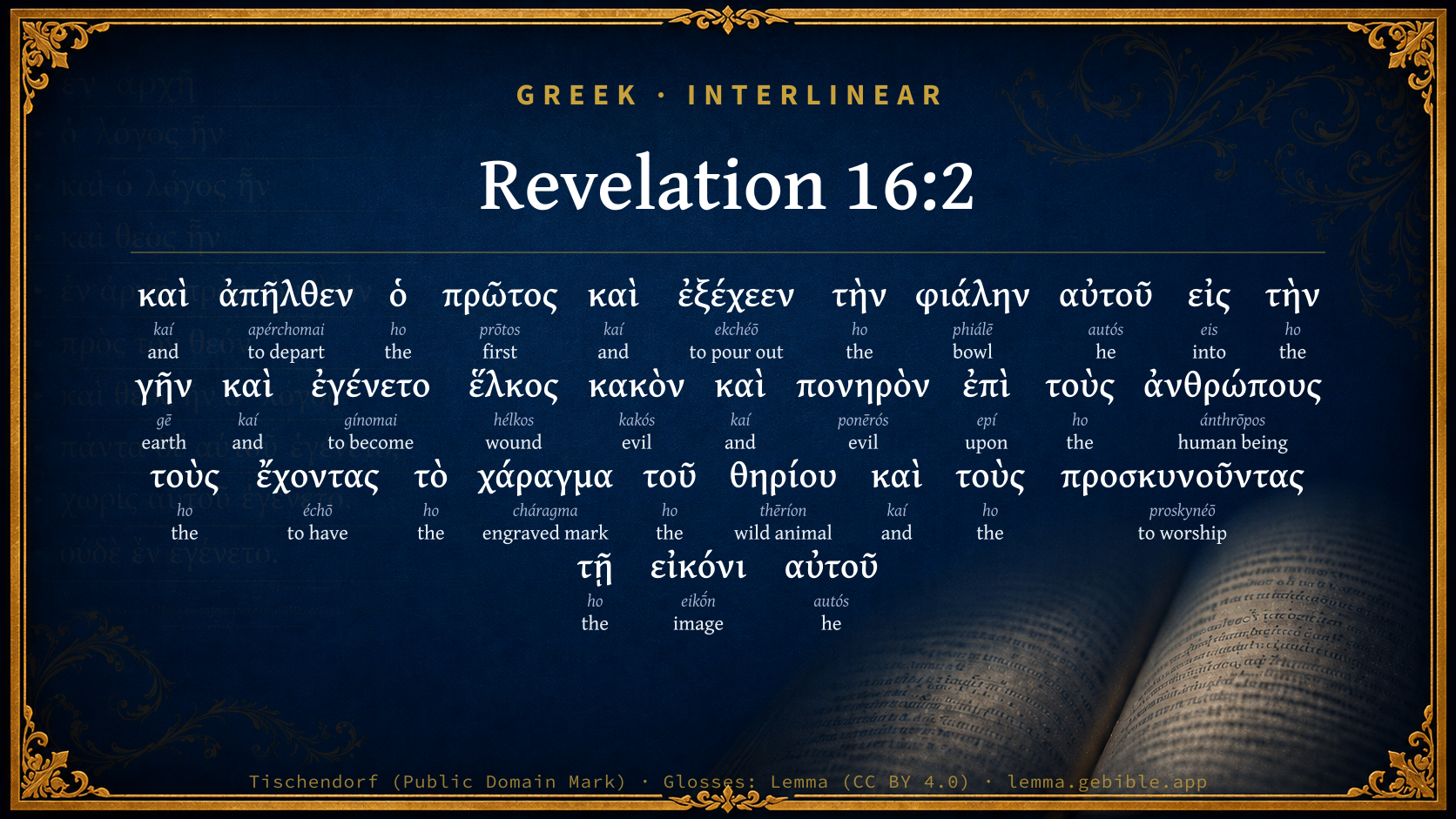
  1. καὶ kaí G2532 “and” Conjunction
  2. ἀπῆλθεν apérchomai G565 “to depart” Verb, Aorist, Active, Indicative, 3rd person, Singular
  3. ὁ ho G3588 “the” Article, Nominative, Singular, Masculine
  4. πρῶτος prōtos G4413 “first” Adjective, Nominative, Singular, Masculine, Superlative
  5. καὶ kaí G2532 “and” Conjunction
  6. ἐξέχεεν ekchéō G1632 “to pour out” Verb, Aorist, Active, Indicative, 3rd person, Singular
  7. τὴν ho G3588 “the” Article, Accusative, Singular, Feminine
  8. φιάλην phiálē G5357 “bowl” Noun, Accusative, Singular, Feminine
  9. αὐτοῦ autós G846 “he” Personal pronoun, Genitive, Singular, Masculine
  10. εἰς eis G1519 “into” Preposition
  11. τὴν ho G3588 “the” Article, Accusative, Singular, Feminine
  12. γῆν gē G1093 “earth” Noun, Accusative, Singular, Feminine
  13. καὶ kaí G2532 “and” Conjunction
  14. ἐγένετο gínomai G1096 “to become” Verb, Aorist, Middle deponent, Indicative, 3rd person, Singular
  15. κακὸν kakós G2556 “evil” Adjective, Nominative, Singular, Neuter
  16. καὶ kaí G2532 “and” Conjunction
  17. πονηρὸν ponērós G4190 “evil” Adjective, Nominative, Singular, Neuter
  18. ἐπὶ epí G1909 “upon” Preposition
  19. τοὺς ho G3588 “the” Article, Accusative, Plural, Masculine
  20. ἀνθρώπους ánthrōpos G444 “human being” Noun, Accusative, Plural, Masculine
  21. τοὺς ho G3588 “the” Article, Accusative, Plural, Masculine
  22. ἔχοντας échō G2192 “to have” Verb, Present, Active, Participle, Accusative, Plural, Masculine
  23. τὸ ho G3588 “the” Article, Accusative, Singular, Neuter
  24. χάραγμα cháragma G5480 “engraved mark” Noun, Accusative, Singular, Neuter
  25. τοῦ ho G3588 “the” Article, Genitive, Singular, Neuter
  26. θηρίου thēríon G2342 “wild animal” Noun, Genitive, Singular, Neuter
  27. καὶ kaí G2532 “and” Conjunction
  28. τοὺς ho G3588 “the” Article, Accusative, Plural, Masculine
  29. προσκυνοῦντας proskynéō G4352 “to worship” Verb, Present, Active, Participle, Accusative, Plural, Masculine
  30. τῇ ho G3588 “the” Article, Dative, Singular, Feminine
  31. εἰκόνι eikṓn G1504 “image” Noun, Dative, Singular, Feminine
  32. αὐτοῦ autós G846 “he” Personal pronoun, Genitive, Singular, Neuter

About this verse

These counts appear in no published source. They are computed here, from the morphology-tagged text and Lemma’s own curated glosses. What Lemma adds →

33
words
20
distinct lemmas
Revelation
section

Notable vocabulary

The rarest word here is ἕλκος wound G1668 — appearing just 3 times in the whole Greek New Testament.

Shared distinctive vocabulary

ἕλκος wound G1668 occurs in 3 verses of the Greek New Testament. Also found in:

Repetition

Words recur within this verse:

Cross-references

17

Topical passages linked to Revelation 16:2 in the Treasury of Scripture Knowledge — connected by theme and wording, ordered by reader-vote popularity; previews shown in the World English Bible.

  • Revelation 8:7 The first sounded, and there followed hail and fire, mixed with blood, and they were thrown to the earth. One third of the earth was burnt up, and one third of the trees were burnt up, and all green grass was burnt up.
  • Revelation 13:15–18 It was given to him to give breath to it, to the image of the beast, that the image of the beast should both speak, and cause as many as wouldn't worship the image of the beast to be killed.
  • Revelation 16:11 and they blasphemed the God of heaven because of their pains and their sores. They didn't repent of their works.
  • Exodus 9:8–11 Yahweh said to Moses and to Aaron, "Take to you handfuls of ashes of the furnace, and let Moses sprinkle it toward the sky in the sight of Pharaoh.
  • Deuteronomy 28:27 Yahweh will strike you with the boil of Egypt, and with the tumors, and with the scurvy, and with the itch, of which you can not be healed.
  • Luke 16:20–22 A certain beggar, named Lazarus, was laid at his gate, full of sores,
  • Deuteronomy 7:15 Yahweh will take away from you all sickness; and none of the evil diseases of Egypt, which you know, will he put on you, but will lay them on all those who hate you.
  • 1 Samuel 5:6 But the hand of Yahweh was heavy on them of Ashdod, and he destroyed them, and struck them with tumors, even Ashdod and the borders of it.
  • 1 Samuel 5:9 It was so, that after they had carried it about, the hand of Yahweh was against the city with a very great confusion: and he struck the men of the city, both small and great; and tumors broke out on them.
  • 2 Chronicles 21:15 and you shall have great sickness by disease of your bowels, until your bowels fall out by reason of the sickness, day by day.
  • 2 Chronicles 21:18 After all this Yahweh struck him in his bowels with an incurable disease.
  • Job 2:7–8 So Satan went forth from the presence of Yahweh, and struck Job with painful sores from the sole of his foot to his head.
  • Isaiah 1:5–6 Why should you be beaten more, That you revolt more and more? The whole head is sick, And the whole heart faint.
  • Isaiah 3:17 Therefore the Lord brings sores on the crown of the head of the women of Zion, And Yahweh will make their scalps bald."
  • Acts 12:23 Immediately an angel of the Lord struck him, because he didn't give God the glory, and he was eaten by worms and died.
  • Psalms 78:26 He caused the east wind to blow in the sky. By his power he guided the south wind.
  • Isaiah 3:24 It shall happen that instead of sweet spices, there shall be rottenness; Instead of a belt, a rope; Instead of well set hair, baldness; Instead of a robe, a girding of sackcloth; And branding instead of beauty.

Cross-references courtesy of OpenBible.info (CC BY 4.0).

Commentary

Notes on Revelation 16:2 from classic Christian and Jewish commentators (each source and its license shown beneath its notes). The classic Christian expositions comment on the surrounding passage and are grouped to its opening verse, so a note may address several verses; the Jewish commentaries on the Tanakh (Rashi and others) are per-verse, so they appear only where the commentator wrote on this verse.

Lemma curates 59 commentaries, every one of them public domain or Creative Commons licensed, each selected and text-cleaned for this edition rather than reprinted as found. About our sources →

Albert Barnes' Notes on the Bible

And the first went - Went forth from heaven, where the seat of the vision was laid.

And poured out his vial upon the earth - That is, upon the land, in contradistinction from the sea, the rivers, the air, the seat of the beast, the sun, as represented in the other vials. In Rev 16:1, the word earth is used in the general sense to denote this world as distinguished from heaven; in this verse it is used in the specific sense, to denote land as distinguished from other things. Compare Mar 4:1; Mar 6:47; Joh 6:21; Act 27:29, Act 27:43-44. In many respects there is a strong resemblance between the pouring out of those seven vials, and the sounding of the seven trumpets, in Rev. 8–9, though they refer to different events. In the sounding of the first trumpet Rev 8:7, it was the earth that was particularly affected in contradistinction from the sea, the fountains, and the sun: “The first angel sounded, and there followed hail and fire mingled with blood, and they were cast upon the earth.” Compare Rev 8:8, Rev 8:10, Rev 8:12. In regard to the symbolical meaning of the term earth, considered with reference to divine judgments, see the notes on Rev 8:7.

And there fell a noisome and grievous sore - The judgment here is specifically different from that inflicted under the first trumpet, Rev 8:7. There it is said to have been that “the third part of trees was burnt up, and all green grass was burnt up.” Here it is that there fell upon people a “noisome and grievous sore.” The two, therefore, are designed to refer to different events, and to different forms of punishment. The word rendered “sore” properly denotes a wound (Homer, Iliad xi. 812), and then, in later writers, an ulcer or sore. It is used in the New Testament only in the following places: Luk 16:21, “The dogs came and licked his sores”; and in Rev 16:2, Rev 16:11, where it is rendered “sore,” and “sores.” It is used in the Septuagint, in reference to the boils that were brought upon the Egyptians, in Exo 9:9-12, and probably Deu 28:27; in reference to the leprosy, Lev 13:18-20, Lev 13:23; in reference to the boil, ulcer, or elephantiasis brought upon Job Job 2:7; and in reference to any sore or ulcer, in Deu 28:35.

In all these places it is the translation of the word שׁחין shechiyn - rendered in our English version as “boil,” Exo 9:9-11; Lev 13:18-20, Lev 13:23; 2Ki 20:7; Job 2:7; Isa 38:21; and “botch,” Deu 28:27, Deu 28:35. The proper meaning, therefore, is that of a sore, ulcer, or boil of a severe and painful character; and the most obvious reference in the passage, to one who was accustomed to the language of Scripture, would be to some fearful plague like what was sent upon the Egyptians. In the case of Hezekiah 2Ki 20:7; Isa 38:21, it was probably used to denote a “plague-boil,” or the black leprosy. See the notes on Isa 38:21. The word “noisome” - κακὸν kakon, “evil, bad” - is used here to characterize the plague referred to as being especially painful and dangerous. The word “grievous” - πονηρον ponēron - “bad, malignant, hurtful” - is further used to increase the intensity of the expression, and to characterize the plague as particularly severe. There is no reason to suppose that it is meant that this would be literally inflicted, anymore than it is in the next plague, where it is said that the “rivers and fountains became blood.” What is obviously meant is, that there would be some calamity which would be well represented or symbolized by such a fearful plague.

Upon the men - Though the plague was poured upon “the earth,” yet its effects were seen upon “men.” Some grievous calamity would befall them, as if they were suddenly visited with the plague.

Which had the mark of the beast - notes on Rev 13:16-17. This determines the portion of the earth that was to be afflicted. It was not the whole world; it was only that part of it where the “beast” was honored. According to the interpretation proposed in Rev. 13, this refers to those who are under the dominion of the papacy.

And upon them which worshipped his image - See the notes on Rev 13:14-15. According to the interpretation in Rev. 13, those are meant who sustained the civil or secular power to which the papacy gave life and strength, and from which it, in turn, received countenance and protection.

In regard to the application or fulfillment of this symbol, it is unnecessary to say that there have been very different opinions in the world, and that very different opinions still prevail. The great mass of Protestant commentators suppose that it refers to the papacy; and of those who entertain this opinion, the greater portion suppose that the calamity referred to by the pouring out of this vial is already past, though it is supposed by many that the things foreshadowed by a part of these “vials” are yet to be accomplished. As to the true meaning of the symbol before us, I would make the following remarks:

(1) It refers to the papal power. This application is demanded by the results which were reached in the examination of Rev. 13. See the remarks on the “beast” in the notes on Rev 13:1-2, Rev 13:11, and on “the image of the beast” in the notes on Rev 13:14-15. This one mighty power existed in two forms closely united, and mutually sustaining each other - the civil or secular, and the ecclesiastical or spiritual. It is this combined and consolidated power - the papacy as such - that is referred to here, for this has been the grand anti-Christian power in the world.

(2) It refers to some grievous and fearful calamity which would come upon that power, and which would be like a plague-spot on the human body - something which would be of the nature of a divine judgment, resembling what came upon the Egyptians for their treatment of the people of God.

(3) The course of this exposition leads us to suppose, that this would be the beginning in the series of judgments, which would terminate in the complete overthrow of that formidable power. It is the first of the vials of wrath, and the whole description evidently contemplates a series of disasters, which would be properly represented by these successive vials. In the application of this, therefore, we should naturally look for the first of a series of such judgments, and should expect to find some facts in history which would he properly represented by the vial “poured upon the earth.”

(4) In accordance with this representation, we should expect to find such a series of calamities gradually weakening, and finally terminating the papal power in the world, as would be properly represented by the number seven.

(5) In regard now to the application of this series of symbolical representations, it may be remarked, that most recent expositors - as Elliott, Cunninghame, Keith, Faber, Lord, and others - refer them to the events of the French revolution, as important events in the overthrow of the papal power; and this, I confess, although the application is attended with some considerable difficulties, has more plausibility than any other explanation proposed. In support of this application, the following considerations may be suggested:

(a) France, in the time of Charlemagne, was the kingdom to which the papacy owed its civil organization and its strength - a kingdom to which could be traced all the civil or secular power of the papacy, and which was, in fact, a restoration or reconstruction of the old Roman power - the fourth kingdom of Daniel. See the notes on Dan 7:24-28; and compare the notes on Rev 13:3, Rev 13:12-14. The restoration of the old Roman dominion under Charlemagne, and the aid which he rendered to the papacy in its establishment as to a temporal power, would make it probable that this kingdom would be referred to in the series of judgments that were to accomplish the overthrow of the papal dominion.

(b) In an important sense France has always been the head of the papal power. The king of France has been usually styled, by the popes themselves, “the oldest son of the church.” In reference to the whole papal dominion in former times, one of the principal reliances has been on France, and, to a very large extent, the state of Europe has been determined by the condition of France. “A revolution in France,” said Napoleon, “is sooner or later followed by a revolution in Europe” (Alison). Its central position; its power; its direct relation to all the purposes and aims of the papacy, would seem to make it probable that, in the account of the final destruction of that power, this kingdom would not be overlooked.

(c) The scenes which occurred in the times of the French revolution were such as would be properly symbolized by the pouring out of the first, the second, the third, and the fourth vials. In the passage before us - the pouring out of the first vial - the symbol employed is that of “a noisome and grievous sore” - boil, ulcer, plague-spot - “on the men which had the mark of the beast, and on them which worshipped his image.” This representation was undoubtedly derived from the account of the sixth plague on Egypt Exo 9:9-11; and the sense here is, not that this would be literally inflicted on the power here referred to, but that a calamity would come upon it which would be well represented by that, or of which that would be an appropriate emblem. This interpretation is further confirmed by Rev 11:8, where Rome is referred to under the name of Egypt, and where it is clear that we are to look for a course of divine dealing, in regard to the one, resembling what occurred to the other.

See the notes on that passage. Now, this “noisome and grievous sore would well represent the moral corruption, the pollution, the infidelity, the atheism, the general dissolution of society, that preceded and accompanied the French revolution; for that was a universal breaking out of loathsome internal disease - of corruption at the center - and in its general features might be represented as a universal plague-spot on society, extending over the countries where the beast and his image were principally worshipped. The symbol would properly denote that “tremendous outbreak of social and moral evil, of democratic fury, atheism, and vice, which was specially seen to characterize the French revolution: that of which the ultimate source was in the long and deep-seated corruption and irreligion of the nation; the outward vent, expression, and organ of its Jacobin clubs, and seditious and atheistic publications; the result, the dissolution of all society, all morals, and all religion; with acts of atrocity and horror accompanying, scarce paralleled in the history of people; and suffering and anguish of correspondent intensity throbbing throughout the social mass and corroding it; what, from France as a center, spread like a plague throughout its affiliated societies to the other countries of papal Christendom, and was, wherever its poison was imbibed, as much the punishment as the symptoms of the corruption within.”

Of this sad chapter in the history of man, it is unnecessary to give any description here. For scenes of horror, pollution, and blood, its parallel has never been found in the history of our race, and, as an event in history, it was worthy of a notice in the symbols which portrayed the future. The full details of these amazing scenes must be sought in the histories which describe them, and to such works as Alison’s History of Europe, and Burke’s Letters on a Regicide Peace, the reader must be referred. A few expressions copied from those letters of Mr. Burke, penned with no design of illustrating this passage in the Apocalypse, and no expectation that they would be ever so applied, will show with what propriety the spirit of inspiration suggested the phrase, “a noisome and grievous sore” or plague-spot, on the supposition that the design was to refer to these scenes. In speaking of the revolutionary spirit in France, Mr. Burke calls it “the fever of aggravated Jacobinism,” “the epidemic of atheistical fanaticism,” “an evil lying deep in the corruptions of human nature,” “the malignant French distemper,” “a plague, with its fanatical spirit of proselytism, that needed the strictest quarantine to guard against it,” whereof, though the mischief might be “skimmed over” for a time, yet the result into whatever country it entered, was “the corruption of all morals,” “the decomposition of all society,” etc. But it is unnecessary to describe those scenes further. The “world has them by heart,” and they can never be obliterated from the memory of man. In the whole history of the race there has never been an outbreak of evil that showed so deep pollution and corruption within.

(d) The result of this was to affect the papacy - a blow, in fact, aimed at that power. Of course, all the infidelity and atheism of the French nation, before so strongly papal, went just so far in weakening the power of the papacy; and in the ultimate result it will perhaps yet be found that the horrid outbreaks in the French revolution were the first in the series of providential events that will result in the entire overthrow of that anti-Christian power. At all events, it will be admitted, I think, that, on the supposition that it was intended that this should be descriptive of the scenes that occurred in Europe at the close of the last century, no more expressive symbol could have been chosen than has been employed in the pouring out of this first vial of wrath.

Albert Barnes' Notes on the Bible (1834–1885) — public domain. Text from a community e-Sword/MySword module.

Joseph Benson's Commentary

Rev 16:2. And the first poured out his vial upon the earth — This, according to Mr. Fleming, denotes God’s judgments upon the foundation of the Papal kingdom; the earth being that on which we walk, and by the fruits of which we are supported. By this, therefore, he understands the Popish clergy, and the Papal dominions and revenues, by which they were upheld. This vial, he thinks, began with the Reformation, and continued until the time when these agents of Popery were thrown out of as many countries of Europe as embraced the Reformation. And we may easily conceive what a mortification it was to that party, when the pretended sanctity of their bishops, priests, monks, and nuns was discovered to be a mere cheat, and their miracles nothing but lies or tricks; and when their tales of purgatory were exposed to public contempt, and their pardons and indulgences would sell no longer; and consequently, when the pope and his mitred officers saw themselves driven out from so great a part of their dominions, their seminaries for training up their advocates and defenders, of all denominations and orders, pulled down, and so much of their yearly revenues lost. Whence they are said to fall under a noisome and grievous ελκος, ulcer, or sore — Being by this means pained and vexed inwardly, and rendered contemptible to the whole world, which looked upon them as no better than the plagues of mankind. So that this vial began with the rise of Zuinglius and Luther, and the other reformers, in the years 1516 and 1517, and continued to the year 1566; that is, about forty or fifty years; for by that time all the reformed churches were settled, and had published their creeds and confessions of faith against Rome, in opposition to the determinations of the Popish council of Trent, published A.D. 1563, and the creed of Pope Pius IV., which added twelve antichristian articles to the twelve primitive Christian ones, A.D. 1564.

Joseph Benson's Commentary on the Old and New Testaments (1811–1818) — public domain. Text from a community e-Sword module.

Tyndale Open Study Notes

Tyndale Open Resources

16:2 The malignant sores are reminiscent of the sixth plague of Egypt (Exod 9:9-11). • mark of the beast: See Rev 13:13-17; 14:9-10.

Tyndale Open Study Notes — © Tyndale Open Resources, licensed CC BY-SA 4.0. Text via the HelloAO Bible API.

Bengel's Gnomon

Johann Albrecht Bengel

Rev 16:2. Ὁ πρῶτος, the first) Thus, the second, the third, the fourth, the fifth, the sixth, the seventh, without the noun angel.[177] The style expresses a very quick outpouring of the vials, of which quickness this also is a proof, that the vials have no periods of times expressed. These bear a great resemblance to the plagues of Egypt, which the Hebrews generally suppose to have been inflicted at intervals of months. See Meyer ad Seder Olam, p. 287. What if the same thing should be about to happen in the case of the vials? Their whole outpouring indeed is as yet among the things to come.—ἕλκος πονηρὸν, a grievous sore) Deu 28:35, בשחין רע, in the LXX. ἘΝ ἝΛΚΕΙ ΠΟΝΗΡῷ. [This, I believe, will be a new and hitherto unheard of plague.—V. g.]

[177] Rec. Text adds ἄγγελος in ver. 3, with B: ACh Vulg. oppose it. In ver. 4 also: ABCh Vulg. opposing it. In ver. 8, 10, 12 also, with h: ABC Vulg. opposing it. In ver. 17 also, with h: AB Vulg. and Syr. opposing it.—E.

Bengel's Gnomon of the New Testament — English translation (T&T Clark, Edinburgh, 1860) — public domain. Text from a community e-Sword module.

Meyer's Critical & Exegetical Commentary

Heinrich August Wilhelm Meyer

Rev_16:2. The first vial poured forth upon the earth (εἰς τὴν γῆν, in relation to Rev_16:1, as Rev_8:7 to Rev_8:5) produces a severe ulcer.

ἔλκος κακὸν καὶ πονηρόν. Cf. Exo_9:10 sqq.; Deu_28:35.[3670] The πονηρόν[3671] designates, besides the ΚΑΚῸΝ, which expresses only the evil nature, the virulence, malignity, and affliction of the ulcer.[3672]

ἘΠῚ ΤΟῪς ΑΝΘΡ., Κ.Τ.Λ., The accus. after ἘΠΊ results[3673] from the idea that the plague extends to the men.[3674]

Τ. ἜΧ. ΤῸ ΧΆΡΑΓΜΑ, Κ.Τ.Λ. Cf. Rev_13:15 sqq., Rev_14:9 sqq. Of such a pestilence as there was at Rome[3675] in Neros time, nothing is said.

[3670] LXX.: ἔλκος πονηρόν. So also Job_2:7.

[3671] Suidas: ἐπιπονον.

[3672] Cf. my commentary on 1Jn_3:12.

[3673] Cf. Luk_1:65; Luk_3:2. De Wette.

[3674] Cf. Winer, p. 380.

[3675] Volkm.

Meyer — Critical and Exegetical Commentary on the New Testament — English translation by Peter Christie, edited by Frederick Crombie (T&T Clark, 1880) — public domain. Text from a community e-Sword module.

Expositor's Greek Testament

ed. W. Robertson Nicoll

Rev 16:2 . The sixth Egyptian plague, “a noisome and painful ulcer” (the punishment of the impious and rebellious, according to Philo, de Execr. Rev 16:6 ) breaks out on the adherents of the Cæssar-cult.

The Expositor's Greek Testament, edited by W. Robertson Nicoll (1897–1910) — public domain. Text from a community e-Sword module.

Geneva Bible (1599)

Geneva Bible translators

See Rev. 13:16

The history of the first Angel, whose plague upon the earth, is described almost in the same words with that sixth plague of the Egyptians, Exod. 9:9. But it doth signify a spiritual ulcer, and that torture or butchery of conscience seared with an hot iron, which accuseth the ungodly within and both by truth of the word (the light whereof God hath now so long showed forth) and by bitterness stirreth up and forceth out the sword of God’s wrath.

Geneva Bible (1599) marginal notes — public domain. Text via Bolls.life.

Jamieson, Fausset & Brown

Robert Jamieson, A. R. Fausset & David Brown

went--Greek, "went away."

poured out--So the angel cast fire into the earth previous to the series of trumpets (Rev 8:5).

upon--so Coptic. But A, B, C, Vulgate, and Syriac read, "into."

noisome--literally, "evil" (compare Deu 28:27, Deu 28:35). The very same Greek word is used in the Septuagint as here, Greek, "helkos." The reason why the sixth Egyptian plague is the first here is because it was directed against the Egyptian magicians, Jannes and Jambres, so that they could not stand before Moses; and so here the plague is sent upon those who in the beast worship had practiced sorcery. As they submitted to the mark of the beast, so they must bear the mark of the avenging God. Contrast Rev 7:3; Eze 9:4, Eze 9:6.

grievous--distressing to the sufferers.

sore upon the men--antitype to the sixth Egyptian plague.

which had the mark of the beast--Therefore this first vial is subsequent to the period of the beast's rule.

Jamieson, Fausset & Brown — Commentary Critical and Explanatory on the Whole Bible (1871) — public domain (CC PDM 1.0). Text via the HelloAO Bible API.

Adam Clarke's Commentary

Verse 2. A noisome and grievous sore] This is a reference to the sixth Egyptian plague, boils and blains, Ex 9:8; Ex 9:9, &c.

Adam Clarke's Commentary on the Bible (1810–1826) — public domain. Text from a community e-Sword/MySword module.

Ellicott's Commentary for English Readers

(2) And the first . . .—Translate, And the first went forth, &c. The angel which receives the command departs and pours forth his vial upon the earth. All the vials are poured forth “into the earth” (Rev_16:1) generally; the first angel pours his vial forth upon the earth, that is, the dry land. And there came an evil and painful sore upon the men (i.e., upon that part of the human race) who, &c. The plague falls on those who carry the mark of the beast, and who worship it. Like the plagues of Egypt, they are directed against those who aid the oppressor. The plague here described resembles the sixth of the Egyptian plagues, the plague of boils (comp. Exo_9:8-12; Deu_28:27). Egypt is one type of the world-power; and the plagues are used as types also, and are not to be understood literally. The plague of the “evil sore” denotes some throbbing and hateful sore, perhaps spiritual or mental, which distracts attention and disturbs the personal serenity and self-complacency of the worshippers of the world-power.

A Bible Commentary for English Readers, edited by Charles John Ellicott (1878–1897) — public domain. Text from a community e-Sword module.

The Cambridge Bible for Schools and Colleges

gen. ed. J. J. S. Perowne

2. went] Lit., went away, from the Angels’ place in Heaven before the Temple to the edge or “window” whence they can look down upon the earth.

a noisome and grievous sore] The plagues that accompany these vials have a close analogy to those of the trumpets in ch. 8 sqq., and, like them, have some to the plagues of Egypt: here cf. Exo_9:9. The epithets translated “noisome and grievous” are somewhat more general: “bad and evil” would be perhaps their most exact equivalents.

The Cambridge Bible for Schools and Colleges (gen. ed. J. J. S. Perowne; Cambridge University Press, 1878–1918) — public domain. Text from a community e-Sword module.

John Gill's Exposition

And the first went,.... The Arabic and Ethiopic versions read, "the first angel", and who undoubtedly is meant, who readily and cheerfully obeyed the orders given him, as did the rest; by this angel cannot be meant Pope Adrian, as Lyra, a Popish interpreter, imagines; for a pope would never hurt the worshippers of the beast, as this angel does; rather some Christian Protestant prince or magistrate is designed, and Brightman applies it to Queen Elizabeth; though a set of kings and princes yet to come seem to be intended:

and poured out his vial upon the earth; not upon the whole earth, and the inhabitants of it; not upon the temple or church of God, and the worshippers in it, which are measured, hid, and protected; nor upon the Roman Pagan empire, which was destroyed under the sixth seal, and which never had any worshippers of the beast and his image in it, for then he was not risen; nor upon the whole apostate church, only a part of it: some think the meaner and vulgar sort of Papists are meant, who were reformed by the Waldenses, Wycliff, Huss, and others before Luther; but rather the antichristian powers on the continent are designed, and particularly Germany; for as the first trumpet affected the earth, Rev 8:7 and brought the Goths into Germany, and other inland countries on the continent; so this first vial affects the earth, and brings distress upon the Popish party in the same place: and this respects not the Reformation by Luther, as some have thought, nor the wars of the Turks here in the last age; though were it not for some things unfulfilled, which are to precede these vials, one would be tempted to think that this vial was now pouring out upon the empire; but I rather think this refers to a time of distress yet to come on those parts, and which will issue in a reformation from Popery again; for it should be observed, and it may be observed once for all, that though these vials are so many plagues upon antichrist, they are each of them so many steps to the advancement of Christ's kingdom and glory:

and there fell a noisome and grievous sore upon the men which had the mark of the beast, and upon them which worshipped his image; that is, who were professors of the Popish religion, and adherents of the pope of Rome in those parts; see Rev 13:15 who will only feel the effects of this vial, and that by a noisome and grievous sore falling on them, in allusion to the plague of boils in Egypt, Exo 9:8 by which may be meant, either literally something external, but not the plague in Dioclesian's time, for then the beast was not risen; and there were none that could have his mark or worship his image: some have thought the French disease is intended, which first appeared in the world in 1490, among the Papists, as a just judgment upon them for the horrible and unnatural lusts and uncleanness of the Romish clergy; and others understand it of a very great heat, which will be before the burning of the world, and will raise blisters and boils upon men: or rather this may design something internal, either the remorse of their consciences, reflections on their past practices, and black despair and horror of mind; and their madness, wrath, and fury, their malice and envy at the success of the preachers of the Gospel, and of Protestant states and princes against them; see Deu 28:27. Moreover, their secret and wicked practices, both in political and ecclesiastical affairs, will be discovered, and they will appear with boils and blotches upon them all over, which will render them odious to the people, and be the means of a general reformation. Mr. Daubuz thinks the curse of wickedness in the ninth and tenth centuries, after the invocation of saints and angels, and the worship of images were settled, is meant.

John Gill's Exposition of the Whole Bible (1746–1763) — public domain (CC PDM 1.0). Text via the HelloAO Bible API.

Trapp's Complete Commentary

John Trapp

2 And the first went, and poured out his vial upon the earth; and there fell a noisome and grievous sore upon the men which had the mark of the beast, and upon them which worshipped his image.

Ver. 2. And the first went] They went not all at once. Note the patience of God, waiting men’s return unto him.

Upon the earth] Antichrist’s footstool, his branded slaves.

A noisome and grievous sore] The French disease, say some; the devil’s disease, say others, viz. spite and envy at the Reformation wrought in Bohemia, Germany, England, &c., upon the discovery of the Papists’ hypocrisy and filthiness.

John Trapp, A Commentary or Exposition upon All the Books of the Old and New Testament (1647–1656) — public domain. Text from a community e-Sword module.

Haydock's Catholic Bible Commentary

And the first. From hence it appears that the first vial was poured out indiscriminately upon the good equally with the wicked. But behold the different consequences that follow: those that have the mark of the beast are afflicted with a sore and grievous wound, which is said in allusion to the madness, fury, and despair with which the wicked were afflicted, whilst St. John’s omitting to say any thing of the just, shews that they bore it with resignation and joy. (Calmet)

George Leo Haydock (1774–1849), Haydock's Catholic Family Bible and Commentary, 1859 edition — public domain. Excludes Psalms (Douay-Rheims chapter numbering differs from Protestant) and Deuterocanonical books (Catholic canon only).

Matthew Poole's English Annotations

Here is a plain allusion to the plagues which God brought upon Pharaoh king of Egypt for his oppression of his ancient Israel; God hereby showing us, that he would deal by this Romish beast for his persecutions of his gospel churches, as he dealt by Pharaoh: as he turned the Egyptian rivers into blood, so as the fish died, and the waters stunk, Exo 7:20,21, and as he plagued the Egyptians with boils and blains, Exo 9:9; so he would plague the papacy by proportionable judgments, until, as Pharaoh with his whole party was at last drowned in the Red Sea, so all the antichristian party shall be rooted out. Here are two of the Egyptian plagues mentioned, but this vision begins with the sixth of the Egyptian plagues, viz. that of boils breaking out in blains. What is meant by this

grievous sore I must profess myself not to understand, but think Dr. More speaks very probably, interpreting it of trouble and vexation, which the popish party should have upon the first prospect of their kingdom’s going down; it being of the nature of sores to vex and disturb those that are affected with them, so as they are very uneasy so long as they are affected with them. And, indeed, I find many interpreters agree in this notion.

Matthew Poole's English Annotations on the Holy Bible (1683–1685) — public domain. Text from a community e-Sword/MySword module.

Whedon's Commentary on the Bible

Daniel D. Whedon

2. Went—As commissioned, from the temple, (Rev_15:5,) the Christic citadel.

Upon the earth—The Babylonic land or soil; the ground element. Earth was first cursed for man’s sake. Sin has created a discord between man and nature. When man comes right, all will for him be right. But, at any rate, at this crisis of judgment the creation must reflect that retribution upon Babylon.

Sore—Like Egypt’s plague of “boils.”

Exo_9:10. The broad land is plague-smitten, as in Egypt, for the crime of the capital. The earth is, perhaps, made to give forth miasms that corrupt and disease the systems of the Babylonic peoples.

Daniel D. Whedon (gen. ed.), Commentary on the Old and New Testaments (1874–1909) — public domain. Text from a community e-Sword module.

The Pulpit Commentary

And the first went, and poured out his vial upon the earth; his bowl into, etc. (Revised Version). (On "vial," see on Rev_5:8) The preposition eiv , "into," distinguishes the first three vials from the last four, which have epi , "upon," and some writers make this the basis for classifying the vials into groups of three and four; but it seems better to divide into groups of four and three (see on ver. 1, and preliminary remarks on the trumpet visions). And there fell; and it became (Revised Version). Compare the phraseology of Exo_9:10. A noisome and grievous sore upon the men which had the mark of the beast, and upon them which worshipped his image. The counterpart of the sixth plague of Egypt. The word elkov , "sore," used here, is the same used in LXX, Ex 9. It is impossible to say with certainty what (if any) particular judgment upon the ungodly is intended to be signified by St. John in this plague. From amongst the numerous interpretations which have been given to illustrate this passage, we may mention that of Andreas, who sees in it a reference to the "ulcer" (elkov) of conscience. Or it may be that the writer has in contemplation that bodily disease which is the inevitable outcome of sin, and which often afflicts men in this world as the direct result of their misdoings; though, of course, it cannot always be asserted to be a consequence of a man"s own personal misdoings. (On the latter part of the verse, see on Re 13)

The Pulpit Commentary (1880–1919), ed. H.D.M. Spence-Jones & Joseph S. Exell — public domain. Text from a community e-Sword module.

John Wesley's Explanatory Notes

And the first went - So the second, third, &c., without adding angel, to denote the utmost swiftness; of which this also is a token, that there is no period of time mentioned in the pouring out of each phial. They have a great resemblance to the plagues of Egypt, which the Hebrews generally suppose to have been a month distant from each other. Perhaps so may the phials; but they are all yet to come. And poured out his phial upon the earth - Literally taken. And there came a grievous ulcer - As in Egypt, Exod. ix, 10, 11. On the men who had the mark of the wild beast - All of them, and them only. All those plagues seem to be described in proper, not figurative, words.

John Wesley, Explanatory Notes Upon the Whole Bible (1754–1765) — public domain. Text via the GEBible commentary corpus.

Burkitt's Expository Notes on the New Testament

William Burkitt

Observe here, 1. What allusion this plague inflicted upon Babylon has to that plague which God of old inflicted upon Egypt, Exo 9:9. Egypt had her boil, breaking forth with blains, upon men and upon beast; in like manner the worshippers of the beast have noisome and grievous sores upon them; that is, great trouble and uneasiness of mind, upon the first prospect of the shaking of their kingdom, by discovering the vanity, blasphemy, hypocrisy, and tyranny, of their devised religion; even as sores and blains do vex and torture those that are troubled with them.

Learn hence, That it is no small vexation and trouble to the wicked, when they have their sins detected and discovered; it is as great a torture to their minds as an ulcer or boil is to their bodies.

William Burkitt's Expository Notes on the New Testament (1700–1703) — public domain. Text from a community e-Sword module.

The People's New Testament

B. W. Johnson

2. And the first went, and poured out his vial upon the earth. John sees the vial poured out, and marks its effect; very grievous ulcers fall upon men; that is, upon the men which had the mark of the beast, and upon them which worshipped his image. Those who suffer are those who listen to the lamb-like dragon, the anti-Christ, the false spiritual power, or, as has been found in chapter 14, the votaries of Rome. As the vials of the wrath of God are a series of events leading to the destruction of this false power, we must look for the first of the vials, not while it is at the zenith of its power. We have found that a number of distinct prophecies seem to point to the year 1793 as a period when its power will give signs of decay, and its hold upon the nations weaken; hence, we need not look for the first vial before this. Let the reader note the nature of the plagues to be sent. It is described as a grievous ulcer, that afflicts those who have the mark of the beast. An ulcer is not only a painful and dangerous sore, but is often malignant and foul with corruption. The term is often used to describe moral corruption, and the ulcers described may be moral or spiritual. Can we find aught in history about the end of the 1260 years of Papal dominion that corresponds with the symbolism? For many centuries France was the stoutest and staunchest of the supporters of the Romish Church. It was Charlemagne, the emperor of France, who bestowed the temporal power upon the Popes. It was to Avignon in France that, at one time, the Papacy was transferred for seventy years. The ruler of France was long styled “the eldest son of the Church.” It was France that had perpetrated the massacre of St. Bartholomew, the dragonnades of the Cevennes, and the banishment of the Huguenots. The French nation had the mark of the beast to at least as great an extent as any other nation. In 1793, exactly at the close of the period of 1260 years, there breaks out in France a fearful moral ulcer that had long been festering. The French Revolution, the uprising of enslaved masses who were maddened into fury, sent Catholic king, royal families, nobles, and priests to the guillotine by tens of thousands, impelled the nation in its madness to publicly declare itself atheistic, leavened it with skepticism, and broke the hold of Rome to such a degree that she can never more control France. The ulcer was awfully corrupt and deadly. At one time 200,000 citizens of all conditions and both sexes were in prison, and often in Paris alone, fourscore were sent to the scaffold in a day. As the result of breaking forth of this ulcer, the mightiest Catholic nation was convulsed with civil war, every Catholic country in Europe was deluged in blood, and the Papal power received a shock from which it can never recover. The first vial, the breaking forth of grievous, painful, malignant ulcers, most fitly represents the breaking out of the French Revolution, its awful excesses, and irreparable injury done to the great spiritual despotism by the events of which it was the beginning and the cause.

B. W. Johnson's The People's New Testament with Notes (1889–1891) — public domain. Electronic text from the Christian Classics Ethereal Library (CCEL) ThML edition.

unfoldingWord translationNotes

Door43 World Missions Community

poured out his bowl

The word "bowl" refers to what is in it. AT: "poured out the wine from his bowl" or "poured out God's wrath from his bowl" (See: Metonymy)

painful sores

"painful wounds." These could be infections from diseases or injuries that have not healed.

mark of the beast

This was an identifying mark that indicated that the person who received it worshiped the beast. See how you translated this in Revelation 13:17.

translationWords

angel

beast

worship

image

unfoldingWord translationNotes — © Distant Shores Media and the Door43 World Missions Community, licensed CC BY-SA 4.0. Source: git.door43.org/Door43/en_tn.

Cambridge Greek Testament for Schools and Colleges

2. κακὸν καὶ πονηρόν. א* πονηρὸν καὶ κακόν. A omits κακόν.

2. ἀπῆλθεν. Lit. “went away,” from the Angels’ place in Heaven before the Temple to the edge or “window” whence they can look down upon the earth.

ἔλκος κακὸν καὶ πονηρόν. The plagues that accompany these vials have a close analogy to those of the trumpets in ch. 8 sqq., and, like them, have some to the plagues of Egypt: here cf. Exo 9:9. The epithets need not mean more than “bad and evil.” “Noisome and grievous” A. V[570] points out the distinction if one is intended.

[570] Authorised Version.

τοὺς ἔχοντας. This refers back to the previous vision, Rev 14:9-11, as in Rev 9:4 we have a reference to the previous vision, Rev 7:3.

Cambridge Greek Testament for Schools and Colleges (Cambridge University Press, 1896; 21 vols, various authors incl. Carr, Maclear, Plummer, Farrar, Lumby, Moule, M. R. James, Simcox) — public domain. Text from a community e-Sword module.

Alford’s Greek Testament

Henry Alford

2.] And the first departed (each angel, as his turn comes, leaves the heavenly scene, and from the space between heaven and earth, empties his vial on the appointed object) and poured out his vial into the earth (the γῆ, which before in ver. 1 was general, is now particular, and correlative with the objects of the other vials, cf. vv. 2, 3, εἰς τὴν θάλασσαν, εἰς τοὺς ποταμούς): and there came (took place: fell, as E. V.) an evil (κακόν, in itself) and painful (πονηρόν, to the sufferers, ἐπίπονον, Suidas. See reff.) sore upon the men that had the mark of the beast and that worshipped his image (see above ch. 13:15-17, 14:9, 10. The allegorical and historical interpretations have been very various: see them in Elliott, vol. iv. Notice the parallel with the sixth Egyptian plague, Exo 9:8 ff. Cf. Deu 28:27, Deu 28:35).

Henry Alford, The Greek Testament (1849–1861) — public domain. Text from a community e-Sword module.

Vincent's Word Studies in the New Testament

Marvin R. Vincent

And the first went. Each angel, as his turn comes, with draws (uJpagete, see on Joh 6:21; Joh 8:21) from the heavenly scene.

There fell [εγενετο] . Lit., there came to pass. Rev., it became. Elliott, very aptly, there broke out.

Noisome and grievous [κακον και πονηρον] . Similarly the two cognate nouns kakia and ponria malice and wickedness occur together in 1Co 5:8. Ponhrov emphasizes the activity of evil. See on Luk 3:19.

Sore [ελκος] . See on Luk 16:20. Compare the sixth Egyptian plague, Exo 9:8 - 12, where the Septuagint uses this word elkov boil. Also of the boil or scab of leprosy, Lev 13:18; king Hezekiah 's boil, 2Ki 20:7; the botch of Egypt, Deu 28:27, 35. In Job 2:7 (Sept.) the boils are described as here by ponhrov sore.

Marvin R. Vincent, Word Studies in the New Testament (1887–1900) — public domain. Text from a community e-Sword/MySword module.

Lesson kit

Teaching starters — assembled from the data on this page, not authored interpretation. Every prompt links to the verse data it draws on. Edit before teaching.

Revelation, in the Revelation, opens this verse with 33 words (20 distinct Greek lemmas). Its most distinctive word is hélkos (“wound”). A historical commentator’s framing appears above. Read the whole chapter for the surrounding context.

Discussion questions

  1. What does “wound” (hélkos) contribute to the verse as a whole?
  2. Luke 16:21 shares the word «wound» with this verse. How do the two illuminate each other?
  3. “the” occurs 9× in this one verse. What is the effect of the repetition?
  4. These translations render this verse differently. What is at stake in choosing one wording over another?
  5. Reading how Albert Barnes' Notes on the Bible and Joseph Benson's Commentary read this verse, where do the two commentators agree and where do they part?

Things to notice

Reading settings

Reading text

Shown beneath each verse's original-language words.

Old Testament
Old Testament edition

Read the OT as the Masoretic Hebrew (MT) or the Greek Septuagint (LXX).

English shown for the Greek Septuagint (in the Hebrew ↔ Greek comparison).

Comparing translations? Open the Compare panel on any verse page to stack up to four side by side.