

1 Timothy 6:4
Greek (Tischendorf 8th ed.) 1 Timothy 6:4 appears in the Greek New Testament. The text above is from the Tischendorf 8th edition. Each word links to its Strong’s number and a concise gloss. Click any word for its full Thayer’s Greek Lexicon entry.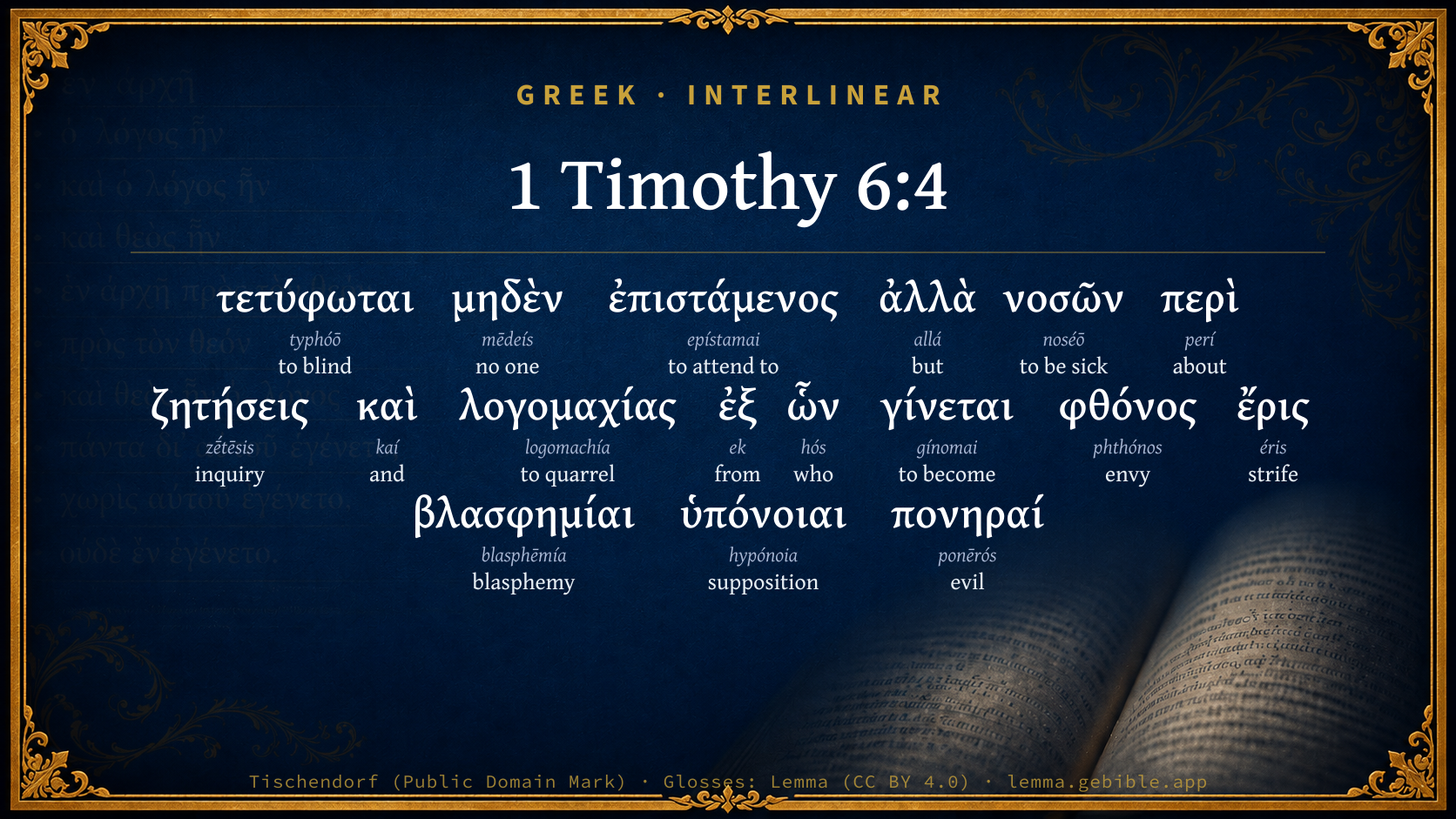
he is conceited, knowing nothing, but obsessed with arguments, disputes, and word battles, from which come envy, strife, reviling, evil suspicions,
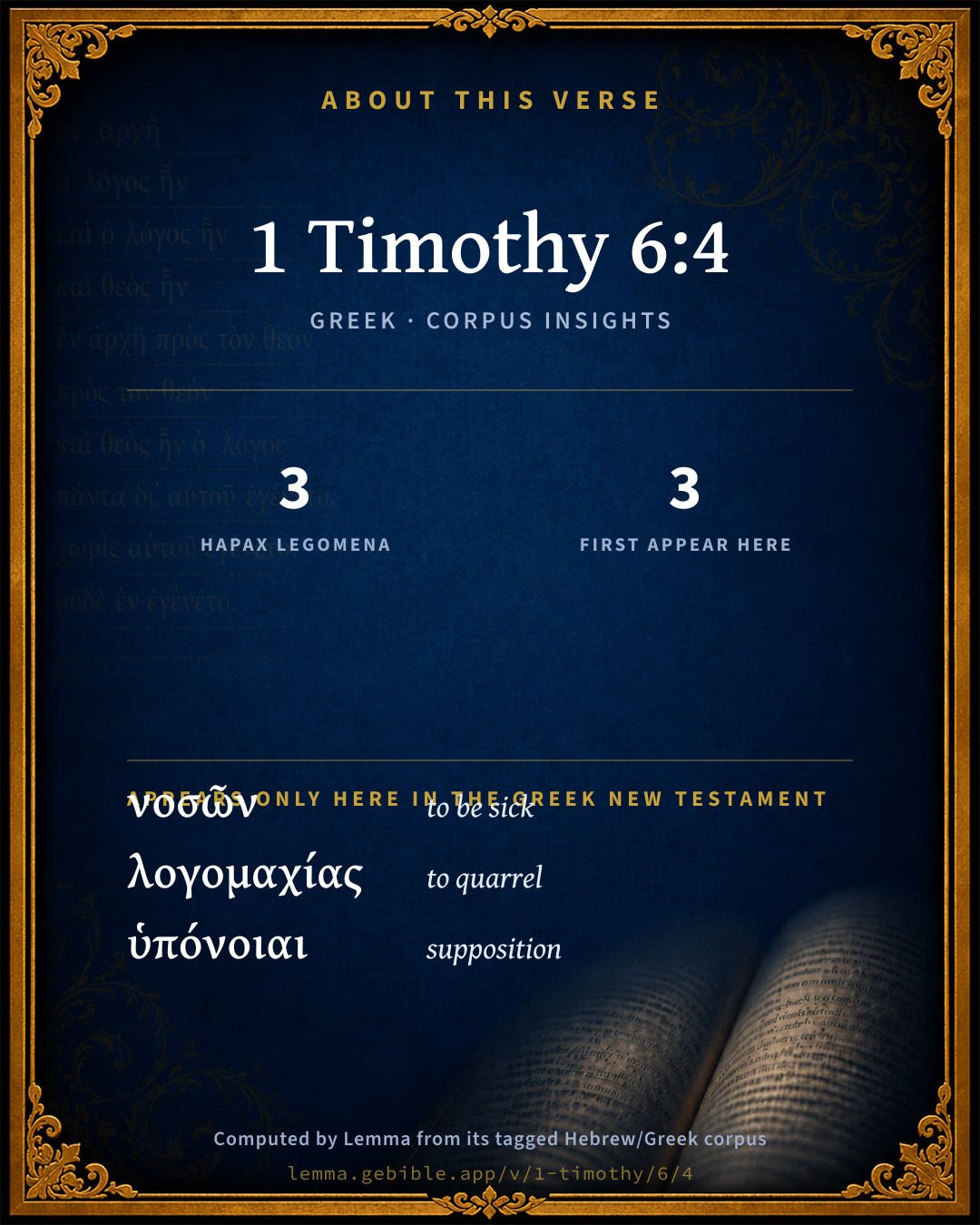
- 3 hapax legomena — only here in the Greek New Testament
- 3 first appearances in the Greek New Testament
Download a study sheet
One document with this verse’s original text, its word-by-word gloss line, the meaning frame, cross-references with their text, attributed commentary, and full source and license credits — printable, and it pastes into notes with its structure intact.
This verse Autodidact and up
A passage Seminary Student
Up to 50 verses in one chapter. A passage sheet keeps up to 6 commentary sources and 12 cross-references per verse, in the order this page ranks them, and says so on the sheet whenever that leaves anything out. Ask for a single verse and you get the Autodidact verse sheet above.
Everything on this page stays free to read, with no account — the sheet is a download of what is already on screen, not access to it.
Compare translations 3
The same verse in 3 English versions, stacked beneath the original-language interlinear above. Click any original word for its lexicon entry.
Each is an independent rendering of the whole verse — the interlinear is not word-aligned to these translations.
Highlighted words mark where these versions differ — a whole-verse word diff, not a word-by-word alignment.
-
World English Bible Public Domain
he is conceited, knowing nothing, but obsessed with arguments, disputes, and word battles, from which come envy, strife, reviling, evil suspicions,
-
King James Version Public Domain
He is proud, knowing nothing, but doting about questions and strifes of words, whereof cometh envy, strife, railings, evil surmisings,
-
unfoldingWord Literal Text CC BY-SA 4.0
he is puffed up, understanding nothing, but being sick with controversies and battles about words, from which come envy, strife, blasphemies, evil suspicions,
unfoldingWord Literal Text — © unfoldingWord, licensed CC BY-SA 4.0. Word-aligned USFM3 via Door43 (git.door43.org/unfoldingWord/en_ult).
Show all 19 translations
Every available English version of this verse, each an independent rendering of the whole verse.
-
World English Bible Public Domain
he is conceited, knowing nothing, but obsessed with arguments, disputes, and word battles, from which come envy, strife, reviling, evil suspicions,
-
Berean Standard Bible Public Domain
he is conceited and understands nothing. Instead, he has an unhealthy interest in controversies and semantics, out of which come envy, strife, abusive talk, evil suspicions,
-
Majority Standard Bible Public Domain
he is conceited and understands nothing. Instead, he has an unhealthy interest in controversies and disputes about words, out of which come envy, strife, abusive talk, evil suspicions,
-
King James Version Public Domain
He is proud, knowing nothing, but doting about questions and strifes of words, whereof cometh envy, strife, railings, evil surmisings,
-
American Standard Version (1901) Public Domain
he is puffed up, knowing nothing, but doting about questionings and disputes of words, whereof cometh envy, strife, railings, evil surmisings,
-
Revised Version (1885) Public Domain
he is puffed up, knowing nothing, but doting about questionings and disputes of words, whereof cometh envy, strife, railings, evil surmisings,
-
Geneva Bible (1599) Public Domain
He is puft vp and knoweth nothing, but doteth about questions and strife of words, whereof commeth enuie, strife, railings, euill surmisings,
-
Douay-Rheims (1899) Public Domain
He is proud, knowing nothing, but sick about questions and strifes of words; from which arise envies, contentions, blasphemies, evil suspicions,
-
Young's Literal Translation Public Domain
he is proud, knowing nothing, but doting about questions and word-striving, out of which doth come envy, strife, evil-speakings, evil-surmisings,
-
Literal Standard Version CC BY-SA 4.0
he is proud, knowing nothing, but unhealthy about questions and word-striving, out of which come envy, strife, slanders, evil-surmisings,
-
Unlocked Literal Bible CC BY-SA 4.0
he is proud and understands nothing. He has an unhealthy interest in controversies and arguments about words that result in envy, strife, insults, evil suspicions,
-
unfoldingWord Literal Text CC BY-SA 4.0
he is puffed up, understanding nothing, but being sick with controversies and battles about words, from which come envy, strife, blasphemies, evil suspicions,
-
Darby Bible Public Domain
he is puffed up, knowing nothing, but sick about questions and disputes of words, out of which arise envy, strife, injurious words, evil suspicions,
-
World Messianic Bible Public Domain
he is conceited, knowing nothing, but obsessed with arguments, disputes, and word battles, from which come envy, strife, insulting, evil suspicions,
-
Webster's Bible Public Domain
He is proud, knowing nothing, but doting about questions and strifes of words, from which cometh envy, strife, railings, evil surmisings,
-
Free Bible Version CC BY-SA 4.0
are arrogant and don't understand anything. They're obsessed with speculation and philosophical debates which only lead to jealousy, arguments, malicious gossip and evil suspicions—
-
Bible in Basic English Public Domain
He has an over-high opinion of himself; being without knowledge, having only an unhealthy love of questionings and wars of words, from which come envy, fighting, cruel words, evil thoughts,
-
Text-Critical English NT CC BY 4.0
he is puffed up and understands nothing. Moreover, he has an unhealthy desire for controversies and quarrels about words, from which come envy, strife, slanderous words, evil suspicions,
-
Tyndale New Testament (1534) Public Domain
he is pufte vp and knoweth nothynge: but wasteth his braynes aboute questions and stryfe of wordes wherof sprynge envie stryfe raylinges evyll surmysinges
Literal Standard Version (2020), Covenant Press — licensed CC BY-SA 4.0. Text via the HelloAO Bible API (eBible.org). Unlocked Literal Bible (unfoldingWord) — licensed CC BY-SA 4.0. Text via the HelloAO Bible API (eBible.org). unfoldingWord Literal Text — © unfoldingWord, licensed CC BY-SA 4.0. Word-aligned USFM3 via Door43 (git.door43.org/unfoldingWord/en_ult). Free Bible Version, Dr. Jonathan Gallagher — licensed CC BY-SA 4.0. Text via the HelloAO Bible API (eBible.org).
Word by word
More ways to search: Search by grammar → Find every occurrence → Compare this word →
Practice this passage: Drill this verse → Learn its vocabulary →
- Appears 1× in the Greek New Testament
- First appears here
- Part of Speech
- Verb
- Tense
- Present
- Voice
- Active
- Mood
- Participle
- Case
- Nominative
- Number
- Singular
- Gender
- Masculine
Full Thayer's Definition
- τετύφωται typhóō G5187 “to blind” Verb, Perfect, Passive, Indicative, 3rd person, Singular
- μηδὲν mēdeís G3367 “no one” Adjective, Accusative, Singular, Neuter, Negative
- ἐπιστάμενος epístamai G1987 “to attend to” Verb, Present, Middle or Passive deponent, Participle, Nominative, Singular, Masculine
- ἀλλὰ allá G235 “but” Conjunction
- νοσῶν noséō G3552 “to be sick” Verb, Present, Active, Participle, Nominative, Singular, Masculine
- περὶ perí G4012 “about” Preposition
- ζητήσεις zḗtēsis G2214 “inquiry” Noun, Accusative, Plural, Feminine
- καὶ kaí G2532 “and” Conjunction
- λογομαχίας logomachía G3055 “to quarrel” Noun, Accusative, Plural, Feminine
- ἐξ ek G1537 “from” Preposition
- ὧν hós G3739 “who” Relative pronoun, Genitive, Plural, Feminine
- γίνεται gínomai G1096 “to become” Verb, Present, Middle or Passive deponent, Indicative, 3rd person, Singular
- φθόνος phthónos G5355 “envy” Noun, Nominative, Singular, Masculine
- ἔρις éris G2054 “strife” Noun, Nominative, Singular, Feminine
- βλασφημίαι blasphēmía G988 “blasphemy” Noun, Nominative, Plural, Feminine
- ὑπόνοιαι hypónoia G5283 “supposition” Noun, Nominative, Plural, Feminine
- πονηραί ponērós G4190 “evil” Adjective, Nominative, Plural, Feminine
About this verse
These counts appear in no published source. They are computed here, from the morphology-tagged text and Lemma’s own curated glosses. What Lemma adds →
- 17
- words
- 17
- distinct lemmas
- Pauline Epistles
- section
Notable vocabulary
3 hapax legomena — words that appear only here in the entire Greek New Testament:
First appearance in Scripture
These words make their first canonical appearance in the Greek New Testament here:
Shared distinctive vocabulary
τετύφωται to blind G5187 occurs in 3 verses of the Greek New Testament. Also found in:
Cross-references
44Topical passages linked to 1 Timothy 6:4 in the Treasury of Scripture Knowledge — connected by theme and wording, ordered by reader-vote popularity; previews shown in the World English Bible.
- 2 Timothy 2:23 But refuse foolish and ignorant questionings, knowing that they generate strife.
- 2 Timothy 3:4 traitors, headstrong, conceited, lovers of pleasure rather than lovers of God;
- 1 Timothy 3:6 not a new convert, lest being puffed up he fall into the same condemnation as the devil.
- 2 Timothy 2:14 Remind them of these things, charging them in the sight of the Lord, that they don't argue about words, to no profit, to the subverting of those who hear.
- 2 Peter 2:12 But these, as unreasoning creatures, born natural animals to be taken and destroyed, speaking evil in matters about which they are ignorant, will in their destroying surely be destroyed,
- Jude 1:10 But these speak evil of whatever things they don't know. What they understand naturally, like the creatures without reason, in these things are they destroyed.
- 1 Timothy 1:4 neither to pay attention to myths and endless genealogies, which cause disputes, rather than God's stewardship, which is in faith--
- 1 Timothy 1:7 desiring to be teachers of the law, though they understand neither what they say, nor about what they strongly affirm.
- 2 Peter 2:18 For, uttering great swelling words of emptiness, they entice in the lusts of the flesh, by licentiousness, those who are indeed escaping from those who live in error;
- Jude 1:16 These are murmurers and complainers, walking after their lusts (and their mouth speaks proud things), showing respect of persons to gain advantage.
- Titus 3:9 but shun foolish questionings, genealogies, strife, and disputes about the law; for they are unprofitable and vain.
- James 1:19 So, then, my beloved brothers, let every man be swift to hear, slow to speak, and slow to anger;
- Acts 15:2 Therefore when Paul and Barnabas had no small discord and discussion with them, they appointed Paul and Barnabas, and some others of them, to go up to Jerusalem to the apostles and elders about this question.
- Proverbs 13:7 There are some who pretend to be rich, yet have nothing. There are some who pretend to be poor, yet have great wealth.
- Proverbs 25:14 As clouds and wind without rain, So is he who boasts of gifts deceptively.
- Proverbs 26:12 Do you see a man wise in his own eyes? There is more hope for a fool than for him.
- Isaiah 58:4 Behold, you fast for strife and contention, and to strike with the fist of wickedness: you don't fast this day so as to make your voice to be heard on high.
- Acts 8:9 But there was a certain man, Simon by name, who used to practice sorcery in the city, and amazed the people of Samaria, making himself out to be some great one,
- Acts 8:21–23 You have neither part nor lot in this matter, for your heart isn't right before God.
- Acts 18:15 but if they are questions about words and names and your own law, look to it yourselves. For I don't want to be a judge of these matters."
- Romans 2:8 but to those who are self-seeking, and don't obey the truth, but obey unrighteousness, will be wrath and indignation,
- Romans 12:16 Be of the same mind one toward another. Don't set your mind on high things, but associate with the humble. Don't be wise in your own conceits.
- Romans 13:13 Let us walk properly, as in the day; not in reveling and drunkenness, not in sexual promiscuity and lustful acts, and not in strife and jealousy.
- Romans 14:1 Now receive one who is weak in faith, but not for disputes over opinions.
- 1 Corinthians 3:3 for you are still fleshly. For insofar as there is jealousy, strife, and factions among you, aren't you fleshly, and don't you walk in the ways of men?
- 1 Corinthians 3:18 Let no one deceive himself. If anyone thinks that he is wise among you in this world, let him become a fool, that he may become wise.
- 1 Corinthians 8:1–2 Now concerning things sacrificed to idols: We know that we all have knowledge. Knowledge puffs up, but love builds up.
- 1 Corinthians 11:16 But if any man seems to be contentious, we have no such custom, neither do God's assemblies.
- 1 Corinthians 11:18 For first of all, when you come together in the assembly, I hear that divisions exist among you, and I partly believe it.
- 2 Corinthians 11:20 For you bear with a man, if he brings you into bondage, if he devours you, if he takes you captive, if he exalts himself, if he strikes you on the face.
- Galatians 5:15 But if you bite and devour one another, be careful that you don't consume one another.
- Galatians 5:20–21 idolatry, sorcery, hatred, strife, jealousies, outbursts of anger, rivalries, divisions, heresies,
- Galatians 5:26 Let's not become conceited, provoking one another, and envying one another.
- Galatians 6:3 For if a man thinks himself to be something when he is nothing, he deceives himself.
- Philippians 1:15 Some indeed preach Christ even out of envy and strife, and some also out of good will.
- Philippians 2:3 doing nothing through rivalry or through conceit, but in humility, each counting others better than himself;
- Philippians 2:14 Do all things without murmurings and disputes,
- Colossians 2:18 Let no one rob you of your prize by a voluntary humility and worshipping of the angels, dwelling in the things which he has not seen, vainly puffed up by his fleshly mind,
- 2 Thessalonians 2:4 he who opposes and exalts himself against all that is called God or that is worshiped; so that he sits as God in the temple of God, setting himself up as God.
- James 2:14–18 What good is it, my brothers, if a man says he has faith, but has no works? Can faith save him?
- James 4:1–2 Where do wars and fightings among you come from? Don't they come from your pleasures that war in your members?
- James 4:5–6 Or do you think that the Scripture says in vain, "The Spirit who lives in us yearns jealously"?
- 1 Peter 2:1–2 Putting away therefore all wickedness, all deceit, hypocrisies, envies, and all evil speaking,
- Revelation 3:17 Because you say, 'I am rich, and have gotten riches, and have need of nothing;' and don't know that you are the wretched one, miserable, poor, blind, and naked;
Cross-references courtesy of OpenBible.info (CC BY 4.0).
Lesson kit
Teaching starters — assembled from the data on this page, not authored interpretation. Every prompt links to the verse data it draws on. Edit before teaching.
1 Timothy, in the Pauline Epistles, opens this verse with 17 words (17 distinct Greek lemmas). Its most distinctive word is noséō (“to be sick”). A historical commentator’s framing appears above. Read the whole chapter for the surrounding context.
Discussion questions
- What does “to be sick” (noséō) contribute to the verse as a whole?
- 3 words here appear nowhere else in the Greek New Testament. Why might the author reach for such rare wording?
- 3 words make their first appearance in Scripture here. What does this debut establish?
- How does 1 Timothy 3:6, which shares the word «to blind», read alongside this verse?
- The translations on this page render this verse differently — a whole-verse word diff, not a word-by-word alignment. What might account for the different wordings?
- Compare how Tyndale Open Study Notes and Bengel's Gnomon read this verse. Where do they agree or differ?
Things to notice
- 3 words in this verse appear nowhere else in the Greek New Testament.
- 3 words make their first canonical appearance in Scripture here.
- These translations choose different wording for 28 words in this verse.
- 17 distinct Greek lemmas span 17 words in this verse.
Commentary
Notes on 1 Timothy 6:4 from classic Christian and Jewish commentators (each source and its license shown beneath its notes). The classic Christian expositions comment on the surrounding passage and are grouped to its opening verse, so a note may address several verses; the Jewish commentaries on the Tanakh (Rashi and others) are per-verse, so they appear only where the commentator wrote on this verse.
Lemma curates 59 commentaries, every one of them public domain or Creative Commons licensed, each selected and text-cleaned for this edition rather than reprinted as found. About our sources →
Tyndale Open Study Notes
Tyndale Open Resources
Tyndale Open Study Notes — © Tyndale Open Resources, licensed CC BY-SA 4.0. Text via the HelloAO Bible API.
Bengel's Gnomon
Johann Albrecht Bengel
Bengel's Gnomon of the New Testament — English translation (T&T Clark, Edinburgh, 1860) — public domain. Text from a community e-Sword module.
Expositor's Greek Testament
ed. W. Robertson Nicoll
The Expositor's Greek Testament, edited by W. Robertson Nicoll (1897–1910) — public domain. Text from a community e-Sword module.
Geneva Bible (1599)
Geneva Bible translators
Geneva Bible (1599) marginal notes — public domain. Text via Bolls.life.
Jamieson, Fausset & Brown
Robert Jamieson, A. R. Fausset & David Brown
Jamieson, Fausset & Brown — Commentary Critical and Explanatory on the Whole Bible (1871) — public domain (CC PDM 1.0). Text via the HelloAO Bible API.
Adam Clarke's Commentary
Adam Clarke's Commentary on the Bible (1810–1826) — public domain. Text from a community e-Sword/MySword module.
John Calvin's Commentaries
John Calvin's Commentaries (1540-1563) — public domain. Text from the Calvin Translation Society English edition (1840s-50s) via the Christian Classics Ethereal Library (ccel.org). Calvin's coverage is partial (roughly two-thirds of the Bible); uncommented books and verses are honest gaps, never fabricated. The 19th-century editor's footnotes and remarks are omitted so the notes are faithfully Calvin's own voice.
Ellicott's Commentary for English Readers
A Bible Commentary for English Readers, edited by Charles John Ellicott (1878–1897) — public domain. Text from a community e-Sword module.
The Cambridge Bible for Schools and Colleges
gen. ed. J. J. S. Perowne
The Cambridge Bible for Schools and Colleges (gen. ed. J. J. S. Perowne; Cambridge University Press, 1878–1918) — public domain. Text from a community e-Sword module.
John Gill's Exposition
John Gill's Exposition of the Whole Bible (1746–1763) — public domain (CC PDM 1.0). Text via the HelloAO Bible API.
Trapp's Complete Commentary
John Trapp
John Trapp, A Commentary or Exposition upon All the Books of the Old and New Testament (1647–1656) — public domain. Text from a community e-Sword module.
Albert Barnes' Notes on the Bible
Albert Barnes' Notes on the Bible (1834–1885) — public domain. Text from a community e-Sword/MySword module.
Haydock's Catholic Bible Commentary
George Leo Haydock (1774–1849), Haydock's Catholic Family Bible and Commentary, 1859 edition — public domain. Excludes Psalms (Douay-Rheims chapter numbering differs from Protestant) and Deuterocanonical books (Catholic canon only).
Matthew Poole's English Annotations
Matthew Poole's English Annotations on the Holy Bible (1683–1685) — public domain. Text from a community e-Sword/MySword module.
Whedon's Commentary on the Bible
Daniel D. Whedon
Daniel D. Whedon (gen. ed.), Commentary on the Old and New Testaments (1874–1909) — public domain. Text from a community e-Sword module.
The Pulpit Commentary
The Pulpit Commentary (1880–1919), ed. H.D.M. Spence-Jones & Joseph S. Exell — public domain. Text from a community e-Sword module.
John Wesley's Explanatory Notes
John Wesley, Explanatory Notes Upon the Whole Bible (1754–1765) — public domain. Text via the GEBible commentary corpus.
Fairbairn on Ezekiel, Jonah & the Pastoral Epistles
Patrick Fairbairn
Patrick Fairbairn — An Exposition of Ezekiel (1851), Jonah (1849), and The Pastoral Epistles (1874) — public domain. Text from a community e-Sword module.
The People's New Testament
B. W. Johnson
B. W. Johnson's The People's New Testament with Notes (1889–1891) — public domain. Electronic text from the Christian Classics Ethereal Library (CCEL) ThML edition.
Cambridge Greek Testament for Schools and Colleges
Cambridge Greek Testament for Schools and Colleges (Cambridge University Press, 1896; 21 vols, various authors incl. Carr, Maclear, Plummer, Farrar, Lumby, Moule, M. R. James, Simcox) — public domain. Text from a community e-Sword module.
Vincent's Word Studies in the New Testament
Marvin R. Vincent
Marvin R. Vincent, Word Studies in the New Testament (1887–1900) — public domain. Text from a community e-Sword/MySword module.