1 Thessalonians 5:22

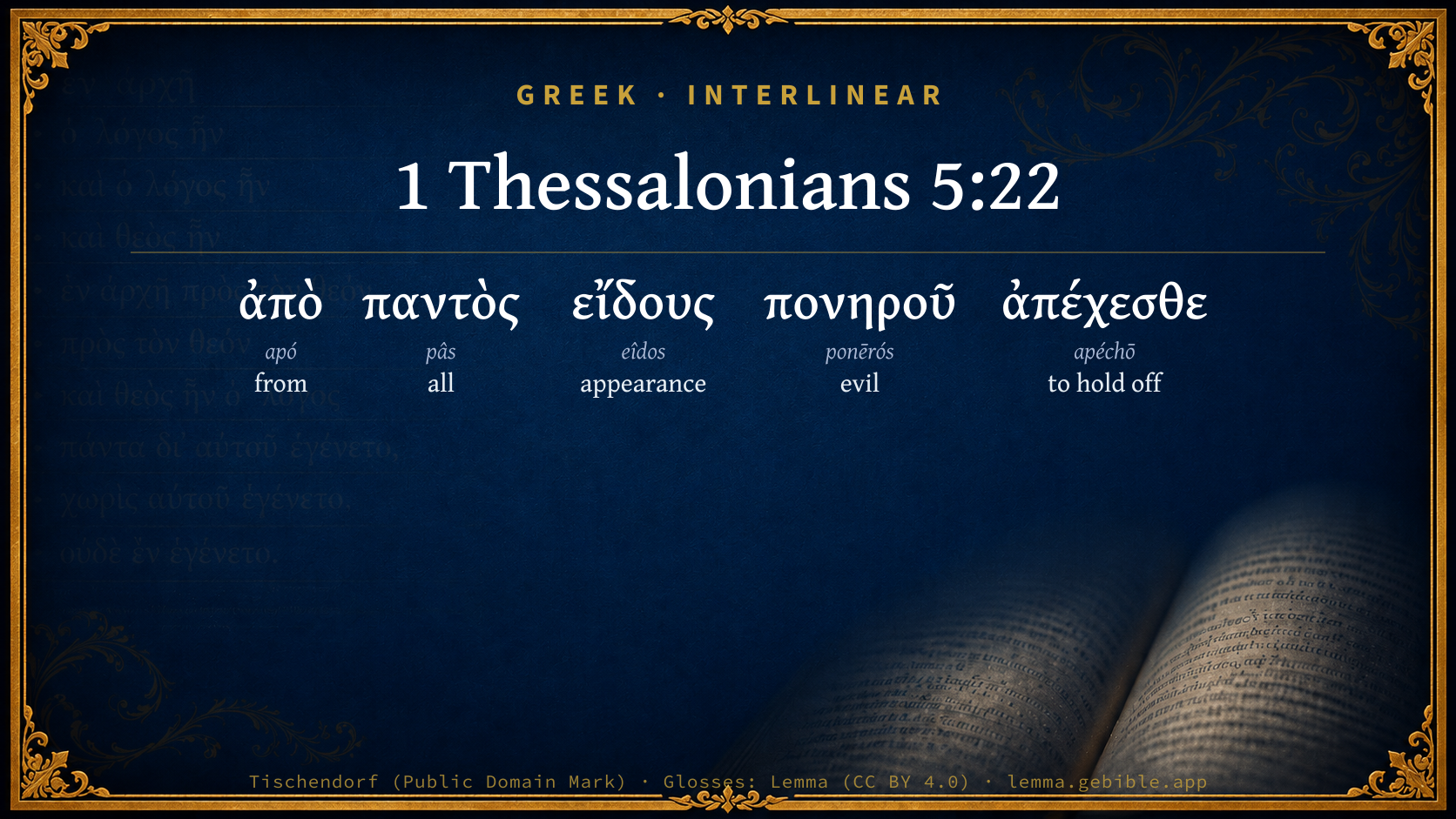
Greek (Tischendorf 8th ed.) 1 Thessalonians 5:22 appears in the Greek New Testament. The text above is from the Tischendorf 8th edition. Each word links to its Strong’s number and a concise gloss. Click any word for its full Thayer’s Greek Lexicon entry.
Download image
Cite this verse

1 Thessalonians 5:22 (World English Bible). Public Domain. Lemma interlinear Bible study tool, https://lemma.gebible.app/v/1-thessalonians/5/22.

Show BibTeX & RIS
BibTeX
RIS
English Translation
Abstain from every form of evil.
World English Bible · Public Domain
Download a study sheet

One document with this verse’s original text, its word-by-word gloss line, the meaning frame, cross-references with their text, attributed commentary, and full source and license credits — printable, and it pastes into notes with its structure intact.

This verse Autodidact and up

Study sheet (.html) Plain text (.txt)

A passage Seminary Student

Up to 50 verses in one chapter. A passage sheet keeps up to 6 commentary sources and 12 cross-references per verse, in the order this page ranks them, and says so on the sheet whenever that leaves anything out. Ask for a single verse and you get the Autodidact verse sheet above.

Everything on this page stays free to read, with no account — the sheet is a download of what is already on screen, not access to it.

Want to remove ads? Support Godless Engineer
Compare translations 3

The same verse in 3 English versions, stacked beneath the original-language interlinear above. Click any original word for its lexicon entry.

Each is an independent rendering of the whole verse — the interlinear is not word-aligned to these translations.

Highlighted words mark where these versions differ — a whole-verse word diff, not a word-by-word alignment.

  • World English Bible Public Domain
    Abstain from every form of evil.
  • King James Version Public Domain
    Abstain from all appearance of evil.
  • unfoldingWord Literal Text CC BY-SA 4.0
    Keep yourselves from every form of evil.

unfoldingWord Literal Text — © unfoldingWord, licensed CC BY-SA 4.0. Word-aligned USFM3 via Door43 (git.door43.org/unfoldingWord/en_ult).

Versions to compare (up to 4)

3 of 4 selected

Show all 19 translations

Every available English version of this verse, each an independent rendering of the whole verse.

  • World English Bible Public Domain
    Abstain from every form of evil.
  • Berean Standard Bible Public Domain
    Abstain from every form of evil.
  • Majority Standard Bible Public Domain
    Abstain from every form of evil.
  • King James Version Public Domain
    Abstain from all appearance of evil.
  • American Standard Version (1901) Public Domain
    abstain from every form of evil.
  • Revised Version (1885) Public Domain
    abstain from every form of evil.
  • Geneva Bible (1599) Public Domain
    Absteine from all appearance of euill.
  • Douay-Rheims (1899) Public Domain
    From all appearance of evil refrain yourselves.
  • Young's Literal Translation Public Domain
    from all appearance of evil abstain ye;
  • Literal Standard Version CC BY-SA 4.0
    abstain from all appearance of evil;
  • Unlocked Literal Bible CC BY-SA 4.0
    Avoid every appearance of evil.
  • unfoldingWord Literal Text CC BY-SA 4.0
    Keep yourselves from every form of evil.
  • Darby Bible Public Domain
    hold aloof from every form of wickedness.
  • World Messianic Bible Public Domain
    Abstain from every form of evil.
  • Webster's Bible Public Domain
    Abstain from all appearance of evil.
  • Free Bible Version CC BY-SA 4.0
    keep away from every kind of evil.
  • Bible in Basic English Public Domain
    Keep from every form of evil.
  • Text-Critical English NT CC BY 4.0
    Avoid every form of evil.
  • Tyndale New Testament (1534) Public Domain
    Abstayne from all suspicious thinges.

Literal Standard Version (2020), Covenant Press — licensed CC BY-SA 4.0. Text via the HelloAO Bible API (eBible.org). Unlocked Literal Bible (unfoldingWord) — licensed CC BY-SA 4.0. Text via the HelloAO Bible API (eBible.org). unfoldingWord Literal Text — © unfoldingWord, licensed CC BY-SA 4.0. Word-aligned USFM3 via Door43 (git.door43.org/unfoldingWord/en_ult). Free Bible Version, Dr. Jonathan Gallagher — licensed CC BY-SA 4.0. Text via the HelloAO Bible API (eBible.org).

Word by word

More ways to search: Search by grammar → Find every occurrence → Compare this word →

Practice this passage: Drill this verse → Learn its vocabulary →

About this verse

These counts appear in no published source. They are computed here, from the morphology-tagged text and Lemma’s own curated glosses. What Lemma adds →

5
words
5
distinct lemmas
Pauline Epistles
section

Notable vocabulary

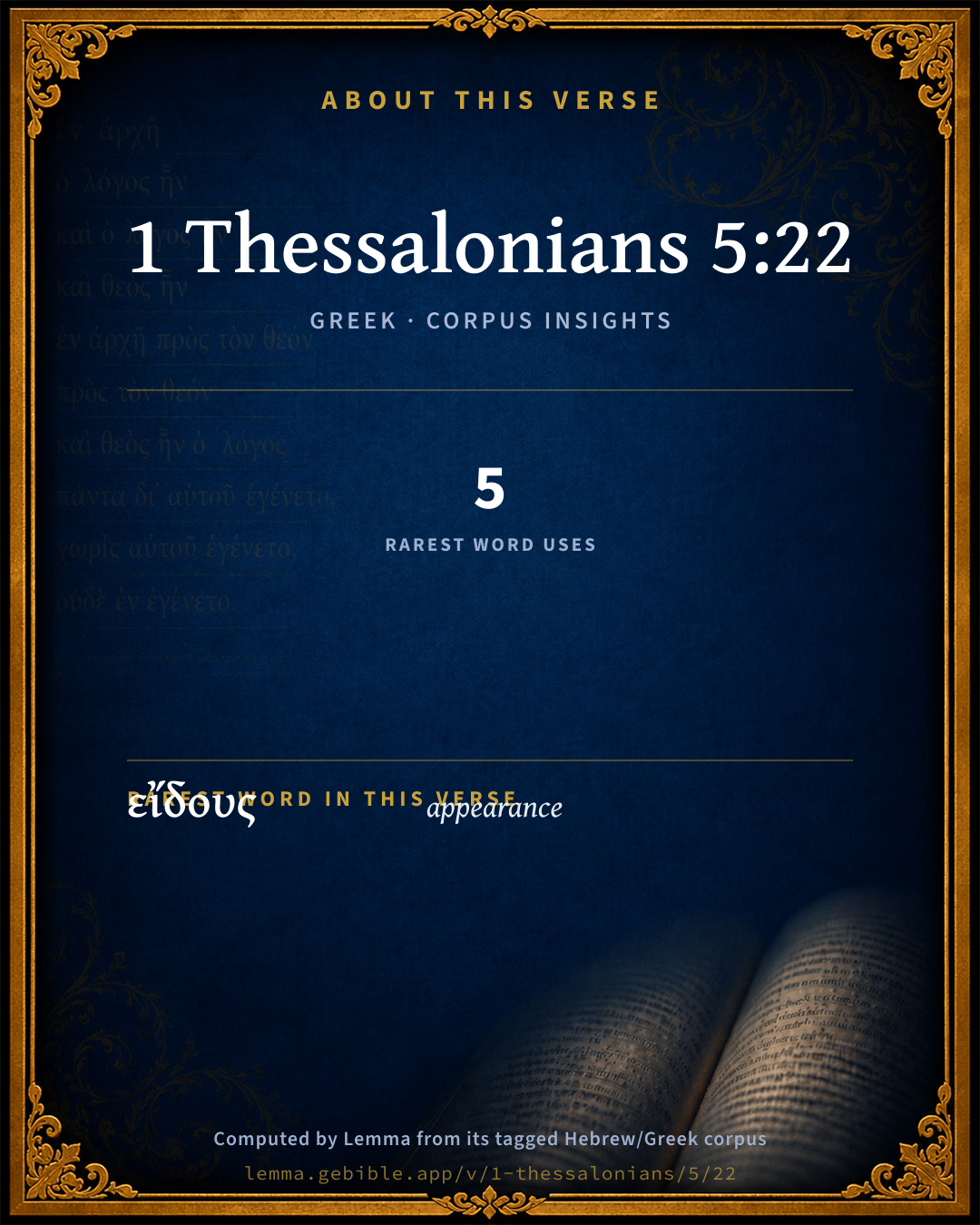
The rarest word here is εἴδους appearance G1491 — appearing just 5 times in the whole Greek New Testament.

Shared distinctive vocabulary

εἴδους appearance G1491 occurs in 5 verses of the Greek New Testament. Also found in:

Cross-references

11

Topical passages linked to 1 Thessalonians 5:22 in the Treasury of Scripture Knowledge — connected by theme and wording, ordered by reader-vote popularity; previews shown in the World English Bible.

  • 2 Corinthians 6:3 We give no occasion of stumbling in anything, that our service may not be blamed,
  • Philippians 4:8 Finally, brothers, whatever things are true, whatever things are honorable, whatever things are just, whatever things are pure, whatever things are lovely, whatever things are of good report; if there is any virtue, and if there is any praise, think about these things.
  • 2 Corinthians 8:20–21 We are avoiding this, that any man should blame us concerning this abundance which is administered by us.
  • 1 Corinthians 10:31–33 Whether therefore you eat, or drink, or whatever you do, do all to the glory of God.
  • Romans 12:17 Repay no one evil for evil. Respect what is honorable in the sight of all men.
  • Exodus 23:7 "Keep far from a false charge, and don't kill the innocent and righteous: for I will not justify the wicked.
  • 1 Corinthians 8:13 Therefore, if food causes my brother to stumble, I will eat no meat forevermore, that I don't cause my brother to stumble.
  • 1 Thessalonians 4:12 that you may walk properly toward those who are outside, and may have need of nothing.
  • Jude 1:23 and some save, snatching them out of the fire with fear, hating even the clothing stained by the flesh.
  • Isaiah 33:15 He who walks righteously, and speaks blamelessly; he who despises the gain of oppressions, who shakes his hands from taking a bribe, who stops his ears from hearing of blood, and shuts his eyes from looking on evil:
  • Matthew 17:26–27 Peter said to him, "From strangers." Jesus said to him, "Therefore the children are exempt.

Cross-references courtesy of OpenBible.info (CC BY 4.0).

Commentary

Notes on 1 Thessalonians 5:22 from classic Christian and Jewish commentators (each source and its license shown beneath its notes). The classic Christian expositions comment on the surrounding passage and are grouped to its opening verse, so a note may address several verses; the Jewish commentaries on the Tanakh (Rashi and others) are per-verse, so they appear only where the commentator wrote on this verse.

Lemma curates 59 commentaries, every one of them public domain or Creative Commons licensed, each selected and text-cleaned for this edition rather than reprinted as found. About our sources →

The Biblical Illustrator

Joseph S. Exell

1Th_5:22

Abstain from all appearance of evil

Safe conduct

A man will never begin to be good till he begins to decline those occasions that have made him bad; therefore saith St.

Paul to the Thessalonians, and through them to all others, Abstain from all appearance of evil.

I. The way to fulfil this counsel. You must shun and be shy of the very shows and shadows of sin. The word which is ordinarily rendered appearance, signifies kind or sort; and so the meaning of the apostle seems to be this, Abstain from all sort, or the whole kind, of evil; from all that is truly evil, be it never so small. The least sin is dangerous. Caesar was stabbed with bodkins, and many have been eaten up by mice. The least spark may consume the greatest house, the tinest leak may sink the noblest vessel, the smallest sin is enough to undo the soul, and, therefore, shun all the occasions that lead to it. Job made a covenant with his eyes (Job_31:1), Joseph would not be in the room where his mistress was (Gen_39:10), and David, when himself, would not sit with vain persons (Psa_26:3-7). As long as there is fuel in our hearts for a temptation we cannot be secure: he that hath gunpowder about him had need keep far enough off from sparkles; he that would neither wound conscience nor credit, God nor Gospel, had need hate the garment spotted with the flesh. In the law, God commanded His people not only that they should worship no idol, but that they should demolish all the monuments of them, and that they should make no covenant nor affinity with those who worshipped them, and all lest they should be drawn by those occasions to commit idolatry with them. He that would not taste of the forbidden fruit must not so much as gaze on it; he that would not be bitten by the serpent, must not so much as parley with him. He that will not fly from the occasions and allurements of sin, though they may seem never so pleasant to the eye or sweet to the taste, shall find them in the end more sharp than vinegar, more bitter than wormwood, more deadly than poison.

II. Noted examples to incite us. Scipio Africanus, warring in Spain, took New Carthage by storm, at which time a beautiful and noble virgin resolved to flee to him for succour to preserve her chastity. Hearing of this, he would not suffer her to come into his presence for fear of temptation, but caused her to be restored in safety to her father. Livia counselled her husband Augustus not only to do no wrong, but not to seem to do it. Caesar would not search Pompeys cabinet, lest he should find new matters for revenge. Plato mounted upon his horse, and judging himself a little moved with pride, at once alighted, lest he should be overtaken with loftiness in riding. Theseus is said to have cut off his golden locks, lest his enemies should take advantage by laying hold of them. Oh, Christian people! shall the very heathen, who sit in darkness, shun and fly from the occasion of sin, and will not you, who sit under the sunshine of the gospel? To prevent carnal carefulness, Christ sends His disciples to take lessons from the irrational creatures (Mat_6:26-32). And to prevent your closing with the temptation to sin, let me send you to school to the like creatures, that you may learn by them to shun and avoid the occasions of sin. A certain kind of fish, perceiving themselves in danger of taking, by an instinct which they have, do darken the water, and so many times escape the net which is laid for them. And a certain kind of fowl, when they fly over Taurus, keep stones in their mouths, lest by shrieking and gabbling they discover themselves to the eagles, which are among the mountains, waiting for them. Now, if all these considerations put together will not incite you to decline the occasions of sin, I know not what will. (T. Brooks.)

Avoiding the appearance of evil

I. The nature of those appearances of evil we are required to avoid.

1. Whatever may be interpreted as evil by others, so as to become a stumbling block or matter of reproach. Their consciences may be too scrupulous and their tempers censorious, yet we are not to offend or grieve the weak unnecessarily. The omission of things indifferent, can neither be sinful nor injurious, their commission may be both (1Co_8:13). This must, of course, be understood with some limitation, else there would be no end of conforming to mens humours and fancies; therefore good men must be left to act according to their own scruples and may disregard scruples which have no shadow of reason or Scripture to support them.

2. What may be an occasion of evil to ourselves. Some things not evil may lead to evil. Peters going into the palace of the high priest led to his denial of Christ. Achans looking stirred up his covetousness; hence David prays to be turned away from beholding vanity, and our Lord taught us to say, Lead us not into temptation, but, etc. The fly that buzzes about the candle will at length singe its wings.

3. Whatever borders on evil or approaches towards it. Instead of inquiring how far we may go in gratifying this or that appetite without offending God, let us keep as far away as we can. If you would not swear do not use expletives: if you would be temperate do not load your table with superfluities.

4. The first risings of evil in the heart such as anger, covetousness, uncleanness. When lust hath conceived it bringing forth sin, etc. Keep thy heart with all diligence, therefore.

II. When may we be said to abstain from every appearance of evil? When our whole conduct will bear the light; when we are sincere in our intentions and circumspect in our actions; when the Divine glory is our aim and the good of man our work. To this end incessant watchfulness is required.

1. In the common concerns of life. Everything like artifice or dishonesty is unworthy of the Christian character (1Th_4:6),

2. In our amusements and recreations. They must be innocent and lawful, few and inexpensive, healthful and select.

3. In our daily intercourse. We must speak the words of truth and soberness (Eph_4:29; Jam_5:12).

4. In religious exercises, Let not your good be evil spoken of.

III. The motives. By abstaining from the appearance of evil.

1. Many of our falls will be prevented.

2. It will give credit to our profession, and tend to convince the world of the reality of our religion.

3. It will contribute much to the peace and satisfaction of our minds. (B. Beddome, M. A.)

Abstinence from the appearance of evil

The tendency is to place too high an estimate on appearances. Hence outward religion comes to be magnified at the expense of inward holiness. To guard against this great stress is laid in the Bible on piety in the heart: but this has lead people to say, Appearances are nothing--it is with the heart God has to do. The object of the text is to give appearances their real importance It is therefore connected with several injunctions which relate to inward and practical Godliness and which issue in a prayer which shows that abstinence from the appearance of evil is an essential attribute of entire sanctification.

I. The import of the precept. There may be the appearance of evil where evil is not intended and where there is no evil in fact.

1. In our actions.

(1) In our social intercourse we may aim to show a proper regard to men of the world for our improvement or for their own, but this association may appear to be the result of elective affinity.

(2) In our pursuits we may seem to ourselves to be merely diligent in business, while we may appear to be contravening the prohibition of laying up treasures upon earth.

(3) In our dress and furniture we may merely seek our own convenience, while to others we may appear conforming to the world.

(4) In our contributions and other expenditure we may seem to be merely liberal, but to others prodigal.

(5) In our intercourse with the other sex we may think ourselves only courteous, but appear to others amorous.

Conversely--

(1) We may shun society for the purpose of avoiding its contamination, but appear to others to forget our social relations and duties.

(2) We may design to live above the world, but the world may think us negligent of business.

(3) We may intend to be plain in dress, but appear to others to make religion consist in plainness.

(4) We may be merely economical, but appear penurious.

(5) We may think ourselves correct in our bearing to the other sex, but they may think us morose. It is difficult to determine on which side of the happy medium the greatest evil lies, but as the least appearance of evil is injurious we should always be on our guard.

2. In our words.

(1) We may design to be free and pleasant and yet appear trifling.

(2) We may be in earnest only, and yet appear to be in a passion.

(3) We may be faithful in reproof and appear censorious.

(4) We may only intend to use plain language but it appears course and indelicate.

(5) We may be imparting instruction and be voted conceited.

3. In our spirit.

(1) Zeal may have the appearance of fanaticism;

(2) Elevation of mind, of haughtiness;

(3) Promptness of obstinacy;

(4) Calmness of stoicism;

(5) Humility of mean spiritedness;

(6) Deliberation of infirmity of purpose.

II. The reasons for the precept.

1. Those which affect ourselves. Falling into evil appearances--

(1) Results from the want of a correct taste, a well disciplined conscience, knowledge, watch fulness, evils which will ripen into bad habits if not checked.

(2) Will mar our own enjoyment of religion when we find that it has done harm.

(3) Will ruin our usefulness which depends on our influence, which acts through appearances, and is estimated by them.

2. Those which affect Gods glory. We honour God in proportion as we exhibit a practical illustration of the purity of the Christian character before the world. The ungodly associate our blemishes with our religion.

3. Those which regard the well-being of others. All example consists in appearances, and no one liveth to himself; we are contributing by our appearances to the formation of the characters of those around us, and any one of those appearances may make all the difference between heaven and hell.

III. Inferences.

1. That appearances are of high importance.

2. That appearances, and not what a man means, determine his influence as a member of the Church.

3. That the qualities which will enable us to avoid the appearance of evil should be sedulously cultivated--an accurate judgment, a tender conscience, perfect self-knowledge.

4. That the Scriptures which pourtray so minutely the appearances of evil should be diligently studied. (G. Peck, D. D.)

Avoiding sins of every appearance

1. The appearance of material things does not depend entirely upon their form, but largely upon the medium through which, the light in which, and the eye by which they are seen. Some men are colour blind. Some men have the jaundice. Thoughts and feelings are still more liable to be misapprehended, because they must be addressed by one soul to another through the senses--the eye, the ear, the touch, by the pressure of the hand, by speech, by gesture, by writing. A thought or emotion, therefore, suffers a double refraction in passing from one mind to another. And thus it comes to pass that even in communities composed of most serene and wise intellects and loving hearts, the appearance does not always match and represent the ideal.

2. The difficulty of the rule as it stands in our version is this, that there is nothing so good but it may appear evil. To the evil all things seem evil, and you cannot help that. Was there ever a virtue that did not seem a vice to a mans enemy? Does not his liberality appear prodigality, his economy parsimony, his cheerfulness levity, his conscientiousness puritanism, his temperance asceticism, his courage foolhardiness, his devotion hypocrisy? How is it possible to avoid such judgments as these unless a man could have the whole world for his friends? Can the heavenly Father demand more of you than that you really be true and faithful and pure? Must you also fritter your strength away in striving to make your good life seem good in the eyes of perverse men?

3. The attempt to gain the favourable verdict of all men is not only impracticable, but it is demoralizing. It occupies a man with appearances, and not realities; with his reputation, and not with his character. There can be devised no shorter cut to hypocrisy than a constant effort to abstain from all appearance of evil.

4. What, then, did the apostle mean? The difficulties of the text are removed by the translation abstain from evil of every form. The lesson is total abstinence from what is really evil. The complementary thought is that evil can never be good by a mere change of appearance. Let us look at some of the ways in which we may follow what is really evil because its appearance is good, and show how Satan disguises himself as an angel of light.

I. Unity and uniformity. The most important thing about any man is his faith. A thorough belief in a real truth is life: it will reproduce itself in the outward action. How easy it is here to find real evil that is apparently good. To strive to compel men to uniformity seems a goud, whereas it is really an evil. One may even quote Scripture in justification. One faith. A man may forget that the essential principle may be one, while the phenomenal presentation may be manifold. All compulsory uniformity is mischievous. The inquisition produced cruelties among good men, and hypocrisies among bad. In its essence truth has always unity, in its development seldom uniformity. Some think it would be delightful for all men to see truth at the same angle; but if there were but two men who should profess to do it, it would be either a mistake, or a falsehood. Give over the effort to secure ecclesiastical uniformity. Let grace be natural, and nature gracious. Give room for God in man, and in the Church as you do in nature.

II. Liberty and licentiousness. There is something very captivating in liberty. The very word sounds open and breezy. Liberty has been made a queen and a goddess. More money has been spent for her, and more blood shed for her, than for any other. When one recollects the history of the race, one is not surprised that when Madame Roland was going to her doom, she should have saluted the statue of Liberty with the bitter exclamation, O Liberty, what outrages are perpetrated in thy name! It is exceedingly difficult to draw the line between licentiousness and liberty, and hence the danger is greater. True freedom of intellect and heart and life consists in voluntary and exact obedience to the law of God. A compulsory obedience is mere hypocrisy. An inexact obedience is a perpetual weakness. Every step taken in the statutes of the Lord with a free will is a step of freedom. David perceived this when he said, I will walk at liberty, for I seek Thy precepts. But, the moment a man lifts his foot from the law of the Lord, and sets it down outside, he places it in the nets of evil, and is ensnared. But the modern and atheistic idea of liberty is the absence of all moral law, or the refusal to be controlled by law. In other words, it is licentiousness. Avoid it, no matter what its appearance. How vast are the hull and rigging of the largest vessel on the ocean, and how small is the helm; and yet that little helm turns that great bulk whithersoever the helmsman listeth. Suppose the great vessel should say, I will not endure this impertinent interference, this incessant control, and should throw the helmsman overboard, and unship both helm and rudder. She would be free then, would she not? Yes, but a free prey to all winds and waves. Is that the freedom to be desired? And yet that is the idea of this age. The State, the Church, the family are to be overthrown, for men must be free! It is pitiful and painful to see human beings struggling to be free, to be hated, to starve, to die, to be damned. Avoid this evil. Remember that no splendour of dress can make a leper clean, and no brilliancy of appearance can make an evil good.

III. Justice and intolerance. The dogma of infallibility is not a mere ecclesiastical development. Its seed is in every heart. If we are unconscious of it, who does not act upon it? We pronounce judgment as if there could be no appeal, and act upon such sentences as final. Nay, more. There is a disposition on the part of many to go beyond, and keep surveillance of society, making themselves general detectives. They are often heresy hunters, self-constituted health boards, enforcing social sanitary regulations of their own. The plain fact is, they are censorious. The reason they did not abstain from this evil is, because it has the appearance of good. It seems to evince a high moral sense. It looks like loyalty to truth, and unselfish. The man is not seeking to be popular! He is a martyr to his sense of right? It is good and grand! He applauds himself. He feels that others ought to applaud him. He undertakes to execute his own sentences. The condemned is treated like a leper, like a lost man. All that is done that the purity of the judge shall be evinced. Men and women seem to think that kindness to a sinner is endorsement of, and participation in his sin. Hence the evil of social ostracism. A man that has fallen has so few helps to rise, and a woman who has fallen has no aids but what God gives. Abstain from this evil of censoriousness, whatever appearance it may have. It is very easy to get up the requisite amount of virtuous indignation, but it is difficult to keep indignation virtuous. While burning the sins I ought to hate, it will soon begin to burn the sinner whom I ought to love.

IV. Generosity and prodigality. The latter is an evil under any name and in every guise. It leads men to be careless and lazy about their expenditures. Because there are so many easy givers, there are so many easy beggars. It is injurious to give to the undeserving as it is injurious to withhold from those who deserve. The man who walks through the streets talking or thinking, and pulls something out of his pocket for every beggar without looking the applicant in the face, or recollecting him ten minutes after, is not charitable. He is a thriftless prodigal. True charity, and true liberality, and true generosity know how much, and to whom, and why, they gave; not in remembrance of self-complaisance, but that they may see how much more they can do. Abstain from the evil of prodigality which has the appearance of liberality.

V. Economy and stinginess. The grip of selfishness on money is the vice that makes a man feel that it is better ninety-nine worthy cases suffer than that one unworthy case be helped. It is a stone-blind vice. Men know when they are liars, thieves, murderers, but they do not know when they are covetous. Every sin committed by man against man has been admitted by some one who was guilty, except two; and one of them is covetousness. It puts on so good an appearance! It is called among men prudence, economy, thrift, any word which glosses over the inner viciousness. It was so in the time of David, who said, Men will praise thee when thou doest well to thyself. But abstain from this evil of doing so well for yourself that you can do nothing for others, and remember that the Lord will praise thee when they doest well to another.

VI. Independence and contempt for appearances. We are not to do a thing that is wrong because it has the appearance of right in the eyes of many, and we are bound to do good, however it may seem to others; but we are also to see to it that our good be not evil spoken of. There is in some men a swaggering boastfulness of independence of the opinion of others, of determination to do just what they think right, and of regardlessness of the feelings of others. They think it looks well. There is an appearance of stern virtue in all this; of character; of independence. Any voluntary hazarding of the appearance of evil is most foolish, if not criminal. No man has a right on any pretence to give a just offence to the moral sentiments of the community. (C. F. Deems, D. D.)

Avoiding the appearance of evil

Venn was given to understand that a lady to whom his ministry had been singularly blessed, had been pleased to requite her obligations by making him heir to her property, which was very considerable. And we may not doubt that he gladly accepted the intended favour, and persuaded himself that it was a seasonable gift from God, for the relief of his mind, and for the comfort of his family. Perhaps he might have so reasoned and felt, in regard to it, but the following letter which he addressed to the lady, on hearing of her kind intention, will show in what a pure, lofty sphere his spirit moved: My very dear friend, I understand, by my wife, your most kind and generous intention toward us in your will. The legacy would be exceedingly acceptable, and I can assure you the person from whom it would come would greatly enhance the benefit. I love my sweet children as much as is lawful, and as I know it would give you pleasure to minister to the comfort of me and mine, I should, with greater joy, accept of your liberality. But an insurmountable bar stands in the way--the love of Him to whom we are both indebted, not for a transient benefit, for silver or gold, but for an inheritance, incorruptible, undefiled, and that fadeth not away, reserved in heaven for us. His honour, His cause, is, and must be, dearer to His people than wife, children, or life itself. It is the firm resolve of His saints, yea, doubtless, I count all things but loss for the excellency of the knowledge of Christ Jesus my Lord. To be, therefore, a stumbling block in the way of any that are seeking Him--to give the least countenance to any that would be glad to bring His followers into contempt, and call in question their sincere and disinterested attachment to Him would grieve me while in health, darken my mind in sickness, and load me with self-condemnation on a bed of death. How would it also render all my exhortations feeble, and make them be accounted only as pulpit declamation, if, when I was pressing that solemn truth upon my people, Love not the world, neither the things in the world, they could say, our minister, however, was careful to secure the favour of this rich proselyte, and, at length, to gain sufficiently by her! After the most mature deliberation, therefore, it is our request, which we cannot permit you to refuse us, that you will not leave us any other token of your regard than something of little value, but what it derives from the giver. If it should please God that our connection should be prolonged some years, we shall, in our hearts, still more abundantly enjoy your friendship when we are sure that we are not in danger of being influenced by a regard to our own interest. And if we must soon have the cutting affliction of losing you, you may depend on it, we shall not less affectionately make mention of your name, and your unfeigned love for us both in Christ Jesus, than if we had what the world esteems the only substantial proof of your regard. As for our children, whom many will think that we have not the love for that we owe them, by refusing your great favour, I would say only this, we both know of no inheritance equal to the blessing of God; and the certain way of securing it, as far as means can avail, is to be found ready to love or suffer any thing sooner than to incur the appearance of evil. (Memoir of Venn.)

The appearance of evil

A missionary magazine, in giving an account of the conversion to Christianity of a high-caste Brahmin in India, stated, as a good test of the new converts sincerity, the following fact: A Christian friend, knowing that the Hindoo custom of wearing the hair long, and fastened with sacred flowers in a knot at the back of the head, was intimately connected with certain acts of idolatrous worship, advised the Brahmin to cut off this hair at once, and thus demonstrate to all men that he had really ceased to be an idolater. To this suggestion the convert promptly replied, Yes, certainly, for it is the devils flag. Accordingly, the hair was immediately cut off.

The appearance of evil

An old Chinese proverb says, Do not stop in a cucumber field to tie the shoe. The meaning is very plain. Some one will be likely to fancy that you are stealing fruit. Always remember the injunction: Abstain from all appearance of evil. Do not stop under the saloon porch to rest yourself, however shady the trees may be, or however inviting the chairs. Some one may fancy you are a common lounger there, and so your name be tarnished. Dont go to a liquor saloon to get a glass of lemonade, however refreshing it may seem to you. Rather buy your lemons and prepare the cooling beverage at home, where others may share it with you, probably at no greater expense than your single glass would cost you. Somebody seeing you drinking at the bar will be sure to tell the story, and will not be particular to state that you were drinking only lemonade. Then, too, if you are careless about the appearance of evil, you will soon grow equally careless about the evil itself. (Great Thoughts.)

Fear of sin

The old naturalist, Ulysses Androvaldus, tell us that a dove is so afraid of a hawk, that she will be frightened at the sight of one of its feathers. Whether it be so or not, I cannot tell; but this I know, that when a man has had a thorough shaking over the jaws of hell, he will be so afraid of sin, that even one of its feathers--any one sin--will alarm and send a thrill of fear through his soul This is a part of the way by which the Lord turns us when we are turned indeed. (C. H. Spurgeon.)

The need of guarding against all evil

Manton says: A man that would keep out the cold in winter shutteth all his doors and windows, yet the wind will creep in, though he doth not leave any open hole for it. We must leave no inlet for sin, but stop up every hole and cranny by which it can enter. There is need of great care in doing this, for when our very best is done sin will find an entrance. During the bitter cold weather we list the doors, put sandbags on the windows, draw curtains, and arrange screens, and yet we are made to feel that we live in a northern climate: in the same way must we be diligent to shut out sin, and we shall find abundant need to guard every point, for after we have done all, we shall, in one way or another, be made to feel that we live in a sinful world. Well, what must we do? We must follow the measures which common prudence teaches us in earthly matters. We must drive out the cold by keeping up a good fire within. The presence of the Lord Jesus in the soul can so warm the heart that worldliness and sin will be expelled, and we shall be both holy and happy. The Lord grant, it for Jesus sake. (C. H. Spurgeon.)

The Biblical Illustrator, edited by Joseph S. Exell (c. 1880s–1900s) — public domain. Text from a community e-Sword module.

Tyndale Open Study Notes

Tyndale Open Resources

5:22 They should reject every kind of evil, especially false prophecies (5:19-21).

Tyndale Open Study Notes — © Tyndale Open Resources, licensed CC BY-SA 4.0. Text via the HelloAO Bible API.

Bengel's Gnomon

Johann Albrecht Bengel

1Th 5:22. Ἀπὸ παντὸς εἴδους πονηροῦ, from every bad species or kind of thought, act, or word) Species, in the sense, “appearance of evil” [as Engl. Vers.], would be εἶδος ΤΟΥ πονηροῦ, with the article, which TO καλὸν, that which is good, has, 1Th 5:21. But εἶδος πονηρὸν is a bad kind or species: εἶδος, species, Germ. Gattung; LXX., Jer 15:3 [“I will appoint over them four kinds—the sword—the dogs—the fowls—the beasts”]; Sir 23:21 (16), 25:(2) 3. We ought to abstain from every species of evil [evil species of thing], lest we be deceived. The whole genus of good is simple, belonging to the “spirit, soul, and body,” [1Th 5:23]; the species or kinds of evil are many, 2Co 7:1; comp. the antithesis in the following verse.

Bengel's Gnomon of the New Testament — English translation (T&T Clark, Edinburgh, 1860) — public domain. Text from a community e-Sword module.

Meyer's Critical & Exegetical Commentary

Heinrich August Wilhelm Meyer

1Th_5:22. With 1Th_5:22 the discourse again reverts to what is general, whilst the requirement to hold fast that which is good in the discourses of the inspired very naturally required the transition to the further requirement to keep at a distance from every kind of evil, accordingly also from that which was perhaps intermixed in these discourses. Usually 1Th_5:22 is referred exclusively to the discourses of the inspired, so that πάντα δὲ δοκιμάζετε contains the chief point which is then unfolded according to its two sides, first positively (τὸ καλὸν κατέχετε), and then negatively (1Th_5:22). But ἀπὸ παντὸς εἴδους πονηροῦ is against this view: ἀπὸ τοῦ πονηροῦ would require to have been written. Erasmus, Luther, Calvin, Drusius, Piscator, Grotius, Calixt, Calovius, Seb. Schmid, Michaelis, and others find in 1Th_5:22 the meaning: avoid all evil appearance. But (1) εἶδος never signifies appearance. (2) A distorted thought would arise. For as the apostle has required the holding fast not that which has the appearance of good, but that which is actually good; so also in 1Th_5:22, on account of the close reference of πονηροῦ to the preceding καλόν, the discourse must also be of an abstinence from that which is actually evil. (3) To preserve oneself from all appearance of evil is not within the power of man.

Εἶδος denotes very often the particular kind of a class (the species of a genus). Comp. Porphyry, isagoge de quinque vocibus 1 Thessalonians 2 : λέγεται δὲ εἶδος καὶ τὸ ὑπὸ τὸ ἀποδοθὲν γένος· καθʼ ὃ εἰώθαμεν λέγειν τὸν μὲν ἄνθρωπον εἶδος τοῦ ζώου, γένους ὄντος τοῦ ζώου· τὸ δὲ λευκὸν τοῦ χρώματος εἶδος· τὸ δὲ τρίγωνον τοῦ σχήματος εἶδος.

πονηροῦ] is not to be taken, with Bengel, Pelt, Schott, and others, as an adjective (ab omni mala specie), but as a substantive (ab omni specie mali). What Bengel and Schott object against this meaning, that the article τοῦ would be required before πονηροῦ, would be correct if the discourse were specially of the πονηρόν contained in the πάντα, 1Th_5:21; but is erroneous, as πονηροῦ is taken in abstract generality. See Kühner, II. pp. 129, 141. Comp. Heb_5:14; Joseph. Ant. vii. 4. 1 Thessalonians 2 : πᾶν εἶδος μέλους; ibid. x. 3. 1 Thessalonians 1 : πᾶν εἶδος πονηρίας.1Th_5:22, as well as 1Th_5:21, is peculiarly interpreted by Hänsel (Theol. Stud. u. Krit. 1836, Part 1, p. 170 ff.).[66] 1Th_5:21-22 are repeatedly cited by Cyril Alexandrinus as an expression of the Apostle Paul, in such a manner that with this citation, and indeed as its contents, the words ΓΊΝΕΣΘΕ ΔΌΚΙΜΟΙ ΤΡΑΠΕΖῖΤΑΙ are united. Also these words are elsewhere frequently by the Fathers united with our passage, being quoted sometimes as a saying of Christ, sometimes generally as a saying of Scripture, and sometimes specially as a saying of the Apostle Paul. See Suicer, Thesaurus, II. p. 1281 ff. (Sacr. Observ. p. 140 ff.); Fabricius, Cod. Apocr. N. T. I. p. 330 ff., III. p. 524. On this Hänsel supports his opinion. He regards the words γίνεσθε δόκιμοι τραπεζῖται as a saying of Christ, and thinks that this dictum ἌΓΡΑΦΟΝ of the Lord was in the mind of the Apostle Paul, and in consequence of this the expressions in 1Th_5:21-22 were selected by him, which were usual in the money terms employed by antiquity. So that the sense would be: Act as experienced exchangers; everything which is presented to you as good coin, that test; preserve the good coin (what actually is divine truth), but guard against every false coin (reject all false doctrine). But evidently only the expression ΔΟΚΙΜΆΖΕΤΕ was the occasion for the Fathers uniting the dictum ἌΓΡΑΦΟΝ of Christ, handed down by tradition, with our passage. Paul, on the contrary, could not have thought of it, even supposing it to have been known to him. For although the verb ΔΟΚΙΜΆΖΕΙΝ would well suit, if otherwise the reference was to the figure of exchangers, yet in an actual reference to the same the words τὸ καλὸν εἶδος κατέχετε, ἀπὸ δὲ τοῦ πονηροῦ ἀπέχεσθε would have been written. Lastly, add to this that ΕἾΔΟς cannot import in itself a coin, νομίσματος must be added, or money must have been spoken of in what goes before.

[66] Baumgarten-Crusius accedes to the interpretation of Hänsel; Koch strangely rejects it for ver. 22, but adopts it for ver. 23.

Meyer — Critical and Exegetical Commentary on the New Testament — English translation by Peter Christie, edited by Frederick Crombie (T&T Clark, 1880) — public domain. Text from a community e-Sword module.

Expositor's Greek Testament

ed. W. Robertson Nicoll

1Th 5:22 . A further general precept, added to bring out the negative side of κατέχετε , κ . τ . λ . πονηροῦ neut. abstract = “of wickedness,” as Gen 2:9 ( τοῦ εἰδέναι γνωστὸν καλοῦ καὶ πονηροῦ ). παντὸς κ . τ . λ ., perhaps an allusion to the manifold ways of going wrong (Arist., Nik. Eth. , ii. 6 14, τὸ μὲν ἁμαρτάνειν πολλαχῶς ἐστίν … τὸ δὲ κατορθοῦν μοναχῶς ).

The Expositor's Greek Testament, edited by W. Robertson Nicoll (1897–1910) — public domain. Text from a community e-Sword module.

International Critical Commentary

22. εἴδους πονηρου. “Evil kind” of χάρισμ or πνεῦμ (cf. 1Co 12:10, 1Jn 4:1). As a result of testing it appears that there is but one kind of operation of the Spirit that can really be called such, namely, that which makes for the good; while the kinds which are attributed to the Spirit, but which prove themselves evil, are many. Hence, instead of ἀπὸ τοῦ πονηρου, “ to balance τὸκαλό, we have ἀπὸ παντὸς εἴδους πονηρου, “from every evil sort hold yourselves aloof” (ἀπέχωσθ as 4:3).

If τὸ καλὸν κατέχετ is general (Lft., Born, Wohl., et al.), then ἀπέχεσθ is likewise general; if, however, the former is specific (Lün., Ell. et al.), then the latter is likewise specific. The objection (Lün.) that the specific sense would require ἀπὸ τοῦ πονηρου is not cogent, for in v. 15 κακό is balanced by τὸ ἀγαθό; and furthermore Paul purposes to contrast the one good with the many evil forms. Whether πονηρου is a noun (De W., Lün., Ell., Schmiedel, Born, Vincent, Find., Wohl., Mill. and most) or adjective (Erasmus, Bengel, Pelt., Lft., Dob., et al.) is uncertain; in either case the meaning is the same (Calv.). The absence of the article “does not contribute to the decision” (Ell.); nor the possible allusion to Job 1:1 = 1:8 (ἀπεχόμενος ἀπὸ παντὸς πονηρου πράγματο) or 2:3 (ἀπεχόμενος ἀπὸ παντὸς κακου). Apart from ὁ πονηρό (II 3:3, 1Co 5:13, Eph 6:16) and τὸ πονηρό (Rom 12:9), πονηρό in Paul is an adjective and anarthrous (II 3:2, Col 1:21, Eph 5:16, Eph 6:13), unless Gal 1:4 (ἐκ τοῦ αἰῶνος τοῦ ἐνεστῶτος πονηρου is an exception.—εἶδο is rare in N. T. but common in Lxx It may mean (1) that which is seen whether “physical form” (Joh 5:37, Luk 3:22; frequently in Lxx of the human form καλό or αἰσχρὸς τῷ εἴδε) or “look,” “mien” (Luk 9:29, Job 41:10, Pro 7:10, etc.), or physical “appearance,” “manifestation,” quod aspicitur (e. g. 2Co 5:7, Exo 24:17, Num 9:15); or (2) “sort,” “kind,” “class” (Jer 15:3, Sir. 23:16, 25:2; cf. P. Tebt. 58:20 f. ἀπὁ παντὸς εἴδους(πυρου); cf. Witk., 78). This meaning fits our passage admirably. Calvin, however, misled by species (Vulg), understands εἶδο as “appearance” over against reality, “abstain not simply from evil but from all appearance of evil.” This interpretation puts the stress not on πονηρου (which τὸ καλό demands) but on εἴδου and introduces a meaning of εἶδο which is doubtful lexically.—From Hänsel (SK 1836, 170-184) to Resch (Agrapha, 2 112-128), it has been held frequently that in vv. 21-22 there is an allusion to an agraphon, γίνεσθε δόκιμοι τραπεζῖτα (on this agraphon, see Ropes, Sprüche Jesu, 141-143, or HDB V, 349). Rutherford seems to have this in mind when he translates: “Rather, assay all things thereby. Stick to the true metal; have nothing to do with the base.” There is, however, no mention of τραπεζῖτα or νόμισμ in this context; and, as we have seen, δοκιμάζει is, in the light of vv. 19-20, naturally to be understood of the testing of πνεύματ

V. PRAYER (5:23-24)

Recognising that the exhortations (4:1-5:22) especially to ethical consecration (4:3-8) and peace (5:12-13; cf. 4:10-12) would be of no avail without the divine assistance; and recognising further the necessity of the consecration not only of soul but of body (4:3-8),—a consecration which would be impossible unless the Spirit of God as immanent in the individual were inseparably bound to the human personality, body and soul; he prays first in general that God may consecrate them through and through, and then specifically that he may keep their spirit, the divine element, and the soul and body, the human element, intact as an undivided whole so that they may be blameless when the Lord comes. That the prayer will be answered is certain, for God the faithful not only calls but also consecrates and keeps them blameless to the end.

23Now may the God of peace himself consecrate you through and through, and may your spirit and soul and body be kept intact so as to be blameless at the coming of our Lord Jesus Christ. 24Faithful is he who calls you; who also will do this very thing.

International Critical Commentary — older volumes (1896–1929), various authors — public domain. Text from a community e-Sword module.

Geneva Bible (1599)

Geneva Bible translators

A general conclusion, that we waiting for the coming of Christ, do give ourselves to pureness both in mind, will, and body, through the grace and strength of the Spirit of God.

Whatsoever hath but the very show of evil, abstain from it.

Geneva Bible (1599) marginal notes — public domain. Text via Bolls.life.

Jamieson, Fausset & Brown

Robert Jamieson, A. R. Fausset & David Brown

TITTMANN supports English Version, "from every evil appearance" or "semblance." The context, however, does not refer to evil appearances IN OURSELVES which we ought to abstain from, but to holding ourselves aloof from every evil appearance IN OTHERS; as for instance, in the pretenders to spirit-inspired prophesyings. In many cases the Christian should not abstain from what has the semblance ("appearance") of evil, though really good. Jesus healed on the sabbath, and ate with publicans and sinners, acts which wore the appearance of evil, but which were not to be abstained from on that account, being really good. I agree with TITTMANN rather than with BENGEL, whom ALFORD follows. The context favors this sense: However specious be the form or outward appearance of such would-be prophets and their prophesyings, hold yourselves aloof from every such form when it is evil, literally, "Hold yourselves aloof from every evil appearance" or "form."

Jamieson, Fausset & Brown — Commentary Critical and Explanatory on the Whole Bible (1871) — public domain (CC PDM 1.0). Text via the HelloAO Bible API.

Adam Clarke's Commentary

Verse 22. Abstain from all appearance of evil.] Sin not, and avoid even the appearance of it. Do not drive your morality so near the bounds of evil as to lead even weak persons to believe that ye actually touch, taste, or handle it. Let not the form of it, ειδος, appear with or among you, much less the substance. Ye are called to holiness; be ye holy, for God is holy.

Adam Clarke's Commentary on the Bible (1810–1826) — public domain. Text from a community e-Sword/MySword module.

John Calvin's Commentaries

22 From every evil appearance. Some think that this is a universal statement, as though he commanded to abstain from all things that bear upon their front an appearance of evil. In that case the meaning would be, that it is not enough to have an internal testimony of conscience, unless regard be at the same time had to brethren, so as to provide against occasions of offense, by avoiding every thing that can have the appearance of evil.

Those who explain the word speciem after the manner of dialecticians as meaning the subdivision of a general term, fall into an exceedingly gross blunder. For he has employed the term speciem as meaning what we commonly term appearance. It may also be rendered either—evil appearance, or appearance of evil. The meaning, however, is the same. I rather prefer Chrysostom and Ambrose, who connect this sentence with the foregoing one. At the same time, neither of them explains Paul’s meaning, and perhaps have not altogether hit upon what he intends. I shall state briefly my view of it.

In the first place, the phrase appearance of evil, or evil appearance, I understand to mean — when falsity of doctrine has not yet been discovered in such a manner, that it can on good grounds be rejected; but at the same time an unhappy suspicion is left upon the mind, and fears are entertained, lest there should be some poison lurking. He, accordingly, commands us to abstain from that kind of doctrine, which has an appearance of being evil, though it is not really so — not that he allows that it should be altogether rejected, but inasmuch as it ought not to be received, or to obtain belief. For why has he previously commanded that what is good should be held fast, while he now desires that we should abstain not simply from evil, but from all appearance of evil? It is for this reason, that, when truth has been brought to light by careful examination, it is assuredly becoming in that case to give credit to it. When, on the other hand, there is any fear of false doctrine, or when the mind is involved in doubt, it is proper in that case to retreat, or to suspend our step, as they say, lest we should receive anything with a doubtful and perplexed conscience. In short, he shews us in what way prophecy will be useful to us without any danger — in the event of our being attentive in proving all things, and our being free from lightness and haste.

John Calvin's Commentaries (1540-1563) — public domain. Text from the Calvin Translation Society English edition (1840s-50s) via the Christian Classics Ethereal Library (ccel.org). Calvin's coverage is partial (roughly two-thirds of the Bible); uncommented books and verses are honest gaps, never fabricated. The 19th-century editor's footnotes and remarks are omitted so the notes are faithfully Calvin's own voice.

Ellicott's Commentary for English Readers

(22) Abstain from all appearance of evil.—This translation cannot stand. Possibly it might be rendered “every form of evil,” but the most natural version would be, “Hold yourselves aloof from every evil kind”—i.e., evil kind of whatever you may be testing. The word “evil” is here used in the moral sense, and does not constitute an exact antithesis to the “good” of the preceding verse.

A Bible Commentary for English Readers, edited by Charles John Ellicott (1878–1897) — public domain. Text from a community e-Sword module.

The Cambridge Bible for Schools and Colleges

gen. ed. J. J. S. Perowne

22. Abstain from all appearance of evil] from every form of evil (R. V.). The Apostle does not advise the Thessalonians to avoid what looks like evil; the command thus understood encourages the studying of appearances, and tends to the “doing of our works to be seen of men” which our Lord condemns (Mat_23:5). But in completing on the negative side the previous command, “hold fast the good (in prophesyings),” he gives to it the widest possible extension: “Keep yourselves not only from this, but from every sort of evil.” It is difficult, however, for the Greek scholar to justify the reading of evil in this sentence as a substantive, and the rendering of the governing noun by kind instead of appearance (rendered form, fashion, shape, in Luk_3:22; Luk_9:29, Joh_5:37). This noun St Paul uses once besides, in 2Co_5:7 : “We walk by faith, not by sight”—i.e. with no visible form, or appearance, to walk by. His meaning here may be similar: Abstain from every evil sight (or show)—from all that is evil in the outward show of things about you: ab omni specie mala (Vulgate).

There are two words for “evil” in Greek—that used here, signifying harmful, mischievous (so designating “the Evil One,” see note on 2Th_3:3); and that employed in 1Th_5:15, denoting bad, base, malicious.

With this emphatic word, keep yourselves, the Apostle concludes his directions to the Thessalonians, extending from 1Th_5:12-22, as to what they must do in order to preserve and sustain the life of grace in themselves. The prayer of the next verse invokes the power of God to accomplish for them that which mere human effort can never attain. Comp. the transition of ch. 1Th_3:11, expressed in similar language (see note), and of 2Th_2:16; 2Th_3:3. All that the Christian can do for his own safe-keeping, or for the service of his fellows, is merged in the greatness and completeness of that which God will do for them.

The Cambridge Bible for Schools and Colleges (gen. ed. J. J. S. Perowne; Cambridge University Press, 1878–1918) — public domain. Text from a community e-Sword module.

John Gill's Exposition

Faithful is he that calleth you,.... Into the fellowship of his Son, and to his kingdom and glory, and who continues to do so, not only externally by his word, but internally by his Spirit and grace.

Who also will do it. Two things the apostle mentions as the ground of confidence that the above petition, would be heard and answered; that is, that God would wholly sanctify them, and preserve the whole of them blameless to the coming of Christ; and they are the faithfulness of God, and the effectual calling of his saints. God is faithful to his word, his covenant and promises; he has promised to sanctify and cleanse his people from all their sins, and to preserve them safe to his kingdom and glory; agreeably the Arabic version renders this last clause, "and will execute his promise": and the effectual calling is a sure pledge of glorification; whom God calls he justifies and glorifies; as sure as he gives grace, he will give glory; and whom he calls to his eternal glory, he will make perfect, stablish, strengthen, and settle. The Complutensian edition reads, "who also will make your hope firm"; that is, with respect to the above things.

John Gill's Exposition of the Whole Bible (1746–1763) — public domain (CC PDM 1.0). Text via the HelloAO Bible API.

Trapp's Complete Commentary

John Trapp

22 Abstain from all appearance of evil.

Ver. 22. Abstain from all, &c.] Whatsoever is heterodox, unsound, and unsavoury, shun it, as you would do a serpent in your way or poison in your meats. Theodosius tare the Arian’s arguments presented to him in writing, because he found them repugnant to the Scriptures. And Austin retracteth even ironies only, because they had the appearance of lying. God commanded the Jews to abstain from swine’s flesh; they would not so much as name it, but in their common talk would call a sow dabbar Achar, another thing. (Elias Thisbit.)

John Trapp, A Commentary or Exposition upon All the Books of the Old and New Testament (1647–1656) — public domain. Text from a community e-Sword module.

Albert Barnes' Notes on the Bible

Abstain from all appearance of evil - Not only from evil itself, but from that which seems to be wrong. There are many things which are known to be wrong. They are positively forbidden by the laws of heaven, and the world concurs in the sentiment that they are wicked. But there are also many things about which there may be some reasonable doubt. It is not quite easy to determine in the case what is right or wrong. The subject has not been fully examined, or the question of its morality may be so difficult to settle, that the mind may be nearly or quite balanced in regard to it. There are many things which, in themselves, may not appear to us to be positively wrong, but which are so considered by large and respectable portions of the community; and for us to do them would be regarded as inconsistent and improper. There are many things, also, in respect to which there is great variety of sentiment among mankind - where one portion would regard them as proper, and another as improper.

There are things, also, where, whatever may be our motive, we may be certain that our conduct will be regarded as improper. A great variety of subjects, such as those pertaining to dress, amusements, the opera, the ball-room, games of chance and hazard, and various practices in the transaction of business, come under this general class; which, though on the supposition that they cannot be proved to be in themselves positively wrong or forbidden, have much the “appearance” of evil, and will be so interpreted by others. The safe and proper rule is to lean always to the side of virtue. In these instances it may be certain that there will be no sin committed by abstaining; there may be by indulgence. No command of God, or of propriety, will be violated if we decline complying with these customs; but on the other hand we may wound the cause of religion by yielding to what possibly is a mere temptation. No one ever does injury or wrong by abstaining from the pleasures of the ball-room, the theater, or a glass of wine; who can indulge in them without, in the view of large and respectable portions of the community, doing that which has the “appearance” at least of “evil?”

Albert Barnes' Notes on the Bible (1834–1885) — public domain. Text from a community e-Sword/MySword module.

Matthew Poole's English Annotations

To make this verse have its connection with the former, some expositors understand it of doctrines and opinions only; to take heed of opinions that seem erroneous, and not rashly to receive them without due examination. Though this sense is not to be excluded, yet the verse need not be confined to it, but to extend to practice also; as in worship to abstain from the show of idolatry; as to eat meat in an idol’s temple was not always gross idolatry, but had some appearance of it, and therefore the apostle forbids it, 1Co 10:14. And so in civil conversation, not only to abstain from vice, but the appearance of it; as of pride, covetousness, drunkenness, whoredom, &c.; and that both with respect to ourselves, lest by venturing upon that which hath some show of evil, we step into the evil itself; and with respect to others, that we may not occasion the taking offence though not justly given, or do that which may any way encourage a real evil in them by that appearance of it which they see in ourselves; yet we ought not upon this account to forbear the discharge of any necessary duty. Some read the words: Abstain from all kind of evil, ’ Apo pantov iedouv ponhrou, and the Greek word is so used by logicians: but here to insist on particulars is infinite. And thus the apostle concludes all these positive duties with a general precept which he leaves with them at the close of his Epistle; having dehorted them from many evils, now he exhorts them to abstain from the appearance of them.

Matthew Poole's English Annotations on the Holy Bible (1683–1685) — public domain. Text from a community e-Sword/MySword module.

Whedon's Commentary on the Bible

Daniel D. Whedon

22. But while ye grasp the good, abstain, that is, hold yourself away from evil. When your test, your prove, has proved the spirit or doctrine not good, but evil, then avaunt! away! abstain!

All appearance—Rather, every form or kind of evil. It is wide of the mark to interpret this, Avoid exhibiting to others any appearance of wrong in your own conduct. That may be, if sensibly and cautiously applied, a very good precept. Hence a saying of the Rabbies, “Keep far from baseness, and from every thing that has the appearance of it.” Yet often the apparent evil may be a real good, or evil only in a narrow and foolish judgment, which should not be encouraged but corrected. But such a rendering of this verse breaks the connexion. The evil is the antithesis of the good in the last verse, which signifies the good spirit or doctrine we hold fast.

Appearance—Rather, form, or species. The meaning is: Withdraw yourself from every form or kind of evil of doctrine or spirit detected by your prove in 1Th_5:21. The reader should be careful to combine the whole of 1Th_5:19-22 into one paragraph.

Daniel D. Whedon (gen. ed.), Commentary on the Old and New Testaments (1874–1909) — public domain. Text from a community e-Sword module.

The Pulpit Commentary

Abstain from all appearance of evil. This verse is connected with the last, and states negatively what is there stated positively. Test the declarations of the prophets; retain the good, and reject the evil. The word translated "appearance" has been differently rendered; it denotes form, figure, species, kind; so that the clause is to be rendered, "Abstain from all form of evil" (R.V), or, "of the evil," the word being an abstract substantive. The whole exhortation is similar to that given in Rom_12:9, only there the negative statement is put first: "Abhor that which is evil; cleave to that which is good." Some suppose that the metaphor employed is from the practice of money-changers who tested the money offered to them, rejecting what was base and retaining what was genuine. Among the Fathers we meet with the phrase, "Be ye experienced money-changers," as a traditionary saying of our Lord; and some suppose that the apostle refers to this saying, and give the following paraphrase: "The good money keep; with every sort of bad money have nothing to do; act as experienced money-changers: all the money presented to you as good, test." Such a supposition is fanciful and far-fetched.

Warning against every form of evil.

from every form of evil," whether practical or doctrinal.

I WE NEED TO BE WARNED AGAINST EVIL.

1. Because we naturally tend to do evil.

2. Because evil is so injurious to our spirits, in repressing joy, prayer, and thanksgiving.

3. Because it gives offence to others. Therefore we ought to abhor that which is evil, to cleave to that which is good.

II THE FORMS OF EVIL ARE VERY VARIOUS, AND THEREFORE NOT EASILY DETECTED. Truth is one; error is manifold. Satan can disguise error under forms difficult of detection. It is sometimes difficult to decide what is evil. But "a sound heart is the best casuist. T.C.

The Pulpit Commentary (1880–1919), ed. H.D.M. Spence-Jones & Joseph S. Exell — public domain. Text from a community e-Sword module.

John Wesley's Explanatory Notes

And be equally zealous and careful to abstain from all appearance of evil - Observe, those who "heap to themselves teachers, having itching ears," under pretense of proving all things, have no countenance or excuse from this scripture.

John Wesley, Explanatory Notes Upon the Whole Bible (1754–1765) — public domain. Text via the GEBible commentary corpus.

Burkitt's Expository Notes on the New Testament

William Burkitt

This advice genuinely follows upon the former; after we have tried all things, we must hold fast that which is good, and abstain from evil.

Where note, the gradation used by our apostle, we must abstain from evil, from all evil, from all appearance of evil.

Yet observe, it is not the apostle’s meaning that we abstain from all that which appears evil to others; for that would be to destroy our Christian liberty in things indifferent, and create in our minds continual perplexities; there is nothing almost we can do, but may appear evil to some. But St. Paul here enjoins us to abstain from every thing which after trial seems evil to ourselves, and is judged by us so to be; yet it is our duty not to give any just occasion of scandal to any, but to live not only sine crimine, but sine labe, not only without fault, but, if possible, without flaw, that the world may have nothing to spot us withal.

William Burkitt's Expository Notes on the New Testament (1700–1703) — public domain. Text from a community e-Sword module.

McGarvey & Pendleton's Commentaries

J. W. McGarvey

abstain from every form of evil . [These words close the sentence; the full thought is this: despise no prophecy, but prove it; if it is good, hold fast to it, but abstain from every form of evil teaching or practice.]

J. W. McGarvey (with Philip Y. Pendleton), Commentaries on the New Testament (The Fourfold Gospel, 1914; Acts; and the epistles) — public domain. Text from a community e-Sword/MySword module.

The People's New Testament

B. W. Johnson

22. Abstain from all appearance of evil. The meaning is to avoid evil in every form.

B. W. Johnson's The People's New Testament with Notes (1889–1891) — public domain. Electronic text from the Christian Classics Ethereal Library (CCEL) ThML edition.

Alford’s Greek Testament

Henry Alford

22. ἀπὸ π. εἴδ. πον. ἀπέχ.] These words cannot by any possibility be rendered as in E. V., ‘abstain from all appearance of evil.’ For (1) εἶδος never signifies ‘appearance’ in this sense: (2) the two members of the sentence would thus not be logically correspondent, but a new idea would be introduced in the second which has no place in the context: for it is not against being deceived by false appearance, nor against giving occasion by behaviour which appears like evil, that he is cautioning them, but merely to distinguish and hold fast that which is good, and reject that which is evil. εἶδος is the species, as subordinated to the genus. So Porphyr. (in Lünem.) isagoge de quinque vocibus 2: λέγεται δὲ εἶδος καὶ τὸ ὑπὸ τὸ ἀποδοθέν γένος· καθʼ ὃ εἰώθαμεν λέγειν τὸν μὲν ἄνθρωπον εἶδος τοῦ ζώου, γένους ὄντος τοῦ ζώου· τὸ δὲ λευκὸν τοῦ χρώματος εἶδος· τὸ δὲ τρίγωνον τοῦ σχήματος εἶδος. And πονηροῦ is not an adjective, but a substantive:—from every species (or form) of evil. The objection which Bengel brings against this, ‘species mali esset εἶδος τοῦ πονηροῦ,’ is null, as such articles in construction are continually omitted, and especially when the genitive of construction is an abstract noun. Lün. quotes πρὸς διάκρισιν καλοῦ τε κ. κακοῦ, Heb 5:14: πᾶν εἶδος πονηρίας, Jos. Antt. x. 3. 1.

23,

Henry Alford, The Greek Testament (1849–1861) — public domain. Text from a community e-Sword module.

Vincent's Word Studies in the New Testament

Marvin R. Vincent

Appearance [ειδους] . As commonly explained, abstain from everything that even looks like evil. But the word signifies form or kind. Comp. Luk 3:22; Joh 5:37, and see nearly the same phrase in Joseph. Ant 10:3, 1. It never has the sense of semblance. Moreover, it is impossible to abstain from everything that looks like evil.

Of evil [πονηρου] . To be taken as a noun; not as an adjective agreeing with eidouv form (from every evil form). The meaning of ponhrov in N. T. cannot be limited to active evil, mischief, though it often has that sense. The same is true in LXX, where it sometimes means grudying or niggardly. See Sir. 14 4, 5; 34 23.

Marvin R. Vincent, Word Studies in the New Testament (1887–1900) — public domain. Text from a community e-Sword/MySword module.

Lesson kit

Teaching starters — assembled from the data on this page, not authored interpretation. Every prompt links to the verse data it draws on. Edit before teaching.

1 Thessalonians, in the Pauline Epistles, opens this verse with 5 words (5 distinct Greek lemmas). Its most distinctive word is eîdos (“appearance”). A historical commentator’s framing appears above. Read the whole chapter for the surrounding context.

Discussion questions

  1. What does “appearance” (eîdos) contribute to the verse as a whole?
  2. Luke 3:22 shares the word «appearance» with this verse. How do the two illuminate each other?
  3. These translations render this verse differently. What is at stake in choosing one wording over another?
  4. Reading how The Biblical Illustrator and Tyndale Open Study Notes read this verse, where do the two commentators agree and where do they part?

Things to notice

Reading settings

Reading text

Shown beneath each verse's original-language words.

Old Testament
Old Testament edition

Read the OT as the Masoretic Hebrew (MT) or the Greek Septuagint (LXX).

English shown for the Greek Septuagint (in the Hebrew ↔ Greek comparison).

Comparing translations? Open the Compare panel on any verse page to stack up to four side by side.