James 2:4

Greek (Tischendorf 8th ed.) James 2:4 appears in the Greek New Testament. The text above is from the Tischendorf 8th edition. Each word links to its Strong’s number and a concise gloss. Click any word for its full Thayer’s Greek Lexicon entry.
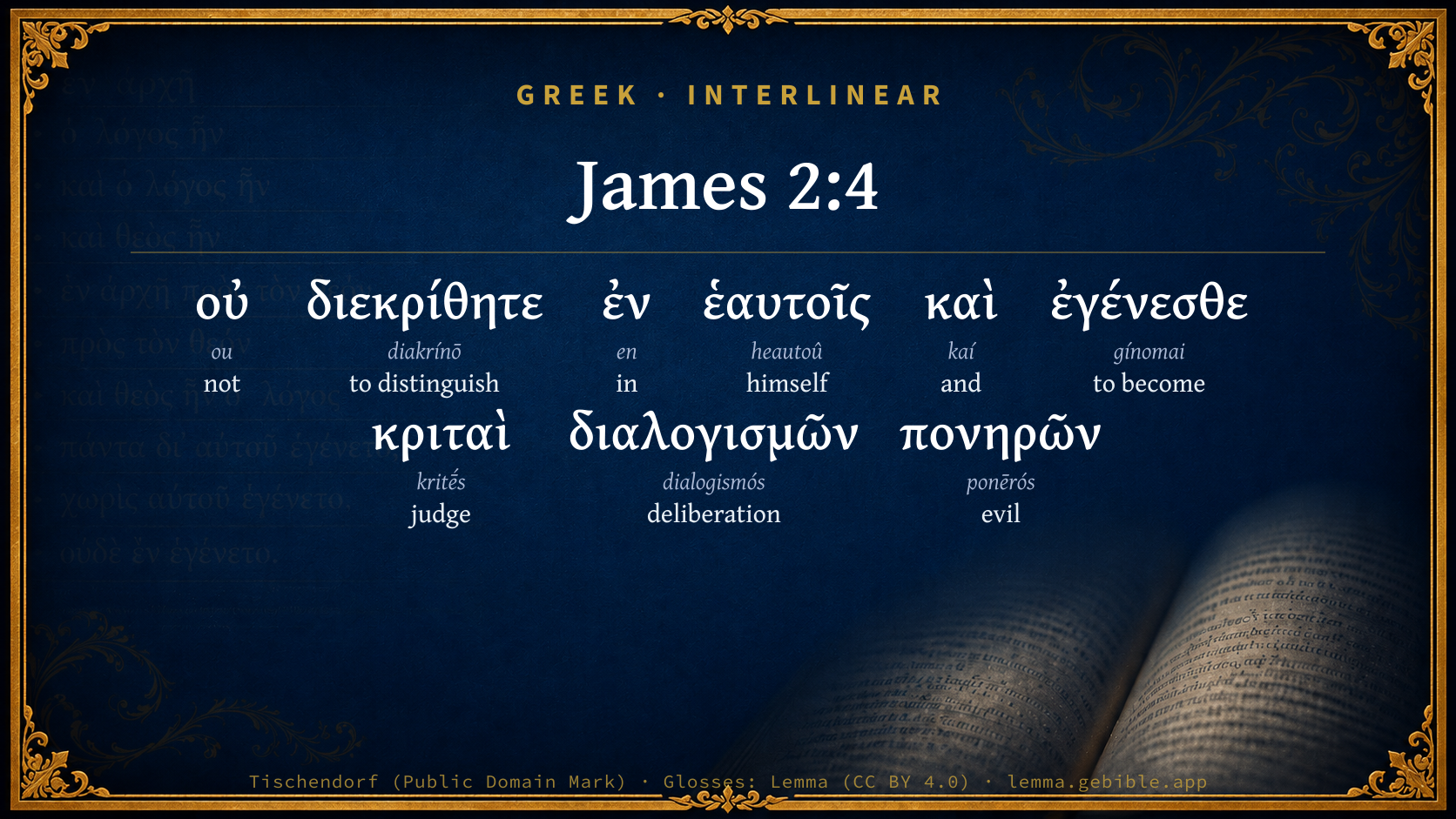
Download image
Cite this verse

James 2:4 (World English Bible). Public Domain. Lemma interlinear Bible study tool, https://lemma.gebible.app/v/james/2/4.

Show BibTeX & RIS
BibTeX
RIS
English Translation
haven't you shown partiality among yourselves, and become judges with evil thoughts?
World English Bible · Public Domain
Download a study sheet

One document with this verse’s original text, its word-by-word gloss line, the meaning frame, cross-references with their text, attributed commentary, and full source and license credits — printable, and it pastes into notes with its structure intact.

This verse Autodidact and up

Study sheet (.html) Plain text (.txt)

A passage Seminary Student

Up to 50 verses in one chapter. A passage sheet keeps up to 6 commentary sources and 12 cross-references per verse, in the order this page ranks them, and says so on the sheet whenever that leaves anything out. Ask for a single verse and you get the Autodidact verse sheet above.

Everything on this page stays free to read, with no account — the sheet is a download of what is already on screen, not access to it.

Want to remove ads? Support Godless Engineer
Compare translations 3

The same verse in 3 English versions, stacked beneath the original-language interlinear above. Click any original word for its lexicon entry.

Each is an independent rendering of the whole verse — the interlinear is not word-aligned to these translations.

Highlighted words mark where these versions differ — a whole-verse word diff, not a word-by-word alignment.

  • World English Bible Public Domain
    haven't you shown partiality among yourselves, and become judges with evil thoughts?
  • King James Version Public Domain
    Are ye not then partial in yourselves, and are become judges of evil thoughts?
  • unfoldingWord Literal Text CC BY-SA 4.0
    have you not distinguished among yourselves and become judges of evil thoughts?

unfoldingWord Literal Text — © unfoldingWord, licensed CC BY-SA 4.0. Word-aligned USFM3 via Door43 (git.door43.org/unfoldingWord/en_ult).

Versions to compare (up to 4)

3 of 4 selected

Show all 19 translations

Every available English version of this verse, each an independent rendering of the whole verse.

  • World English Bible Public Domain
    haven't you shown partiality among yourselves, and become judges with evil thoughts?
  • Berean Standard Bible Public Domain
    have you not discriminated among yourselves and become judges with evil thoughts?
  • Majority Standard Bible Public Domain
    have you not discriminated among yourselves and become judges with evil thoughts?
  • King James Version Public Domain
    Are ye not then partial in yourselves, and are become judges of evil thoughts?
  • American Standard Version (1901) Public Domain
    Do ye not make distinctions among yourselves, and become judges with evil thoughts?
  • Revised Version (1885) Public Domain
    are ye not divided in your own mind, and become judges with evil thoughts?
  • Geneva Bible (1599) Public Domain
    Are yee not partiall in your selues, and are become iudges of euill thoughts?
  • Douay-Rheims (1899) Public Domain
    Do you not judge within yourselves, and are become judges of unjust thoughts?
  • Young's Literal Translation Public Domain
    ye did not judge fully in yourselves, and did become ill-reasoning judges.
  • Literal Standard Version CC BY-SA 4.0
    you did not judge fully in yourselves, and became ill-reasoning judges.
  • Unlocked Literal Bible CC BY-SA 4.0
    are you not judging among yourselves? Have you not become judges with evil thoughts?
  • unfoldingWord Literal Text CC BY-SA 4.0
    have you not distinguished among yourselves and become judges of evil thoughts?
  • Darby Bible Public Domain
    have ye not made a difference among yourselves, and become judges having evil thoughts?
  • World Messianic Bible Public Domain
    haven’t you shown partiality among yourselves, and become judges with evil thoughts?
  • Webster's Bible Public Domain
    Are ye not then partial in yourselves, and are become judges of evil thoughts?
  • Free Bible Version CC BY-SA 4.0
    haven't you discriminated and judged with bad motives?
  • Bible in Basic English Public Domain
    Is there not a division in your minds? have you not become judges with evil thoughts?
  • Text-Critical English NT CC BY 4.0
    have you not made distinctions among yourselves and become judges with evil thoughts?
  • Tyndale New Testament (1534) Public Domain
    are ye not parciall in youre selves and have iudged after evyll thoughtes?

Literal Standard Version (2020), Covenant Press — licensed CC BY-SA 4.0. Text via the HelloAO Bible API (eBible.org). Unlocked Literal Bible (unfoldingWord) — licensed CC BY-SA 4.0. Text via the HelloAO Bible API (eBible.org). unfoldingWord Literal Text — © unfoldingWord, licensed CC BY-SA 4.0. Word-aligned USFM3 via Door43 (git.door43.org/unfoldingWord/en_ult). Free Bible Version, Dr. Jonathan Gallagher — licensed CC BY-SA 4.0. Text via the HelloAO Bible API (eBible.org).

Word by word

More ways to search: Search by grammar → Find every occurrence → Compare this word →

Practice this passage: Drill this verse → Learn its vocabulary →

About this verse

These counts appear in no published source. They are computed here, from the morphology-tagged text and Lemma’s own curated glosses. What Lemma adds →

9
words
9
distinct lemmas
General Epistles
section

Notable vocabulary

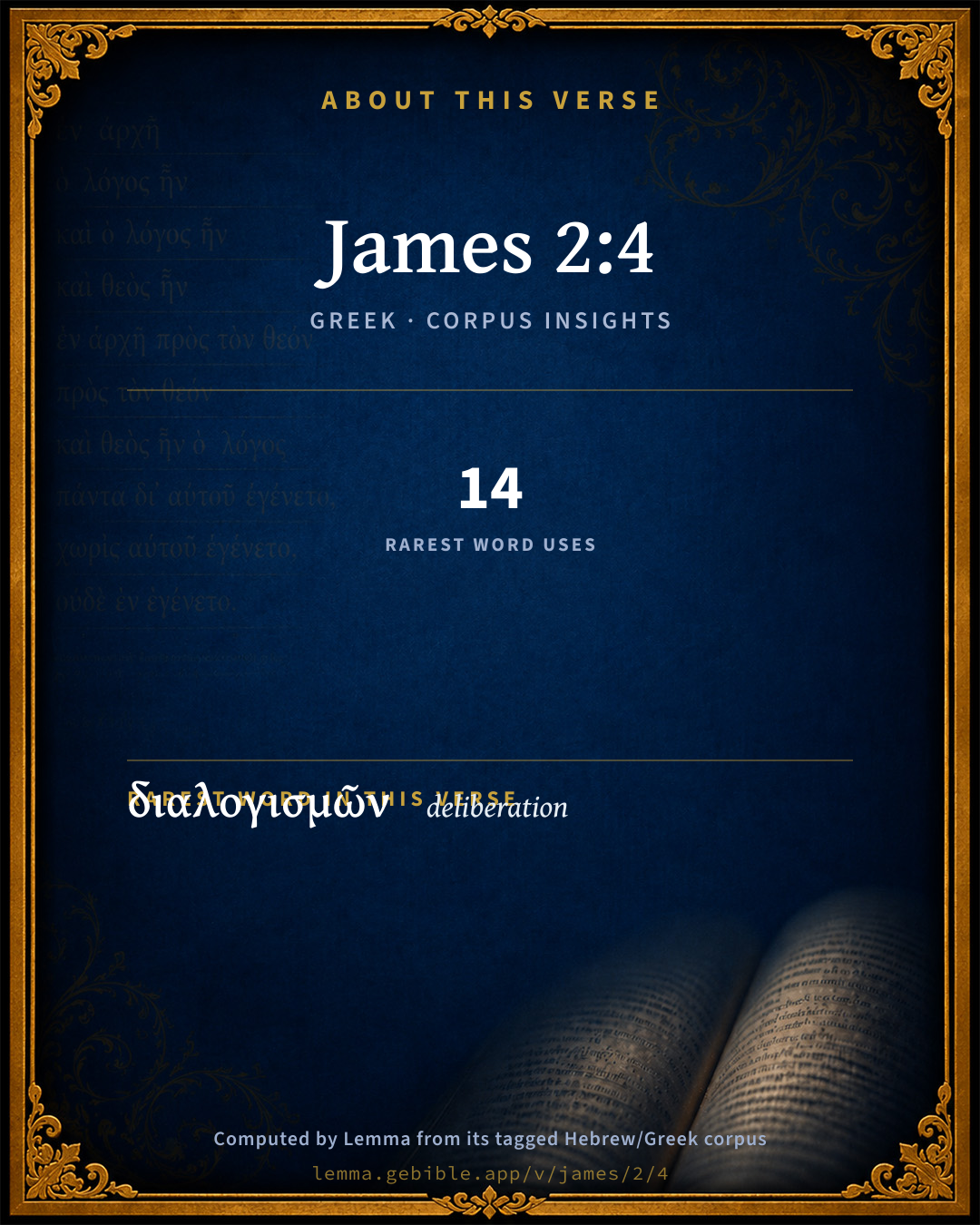
The rarest word here is διαλογισμῶν deliberation G1261 — appearing just 14 times in the whole Greek New Testament.

Shared distinctive vocabulary

διαλογισμῶν deliberation G1261 occurs in 14 verses of the Greek New Testament. Also found in:

Cross-references

10

Topical passages linked to James 2:4 in the Treasury of Scripture Knowledge — connected by theme and wording, ordered by reader-vote popularity; previews shown in the World English Bible.

  • John 7:24 Don't judge according to appearance, but judge righteous judgment."
  • Job 34:19 Who doesn't respect the persons of princes, Nor regards the rich more than the poor; For they all are the work of his hands.
  • Matthew 7:1–5 "Don't judge, so that you won't be judged.
  • Psalms 58:1 Do you indeed speak righteousness, silent ones? Do you judge blamelessly, you sons of men?
  • Psalms 82:2 "How long will you judge unjustly, And show partiality to the wicked?" Selah.
  • Malachi 2:9 "Therefore I have also made you contemptible and base before all the people, according to the way you have not kept my ways, but have had respect for persons in the law.
  • James 4:11 Don't speak against one another, brothers. He who speaks against a brother and judges his brother, speaks against the law and judges the law. But if you judge the law, you are not a doer of the law, but a judge.
  • Job 21:27 "Behold, I know your thoughts, The devices with which you would wrong me.
  • Psalms 109:31 For he will stand at the right hand of the needy, To save him from those who judge his soul.
  • James 1:1–27 James, a servant of God and of the Lord Jesus Christ, to the twelve tribes which are in the Dispersion: Greetings.

Cross-references courtesy of OpenBible.info (CC BY 4.0).

Commentary

Notes on James 2:4 from classic Christian and Jewish commentators (each source and its license shown beneath its notes). The classic Christian expositions comment on the surrounding passage and are grouped to its opening verse, so a note may address several verses; the Jewish commentaries on the Tanakh (Rashi and others) are per-verse, so they appear only where the commentator wrote on this verse.

Lemma curates 59 commentaries, every one of them public domain or Creative Commons licensed, each selected and text-cleaned for this edition rather than reprinted as found. About our sources →

Bengel's Gnomon

Johann Albrecht Bengel

Jas 2:4. Καὶ οὐ, nor) If, of Jas 2:2, has its Apodosis in this verse: καὶ οὐ, καὶ, “both ye do not discriminate aright, and.”—οὐ διακρίθητε) Though you make that difference (discrimination) between the rich and the poor, “you do not discriminate” with just hesitation, consideration, and weighing, that which should have been given to the poor man, rather, or at any rate not less, than to the rich. Διεκρίθη occurs in an active sense also in Rom 4:20. Διακρίνεσθαι is used in this passage of James in a good sense. [But Engl. Vers. takes it in a bad sense, and with an interrogation, “Are ye not partial?”] To this compound word the simple κριταὶ is opposed, which word denotes those who settle any subject definitely. Διάκρισις (discrimination) ought to precede κρίσις (judgment); whereas you omit the former and exercise the latter.—κριταὶ διαλογισμῶν πονηρῶν) judges, approvers of evil thoughts: that is, of the rich, who have outward splendour, but abound with evil thoughts. They who honour the rich man in preference to the poor, do not expressly desire to approve of his evil thoughts; but James puts this interpretation upon their conduct, and lays it to their charge, because the rich man in his pomp is full of evil thoughts. The more common sentiment is presupposed as well known.

Bengel's Gnomon of the New Testament — English translation (T&T Clark, Edinburgh, 1860) — public domain. Text from a community e-Sword module.

Meyer's Critical & Exegetical Commentary

Heinrich August Wilhelm Meyer

Jam_2:4 forms the apodosis to Jam_2:2-3, and rebukes what is blameable in the conduct described. Expositors greatly differ in the explanation of this verse, according as they explain the verb διεκρίθητε, and understand οὐ as a pure negation, or as an interrogative particle. It is best to take διεκρίθητε, in form indeed passive, in meaning as the aorist middle, as in Mat_21:21, Mar_11:23, Rom_4:20, and to give to the verb here the same meaning which it has constantly in the usage of the N. T.; so that it denotes the doubt, which consists in the assertion of thoughts at variance with faith; see on chap. Jam_1:6. But then the sentence must be taken as interrogative: Did you not then doubt among yourselves? i.e., Have ye not fallen into a contradiction with your faith (Jam_2:1), according to which external glory and riches are nothing, whilst ye by your conduct have attached a value to them? To this question the second is added, to which the preceding οὐ is also to be referred: and became ye not (thus) judges of evil thoughts? This second question indicates the direct consequence of διακρίνεσθαι. James calls them κριταί, because in their conduct they expressed their judgment on the rich and poor. The genitive διαλογισμῶν πονηρῶν is not the genitive of object,[113] but of quality. διαλογισμοί is here, as predominantly in the N. T. in malam partem (see especially Luk_5:21-22), thoughts of doubt ana unbelief; the bad meaning is here heightened by πονηρῶν.

[113] Elsner: iniquas istas cogitationes approbastis; Bengel: judices approbatores, malarum cogitationum i. e. divitum, foris splendentium, sed malis cogitationibus sentientium.

Other explanations are as follow:

(1) διακρίνεσθαι = separare: then the sentence is interrogative; ἐν ἑαυτοῖς = ἐν ἀλλήλοις (Gebser, Schulthess, Semler, Erasmus Schmid, etc.); the verb being either passive: nonne inter vos ipsos estis discreti ac separati? or middle: nonne vos discernitis inter vos ipsos? Do you not separate, divide yourselves among yourselves? (Lange).

(2) διακρίνεσθαι = discrimen facere. (a) The verb active(α) interrogative: nonne discrimen fecistis apud vos ipsos? (Laurentius, Grotius, Wolf, Hottinger, Knapp). In this explanation ἐν ἐαυτοῖς = ἐν ἀλλήλοις; Schneckenburger, however, explains ἐν ἑαυτοῖς = in animis vestris; but then the meaning: discrimen facere, would pass into an act of the judgment, statuere. (β) Negative: Then partly ye would not have distinguished (according to a sound judgment) among yourselves, and partly also ye would have judged after an evil manner of thinking (thus an error of the understanding and of the heart) (Grashof).(b) The verb passive: dupliciter peccatis, primo: inter vos ipsos non estis discriminati h. e. cessat piorum et impiorum differentia (Oeder).

(3) διακρίνεσθαι = judicare. (a) The verb active(α) interrogative: nonne judicastis, deliberastis ipsi? Are ye not yourselves persuaded how wrong this is? (Augusti). (β) Negative: non discrevistis justa dubitatione, considerantia et aestimatione, quid tribuendum esset pauperi potius vel certe non minus, quam diviti (Bengel). Luther combines this rendering with that under James 2 : And ye do not well consider, but ye become judges, and make an evil distinction. Here also comes in the explanation of Oecumenius: τὸ διακριτικὸν ὑμῶν διφθείρατε, μηδεμίαν συζήτησιν ποιήσαντες πότερον τιμητέον … ἀλλʼ οὕτως, ἀδιακρίτως, καὶ ἐν προοωποληψίᾳ τὸν μὲν ἐτιμήσατε … τὸν δὲ ἠτιμάσατε.(b) The verb passive(α) interrogative: Nonne vos in conscientiis dijudicati h. e. convicti estis? Paraeus; so also Bouman: nonne igitur in vestris ipsorum jam judicati estis animis? (β) Negative: et dijudicati inter vos ipsos non estis ut judicastis secundum prava ratiocinia vestra (Heisen). Differently Cajetanus: haec faciendo non estis judicati in vestibus et divitiis et paupertate; laying the chief stress on ἐν ἑαυτοῖς.

(4) διακρίνεσθαι = dubitare, to entertain doubts. (a) Interrogative: et non dubitastis apud vosmet ipsos? et facti estis iniqui judices? Should you not yourselves have entertained doubts? Should you actually have passed evil-minded judgments? (Theile). (b) Negative: non dubitastis apud animum, ne subiit quidem haec cogitatio, id factum forte malum esse, certo apud vos statuistis id jure ac bene fieri.

All these explanations are untenable, because they proceed upon a meaning of διακρίνεσθαι foreign to the usage of the N. T. Besides, several require arbitrary completions, and many do not correspond to the context. Brückner, de Wette, and Wiesinger have also here correctly maintained the meaning to doubt. De Wette: Have you not then become doubtful in your faith? Wiesinger: Have you not forsaken the law of faith, which recognises only one true riches? With the reading of B (omitting οὐ) the thought is the same; the interrogative (οὐ), however, serves for the heightening of the thought, the readers themselves being thereby charged to pronounce the judgment. The καί of the Receptus stands as in Mar_10:26, Luk_10:29, 1Co_5:2, with the question suddenly introduced. Or, since in the N. T. no other passage is found where καί is placed before a question forming the apodosis of a protasis beginning with ἐάν (on 2Co_2:2, see Meyer), it is to be explained from the fact that one would make Jam_2:4 a part of the protasis; see above.

Meyer — Critical and Exegetical Commentary on the New Testament — English translation by Peter Christie, edited by Frederick Crombie (T&T Clark, 1880) — public domain. Text from a community e-Sword module.

Expositor's Greek Testament

ed. W. Robertson Nicoll

Jas 2:4 . οὐ διεκρίθητε ἐν ἑαυτοῖς : “Are ye not divided among yourselves”? The Peshiṭtâ uses the word אתפלג , the same as that used in Luk 11:17 . “Every Kingdom divided against itself.” The reference in the verse before us might be to the class distinctions which were thus being made, and which would have the effect of engendering envy and strife, and thus divisions. κριταί : the Peshiṭtâ has the interesting rendering מפר̈שנא (instead of the usual word for “judge” דינא ), which comes from the root meaning “to divide”. διαλογισμῶν πονηρῶν : Cf. Mat 15:19 , ἐκ τῆς καρδίας ἔρχονται διαλογισμοὶ πονηροί : genitive of quality, “judges with evil surmisings,” viz. , of breaking up the unity of the worshippers by differentiating between their worldly status; the writer is very modern! διαλογισμοί is generally used in a bad sense, cf. Luk 5:21-22 ; Rom 1:21 .

The Expositor's Greek Testament, edited by W. Robertson Nicoll (1897–1910) — public domain. Text from a community e-Sword module.

Geneva Bible (1599)

Geneva Bible translators

Have ye not (which you ought not to do) by this means with yourselves judged one man to be preferred before another?

Geneva Bible (1599) marginal notes — public domain. Text via Bolls.life.

Jamieson, Fausset & Brown

Robert Jamieson, A. R. Fausset & David Brown

Are ye not . . . partial--literally, "Have ye not made distinctions" or "differences" (so as to prefer one to another)? So in Jde 1:22.

in yourselves--in your minds, that is, according to your carnal inclination [GROTIUS].

are become judges of evil thoughts--The Greek words for "judges" and for "partial," are akin in sound and meaning. A similar translation ought therefore to be given to both. Thus, either for "judges," &c. translate, "distinguishers of (that is, according to your) evil thoughts"; or, do ye not partially judge between men, and are become evilly-thinking judges (Mar 7:21)? The "evil thoughts" are in the judges themselves; as in Luk 18:6, the Greek, "judge of injustice," is translated, "unjust judge." ALFORD and WAHL translate, "Did ye not doubt" (respecting your faith, which is inconsistent with the distinctions made by you between rich and poor)? For the Greek constantly means "doubt" in all the New Testament. So in Jam 1:6, "wavering." Mat 21:21; Act 10:20; Rom 4:20, "staggered not." The same play on the same kindred words occurs in the Greek of Rom 14:10, Rom 14:23, "judge . . . doubteth." The same blame of being a judge, when one ought to be an obeyer, of the law is found in Jam 4:11.

Jamieson, Fausset & Brown — Commentary Critical and Explanatory on the Whole Bible (1871) — public domain (CC PDM 1.0). Text via the HelloAO Bible API.

Adam Clarke's Commentary

Verse 4. Are ye not then partial] ου διεκριθητε. Do ye not make a distinction, though the case has not been heard, and the law has not decided?

Judges of evil thoughts?] κριται διαλογισμων πονηρων. Judges of evil reasonings; that is, judges who reason wickedly; who, in effect, say in your hearts, we will espouse the cause of the rich, because they can befriend us; we will neglect that of the poor, because they cannot help us, nor have they power to hurt us.

Adam Clarke's Commentary on the Bible (1810–1826) — public domain. Text from a community e-Sword/MySword module.

John Calvin's Commentaries

4 Are ye not then partial in yourselves? or, are ye not condemned in yourselves. This may be read affirmatively as well as interrogatively, but the sense would be the same, for he amplifies the fault by this, that they took delight and indulged themselves in so great a wickedness. If it be read interrogatively, the meaning is, “Does not your own conscience hold you convicted, so that you need no other judge?” If the affirmative be preferred, it is the same as though he had said, “This evil also happens, that ye think not that ye sin, nor know that your thoughts are so wicked as they are.”

John Calvin's Commentaries (1540-1563) — public domain. Text from the Calvin Translation Society English edition (1840s-50s) via the Christian Classics Ethereal Library (ccel.org). Calvin's coverage is partial (roughly two-thirds of the Bible); uncommented books and verses are honest gaps, never fabricated. The 19th-century editor's footnotes and remarks are omitted so the notes are faithfully Calvin's own voice.

Ellicott's Commentary for English Readers

(4) Are ye not then partial in yourselves, and are become judges of evil thoughts?—Or, as the sense, fully expressed, would be: “My brethren, if you acted thus, did you not doubt in yourselves, and become by such false and unfaithful discrimination judges of and in your own evil thoughts? Did you not lose the idea of brotherhood, and become contentious as to supremacy of self and place—serving yourselves while prepared for the service of Christ? The Lord Jesus thought not His equality with God a thing ever to be grasped at, if work for man could be done by self-humiliation. Therefore, although being ‘equal to the Father, as touching His Godhead,’ He became ‘inferior . . . as touching His Manhood.’ And none may turn unmoved from that picture of sublime condescension to the petty strifes of quality and position which profane the Christian sanctuary. Most sadly true is it that in making distinctions such as these between rich and poor, we ‘become of the number of those who doubt respecting their faith;’ for, while it abolishes such altogether in the presence of God, we set them up of our own arrogance and pride. ‘We draw nigh unto Him with our mouth, and honour Him with our lips, but our heart is far from Him; and our worship therefore vain.’” (Comp. Isa_29:13; Eze_33:31; Mat_15:8-9.)

A Bible Commentary for English Readers, edited by Charles John Ellicott (1878–1897) — public domain. Text from a community e-Sword module.

The Cambridge Bible for Schools and Colleges

gen. ed. J. J. S. Perowne

4. are ye not then partial in yourselves?] The verb is the same as that translated “waver” in chap. Jas_1:6 and elsewhere, as in Mat_21:21; Mar_11:23; Act_10:20; Rom_14:23 by “doubt.” Nor is any other meaning, such as that of “making distinctions,” necessary, or admissible, here. “When you acted in this way (the tense assumes that the thing had been actually done) did you not doubt, as others doubt, in your own hearts?” Faith in Christ’s words as to the deceitfulness of riches and the little honour due to them would have kept men from such servility. They shewed by their words and acts that they were half-hearted, or, in St James’s sense of the word, “double-minded.”

judges of evil thoughts?] The construction is the same as that of the English phrase “a man of bad temper,” and is precisely analogous to that rendered “unjust judge” (literally, judge of injustice) in Luk_18:6, and to the “forgetful hearer” or “hearer of forgetfulness” in chap. Jas_1:25. It means accordingly, “evil-thinking judges.” In acting as they did, men made themselves judges between rich and poor, and with “base reasonings,” or better, perhaps, what we call “base calculations,” gave a preference to the former.

The Cambridge Bible for Schools and Colleges (gen. ed. J. J. S. Perowne; Cambridge University Press, 1878–1918) — public domain. Text from a community e-Sword module.

John Gill's Exposition

Are ye not then partial in yourselves,.... That is, guilty of such partiality as must appear to yourselves, and your own consciences must accuse you of; or do not ye distinguish, or make a difference among yourselves, by such a conduct, towards the rich and the poor:

and are become judges of evil thoughts; or "are distinguishers by evil thoughts"; that is, make a distinction between the rich and the poor, by an evil way of thinking, that one is better than the other, and to be preferred before him.

John Gill's Exposition of the Whole Bible (1746–1763) — public domain (CC PDM 1.0). Text via the HelloAO Bible API.

Trapp's Complete Commentary

John Trapp

4 Are ye not then partial in yourselves, and are become judges of evil thoughts?

Ver. 4. Are ye not then partial] ου διακριθητε, or, "Are ye not for so doing condemned in your own consciences?" Or, "Neither have ye so much as once doubted or questioned the matter within yourselves, whether in so doing you have not done amiss?"

John Trapp, A Commentary or Exposition upon All the Books of the Old and New Testament (1647–1656) — public domain. Text from a community e-Sword module.

Albert Barnes' Notes on the Bible

Are ye not then partial in yourselves? - Among yourselves. Do you not show that you are partial?

And are become judges of evil thoughts - There has been considerable difference of opinion respecting this passage, yet the sense seems not to be difficult. There are two ideas in it: one is, that they showed by this conduct that they took it upon themselves to be judges, to pronounce on the character of men who were strangers, and on their claims to respect (Compare Mat 7:1); the other is, that in doing this, they were not guided by just rules, but that they did it under the influence of improper “thoughts.” They did it not from benevolence; not from a desire to do justice to all according to their moral character; but from that improper feeling which leads us to show honor to men on account of their external appearance, rather than their real worth. The wrong in the case was in their presuming to “judge” these strangers at all, as they practically did by making this distinction, and then by doing it under the influence of such an unjust rule of judgment. The sense is, that we have no right to form a decisive judgment of men on their first appearance, as we do when we treat one with respect and the other not; and that when we make up our opinion in regard to them, it should be by some other means of judging than the question whether they can wear gold rings, and dress well, or not. Beza and Doddridge render this, “ye become judges who reason ill.”

Albert Barnes' Notes on the Bible (1834–1885) — public domain. Text from a community e-Sword/MySword module.

Haydock's Catholic Bible Commentary

Are become judges of (or with ) unjust thoughts,[2] when against justice you favour the rich. Or, if in Church assemblies you discover a wrong and partial judgment in you minds and thoughts, by the high value and esteem you shew to the rich on account of their riches, and the contempt you have of poverty and of the poor, when they are perhaps more deserving in the sight of God, who hath chosen them who are rich in faith, whom he hath made his adoptive children, and heirs of his kingdom. These are much the greater riches: this is a dignity far surpassing that of the greatest king or emperor. And you have less reason to shew such distinguishing marks of honour and esteem for the rich of this world, since it is they who by might and violence oppress you, draw you to judgment-seats: and they are less worthy of your honour and esteem, when by their scandalous behaviour they blaspheme, or cause to be blasphemed and ill-spoken of, the good and holy name of God, which is invoked upon you. (Witham)

===============================

[BIBLIOGRAPHY]

Judices cogitationum iniquarum: it is the same in the Greek, Greek: kritai dialogismon poneron: the sense is, Judices inique cogitantes.

George Leo Haydock (1774–1849), Haydock's Catholic Family Bible and Commentary, 1859 edition — public domain. Excludes Psalms (Douay-Rheims chapter numbering differs from Protestant) and Deuterocanonical books (Catholic canon only).

Matthew Poole's English Annotations

Are ye not then partial in yourselves? Either, are ye not judged in yourselves, convicted by your own consciences of partiality, and accepting men’s persons? Or, have ye not made a difference? viz. out of a corrupt affection rather than a right judgment; and then it falls in with our translation; Are ye not partial? The Greek word is used in this sense, Act 15:9; Jud 1:22.

And are become judges of evil thoughts; i.e. judges that have evil thoughts, or are evil affected: q.d. You evidence the corruptness of your affections by your thus perversely judging.

Matthew Poole's English Annotations on the Holy Bible (1683–1685) — public domain. Text from a community e-Sword/MySword module.

The Pulpit Commentary

The copula (kai) of the Received Text is certainly spurious. It is found in K, L, but is wanting in a, A, B, C, Vulgate, Syriac, Coptic. B also omits the negative ouj (so Westcott and Herr margin). If this manuscript is followed, the sentence must be read as a direct statement, and not as interrogative. But if (with most manuscripts and editions) the interrogative be retained, the translation is still doubtful. Diekriqhte ejn eJautoiv may mean:

(1) "Are ye not divided in your own mind?" so the Syriac and R.V, which would imply that this respect of persons showed that they were halting between God and the world in fact, double-minded.

(2) "Do ye not make distinctions among yourselves?" R.V margin; this gives an excellent sense, but is wanting in authority, as there appears to be no other instance forthcoming of the passive with this meaning.

(3) "Did you not doubt among yourselves?" this (doubt) is the almost invariable meaning of diakrinaomai in the New Testament, and the word has already been used in this sense by St. James. (Jam_1:6) Hence this rendering is to be preferred. So Huther, Plumptre, and Farrar, the latter of whom explains the passage as follows: "It shows doubt to act as though Christ had never promised his kingdom to the poor, rich in faith; and wicked reasonings to argue mentally that the poor must be less worthy of honor than the rich." Judges of evil thoughts (kritai dialogismwn ponhrwn); sc. their own (thoughts), which caused them to respect persons. Thus the phrase is equivalent to "evil-thinking judges." (On the genitive, see Winer, "Gram. of N. T. Greek," p. 233; and cf. thv Jam_1:25, ajkroa ejpilhsmonhv.)

The Pulpit Commentary (1880–1919), ed. H.D.M. Spence-Jones & Joseph S. Exell — public domain. Text from a community e-Sword module.

John Wesley's Explanatory Notes

Ye distinguish not - To which the most respect is due, to the poor or to the rich. But are become evil-reasoning Judges - You reason ill, and so judge wrong: for fine apparel is no proof of worth in him that wears it.

John Wesley, Explanatory Notes Upon the Whole Bible (1754–1765) — public domain. Text via the GEBible commentary corpus.

The People's New Testament

B. W. Johnson

4. Are ye not then partial? Show partiality from outward appearance. Judges of evil thoughts. Judge between the two men under the influence of evil thoughts.

B. W. Johnson's The People's New Testament with Notes (1889–1891) — public domain. Electronic text from the Christian Classics Ethereal Library (CCEL) ThML edition.

Cambridge Greek Testament for Schools and Colleges

4. οὐ διεκρίθητε with אAB2C and most cursives. B* omits οὐ, so also ff. KLP and others have καὶ οὐ.

4. οὐ διεκρίθητε. For reading see critical notes. Did ye not make a distinction among yourselves (though you are ἀδελφοί), and thereby shewed yourselves to be judges whose reasonings are evil? διεκρίθητε though passive in form has here a middle or intransitive meaning. This appears from the two other passages in the N.T. where the same form occurs, Mat 21:21; Mar 11:23. Compare the prevailing N.T. form ἀπεκρίθη in place of the far rarer ἀπεκρίνατο, which last occurs four times only in the synoptic gospels, and three of these are in the parallel accounts of the Passion.

There is a tendency in later Greek to the disuse of middle forms. In Modern Greek the middle voice has ceased to exist. There are also instances in Hellenistic Greek of recurrence to original forms, and “the aorist stems in -η and -θη appear to have originally had an intransitive sense of which the passive sense was a growth or adaptation.” Monro’s Hom. Gram. § 44.

But apart from these arguments from the history of language the passive rendering fails here to give good sense.

διαλογισμῶν πονηρῶν. See on ἀκροατὴς ἐπιλησμονῆς Jas 1:25. διαλογισμοί, reasonings, never in a good sense in N.T., διαλογισμοὶ πονηροί, Mat 15:19; οἱ διαλ. οἱ κακοί, Mar 7:21. See also Rom 14:1; Php 2:14; 1Ti 2:8.

Cambridge Greek Testament for Schools and Colleges (Cambridge University Press, 1896; 21 vols, various authors incl. Carr, Maclear, Plummer, Farrar, Lumby, Moule, M. R. James, Simcox) — public domain. Text from a community e-Sword module.

Alford’s Greek Testament

Henry Alford

4.] (Now comes the apodosis in the form of a question)—did ye not (in the case supposed) doubt (such is the constant sense of διακρίνομαι in the N. T. throughout (reff.), except in two passages, Act 11:2: Jud 1:9, where it means “disputing,” a sense which cannot enter here (on Jud 1:22, see there). And here, the sense seems very good: ‘Did ye not, in making such distinction between rich and poor, become of the number of those who doubt respecting their faith, ch. 1:6? Your faith abolishes such distinction: you set it up in practice. You are not then whole in that faith.’ Various other explanations have been given, which Huther enumerates thus: διακρίνεσθαι 1. = “separare:” thus Schulthess, Semler, Erasm. Schmid, al., with the verb either passive, “Nonne inter vos ipsos estis discreti et separati?” or middle, “Nonne vos discernitis inter vos ipsos?” 2. = “discrimen facere:” a. the verb active, and that, α. interrogative: “Nonne discrimen fecistis apud vos ipsos?” so Laurentius, Grot., Wolf, Hottinger, Knapp: thus ἐν ἑαυτοῖς = ἐν ἀλλήλοις: Schneckenburger however gives it “in animis vestris,” and makes “discrimen facere” to pass into an act of individual judgment, “statuere:” β. negative: “Then ye have not made a sound distinction in yourselves:” so Grashof: b. the verb passive, “Inter vos ipsos non estis discriminati, N. E. cessat piorum et impiorum differentia,” Oeder. 3. = “judicare:” a. the verb active: and that, α. interrogative: “Nonne judicastis, deliberastis ipsi?” i. e. are ye not yourselves persuaded how wrong this is? Augusti:) β. negative: “Non discrevistis justa deliberatione, considerantia et æstimatione, quid tribuendum esset pauperi potius vel certe non minus quam diviti,” Bengel (Luther combines this rendering with that under (2): und bedenket es nicht recht, sondern ihr werdet Richter, und macht bösen Unterschied): here also comes in the explanation of Œc.: τὸ διακριτικὸν ὑμῶν διεφθείρατε, μηδεμίαν συζήτησιν ποιήσαντες πότερον τιμητέον, … ἀλλʼ οὕτως ἀδιακρίτως κ. ἐν προσωποληψίᾳ τὸν μὲν ἐτιμήσατε … τὸν δὲ ἠτιμάσατε: b. the verb passive: and that, α. interrogative: “Nonne vos in conscientiis dijudicati, h. e. convicti estis?” Paræus: β. negative: “Et dijudicati inter vos ipsos non estis ut judicastis secundum prava ratiocinia vestra,” Heisen. Cajetan, somewhat differently, “Hæc faciendo non estis judicati in vobis ipsis, sed estis judicati in vestibus et divitis et pauperis:” laying the chief stress on ἐν ἑαυτοῖς. 4. διακρίνεσθαι = ‘dubitare,’ to entertain doubts: α. interrogative: “Et non dubitastis apud vosmetipsos? et facti estis iniqui judices?” “Should you not yourselves have entertained doubts? should you actually have passed evil-minded judgment?” Theile: β. negative: “Non dubitastis apud animum, ne scilicet quidem hæc cogitatio, id factum forte malum esse, sed certo apud vos statuistis id jure ac bene fieri.”

The meaning above given is held by Keen, De Wette, Wiesinger, Huther) within yourselves (in your own minds, being at issue with your own faith), and become judges (in the case of the rich and poor; judges of the case before you), of evil thoughts (the gen. is one of quality, like ὁ κριτὴς τῆς ἀδικίας, Luk 18:6: ἀκροατὴς ἐπιλησμονῆς, ch. 1:25: not an objective gen., as Elsner, “Iniquas illas cogitationes approbastis:” and Bengel, “judices, approbatores, malarum cogitationum: i. e. divitum, foris splendentium, sed malis cogitationibus scatentium.” The evil thoughts are in the judges themselves, and consist in the undue preference given by them to the rich. The same blame, of being a judge when a man ought to be an obeyer of the law, is found in ch. 4:11. Notice also the parallel containing the same paronomasia, in Rom_14: σὺ δὲ τί κρίνεις τὸν ἀδελφόν σου; (ver. 10:).… ὁ δὲ διακρινόμενος ἐὰν φάγῃ κατακέκριται (ver. 23))?

Henry Alford, The Greek Testament (1849–1861) — public domain. Text from a community e-Sword module.

International Critical Commentary

4. οὐ] Omitted by B ff minn. The repetition of —ΟΥ ΟΥ might suggest either the insertion or the omission of the word in transcription. The attestation and the greater intrinsic vigour of the sense speak for the omission.

KLP minn read καὶ οὐ, the καί being added to indicate the apodosis.

διεκρίθητε. “Ye have wavered,” “doubted,” i. e. “practically, by your unsuitable conduct, departed from and denied the faith of v. 1, and thus fallen under the condemnation pronounced in 1:6-8 against the δίψυχος.” Cf. 1:6 and note, 3:17 ἀδιάκριτος; and, for the mode of argument, 1:8 δίψυχος, 4:8 ἁμαρτωλοί, δίψυχοι.

Of the various meanings proposed for διεκρίθητε this one, which is common in the N. T. although not attested in secular Greek, yields in the present context the best sense, being especially recommended by the allusion to the “waverer” of 1:6. Cf. Mat 21:21, Mar 11:23, Rom 14:23, Jas 1:6, and the kindred sense “hesitate” in Act 10:20, Rom 4:20.

Other interpretations which have been given are classified as follows by Huther, whose elaborate note, as reproduced with additions by Beyschlag, pp. 103 f., should be consulted for the history of the exegesis.

διακρίνεσθαι = (1) separare;

(2) discrimen facere;

(3) judicare;

(4) dubitare (“hesitate”).

Under each of these senses several interpretations are possible according as the verb is taken as an affirmation or a question, and under several of them a choice between an active and passive meaning is possible. Most of the interpretations are too remote from the natural suggestion of the context, or any natural meaning of the verb, to be worth considering, and none suits on the whole so well as the interpretation given above.

The renderings of A.V., “Are ye not then partial?” and R.V. mg., “Do ye not make distinctions?” are based on (2), the verb being given an active sense. This corresponds to the view of Grotius and others, and is perhaps not impossible, even with the passive aorist, but at best it would be unusual, it runs counter to all N. T. usage, and it gives an inherently weak and tautologous sense. To R.V. text, “Are ye not divided?” no objection from the ordinary meaning of the verb can be brought, but it is less idiomatic and pointed than the rendering “waver.”

κριταὶ means “judges”; it cannot mean “approvers” (as Wetstein takes it).

κριταὶ διαλογισμῶν πονηρῶν, “judges with evil thoughts,” gen. of quality. Evidently, like διεκρίθητε, this describes in language already familiar an admittedly wrong attitude. There is a play on words in διεκρίθητε, κριταί, which cannot be imitated in English, and which goes far to account for the introduction of κριταί into a context to which the idea of “judging” in any proper sense is foreign. That προσωπολημψία is the characteristic sin of the bad judge may also have had its influence. The sentence must be taken to mean: “You have passed judgments (i. e. on rich or poor) prompted by unworthy motives.”

For διαλογισμῶν πονηρῶν, cf. Mat 15:19, Mar 7:21, and Psa 56:5. διαλογισμός (like מַהֲשָׁבָה) is in Biblical usage a general word which includes purpose as well as deliberation. See Lightfoot on Php 2:14; Hatch, Essays, p. 8.

4. The interpretation defended above is not open to any of these objections.

II. τις as an ally.

The unsatisfactoriness of the more usual of the interpretations above described has led a second group of interpreters to take the sentence introduced by ἀλλʼ ἐρεῖ τις as coming not from an opponent but from a third party, who is an ally of James. The sentence σὺ πίστιν ἔχεις κἀγὼ ἔργα ἔχω is then taken to be merely the introduction, establishing a basis for argument, while δεῖξόν μοι κτλ. contains the real gist of the utterance of τις: “Nay, someone will say, ‘Thou (the person censured by James) hast, or art supposed to have, faith, while I (the ally of James now speaking) really have works; in fact thy faith (since it cannot be demonstrated by works) is not only dead but practically non-existent, while my recognized works prove that I have faith as well.’ ”

Where the quotation from the imaginary ally stops is less easy to determine, and that is not very important, since in most forms of this theory the point of view of the ally and of James are identical. Some make it stop with v. 18, others carry the interjected remarks on to the end of v. 23. This latter view has the great disadvantage of separating the example of Abraham from the parallel instance of Rahab.

International Critical Commentary — older volumes (1896–1929), various authors — public domain. Text from a community e-Sword module.

Vincent's Word Studies in the New Testament

Marvin R. Vincent

Are ye not partial in yourselves? [ου διεκριθητε εν εαυτοις] . Wrong. The constant sense of the verb in the New Testament is doubt, except Act 11:2; Jude 1:9, where it means dispute. Compare ch. 1 6. The meaning here is, therefore, that, in making a distinction between the rich and the poor, they expressed a doubt concerning the faith which they professed, and which abolished such distinctions. Hence, Rev., rightly, Are ye not divided in your own mind ?

Judges of evil thoughts [κριτιαι διαλογισμων πονηρων] . Better, as Rev., "judges with evil thoughts." The form of expression is the same as in Luk 18:6, krithv thv ajdikiav, the judge of injustice, i e., the unjust judge. So Jas 1:25, a hearer of forgetfulness. The word thoughts is, rather, reasonings. See on deceiving yourselves (ch. 1 22). Compare Luk 5:21. Their evil processes of thought lead to these unjust discriminations.

Marvin R. Vincent, Word Studies in the New Testament (1887–1900) — public domain. Text from a community e-Sword/MySword module.

Lesson kit

Teaching starters — assembled from the data on this page, not authored interpretation. Every prompt links to the verse data it draws on. Edit before teaching.

James, in the General Epistles, opens this verse with 9 words (9 distinct Greek lemmas). Its most distinctive word is dialogismós (“deliberation”). A historical commentator’s framing appears above. Read the whole chapter for the surrounding context.

Discussion questions

  1. What does “deliberation” (dialogismós) contribute to the verse as a whole?
  2. Matthew 15:19 shares the word «deliberation» with this verse. How do the two illuminate each other?
  3. These translations render this verse differently. What is at stake in choosing one wording over another?
  4. Reading how Bengel's Gnomon and Meyer's Critical & Exegetical Commentary read this verse, where do the two commentators agree and where do they part?

Things to notice

Reading settings

Reading text

Shown beneath each verse's original-language words.

Old Testament
Old Testament edition

Read the OT as the Masoretic Hebrew (MT) or the Greek Septuagint (LXX).

English shown for the Greek Septuagint (in the Hebrew ↔ Greek comparison).

Comparing translations? Open the Compare panel on any verse page to stack up to four side by side.