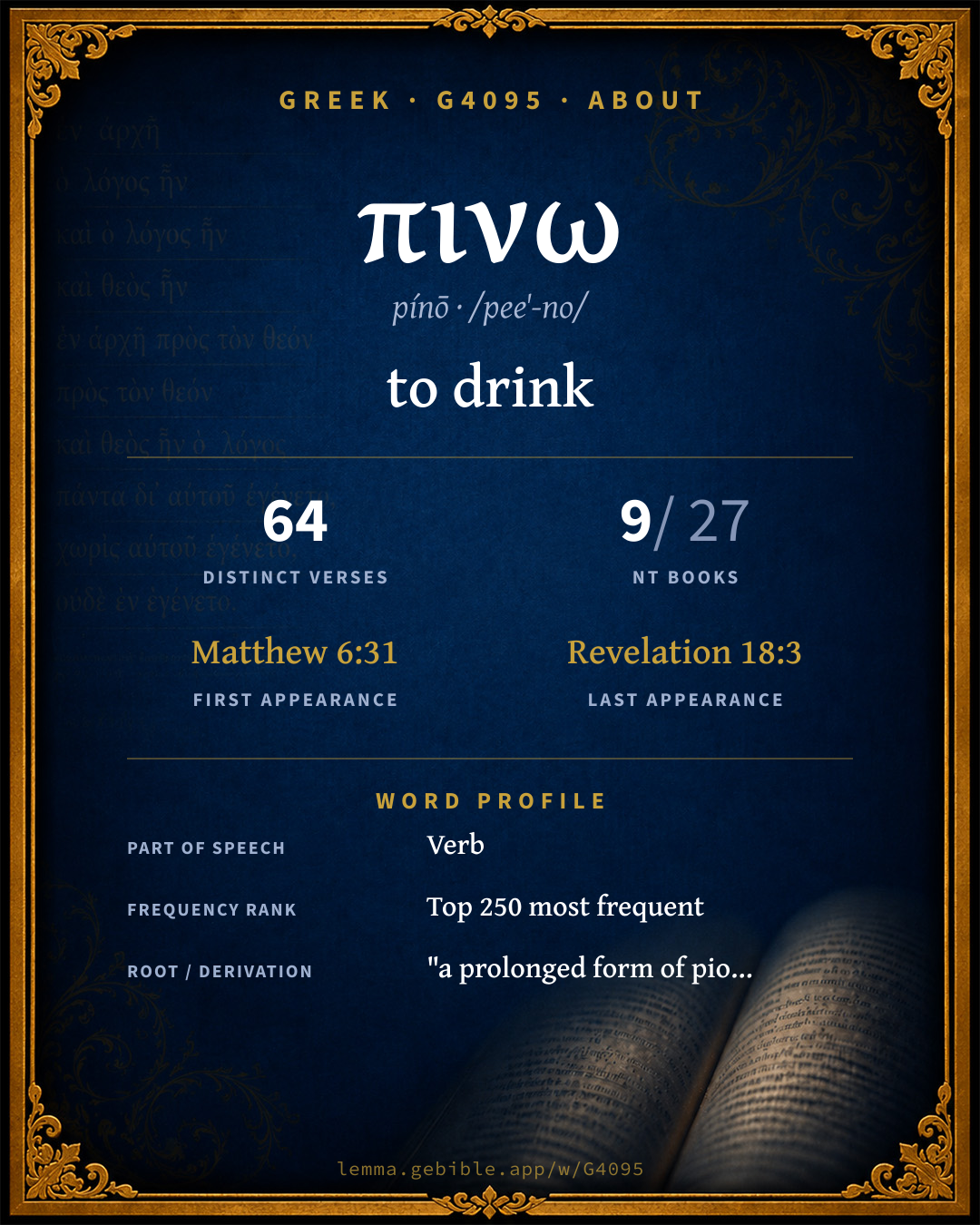
πινω
to drink
‘to drink’ is one of 2 main senses fuller range ↓
Full lexicon entry — Thayer's Greek Lexicon
From Thayer's Greek Lexicon
Where this word appears
See every Aorist-tense verb in the Greek New Testament →
Grammar key — what these labels mean
Part of speech
- Verb
- An action or state-of-being word.
Tense
- Aorist
- Action viewed as a simple whole, without regard to duration — often past (perfective aspect).
- Present
- Ongoing or general action in present time (imperfective aspect).
- Imperfect
- Continuous or repeated action in past time (“was writing”).
- Future
- Action expected in future time.
- Perfect
- A completed past action with continuing present results.
Voice
- Active
- The subject performs the action.
- Middle deponent
- Middle in form but active in meaning.
Mood
- Infinitive
- A verbal noun (“to write”), unmarked for person or number.
- Participle
- A verbal adjective (“writing,” “having written”).
- Subjunctive
- Expresses probability, purpose, or possibility (the mood of contingency).
- Indicative
- States a fact or asks a factual question (the mood of reality).
- Imperative
- Expresses a command or request.
Case
- Nominative
- The case of the subject (and the predicate nominative).
Person
- 1st person
- The speaker (“I / we”).
- 3rd person
- The one spoken about (“he / she / it / they”).
- 2nd person
- The one addressed (“you”).
Gender
- Masculine
- Grammatically masculine.
- Feminine
- Grammatically feminine.
Number
- Singular
- One.
- Plural
- More than one.
Grammatical forms 29 distinct
- Verb, Aorist, Active, Infinitive 13 times (18%)
- Verb, Present, Active, Participle, Nominative, Singular, Masculine 8 times (11%)
- Verb, Aorist, Active, Subjunctive, 1st person, Singular 6 times (8%)
- Verb, Present, Active, Infinitive 4 times (5%)
- Verb, Imperfect, Active, Indicative, 3rd person, Plural 3 times (4%)
- Verb, Present, Active, Subjunctive, 2nd person, Plural 3 times (4%)
- Verb, Aorist, Active, Indicative, 3rd person, Plural 2 times (3%)
- Verb, Aorist, Active, Indicative, 3rd person, Singular 2 times (3%)
+21 more forms (32 occurrences)
Parsed forms decoded from the imported morphology (Robinson–Tischendorf, public domain), counted across 73 parsed occurrences — not distinct verses.
Every verse where G4095 appears — 64 distinct verses across 9 books. Click any verse to open its interlinear word-by-word view. Verse text shown in the World English Bible for context — . Each verse’s Greek form is shown with its reference; the English is not keyword-highlighted, since the data carries no word-level English alignment. Use “Compare translations” on any verse to read it across multiple English versions. This concordance covers the Greek New Testament; Septuagint (Greek Old Testament) occurrences of this word are not indexed here.
Matthew 11 verses
- Matthew 6:31 πίωμεν aor act subj 1pl "Therefore don't be anxious, saying, 'What will we eat?', 'What will we drink?' or, 'With what will we be clothed?'
- Matthew 11:18 πίνων pres act ptcp nom sg masc For John came neither eating nor drinking, and they say, 'He has a demon.'
- Matthew 11:19 πίνων pres act ptcp nom sg masc The Son of Man came eating and drinking, and they say, 'Behold, a gluttonous man and a drunkard, a friend of tax collectors and sinners!' But wisdom is justified by her children."
- Matthew 20:22 πιεῖν πίνειν aor act inf pres act inf But Jesus answered, "You don't know what you are asking. Are you able to drink the cup that I am about to drink, and be baptized with the baptism that I am baptized with?" They said to him, "We are able."
- Matthew 20:23 πίεσθε fut mid.dep ind 2pl He said to them, "You will indeed drink my cup, and be baptized with the baptism that I am baptized with, but to sit on my right hand and on my left hand is not mine to give; but it is for whom it has been prepared by my Father."
- Matthew 24:38 πίνοντες pres act ptcp nom pl masc For as in those days which were before the flood they were eating and drinking, marrying and giving in marriage, until the day that Noah entered into the ark,
- Matthew 24:49 πίνῃ pres act subj 3sg and begins to beat his fellow-servants, and eat and drink with the drunken,
- Matthew 26:27 πίετε aor act impv 2pl He took the cup, gave thanks, and gave to them, saying, "All of you drink it,
- Matthew 26:29 πίω πίνω aor act subj 1sg pres act subj 1sg But I tell you that I will not drink of this fruit of the vine from now on, until that day when I drink it anew with you in my Father's Kingdom."
- Matthew 26:42 πίω aor act subj 1sg Again, a second time he went away, and prayed, saying, "My Father, if this cup can't pass away from me unless I drink it, your desire be done."
- Matthew 27:34 πεῖν πεῖν aor act inf aor act inf They gave him sour wine to drink mixed with gall. When he had tasted it, he would not drink.
Mark 6 verses
- Mark 2:16 πίνει pres act ind 3sg The scribes and the Pharisees, when they saw that he was eating with the sinners and tax collectors, said to his disciples, "Why is it that he eats and drinks with tax collectors and sinners?"
- Mark 10:38 πιεῖν πίνω aor act inf pres act ind 1sg But Jesus said to them, "You don't know what you are asking. Are you able to drink the cup that I drink, and to be baptized with the baptism that I am baptized with?"
- Mark 10:39 πίνω πίεσθε pres act ind 1sg fut mid.dep ind 2pl They said to him, "We are able." Jesus said to them, "You shall indeed drink the cup that I drink, and you shall be baptized with the baptism that I am baptized with;
- Mark 14:23 ἔπιον aor act ind 3pl He took the cup, and when he had given thanks, he gave to them. They all drank of it.
- Mark 14:25 πίω πίνω aor act subj 1sg pres act subj 1sg Most assuredly I tell you, I will no more drink of the fruit of the vine, until that day when I drink it anew in the Kingdom of God."
- Mark 16:18 πίωσιν aor act subj 3pl they will take up serpents; and if they drink any deadly thing, it will in no way hurt them; they will lay hands on the sick, and they will recover."
Luke 16 verses
- Luke 1:15 πίῃ aor act subj 3sg For he will be great in the sight of the Lord, and he will drink no wine nor strong drink. He will be filled with the Holy Spirit, even from his mother's womb.
- Luke 5:30 πίνετε pres act ind 2pl Their scribes and the Pharisees murmured against his disciples, saying, "Why do you eat and drink with the tax collectors and sinners?"
- Luke 5:33 πίνουσιν pres act ind 3pl They said to him, "Why do John's disciples often fast and pray, likewise also the disciples of the Pharisees, but yours eat and drink?"
- Luke 5:39 πιὼν aor act ptcp nom sg masc No man having drunk old wine immediately desires new, for he says, 'The old is better.'"
- Luke 7:33 πίνων pres act ptcp nom sg masc For John the Baptizer came neither eating bread nor drinking wine, and you say, 'He has a demon.'
- Luke 7:34 πίνων pres act ptcp nom sg masc The Son of Man has come eating and drinking, and you say, 'Behold, a gluttonous man, and a drunkard; a friend of tax collectors and sinners!'
- Luke 10:7 πίνοντες pres act ptcp nom pl masc Remain in that same house, eating and drinking the things they give, for the laborer is worthy of his wages. Don't go from house to house.
- Luke 12:19 πίε aor act impv 2sg I will tell my soul, "Soul, you have many goods laid up for many years. Take your ease, eat, drink, be merry."'
- Luke 12:29 πίητε aor act subj 2pl Don't seek what you will eat or what you will drink; neither be anxious.
- Luke 12:45 πίνειν pres act inf But if that servant says in his heart, 'My lord delays his coming,' and begins to beat the menservants and the maidservants, and to eat and drink, and to be drunken,
- Luke 13:26 ἐπίομεν aor act ind 1pl Then you will begin to say, 'We ate and drink in your presence, and you taught in our streets.'
- Luke 17:8 πίω πίεσαι aor act subj 1sg fut mid.dep ind 2sg and will not rather tell him, 'Prepare my supper, clothe yourself properly, and serve me, while I eat and drink. Afterward you shall eat and drink'?
- Luke 17:27 ἔπινον impf act ind 3pl They ate, they drank, they married, they were given in marriage, until the day that Noah entered into the ark, and the flood came, and destroyed them all.
- Luke 17:28 ἔπινον impf act ind 3pl Likewise, even as it happened in the days of Lot: they ate, they drank, they bought, they sold, they planted, they built;
- Luke 22:18 πίω aor act subj 1sg for I tell you, I will not drink at all again from the fruit of the vine, until the Kingdom of God comes."
- Luke 22:30 πίνητε pres act subj 2pl that you may eat and drink at my table in my Kingdom. You will sit on thrones, judging the twelve tribes of Israel."
John 11 verses
- John 4:7 πεῖν aor act inf A woman of Samaria came to draw water. Jesus said to her, "Give me a drink."
- John 4:9 πεῖν aor act inf The Samaritan woman therefore said to him, "How is it that you, being a Jew, ask for a drink from me, a Samaritan woman?" (For Jews have no dealings with Samaritans.)
- John 4:10 πεῖν aor act inf Jesus answered her, "If you knew the gift of God, and who it is who says to you, 'Give me a drink,' you would have asked him, and he would have given you living water."
- John 4:12 ἔπιεν aor act ind 3sg Are you greater than our father, Jacob, who gave us the well, and drank of it himself, as did his children, and his cattle?"
- John 4:13 πίνων pres act ptcp nom sg masc Jesus answered her, "Everyone who drinks of this water will thirst again,
- John 4:14 πίῃ aor act subj 3sg but whoever drinks of the water that I will give him will never thirst again; but the water that I will give him will become in him a well of water springing up to eternal life."
- John 6:53 πίητε aor act subj 2pl Jesus therefore said to them, "Most assuredly I tell you, unless you eat the flesh of the Son of Man and drink his blood, you don't have life in yourselves.
- John 6:54 πίνων pres act ptcp nom sg masc He who eats my flesh and drinks my blood has eternal life, and I will raise him up at the last day.
- John 6:56 πίνων pres act ptcp nom sg masc He who eats my flesh and drinks my blood lives in me, and I in him.
- John 7:37 πινέτω pres act impv 3sg Now on the last and greatest day of the feast, Jesus stood and cried out, "If anyone is thirsty, let him come to me and drink!
- John 18:11 πίω aor act subj 1sg Jesus therefore said to Peter, "Put the sword into its sheath. The cup which the Father has given me, shall I not surely drink it?"
Acts 3 verses
- Acts 9:9 ἔπιεν aor act ind 3sg He was without sight for three days, and neither ate nor drank.
- Acts 23:12 πιεῖν aor act inf When it was day, some of the Jews banded together, and bound themselves under a curse, saying that they would neither eat nor drink until they had killed Paul.
- Acts 23:21 πιεῖν aor act inf Therefore don't yield to them, for more than forty men lie in wait for him, who have bound themselves under a curse neither to eat nor to drink until they have killed him. Now they are ready, looking for the promise from you."
Romans 1 verse
1 Corinthians 12 verses
- 1 Corinthians 9:4 πεῖν aor act inf Have we no right to eat and to drink?
- 1 Corinthians 10:4 ἔπιον ἔπινον aor act ind 3pl impf act ind 3pl and all drank the same spiritual drink. For they drank of a spiritual rock that followed them, and the rock was Christ.
- 1 Corinthians 10:7 πεῖν aor act inf Neither be idolaters, as some of them were. As it is written, "The people sat down to eat and drink, and rose up to play."
- 1 Corinthians 10:21 πίνειν pres act inf You can't both drink the cup of the Lord and the cup of demons. You can't both partake of the table of the Lord, and of the table of demons.
- 1 Corinthians 10:31 πίνετε pres act ind 2pl Whether therefore you eat, or drink, or whatever you do, do all to the glory of God.
- 1 Corinthians 11:22 πίνειν pres act inf What, don't you have houses to eat and to drink in? Or do you despise God's assembly, and put them to shame who don't have? What shall I tell you? Shall I praise you? In this I don't praise you.
- 1 Corinthians 11:25 πίνητε pres act subj 2pl In the same way he also took the cup, after supper, saying, "This cup is the new covenant in my blood. Do this, as often as you drink, in memory of me."
- 1 Corinthians 11:26 πίνητε pres act subj 2pl For as often as you eat this bread and drink this cup, you proclaim the Lord's death until he comes.
- 1 Corinthians 11:27 πίνῃ pres act subj 3sg Therefore whoever eats this bread or drinks the Lord's cup in a manner unworthy of the Lord will be guilty of the body and the blood of the Lord.
- 1 Corinthians 11:28 πινέτω pres act impv 3sg But let a man examine himself, and so let him eat of the bread, and drink of the cup.
- 1 Corinthians 11:29 πίνων πίνει pres act ptcp nom sg masc pres act ind 3sg For he who eats and drinks in an unworthy manner eats and drinks judgment to himself, if he doesn't discern the Lord's body.
- 1 Corinthians 15:32 πίωμεν aor act subj 1pl If I fought with animals at Ephesus for human purposes, what does it profit me? If the dead are not raised, then "let us eat and drink, for tomorrow we die."
Hebrews 1 verse
Revelation 3 verses
- Revelation 14:10 πίεται fut mid.dep ind 3sg he also will drink of the wine of the wrath of God, which is prepared unmixed in the cup of his anger. He will be tormented with fire and sulfur in the presence of the holy angels, and in the presence of the Lamb.
- Revelation 16:6 πεῖν aor act inf For they poured out the blood of the saints and the prophets, and you have given them blood to drink. They deserve this."
- Revelation 18:3 πέπωκαν perf act ind 3pl For all the nations have drunk of the wine of the wrath of her sexual immorality, the kings of the earth committed sexual immorality with her, and the merchants of the earth grew rich from the abundance of her luxury."
About this entry
At a glance — auto-summarized from this page’s data, not written by a person. Every figure links to its source below. This summary describes the numbers; it doesn’t interpret them.
The Greek verb πινω centers on the idea of “to drink.” Debuting at Matthew 6:31, it then recurs through the corpus. Spanning 64 verses in 9 books, it ranks among the moderately common words of the Greek New Testament. Luke dominates its distribution — 16 of 64 verses. Thayer's distinguishes 2 senses for it. For the data behind this summary, explore the sense tree and the renderings breakdown below.
Gloss history
Strong's 1890 vs modern scholarship
About this word
Strong's G4095 catalogs a Greek word from the Greek New Testament.
These counts are not copied from any lexicon or concordance. They are computed here, from the morphology-tagged Greek New Testament. What Lemma adds →
- 64
- distinct verses
- The word appears in 64 distinct verses.
- 9 / 27
- NT books
- The word appears in 9 of 27 New Testament books.
- #233
- by frequency
- Top 250 most frequent Greek words (rank 233 of 5,347 Greek words by occurrence).
View all 64 occurrences in the concordance →
Most concentrated in
- Luke 16 verses 25%
- 1 Corinthians 12 verses 19%
- Matthew 11 verses 17%
By section of the New Testament
By traditional corpus
Conventional, traditional groupings — biblical authorship is debated, so this is a traditional corpus grouping, not an authorship claim. Some books belong to more than one corpus (Luke is in both the Gospels and the Lukan corpus, and so on), so these shares overlap and need not total 100%. Each figure is a share of the word’s 64 distinct verses.
- Gospels 44 verses · 69%
- Lukan (Luke–Acts) 19 verses · 30%
- Johannine 14 verses · 22%
- Pauline corpus 13 verses · 20%
- Revelation 3 verses · 5%
- Hebrews 1 verse · 2%
How translations render this word
Counts come from each version’s own published word-to-Strong’s tagging or interlinear alignment — an approximate guide to how each version renders this word, not a word-level alignment the data otherwise carries. Because each total is that version’s own tagged count, the per-version totals vary from one another and need not match the appearance or distinct-verse counts above. These counts may also differ from a printed concordance because Lemma counts each distinctly tagged rendering and does not collapse phrase taggings into a single head-word total. This is a fixed set of word-tagged versions (KJV, ASV, BSB, ULT) and does not change with the reading translation you choose elsewhere. Each version’s license is shown beside its name below (and on Sources).
- King James Version: Drink 37×, Drinketh 7×, Drinking 6×
- American Standard Version: Drink 38×, Drinketh 6×, Drinking 6×
- Berean Standard Bible: Drink 33×, Drinking 9×, Drinks 8×
- unfoldingWord Literal Text: Drink 36×, Drinking 10×, Drank 5×
King James Version Public Domain
Renders G4095 across 80 tagged occurrences — most commonly:
Plus 12 renderings that appear only once — usually multi-word phrases or single function words the recovered tagging swept in, not distinct renderings.
American Standard Version Public Domain
Renders G4095 across 75 tagged occurrences — most commonly:
Plus 18 renderings that appear only once — usually multi-word phrases or single function words the recovered tagging swept in, not distinct renderings.
Berean Standard Bible Public Domain
Renders G4095 across 73 tagged occurrences — most commonly:
Plus 13 renderings that appear only once — usually multi-word phrases or single function words the recovered tagging swept in, not distinct renderings.
unfoldingWord Literal Text CC BY-SA 4.0
Renders G4095 across 83 tagged occurrences — most commonly:
Plus 12 renderings that appear only once — usually multi-word phrases or single function words the recovered tagging swept in, not distinct renderings.
Senses in Thayer's
The 2 senses Thayer's distinguishes for this word, in lexicon order (not ranked by frequency or importance). The full entry — with sub-senses — is in the Lexicon Entry tab.
- to drink
- figuratively, to receive into the soul what serves to refresh strengthen, nourish it unto life eternal
Word origin
Origin: "a prolonged form of pio pee'-o; which (together with another form poo po'-o, occurs only as an alternate in certain tenses"
the first is a prolonged form of the second which (together with the third form) occurs only as an alternate in certain tenses; to imbibe (literally or figuratively): - drink.
— Strong’s Exhaustive Concordance (1890), public domain.
Forms in the corpus
The 29 distinct written forms G4095 takes in the Greek New Testament, most frequent first — each parse links to that tense’s occurrences in the concordance.
Same root — word family
Other Thayer's entries built from the same root as G4095, grouped by Strong’s listed origin. These share a root / origin per the lexicon — not necessarily a shared meaning. Each links to that word’s own entry.
Derived from this word
- πιοτης piótēs G4096 fatness
- πομα póma G4188 drink
- ποσις pósis G4213 drink
- ποταμος potamós G4215 river
- ποτηριον potḗrion G4221 cup
- ποτιζω potízō G4222 to give drink
- ποτος pótos G4224 drinking
Compare all same-root words → Showing 4 of 8 — not the complete family. They share a root, not necessarily a meaning.
Septuagint usage
The same Greek word πινω appears 239 times in the Greek Old Testament (Septuagint), across 208 verses in 33 books.
- 239
- LXX occurrences
- Tagged occurrences of this Greek word in the Septuagint.
- 208
- verses
- Distinct Septuagint verses containing this word.
- 33 / 39
- OT books
- The word appears in 33 of the 39 Old Testament books.
Sample Septuagint occurrences
- Genesis 9:21 πίνω
- Exodus 7:18 πίνω
- Leviticus 10:9 πίνω
- Numbers 6:3 πίνω
- Deuteronomy 2:6 πίνω
- Judges 7:5 πίνω
- Ruth 2:9 πίνω
- 1 Samuel 1:11 πίνω
- 2 Samuel 11:11 πίνω
- 1 Kings 1:25 πίνω
- 2 Kings 3:17 πίνω
- 1 Chronicles 11:18 πίνω
Septuagint occurrences (same lexeme)
Every verse where the same Strong’s number (G4095) appears in the Greek Septuagint — showing the first 50 of 208. Verse text shown in the World English Bible for context; the Greek form is the matched word — the English is not keyword-highlighted.
- Genesis 9:21 πίνω He drank of the wine, and got drunk. He was uncovered within his tent.
- Genesis 24:14 πίνω Let it happen, that the young lady to whom I will say, 'Please let down your pitcher, that I may drink.' She will say, 'Drink, and I will also give your camels a drink.' Let the same be she who you have appointed for your servant Isaac. Thereby will I know that you have shown kindness to my master."
- Genesis 24:18 πίνω She said, "Drink, my lord." She hurried, and let down her pitcher on her hand, and gave him drink.
- Genesis 24:19 πίνω When she had done giving him drink, she said, "I will also draw for your camels, until they have done drinking."
- Genesis 24:22 πίνω It happened, as the camels had done drinking, that the man took a golden ring of half a shekel weight, and two bracelets for her hands of ten shekels weight of gold,
- Genesis 24:44 πίνω She will tell me, "Drink, and I will also draw for your camels." Let the same be the woman whom Yahweh has appointed for my master's son.'
- Genesis 24:46 πίνω She hurried and let down her pitcher from her shoulder, and said, 'Drink, and I will also give your camels a drink.' So I drank, and she made the camels drink also.
- Genesis 24:54 πίνω They ate and drank, he and the men who were with him, and stayed all night. They rose up in the morning, and he said, "Send me away to my master."
- Genesis 25:34 πίνω Jacob gave Esau bread and stew of lentils. He ate and drank, rose up, and went his way. So Esau despised his birthright.
- Genesis 26:30 πίνω He made them a feast, and they ate and drink.
- Genesis 27:25 πίνω He said, "Bring it near to me, and I will eat of my son's venison, that my soul may bless you." He brought it near to him, and he ate. He brought him wine, and he drank.
- Genesis 30:38 πίνω He set the rods which he had peeled opposite the flocks in the gutters in the watering-troughs where the flocks came to drink. They conceived when they came to drink.
- Genesis 31:46 πίνω Jacob said to his relatives, "Gather stones." They took stones, and made a heap. They ate there by the heap.
- Genesis 31:54 πίνω Jacob offered a sacrifice in the mountain, and called his relatives to eat bread. They ate bread, and stayed all night in the mountain.
- Genesis 43:34 πίνω He sent portions to them from before him, but Benjamin's portion was five times as much as any of theirs. They drank, and were merry with him.
- Genesis 44:5 πίνω Isn't this that from which my lord drinks, and by which he indeed divines? You have done evil in so doing.'"
- Exodus 7:18 πίνω The fish that are in the river shall die, and the river shall become foul; and the Egyptians shall loathe to drink water from the river."'"
- Exodus 7:21 πίνω The fish that were in the river died; and the river became foul, and the Egyptians couldn't drink water from the river; and the blood was throughout all the land of Egypt.
- Exodus 7:24 πίνω All the Egyptians dug round about the river for water to drink; for they couldn't drink of the water of the river.
- Exodus 15:22 πίνω Moses led Israel onward from the Red Sea, and they went out into the wilderness of Shur; and they went three days in the wilderness, and found no water.
- Exodus 15:23 πίνω When they came to Marah, they couldn't drink from the waters of Marah, for they were bitter. Therefore the name of it was called Marah.
- Exodus 15:24 πίνω The people murmured against Moses, saying, "What shall we drink?"
- Exodus 17:1 πίνω All the congregation of the children of Israel traveled from the wilderness of Sin, by their journeys, according to Yahweh's commandment, and encamped in Rephidim; but there was no water for the people to drink.
- Exodus 17:2 πίνω Therefore the people quarreled with Moses, and said, "Give us water to drink." Moses said to them, "Why do you quarrel with me? Why do you test Yahweh?"
- Exodus 17:6 πίνω Behold, I will stand before you there on the rock in Horeb. You shall strike the rock, and water will come out of it, that the people may drink." Moses did so in the sight of the elders of Israel.
- Exodus 24:11 πίνω He didn't lay his hand on the nobles of the children of Israel. They saw God, and ate and drank.
- Exodus 32:6 πίνω They rose up early on the next day, and offered burnt offerings, and brought peace-offerings; and the people sat down to eat and to drink, and rose up to play.
- Exodus 34:28 πίνω He was there with Yahweh forty days and forty nights; he neither ate bread, nor drank water. He wrote on the tablets the words of the covenant, the ten commandments.
- Leviticus 10:9 πίνω "Drink no wine nor strong drink, you, nor your sons with you, when you go into the Tent of Meeting, that you don't die: it shall be a statute forever throughout your generations:
- Leviticus 11:34 πίνω All food which may be eaten, that on which water comes, shall be unclean; and all drink that may be drunk in every such vessel shall be unclean.
- Numbers 6:3 πίνω he shall separate himself from wine and strong drink. He shall drink no vinegar of wine, or vinegar of fermented drink, neither shall he drink any juice of grapes, nor eat fresh grapes or dried.
- Numbers 6:20 πίνω and the priest shall wave them for a wave offering before Yahweh. This is holy for the priest, together with the breast that is waved and the thigh that is offered. After that the Nazirite may drink wine.
- Numbers 20:5 πίνω Why have you made us to come up out of Egypt, to bring us in to this evil place? it is no place of seed, or of figs, or of vines, or of pomegranates; neither is there any water to drink.
- Numbers 20:11 πίνω Moses lifted up his hand, and struck the rock with his rod twice: and water came forth abundantly, and the congregation drank, and their cattle.
- Numbers 20:17 πίνω Please let us pass through your land: we will not pass through field or through vineyard, neither will we drink of the water of the wells: we will go along the king's highway; we will not turn aside to the right hand nor to the left, until we have passed your border.
- Numbers 20:19 πίνω The children of Israel said to him, We will go up by the highway; and if we drink of your water, I and my cattle, then will I give the price of it: let me only, without [doing] anything [else], pass through on my feet.
- Numbers 21:16 πίνω From there they traveled to Beer: that is the well of which Yahweh said to Moses, Gather the people together, and I will give them water.
- Numbers 21:22 πίνω Let me pass through your land: we will not turn aside into field, or into vineyard; we will not drink of the water of the wells: we will go by the king's highway, until we have passed your border.
- Numbers 23:24 πίνω Behold, the people rises up as a lioness, As a lion does he lift himself up: He shall not lie down until he eat of the prey, Drink the blood of the slain.
- Numbers 33:14 πίνω They traveled from Alush, and encamped in Rephidim, where was no water for the people to drink.
- Deuteronomy 2:6 πίνω You shall purchase food of them for money, that you may eat; and you shall also buy water of them for money, that you may drink.
- Deuteronomy 2:28 πίνω You shall sell me food for money, that I may eat; and give me water for money, that I may drink: only let me pass through on my feet,
- Deuteronomy 9:9 πίνω When I was gone up onto the mountain to receive the tables of stone, even the tables of the covenant which Yahweh made with you, then I stayed on the mountain forty days and forty nights; I did neither eat bread nor drink water.
- Deuteronomy 9:18 πίνω I fell down before Yahweh, as at the first, forty days and forty nights; I did neither eat bread nor drink water; because of all your sin which you sinned, in doing that which was evil in the sight of Yahweh, to provoke him to anger.
- Deuteronomy 11:11 πίνω but the land, where you go over to possess it, is a land of hills and valleys, [and] drinks water of the rain of the sky,
- Deuteronomy 28:39 πίνω You shall plant vineyards and dress them, but you shall neither drink of the wine, nor gather [the grapes]; for the worm shall eat them.
- Deuteronomy 29:5 πίνω I have led you forty years in the wilderness: your clothes have not grown old on you, and your shoe has not grown old on your foot.
- Deuteronomy 32:14 πίνω Butter of the herd, and milk of the flock, With fat of lambs, Rams of the breed of Bashan, and goats, With the finest of the wheat; Of the blood of the grape you drank wine.
- Deuteronomy 32:38 πίνω Which ate the fat of their sacrifices, And drank the wine of their drink-offering? Let them rise up and help you, Let them be your protection.
- Judges 7:5 πίνω So he brought down the people to the water: and Yahweh said to Gideon, Everyone who laps of the water with his tongue, as a dog laps, him shall you set by himself; likewise everyone who bows down on his knees to drink.
These are occurrences of the same Greek lexeme (G4095) in the Septuagint — not a translation of any one Hebrew word. The store carries no word-level Hebrew↔Greek alignment, so no Hebrew original is asserted here. Counts come from the recovered LXX Strong's tagging — high-frequency vocabulary is well covered, while rare or late forms may be untagged — so they reflect tagged occurrences and may slightly undercount.