
Luke 17:28

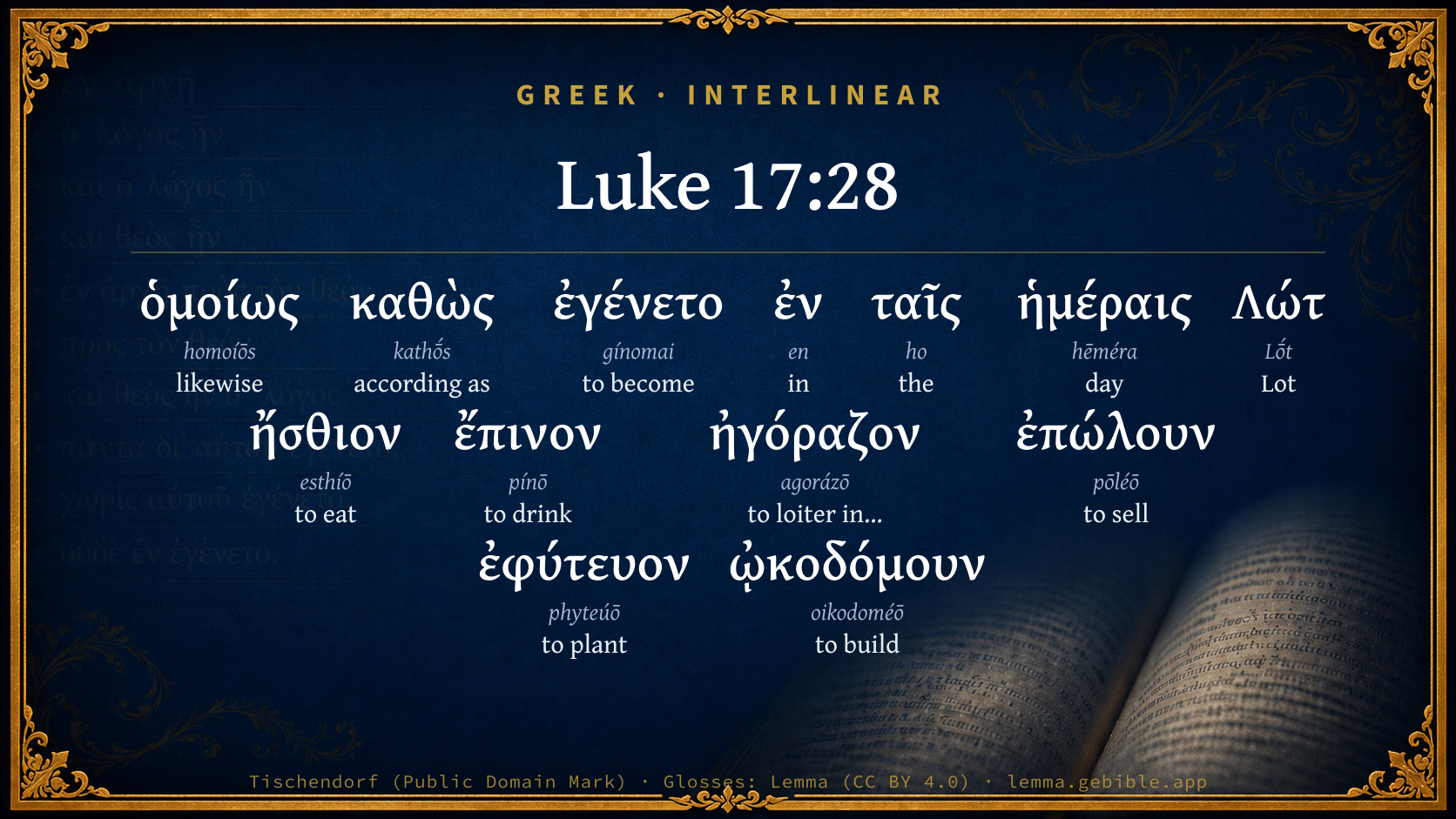
Greek (Tischendorf 8th ed.) Luke 17:28 appears in the Greek New Testament. The text above is from the Tischendorf 8th edition. Each word links to its Strong’s number and a concise gloss. Click any word for its full Thayer’s Greek Lexicon entry.
Download image
Cite this verse

Luke 17:28 (World English Bible). Public Domain. Lemma interlinear Bible study tool, https://lemma.gebible.app/v/luke/17/28.

Show BibTeX & RIS
BibTeX
RIS
English Translation
Likewise, even as it happened in the days of Lot: they ate, they drank, they bought, they sold, they planted, they built;
World English Bible · Public Domain
Highlights
  • 1 first appearance in the Greek New Testament
Full analysis ↓
Download a study sheet

One document with this verse’s original text, its word-by-word gloss line, the meaning frame, cross-references with their text, attributed commentary, and full source and license credits — printable, and it pastes into notes with its structure intact.

This verse Autodidact and up

Study sheet (.html) Plain text (.txt)

A passage Seminary Student

Up to 50 verses in one chapter. A passage sheet keeps up to 6 commentary sources and 12 cross-references per verse, in the order this page ranks them, and says so on the sheet whenever that leaves anything out. Ask for a single verse and you get the Autodidact verse sheet above.

Everything on this page stays free to read, with no account — the sheet is a download of what is already on screen, not access to it.

Want to remove ads? Support Godless Engineer
Compare translations 3

The same verse in 3 English versions, stacked beneath the original-language interlinear above. Click any original word for its lexicon entry.

Each is an independent rendering of the whole verse — the interlinear is not word-aligned to these translations.

Highlighted words mark where these versions differ — a whole-verse word diff, not a word-by-word alignment.

  • World English Bible Public Domain
    Likewise, even as it happened in the days of Lot: they ate, they drank, they bought, they sold, they planted, they built;
  • King James Version Public Domain
    Likewise also as it was in the days of Lot; they did eat, they drank, they bought, they sold, they planted, they builded;
  • unfoldingWord Literal Text CC BY-SA 4.0
    Likewise, just as it happened in the days of Lot—they were eating, they were drinking, they were buying, they were selling, they were planting, they were building.

unfoldingWord Literal Text — © unfoldingWord, licensed CC BY-SA 4.0. Word-aligned USFM3 via Door43 (git.door43.org/unfoldingWord/en_ult).

Versions to compare (up to 4)

3 of 4 selected

Show all 19 translations

Every available English version of this verse, each an independent rendering of the whole verse.

  • World English Bible Public Domain
    Likewise, even as it happened in the days of Lot: they ate, they drank, they bought, they sold, they planted, they built;
  • Berean Standard Bible Public Domain
    It was the same in the days of Lot: People were eating and drinking, buying and selling, planting and building.
  • Majority Standard Bible Public Domain
    It was the same in the days of Lot: People were eating and drinking, buying and selling, planting and building.
  • King James Version Public Domain
    Likewise also as it was in the days of Lot; they did eat, they drank, they bought, they sold, they planted, they builded;
  • American Standard Version (1901) Public Domain
    Likewise even as it came to pass in the days of Lot; they ate, they drank, they bought, they sold, they planted, they builded;
  • Revised Version (1885) Public Domain
    Likewise even as it came to pass in the days of Lot; they ate, they drank, they bought, they sold, they planted, they builded;
  • Geneva Bible (1599) Public Domain
    Likewise also, as it was in the dayes of Lot: they ate, they dranke, they bought, they solde, they planted, they built.
  • Douay-Rheims (1899) Public Domain
    Likewise as it came to pass, in the days of Lot: they did eat and drink, they bought and sold, they planted and built.
  • Young's Literal Translation Public Domain
    in like manner also, as it came to pass in the days of Lot; they were eating, they were drinking, they were buying, they were selling, they were planting, they were building;
  • Literal Standard Version CC BY-SA 4.0
    in like manner also, as it came to pass in the days of Lot; they were eating, they were drinking, they were buying, they were selling, they were planting, they were building;
  • Unlocked Literal Bible CC BY-SA 4.0
    Likewise, even as it happened in the days of Lot—they were eating and drinking, buying and selling, planting and building.
  • unfoldingWord Literal Text CC BY-SA 4.0
    Likewise, just as it happened in the days of Lot—they were eating, they were drinking, they were buying, they were selling, they were planting, they were building.
  • Darby Bible Public Domain
    and in like manner as took place in the days of Lot: they ate, they drank, they bought, they sold, they planted, they builded;
  • World Messianic Bible Public Domain
    Likewise, even as it was in the days of Lot: they ate, they drank, they bought, they sold, they planted, they built;
  • Webster's Bible Public Domain
    Likewise also as it was in the days of Lot: they ate, they drank, they bought, they sold, they planted, they built;
  • Free Bible Version CC BY-SA 4.0
    It will be like it was in Lot's day. People went on eating and drinking, buying and selling, planting and building.
  • Bible in Basic English Public Domain
    In the same way, in the days of Lot; they were feasting and trading, they were planting and building;
  • Text-Critical English NT CC BY 4.0
    It will be the same as it was in the days of Lot. People were eating and drinking, buying and selling, planting and building.
  • Tyndale New Testament (1534) Public Domain
    Lykewyse also as it chaunsed in the dayes of Lot. They ate they dranke they bought they solde they planted they bilte.

Literal Standard Version (2020), Covenant Press — licensed CC BY-SA 4.0. Text via the HelloAO Bible API (eBible.org). Unlocked Literal Bible (unfoldingWord) — licensed CC BY-SA 4.0. Text via the HelloAO Bible API (eBible.org). unfoldingWord Literal Text — © unfoldingWord, licensed CC BY-SA 4.0. Word-aligned USFM3 via Door43 (git.door43.org/unfoldingWord/en_ult). Free Bible Version, Dr. Jonathan Gallagher — licensed CC BY-SA 4.0. Text via the HelloAO Bible API (eBible.org).

Word by word

More ways to search: Search by grammar → Find every occurrence → Compare this word →

Practice this passage: Drill this verse → Learn its vocabulary →

Λώτ
Lṓt
G3091
“Lot”
Noun, Proper, indeclinable
Part of Speech
Noun · Proper, indeclinable
Full Thayer's Definition

Origin: of hebrew origin H3876

TDNT: None

Lot = "veil or covering" 1. the son of Haran and nephew to Abraham
  1. ὁμοίως homoíōs G3668 “likewise” Adverb
  2. καθὼς kathṓs G2531 “according as” Adverb
  3. ἐγένετο gínomai G1096 “to become” Verb, Aorist, Middle deponent, Indicative, 3rd person, Singular
  4. ἐν en G1722 “in” Preposition
  5. ταῖς ho G3588 “the” Article, Dative, Plural, Feminine
  6. ἡμέραις hēméra G2250 “day” Noun, Dative, Plural, Feminine
  7. ἤσθιον esthíō G2068 “to eat” Verb, Imperfect, Active, Indicative, 3rd person, Plural
  8. ἔπινον pínō G4095 “to drink” Verb, Imperfect, Active, Indicative, 3rd person, Plural
  9. ἠγόραζον agorázō G59 “to loiter in marketplace” Verb, Imperfect, Active, Indicative, 3rd person, Plural
  10. ἐπώλουν pōléō G4453 “to sell” Verb, Imperfect, Active, Indicative, 3rd person, Plural
  11. ἐφύτευον phyteúō G5452 “to plant” Verb, Imperfect, Active, Indicative, 3rd person, Plural
  12. ᾠκοδόμουν oikodoméō G3618 “to build” Verb, Imperfect, Active, Indicative, 3rd person, Plural

About this verse

These counts appear in no published source. They are computed here, from the morphology-tagged text and Lemma’s own curated glosses. What Lemma adds →

13
words
13
distinct lemmas
Gospels
section

Notable vocabulary

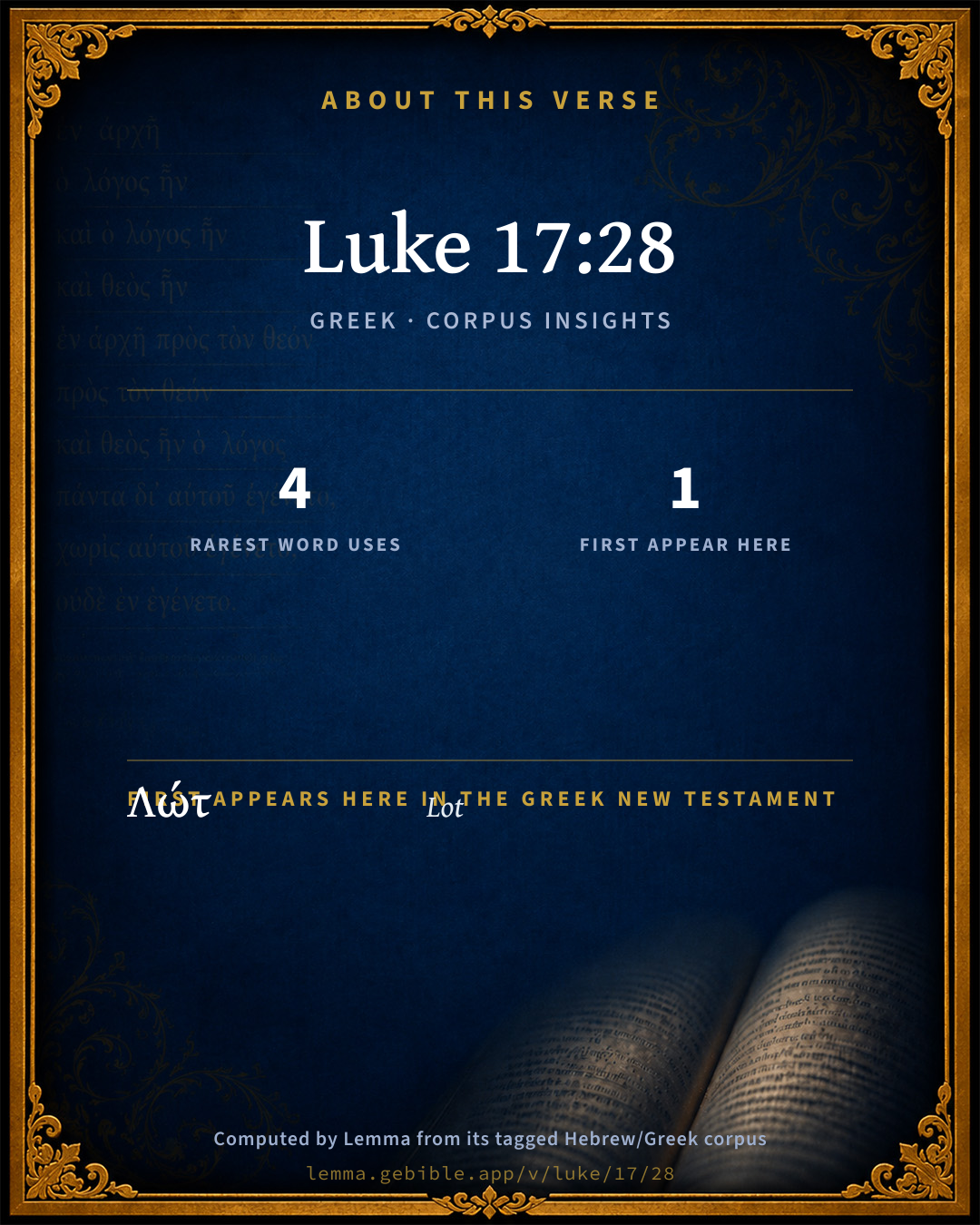
The rarest word here is Λώτ Lot G3091 — appearing just 4 times in the whole Greek New Testament.

First appearance in Scripture

This word makes its first canonical appearance in the Greek New Testament here:

Shared distinctive vocabulary

Λώτ Lot G3091 occurs in 4 verses of the Greek New Testament. Also found in:
Cross-references

5

Topical passages linked to Luke 17:28 in the Treasury of Scripture Knowledge — connected by theme and wording, ordered by reader-vote popularity; previews shown in the World English Bible.

  • Ezekiel 16:49–50 Behold, this was the iniquity of your sister Sodom: pride, fullness of bread, and prosperous ease was in her and in her daughters; neither did she strengthen the hand of the poor and needy.
  • Genesis 18:20–21 Yahweh said, "Because the cry of Sodom and Gomorrah is great, and because their sin is very grievous,
  • James 5:1–5 Come now, you rich, weep and howl for your miseries that are coming on you.
  • Genesis 13:13 Now the men of Sodom were exceedingly wicked and sinners against Yahweh.
  • Genesis 19:1–28 The two angels came to Sodom at evening. Lot sat in the gate of Sodom. Lot saw them, and rose up to meet them. He bowed himself with his face to the earth,

Cross-references courtesy of OpenBible.info (CC BY 4.0).

Commentary

Notes on Luke 17:28 from classic Christian and Jewish commentators (each source and its license shown beneath its notes). The classic Christian expositions comment on the surrounding passage and are grouped to its opening verse, so a note may address several verses; the Jewish commentaries on the Tanakh (Rashi and others) are per-verse, so they appear only where the commentator wrote on this verse.

Lemma curates 59 commentaries, every one of them public domain or Creative Commons licensed, each selected and text-cleaned for this edition rather than reprinted as found. About our sources →

Godbey's Commentary on the New Testament

William B. Godbey

THE DAYS OF LOT

Luk 17:28-30. “Likewise it was thus in the days of Lot. They were eating, drinking, buying, selling, planting, building; and on the day Lot went out from Sodom, fire and brimstone rained from heaven, and destroyed them all. According to these things shall it be in the day the Son of man is revealed.” Among the cities which dotted the Salt Sea round and round in the beautiful Vale of Siddim, indescribably fertile, and “well watered as the garden of the Lord,” encompassed by the mountains of Simeon, Judah, and Benjamin on the west, and those of Moab on the east, the largest and most prominent were Sodom and Gomorrah. We not only have Lot’s testimony as to the fertility, irrigation, and prosperity of this country, but (Genesis 14) we find four great kings coming from Babylon, Nineveh, Persia, and Mesopotamia to invade this country, conquer it, and carry away the spoils. Hence it must have been very important. At present that whole region is desolate and barren, without an inhabitant, unless the wandering Arab should there pitch his tent. It is now a desert for the want of water, whereas the Bible assures us that in the days of its prosperity it was “well watered.” The soil is now very rich, and would be exceedingly productive if the rains fell on it. It is by all authorities admitted that the very site of Sodom and Gomorrah is now under the waters of the Dead Sea, so called because no fish can live in its waters, which doubtless abounded with valuable fish before the retribution of the Almighty fell on it, destroying the cities with fire and brimstone, withering and blighting all the surrounding country, so that death reigns without a rival, and the sea is significantly denominated “Dead.” The ruins of cities are found all around on the coast of that sea, while all authorities locate Sodom and Gomorrah within the territory now occupied by the sea. Just as Lot and his family were delivered from the awful doom of Sodom and Gomorrah, so will the saints be delivered when the Lord cometh. Jesus here says, with reference to both Noah and Lot, that they illustrate the state of things — calamities on the wicked and deliverance to the righteous — when the Son of man is revealed.

William B. Godbey, Commentary on the New Testament (1896–1900) — public domain. Text from a community e-Sword module.

Bengel's Gnomon

Johann Albrecht Bengel

Luk 17:28. Ἐν ταῖς ἡμέραις Λὼς, in the days of Lot) Gen 19:14.—ἠγόραζον, they were buying) Already the world had become more motley in its employments in the time of Lot, than in that of Noah; how much more so in our times, when the arts of merchandise, navigation, war, the bar [or the market], the school, the senate, etc., have been advanced to the highest perfection!

Bengel's Gnomon of the New Testament — English translation (T&T Clark, Edinburgh, 1860) — public domain. Text from a community e-Sword module.

Meyer's Critical & Exegetical Commentary

Heinrich August Wilhelm Meyer

Luk_17:28-30. Ὁμοίως] does not belong to ἅπαντας (Bornemann, who assumes a Latinism: perdidit omnes pariter atque ut accidit), against which is to be set the similarity of the twofold καὶ ἀπώλεσεν ἅπαντας, Luk_17:27; Luk_17:29. Moreover, we are not to conceive of ἔσται again after ὁμ. καί (Paulus, Bleek), against which is Luk_17:30; but similiter quoque, sicuti accidit, etc. This ὁμοίως καί is afterwards again taken up by κατὰ τὰ αὐτά, Luk_17:30, and the ἤσθιον … ἅπαντας that lies between the two is epexegetically annexed to the ὡς ἐγένετο, as in Luk_7:11, Luk_8:40, and frequently; so that ἤσθιον … ἅπαντας is not to be put in a parenthesis at all (Lachmann), but neither is any point to be placed after ἅπαντας (Tischendorf).

Luk_17:29 f. ἔβρεξε] scil. θεός. Comp. Mat_5:45; Gen_19:24. In remembrance of the latter passage the subject is presupposed as known, and hence the verb is not intransitive, as at Rev_11:6 (Grotius). On the use of the word in classical Greek, see Lobeck, ad Phryn. p. 291.

πῦρ κ. θεῖον] Comp. Hom. Od. xxii. 493; it is not to be transformed into lightnings (Kuinoel); Jesus follows the representation of Genesis 19

ἀποκαλύπτεται] is revealed, 1Pe_5:4; 1Jn_2:28; 1Jn_3:2. Up to that time He is hidden with God in His glory, Col_3:3 f.; 2Th_1:7; 1Co_1:7; 1Pe_1:7; 1Pe_4:13.

Meyer — Critical and Exegetical Commentary on the New Testament — English translation by Peter Christie, edited by Frederick Crombie (T&T Clark, 1880) — public domain. Text from a community e-Sword module.

Expositor's Greek Testament

ed. W. Robertson Nicoll

Luk 17:28 . ὁμοίως : introducing a new comparison = similarly, as it was in the days, etc. so shall it be in the day of, etc. (Luk 17:30 ). Bornemann ingeniously connects ὁμοίως with ἅπαντας going before, and, treating it as a Latinism, renders perdidit omnes pariter . ἤσθιον , etc.: again a series of unconnected verbs, and a larger, six , and all in the imperfect tense. This second comparison, taken from Lot’s history, is not given in Mt. The suddenness of the catastrophe makes it very apposite.

The Expositor's Greek Testament, edited by W. Robertson Nicoll (1897–1910) — public domain. Text from a community e-Sword module.

Ellicott's Commentary for English Readers

(28) Likewise also as it was in the days of Lot.—The illustration does not occur in the otherwise parallel passage of Mat_24:26-27, but was naturally suggested by our Lord’s frequent reference to the Cities of the Plain (Luk_10:12; Mat_10:15; Mat_11:23); The allusion to Lot in 2Pe_2:7, may perhaps be traced to the impression made on the Apostle by this revival of the history.

They bought, they sold.—As in the preceding verse, the imperfect tense is used, they were buying, they were selling. There is a characteristic difference in the insertion of these verbs and the two which follow, as indicating a higher advance in social life than in the days of Noah.

A Bible Commentary for English Readers, edited by Charles John Ellicott (1878–1897) — public domain. Text from a community e-Sword module.

The Cambridge Bible for Schools and Colleges

gen. ed. J. J. S. Perowne

28. in the days of Lot] See Gen_19:15-25; Jdg_1:7; Eze_16:46-56; Amo_4:11; Isa_13:19.

The Cambridge Bible for Schools and Colleges (gen. ed. J. J. S. Perowne; Cambridge University Press, 1878–1918) — public domain. Text from a community e-Sword module.

John Gill's Exposition

But the same day Lot went out of Sodom,.... Being plucked and brought from thence by the angels early in the morning; and a fine morning it was; the sun was risen, and shone out upon the earth, as Lot got into Zoar, Gen 19:15. "The Jews" (i) say it was the sixteenth day of Nisan:

it rained fire and brimstone from heaven; the Syriac version reads, "the Lord rained"; so it is said in Gen 19:24 "the Lord rained from the Lord"; Jehovah the Son, rained from Jehovah the Father; or the word of the Lord, as the Targums of Jonathan and Jerusalem render it; and which is no inconsiderable proof of the deity of Christ: and the Persic version here reads, "God rained"; and so this amazing shower of fire and brimstone, and which was a violent storm of thunder and lightning, is ascribed to God in See Gill on Pe2 2:6. The Hebrew word, used in Gen 19:24 though it is rendered in the Targum of Jonathan, and by the Septuagint, both which words signify "sulphur", or brimstone; and which last word is used here, following the Greek version; yet it is observed, by some learned men, that it rather signifies "pitch", or "rosin", which proceeds from some sort of trees; and indeed, by its derivation, it seems to signify something belonging to or that comes out of the wood of Gopher, of which the ark was made, Gen 6:14 which some think to be the pine tree, from whence comes pitch: and this, though it comes from the inside of a tree, may as well be said to be rained from heaven, as brimstone, which is taken out of the bowels of the earth: and the rather, since pitch is sometimes fluid; and especially it being combustible, may be joined with fire, as well as sulphur, or brimstone; though a shower of neither, can be accounted for in an ordinary way, but must be extraordinary and miraculous: the destruction of this city, with others, by fire from heaven, and the lake Asphaltites, being a bituminous and sulphureous one, into which the tract of land they stood upon was converted, are confirmed by the testimonies of Heathen writers; as Tacitus (k), Solinus (l), Strabo (m), Justin (n), and Pliny (o); as well as by Josephus (p), and Philo the Jew (q).

And destroyed them all; all the inhabitants of Sodom, and all of Gomorrah, Admah, and Zeboiim; and which was an ensample of the destruction of Jerusalem, and the land of Judea. Deu 29:23 and of the burning of the world, and of the perdition of the wicked in hell, Pe2 2:6.

(i) Bereshit Rabba, sect. 50. fol. 45. 3. (k) Hist. l. 5. (l) Polyhistor. c. 48. (m) Geograph. l. 16. (n) Histor. l. 36. c. 3. (o) Nat. Hist. l. 5. c. 16. (p) Antiqu. l. 1. c. 11. sect. 4. & de Bello Jud. l. 5. c. 21. (q) De Vita Mosis, l. 2. p. 662.

John Gill's Exposition of the Whole Bible (1746–1763) — public domain (CC PDM 1.0). Text via the HelloAO Bible API.

Trapp's Complete Commentary

John Trapp

28 Likewise also as it was in the days of Lot; they did eat, they drank, they bought, they sold, they planted, they builded;

Ver. 28. They did eat, they drank] It is not said here, as Luk 17:27, they married wives; they affected rather those odious concubitus, qui non utrinque resolvunt (Ovid). The Turkish pashas have their catamites, {a} which are their serious loves; for their wives are used but to dress their meat, to laundress, and for reputation, saith one that had been among them. Sodomy (saith he) in the Levant is not held a vice. (Blount’s Voyage.)

{a} A boy kept for unnatural purposes. ŒD

John Trapp, A Commentary or Exposition upon All the Books of the Old and New Testament (1647–1656) — public domain. Text from a community e-Sword module.

Albert Barnes' Notes on the Bible

They did eat ... - They were busy in the affairs of this life, as if nothing were about to happen.

The same day ... - See Gen 19:23-25. “It rained.” The word here used “might” have been rendered “he” rained. In Genesis it is said that the “Lord” did it.

Fire and brimstone - God destroyed Sodom on account of its great wickedness. He took vengeance on it for its sins; and the example of Sodom is set before people to deter them from committing great transgressions, and as a “full proof” that God will punish the guilty. See Jud 1:7; also Isa 1:10; Jer 23:14. Yet, in overthrowing it, he used natural means. He is not to be supposed to have “created” fire and brimstone for the occasion, but to have “directed” the natural means at his disposal for their overthrow; as he did not “create” the waters to drown the world, but merely broke up the fountains of the great deep and opened the windows of heaven. Sodom and Gomorrah, Admah and Zeboim Deu 29:23, were four great cities, on a plain where is now the Dead Sea, at the southeast of Palestine, and into which the river Jordan flows. They were built on ground which abounded, doubtless, as all that region now does, in “bitumen or naphtha,” which is easily kindled, and which burns with great intensity. The phrase “fire and brimstone” is a Hebrew form of expression, denoting sulphurous fire, or fire having the smell of sulphur; and may denote a volcanic eruption, or any burning like that of naphtha. There is no improbability in supposing either that this destruction was accomplished by lightning, which ignited the naphtha, or that it was a volcanic eruption, which, by direction of God, overthrew the wicked cities.

From heaven - By command of God, or from the sky. To the people of Sodom it had “the appearance” of coming from heaven, as all volcanic eruptions would have. Hundreds of towns have been overthrown in this way, and all by the agency of God. He rules the elements, and makes them his instruments, at his pleasure, in accomplishing the destruction of the wicked.

Luk 17:30

Even thus ... - Destruction came upon the old world, and upon Sodom, “suddenly;” when they were engaged in other things, and little expecting this. “So” suddenly and unexpectedly, says he, shall destruction come upon the Jewish people. See the notes at Matt. 24.

Albert Barnes' Notes on the Bible (1834–1885) — public domain. Text from a community e-Sword/MySword module.

Whedon's Commentary on the Bible

Daniel D. Whedon

28. Days of Lot—Were this entire part 26-37 a fragmentary report by a fourth hand of some passage in the great discourse on Olivet, this passage would be additional to what has been furnished by any other hand.

Eat… drank… bought… sold… planted… builded—All these describe not any special course of sinfulness, but a regular train of careless daily life, expecting no sudden advent of destruction.

Daniel D. Whedon (gen. ed.), Commentary on the Old and New Testaments (1874–1909) — public domain. Text from a community e-Sword module.

unfoldingWord translationNotes

Door43 World Missions Community

Likewise, even as it happened in the days of Lot

The "days of Lot" refers to the time just before God punished the cities of Sodom and Gomorrah. AT: "Another example is how it happened in the days of Lot" or "As people were doing when Lot lived" (See: Assumed Knowledge and Implicit Information)

they were eating and drinking

"the people of Sodom were eating and drinking"

it rained fire and sulfur from heaven

"fire and burning sulfur fell from the sky like rain"

destroyed them all

This does not include Lot and his family. AT: "destroyed all those who stayed in the city"

translationWords

Lot

Sodom

sulfur

heaven

unfoldingWord translationNotes — © Distant Shores Media and the Door43 World Missions Community, licensed CC BY-SA 4.0. Source: git.door43.org/Door43/en_tn.

Cambridge Greek Testament for Schools and Colleges

28. Λώτ. See Gen 19:15-25; Jud 1:7; Eze 16:46-56; Amo 4:11; Isa 13:19.

Cambridge Greek Testament for Schools and Colleges (Cambridge University Press, 1896; 21 vols, various authors incl. Carr, Maclear, Plummer, Farrar, Lumby, Moule, M. R. James, Simcox) — public domain. Text from a community e-Sword module.

Alford’s Greek Testament

Henry Alford

28.] Bornemann joins ὁμοίως with the former verse—but thus the parallelism (see ver. 29, end) is broken.

Henry Alford, The Greek Testament (1849–1861) — public domain. Text from a community e-Sword module.

International Critical Commentary

28, 29. There is no parallel to this in Mat_24. It is a second instance of careless enjoyment suddenly overwhelmed. Comp. 2Pe 2:5, 2Pe 2:6.

International Critical Commentary — older volumes (1896–1929), various authors — public domain. Text from a community e-Sword module.

Lesson kit

Teaching starters — assembled from the data on this page, not authored interpretation. Every prompt links to the verse data it draws on. Edit before teaching.

Luke, in the Gospels, opens this verse with 13 words (13 distinct Greek lemmas). Its most distinctive word is Lṓt (“Lot”). A historical commentator’s framing appears above. Read the whole chapter for the surrounding context.

Discussion questions

  1. The word Lṓt carries the sense “Lot.” How does it shape the verse?
  2. This is the first place “Lot” appears in Scripture (first appears here). What does its debut here establish?
  3. How does Luke 17:29, which shares the word «Lot», read alongside this verse?
  4. These translations render this verse differently; the difference is in the English rendering, not the original. What questions does that raise?
  5. Compare how Godbey's Commentary on the New Testament and Bengel's Gnomon read this verse. Where do they agree or differ?

Things to notice

  • 1 word makes its first canonical appearance in Scripture here.
  • These translations choose different wording for 21 words in this verse.
  • 13 distinct Greek lemmas span 13 words in this verse.

Reading settings

Reading text

Shown beneath each verse's original-language words.

Old Testament
Old Testament edition

Read the OT as the Masoretic Hebrew (MT) or the Greek Septuagint (LXX).

English shown for the Greek Septuagint (in the Hebrew ↔ Greek comparison).

Comparing translations? Open the Compare panel on any verse page to stack up to four side by side.