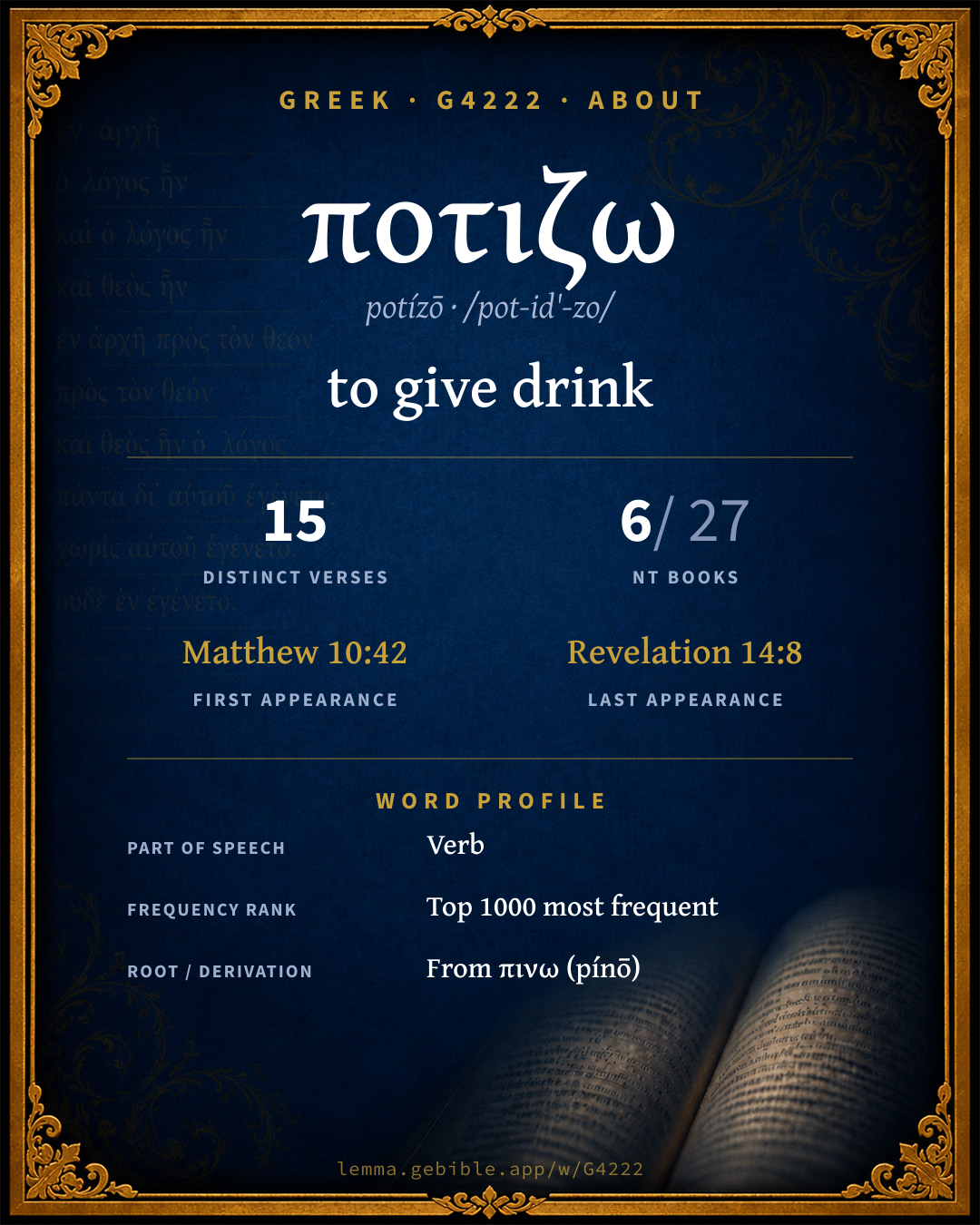
ποτίζω
to give drink
‘to give drink’ is one of 3 main senses fuller range ↓
Full lexicon entry — Thayer's Greek Lexicon
From Thayer's Greek Lexicon
Where this word appears
See every Aorist-tense verb in the Greek New Testament →
Grammar key — what these labels mean
Part of speech
- Verb
- An action or state-of-being word.
Tense
- Aorist
- Action viewed as a simple whole, without regard to duration — often past (perfective aspect).
- Imperfect
- Continuous or repeated action in past time (“was writing”).
- Present
- Ongoing or general action in present time (imperfective aspect).
- Perfect
- A completed past action with continuing present results.
Voice
- Active
- The subject performs the action.
- Passive
- The subject receives the action.
Mood
- Indicative
- States a fact or asks a factual question (the mood of reality).
- Subjunctive
- Expresses probability, purpose, or possibility (the mood of contingency).
- Participle
- A verbal adjective (“writing,” “having written”).
- Imperative
- Expresses a command or request.
Case
- Nominative
- The case of the subject (and the predicate nominative).
Person
- 2nd person
- The one addressed (“you”).
- 3rd person
- The one spoken about (“he / she / it / they”).
- 1st person
- The speaker (“I / we”).
Gender
- Masculine
- Grammatically masculine.
Number
- Plural
- More than one.
- Singular
- One.
Grammatical forms 11 distinct
- Verb, Aorist, Active, Indicative, 2nd person, Plural 2 times (13%)
- Verb, Aorist, Active, Subjunctive, 3rd person, Singular 2 times (13%)
- Verb, Imperfect, Active, Indicative, 3rd person, Singular 2 times (13%)
- Verb, Present, Active, Participle, Nominative, Singular, Masculine 2 times (13%)
- Verb, Aorist, Active, Indicative, 1st person, Plural 1 time (7%)
- Verb, Aorist, Active, Indicative, 1st person, Singular 1 time (7%)
- Verb, Aorist, Active, Indicative, 3rd person, Singular 1 time (7%)
- Verb, Aorist, Passive, Indicative, 1st person, Plural 1 time (7%)
+3 more forms (3 occurrences)
Parsed forms decoded from the imported morphology (Robinson–Tischendorf, public domain), counted across 15 parsed occurrences — not distinct verses.
Every verse where G4222 appears — 15 distinct verses across 6 books. Click any verse to open its interlinear word-by-word view. Verse text shown in the World English Bible for context — . Each verse’s Greek form is shown with its reference; the English is not keyword-highlighted, since the data carries no word-level English alignment. Use “Compare translations” on any verse to read it across multiple English versions. This concordance covers the Greek New Testament; Septuagint (Greek Old Testament) occurrences of this word are not indexed here.
Matthew 5 verses
- Matthew 10:42 ποτίσῃ aor act subj 3sg Whoever gives one of these little ones just a cup of cold water to drink in the name of a disciple, most assuredly I tell you he will in no way lose his reward."
- Matthew 25:35 ἐποτίσατέ aor act ind 2pl for I was hungry, and you gave me food to eat; I was thirsty, and you gave me drink; I was a stranger, and you took me in;
- Matthew 25:37 ἐποτίσαμεν aor act ind 1pl "Then the righteous will answer him, saying, 'Lord, when did we see you hungry, and feed you; or thirsty, and give you a drink?
- Matthew 25:42 ἐποτίσατέ aor act ind 2pl for I was hungry, and you didn't give me food to eat; I was thirsty, and you gave me no drink;
- Matthew 27:48 ἐπότιζεν impf act ind 3sg Immediately one of them ran, and took a sponge, and filled it with vinegar, and put it on a reed, and gave him a drink.
Mark 2 verses
- Mark 9:41 ποτίσῃ aor act subj 3sg For whoever will give you a cup of water to drink in my name, because you are Christ's, most assuredly I tell you, he will in no way lose his reward.
- Mark 15:36 ἐπότιζεν impf act ind 3sg One ran, and filling a sponge full of vinegar, put it on a reed, and gave it to him to drink, saying, "Let him be. Let's see whether Elijah comes to take him down."
Luke 1 verse
Romans 1 verse
1 Corinthians 5 verses
- 1 Corinthians 3:2 ἐπότισα aor act ind 1sg I fed you with milk, not with meat; for you weren't yet ready. Indeed, not even now are you ready,
- 1 Corinthians 3:6 ἐπότισεν aor act ind 3sg I planted. Apollos watered. But God gave the increase.
- 1 Corinthians 3:7 ποτίζων pres act ptcp nom sg masc So then neither he who plants is anything, nor he who waters, but God who gives the increase.
- 1 Corinthians 3:8 ποτίζων pres act ptcp nom sg masc Now he who plants and he who waters are the same, but each will receive his own reward according to his own labor.
- 1 Corinthians 12:13 ἐποτίσθημεν aor pass ind 1pl For in one Spirit we were all baptized into one body, whether Jews or Greeks, whether bond or free; and were all given to drink into one Spirit.
Revelation 1 verse
About this entry
At a glance — auto-summarized from this page’s data, not written by a person. Every figure links to its source below. This summary describes the numbers; it doesn’t interpret them.
“to give drink” is the headline sense of the Greek verb ποτιζω (potízō). First canonically at Matthew 10:42, it enters the text early. The Greek New Testament uses it across 15 verses — uncommon. More than a third of its appearances fall in Matthew. Catalogued under 3 senses, its meaning is not single-sense. See the sense tree, 15-verse concordance, and the renderings breakdown below.
Gloss history
Strong's 1890 vs modern scholarship
About this word
Strong's G4222 catalogs a Greek word from the Greek New Testament.
These counts are not copied from any lexicon or concordance. They are computed here, from the morphology-tagged Greek New Testament. What Lemma adds →
- 15
- distinct verses
- The word appears in 15 distinct verses.
- 6 / 27
- NT books
- The word appears in 6 of 27 New Testament books.
- #768
- by frequency
- Top 1000 most frequent Greek words (rank 768 of 5,347 Greek words by occurrence).
View all 15 occurrences in the concordance →
Most concentrated in
- Matthew 5 verses 33%
- 1 Corinthians 5 verses 33%
- Mark 2 verses 13%
By section of the New Testament
By traditional corpus
Conventional, traditional groupings — biblical authorship is debated, so this is a traditional corpus grouping, not an authorship claim. Some books belong to more than one corpus (Luke is in both the Gospels and the Lukan corpus, and so on), so these shares overlap and need not total 100%. Each figure is a share of the word’s 15 distinct verses.
- Gospels 8 verses · 53%
- Pauline corpus 6 verses · 40%
- Lukan (Luke–Acts) 1 verse · 7%
- Johannine 1 verse · 7%
- Revelation 1 verse · 7%
How translations render this word
Counts come from each version’s own published word-to-Strong’s tagging or interlinear alignment — an approximate guide to how each version renders this word, not a word-level alignment the data otherwise carries. Because each total is that version’s own tagged count, the per-version totals vary from one another and need not match the appearance or distinct-verse counts above. These counts may also differ from a printed concordance because Lemma counts each distinctly tagged rendering and does not collapse phrase taggings into a single head-word total. This is a fixed set of word-tagged versions (KJV, ASV, BSB, ULT) and does not change with the reading translation you choose elsewhere. Each version’s license is shown beside its name below (and on Sources).
- King James Version: Drink 7×, Gave 2×, He that watereth 2×
- American Standard Version: Drink 7×, Gave 2×, Ye gave 2×
- Berean Standard Bible: Gives 2×, Held it up for to drink 2×, Waters 2×
- unfoldingWord Literal Text: Drink 9×, Give 3×, Gives 2×
King James Version Public Domain
Renders G4222 across 23 tagged occurrences — most commonly:
Plus 10 renderings that appear only once — usually multi-word phrases or single function words the recovered tagging swept in, not distinct renderings.
American Standard Version Public Domain
Renders G4222 across 23 tagged occurrences — most commonly:
Plus 12 renderings that appear only once — usually multi-word phrases or single function words the recovered tagging swept in, not distinct renderings.
Berean Standard Bible Public Domain
Renders G4222 across 15 tagged occurrences — most commonly:
Plus 9 renderings that appear only once — usually multi-word phrases or single function words the recovered tagging swept in, not distinct renderings.
unfoldingWord Literal Text CC BY-SA 4.0
Renders G4222 across 27 tagged occurrences — most commonly:
Plus 9 renderings that appear only once — usually multi-word phrases or single function words the recovered tagging swept in, not distinct renderings.
Senses in Thayer's
The 3 senses Thayer's distinguishes for this word, in lexicon order (not ranked by frequency or importance). The full entry — with sub-senses — is in the Lexicon Entry tab.
- to give to drink, to furnish drink
- to water, irrigate (plants, fields etc.)
- metaph. to imbue, saturate one's mind
Word origin
Derived from πινω (pínō) (G4095) — to drink.
From a derivative of the alternate of G4095 ; to furnish drink irrigate : - give (make) to drink feed water.
— Strong’s Exhaustive Concordance (1890), public domain.
Forms in the corpus
The 11 distinct written forms G4222 takes in the Greek New Testament, most frequent first — each parse links to that tense’s occurrences in the concordance.
Same root — word family
Other Thayer's entries built from the same root as G4222, grouped by Strong’s listed origin. These share a root / origin per the lexicon — not necessarily a shared meaning. Each links to that word’s own entry.
Derives from
Shares the same root
- πιοτης piótēs G4096 fatness
- πομα póma G4188 drink
- ποσις pósis G4213 drink
- ποταμος potamós G4215 river
- ποτηριον potḗrion G4221 cup
- ποτος pótos G4224 drinking
Compare all same-root words → Showing 4 of 8 — not the complete family. They share a root, not necessarily a meaning.
Septuagint usage
The same Greek word ποτιζω appears 59 times in the Greek Old Testament (Septuagint), across 57 verses in 19 books.
- 59
- LXX occurrences
- Tagged occurrences of this Greek word in the Septuagint.
- 57
- verses
- Distinct Septuagint verses containing this word.
- 19 / 39
- OT books
- The word appears in 19 of the 39 Old Testament books.
Sample Septuagint occurrences
- Genesis 2:6 ποτίζω
- Exodus 2:16 ποτίζω
- Numbers 5:24 ποτίζω
- Deuteronomy 11:10 ποτίζω
- Judges 4:19 ποτίζω
- 1 Samuel 30:11 ποτίζω
- 2 Samuel 23:15 ποτίζω
- 1 Chronicles 11:17 ποτίζω
- Job 22:7 ποτίζω
- Psalms 35:9 ποτίζω
- Proverbs 25:21 ποτίζω
- Ecclesiastes 2:6 ποτίζω
Septuagint occurrences (same lexeme)
Every verse where the same Strong’s number (G4222) appears in the Greek Septuagint — showing the first 50 of 57. Verse text shown in the World English Bible for context; the Greek form is the matched word — the English is not keyword-highlighted.
- Genesis 2:6 ποτίζω but a mist went up from the earth, and watered the whole surface of the ground.
- Genesis 2:10 ποτίζω A river went out of Eden to water the garden; and from there it was parted, and became four heads.
- Genesis 13:10 ποτίζω Lot lifted up his eyes, and saw all the plain of the Jordan, that it was well watered every where, before Yahweh destroyed Sodom and Gomorrah, like the garden of Yahweh, like the land of Egypt, as you go to Zoar.
- Genesis 19:32 ποτίζω Come, let's make our father drink wine, and we will lie with him, that we may preserve our father's seed."
- Genesis 19:33 ποτίζω They made their father drink wine that night: and the firstborn went in, and lay with her father. He didn't know when she lay down, nor when she arose.
- Genesis 19:34 ποτίζω It came to pass on the next day, that the firstborn said to the younger, "Behold, I lay last night with my father. Let us make him drink wine again, tonight. You go in, and lie with him, that we may preserve our father's seed."
- Genesis 19:35 ποτίζω They made their father drink wine that night also. The younger arose, and lay with him. He didn't know when she lay down, nor when she arose.
- Genesis 21:19 ποτίζω God opened her eyes, and she saw a well of water. She went, filled the bottle with water, and gave the boy drink.
- Genesis 24:14 ποτίζω Let it happen, that the young lady to whom I will say, 'Please let down your pitcher, that I may drink.' She will say, 'Drink, and I will also give your camels a drink.' Let the same be she who you have appointed for your servant Isaac. Thereby will I know that you have shown kindness to my master."
- Genesis 24:17 ποτίζω The servant ran to meet her, and said, "Please give me a drink, a little water from your pitcher."
- Genesis 24:18 ποτίζω She said, "Drink, my lord." She hurried, and let down her pitcher on her hand, and gave him drink.
- Genesis 24:43 ποτίζω Behold, I am standing by the spring of water. Let it happen, that the maiden who comes forth to draw, to whom I will say, Give me, I pray you, a little water from your pitcher to drink.
- Genesis 24:45 ποτίζω Before I had done speaking in my heart, behold, Rebekah came forth with her pitcher on her shoulder. She went down to the spring, and drew. I said to her, 'Please let me drink.'
- Genesis 24:46 ποτίζω She hurried and let down her pitcher from her shoulder, and said, 'Drink, and I will also give your camels a drink.' So I drank, and she made the camels drink also.
- Genesis 29:2 ποτίζω He looked, and behold, a well in the field, and, behold, three flocks of sheep lying there by it. For out of that well they watered the flocks. The stone on the well's mouth was great.
- Genesis 29:3 ποτίζω There all the flocks were gathered. They rolled the stone from the well's mouth, and watered the sheep, and put the stone again on the well's mouth in its place.
- Genesis 29:7 ποτίζω He said, "Behold, it is still the middle of the day, not time to gather the cattle together. Water the sheep, and go and feed them."
- Genesis 29:8 ποτίζω They said, "We can't, until all the flocks are gathered together, and they roll the stone from the well's mouth. Then we water the sheep."
- Genesis 29:10 ποτίζω It happened, when Jacob saw Rachel the daughter of Laban, his mother's brother, and the sheep of Laban, his mother's brother, that Jacob went near, and rolled the stone from the well's mouth, and watered the flock of Laban his mother's brother.
- Exodus 2:16 ποτίζω Now the priest of Midian had seven daughters. They came and drew water, and filled the troughs to water their father's flock.
- Exodus 2:17 ποτίζω The shepherds came and drove them away; but Moses stood up and helped them, and watered their flock.
- Exodus 2:19 ποτίζω They said, "An Egyptian delivered us out of the hand of the shepherds, and moreover he drew water for us, and watered the flock."
- Exodus 32:20 ποτίζω He took the calf which they had made, and burnt it with fire, ground it to powder, and scattered it on the water, and made the children of Israel drink of it.
- Numbers 5:24 ποτίζω He shall make the woman drink the water of bitterness that causes the curse; and the water that causes the curse shall enter into her and become bitter.
- Numbers 5:26 ποτίζω The priest shall take a handful of the meal offering, as the memorial of it, and burn it on the altar, and afterward shall make the woman drink the water.
- Numbers 20:8 ποτίζω Take the rod, and assemble the congregation, you, and Aaron your brother, and speak you to the rock before their eyes, that it give forth its water; and you shall bring forth to them water out of the rock; so you shall give the congregation and their cattle drink.
- Deuteronomy 11:10 ποτίζω For the land, where you go in to possess it, isn't as the land of Egypt, from whence you came out, where you sowed your seed, and watered it with your foot, as a garden of herbs;
- Judges 4:19 ποτίζω He said to her, Please give me a little water to drink; for I am thirsty. She opened a bottle of milk, and gave him drink, and covered him.
- 1 Samuel 30:11 ποτίζω They found an Egyptian in the field, and brought him to David, and gave him bread, and he ate; and they gave him water to drink.
- 2 Samuel 23:15 ποτίζω David longed, and said, Oh that one would give me water to drink of the well of Bethlehem, which is by the gate!
- 1 Chronicles 11:17 ποτίζω David longed, and said, Oh that one would give me water to drink of the well of Bethlehem, which is by the gate!
- Job 22:7 ποτίζω You haven't given water to the weary to drink, And you have withheld bread from the hungry.
- Psalms 35:9 ποτίζω My soul shall be joyful in Yahweh. It shall rejoice in his salvation.
- Psalms 59:5 ποτίζω You, Yahweh God of hosts, the God of Israel, Rouse yourself to punish the nations. Show no mercy to the wicked traitors. Selah.
- Psalms 68:22 ποτίζω The Lord said, "I will bring you again from Bashan, I will bring you again from the depths of the sea;
- Psalms 77:15 ποτίζω You have redeemed your people with your arm, The sons of Jacob and Joseph. Selah.
- Psalms 79:6 ποτίζω Pour out your wrath on the nations that don't know you; On the kingdoms that don't call on your name;
- Psalms 103:11 ποτίζω For as the heavens are high above the earth, So great is his loving kindness toward those who fear him.
- Psalms 103:13 ποτίζω Like a father has compassion on his children, So Yahweh has compassion on those who fear him.
- Proverbs 25:21 ποτίζω If your enemy is hungry, give him food to eat; If he is thirsty, give him water to drink:
- Ecclesiastes 2:6 ποτίζω I made myself pools of water, to water from it the forest where trees were reared.
- Song of Solomon 8:2 ποτίζω I would lead you, bringing you into my mother's house, Who would instruct me. I would have you drink spiced wine, Of the juice of my pomegranate.
- Isaiah 27:3 ποτίζω I Yahweh am its keeper; I will water it every moment: lest any hurt it, I will keep it night and day.
- Isaiah 29:10 ποτίζω For Yahweh has poured out on you the spirit of deep sleep, and has closed your eyes, the prophets; and your heads, the seers, has he covered.
- Isaiah 43:20 ποτίζω The animals of the field shall honor me, the jackals and the ostriches; because I give waters in the wilderness, and rivers in the desert, to give drink to my people, my chosen,
- Jeremiah 8:14 ποτίζω Why do we sit still? assemble yourselves, and let us enter into the fortified cities, and let us be silent there; for Yahweh our God has put us to silence, and given us water of gall to drink, because we have sinned against Yahweh.
- Jeremiah 9:14 ποτίζω but have walked after the stubbornness of their own heart, and after the Baals, which their fathers taught them;
- Jeremiah 16:7 ποτίζω neither shall men break [bread] for them in mourning, to comfort them for the dead; neither shall men give them the cup of consolation to drink for their father or for their mother.
- Jeremiah 23:15 ποτίζω Therefore thus says Yahweh of Hosts concerning the prophets: Behold, I will feed them with wormwood, and make them drink the water of gall; for from the prophets of Jerusalem is ungodliness gone forth into all the land.
- Jeremiah 32:2 ποτίζω Now at that time the king of Babylon's army was besieging Jerusalem; and Jeremiah the prophet was shut up in the court of the guard, which was in the king of Judah's house.
These are occurrences of the same Greek lexeme (G4222) in the Septuagint — not a translation of any one Hebrew word. The store carries no word-level Hebrew↔Greek alignment, so no Hebrew original is asserted here. Counts come from the recovered LXX Strong's tagging — high-frequency vocabulary is well covered, while rare or late forms may be untagged — so they reflect tagged occurrences and may slightly undercount.