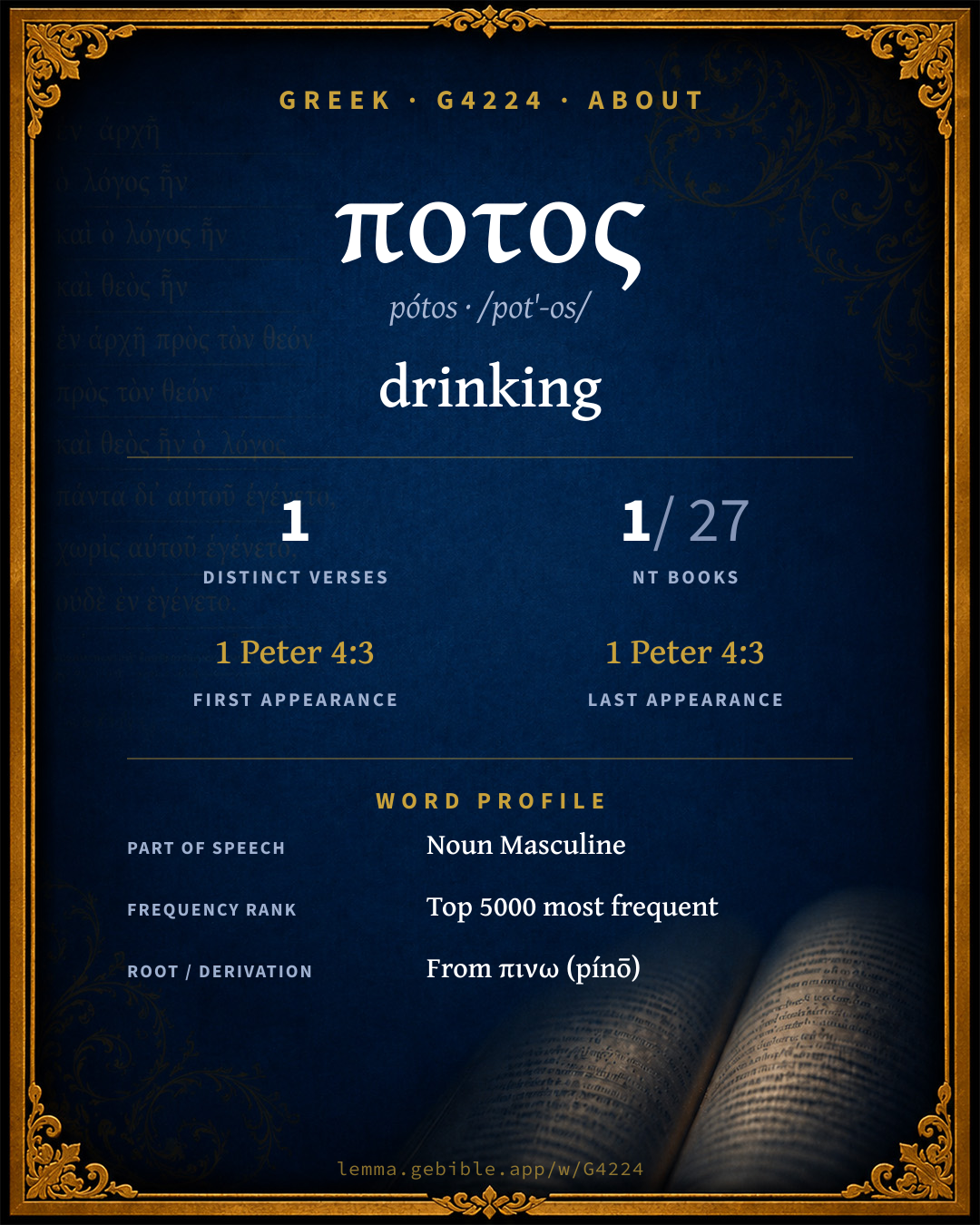
πότος
drinking
Full lexicon entry — Thayer's Greek Lexicon
From Thayer's Greek Lexicon
Where this word appears
Grammar key — what these labels mean
Part of speech
- Noun
- A naming word — a person, place, thing, or idea.
Case
- Dative
- The case of the indirect object, means, or location — “to / for / with / in.”
Gender
- Masculine
- Grammatically masculine.
Number
- Plural
- More than one.
Every verse where G4224 appears — 1 distinct verse across 1 book. Click any verse to open its interlinear word-by-word view. Verse text shown in the World English Bible for context — . Each verse’s Greek form is shown with its reference; the English is not keyword-highlighted, since the data carries no word-level English alignment. Use “Compare translations” on any verse to read it across multiple English versions. This concordance covers the Greek New Testament; Septuagint (Greek Old Testament) occurrences of this word are not indexed here.
1 Peter 1 verse
About this entry
At a glance — auto-summarized from this page’s data, not written by a person. Every figure links to its source below. This summary describes the numbers; it doesn’t interpret them.
The Greek noun ποτος centers on the idea of “drinking.” With only 1 verse it sits in the long tail of Greek New Testament vocabulary. The word gravitates to 1 Peter (100%). Scripture uses it exactly once, at 1 Peter 4:3. It shares a root with πινω, πιοτης and πομα. For the data behind this summary, explore the sense tree and the renderings breakdown below.
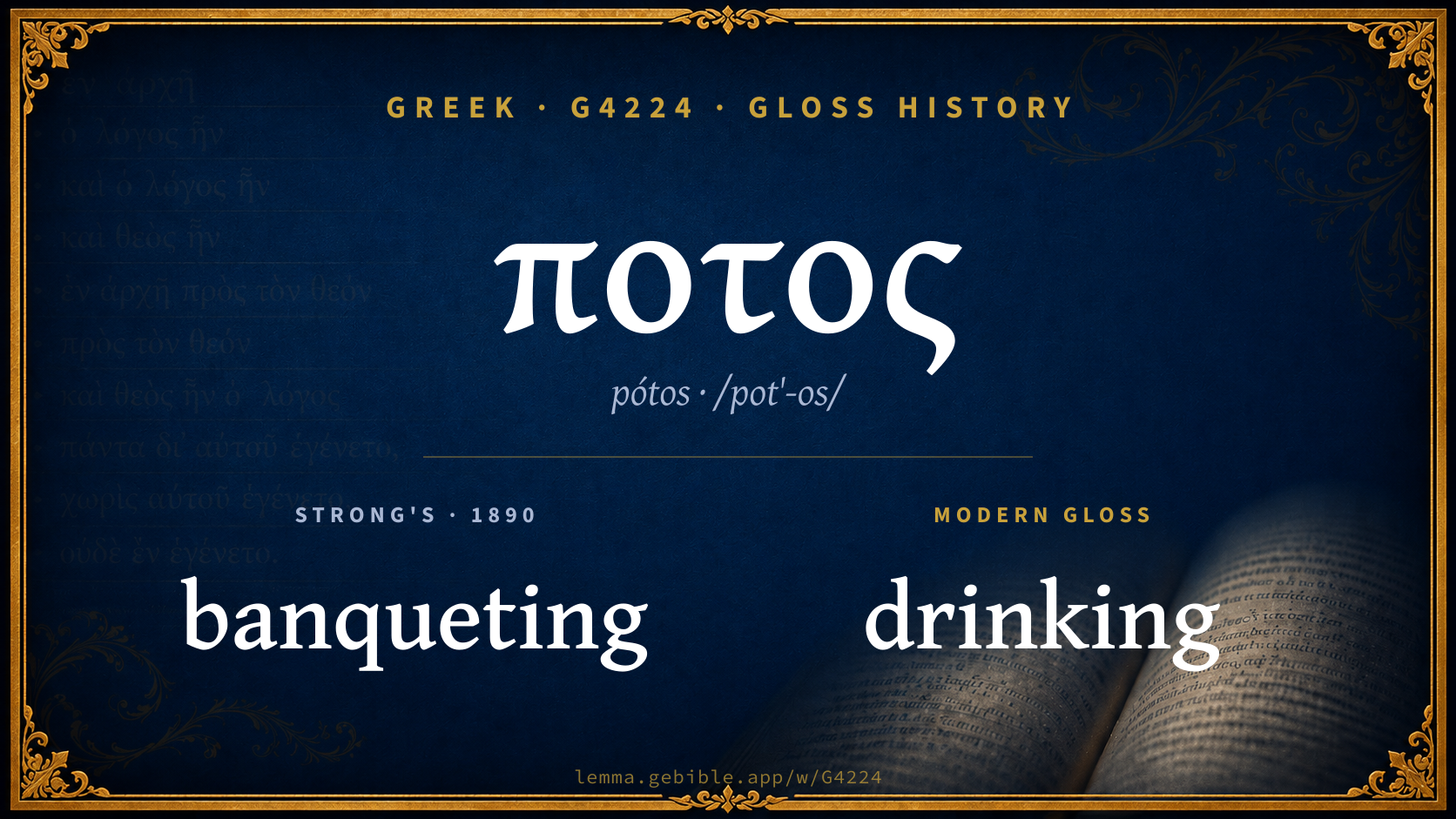
Gloss history
Strong's 1890 vs modern scholarship
About this word
Strong's G4224 catalogs a Greek word from the Greek New Testament.
These counts are not copied from any lexicon or concordance. They are computed here, from the morphology-tagged Greek New Testament. What Lemma adds →
- 1
- distinct verses
- The word appears in 1 distinct verse.
- 1 / 27
- NT books
- The word appears in 1 of 27 New Testament books.
- #3,503
- by frequency
- Top 5000 most frequent Greek words (rank 3,503 of 5,347 Greek words by occurrence).
View all 1 occurrence in the concordance →
Most concentrated in
- 1 Peter 1 verse 100%
By section of the New Testament
By traditional corpus
Conventional, traditional groupings — biblical authorship is debated, so this is a traditional corpus grouping, not an authorship claim. Some books belong to more than one corpus (Luke is in both the Gospels and the Lukan corpus, and so on), so these shares overlap and need not total 100%. Each figure is a share of the word’s 1 distinct verse.
- General (Catholic) Epistles 1 verse · 100%
How translations render this word
Counts come from each version’s own published word-to-Strong’s tagging or interlinear alignment — an approximate guide to how each version renders this word, not a word-level alignment the data otherwise carries. Because each total is that version’s own tagged count, the per-version totals vary from one another and need not match the appearance or distinct-verse counts above. These counts may also differ from a printed concordance because Lemma counts each distinctly tagged rendering and does not collapse phrase taggings into a single head-word total. This is a fixed set of word-tagged versions (KJV, ASV, BSB, ULT) and does not change with the reading translation you choose elsewhere. Each version’s license is shown beside its name below (and on Sources).
- King James Version: Banquetings 1×
- American Standard Version: Carousings 1×
- Berean Standard Bible: Carousing 1×
- unfoldingWord Literal Text: Drinking parties 1×
King James Version Public Domain
Renders G4224 across 1 tagged occurrence — most commonly:
American Standard Version Public Domain
Renders G4224 across 1 tagged occurrence — most commonly:
Berean Standard Bible Public Domain
Renders G4224 across 1 tagged occurrence — most commonly:
unfoldingWord Literal Text CC BY-SA 4.0
Renders G4224 across 1 tagged occurrence — most commonly:
Senses in Thayer's
The 1 sense Thayer's distinguishes for this word, in lexicon order (not ranked by frequency or importance). The full entry — with sub-senses — is in the Lexicon Entry tab.
- a drinking, carousing
Word origin
Derived from πινω (pínō) (G4095) — to drink.
From the alternate of G4095 ; a drinking bout or carousal : - banqueting.
— Strong’s Exhaustive Concordance (1890), public domain.
Same root — word family
Other Thayer's entries built from the same root as G4224, grouped by Strong’s listed origin. These share a root / origin per the lexicon — not necessarily a shared meaning. Each links to that word’s own entry.
Derives from
Shares the same root
- πιοτης piótēs G4096 fatness
- πομα póma G4188 drink
- ποσις pósis G4213 drink
- ποταμος potamós G4215 river
- ποτηριον potḗrion G4221 cup
- ποτιζω potízō G4222 to give drink
Compare all same-root words → Showing 4 of 8 — not the complete family. They share a root, not necessarily a meaning.
Septuagint usage
The same Greek word ποτος appears 27 times in the Greek Old Testament (Septuagint), across 25 verses in 11 books.
- 27
- LXX occurrences
- Tagged occurrences of this Greek word in the Septuagint.
- 25
- verses
- Distinct Septuagint verses containing this word.
- 11 / 39
- OT books
- The word appears in 11 of the 39 Old Testament books.
Sample Septuagint occurrences
- Genesis 19:3 πότος
- Leviticus 11:34 ποτός
- Judges 14:10 πότος
- 1 Samuel 25:36 πότος
- 2 Samuel 3:20 πότος
- 1 Kings 3:15 πότος
- Ezra 3:7 ποτός
- Esther 1:5 πότος
- Job 1:4 πότος
- Proverbs 23:30 πότος
- Ecclesiastes 7:2 πότος
Septuagint occurrences (same lexeme)
Every verse where the same Strong’s number (G4224) appears in the Greek Septuagint. Verse text shown in the World English Bible for context; the Greek form is the matched word — the English is not keyword-highlighted.
- Genesis 19:3 πότος He urged them greatly, and they came in with him, and entered into his house. He made them a feast, and baked unleavened bread, and they ate.
- Genesis 40:20 πότος It happened the third day, which was Pharaoh's birthday, that he made a feast for all his servants, and he lifted up the head of the chief cupbearer and the head of the chief baker among his servants.
- Leviticus 11:34 ποτός All food which may be eaten, that on which water comes, shall be unclean; and all drink that may be drunk in every such vessel shall be unclean.
- Judges 14:10 πότος His father went down to the woman: and Samson made there a feast; for so used the young men to do.
- Judges 14:12 πότος Samson said to them, Let me now put forth a riddle to you: if you can declare it to me within the seven days of the feast, and find it out, then I will give you thirty linen garments and thirty changes of clothing;
- Judges 14:17 πότος She wept before him the seven days, while their feast lasted: and it happened on the seventh day, that he told her, because she pressed him sore; and she told the riddle to the children of her people.
- 1 Samuel 25:36 πότος Abigail came to Nabal; and, behold, he held a feast in his house, like the feast of a king; and Nabal's heart was merry within him, for he was very drunken: therefore she told him nothing, less or more, until the morning light.
- 2 Samuel 3:20 πότος So Abner came to David to Hebron, and twenty men with him. David made Abner and the men who were with him a feast.
- 2 Samuel 13:27 πότος But Absalom pressed him, and he let Amnon and all the king's sons go with him.
- 1 Kings 3:15 πότος Solomon awoke; and, behold, it was a dream: and he came to Jerusalem, and stood before the ark of the covenant of Yahweh, and offered up burnt offerings, and offered peace-offerings, and made a feast to all his servants.
- 1 Kings 10:21 πότος All king Solomon's drinking vessels were of gold, and all the vessels of the house of the forest of Lebanon were of pure gold: none were of silver; it was nothing accounted of in the days of Solomon.
- Ezra 3:7 ποτός They gave money also to the masons, and to the carpenters; and food, and drink, and oil, to them of Sidon, and to them of Tyre, to bring cedar trees from Lebanon to the sea, to Joppa, according to the grant that they had of Cyrus king of Persia.
- Esther 1:5 πότος When these days were fulfilled, the king made a feast to all the people who were present in Shushan the palace, both great and small, seven days, in the court of the garden of the king's palace.
- Esther 1:8 πότος The drinking was according to the law; none could compel: for so the king had appointed to all the officers of his house, that they should do according to every man's pleasure.
- Esther 1:9 πότος Also Vashti the queen made a feast for the women in the royal house which belonged to king Ahasuerus.
- Esther 2:18 πότος Then the king made a great feast to all his princes and his servants, even Esther's feast; and he made a release to the provinces, and gave gifts, according to the bounty of the king.
- Esther 5:4 πότος Esther said, If it seem good to the king, let the king and Haman come this day to the banquet that I have prepared for him.
- Esther 6:14 πότος While they were yet talking with him, came the king's chamberlains, and hurried to bring Haman to the banquet that Esther had prepared.
- Esther 7:2 πότος The king said again to Esther on the second day at the banquet of wine, What is your petition, queen Esther? and it shall be granted you: and what is your request? even to the half of the kingdom it shall be performed.
- Job 1:4 πότος His sons went and held a feast in the house of each one on his birthday; and they sent and called for their three sisters to eat and to drink with them.
- Job 1:5 πότος It was so, when the days of their feasting had run their course, that Job sent and sanctified them, and rose up early in the morning, and offered burnt offerings according to the number of them all. For Job said, "It may be that my sons have sinned, and renounced God in their hearts." Thus did Job continually.
- Job 8:11 πότος "Can the papyrus grow up without mire? Can the rushes grow without water?
- Job 15:16 ποτός How much less one who is abominable and corrupt, A man who drinks iniquity like water!
- Proverbs 23:30 πότος Those who stay long at the wine; Those who go to seek out mixed wine.
- Ecclesiastes 7:2 πότος It is better to go to the house of mourning than to go to the house of feasting: for that is the end of all men, and the living should take this to heart.
These are occurrences of the same Greek lexeme (G4224) in the Septuagint — not a translation of any one Hebrew word. The store carries no word-level Hebrew↔Greek alignment, so no Hebrew original is asserted here. Counts come from the recovered LXX Strong's tagging — high-frequency vocabulary is well covered, while rare or late forms may be untagged — so they reflect tagged occurrences and may slightly undercount.