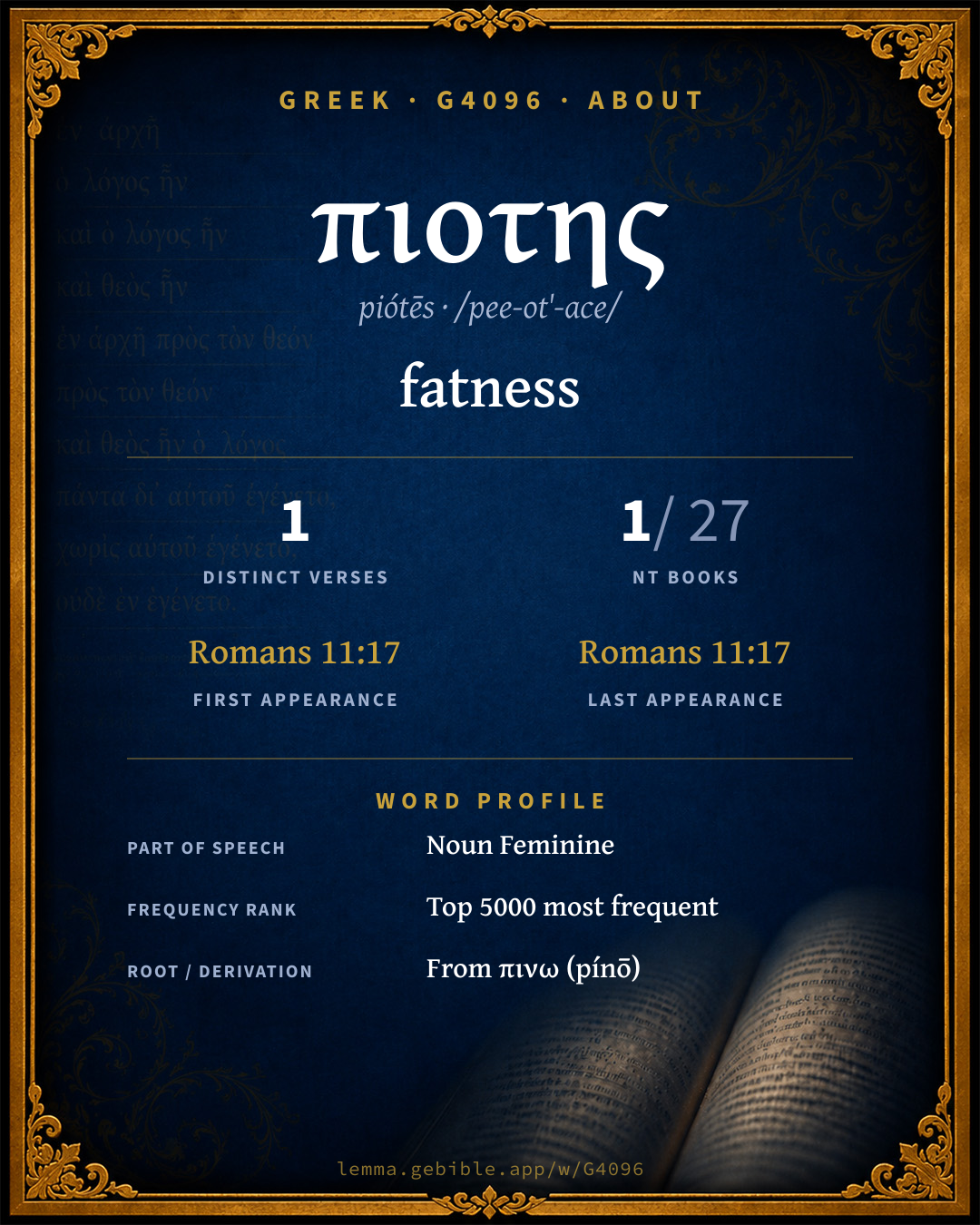
πιότης
fatness
Full lexicon entry — Thayer's Greek Lexicon
From Thayer's Greek Lexicon
Where this word appears
Grammar key — what these labels mean
Part of speech
- Noun
- A naming word — a person, place, thing, or idea.
Case
- Genitive
- The case of source, possession, or “of” — answers “whose / from what.”
Gender
- Feminine
- Grammatically feminine.
Number
- Singular
- One.
Every verse where G4096 appears — 1 distinct verse across 1 book. Click any verse to open its interlinear word-by-word view. Verse text shown in the World English Bible for context — . Each verse’s Greek form is shown with its reference; the English is not keyword-highlighted, since the data carries no word-level English alignment. Use “Compare translations” on any verse to read it across multiple English versions. This concordance covers the Greek New Testament; Septuagint (Greek Old Testament) occurrences of this word are not indexed here.
Romans 1 verse
About this entry
At a glance — auto-summarized from this page’s data, not written by a person. Every figure links to its source below. This summary describes the numbers; it doesn’t interpret them.
At its core, πιοτης (piótēs) means “fatness.” It is rare — just 1 verse in the entire Greek New Testament. Its uses cluster heavily in Romans (100% of all occurrences). It occurs only once, in Romans 11:17. Sharing its root, it stands alongside πινω, πομα and ποσις. Each statement above links to its evidence; the full detail follows below.
Gloss history
Strong's 1890 vs modern scholarship
About this word
Strong's G4096 catalogs a Greek word from the Greek New Testament.
These counts are not copied from any lexicon or concordance. They are computed here, from the morphology-tagged Greek New Testament. What Lemma adds →
- 1
- distinct verses
- The word appears in 1 distinct verse.
- 1 / 27
- NT books
- The word appears in 1 of 27 New Testament books.
- #3,503
- by frequency
- Top 5000 most frequent Greek words (rank 3,503 of 5,347 Greek words by occurrence).
View all 1 occurrence in the concordance →
Most concentrated in
- Romans 1 verse 100%
By section of the New Testament
By traditional corpus
Conventional, traditional groupings — biblical authorship is debated, so this is a traditional corpus grouping, not an authorship claim. Some books belong to more than one corpus (Luke is in both the Gospels and the Lukan corpus, and so on), so these shares overlap and need not total 100%. Each figure is a share of the word’s 1 distinct verse.
- Pauline corpus 1 verse · 100%
How translations render this word
Counts come from each version’s own published word-to-Strong’s tagging or interlinear alignment — an approximate guide to how each version renders this word, not a word-level alignment the data otherwise carries. Because each total is that version’s own tagged count, the per-version totals vary from one another and need not match the appearance or distinct-verse counts above. These counts may also differ from a printed concordance because Lemma counts each distinctly tagged rendering and does not collapse phrase taggings into a single head-word total. This is a fixed set of word-tagged versions (KJV, ASV, BSB, ULT) and does not change with the reading translation you choose elsewhere. Each version’s license is shown beside its name below (and on Sources).
- King James Version: Fatness 1×
- American Standard Version: Root of the fatness 1×
- Berean Standard Bible: Nourishment 1×
- unfoldingWord Literal Text: Richness 1×
King James Version Public Domain
Renders G4096 across 1 tagged occurrence — most commonly:
American Standard Version Public Domain
Renders G4096 across 1 tagged occurrence — most commonly:
Berean Standard Bible Public Domain
Renders G4096 across 1 tagged occurrence — most commonly:
unfoldingWord Literal Text CC BY-SA 4.0
Renders G4096 across 1 tagged occurrence — most commonly:
Senses in Thayer's
The 1 sense Thayer's distinguishes for this word, in lexicon order (not ranked by frequency or importance). The full entry — with sub-senses — is in the Lexicon Entry tab.
- fatness
Word origin
Derived from πινω (pínō) (G4095) — to drink.
From πίων piō n ( fat ; perhaps akin to the alternate of G4095 through the idea of repletion ); plumpness that is (by implication) richness ( oiliness ): - fatness.
— Strong’s Exhaustive Concordance (1890), public domain.
Same root — word family
Other Thayer's entries built from the same root as G4096, grouped by Strong’s listed origin. These share a root / origin per the lexicon — not necessarily a shared meaning. Each links to that word’s own entry.
Derives from
Shares the same root
- πομα póma G4188 drink
- ποσις pósis G4213 drink
- ποταμος potamós G4215 river
- ποτηριον potḗrion G4221 cup
- ποτιζω potízō G4222 to give drink
- ποτος pótos G4224 drinking
Compare all same-root words → Showing 4 of 8 — not the complete family. They share a root, not necessarily a meaning.
Septuagint usage
The same Greek word πιοτης appears 11 times in the Greek Old Testament (Septuagint), across 11 verses in 7 books.
- 11
- LXX occurrences
- Tagged occurrences of this Greek word in the Septuagint.
- 11
- verses
- Distinct Septuagint verses containing this word.
- 7 / 39
- OT books
- The word appears in 7 of the 39 Old Testament books.
Sample Septuagint occurrences
- Genesis 27:28 πιότης
- Judges 9:9 πιότης
- 1 Kings 13:3 πιότης
- Job 36:16 πιότης
- Psalms 35:9 πιότης
- Ezekiel 25:4 πιότης
- Zechariah 4:14 πιότης
Septuagint occurrences (same lexeme)
Every verse where the same Strong’s number (G4096) appears in the Greek Septuagint. Verse text shown in the World English Bible for context; the Greek form is the matched word — the English is not keyword-highlighted.
- Genesis 27:28 πιότης God give you of the dew of the sky, of the fatness of the earth, and plenty of grain and new wine.
- Genesis 27:39 πιότης Isaac his father answered him, "Behold, of the fatness of the earth will be your dwelling, and of the dew of the sky from above.
- Judges 9:9 πιότης But the olive tree said to them, Should I leave my fatness, with which by me they honor God and man, and go to wave back and forth over the trees?
- 1 Kings 13:3 πιότης He gave a sign the same day, saying, This is the sign which Yahweh has spoken: Behold, the altar shall be torn, and the ashes that are on it shall be poured out.
- 1 Kings 13:5 πιότης The altar also was torn, and the ashes poured out from the altar, according to the sign which the man of God had given by the word of Yahweh.
- Job 36:16 πιότης Yes, he would have allured you out of distress, Into a broad place, where there is no restriction. That which is set on your table would be full of fatness.
- Psalms 35:9 πιότης My soul shall be joyful in Yahweh. It shall rejoice in his salvation.
- Psalms 62:6 πιότης He alone is my rock and my salvation, my fortress. I will not be shaken.
- Psalms 64:12 πιότης
- Ezekiel 25:4 πιότης therefore, behold, I will deliver you to the children of the east for a possession, and they shall set their encampments in you, and make their dwellings in you; they shall eat your fruit, and they shall drink your milk.
- Zechariah 4:14 πιότης Then he said, "These are the two anointed ones who stand by the Lord of the whole earth."
These are occurrences of the same Greek lexeme (G4096) in the Septuagint — not a translation of any one Hebrew word. The store carries no word-level Hebrew↔Greek alignment, so no Hebrew original is asserted here. Counts come from the recovered LXX Strong's tagging — high-frequency vocabulary is well covered, while rare or late forms may be untagged — so they reflect tagged occurrences and may slightly undercount.