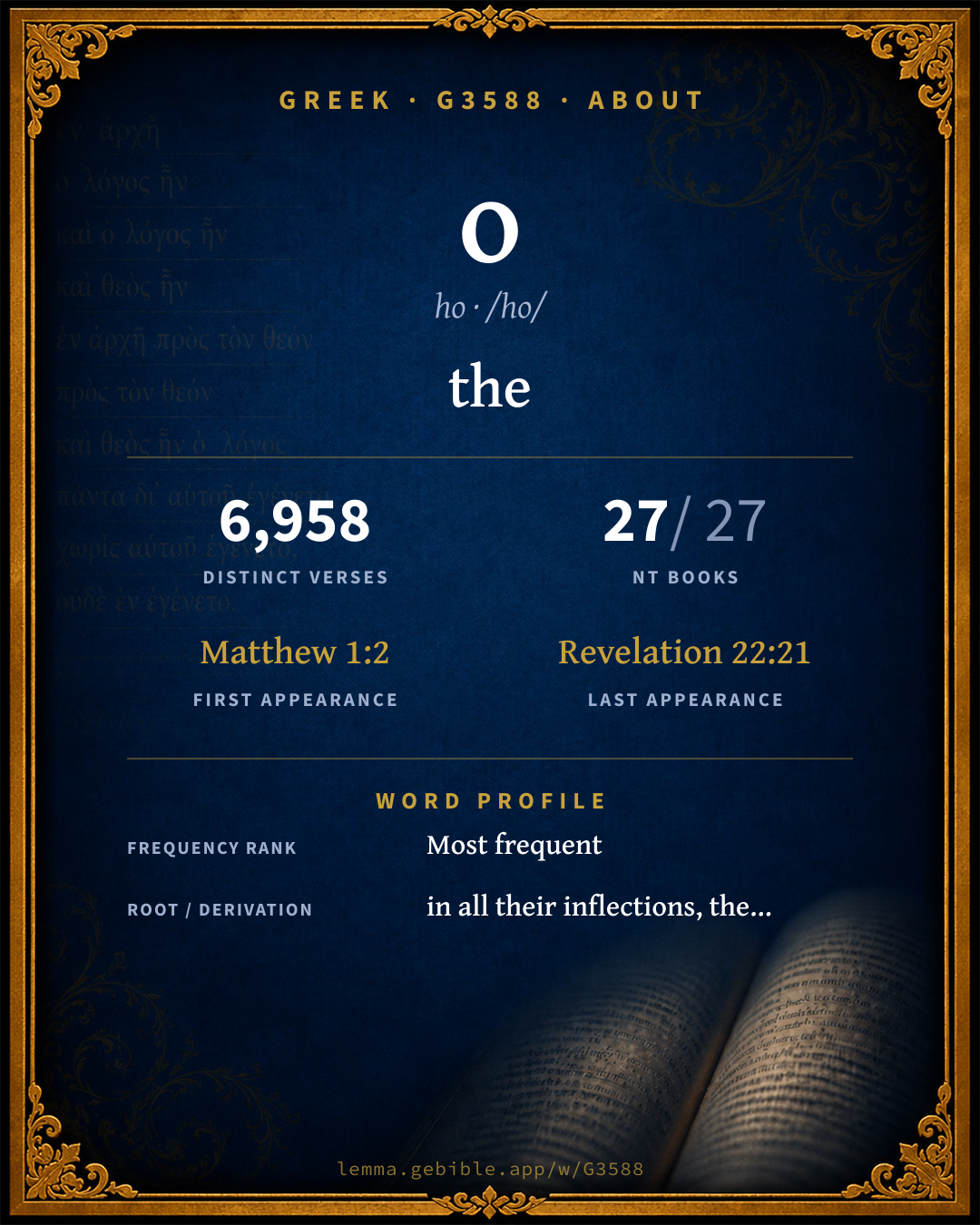
ο
the
Full lexicon entry — Thayer's Greek Lexicon
From Thayer's Greek Lexicon
Where this word appears
See every Nominative-case word in the Greek New Testament →
Grammar key — what these labels mean
Part of speech
- Article
- The Greek definite article (“the”), agreeing with its noun in case, number, and gender.
Case
- Nominative
- The case of the subject (and the predicate nominative).
- Genitive
- The case of source, possession, or “of” — answers “whose / from what.”
- Accusative
- The case of the direct object and of extent.
- Dative
- The case of the indirect object, means, or location — “to / for / with / in.”
Gender
- Masculine
- Grammatically masculine.
- Feminine
- Grammatically feminine.
- Neuter
- Grammatically neuter.
Number
- Singular
- One.
- Plural
- More than one.
Page 4 of 4 — showing verses 601–646 of 646 distinct verses where G3588 appears in the Nominative case in the Book of Matthew. Filtered view — show all forms. Click any verse to open its interlinear word-by-word view. Verse text shown in the World English Bible for context — . Each verse’s Greek form is shown with its reference; the English is not keyword-highlighted, since the data carries no word-level English alignment. Use “Compare translations” on any verse to read it across multiple English versions. This concordance covers the Greek New Testament; Septuagint (Greek Old Testament) occurrences of this word are not indexed here.
Matthew
- Matthew 27:8 ὁ τῆς art nom sg masc art gen sg fem Therefore that field was called "The Field of Blood" to this day.
- Matthew 27:9 τὸ τοῦ τὰ τὴν τοῦ art nom sg neut art gen sg masc art acc pl neut art acc sg fem art gen sg masc Then that which was spoken through Jeremiah the prophet was fulfilled, saying, "They took the thirty pieces of silver, The price of him upon whom a price had been set, Whom some of the children of Israel priced,
- Matthew 27:11 Ὁ τοῦ ὁ ὁ τῶν ὁ art nom sg masc art gen sg masc art nom sg masc art nom sg masc art gen pl masc art nom sg masc Now Jesus stood before the governor: and the governor asked him, saying, "Are you the King of the Jews?" Jesus said to him, "So you say."
- Matthew 27:13 ὁ art nom sg masc Then Pilate said to him, "Don't you hear how many things they testify against you?"
- Matthew 27:15 ὁ τῷ art nom sg masc art dat sg masc Now at the feast the governor was accustomed to release to the multitude one prisoner, whom they desired.
- Matthew 27:17 ὁ τὸν art nom sg masc art acc sg masc When therefore they were gathered together, Pilate said to them, "Whom do you want me to release to you? Barabbas, or Jesus, who is called Christ?"
- Matthew 27:19 τοῦ ἡ τῷ art gen sg neut art nom sg fem art dat sg masc While he was sitting on the judgment seat, his wife sent to him, saying, "Have nothing to do with that righteous man, for I have suffered many things this day in a dream because of him."
- Matthew 27:20 οἱ οἱ τοὺς τὸν τὸν art nom pl masc art nom pl masc art acc pl masc art acc sg masc art acc sg masc Now the chief priests and the elders persuaded the multitudes to ask for Barabbas, and destroy Jesus.
- Matthew 27:21 ὁ τῶν οἱ τὸν art nom sg masc art gen pl masc art nom pl masc art acc sg masc But the governor answered them, "Which of the two do you want me to release to you?" They said, "Barabbas!"
- Matthew 27:22 ὁ τὸν art nom sg masc art acc sg masc Pilate said to them, "What then shall I do to Jesus, who is called Christ?" They all said to him, "Let him be crucified!"
- Matthew 27:23 ὁ οἱ art nom sg masc art nom pl masc But the governor said, "Why? What evil has he done?" But they cried out exceedingly, saying, "Let him be crucified!"
- Matthew 27:24 ὁ τὰς τοῦ τοῦ art nom sg masc art acc pl fem art gen sg masc art gen sg neut So when Pilate saw that nothing was being gained, but rather that a disturbance was starting, he took water, and washed his hands before the multitude, saying, "I am innocent of the blood of this righteous person. You see to it."
- Matthew 27:25 ὁ τὸ τὰ art nom sg masc art nom sg neut art acc pl neut All the people answered, "May his blood be on us, and on our children!"
- Matthew 27:27 οἱ τοῦ τὸν τὸ τὴν art nom pl masc art gen sg masc art acc sg masc art acc sg neut art acc sg fem Then the governor's soldiers took Jesus into the Praetorium, and gathered the whole garrison together against him.
- Matthew 27:29 τῆς τῇ ὁ τῶν art gen sg fem art dat sg fem art nom sg masc art gen pl masc They braided a crown of thorns and put it on his head, and a reed in his right hand; and they kneeled down before him, and mocked him, saying, "Hail, King of the Jews!"
- Matthew 27:37 τῆς τὴν ὁ τῶν art gen sg fem art acc sg fem art nom sg masc art gen pl masc They set up over his head the accusation against him written, "THIS IS JESUS, THE KING OF THE JEWS."
- Matthew 27:39 οἱ τὰς art nom pl masc art acc pl fem Those who passed by blasphemed him, wagging their heads,
- Matthew 27:40 ὁ τὸν τοῦ τοῦ art nom sg masc art acc sg masc art gen sg masc art gen sg masc and saying, "You who destroy the temple, and build it in three days, save yourself! If you are the Son of God, come down from the cross!"
- Matthew 27:41 οἱ τῶν art nom pl masc art gen pl masc Likewise the chief priests also mocking, with the scribes, the Pharisees, and the elders, said,
- Matthew 27:44 τὸ οἱ οἱ art acc sg neut art nom pl masc art nom pl masc The robbers also who were crucified with him cast on him the same reproach.
- Matthew 27:46 τὴν ὁ art acc sg fem art nom sg masc About the ninth hour Jesus cried with a loud voice, saying, "Eli, Eli, lima sabachthani?" That is, "My God, my God, why have you forsaken me?"
- Matthew 27:49 οἱ art nom pl masc The rest said, "Let him be. Let's see whether Elijah comes to save him."
- Matthew 27:50 Ὁ τὸ art nom sg masc art acc sg neut Jesus cried again with a loud voice, and yielded up his spirit.
- Matthew 27:51 τὸ τοῦ ἡ αἱ art nom sg neut art gen sg masc art nom sg fem art nom pl fem Behold, the veil of the temple was torn in two from the top to the bottom. The earth quaked and the rocks were split.
- Matthew 27:52 τὰ τῶν art nom pl neut art gen pl masc The tombs were opened, and many bodies of the saints who had fallen asleep were raised;
- Matthew 27:54 ὁ οἱ τὸν τὸν τὰ art nom sg masc art nom pl masc art acc sg masc art acc sg masc art acc pl neut Now the centurion, and those who were with him watching Jesus, when they saw the earthquake, and the things that were done, feared exceedingly, saying, "Truly this was the Son of God."
- Matthew 27:56 ἡ ἡ τοῦ ἡ τῶν art nom sg fem art nom sg fem art gen sg masc art nom sg fem art gen pl masc Among them were Mary Magdalene, Mary the mother of James and Joses, and the mother of the sons of Zebedee.
- Matthew 27:58 τῷ τὸ τοῦ ὁ art dat sg masc art acc sg neut art gen sg masc art nom sg masc This man went to Pilate, and asked for Jesus' body. Then Pilate commanded the body to be given up.
- Matthew 27:59 τὸ ὁ art acc sg neut art nom sg masc Joseph took the body, and wrapped it in a clean linen cloth,
- Matthew 27:61 ἡ ἡ τοῦ art nom sg fem art nom sg fem art gen sg masc Mary Magdalene was there, and the other Mary, sitting opposite the tomb.
- Matthew 27:62 Τῇ τὴν οἱ οἱ art dat sg fem art acc sg fem art nom pl masc art nom pl masc Now on the next day, which was the day after the Preparation Day, the chief priests and the Pharisees were gathered together to Pilate,
- Matthew 27:63 ὁ art nom sg masc saying, "Sir, we remember what that deceiver said while he was still alive: 'After three days I will rise again.'
- Matthew 27:64 τὸν τῆς οἱ τῷ τῶν ἡ τῆς art acc sg masc art gen sg fem art nom pl masc art dat sg masc art gen pl masc art nom sg fem art gen sg fem Command therefore that the tomb be made secure until the third day, lest perhaps his disciples come at night and steal him away, and tell the people, 'He is risen from the dead;' and the last deception will be worse than the first."
- Matthew 27:65 ὁ art nom sg masc Pilate said to them, "You have a guard. Go, make it as secure as you can."
- Matthew 27:66 οἱ τὸν τὸν τῆς art nom pl masc art acc sg masc art acc sg masc art gen sg fem So they went with the guard and made the tomb secure, sealing the stone.
- Matthew 28:1 τῇ ἡ ἡ τὸν art dat sg fem art nom sg fem art nom sg fem art acc sg masc Now after the Sabbath, as it began to dawn on the first day of the week, Mary Magdalene and the other Mary came to see the tomb.
- Matthew 28:3 ἡ τὸ art nom sg fem art nom sg neut His appearance was like lightning, and his clothing white as snow.
- Matthew 28:4 τοῦ οἱ art gen sg masc art nom pl masc For fear of him, the guards shook, and became like dead men.
- Matthew 28:5 ὁ ταῖς τὸν art nom sg masc art dat pl fem art acc sg masc The angel answered the women, "Don't be afraid, for I know that you seek Jesus, who has been crucified.
- Matthew 28:9 αἱ τοὺς art nom pl fem art acc pl masc As they went to tell his disciples, behold, Jesus met them, saying, "Rejoice!" They came and took hold of his feet, and worshiped him.
- Matthew 28:10 ὁ τοῖς τὴν art nom sg masc art dat pl masc art acc sg fem Then Jesus said to them, "Don't be afraid. Go tell my brothers that they should go into Galilee, and there they will see me."
- Matthew 28:13 οἱ art nom pl masc saying, "Say that his disciples came by night, and stole him away while we slept.
- Matthew 28:15 οἱ τὰ ὁ τῆς art nom pl masc art acc pl neut art nom sg masc art gen sg fem So they took the money and did as they were told. This saying was spread abroad among the Jews, and continues until this day.
- Matthew 28:16 Οἱ τὴν τὸ ὁ art nom pl masc art acc sg fem art acc sg neut art nom sg masc But the eleven disciples went into Galilee, to the mountain where Jesus had sent them.
- Matthew 28:17 οἱ art nom pl masc When they saw him, they bowed down to him, but some doubted.
- Matthew 28:18 ὁ art nom sg masc Jesus came to them and spoke to them, saying, "All authority has been given to me in heaven and on earth.
About this entry
At a glance — auto-summarized from this page’s data, not written by a person. Every figure links to its source below. This summary describes the numbers; it doesn’t interpret them.
ο (ho) is a Greek word most often rendered “the.” Its English rendering has broadened — “which” classically, “the” (Berean Standard Bible) in modern versions; see the renderings breakdown. Spanning 6,958 verses in 27 books, it ranks among the most common words of the Greek New Testament. It first appears in Matthew 1:2. Related forms include τανυν, οδε and οιος. For the data behind this summary, explore the sense tree and the renderings breakdown below.
Gloss history
Strong's 1890 vs modern scholarship
About this word
Strong's G3588 catalogs a Greek word from the Greek New Testament.
These counts are not copied from any lexicon or concordance. They are computed here, from the morphology-tagged Greek New Testament. What Lemma adds →
- 6,958
- distinct verses
- The word appears in 6,958 distinct verses.
- 27 / 27
- NT books
- The word appears in 27 of 27 New Testament books.
- #1
- by frequency
- Most frequent Greek word — of 5,347 Greek words by occurrence.
View all 6,958 occurrences in the concordance →
By section of the New Testament
By traditional corpus
Conventional, traditional groupings — biblical authorship is debated, so this is a traditional corpus grouping, not an authorship claim. Some books belong to more than one corpus (Luke is in both the Gospels and the Lukan corpus, and so on), so these shares overlap and need not total 100%. Each figure is a share of the word’s 6,958 distinct verses.
- Gospels 3,366 verses · 48%
- Lukan (Luke–Acts) 1,951 verses · 28%
- Pauline corpus 1,635 verses · 23%
- Johannine 1,309 verses · 19%
- Revelation 386 verses · 6%
- General (Catholic) Epistles 371 verses · 5%
- Hebrews 263 verses · 4%
How translations render this word
Counts come from each version’s own published word-to-Strong’s tagging or interlinear alignment — an approximate guide to how each version renders this word, not a word-level alignment the data otherwise carries. Because each total is that version’s own tagged count, the per-version totals vary from one another and need not match the appearance or distinct-verse counts above. These counts may also differ from a printed concordance because Lemma counts each distinctly tagged rendering and does not collapse phrase taggings into a single head-word total. This is a fixed set of word-tagged versions (KJV, ASV, BSB, ULT) and does not change with the reading translation you choose elsewhere. Each version’s license is shown beside its name below (and on Sources).
- King James Version: Which 391×, Who 79×, Things 12×
- American Standard Version: That 206×, Who 79×, Which 73×
- Berean Standard Bible: The 7,625×, Who 563×, Of 346×
- unfoldingWord Literal Text: The 7,661×, God 966×, One 603×
King James Version Public Domain
Renders G3588 across 542 tagged occurrences — most commonly:
Plus other, less common renderings. Plus 22 renderings that appear only once — usually multi-word phrases or single function words the recovered tagging swept in, not distinct renderings. Not rendered by a distinct English word in 1 further occurrence.
American Standard Version Public Domain
Renders G3588 across 1,005 tagged occurrences — most commonly:
Plus other, less common renderings. Plus 68 renderings that appear only once — usually multi-word phrases or single function words the recovered tagging swept in, not distinct renderings. Not rendered by a distinct English word in 2 further occurrences.
Berean Standard Bible Public Domain
Renders G3588 across 9,912 tagged occurrences — most commonly:
Plus other, less common renderings. Plus 107 renderings that appear only once — usually multi-word phrases or single function words the recovered tagging swept in, not distinct renderings. Not rendered by a distinct English word in 9,622 further occurrences.
unfoldingWord Literal Text CC BY-SA 4.0
Renders G3588 across 20,796 tagged occurrences — most commonly:
Plus other, less common renderings. Plus 1,052 renderings that appear only once — usually multi-word phrases or single function words the recovered tagging swept in, not distinct renderings. Not rendered by a distinct English word in 3 further occurrences.
Senses in Thayer's
The 1 sense Thayer's distinguishes for this word, in lexicon order (not ranked by frequency or importance). The full entry — with sub-senses — is in the Lexicon Entry tab.
- this, that, these, etc.
Word origin
Origin: in all their inflections, the definite article
the masculine feminine (second) and neuter (third) forms in all their inflections; the definite article; the (sometimes to be supplied at others omitted in English idiom): - the this that one he she it etc.
— Strong’s Exhaustive Concordance (1890), public domain.
Forms in the corpus
The 42 distinct written forms G3588 takes in the Greek New Testament, most frequent first — each parse links to that case’s occurrences in the concordance.
Same root — word family
Other Thayer's entries built from the same root as G3588, grouped by Strong’s listed origin. These share a root / origin per the lexicon — not necessarily a shared meaning. Each links to that word’s own entry.
Derived from this word
- τανυν tanŷn G3569 present
- οδε hóde G3592 this
- οιος hoîos G3634 what sort of
- ος hós G3739 who
- ουτος hoûtos G3778 this
- σημερον sḗmeron G4594 this day
- ταυτα tautá G5024 thus
- τηλικουτος tēlikoûtos G5082 of such size
- τοι toí G5104 truly
- τοσουτος tosoûtos G5118 so great
- τοτε tóte G5119 then
- του toû G5120 his
- τουναντιον tounantíon G5121 on the contrary
- τουνομα toúnoma G5122 by name
Proper names from this root
People and places named from this root — a name, not an additional meaning of the word.
- θεος theós G2316 God
- ο ων και ο ην και ο ερχομενος ho ṑn kaí ho ēn kaí ho erchómenos G3801 He who is
Compare all same-root words → Showing 4 of 17 — not the complete family. 2 of the same-root words are proper names (people or places). They share a root, not necessarily a meaning.
Septuagint usage
The same Greek word ο appears 68,018 times in the Greek Old Testament (Septuagint), across 19,787 verses in 38 books.
- 68,018
- LXX occurrences
- Tagged occurrences of this Greek word in the Septuagint.
- 19,787
- verses
- Distinct Septuagint verses containing this word.
- 38 / 39
- OT books
- The word appears in 38 of the 39 Old Testament books.
Sample Septuagint occurrences
- Genesis 1:1 ὁ
- Exodus 1:1 ὁ
- Leviticus 1:1 ὁ
- Numbers 1:1 ὁ
- Deuteronomy 1:1 ὁ
- Joshua 1:1 ὁ
- Judges 1:1 ὁ
- Ruth 1:1 ὁ
- 1 Samuel 1:2 ὁ
- 2 Samuel 1:1 ὁ
- 1 Kings 1:1 ὁ
- 2 Kings 1:1 ὁ
Septuagint occurrences (same lexeme)
Every verse where the same Strong’s number (G3588) appears in the Greek Septuagint — showing the first 50 of 19,787. Verse text shown in the World English Bible for context; the Greek form is the matched word — the English is not keyword-highlighted.
- Genesis 1:1 ὁ In the beginning God created the heavens and the earth.
- Genesis 1:2 ὁ Now the earth was formless and empty. Darkness was on the surface of the deep. God's Spirit was hovering over the surface of the waters.
- Genesis 1:3 ὁ God said, "Let there be light," and there was light.
- Genesis 1:4 ὁ God saw the light, and saw that it was good. God divided the light from the darkness.
- Genesis 1:5 ὁ God called the light Day, and the darkness he called Night. There was evening and there was morning, one day.
- Genesis 1:6 ὁ God said, "Let there be an expanse in the midst of the waters, and let it divide the waters from the waters."
- Genesis 1:7 ὁ God made the expanse, and divided the waters which were under the expanse from the waters which were above the expanse, and it was so.
- Genesis 1:8 ὁ God called the expanse sky. There was evening and there was morning, a second day.
- Genesis 1:9 ὁ God said, "Let the waters under the sky be gathered together to one place, and let the dry land appear," and it was so.
- Genesis 1:10 ὁ God called the dry land Earth, and the gathering together of the waters he called Seas. God saw that it was good.
- Genesis 1:11 ὁ God said, "Let the earth put forth grass, herbs yielding seed, and fruit trees bearing fruit after their kind, with its seed in it, on the earth," and it was so.
- Genesis 1:12 ὁ The earth brought forth grass, herbs yielding seed after their kind, and trees bearing fruit, with its seed in it, after their kind: and God saw that it was good.
- Genesis 1:14 ὁ God said, "Let there be lights in the expanse of sky to divide the day from the night; and let them be for signs, and for seasons, and for days and years;
- Genesis 1:15 ὁ and let them be for lights in the expanse of sky to give light on the earth," and it was so.
- Genesis 1:16 ὁ God made the two great lights: the greater light to rule the day, and the lesser light to rule the night. He also made the stars.
- Genesis 1:17 ὁ God set them in the expanse of sky to give light to the earth,
- Genesis 1:18 ὁ and to rule over the day and over the night, and to divide the light from the darkness. God saw that it was good.
- Genesis 1:20 ὁ God said, "Let the waters swarm with swarms of living creatures, and let birds fly above the earth in the open expanse of sky."
- Genesis 1:21 ὁ God created the large sea creatures, and every living creature that moves, with which the waters swarmed, after their kind, and every winged bird after its kind. God saw that it was good.
- Genesis 1:22 ὁ God blessed them, saying, "Be fruitful, and multiply, and fill the waters in the seas, and let birds multiply on the earth."
- Genesis 1:24 ὁ God said, "Let the earth bring forth living creatures after their kind, cattle, creeping things, and animals of the earth after their kind," and it was so.
- Genesis 1:25 ὁ God made the animals of the earth after their kind, and the cattle after their kind, and everything that creeps on the ground after its kind. God saw that it was good.
- Genesis 1:26 ὁ God said, "Let us make man in our image, after our likeness: and let them have dominion over the fish of the sea, and over the birds of the sky, and over the cattle, and over all the earth, and over every creeping thing that creeps on the earth."
- Genesis 1:27 ὁ God created man in his own image. In God's image he created him; male and female he created them.
- Genesis 1:28 ὁ God blessed them. God said to them, "Be fruitful, multiply, fill the earth, and subdue it. Have dominion over the fish of the sea, over the birds of the sky, and over every living thing that moves on the earth."
- Genesis 1:29 ὁ God said, "Behold, I have given you every herb yielding seed, which is on the surface of all the earth, and every tree, which bears fruit yielding seed. It will be your food.
- Genesis 1:30 ὁ To every animal of the earth, and to every bird of the sky, and to everything that creeps on the earth, in which there is life, I have given every green herb for food." And it was so.
- Genesis 1:31 ὁ God saw everything that he had made, and, behold, it was very good. There was evening and there was morning, the sixth day.
- Genesis 2:1 ὁ The heavens and the earth were finished, and all the host of them.
- Genesis 2:2 ὁ On the seventh day God finished his work which he had made; and he rested on the seventh day from all his work which he had made.
- Genesis 2:3 ὁ God blessed the seventh day, and made it holy, because he rested in it from all his work which he had created and made.
- Genesis 2:4 ὁ This is the history of the generations of the heavens and of the earth when they were created, in the day that Yahweh God made earth and the heavens.
- Genesis 2:5 ὁ No plant of the field was yet in the earth, and no herb of the field had yet sprung up; for Yahweh God had not caused it to rain on the earth. There was not a man to till the ground,
- Genesis 2:6 ὁ but a mist went up from the earth, and watered the whole surface of the ground.
- Genesis 2:7 ὁ Yahweh God formed man from the dust of the ground, and breathed into his nostrils the breath of life; and man became a living soul.
- Genesis 2:8 ὁ Yahweh God planted a garden eastward, in Eden, and there he put the man whom he had formed.
- Genesis 2:9 ὁ Out of the ground Yahweh God made every tree to grow that is pleasant to the sight, and good for food; the tree of life also in the midst of the garden, and the tree of the knowledge of good and evil.
- Genesis 2:10 ὁ A river went out of Eden to water the garden; and from there it was parted, and became four heads.
- Genesis 2:11 ὁ The name of the first is Pishon: this is the one which flows through the whole land of Havilah, where there is gold;
- Genesis 2:12 ὁ and the gold of that land is good. There is aromatic resin and the onyx stone.
- Genesis 2:13 ὁ The name of the second river is Gihon: the same river that flows through the whole land of Cush.
- Genesis 2:14 ὁ The name of the third river is Hiddekel: this is the one which flows in front of Assyria. The fourth river is the Euphrates.
- Genesis 2:15 ὁ Yahweh God took the man, and put him into the garden of Eden to dress it and to keep it.
- Genesis 2:16 ὁ Yahweh God commanded the man, saying, "Of every tree of the garden you may freely eat:
- Genesis 2:17 ὁ but of the tree of the knowledge of good and evil, you shall not eat of it: for in the day that you eat of it you will surely die."
- Genesis 2:18 ὁ Yahweh God said, "It is not good that the man should be alone; I will make him a helper suitable for him."
- Genesis 2:19 ὁ Out of the ground Yahweh God formed every animal of the field, and every bird of the sky, and brought them to the man to see what he would call them. Whatever the man called every living creature, that was its name.
- Genesis 2:20 ὁ The man gave names to all cattle, and to the birds of the sky, and to every animal of the field; but for man there was not found a helper suitable for him.
- Genesis 2:21 ὁ Yahweh God caused a deep sleep to fall on the man, and he slept; and he took one of his ribs, and closed up the flesh in its place.
- Genesis 2:22 ὁ He made the rib, which Yahweh God had taken from the man, into a woman, and brought her to the man.
These are occurrences of the same Greek lexeme (G3588) in the Septuagint — not a translation of any one Hebrew word. The store carries no word-level Hebrew↔Greek alignment, so no Hebrew original is asserted here. Counts come from the recovered LXX Strong's tagging — high-frequency vocabulary is well covered, while rare or late forms may be untagged — so they reflect tagged occurrences and may slightly undercount.