
Matthew 27:39

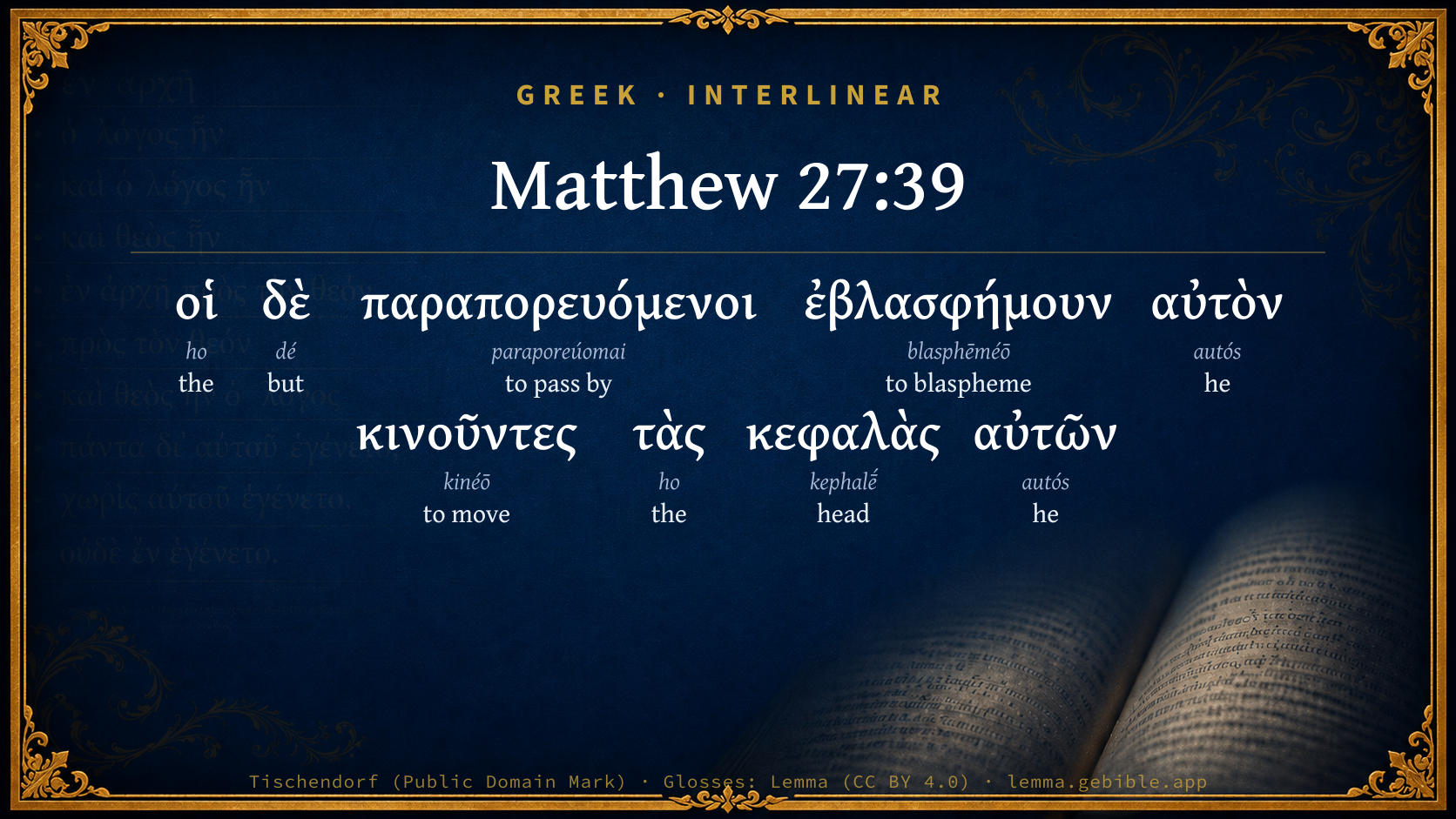
Greek (Tischendorf 8th ed.) Matthew 27:39 appears in the Greek New Testament. The text above is from the Tischendorf 8th edition. Each word links to its Strong’s number and a concise gloss. Click any word for its full Thayer’s Greek Lexicon entry.
Download image
Cite this verse

Matthew 27:39 (World English Bible). Public Domain. Lemma interlinear Bible study tool, https://lemma.gebible.app/v/matthew/27/39.

Show BibTeX & RIS
BibTeX
RIS
English Translation
Those who passed by blasphemed him, wagging their heads,
World English Bible · Public Domain
Highlights
  • 1 first appearance in the Greek New Testament
Full analysis ↓
Download a study sheet

One document with this verse’s original text, its word-by-word gloss line, the meaning frame, cross-references with their text, attributed commentary, and full source and license credits — printable, and it pastes into notes with its structure intact.

This verse Autodidact and up

Study sheet (.html) Plain text (.txt)

A passage Seminary Student

Up to 50 verses in one chapter. A passage sheet keeps up to 6 commentary sources and 12 cross-references per verse, in the order this page ranks them, and says so on the sheet whenever that leaves anything out. Ask for a single verse and you get the Autodidact verse sheet above.

Everything on this page stays free to read, with no account — the sheet is a download of what is already on screen, not access to it.

Want to remove ads? Support Godless Engineer
Compare translations 3

The same verse in 3 English versions, stacked beneath the original-language interlinear above. Click any original word for its lexicon entry.

Each is an independent rendering of the whole verse — the interlinear is not word-aligned to these translations.

Highlighted words mark where these versions differ — a whole-verse word diff, not a word-by-word alignment.

  • World English Bible Public Domain
    Those who passed by blasphemed him, wagging their heads,
  • King James Version Public Domain
    And they that passed by reviled him, wagging their heads,
  • unfoldingWord Literal Text CC BY-SA 4.0
    But the ones passing by were blaspheming him, wagging their heads

unfoldingWord Literal Text — © unfoldingWord, licensed CC BY-SA 4.0. Word-aligned USFM3 via Door43 (git.door43.org/unfoldingWord/en_ult).

Versions to compare (up to 4)

3 of 4 selected

Show all 19 translations

Every available English version of this verse, each an independent rendering of the whole verse.

  • World English Bible Public Domain
    Those who passed by blasphemed him, wagging their heads,
  • Berean Standard Bible Public Domain
    And those who passed by heaped abuse on Him, shaking their heads
  • Majority Standard Bible Public Domain
    And those who passed by heaped abuse on Him, shaking their heads
  • King James Version Public Domain
    And they that passed by reviled him, wagging their heads,
  • American Standard Version (1901) Public Domain
    And they that passed by railed on him, wagging their heads,
  • Revised Version (1885) Public Domain
    And they that passed by railed on him, wagging their heads,
  • Geneva Bible (1599) Public Domain
    And they that passed by, reuiled him, wagging their heades,
  • Douay-Rheims (1899) Public Domain
    And they that passed by, blasphemed him, wagging their heads,
  • Young's Literal Translation Public Domain
    and those passing by were speaking evil of him, wagging their heads,
  • Literal Standard Version CC BY-SA 4.0
    and those passing by kept slandering Him, wagging their heads,
  • Unlocked Literal Bible CC BY-SA 4.0
    Those who passed by insulted him, shaking their heads
  • unfoldingWord Literal Text CC BY-SA 4.0
    But the ones passing by were blaspheming him, wagging their heads
  • Darby Bible Public Domain
    But the passers-by reviled him, shaking their heads
  • World Messianic Bible Public Domain
    Those who passed by blasphemed him, wagging their heads
  • Webster's Bible Public Domain
    And they that passed by, reviled him, wagging their heads,
  • Free Bible Version CC BY-SA 4.0
    Those who passed by shouted insults at him, shaking their heads,
  • Bible in Basic English Public Domain
    And those who went by said bitter words to him, shaking their heads and saying,
  • Text-Critical English NT CC BY 4.0
    Those who passed by reviled him, shaking their heads
  • Tyndale New Testament (1534) Public Domain
    They that passed by revyled him waggynge ther heeddes

Literal Standard Version (2020), Covenant Press — licensed CC BY-SA 4.0. Text via the HelloAO Bible API (eBible.org). Unlocked Literal Bible (unfoldingWord) — licensed CC BY-SA 4.0. Text via the HelloAO Bible API (eBible.org). unfoldingWord Literal Text — © unfoldingWord, licensed CC BY-SA 4.0. Word-aligned USFM3 via Door43 (git.door43.org/unfoldingWord/en_ult). Free Bible Version, Dr. Jonathan Gallagher — licensed CC BY-SA 4.0. Text via the HelloAO Bible API (eBible.org).

Word by word

More ways to search: Search by grammar → Find every occurrence → Compare this word →

Practice this passage: Drill this verse → Learn its vocabulary →

About this verse

These counts appear in no published source. They are computed here, from the morphology-tagged text and Lemma’s own curated glosses. What Lemma adds →

9
words
7
distinct lemmas
Gospels
section

Notable vocabulary

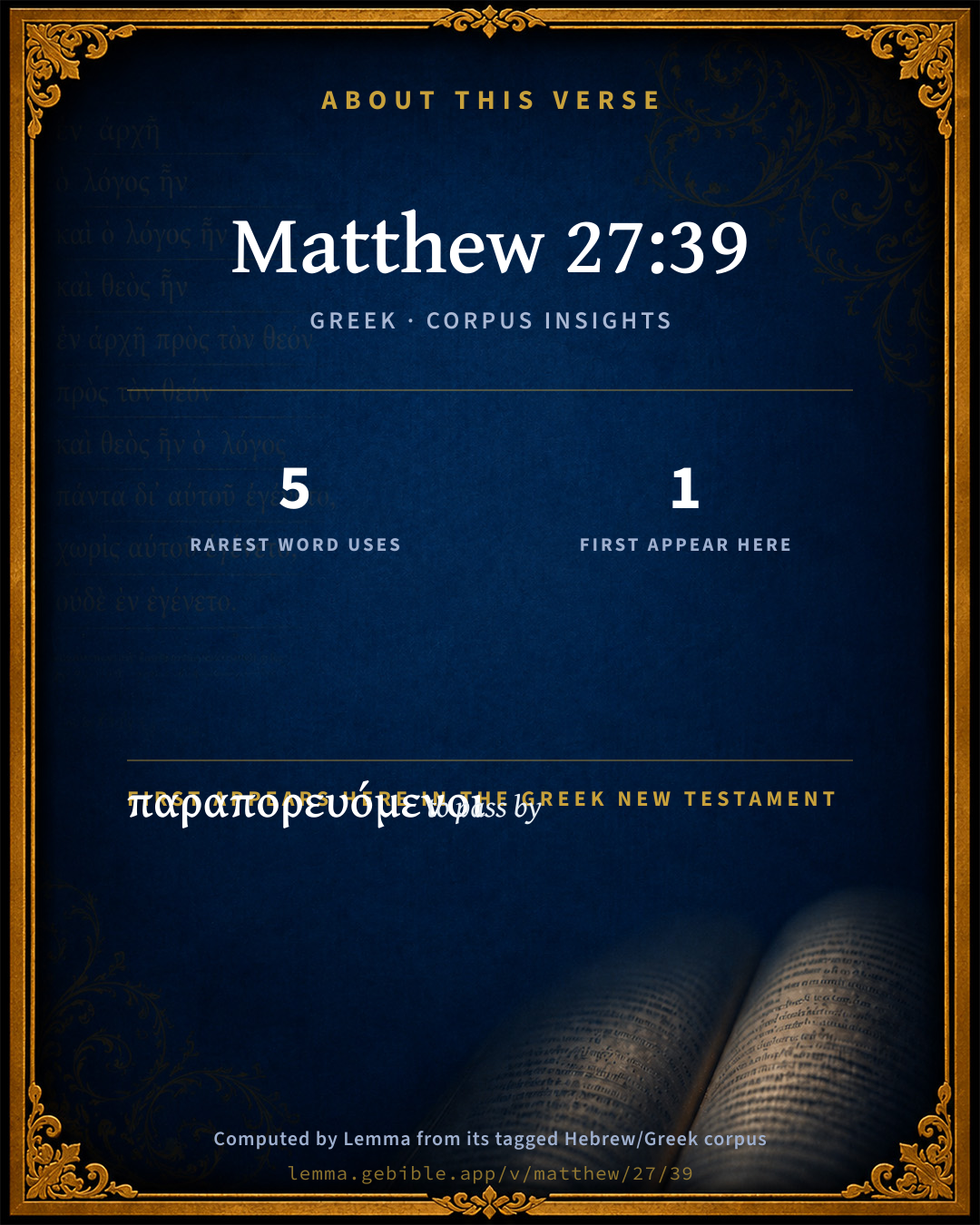
The rarest word here is παραπορευόμενοι to pass by G3899 — appearing just 5 times in the whole Greek New Testament.

First appearance in Scripture

This word makes its first canonical appearance in the Greek New Testament here:

  • παραπορευόμενοι to pass by G3899

Shared distinctive vocabulary

παραπορευόμενοι to pass by G3899 occurs in 5 verses of the Greek New Testament. Also found in:
Repetition

Words recur within this verse:

  • οἱ the G3588 ×2
  • αὐτὸν he G846 ×2

Cross-references

14

Topical passages linked to Matthew 27:39 in the Treasury of Scripture Knowledge — connected by theme and wording, ordered by reader-vote popularity; previews shown in the World English Bible.

  • Psalms 109:25 I have also become a reproach to them. When they see me, they shake their head.
  • Lamentations 1:12 Is it nothing to you, all you who pass by? Look, and see if there be any sorrow like my sorrow, which is brought on me, With which Yahweh has afflicted [me] in the day of his fierce anger.
  • Job 16:4 I also could speak as you do. If your soul were in my soul's place, I could join words together against you, And shake my head at you.
  • Psalms 22:6–7 But I am a worm, and no man; A reproach of men, and despised by the people.
  • Psalms 22:17 I can count all of my bones. They look and stare at me.
  • Psalms 31:11–13 Because of all my adversaries I have become utterly contemptible to my neighbors, A fear to my acquaintances. Those who saw me on the street fled from me.
  • Psalms 35:15–21 But in my adversity, they rejoiced, and gathered themselves together. The attackers gathered themselves together against me, and I didn't know it. They tore at me, and didn't cease.
  • Psalms 69:7–12 Because for your sake, I have borne reproach. Shame has covered my face.
  • Psalms 69:20 Reproach has broken my heart, and I am full of heaviness. I looked for some to take pity, but there was none; For comforters, but I found none.
  • Psalms 109:2 For they have opened the mouth of the wicked and the mouth of deceit against me. They have spoken to me with a lying tongue.
  • Lamentations 2:15–17 All that pass by clap their hands at you; They hiss and wag their head at the daughter of Jerusalem, [saying], Is this the city that men called The perfection of beauty, The joy of the whole earth?
  • Mark 15:29–30 Those who passed by blasphemed him, wagging their heads, and saying, "Ha! You who destroy the temple, and build it in three days,
  • Luke 23:35–39 The people stood watching. The rulers with them also scoffed at him, saying, "He saved others. Let him save himself, if this is the Christ of God, his chosen one!"
  • 1 Peter 2:22–24 who did not sin, "neither was deceit found in his mouth."

Cross-references courtesy of OpenBible.info (CC BY 4.0).

Commentary

Notes on Matthew 27:39 from classic Christian and Jewish commentators (each source and its license shown beneath its notes). The classic Christian expositions comment on the surrounding passage and are grouped to its opening verse, so a note may address several verses; the Jewish commentaries on the Tanakh (Rashi and others) are per-verse, so they appear only where the commentator wrote on this verse.

Lemma curates 59 commentaries, every one of them public domain or Creative Commons licensed, each selected and text-cleaned for this edition rather than reprinted as found. About our sources →

The Biblical Illustrator

Joseph S. Exell

Mat_27:39-40

He saved others; Himself lie cannot save.

He saved others, Himself He cannot save

I. The incontestible fact-He saved others. Let us bring forth witnesses: Angels, healed men and women.

II. Himself He cannot save. He is Divine. The world was made by Him; yet Himself He cannot save. The acts of unlimited providence are ascribed to Him He sustaineth all things by the word of His power. Himself He cannot save. The resurrection of the dead, administration of judgment are ascribed to Him. Himself He cannot save. The power to save Himself is demonstrated in those very acts by which He saved others. The devils were subject to Him. No man taketh my life from Me, I lay it down of Myself.

III. However paradoxical all this may seem, I must proceed to establish the momentous truth ignorantly expressed in those words. In its literal sense it was false; Jesus was not destitute of physical power to save Himself; in its theological sense it was true. There was no original necessity that the Son of God must die; He might have left the race to perish. The necessity of the death of Jesus was founded-

1. In the purpose and foreordination of God.

2. On the fulfilment which that event gives to the predictions of sacred Scripture.

3. To fulfil the typical representations by which, under the Mosaic law, it had been prefigured.

4. In order to verify His own declarations.

5. As a sacrificial atonement for the sins of the world.

6. In order to the effusion of the Holy Spirit.

7. Even in order to the perfection of His example.

Learn:

1. The affecting display which our subject presents of the love of Christ.

2. The glorious and certain effects of the Redeemers sufferings.

3. I conjure you to seek a personal interest in the important benefits of the Saviours death.

4. Let it be the theme of your meditation and the confirmation of your faith. (J. Bowers.)

Success in apparent failure

Christ seems a failure. Thus His enemies asserted and His friends seemed to admit it. Where they right?

I. What is success?

1. Certainly not that which is merely in appearance strong, beautiful, or prosperous, for inwardly it may be quite different. The ship on the waters may be beautiful to look at, but if made of inferior material is not a success.

2. Not that which is good merely for the time being. The finest house built on a sand-hill has its ruin beneath it.

3. Nor is it a necessary element of success, that it should confer aught of benefit or reward upon him who has brought it about. The highest favour often comes after death.

4. Nor is any result, however magnificent, obtained on doubtful principles worthy of this royal title. God and His laws are against it. Success is that good purpose which hath been conducted upon right principles to a prosperous and durable completion.

II. Christ we claim was and is a success.

1. His purpose was good-to save His people from their sins.

2. His purpose was conducted upon pure and holy principles.

3. Though small in its beginnings His purpose is evidently intended to prosper. His influence has been steadily increasing.

4. His success is always durable.

III. Hence the pharisees erred. They mistook the dawn of success for the clouds of a coming failure. The causes that led them to the error.

1. The bad habit of looking only at the outside of things. They were quick to see a colour or a cloth, but not a principle.

2. Because they judged results by what they wanted instead of by what He wanted. They wanted a temporal Messiah, He a spiritual.

3. Because they deemed success a matter of thirty or forty years instead of all time.

4. They could not understand His tearing self out of view. The omnipotence of love exceeds mere physical almightiness. (W. W. Walker.)

The Saviour of all bus Himself

I. What they deemed he could do. Himself He cannot save.

1. He could. It was not in the power of man.

2. He could not. He would fulfil the Scripture.

II. What they allowed he could do. (S. H. Simpson.)

When originally spoken.

I. Implied a critical position.

II. Expressed a mistaken view of religion. The men who saw the Saviour dying thought exclusively of the present; were more concerned for pain and physical deprivation than for sin; argued from self-love to the salvation of others.

III. Witnessed unconsciously to the principle of atonement. A moral necessity compelled Him to die: the righteousness of God had to be vindicated; He could only save others (in the deeper sense of the word) by self-sacrifice. The great question with us all now should be, not Could He save Himself? or Could He save others? but, Has He saved us-has He enfranchised us from self? (A. F. Muir, M. A.)

Self-sacrifice

Many voices from Calvary; all significant.

I. A great truth. Truer word never uttered. Who meant by others? Whoever referred to, the words true. This His work day by day. All ages shall declare that this testimony of enemies was true.

II. A falsehood. He could save Himself. Did the speakers know their words were false?

III. A latent truth. Concealed from the men who proclaimed it. A power at work within Christ which made it impossible for Him to save Himself. Impossibility seen in whatever way we regard His death. As a martyr, example, victim of sin, substitute for sin, He could not save Himself. Conclusion: The death of Christ a lesson of self-sacrifice. The highest rule in the world that of Christ. His Spirits rule who could not save Himself. Is the cross of Christ such a power in our lives as to lead us in daily life to feel and to show that though we can, yet we cannot? Appeal to men to yield themselves to Him who gave Himself for them. (J. M. Blackie, LL. B.)

He saved others, Himself He cannot save.-

Necessity of the cross

These men only needed to alter one letter to be grandly and gloriously right. If, instead of cannot, they had said will not, they would have grasped the very heart of the power, and the very central brightness of the glory of Christianity. He saved others; and just because He saves others, Himself He will not, and, in a real sense, He cannot, save.… It was His own will, and no outward necessity, that fastened Him to the cross; and that will was kept steadfast and immoveable by nothing else but His love: He Himself fixed the iron chain which bound Him. He Himself made the cannot. It was His love that made it impossible He should relinquish the task; therefore His steely will, like a strong spring constantly working, kept Him close up against the sharp edge of the knife that cut into His very hearts life. Though there were outward powers that seemed to knit Him there, and though to the eye of sense the taunt of the priests might be true, Himself He cannot save,-the inmost verity of that cross is, No man taketh My life from Me, I lay it down of Myself, because I love and will save the world.… Yet a Divine necessity for the cross there was. No saving of men from any evil can be effective but at the cost of self-sacrifice. The lamp burns out in the very act of giving light. So that, while on the one side there is necessity, on the other there is free, willing submission. It was not high priests, Pilate, soldiers, nails, that fastened Jesus to the cross. He was bound there by the cords of love, and by the bands of his own infinitely merciful purpose. (A. Maclaren, D. D.)

He saved others, Himself He cannot save

I. The confession made by the bitterest enemies of the Lord Jesus. They had long tried falsehood, now they admit the truth-He saved others. But we may go back to the earlier eras in proof of this assertion. It was He that saved Lot; the Egyptians from bondage; the people out of Babylon. He is able to save others to the uttermost of human guilt, to the uttermost of human life, to the uttermost of human time. How it comes to pass that He who saved others, could not save Himself? It was not for want of power, for He had all power in heaven and earth. It was not through any deadness to a feeling of pain; for his sensibilities were keen. It was not from any ignorance of the issue. The answer is, He came to seek and to save, etc. The inability to save Himself was not physical.

I. It arose from the nature of the work he had undertaken. Without shedding of blood was no remission. If others were to be saved Christ must die.

II. The everlasting purpose of the Father was another reason why He could not save Himself.

III. The Saviours free undertaking of the office of a Priest and Victim and Redeemer brought Him into the condition that while He saved others Himself He could not save. He pledged Himself to go through with the amazing work of redemption, even though hell oppose.

IV. The glory and honour of God made ,it the only alternative that while He saved others, Himself He could not save.

V. The love that He bore to us is another reason of the truth of the text. Learn:

1. The inseparable connection that subsists between the sacrifice of Jesus and the salvation of His people.

2. Deduce the length, height, depth of the love of Jesus.

3. What a fearful and obnoxious thing is sin.

4. What must be the great theme of the gospel ministry. (J. Cumming, D. D.)

The Biblical Illustrator, edited by Joseph S. Exell (c. 1880s–1900s) — public domain. Text from a community e-Sword module.

Joseph Benson's Commentary

Mat 27:39-44. They that passed by reviled him, &c. — As it was a great aggravation of our Lord’s sufferings that he was crucified along with two thieves, and in the middle of them, as though he had been the chief malefactor of the three, so it was a further aggravation thereof that he was reviled, mocked, and derided by different descriptions of persons. The common people, whom the priests had incensed against him by the malicious lies which they spread concerning him, and which they pretended to found on the evidence of witnesses, seeing him hang as a malefactor on the cross, and reading the superscription that was placed over his head, expressed their indignation against him by railing on him, and saying, Thou that destroyest the temple, &c., save thyself — The rulers having, as they imagined, wholly overturned his pretensions as the Messiah, ridiculed him on that head, and, with a meanness of soul which will render them for ever infamous, mocked him while in the agonies of death, and even most basely upbraided him with the saving power, which they could not deny that he had exerted; saying, he saved others, himself he cannot save — Thus they scoff at the wonderful miracles of healing, by which he had demonstrated that he was the Messiah; and they promise to believe on him on condition that he would prove his pretensions by coming down from the cross. In the mean time nothing could be more false and hypocritical, for they continued in their unbelief notwithstanding that he raised himself from the dead, which was a much greater miracle than his coming down from the cross would have been; a miracle also that was attested by witnesses whose veracity they could not call in question; for it was told them by the soldiers whom they themselves had placed at the sepulchre to watch his body. It is plain, therefore, that their incorrigible stubbornness would not have yielded to any proof, however convincing, and that when they said they would believe if he would come down from the cross, they only meant to insult him; thinking it impossible now for him to escape out of their hands. In saying, He trusted in God, &c., they deride his faith and reliance on God, whom he had called his Father, and thus show themselves to be either real infidels, or very profane, though under a profession of religion. In speaking thus, however, they fulfilled a remarkable prophecy concerning the Messiah’s sufferings, Psa 22:8, where it is foretold that his enemies would utter these very words, in derision of his pretensions. The thieves also, &c., cast the same in his teeth — That is, one of them did so, for, according to Luk 23:39, &c., the other exercised a most extraordinary faith in our Lord, and that at a time when he was deserted by his Father, mocked by men, and hung on a cross as the worst of malefactors. Some commentators endeavour to reconcile the two evangelists by supposing, that both the thieves might revile Jesus at first. But this solution is not very probable. In Scripture, a single person or thing is often expressed in the plural number, especially when it is not the speaker’s or writer’s intention to be more particular.

Joseph Benson's Commentary on the Old and New Testaments (1811–1818) — public domain. Text from a community e-Sword module.

Whedon's Commentary on the Bible

Daniel D. Whedon

REVILING OF JESUS ON THE CROSS, Mat_27:39-44.

In the extremity of his physical pain the Son of man must endure the utmost that human contempt can think and say and do. The accidental spectator, the chance specimens of our race; the chief priests, the representatives of rank, sacred and secular, are present. The powerful exert the uttermost of their power, and the vilest do their best and vilest. They utter taunts founded on calumnious misrepresentations of his words; they ridicule his kingship, and even his piety. They trample on his pretences, and exult over his weakness.

39. Wagging their heads — An accompanying gesture, expressive of the contempt uttered in their words.

Daniel D. Whedon (gen. ed.), Commentary on the Old and New Testaments (1874–1909) — public domain. Text from a community e-Sword module.

Godbey's Commentary on the New Testament

William B. Godbey

THEY REVILE HIM ON THE CROSS

Mar 15:29-32; Luk 23:35-43; Mat 27:39-44. “And passing by, they continued to blaspheme Him, wagging their heads, and saying, Thou that destroyest the temple, and buildest it in three days, save Thyself. If Thou art the Son of God, come down from the cross. Likewise the high priests mocking Him, with the scribes and elders, continued to say, He saved others; Himself He is not able to save. If He is the King of Israel, let Him now come down from the cross, and we will believe on Him. He trusted in God; let Him now deliver Him, if He wishes Him: for He said, I am the Son of God.” This scene, led off by the high priests, elders, and scribes, whose honorable example, of course, many thoughtless people followed, both citizens and soldiers, was not only barbaric in the extreme and infinitely worse than brutal, but diabolical in the superlative degree. And yet it was perpetrated by the ministers and elders standing at the head of the Church, illustrating the significant fact that collegiate education, religious professions, official dignity, and clerical sanctity are no guarantee against the vilest and most demoniacal persecutions when the devil is in them. Shall we not all learn a profitable lesson by this scene, and that is, to have no faith in man, but all in God?

“The thieves also, being crucified along with Him, continued to cast this same reproach on Him.” Luk 22:39-43 : “But one of the malefactors, having been hanged up, continued to blaspheme Him, If Thou art the Christ, save Thyself and us.” There is no contradiction of the preceding with the following. Simply recognize the fact that both of the robbers at first joined with the high priest and the rabble in reproaching Him. But after so long a time, something in the look or the manner of Jesus sent conviction deep into the heart of one of the malefactors, superinducing a tremendous reaction, such as to evoke from the repentant thief the following: “And the other one, responding, continued to rebuke him, saying, Dost thou not fear God, because thou art in the same condemnation? And we indeed justly; for we are receiving the punishment worthy of the crimes which we have committed; but this One has done nothing wrong. He said to Jesus, Lord, when Thou mayest come in Thy kingdom, remember me. And Jesus said to him, Truly I say unto thee, This day thou shalt be with Me in paradise.” On the resurrection morn, three days subsequently, Jesus said to Mary, “I have not yet ascended unto My Father,” setting forth the indisputable fact that He had not met the thief in heaven. He was a Jew, and was saved under the Abrahamic covenant, which all concentrates in Christ. So he went to Abraham’s bosom (Luke 16), whither Lazarus and all of the Old Testament saints had been gathering since the days of Abel. Jesus, expiring on the cross, His disembodied human soul (1Pe 3:19) went and proclaimed to the spirits in prison — i. e. the inmates of hell — the victory won on Calvary (Act 2:27-31); then, crossing the impassable chasm, entered the intermediate paradise — i. e., Abraham’s bosom — and met the thief before the expiration of that day at midnight; spent a wonderful hallelujah Sabbath with the patriarchs and prophets and all of the Old Testament saints; early, the first day of the week, abolished the intermediate paradise, and led up all the inmates with Him (Eph 4:8-10), and, coming to the tomb, received His body, the mighty host of Old Testament saints — being invisible, because not having their bodies — accompanied Him the forty days, and finally ascended with Him up to heaven. The prophetic eye of David (Psalms 24) catching the vision of the triumphant host, hears the shout, “Lift up your heads, O ye gates, and be ye lifted up, ye everlasting doors, and let the King of glory come in.” Then the shout roars back from the celestial portals, “Who is this King of glory?” The answer is prompt, “The Lord, mighty to save and strong to deliver; He is the King of glory.” Now the gates swing high, and millions of glorified spirits shout Him welcome, with the triumphant host captured from the cruel clutches of Satan. The grandest ovation heaven has seen in all the ages now monopolizes the interest of the celestial universe, while the Conqueror of Mount Calvary leads His blood-washed pilgrims up into the august presence of the Almighty Father, presenting them before Him, “Behold, I and the children whom Thou hast given unto Me.” O what a thrilling testimony-meeting follows, Father Abraham, the patriarchs and prophets, all participating, to the most delectable edification of angels, archangels, cherubim, and seraphim! A false exegesis has been put on this passage, in order to sustain that miserable materialistic heresy which deprives man of his soul, ignoring the idea that the soul is ever separate from the body, as this false dogma does not concede that you have a soul. As this positive statement of Jesus to the thief, “This day thou shalt be with Me in paradise,” so clearly and unequivocally recognizes the soul of the thief as going out of the body hanging on the cross and entering paradise that very day, to their ineffaceable shame be it said, they have condescended to the diabolical audacity to change the punctuation of the very identical words which Jesus spoke, so moving the comma as to make it read, “Truly I say unto thee this day, Thou shalt be with Me in paradise,” making the adverb semeron, “this day,” qualify “say unto thee,” instead of “thou shalt be with Me in paradise,” thus making our Savior commit a solecism and talk nonsense. As this occult form of infidelity — i. e., soul-sleeping materialism has been sown by Satan throughout this continent, we feel it our duty to expose it, as it is utterly destitute of truth. The salvation of the thief on the cross is infinitely consolatory to penitent sinners in the hour and article of death. However, it is awfully risky to make our Lord’s mercy in this notable instance an apology for continuing in sin. All should bear in mind the obvious fact that this poor thief had never seen Jesus before, nor hardened his heart by slighting opportunities.

William B. Godbey, Commentary on the New Testament (1896–1900) — public domain. Text from a community e-Sword module.

Bengel's Gnomon

Johann Albrecht Bengel

Mat 27:39. Οἱ δὲ παραπαρευόμενοι, but they that were passing by) Many did not even condescend to stand still.—κινοῦντες τὰς κεφαλὰς, shaking their heads) The gesture of one who refuses to acknowledge something.

Bengel's Gnomon of the New Testament — English translation (T&T Clark, Edinburgh, 1860) — public domain. Text from a community e-Sword module.

Meyer's Critical & Exegetical Commentary

Heinrich August Wilhelm Meyer

Mat_27:39 Οἱ δὲ παραπορ.] That what is here said seems to imply, what would ill accord with the synoptic statement as to the day on which our Lord was crucified, that this took place on a working day (Fritzsche, de Wette), is not to be denied (comp. on Joh_18:28; Mar_15:21), though it cannot be assumed with certainty that such was the case. But there can be no doubt that the place of execution was close to a public thoroughfare.

κινοῦντες τὰς κεφ. αὐτ.] The shaking of the head here is not to be regarded as that which expresses refusal or passion (Hom. Il. xviii. 200, 442; Od. v. 285, 376), but, according to Psa_22:8, as indicating a malicious jeering at the helplessness of one who had made such lofty pretensions, Mat_27:40. Comp. Job_16:4; Psa_109:25; Lam_2:15; Isa_37:22; Jer_18:16; Buxt. Lex. Talm. p. 2039; Justin, Ap. I. 38.

Meyer — Critical and Exegetical Commentary on the New Testament — English translation by Peter Christie, edited by Frederick Crombie (T&T Clark, 1880) — public domain. Text from a community e-Sword module.

Expositor's Greek Testament

ed. W. Robertson Nicoll

Mat 27:39-44 . Taunts of spectators (Mar 15:29-32 ; Luk 23:35-37 ; Luk 23:39 ). The last drop in Christ’s bitter cup. To us it may seem incredible that even His worst enemies could be guilty of anything so brutal as to hurl taunts at one suffering the agonies of crucifixion. But men then felt very differently from us, thanks to the civilising influence of the Christian faith, which has made the whole details of the Passion history so revolting to the Christian heart. These sneers at the great Sufferer are not invented fulfilments of prophecy (Psa 22:7-8 ; so Brandt), but belong to the certainties of the tragic story as told by the synoptists.

Mat 27:39 . οἱ παραπορευόμενοι , the passers by: the place of crucifixion therefore near a road; going to or from the temple services ( Speaker’s Com. ); or on work-day business, the 13th not the 14th of the month? (Fritzsche, De Wette). κινοῦντες τ . κ . α ., shaking or nodding the head in the direction of the cross, as if to say: that is what it has come to.

The Expositor's Greek Testament, edited by W. Robertson Nicoll (1897–1910) — public domain. Text from a community e-Sword module.

Geneva Bible (1599)

Geneva Bible translators

To make full satisfaction for us, Christ suffereth and overcometh, not only the torments of the body, but also the most horrible torments of the mind.

Geneva Bible (1599) marginal notes — public domain. Text via Bolls.life.

Adam Clarke's Commentary

Verse 39. Wagging their heads] In token of contempt.

Adam Clarke's Commentary on the Bible (1810–1826) — public domain. Text from a community e-Sword/MySword module.

Ellicott's Commentary for English Readers

(39) They that passed by.—The words bring before us the picture of a lounging crowd, strolling from one cross to the other, and mocking the central sufferer of the three. Rulers and chief priests were not ashamed to take part in the brutal mockery of a dying man. The spoken taunts were doubtless often repeated, and not always in the same form, but their burden is always the same.

A Bible Commentary for English Readers, edited by Charles John Ellicott (1878–1897) — public domain. Text from a community e-Sword module.

The Cambridge Bible for Schools and Colleges

gen. ed. J. J. S. Perowne

39. See Psa_22:7.

The Cambridge Bible for Schools and Colleges (gen. ed. J. J. S. Perowne; Cambridge University Press, 1878–1918) — public domain. Text from a community e-Sword module.

John Gill's Exposition

And saying, thou that destroyest the temple,.... The Vulgate Latin, and Munster's Hebrew Gospel, read, "the temple of God"; and add "ah!" here, as in Mar 15:29, and so Beza says it is read in a certain copy. They refer to the charge of the false witnesses against him, who misrepresenting his words in Joh 2:19, declared that he gave out that he was able to destroy the temple of Jerusalem, and rebuild it in three days time; wherefore it is added,

and buildest it in three days, save thyself. They reproach him with it, and suggest, that these were vain and empty boasts of his; for if he was able to do any thing of that kind, he need not hang upon the tree, but could easily save himself:

if thou be the Son of God, come down from the cross. The Jews themselves say (a) that the following words were said to Jesus on the cross,

"if thou be the Son of God, why dost thou not deliver thyself out of our hands?

As Satan before them, they put an "if" upon the sonship of Christ: and seeing his followers believed in him as the Son of God, and he had owned himself to be so before the sanhedrim, they require a sign of it by his power, and to do that which they believed no mere man in his situation could do; which shows, that they had no other notion of the Son of God, but that he was a divine person: but his sonship was not to be declared by his coming down from the cross, which he could have easily effected, but by a much greater instance of power, even by his resurrection from the dead; and no other but that sign was to be given to that wicked and perverse generation,

(a) Toldos Jesu, p. 17.

John Gill's Exposition of the Whole Bible (1746–1763) — public domain (CC PDM 1.0). Text via the HelloAO Bible API.

Trapp's Complete Commentary

John Trapp

39 And they that passed by reviled him, wagging their heads,

Ver. 39. Reviled him, wagging their heads] God took notice of Cain’s frowns, Gen 4:6, Miriam’s mutterings, Num 12:2, these men’s noddings, Rabshakeh’s lofty looks, Isa 37:23, Laban’s lourings (scowling), Gen 31:2, and sets them upon record. He is jealous for Jerusalem with a great jealousy, Zec 1:14; (and jealousy is very wakeful, hardly shall the sly paramour avoid the husband’s eye), if he see any indignity offered to his beloved spouse, he will arise and play Phineas’ part, as that martyr said. The virgin daughter of Zion, though she be but a virgin, hath a champion that will not see nor suffer her to be abused, Isa 37:22. See how he revileth her revilers, Isa 57:3-4 "But draw near hither, ye sons of the sorceress, the seed of the adulterer and the whore. Against whom do ye sport yourselves against whom make yea wide mouth, and draw out the tongue? are ye not children of transgression, a seed of falsehood?" Yea, he giveth encouragement to his spouse, in a holy scorn to despise and deride her deriders, shaking her head at them, as they do at her, and saying, "Whom hast thou reproached and blasphemed?" &c. q.d. Dost thou know what thou hast done? &c. At Brightwell in Berkshire, one Lener said that he saw that evil favoured knave Latimer, when he was burned at Oxford; and that he had teeth like a horse. But the Lord suffered not this scorn and contempt of his servant to go unpunished. For that very day, and about the same hour that Lener spake those words, his son wickedly hanged himself.

John Trapp, A Commentary or Exposition upon All the Books of the Old and New Testament (1647–1656) — public domain. Text from a community e-Sword module.

Albert Barnes' Notes on the Bible

Wagging their heads - In token of derision and insult. See Job 16:4; Psa 109:25.

Albert Barnes' Notes on the Bible (1834–1885) — public domain. Text from a community e-Sword/MySword module.

Haydock's Catholic Bible Commentary

They ... blasphemed, reviled, and insulted him with words and gestures. (Witham)

George Leo Haydock (1774–1849), Haydock's Catholic Family Bible and Commentary, 1859 edition — public domain. Excludes Psalms (Douay-Rheims chapter numbering differs from Protestant) and Deuterocanonical books (Catholic canon only).

The Pulpit Commentary

They that passed by. Golgotha being near a great high road and a much-frequented city gate, (Joh_19:20) passersby were numerous, even without counting those who were attracted by the woeful sight. Many of them knew nothing of Christ"s case, but seeing him punished in company with the two malefactors, thought that he was doubtless guilty of the same crimes as they; others, perhaps, who had seen his miracles and heard something of his teaching, conceived the notion that one whom the priests and rulers condemned must be a dangerous impostor, and deserved the cruelest of deaths. Reviled him; eblasfhmoun : railed on him; blasphemabant (Vulgate). The expression, indeed, is true in its worse sense, for they who could thus revile the Son of God were guilty, however ignorantly, of gross impiety and irreverence. Wagging their heads. In mockery and contempt, thus fulfilling the psalmist"s words, "All they that see me laugh me to scorn; they shoot out the lip, they shake the head;" and, "I am become a reproach unto them; when they see me, they shake their heads". (Psa_22:7 Psa_109:25)

The Pulpit Commentary (1880–1919), ed. H.D.M. Spence-Jones & Joseph S. Exell — public domain. Text from a community e-Sword module.

The People's New Testament

B. W. Johnson

39. They that passed by reviled him. The people going in and out of the city, on the thoroughfare near the place of crucifixion. Wagging their heads. Derisively and insultingly. Compare 2 Kings 19:21; Job 16:4; Psalm 109:25.

B. W. Johnson's The People's New Testament with Notes (1889–1891) — public domain. Electronic text from the Christian Classics Ethereal Library (CCEL) ThML edition.

Cambridge Greek Testament for Schools and Colleges

39. See Psa 22:7. This was not a Psalm of David, but was probably ‘composed by one of the exiles during the Babylonish Captivity … who would cling to the thought that he suffered not only as an individual, but as one of the chosen of God. But it has more than an individual reference. It looks forward to Christ.’ Dean Perowne on Psalms 22.

Cambridge Greek Testament for Schools and Colleges (Cambridge University Press, 1896; 21 vols, various authors incl. Carr, Maclear, Plummer, Farrar, Lumby, Moule, M. R. James, Simcox) — public domain. Text from a community e-Sword module.

Alford’s Greek Testament

Henry Alford

39-44.] He is mocked on the cross. Mar 15:29-32.Luk 23:35-37Luk 23:35-37; 39-43. Our narrative and that of Mark are from a common source. Luke’s is wholly distinct. The whole of these indignities are omitted by John.

39. οἱ παραπ.] These words say nothing as to its being a working-day, or as to the situation of the spot. A matter of so much public interest would be sure to attract a crowd, among whom we find, ver. 41, the chief priests, scribes, and elders. These passers-by were the multitude going in and out of the city, some coming to see, others returning.

κιν. τ. κεφ.] see Psa 22:7. The first reproach refers to ch. 26:61; the second to ibid., ver. 64.

Henry Alford, The Greek Testament (1849–1861) — public domain. Text from a community e-Sword module.

International Critical Commentary

(M) 39. And the passers-by were blaspheming Him, shaking their heads.] so Mk. Cf. Lam 2:15.

International Critical Commentary — older volumes (1896–1929), various authors — public domain. Text from a community e-Sword module.

Lesson kit

Teaching starters — assembled from the data on this page, not authored interpretation. Every prompt links to the verse data it draws on. Edit before teaching.

Matthew, in the Gospels, opens this verse with 9 words (7 distinct Greek lemmas). Its most distinctive word is paraporeúomai (“to pass by”). A historical commentator’s framing appears above. Read the whole chapter for the surrounding context.

Discussion questions

  1. What does “to pass by” (paraporeúomai) contribute to the verse as a whole?
  2. This is the first place “to pass by” appears in Scripture (first appears here). What does its debut here establish?
  3. How does Mark 2:23, which shares the word «to pass by», read alongside this verse?
  4. What does the repetition of “the” (2× in this one verse) do in this verse?
  5. The translations on this page render this verse differently — a whole-verse word diff, not a word-by-word alignment. What might account for the different wordings?
  6. Compare how The Biblical Illustrator and Joseph Benson's Commentary read this verse. Where do they agree or differ?

Things to notice

  • 1 word makes its first canonical appearance in Scripture here.
  • These translations choose different wording for 7 words in this verse.
  • “the” occurs 2× in this single verse.
  • 7 distinct Greek lemmas span 9 words in this verse.

Reading settings

Reading text

Shown beneath each verse's original-language words.

Old Testament
Old Testament edition

Read the OT as the Masoretic Hebrew (MT) or the Greek Septuagint (LXX).

English shown for the Greek Septuagint (in the Hebrew ↔ Greek comparison).

Comparing translations? Open the Compare panel on any verse page to stack up to four side by side.