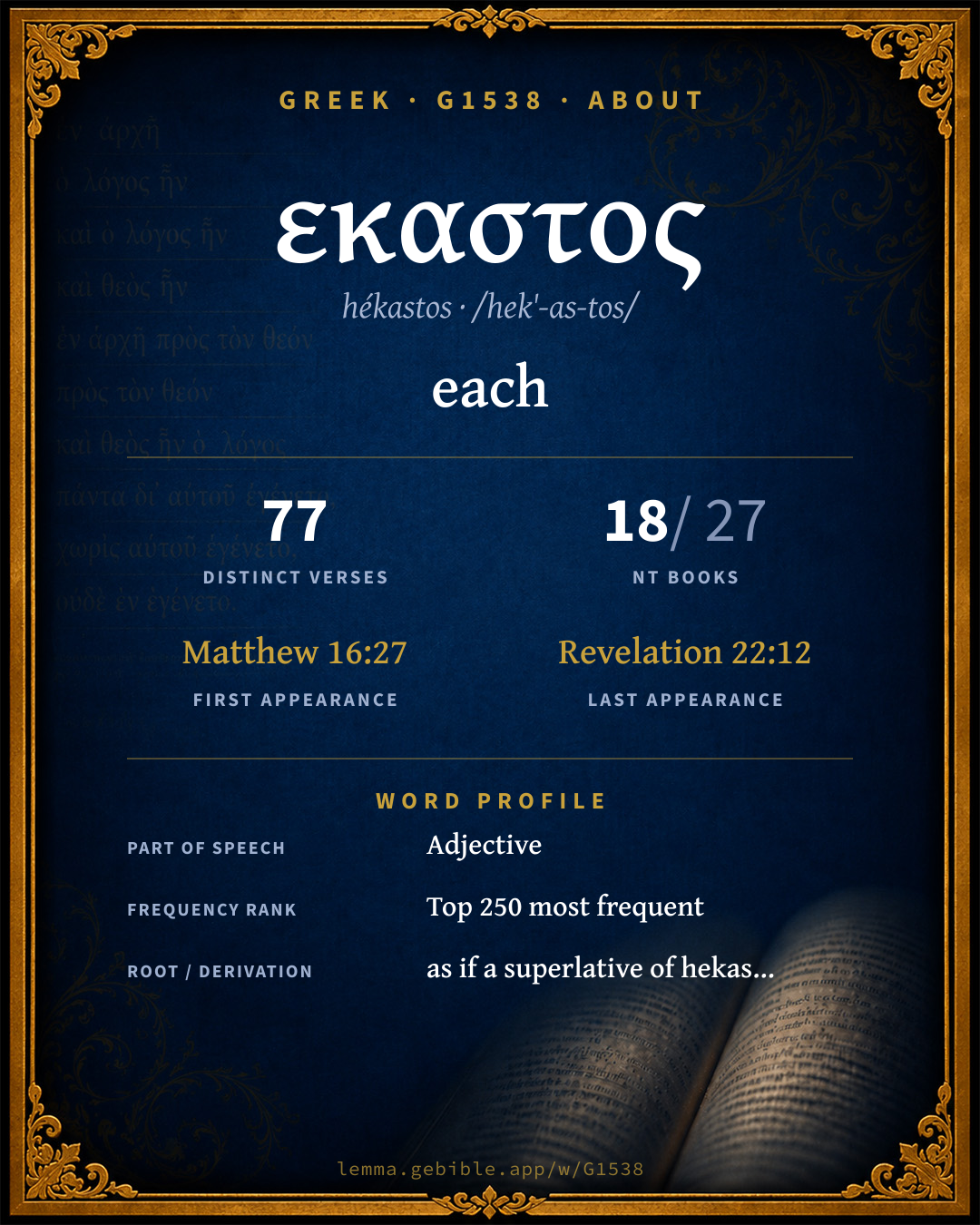
ἕκαστος
each
Full lexicon entry — Thayer's Greek Lexicon
From Thayer's Greek Lexicon
Where this word appears
See every Nominative-case word in the Greek New Testament →
Grammar key — what these labels mean
Part of speech
- Adjective
- A word that describes or qualifies a noun.
Case
- Nominative
- The case of the subject (and the predicate nominative).
- Dative
- The case of the indirect object, means, or location — “to / for / with / in.”
- Accusative
- The case of the direct object and of extent.
- Genitive
- The case of source, possession, or “of” — answers “whose / from what.”
Gender
- Masculine
- Grammatically masculine.
- Neuter
- Grammatically neuter.
- Feminine
- Grammatically feminine.
Number
- Singular
- One.
- Plural
- More than one.
Grammatical forms 10 distinct
- Adjective, Nominative, Singular, Masculine 39 times (48%)
- Adjective, Dative, Singular, Masculine 18 times (22%)
- Adjective, Accusative, Singular, Masculine 10 times (12%)
- Adjective, Genitive, Singular, Masculine 7 times (9%)
- Adjective, Nominative, Plural, Masculine 2 times (2%)
- Adjective, Nominative, Singular, Neuter 2 times (2%)
- Adjective, Accusative, Singular, Feminine 1 time (1%)
- Adjective, Accusative, Singular, Neuter 1 time (1%)
+2 more forms (2 occurrences)
Parsed forms decoded from the imported morphology (Robinson–Tischendorf, public domain), counted across 82 parsed occurrences — not distinct verses.
Every verse where G1538 appears — 77 distinct verses across 18 books. Click any verse to open its interlinear word-by-word view. Verse text shown in the World English Bible for context — . Each verse’s Greek form is shown with its reference; the English is not keyword-highlighted, since the data carries no word-level English alignment. Use “Compare translations” on any verse to read it across multiple English versions. This concordance covers the Greek New Testament; Septuagint (Greek Old Testament) occurrences of this word are not indexed here.
Matthew 4 verses
- Matthew 16:27 ἑκάστῳ adj dat sg masc For the Son of Man will come in the glory of his Father with his angels, and then he will render to everyone according to his deeds.
- Matthew 18:35 ἕκαστος adj nom sg masc So my heavenly Father will also do to you, if you don't each forgive your brother from your hearts for his misdeeds."
- Matthew 25:15 ἑκάστῳ adj dat sg masc To one he gave five talents, to another two, to another one; to each according to his own ability. Then he went on his journey.
- Matthew 26:22 ἕκαστος adj nom sg masc They were exceedingly sorrowful, and each began to ask him, "It isn't me, is it, Lord?"
Mark 1 verse
Luke 5 verses
- Luke 2:3 ἕκαστος adj nom sg masc All went to enroll themselves, everyone to his own city.
- Luke 4:40 ἑκάστῳ adj dat sg masc When the sun was setting, all those who had any sick with various diseases brought them to him; and he laid his hands on every one of them, and healed them.
- Luke 6:44 ἕκαστον adj nom sg neut For each tree is known by its own fruit. For people don't gather figs from thorns, nor do they gather grapes from a bramble bush.
- Luke 13:15 ἕκαστος adj nom sg masc Therefore the Lord answered him, "You hypocrites! Doesn't each one of you free his ox or his donkey from the stall on the Sabbath, and lead him away to water?
- Luke 16:5 ἕκαστον adj acc sg masc Calling each one of his lord's debtors to him, he said to the first, 'How much do you owe to my lord?'
John 4 verses
- John 6:7 ἕκαστος adj nom sg masc Philip answered him, "Two hundred denarii worth of bread is not sufficient for them, that everyone of them may receive a little."
- John 7:53 εκαστος adj nom sg masc Everyone went to his own house,
- John 16:32 ἕκαστος adj nom sg masc Behold, the time is coming, yes, and has now come, that you will be scattered, everyone to his own place, and you will leave me alone. Yet I am not alone, because the Father is with me.
- John 19:23 ἑκάστῳ adj dat sg masc Then the soldiers, when they had crucified Jesus, took his garments and made four parts, to every soldier a part; and also the coat. Now the coat was without seam, woven from the top throughout.
Acts 11 verses
- Acts 2:3 ἕκαστον adj acc sg masc Tongues like fire appeared and were distributed to them, and one sat on each of them.
- Acts 2:6 ἕκαστος adj nom sg masc When this sound was heard, the multitude came together, and were bewildered, because everyone heard them speaking in his own language.
- Acts 2:8 ἕκαστος adj nom sg masc How do we hear, everyone in our own native language?
- Acts 2:38 ἕκαστος adj nom sg masc Peter said to them, "Repent, and be baptized, everyone of you, in the name of Jesus Christ for the forgiveness of sins, and you will receive the gift of the Holy Spirit.
- Acts 3:26 ἕκαστον adj acc sg masc God, having raised up his servant, Jesus, sent him to you first, to bless you, in turning away everyone of you from your wickedness."
- Acts 4:35 ἑκάστῳ adj dat sg masc and laid them at the apostles' feet, and distribution was made to each, according as anyone had need.
- Acts 11:29 ἕκαστος adj nom sg masc As any of the disciples had plenty, each determined to send relief to the brothers who lived in Judea;
- Acts 17:27 ἑκάστου adj gen sg masc that they should seek the Lord, if perhaps they might reach out for him and find him, though he is not far from each one of us.
- Acts 20:31 ἕκαστον adj acc sg masc Therefore watch, remembering that for a period of three years I didn't cease to admonish everyone night and day with tears.
- Acts 21:19 ἕκαστον adj acc sg neut When he had greeted them, he reported one by one the things which God had worked among the Gentiles through his ministry.
- Acts 21:26 ἑκάστου adj gen sg masc Then Paul took the men, and the next day, purified himself and went with them into the temple, declaring the fulfillment of the days of purification, until the offering was offered for every one of them.
Romans 5 verses
- Romans 2:6 ἑκάστῳ adj dat sg masc who "will pay back to everyone according to their works:"
- Romans 12:3 ἑκάστῳ adj dat sg masc For I say, through the grace that was given me, to every man who is among you, not to think of himself more highly than he ought to think; but to think reasonably, as God has apportioned to each person a measure of faith.
- Romans 14:5 ἕκαστος adj nom sg masc One man esteems one day as more important. Another esteems every day alike. Let each man be fully assured in his own mind.
- Romans 14:12 ἕκαστος adj nom sg masc So then each one of us will give account of himself to God.
- Romans 15:2 ἕκαστος adj nom sg masc Let each one of us please his neighbor for that which is good, to be building him up.
1 Corinthians 19 verses
- 1 Corinthians 1:12 ἕκαστος adj nom sg masc Now I mean this, that each one of you says, "I follow Paul," "I follow Apollos," "I follow Cephas," and, "I follow Christ."
- 1 Corinthians 3:5 ἑκάστῳ adj dat sg masc Who then is Apollos, and who is Paul, but servants through whom you believed; and each as the Lord gave to him?
- 1 Corinthians 3:8 ἕκαστος adj nom sg masc Now he who plants and he who waters are the same, but each will receive his own reward according to his own labor.
- 1 Corinthians 3:10 ἕκαστος adj nom sg masc According to the grace of God which was given to me, as a wise master builder I laid a foundation, and another builds on it. But let each man be careful how he builds on it.
- 1 Corinthians 3:13 ἑκάστου ἑκάστου adj gen sg masc adj gen sg masc each man's work will be revealed. For the Day will declare it, because it is revealed in fire; and the fire itself will test what sort of work each man's work is.
- 1 Corinthians 4:5 ἑκάστῳ adj dat sg masc Therefore judge nothing before the time, until the Lord comes, who will both bring to light the hidden things of darkness, and reveal the counsels of the hearts. Then each man will get his praise from God.
- 1 Corinthians 7:2 ἕκαστος ἑκάστη adj nom sg masc adj nom sg fem But, because of sexual immoralities, let each man have his own wife, and let each woman have her own husband.
- 1 Corinthians 7:7 ἕκαστος adj nom sg masc Yet I wish that all men were like me. However each man has his own gift from God, one of this kind, and another of that kind.
- 1 Corinthians 7:17 ἑκάστῳ ἕκαστον adj dat sg masc adj acc sg masc Only, as the Lord has distributed to each man, as God has called each, so let him walk. So I command in all the assemblies.
- 1 Corinthians 7:20 ἕκαστος adj nom sg masc Let each man stay in that calling in which he was called.
- 1 Corinthians 7:24 ἕκαστος adj nom sg masc Brothers, let each man, in whatever condition he was called, stay in that condition with God.
- 1 Corinthians 11:21 ἕκαστος adj nom sg masc For in your eating each one takes his own supper before others. One is hungry, and another is drunken.
- 1 Corinthians 12:7 ἑκάστῳ adj dat sg masc But to each one is given the manifestation of the Spirit for the profit of all.
- 1 Corinthians 12:11 ἑκάστῳ adj dat sg masc But the one and the same Spirit works all of these, distributing to each one separately as he desires.
- 1 Corinthians 12:18 ἕκαστον adj nom sg neut But now God has set the members, each one of them, in the body, just as he desired.
- 1 Corinthians 14:26 ἕκαστος adj nom sg masc What is it then, brothers? When you come together, each one of you has a psalm, has a teaching, has a revelation, has another language, has an interpretation. Let all things be done to build each other up.
- 1 Corinthians 15:23 ἕκαστος adj nom sg masc But each in his own order: Christ the first fruits, then those who are Christ's, at his coming.
- 1 Corinthians 15:38 ἑκάστῳ adj dat sg neut But God gives it a body even as it pleased him, and to each seed a body of its own.
- 1 Corinthians 16:2 ἕκαστος adj nom sg masc On the first day of the week, let each one of you save, as he may prosper, that no collections be made when I come.
2 Corinthians 2 verses
- 2 Corinthians 5:10 ἕκαστος adj nom sg masc For we must all be revealed before the judgment seat of Christ; that each one may receive the things in the body, according to what he has done, whether good or bad.
- 2 Corinthians 9:7 ἕκαστος adj nom sg masc Let each man give according as he has determined in his heart; not grudgingly, or under compulsion; for God loves a cheerful giver.
Galatians 2 verses
Ephesians 5 verses
- Ephesians 4:7 ἑκάστῳ adj dat sg masc But to each one of us was the grace given according to the measure of the gift of Christ.
- Ephesians 4:16 ἑκάστου adj gen sg masc from whom all the body, being fitted and knit together through that which every joint supplies, according to the working in measure of each individual part, makes the body increase to the building up of itself in love.
- Ephesians 4:25 ἕκαστος adj nom sg masc Therefore, putting away falsehood, speak truth each one with his neighbor. For we are members one of another.
- Ephesians 5:33 ἕκαστος adj nom sg masc Nevertheless each of you must also love his own wife even as himself; and let the wife see that she respects her husband.
- Ephesians 6:8 ἕκαστος adj nom sg masc knowing that whatever good thing each one does, he will receive the same again from the Lord, whether he is bound or free.
Philippians 1 verse
Colossians 1 verse
1 Thessalonians 2 verses
2 Thessalonians 1 verse
Hebrews 4 verses
- Hebrews 3:13 ἑκάστην adj acc sg fem but exhort one another day by day, so long as it is called "today;" lest any one of you be hardened by the deceitfulness of sin.
- Hebrews 6:11 ἕκαστον adj acc sg masc We desire that each one of you may show the same diligence to the fullness of hope even to the end,
- Hebrews 8:11 ἕκαστος ἕκαστος adj nom sg masc adj nom sg masc They will not teach every man his fellow citizen, Every man his brother, saying, 'Know the Lord,' For all will know me, From the least of them to the greatest of them.
- Hebrews 11:21 ἕκαστον adj acc sg masc By faith, Jacob, when he was dying, blessed each of the sons of Joseph, and worshiped, leaning on the top of his staff.
James 1 verse
1 Peter 2 verses
- 1 Peter 1:17 ἑκάστου adj gen sg masc If you call on him as Father, who without respect of persons judges according to each man's work, pass the time of your living as strangers here in reverent fear:
- 1 Peter 4:10 ἕκαστος adj nom sg masc According as each has received a gift, be ministering it among yourselves, as good stewards of the grace of God in its various forms.
Revelation 7 verses
- Revelation 2:23 ἑκάστῳ adj dat sg masc I will kill her children with Death, and all the assemblies will know that I am he who searches the minds and hearts. I will give to each one of you according to your deeds.
- Revelation 5:8 ἕκαστος adj nom sg masc Now when he had taken the book, the four living creatures and the twenty-four elders fell down before the Lamb, each one having a harp, and golden bowls full of incense, which are the prayers of the saints.
- Revelation 6:11 ἑκάστῳ adj dat sg masc A long white robe was given to each of them. They were told that they should rest yet for a while, until their fellow servants and their brothers, who would also be killed even as they were, should complete their course.
- Revelation 20:13 ἕκαστος adj nom sg masc The sea gave up the dead who were in it. Death and Hades gave up the dead who were in them. They were judged, each one according to his works.
- Revelation 21:21 ἕκαστος adj nom sg masc The twelve gates were twelve pearls. Each one of the gates was made of one pearl. The street of the city was pure gold, like transparent glass.
- Revelation 22:2 ἕκαστον adj acc sg masc in the middle of its street. On this side of the river and on that was the tree of life, bearing twelve kinds of fruits, yielding its fruit every month. The leaves of the tree were for the healing of the nations.
- Revelation 22:12 ἑκάστῳ adj dat sg masc "Behold, I come quickly. My reward is with me, to repay to each man according to his work.
About this entry
At a glance — auto-summarized from this page’s data, not written by a person. Every figure links to its source below. This summary describes the numbers; it doesn’t interpret them.
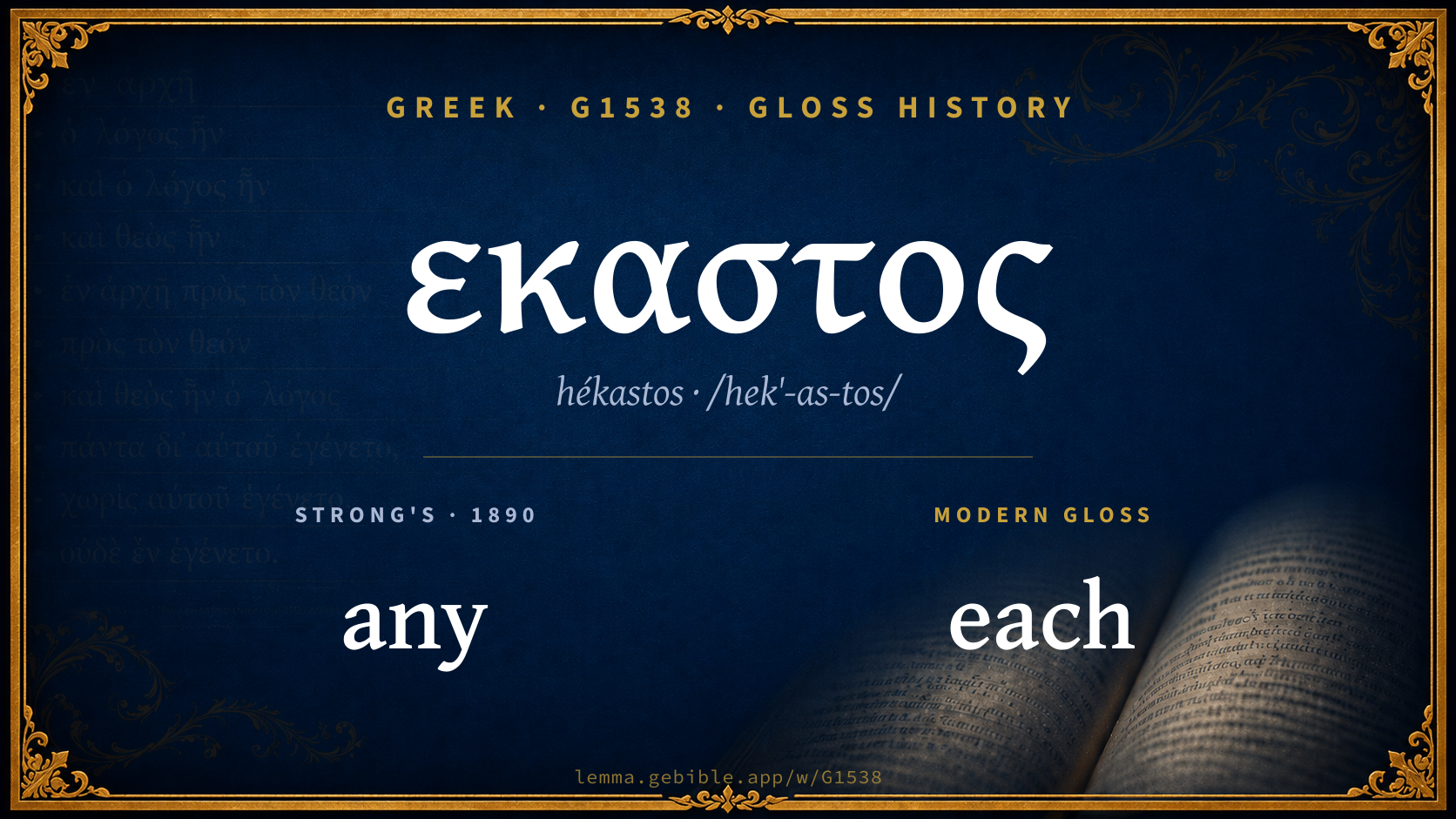
The Greek adjective εκαστος centers on the idea of “each.” Its English rendering has broadened — “every man” classically, “each” (Berean Standard Bible) in modern versions; see the renderings breakdown. The Greek New Testament uses it across 77 verses — moderately common. 1 Corinthians dominates its distribution — 19 of 77 verses. Its earliest occurrence is Matthew 16:27. Dig into 77-verse concordance and the renderings breakdown below.
Gloss history
Strong's 1890 vs modern scholarship
About this word
Strong's G1538 catalogs a Greek word from the Greek New Testament.
These counts are not copied from any lexicon or concordance. They are computed here, from the morphology-tagged Greek New Testament. What Lemma adds →
- 77
- distinct verses
- The word appears in 77 distinct verses.
- 18 / 27
- NT books
- The word appears in 18 of 27 New Testament books.
- #207
- by frequency
- Top 250 most frequent Greek words (rank 207 of 5,347 Greek words by occurrence).
View all 77 occurrences in the concordance →
Most concentrated in
- 1 Corinthians 19 verses 25%
- Acts 11 verses 14%
- Revelation 7 verses 9%
By section of the New Testament
By traditional corpus
Conventional, traditional groupings — biblical authorship is debated, so this is a traditional corpus grouping, not an authorship claim. Some books belong to more than one corpus (Luke is in both the Gospels and the Lukan corpus, and so on), so these shares overlap and need not total 100%. Each figure is a share of the word’s 77 distinct verses.
- Pauline corpus 38 verses · 49%
- Lukan (Luke–Acts) 16 verses · 21%
- Gospels 14 verses · 18%
- Johannine 11 verses · 14%
- Revelation 7 verses · 9%
- Hebrews 4 verses · 5%
- General (Catholic) Epistles 3 verses · 4%
How translations render this word
Counts come from each version’s own published word-to-Strong’s tagging or interlinear alignment — an approximate guide to how each version renders this word, not a word-level alignment the data otherwise carries. Because each total is that version’s own tagged count, the per-version totals vary from one another and need not match the appearance or distinct-verse counts above. These counts may also differ from a printed concordance because Lemma counts each distinctly tagged rendering and does not collapse phrase taggings into a single head-word total. This is a fixed set of word-tagged versions (KJV, ASV, BSB, ULT) and does not change with the reading translation you choose elsewhere. Each version’s license is shown beside its name below (and on Sources).
- King James Version: Every man 33×, Every 18×, Every one 17×
- American Standard Version: Each 19×, Each man 12×, Each one 12×
- Berean Standard Bible: Each 45×, Each one 15×, Everyone 2×
- unfoldingWord Literal Text: Each 38×, Each one 35×, Each of you 3×
King James Version Public Domain
Renders G1538 across 79 tagged occurrences — most commonly:
Plus 6 renderings that appear only once — usually multi-word phrases or single function words the recovered tagging swept in, not distinct renderings. Not rendered by a distinct English word in 4 further occurrences.
American Standard Version Public Domain
Renders G1538 across 78 tagged occurrences — most commonly:
Plus 11 renderings that appear only once — usually multi-word phrases or single function words the recovered tagging swept in, not distinct renderings. Not rendered by a distinct English word in 1 further occurrence.
Berean Standard Bible Public Domain
Renders G1538 across 74 tagged occurrences — most commonly:
Plus 12 renderings that appear only once — usually multi-word phrases or single function words the recovered tagging swept in, not distinct renderings. Not rendered by a distinct English word in 6 further occurrences.
unfoldingWord Literal Text CC BY-SA 4.0
Renders G1538 across 84 tagged occurrences — most commonly:
Plus 8 renderings that appear only once — usually multi-word phrases or single function words the recovered tagging swept in, not distinct renderings.
Senses in Thayer's
The 1 sense Thayer's distinguishes for this word, in lexicon order (not ranked by frequency or importance). The full entry — with sub-senses — is in the Lexicon Entry tab.
- each, every
Word origin
Origin: as if a superlative of hekas (afar)
As if a superlative of ἕκας hekas ( afar ); each or every : - any both each (one) every (man one woman) particularly.
— Strong’s Exhaustive Concordance (1890), public domain.
Forms in the corpus
The 8 distinct written forms G1538 takes in the Greek New Testament, most frequent first — each parse links to that case’s occurrences in the concordance.
| Form | Parsing | Example | Uses |
|---|---|---|---|
| ἕκαστος hékastos | Adjective, Nominative, Singular, Masculine | Matthew 18:35 | 38 |
| ἑκάστῳ hekástō | Adjective, Dative, Singular, Masculine | Matthew 16:27 | 19 |
| ἕκαστον hékaston | Adjective, Accusative, Singular, Masculine | Luke 16:5 | 13 |
| ἑκάστου hekástou | Adjective, Genitive, Singular, Masculine | Acts 17:27 | 7 |
| ἕκαστοι hékastoi | Adjective, Nominative, Plural, Masculine | Philippians 2:4 | 2 |
| εκαστος ekastos | Adjective, Nominative, Singular, Masculine | John 7:53 | 1 |
| ἑκάστη hekástē | Adjective, Nominative, Singular, Feminine | 1 Corinthians 7:2 | 1 |
| ἑκάστην hekástēn | Adjective, Accusative, Singular, Feminine | Hebrews 3:13 | 1 |
Same root — word family
Other Thayer's entries built from the same root as G1538, grouped by Strong’s listed origin. These share a root / origin per the lexicon — not necessarily a shared meaning. Each links to that word’s own entry.
Derived from this word
Proper names from this root
People and places named from this root — a name, not an additional meaning of the word.
Compare all same-root words → 1 of the same-root words is a proper name (a person or place). They share a root, not necessarily a meaning.
Septuagint usage
The same Greek word εκαστος appears 265 times in the Greek Old Testament (Septuagint), across 235 verses in 28 books.
- 265
- LXX occurrences
- Tagged occurrences of this Greek word in the Septuagint.
- 235
- verses
- Distinct Septuagint verses containing this word.
- 28 / 39
- OT books
- The word appears in 28 of the 39 Old Testament books.
Sample Septuagint occurrences
- Genesis 10:5 ἕκαστος
- Exodus 1:1 ἕκαστος
- Leviticus 7:10 ἕκαστος
- Numbers 1:4 ἕκαστος
- Deuteronomy 1:41 ἕκαστος
- Joshua 1:15 ἕκαστος
- Ruth 1:8 ἕκαστος
- 1 Samuel 4:10 ἕκαστος
- 2 Samuel 2:3 ἕκαστος
- 1 Kings 2:46 ἕκαστος
- 2 Kings 9:13 ἕκαστος
- 1 Chronicles 16:43 ἕκαστος
Septuagint occurrences (same lexeme)
Every verse where the same Strong’s number (G1538) appears in the Greek Septuagint — showing the first 50 of 235. Verse text shown in the World English Bible for context; the Greek form is the matched word — the English is not keyword-highlighted.
- Genesis 10:5 ἕκαστος Of these were the isles of the nations divided in their lands, everyone after his language, after their families, in their nations.
- Genesis 11:7 ἕκαστος Come, let's go down, and there confuse their language, that they may not understand one another's speech."
- Genesis 13:11 ἕκαστος So Lot chose the Plain of the Jordan for himself. Lot traveled east, and they separated themselves the one from the other.
- Genesis 34:25 ἕκαστος It happened on the third day, when they were sore, that two of Jacob's sons, Simeon and Levi, Dinah's brothers, each took his sword, came upon the unsuspecting city, and killed all the males.
- Genesis 37:19 ἕκαστος They said one to another, "Behold, this dreamer comes.
- Genesis 41:11 ἕκαστος We dreamed a dream in one night, I and he. We dreamed each man according to the interpretation of his dream.
- Genesis 42:21 ἕκαστος They said one to another, "We are most assuredly guilty concerning our brother, in that we saw the distress of his soul, when he begged us, and we wouldn't listen. Therefore this distress has come on us."
- Genesis 42:25 ἕκαστος Then Joseph commanded to fill their bags with grain, and to restore every man's money into his sack, and to give them food for the way. So it done to them.
- Genesis 42:35 ἕκαστος It happened as they emptied their sacks, that behold, every man's bundle of money was in his sack. When they and their father saw their bundles of money, they were afraid.
- Genesis 43:21 ἕκαστος and it happened, when we came to the lodging-place, that we opened our sacks, and, behold, every man's money was in the mouth of his sack, our money in full weight. We have brought it again in our hand.
- Genesis 43:33 ἕκαστος They sat before him, the firstborn according to his birthright, and the youngest according to his youth, and the men marveled one with another.
- Genesis 44:1 ἕκαστος He commanded the steward of his house, saying, "Fill the men's sacks with food, as much as they can carry, and put every man's money in his sack's mouth.
- Genesis 44:11 ἕκαστος Then they hurried, and took down every man his sack to the ground, and opened every man his sack.
- Genesis 44:13 ἕκαστος Then they tore their clothes, and loaded every man his donkey, and returned to the city.
- Genesis 49:28 ἕκαστος All these are the twelve tribes of Israel, and this is what their father spoke to them and blessed them. He blessed everyone according to his blessing.
- Exodus 1:1 ἕκαστος Now these are the names of the sons of Israel, who came into Egypt (every man and his household came with Jacob):
- Exodus 5:4 ἕκαστος The king of Egypt said to them, "Why do you, Moses and Aaron, take the people from their work? Get back to your burdens!"
- Exodus 5:8 ἕκαστος The number of the bricks, which they made before, you require from them. You shall not diminish anything of it, for they are idle; therefore they cry, saying, 'Let us go and sacrifice to our God.'
- Exodus 7:12 ἕκαστος For they cast down every man his rod, and they became serpents: but Aaron's rod swallowed up their rods.
- Exodus 11:2 ἕκαστος Speak now in the ears of the people, and let them ask every man of his neighbor, and every woman of her neighbor, jewels of silver, and jewels of gold."
- Exodus 12:3 ἕκαστος Speak to all the congregation of Israel, saying, 'On the tenth day of this month, they shall take to them every man a lamb, according to their fathers' houses, a lamb for a household;
- Exodus 12:4 ἕκαστος and if the household be too little for a lamb, then he and his neighbor next to his house shall take one according to the number of the souls; according to what everyone can eat you shall make your count for the lamb.
- Exodus 12:22 ἕκαστος You shall take a bunch of hyssop, and dip it in the blood that is in the basin, and strike the lintel and the two side-posts with the blood that is in the basin; and none of you shall go out of the door of his house until the morning.
- Exodus 16:16 ἕκαστος This is the thing which Yahweh has commanded: "Gather of it everyone according to his eating; an omer a head, according to the number of your persons, shall you take it, every man for those who are in his tent."
- Exodus 16:18 ἕκαστος When they measured it with an omer, he who gathered much had nothing over, and he who gathered little had no lack. They gathered every man according to his eating.
- Exodus 16:21 ἕκαστος They gathered it morning by morning, everyone according to his eating. When the sun grew hot, it melted.
- Exodus 16:29 ἕκαστος Behold, because Yahweh has given you the Sabbath, therefore he gives you on the sixth day the bread of two days. Everyone stay in his place. Let no one go out of his place on the seventh day."
- Exodus 18:16 ἕκαστος When they have a matter, they come to me, and I judge between a man and his neighbor, and I make them know the statutes of God, and his laws."
- Exodus 26:5 ἕκαστος You shall make fifty loops in the one curtain, and you shall make fifty loops in the edge of the curtain that is in the second coupling. The loops shall be opposite one to another.
- Exodus 28:21 ἕκαστος The stones shall be according to the names of the children of Israel, twelve, according to their names; like the engravings of a signet, everyone according to his name, they shall be for the twelve tribes.
- Exodus 30:12 ἕκαστος "When you take a census of the children of Israel, according to those who are numbered among them, then each man shall give a ransom for his soul to Yahweh, when you number them; that there be no plague among them when you number them.
- Exodus 32:27 ἕκαστος He said to them, "Thus says Yahweh, the God of Israel, 'Every man put his sword on his thigh, and go back and forth from gate to gate throughout the camp, and every man kill his brother, and every man his companion, and every man his neighbor."
- Exodus 32:29 ἕκαστος Moses said, "Consecrate yourselves today to Yahweh, yes, every man against his son, and against his brother; that he may bestow on you a blessing this day."
- Exodus 33:8 ἕκαστος It happened that when Moses went out to the Tent, that all the people rose up, and stood, everyone at their tent door, and watched Moses, until he had gone into the Tent.
- Exodus 33:10 ἕκαστος All the people saw the pillar of cloud stand at the door of the Tent, and all the people rose up and worshiped, everyone at their tent door.
- Exodus 35:21 ἕκαστος They came, everyone whose heart stirred him up, and everyone whom his spirit made willing, and brought Yahweh's offering, for the work of the tent of meeting, and for all of its service, and for the holy garments.
- Exodus 36:4 ἕκαστος All the wise men, who performed all the work of the sanctuary, each came from his work which they did.
- Exodus 36:21 ἕκαστος Ten cubits was the length of a board, and a cubit and a half the breadth of each board.
- Leviticus 7:10 ἕκαστος Every meal offering, mixed with oil or dry, belongs to all the sons of Aaron, one as well as another.
- Leviticus 10:1 ἕκαστος Nadab and Abihu, the sons of Aaron, each took his censer, and put fire in it, and laid incense on it, and offered strange fire before Yahweh, which he had not commanded them.
- Leviticus 19:3 ἕκαστος "'Each one of you shall respect his mother and his father. You shall keep my Sabbaths. I am Yahweh your God.
- Leviticus 19:11 ἕκαστος "'You shall not steal; neither shall you deal falsely, nor lie to one another.
- Leviticus 25:10 ἕκαστος You shall make the fiftieth year holy, and proclaim liberty throughout the land to all its inhabitants. It shall be a jubilee to you; and each of you shall return to his own property, and each of you shall return to his family.
- Leviticus 25:13 ἕκαστος "'In this Year of Jubilee each of you shall return to his property.
- Leviticus 25:46 ἕκαστος You may make them an inheritance for your children after you, to hold for a possession; of them may you take your slaves forever: but over your brothers the children of Israel you shall not rule, one over another, with harshness.
- Numbers 1:4 ἕκαστος With you there shall be a man of every tribe; everyone head of his fathers' house.
- Numbers 2:17 ἕκαστος "Then the tent of meeting shall set out, with the camp of the Levites in the midst of the camps. As they encamp, so shall they set out, every man in his place, by their standards.
- Numbers 2:34 ἕκαστος Thus the children of Israel did. According to all that Yahweh commanded Moses, so they encamped by their standards, and so they set out, everyone by their families, according to their fathers' houses.
- Numbers 4:19 ἕκαστος but thus do to them, that they may live, and not die, when they approach to the most holy things: Aaron and his sons shall go in, and appoint them everyone to his service and to his burden;
- Numbers 5:10 ἕκαστος Every man's holy things shall be his: whatever any man gives the priest, it shall be his."
These are occurrences of the same Greek lexeme (G1538) in the Septuagint — not a translation of any one Hebrew word. The store carries no word-level Hebrew↔Greek alignment, so no Hebrew original is asserted here. Counts come from the recovered LXX Strong's tagging — high-frequency vocabulary is well covered, while rare or late forms may be untagged — so they reflect tagged occurrences and may slightly undercount.