
Exodus 26:5

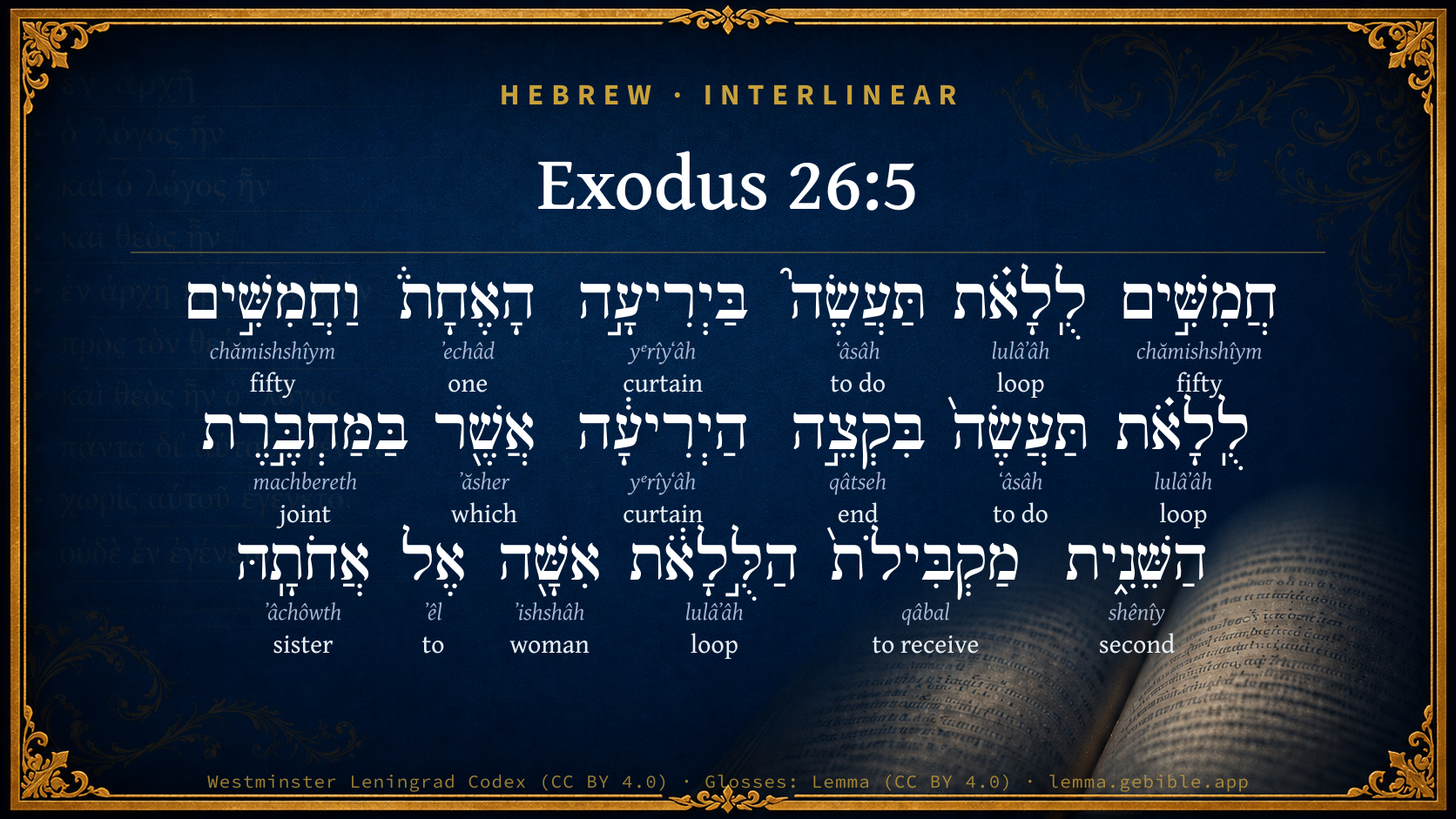
Hebrew (Westminster Leningrad Codex) Exodus 26:5 appears in the Hebrew Old Testament. The text above is from the Westminster Leningrad Codex. Each word links to its Strong’s number, a concise gloss, and parsing drawn from the Open Scriptures Hebrew Bible morphology. Click any word for its full Brown-Driver-Briggs (BDB) entry.
Download image
Cite this verse

Exodus 26:5 (World English Bible). Public Domain. Lemma interlinear Bible study tool, https://lemma.gebible.app/v/exodus/26/5.

Show BibTeX & RIS
BibTeX
RIS
English Translation
You shall make fifty loops in the one curtain, and you shall make fifty loops in the edge of the curtain that is in the second coupling. The loops shall be opposite one to another.
World English Bible · Public Domain
Highlights
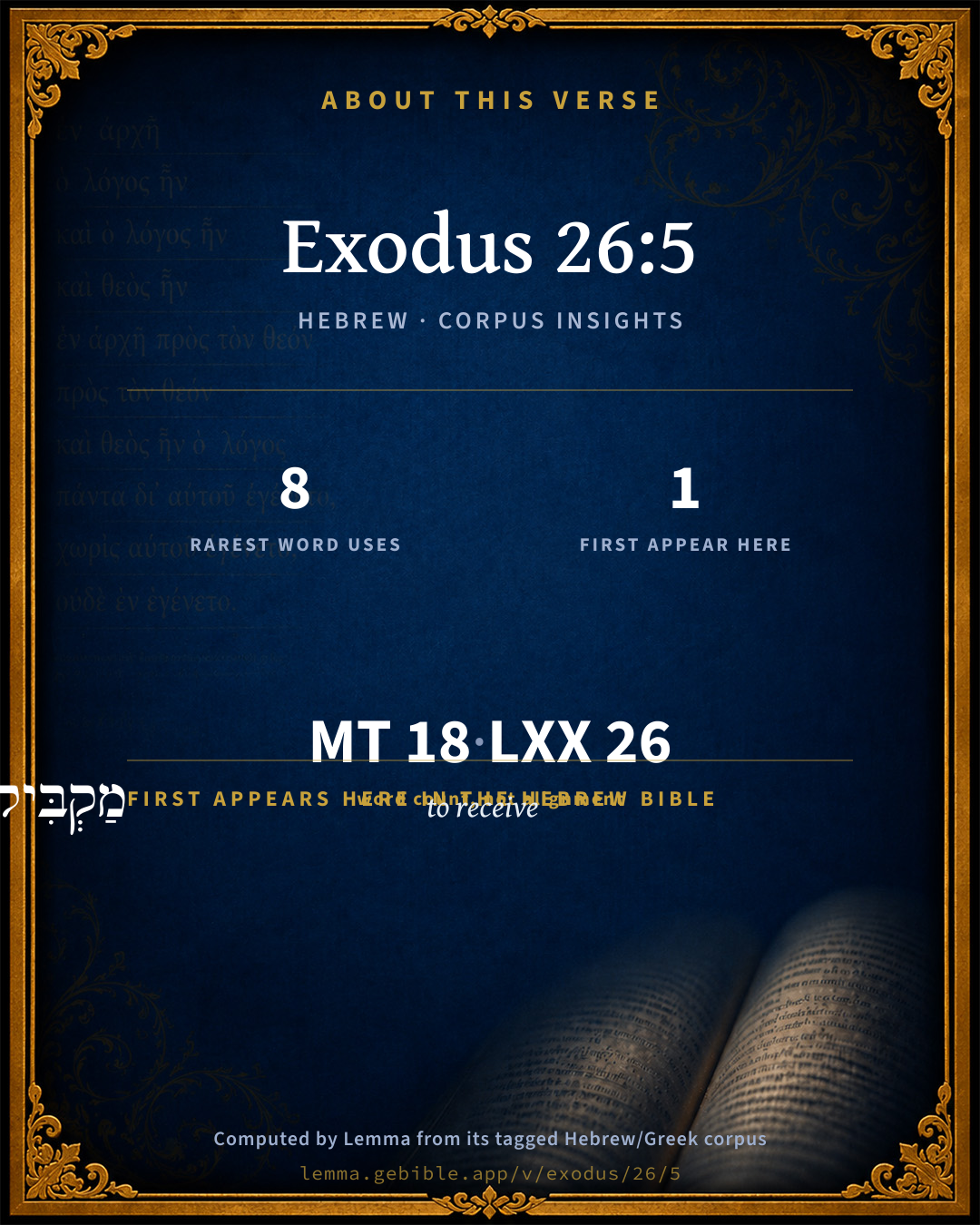
  • 1 first appearance in the Hebrew Bible
Full analysis ↓
Download a study sheet

One document with this verse’s original text, its word-by-word gloss line, the meaning frame, cross-references with their text, attributed commentary, and full source and license credits — printable, and it pastes into notes with its structure intact.

This verse Autodidact and up

Study sheet (.html) Plain text (.txt)

A passage Seminary Student

Up to 50 verses in one chapter. A passage sheet keeps up to 6 commentary sources and 12 cross-references per verse, in the order this page ranks them, and says so on the sheet whenever that leaves anything out. Ask for a single verse and you get the Autodidact verse sheet above.

Everything on this page stays free to read, with no account — the sheet is a download of what is already on screen, not access to it.

Want to remove ads? Support Godless Engineer
Compare translations 3

The same verse in 3 English versions, stacked beneath the original-language interlinear above. Click any original word for its lexicon entry.

Each is an independent rendering of the whole verse — the interlinear is not word-aligned to these translations.

Highlighted words mark where these versions differ — a whole-verse word diff, not a word-by-word alignment.

  • World English Bible Public Domain
    You shall make fifty loops in the one curtain, and you shall make fifty loops in the edge of the curtain that is in the second coupling. The loops shall be opposite one to another.
  • King James Version Public Domain
    Fifty loops shalt thou make in the one curtain, and fifty loops shalt thou make in the edge of the curtain that is in the coupling of the second; that the loops may take hold one of another.
  • unfoldingWord Literal Text CC BY-SA 4.0
    You shall make 50 loops on the first curtain, and you shall make 50 loops on the end of the curtain which is in the second set. The loops should be opposite woman to her sister.

unfoldingWord Literal Text — © unfoldingWord, licensed CC BY-SA 4.0. Word-aligned USFM3 via Door43 (git.door43.org/unfoldingWord/en_ult).

Versions to compare (up to 4)

3 of 4 selected

Show all 18 translations

Every available English version of this verse, each an independent rendering of the whole verse.

  • World English Bible Public Domain
    You shall make fifty loops in the one curtain, and you shall make fifty loops in the edge of the curtain that is in the second coupling. The loops shall be opposite one to another.
  • Berean Standard Bible Public Domain
    Make fifty loops on one curtain and fifty loops on the end curtain of the second set, so that the loops line up opposite one another.
  • Majority Standard Bible Public Domain
    Make fifty loops on one curtain and fifty loops on the end curtain of the second set, so that the loops line up opposite one another.
  • King James Version Public Domain
    Fifty loops shalt thou make in the one curtain, and fifty loops shalt thou make in the edge of the curtain that is in the coupling of the second; that the loops may take hold one of another.
  • American Standard Version (1901) Public Domain
    Fifty loops shalt thou make in the one curtain, and fifty loops shalt thou make in the edge of the curtain that is in the second coupling; the loops shall be opposite one to another.
  • Revised Version (1885) Public Domain
    Fifty loops shalt thou make in the one curtain, and fifty loops shalt thou make in the edge of the curtain that is in the second coupling; the loops shall be opposite one to another.
  • Geneva Bible (1599) Public Domain
    Fiftie strings shalt thou make in one curtaine, and fiftie stringes shalt thou make in the edge of the curtaine, which is in the second coupling: ye stringes shalbe one right against another.
  • Douay-Rheims (1899) Public Domain
    Every curtain shall have fifty loops on both sides, so set on, that one loop may be against another loop, and one may be fitted to the other.
  • Young's Literal Translation Public Domain
    fifty loops thou dost make in the one curtain, and fifty loops thou dost make in the edge of the curtain which `is' in the joining of the second, causing the loops to take hold one unto another;
  • Literal Standard Version CC BY-SA 4.0
    You make fifty loops in the first curtain, and you make fifty loops in the edge of the curtain which [is] in the joining of the second, causing the loops to take hold to one another;
  • Unlocked Literal Bible CC BY-SA 4.0
    You must make fifty loops on the first curtain, and you must make fifty loops on the end curtain in the second set. Do this so that the loops will be opposite to each other.
  • unfoldingWord Literal Text CC BY-SA 4.0
    You shall make 50 loops on the first curtain, and you shall make 50 loops on the end of the curtain which is in the second set. The loops should be opposite woman to her sister.
  • Darby Bible Public Domain
    Fifty loops shalt thou make in the one curtain, and fifty loops shalt thou make at the end of the curtain in the other coupling: the loops shall be opposite to one another.
  • World Messianic Bible Public Domain
    You shall make fifty loops in the one curtain, and you shall make fifty loops in the edge of the curtain that is in the second coupling. The loops shall be opposite one another.
  • Webster's Bible Public Domain
    Fifty loops shalt thou make in the one curtain, and fifty loops shalt thou make in the edge of the curtain that is in the coupling of the second; that the loops may take hold one of another.
  • Free Bible Version CC BY-SA 4.0
    Make fifty loops on one curtain and fifty loops on the last curtain of the second set, lining up the loops with each other.
  • Bible in Basic English Public Domain
    Fifty twists on one curtain and fifty on the other, the twists to be opposite one another.
  • JPS Tanakh (1917) Public Domain
    Fifty loops shalt thou make in the one curtain, and fifty loops shalt thou make in the edge of the curtain that is in the second set; the loops shall be opposite one to another.

Literal Standard Version (2020), Covenant Press — licensed CC BY-SA 4.0. Text via the HelloAO Bible API (eBible.org). Unlocked Literal Bible (unfoldingWord) — licensed CC BY-SA 4.0. Text via the HelloAO Bible API (eBible.org). unfoldingWord Literal Text — © unfoldingWord, licensed CC BY-SA 4.0. Word-aligned USFM3 via Door43 (git.door43.org/unfoldingWord/en_ult). Free Bible Version, Dr. Jonathan Gallagher — licensed CC BY-SA 4.0. Text via the HelloAO Bible API (eBible.org).

Word by word

More ways to search: Search by grammar → Find every occurrence → Compare this word →

Practice this passage: Drill this verse → Learn its vocabulary →

בַּמַּחְבֶּ֣רֶת
machbereth
H4225
“in/at the · joint”
Preposition, Determined + Noun, Common, Feminine, Singular, Absolute
Part of Speech
Preposition + Noun
Type
Common
Gender
Feminine
Number
Singular
State
Absolute
Full BDB Definition

Origin: from H2266

TWOT: 598j

thing joined, joint, seam, place of joining - thing joined - place of joining
  1. חֲמִשִּׁ֣ים chămishshîym H2572 “fifty” Adjective, Cardinal number, Both, Plural, Absolute
  2. לֻֽלָאֹ֗ת lulâʼâh H3924 “loops” Noun, Common, Feminine, Plural, Absolute
  3. תַּעֲשֶׂה֮ ʻâsâh H6213 “to do” Verb, Qal, Imperfect, 2nd Person, Masculine, Singular
  4. בַּיְרִיעָ֣ה yᵉrîyʻâh H3407 “in/at the · curtain” Preposition, Determined + Noun, Common, Feminine, Singular, Absolute
  5. הָאֶחָת֒ ʼechâd H259 “the · one” Particle, Definite Article + Adjective, Cardinal number, Feminine, Singular, Absolute
  6. וַחֲמִשִּׁ֣ים chămishshîym H2572 “and · fifty” Conjunction + Adjective, Cardinal number, Both, Plural, Absolute
  7. לֻֽלָאֹ֗ת lulâʼâh H3924 “loops” Noun, Common, Feminine, Plural, Absolute
  8. תַּעֲשֶׂה֙ ʻâsâh H6213 “to do” Verb, Qal, Imperfect, 2nd Person, Masculine, Singular
  9. בִּקְצֵ֣ה qâtseh H7097 “in/at · end of” Preposition + Noun, Common, Both, Singular, Construct
  10. הַיְרִיעָ֔ה yᵉrîyʻâh H3407 “the · curtain” Particle, Definite Article + Noun, Common, Feminine, Singular, Absolute
  11. אֲשֶׁ֖ר ʼăsher H834 “which” Particle, Relative
  12. הַשֵּׁנִ֑ית shênîy H8145 “the · second” Particle, Definite Article + Adjective, Ordinal number, Feminine, Singular, Absolute
  13. מַקְבִּילֹת֙ qâbal H6901 “receiving” Verb, Hiphil, Participle Active, Feminine, Plural, Absolute
  14. הַלֻּ֣לָאֹ֔ת lulâʼâh H3924 “the · loops” Particle, Definite Article + Noun, Common, Feminine, Plural, Absolute
  15. אִשָּׁ֖ה ʼishshâh H802 “woman” Noun, Common, Feminine, Singular, Absolute
  16. אֶל ʼêl H413 “to” Preposition
  17. אֲחֹתָֽהּ ʼâchôwth H269 “sister · her” Noun, Common, Feminine, Singular, Construct + Suffix, Personal, 3rd Person, Feminine, Singular

About this verse

These counts appear in no published source. They are computed here, from the morphology-tagged text and Lemma’s own curated glosses. What Lemma adds →

18
words
13
distinct lemmas
Pentateuch
section

Notable vocabulary

The rarest word here is בַּמַּחְבֶּ֣רֶת joint H4225 — appearing just 8 times in the whole Hebrew Bible.

First appearance in Scripture

This word makes its first canonical appearance in the Hebrew Bible here:

  • מַקְבִּילֹת֙ to receive H6901

Shared distinctive vocabulary

בַּמַּחְבֶּ֣רֶת joint H4225 occurs in 7 verses of the Hebrew Bible. Also found in:

Grammatical profile

  • 3 verbs
  • 9 nouns
  • 4 adjectives
  • 1 preposition
  • 1 particle

Verb forms

  • תַּעֲשֶׂה֮ Qal · Imperfect
  • תַּעֲשֶׂה֙ Qal · Imperfect
  • מַקְבִּילֹת֙ Hiphil · Participle Active

Repetition

Words recur within this verse — often emphatic in Hebrew:

  • לֻֽלָאֹ֗ת loop H3924 ×3
  • חֲמִשִּׁ֣ים fifty H2572 ×2
  • תַּעֲשֶׂה֮ to do H6213 ×2
  • בַּיְרִיעָ֣ה curtain H3407 ×2

Hebrew & Septuagint length

In English translation the verse runs 35 words from the Hebrew and 37 from the Septuagint (LXX English) — closely comparable.

A rough comparison of the two English renderings, which tokenize alike — not a word-level alignment.

Word counts can differ between the Hebrew and the Greek without any difference in meaning — e.g. the Hebrew direct-object marker אֵת has no separate Greek word, and Greek often adds the article ὁ.

In the original languages it is 18 Hebrew tokens and 26 Greek tokens — but the two are counted differently (Hebrew bundles its prefixes and suffixes into one token; the Greek is in lemma form), so that isn’t a like-for-like length.

Hebrew and Greek witnesses Masoretic Hebrew ↔ Greek Septuagint

The same verse in the two great witnesses to the Old Testament, shown verse-for-verse.

These are two independent witnesses, not word-aligned to each other, and the Septuagint is shown in lemma (dictionary) form.

Hebrew Exodus 26:5 Masoretic · Westminster Leningrad Codex

חֲמִשִּׁ֣ים לֻֽלָאֹ֗ת תַּעֲשֶׂה֮ בַּיְרִיעָ֣ה הָאֶחָת֒ וַחֲמִשִּׁ֣ים לֻֽלָאֹ֗ת תַּעֲשֶׂה֙ בִּקְצֵ֣ה הַיְרִיעָ֔ה אֲשֶׁ֖ר בַּמַּחְבֶּ֣רֶת הַשֵּׁנִ֑ית מַקְבִּילֹת֙ הַלֻּ֣לָאֹ֔ת אִשָּׁ֖ה אֶל אֲחֹתָֽהּ

You shall make fifty loops in the one curtain, and you shall make fifty loops in the edge of the curtain that is in the second coupling. The loops shall be opposite one to another.

World English Bible · Public Domain

Greek LXX Exodus 26:5 Septuagint · lemma form

πεντήκοντα ἀγκύλη ποιέω ὁ αὐλαία ὁ εἷς καί πεντήκοντα ἀγκύλη ποιέω ἐκ ὁ μέρος ὁ αὐλαία κατά ὁ συμβολή ὁ δεύτερος ἀντιπρόσωπος ἀντιπίπτω ἀλλήλω εἰς ἕκαστος

Fifty loops shall you make for one curtain, and fifty loops shall you make on the part of the curtain answering to the coupling of the second, opposite each other, corresponding to each other at each point.

LXX2012 (modern English Septuagint) · Public Domain

Hebrew: Westminster Leningrad Codex (CC BY 4.0). Greek: Septuagint (public domain); English from LXX2012 (modern English Septuagint) (Public Domain). How the Septuagint differs from the Hebrew →

Targum (Aramaic paraphrase)

2

The Targum is the ancient Jewish Aramaic paraphrase of the Hebrew Scriptures — an interpretive translation, not the Hebrew text itself. Onkelos (literal) and Pseudo-Jonathan (expansive) render the Torah, and Jonathan the Prophets. Coverage is partial: where no permissively-licensed English translation exists for a verse, only the Aramaic is shown. This is verse-level text, not a word-by-word alignment to the Hebrew.

  1. Targum Onkelos Torah (Genesis–Deuteronomy)
    חַמְשִׁין עֲנוּבִין תַּעְבֵּד בִּירִיעֲתָא חֲדָא וְחַמְשִׁין עֲנוּבִין תַּעְבֵּד בְּסִטְרָא דִירִיעֲתָא דְבֵית לוֹפֵי תִּנְיָנָא מְכַוְנָן עֲנוּבַיָא חֲדָא לָקֳבֵל חֲדָא:

    (no public-domain English translation for this verse)

    Targum Onkelos — Aramaic: “Onkelos Genesis” (public domain); “Onkelos Exodus” (public domain); “Onkelos Leviticus” (public domain); “Onkelos Numbers” (public domain); “Onkelos Deuteronomy” (public domain). English: “Sefaria Community Translation” (CC0 1.0 (public-domain dedication)); “J.W. Etheridge. The Targums of Onkelos and Jonathan Ben Uzziel on the Pentateuch. London: Longmans, Green, 1862” (public domain). Text via Sefaria.

  2. Targum Pseudo-Jonathan Torah (Genesis–Deuteronomy)
    חַמְשִׁין עֲנוּבִין תַּעֲבֵיד בִּירִיעֲתָא חֲדָא וְחַמְשִׁין עֲנוּבִין תַּעֲבֵיד בְּצִיטְרָא דִירִיעֲתָא דִּבְּבֵית לִיפוּפָא תִנְיָינָא מְכַוְונַן עֲנוּבַיָא חָד כָּל קְבֵיל חָד

    Fifty loops shalt thou make in one curtain, and fifty loops shalt thou make in the side of the second curtain in the place of conjoinment, so that the loops may answer one to the other.

    Targum Pseudo-Jonathan — Aramaic: “Targum Jonathan on Genesis” (public domain); “Targum Jonathan on Exodus” (public domain); “Targum Jonathan on Leviticus” (public domain); “Targum Jonathan on Numbers” (public domain); “Targum Jonathan on Deuteronomy” (public domain). English: “The Targum of Jonathan ben Uzziel, trans. J. W. Etheridge, London, 1862” (public domain). Text via Sefaria.

Commentary

Notes on Exodus 26:5 from classic Christian and Jewish commentators (each source and its license shown beneath its notes). The classic Christian expositions comment on the surrounding passage and are grouped to its opening verse, so a note may address several verses; the Jewish commentaries on the Tanakh (Rashi and others) are per-verse, so they appear only where the commentator wrote on this verse.

Lemma curates 59 commentaries, every one of them public domain or Creative Commons licensed, each selected and text-cleaned for this edition rather than reprinted as found. About our sources →

Geneva Bible (1599)

Geneva Bible translators

In tying together both the sides.

Geneva Bible (1599) marginal notes — public domain. Text via Bolls.life.

Ellicott's Commentary for English Readers

(5) That the loops may take hold one of another.—Rather, correspond one to another. They were not to “take hold,” but to be attached by golden links.

Taches, or clasps. These might be split-rings, or links like modern sleeve-links.

And it shall be one tabernacle.—Rather, and (so) the tabernacle shall be one. The division of the curtain which formed the roof into two portions tended to make a division in the tabernacle itself. To prevent this, the two curtains were to be so looped together as to be practically one. Thus the tabernacle itself became one.

A Bible Commentary for English Readers, edited by Charles John Ellicott (1878–1897) — public domain. Text from a community e-Sword module.

John Gill's Exposition

Fifty loops shalt thou make in the one curtain,.... In the first great curtain, or in the outermost of the five that were sewed together:

and fifty loops shalt thou make in the edge of the curtain that is in the coupling of the second; as many also were to be made in the outermost of the second great curtain where it was to be coupled with the first:

that the loops may take hold one of another; or rather that they might answer to one another in both curtains; for the loops could not take hold of one another, only were made to meet together by the taches, hooks, or clasps put into them, next mentioned.

John Gill's Exposition of the Whole Bible (1746–1763) — public domain (CC PDM 1.0). Text via the HelloAO Bible API.

Rashi

Rabbi Shlomo Yitzchaki (Rashi)

מקבילת הללאת אשה אל אחתה — Be careful that you make the loops (place them on the curtains) to one measurement: that the spaces between one loop and the other be exactly the same, and further, as their measurement is on the one so shall it be on the other, so that when you lay out one section next to the other the loops of the one shall come exactly opposite those of the other. That is what is meant by the expression מקבילות, viz., “one opposite the other”. In the Targum the translation of נֶגֶד “opposite” is לקבל (hence the term מקבילות from קבל). The curtains were twenty-eight cubits long and four cubits wide, so when they joined five curtains together along their lengths it followed that their width was twenty cubits. The same was the case with the other section. The Tabernacle was thirty cubits in length from East to West, for it is said, (Exodus 36:23) “twenty boards for the south side (which was the long side of the Tabernacle) southward,” and the same is stated with reference to the north side; and as each board was one cubit and a half in breadth you have thirty cubits from East to West. The width of the Tabernacle from North to South was ten cubits, for it is said, (Exodus 36:27, 28) “and for the side of the dwelling westward he made six boards … and two boards … for the corners of the dwelling,” so you have ten cubits (this appears to give a breadth of twelve cubits, but each of the corner boards stood partly behind the thickness of the adjoining board that stood at right angles with it, and as the thickness was one cubit it took off a cubit on each side from the inside measurement). — I shall explain these verses each on its place. — They spread the curtains with their length over the breadth of the Tabernacle, whereby the ten middle cubits served as a roofing for the inside over the width of the Tabernacle and a cubit on each side of these ten cubits went to cover the thickness of the boards which were one cubit thick, so that there remained altogether sixteen cubits — eight hanging over on the north side and eight on the south side, covering the vertical boards which were ten cubits in height; consequently the two lowest cubits of the boards were left showing. The breadth of the curtains after having been joined together was forty cubits, twenty cubits for each section. Thirty cubits of these served as a roofing for the inside of the Tabernacle over its length, and one cubit for the thickness of the tops of the boards of the westside and one more cubit to cover the thickness of the columns in the east side — for there were no boards in the east side but there were five columns on the hooks of which the screen was spread and hung as a kind of curtain (cf. Exodus 27:10). Thus there remained eight cubits which hung on the back of the Tabernacle on the west side, leaving the two lowest cubits showing. This I have found in the Boraitha מ"ט מדות. But in Treatise Shabbat 98b it is stated that the curtains did not cover the thickness of the columns on the east side, and consequently there were nine cubits of the curtains hanging on the back of the Tabernacle. The text of this section suppports this view, since it says (v. 33) “and thou shalt hang up the partition veil under the catches;” for if it were as the Boraitha states the partition veil would have been distant from the catches one cubit to the West.

Rashi on the Tanakh — English translations: “The Judaica Press complete Tanach with Rashi, translated by A. J. Rosenberg” (CC BY 4.0); “Pentateuch with Rashi's commentary by M. Rosenbaum and A.M. Silbermann, 1929-1934” (public domain); “The Metsudah Tanach series, Lakewood, N.J” (CC BY 4.0); and “The Book of Joshua, Metsudah Publications, 1997” (CC BY 4.0). Text via Sefaria.

Lesson kit

Teaching starters — assembled from the data on this page, not authored interpretation. Every prompt links to the verse data it draws on. Edit before teaching.

Exodus, in the Pentateuch, opens this verse with 18 words (13 distinct Hebrew lemmas). Its most distinctive word is machbereth (“joint”). A historical commentator’s framing appears above. Read the whole chapter for the surrounding context.

Discussion questions

  1. The word machbereth carries the sense “joint.” How does it shape the verse?
  2. This is the first place “to receive” appears in Scripture (first appears here). What does its debut here establish?
  3. How does Exodus 26:4, which shares the word «joint», read alongside this verse?
  4. What does the repetition of “loop” (3× in this one verse) do in this verse?
  5. These translations render this verse differently; the difference is in the English rendering, not the original. What questions does that raise?
  6. «תַּעֲשֶׂה֮» is a Qal Imperfect verb. How does that grammatical form shape the action described?
  7. Compare how Geneva Bible (1599) and Ellicott's Commentary for English Readers read this verse. Where do they agree or differ?

Things to notice

Reading settings

Reading text

Shown beneath each verse's original-language words.

Old Testament
Old Testament edition

Read the OT as the Masoretic Hebrew (MT) or the Greek Septuagint (LXX).

English shown for the Greek Septuagint (in the Hebrew ↔ Greek comparison).

Comparing translations? Open the Compare panel on any verse page to stack up to four side by side.