Exodus 32:29

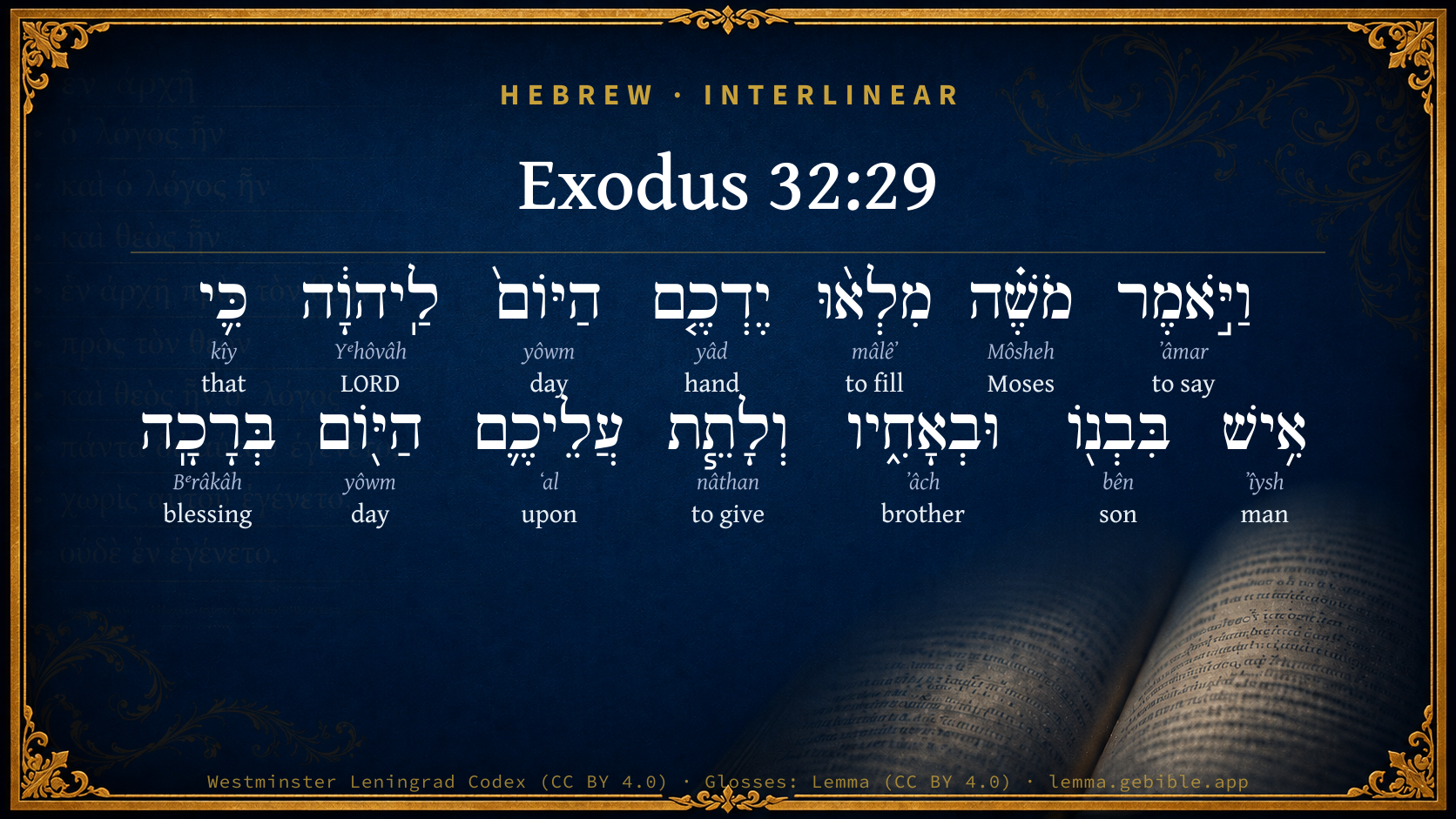
Hebrew (Westminster Leningrad Codex) Exodus 32:29 appears in the Hebrew Old Testament. The text above is from the Westminster Leningrad Codex. Each word links to its Strong’s number, a concise gloss, and parsing drawn from the Open Scriptures Hebrew Bible morphology. Click any word for its full Brown-Driver-Briggs (BDB) entry.
Download image
Cite this verse

Exodus 32:29 (World English Bible). Public Domain. Lemma interlinear Bible study tool, https://lemma.gebible.app/v/exodus/32/29.

Show BibTeX & RIS
BibTeX
RIS
English Translation
Moses said, "Consecrate yourselves today to Yahweh, yes, every man against his son, and against his brother; that he may bestow on you a blessing this day."
World English Bible · Public Domain
Download a study sheet

One document with this verse’s original text, its word-by-word gloss line, the meaning frame, cross-references with their text, attributed commentary, and full source and license credits — printable, and it pastes into notes with its structure intact.

This verse Autodidact and up

Study sheet (.html) Plain text (.txt)

A passage Seminary Student

Up to 50 verses in one chapter. A passage sheet keeps up to 6 commentary sources and 12 cross-references per verse, in the order this page ranks them, and says so on the sheet whenever that leaves anything out. Ask for a single verse and you get the Autodidact verse sheet above.

Everything on this page stays free to read, with no account — the sheet is a download of what is already on screen, not access to it.

Want to remove ads? Support Godless Engineer
Compare translations 3

The same verse in 3 English versions, stacked beneath the original-language interlinear above. Click any original word for its lexicon entry.

Each is an independent rendering of the whole verse — the interlinear is not word-aligned to these translations.

Highlighted words mark where these versions differ — a whole-verse word diff, not a word-by-word alignment.

  • World English Bible Public Domain
    Moses said, "Consecrate yourselves today to Yahweh, yes, every man against his son, and against his brother; that he may bestow on you a blessing this day."
  • King James Version Public Domain
    For Moses had said, Consecrate yourselves today to the LORD, even every man upon his son, and upon his brother; that he may bestow upon you a blessing this day.
  • unfoldingWord Literal Text CC BY-SA 4.0
    And Moses said, “Fill your hand for Yahweh today! For a man against his son and against his brother and for putting a blessing on yourselves today.”

unfoldingWord Literal Text — © unfoldingWord, licensed CC BY-SA 4.0. Word-aligned USFM3 via Door43 (git.door43.org/unfoldingWord/en_ult).

Versions to compare (up to 4)

3 of 4 selected

Show all 18 translations

Every available English version of this verse, each an independent rendering of the whole verse.

  • World English Bible Public Domain
    Moses said, "Consecrate yourselves today to Yahweh, yes, every man against his son, and against his brother; that he may bestow on you a blessing this day."
  • Berean Standard Bible Public Domain
    Afterward, Moses said, “Today you have been ordained for service to the LORD, since each man went against his son and his brother; so the LORD has bestowed a blessing on you this day.”
  • Majority Standard Bible Public Domain
    Afterward, Moses said, “Today you have been ordained for service to the LORD, since each man went against his son and his brother; so the LORD has bestowed a blessing on you this day.”
  • King James Version Public Domain
    For Moses had said, Consecrate yourselves today to the LORD, even every man upon his son, and upon his brother; that he may bestow upon you a blessing this day.
  • American Standard Version (1901) Public Domain
    And Moses said, Consecrate yourselves to-day to Jehovah, yea, every man against his son, and against his brother; that he may bestow upon you a blessing this day.
  • Revised Version (1885) Public Domain
    And Moses said, Consecrate yourselves today to the LORD, yea, every man against his son, and against his brother; that he may bestow upon you a blessing this day.
  • Geneva Bible (1599) Public Domain
    (For Moses had said, Cosecrate your hands vnto the Lord this day, euen euery man vpon his sonne, and vpon his brother, that there may be giuen you a blessing this day)
  • Douay-Rheims (1899) Public Domain
    And Moses said: You have consecrated your hands this day to the Lord, every man in his son and in his brother, that a blessing may be given to you.
  • Young's Literal Translation Public Domain
    and Moses saith, `Consecrate your hand to-day to Jehovah, for a man `is' against his son, and against his brother, so as to bring on you to-day a blessing.'
  • Literal Standard Version CC BY-SA 4.0
    and Moses says, “Consecrate your hand to YHWH today, for a man [is] against his son, and against his brother, so as to bring a blessing on you today.”
  • Unlocked Literal Bible CC BY-SA 4.0
    Moses said to the Levites, “You have been placed into Yahweh's service today, for each of you has taken action against his son and his brother, so Yahweh might give you a blessing today.”
  • unfoldingWord Literal Text CC BY-SA 4.0
    And Moses said, “Fill your hand for Yahweh today! For a man against his son and against his brother and for putting a blessing on yourselves today.”
  • Darby Bible Public Domain
    And Moses said, Consecrate yourselves to-day to Jehovah, yea, every man with his son, and with his brother, and bring on yourselves a blessing to-day.
  • World Messianic Bible Public Domain
    Moses said, “Consecrate yourselves today to the LORD, for every man was against his son and against his brother, that he may give you a blessing today.”
  • Webster's Bible Public Domain
    For Moses had said, Consecrate yourselves to-day to the LORD, even every man upon his son, and upon his brother; that he may bestow upon you a blessing this day.
  • Free Bible Version CC BY-SA 4.0
    Moses told the Levites, “Today you have dedicated yourselves to the Lord because you took action against your sons and brothers. Today you have gained a blessing for yourselves.”
  • Bible in Basic English Public Domain
    And Moses said, You have made yourselves priests to the Lord this day; for every one of you has made the offering of his son and his brother; the blessing of the Lord is on you this day.
  • JPS Tanakh (1917) Public Domain
    And Moses said: 'Consecrate yourselves to-day to the LORD, for every man hath been against his son and against his brother; that He may also bestow upon you a blessing this day.'

Literal Standard Version (2020), Covenant Press — licensed CC BY-SA 4.0. Text via the HelloAO Bible API (eBible.org). Unlocked Literal Bible (unfoldingWord) — licensed CC BY-SA 4.0. Text via the HelloAO Bible API (eBible.org). unfoldingWord Literal Text — © unfoldingWord, licensed CC BY-SA 4.0. Word-aligned USFM3 via Door43 (git.door43.org/unfoldingWord/en_ult). Free Bible Version, Dr. Jonathan Gallagher — licensed CC BY-SA 4.0. Text via the HelloAO Bible API (eBible.org).

Word by word

More ways to search: Search by grammar → Find every occurrence → Compare this word →

Practice this passage: Drill this verse → Learn its vocabulary →

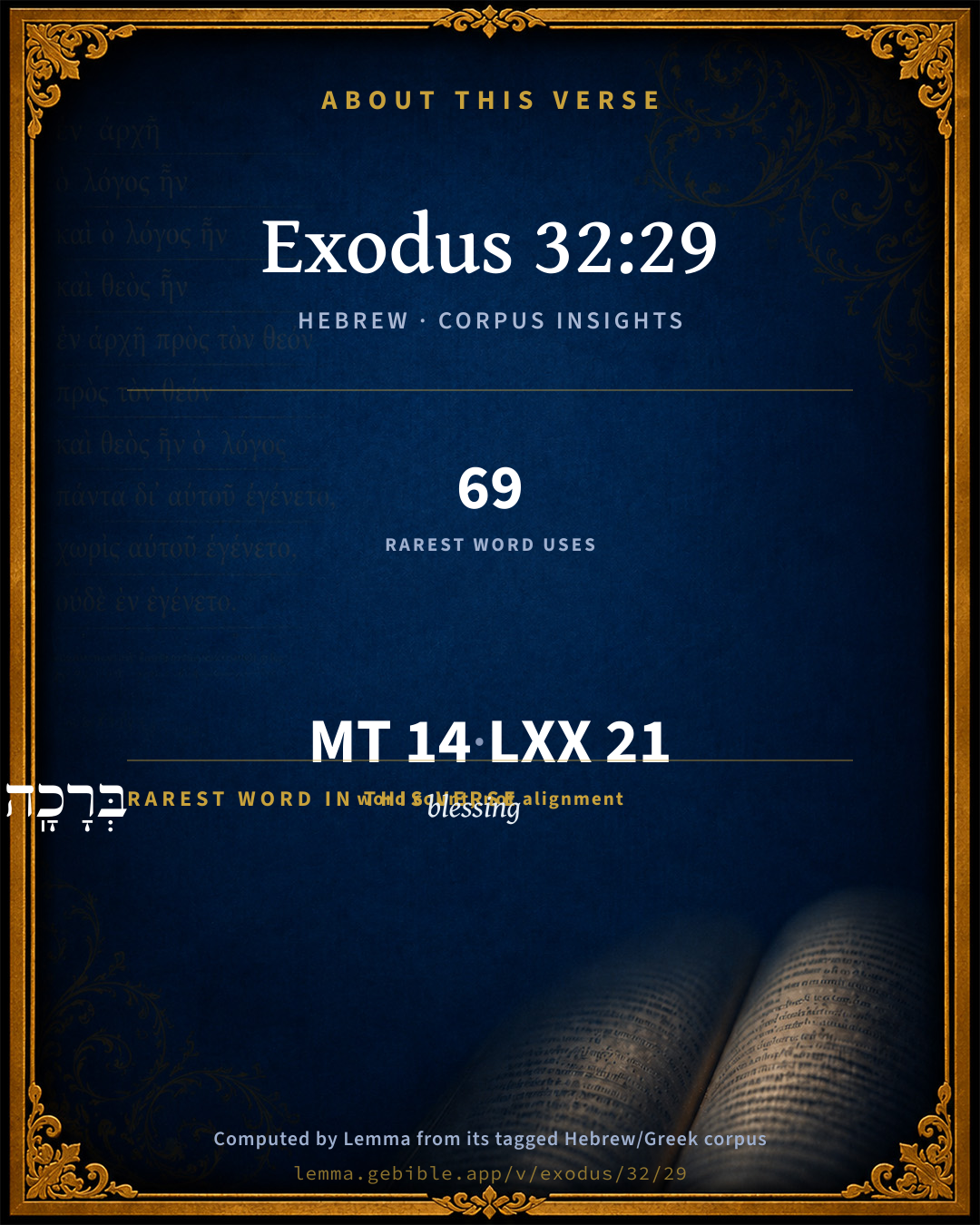
בְּרָכָֽה
Bᵉrâkâh
H1293
“blessing”
Noun, Common, Feminine, Singular, Absolute
Part of Speech
Noun
Type
Common
Gender
Feminine
Number
Singular
State
Absolute
Full BDB Definition

Origin: from H1288

TWOT: None

blessing - (source of) blessing - blessing, prosperity - blessing, praise of God - a gift, present - treaty of peace
  1. וַיֹּ֣אמֶר ʼâmar H559 “and · to say” Conjunction + Verb, Qal, Sequential Imperfect, 3rd Person, Masculine, Singular
  2. מֹשֶׁ֗ה Môsheh H4872 “Moses” Noun, Proper
  3. מִלְא֨וּ mâlêʼ H4390 “fill” Verb, Qal, Imperative, 2nd Person, Masculine, Plural
  4. יֶדְכֶ֤ם yâd H3027 “hand · your” Noun, Common, Both, Singular, Construct + Suffix, Personal, 2nd Person, Masculine, Plural
  5. הַיּוֹם֙ yôwm H3117 “the · day” Particle, Definite Article + Noun, Common, Masculine, Singular, Absolute
  6. לַֽיהוָ֔ה Yᵉhôvâh H3068 “to/for · LORD” Preposition + Noun, Proper
  7. כִּ֛י kîy H3588 “that” Conjunction
  8. אִ֥ישׁ ʼîysh H376 “man” Noun, Common, Masculine, Singular, Absolute
  9. בִּבְנ֖וֹ bên H1121 “in/at · son · his” Preposition + Noun, Common, Masculine, Singular, Construct + Suffix, Personal, 3rd Person, Masculine, Singular
  10. וּבְאָחִ֑יו ʼâch H251 “and · in/at · brother · his” Conjunction + Preposition + Noun, Common, Masculine, Singular, Construct + Suffix, Personal, 3rd Person, Masculine, Singular
  11. וְלָתֵ֧ת nâthan H5414 “and · to give” Conjunction + Preposition + Verb, Qal, Infinitive Construct
  12. עֲלֵיכֶ֛ם ʻal H5921 “upon · you” Preposition + Suffix, Personal, 2nd Person, Masculine, Plural
  13. הַיּ֖וֹם yôwm H3117 “the · day” Particle, Definite Article + Noun, Common, Masculine, Singular, Absolute

About this verse

These counts appear in no published source. They are computed here, from the morphology-tagged text and Lemma’s own curated glosses. What Lemma adds →

14
words
13
distinct lemmas
Pentateuch
section

Grammatical profile

  • 3 verbs
  • 9 nouns
  • 1 preposition
  • 1 conjunction

Verb forms

  • וַיֹּ֣אמֶר Qal · Sequential Imperfect
  • מִלְא֨וּ Qal · Imperative
  • וְלָתֵ֧ת Qal · Infinitive Construct

Repetition

A word recurs within this verse — often emphatic in Hebrew:

  • הַיּוֹם֙ day H3117 ×2

Hebrew & Septuagint length

In English translation the verse runs 27 words from the Hebrew and 32 from the Septuagint (LXX English) — closely comparable.

A rough comparison of the two English renderings, which tokenize alike — not a word-level alignment.

Word counts can differ between the Hebrew and the Greek without any difference in meaning — e.g. the Hebrew direct-object marker אֵת has no separate Greek word, and Greek often adds the article ὁ.

In the original languages it is 14 Hebrew tokens and 21 Greek tokens — but the two are counted differently (Hebrew bundles its prefixes and suffixes into one token; the Greek is in lemma form), so that isn’t a like-for-like length.

Cross-references

8

Topical passages linked to Exodus 32:29 in the Treasury of Scripture Knowledge — connected by theme and wording, ordered by reader-vote popularity; previews shown in the World English Bible.

  • Numbers 25:11–13 Phinehas, the son of Eleazar, the son of Aaron the priest, has turned my wrath away from the children of Israel, in that he was jealous with my jealousy among them, so that I didn't consume the children of Israel in my jealousy.
  • Zechariah 13:3 It will happen that, when anyone still prophesies, then his father and his mother who bore him will tell him, 'You must die, because you speak lies in the name of Yahweh;' and his father and his mother who bore him will stab him when he prophesies.
  • Matthew 10:37 He who loves father or mother more than me is not worthy of me; and he who loves son or daughter more than me isn't worthy of me.
  • Deuteronomy 13:6–11 If your brother, the son of your mother, or your son, or your daughter, or the wife of your bosom, or your friend, who is as your own soul, entice you secretly, saying, Let us go and serve other gods, which you have not known, you, nor your fathers;
  • Proverbs 21:3 To do righteousness and justice Is more acceptable to Yahweh than sacrifice.
  • Deuteronomy 33:9–10 Who said of his father, and of his mother, I have not seen him; Neither did he acknowledge his brothers, Nor knew he his own children: For they have observed your word, Keep your covenant.
  • 1 Samuel 15:18–22 and Yahweh sent you on a journey, and said, 'Go, and utterly destroy the sinners the Amalekites, and fight against them until they are consumed.'
  • Joel 2:12–14 "Yet even now," says Yahweh, "turn to me with all your heart, And with fasting, and with weeping, and with mourning."

Cross-references courtesy of OpenBible.info (CC BY 4.0).

Hebrew and Greek witnesses Masoretic Hebrew ↔ Greek Septuagint

The same verse in the two great witnesses to the Old Testament, shown verse-for-verse.

These are two independent witnesses, not word-aligned to each other, and the Septuagint is shown in lemma (dictionary) form.

Hebrew Exodus 32:29 Masoretic · Westminster Leningrad Codex

וַיֹּ֣אמֶר מֹשֶׁ֗ה מִלְא֨וּ יֶדְכֶ֤ם הַיּוֹם֙ לַֽיהוָ֔ה כִּ֛י אִ֥ישׁ בִּבְנ֖וֹ וּבְאָחִ֑יו וְלָתֵ֧ת עֲלֵיכֶ֛ם הַיּ֖וֹם בְּרָכָֽה

Moses said, "Consecrate yourselves today to Yahweh, yes, every man against his son, and against his brother; that he may bestow on you a blessing this day."

World English Bible · Public Domain

Greek LXX Exodus 32:29 Septuagint · lemma form

καί εἶπον αὐτός μωυσῆς πληρόω ὁ χείρ σύ σήμερον κύριος ἕκαστος ἐν ὁ υἱός ἤ ὁ ἀδελφός δίδωμι ἐπί σύ εὐλογία

And Moses said to them, You⌃ have filled your hands this day to the Lord each one on his son or on his brother, so that blessing should be given to you.

LXX2012 (modern English Septuagint) · Public Domain

Hebrew: Westminster Leningrad Codex (CC BY 4.0). Greek: Septuagint (public domain); English from LXX2012 (modern English Septuagint) (Public Domain). How the Septuagint differs from the Hebrew →

Targum (Aramaic paraphrase)

2

The Targum is the ancient Jewish Aramaic paraphrase of the Hebrew Scriptures — an interpretive translation, not the Hebrew text itself. Onkelos (literal) and Pseudo-Jonathan (expansive) render the Torah, and Jonathan the Prophets. Coverage is partial: where no permissively-licensed English translation exists for a verse, only the Aramaic is shown. This is verse-level text, not a word-by-word alignment to the Hebrew.

  1. Targum Onkelos Torah (Genesis–Deuteronomy)
    וַאֲמַר משֶׁה קָרִיבוּ יֶדְכוֹן קֻרְבָּנָא יוֹמָא דֵין קֳדָם יְיָ אֲרֵי גְבַר בִּבְרֵהּ וּבְאָחוּהִי וּלְאַיְתָאָה עֲלֵיכוֹן יוֹמָא דֵין בִּרְכָן:

    (no public-domain English translation for this verse)

    Targum Onkelos — Aramaic: “Onkelos Genesis” (public domain); “Onkelos Exodus” (public domain); “Onkelos Leviticus” (public domain); “Onkelos Numbers” (public domain); “Onkelos Deuteronomy” (public domain). English: “Sefaria Community Translation” (CC0 1.0 (public-domain dedication)); “J.W. Etheridge. The Targums of Onkelos and Jonathan Ben Uzziel on the Pentateuch. London: Longmans, Green, 1862” (public domain). Text via Sefaria.

  2. Targum Pseudo-Jonathan Torah (Genesis–Deuteronomy)
    וַאֲמַר משֶׁה קְרִיבוּ קוּרְבָּנֵכוֹן עַל שְׁפִיכוּת אַדְמָא דִי בִידֵיכוֹן וְיִתְכַּפֵּר לְכוֹן קֳדָם יְיָ אֲרוּם נְגַעֲתּוּן גְּבַר בִּבְרֵיהּ וּבְאָחוֹי וּלְאַיְיתָאָה עֲלֵיכוֹן יוֹמָא דֵין בִּרְכָתָא

    And Mosheh said, Offer your oblation for the shedding of the blood that is upon your hands, and make atonement for yourselves before the Lord, because you have smitten a man his son or his brother, and that you may bring a blessing upon you this day.

    Targum Pseudo-Jonathan — Aramaic: “Targum Jonathan on Genesis” (public domain); “Targum Jonathan on Exodus” (public domain); “Targum Jonathan on Leviticus” (public domain); “Targum Jonathan on Numbers” (public domain); “Targum Jonathan on Deuteronomy” (public domain). English: “The Targum of Jonathan ben Uzziel, trans. J. W. Etheridge, London, 1862” (public domain). Text via Sefaria.

Commentary

Notes on Exodus 32:29 from classic Christian and Jewish commentators (each source and its license shown beneath its notes). The classic Christian expositions comment on the surrounding passage and are grouped to its opening verse, so a note may address several verses; the Jewish commentaries on the Tanakh (Rashi and others) are per-verse, so they appear only where the commentator wrote on this verse.

Lemma curates 59 commentaries, every one of them public domain or Creative Commons licensed, each selected and text-cleaned for this edition rather than reprinted as found. About our sources →

Trapp's Complete Commentary

John Trapp

Exo 32:29 For Moses had said, Consecrate yourselves to day to the LORD, even every man upon his son, and upon his brother; that he may bestow upon you a blessing this day.

Ver. 29. Consecrate yourselves.] Regain that blessing which your father Levi lost. {Gen 49:5; Gen 49:7}

John Trapp, A Commentary or Exposition upon All the Books of the Old and New Testament (1647–1656) — public domain. Text from a community e-Sword module.

The Biblical Illustrator

Joseph S. Exell

Exo_32:29

Consecrate yourselves to-day to the Lord.

Immediate devotedness to God

I. The nature of this consecration.

1. We must recognize the claims of Jehovah.

2. We must concur as to the manner of our consecration.

3. We must be deeply anxious respecting this consecration.

4. We must earnestly and believingly give ourselves up to the Lord.

5. This act of consecration must be entire and for ever.

6. This act must be our own individual act.

7. This act must be effected and sustained by Divine grace.

8. This act must be immediate. To-day we have life, means, promises. To-morrow all may be lost, and for ever. Now, let us urge you to this immediate consecration--

II. By several important considerations and motives.

1. It is rational.

2. It is improving.

3. It is felicitous.

4. It is consolatory.

5. It is saving.

Application:

1. Let me urge the text on all classes--the young especially.

2. Let me urge all now.

3. I urge by a countless number of considerations.

By the majesty and glory of the God who seeks your salvation, and not death. By the Spirit within you. By the flight of time. (J. Burns, D. D.)

Consecrate yourselves to the Lord

If you say you are on the Lords side, prove it. If you are His in one thing, be His in all things. There are a great many who call themselves on the Lords side when they want daily bread or daily protection, who hesitate to stand out against brother and neighbour when the time of trying division for conscience sake comes. The reason why so many of us accomplish so little for the Lord is, that we are only partially consecrated to the Lord. We are His for Sunday and Wednesday evenings; or for Him in one line or another of thought or conduct; or for Him in all lines but one. Mr. Moody has said that the world has yet to see the power of one man wholly consecrated to God. Uncle Johnny Vassar, or David Livingstone, or Martin Luther, or some such man as that, gives us a glimpse of the possibilities of one who is consecrated to the Lord. What a pity that such illustrations are so exceptional! Consecrate yourselves to-day to the Lord, that He may bestow upon you a blessing! (H. C. Trumbull.)

The Biblical Illustrator, edited by Joseph S. Exell (c. 1880s–1900s) — public domain. Text from a community e-Sword module.

Geneva Bible (1599)

Geneva Bible translators

In revenging God’s glory we must have no respect to person, but put off all carnal affection.

Geneva Bible (1599) marginal notes — public domain. Text via Bolls.life.

Jamieson, Fausset & Brown

Robert Jamieson, A. R. Fausset & David Brown

Consecrate yourselves to-day to the Lord--or, "Ye have consecrated yourselves to-day." The Levites, notwithstanding the dejection of Aaron, distinguished themselves by their zeal for the honor of God and their conduct in doing the office of executioners on this occasion; and this was one reason that they were appointed to a high and honorable office in the service of the sanctuary.

Jamieson, Fausset & Brown — Commentary Critical and Explanatory on the Whole Bible (1871) — public domain (CC PDM 1.0). Text via the HelloAO Bible API.

Adam Clarke's Commentary

Verse 29. For Moses had said, Consecrate yourselves] Fill your hands to the Lord. See the reason of this form of speech in Clarke's note on "Ex 29:19".

Adam Clarke's Commentary on the Bible (1810–1826) — public domain. Text from a community e-Sword/MySword module.

Ellicott's Commentary for English Readers

(29) For Moses had said, Consecrate yourselves.—Moses had explained to them that a brave behaviour under existing circumstances would be accepted as a “consecration,” and would win for the tribe a semi-priestly character. His announcement was made good when the Levites were appointed to the service of the sanctuary in lieu of the firstborn (Num_3:6-13).

A Bible Commentary for English Readers, edited by Charles John Ellicott (1878–1897) — public domain. Text from a community e-Sword module.

The Cambridge Bible for Schools and Colleges

gen. ed. J. J. S. Perowne

29. The Levites are invited to qualify themselves to receive the priesthood as a reward for their zeal.

Fill your hand to-day to Jehovah] i.e. (see on Exo_28:41), Provide yourselves with sacrifices, that you may be installed into the priesthood.

for every man (is) against, &c.] That is the spirit which you have shewn to-day, and which is demanded for the priesthood (Di.). Cf. Deu_33:9 (written under the monarchy), where the priestly tribe is eulogized for its abnegation of natural relationships, though it is uncertain whether the present incident is specifically alluded to.

that he may, &c.] The ‘blessing’ is the privilege of officiating as priests. Cf. Kennedy, DB. i. 341b.

In view of Deu_10:8 (‘At that time Jehovah separated the tribe of Levi to bear the ark’ &c.), where the fragment of an itinerary in vv. 6 f. must be either parenthetic, or misplaced (so that At that time will refer to the period of the stay at Horeb, the subject of Deu_9:8 to Deu_10:5), Di. and others can hardly be wrong in holding that JE’s narrative here was followed originally by an account of the consecration of the tribe of Levi—as a reward, presumably, for the display of zeal on Jehovah’s behalf described in vv. 26–29, which the compiler of Ex. did not deem it necessary to retain by the side of the more detailed particulars of P. In P, it will be remembered, the consecration of the priesthood is narrated in Leviticus 8, and that of the ‘Levites’ (in P the inferior members of the tribe, as distinguished from the priests) in Num_8:5 ff.; but down to the time when Dt. was written, any member of the tribe had the right to exercise priestly functions (Deu_18:1; Deu_18:6-8); and it would be during this stage in the history of the tribe that J or E—like the writer of Deu_10:8 f.—would speak of the whole tribe being set apart or consecrated For priestly functions.

The Cambridge Bible for Schools and Colleges (gen. ed. J. J. S. Perowne; Cambridge University Press, 1878–1918) — public domain. Text from a community e-Sword module.

John Gill's Exposition

And it came to pass on the morrow,.... The eighteenth day of Tammuz it was, the same writers say, that Moses implored the mercy of God for Israel. Jarchi on Exo 32:11 says it was on the seventeenth day the tables were broke, on the eighteenth the calf was burnt, and on the nineteenth that Moses went up to intercede for them:

that Moses said unto the people, ye have sinned a great sin; the sin of idolatry, see Exo 32:21 from whence it appears, that all that were guilty of it were not slain, perhaps only some of one tribe; and there was great reason to fear, that as wrath was gone forth it would not stop here, but others would fall a sacrifice to the divine displeasure; wherefore it is proposed by Moses to make application to the Lord on their behalf, that they might obtain mercy:

and I will go up unto the Lord: on the top of Mount Sinai:

peradventure I shall make atonement for your sin; not by any sacrifice offered, but by his prayers prevail with God to forgive their sin, and not punish any more for it: he had by his first prayer obtained of the Lord not to consume them off of the face of the earth, and utterly destroy them as a nation; but that he did not hinder but that resentment might be shown in a lesser degree, or by parts; as not 3000 men had been cut off, chiefly out of one tribe, if not altogether, the rest of the tribes might expect to be visited, according to the number of their delinquents.

John Gill's Exposition of the Whole Bible (1746–1763) — public domain (CC PDM 1.0). Text via the HelloAO Bible API.

Haydock's Catholic Bible Commentary

To you. Thus they merited the priesthood, and a blessing; (Deuteronomy xxxiii. 9.; Menochius) having been the ministers of God’s just indignation, without sparing any of the most guilty. With these they could not be unacquainted. No external signs on their bodies were requisite to make the delinquents known. They had appeared to publicly. (Haydock) --- The Levites acted with due authority and order, which their father, Levi, had neglected, Genesis xxxiv. (Worthington)

George Leo Haydock (1774–1849), Haydock's Catholic Family Bible and Commentary, 1859 edition — public domain. Excludes Psalms (Douay-Rheims chapter numbering differs from Protestant) and Deuterocanonical books (Catholic canon only).

Matthew Poole's English Annotations

Offer up yourselves to the honour and service of the Lord in this work, which because it was joined with the hazard of their lives, he calls it a consecration or oblation of themselves, as Abraham for the like reason is said to have offered up Isaac.

Consecrate yourselves, Heb. fill your hands, & c., i.e. offer a sacrifice, for so the phrase is oft used, as Exo 28:41; Jdg 17:5,12. That work of justice which they were going to execute might seem an inhuman and barbarous act, but he tells them it was an acceptable sacrifice to God, as the destruction of God’s enemies is called a sacrifice, Isa 34:6; Eze 39:17. Or he hereby intimates that this tribe was designed by God for his immediate service, and therefore recommends this work to them as an excellent initiation into their office, and as a demonstration that they were in some sort worthy of that great trust.

Matthew Poole's English Annotations on the Holy Bible (1683–1685) — public domain. Text from a community e-Sword/MySword module.

Whedon's Commentary on the Bible

Daniel D. Whedon

29. For Moses had said — Thus rendered, this verse is supposed to explain the zeal of the Levites in the slaughter just described. Their zeal and activity were to be a consecration of themselves to Jehovah. But the common version is not in strict accord with the Hebrew text. The margin gives the better rendering. But the explanations of the verse have been various. Translating literally we read: And Moses said, Fill your hand to-day unto (or for) Jehovah, for a man (is or was) against his son and against his brother, and (it was) to give a blessing upon you to-day. The expression “fill the hand” is a metaphor which is used in describing the consecration of persons, (compare Exo_28:41; Exo_29:9; Exo_29:29; Exo_29:33; Lev_8:33; Lev_21:10; Num_3:3; 1Ch_29:5; 2Ch_29:31,) and is translated consecrate in all the passages here referred to. The allusion in the metaphor appears to refer to some ceremony of giving into the hands of those consecrated some sign or symbol of their office and work. It would be thus signified that their hands were thenceforth to be filled with the duties and obligations of their sacred calling. We need not here understand that these Levites were commanded to bring any special offerings at this time, but that the work which they had that day performed was a consecration of themselves to Jehovah. They had filled their hands with an act which would give them memorable distinction. Accordingly, the verse might be thus paraphrased: Consecrate yourselves this day unto Jehovah. For you have shown yourselves worthy to be his ministers by rising above personal and family considerations when Jehovah’s honour was at stake, (comp. Deu_33:8-11; Luk_14:26,) for by turning in this case against son and brother you have shown yourselves loyal to Jehovah and worthy to receive his blessing.

Daniel D. Whedon (gen. ed.), Commentary on the Old and New Testaments (1874–1909) — public domain. Text from a community e-Sword module.

The Pulpit Commentary

For Moses had said. Moses, on giving them their commission (ver. 27), had told them, that their zeal in the matter would he a consecration, and would secure them God"s blessing. They earned by it the semi-priestly position, which was soon afterwards assigned to them. (Num_3:6-13)

The Pulpit Commentary (1880–1919), ed. H.D.M. Spence-Jones & Joseph S. Exell — public domain. Text from a community e-Sword module.

Rashi

Rabbi Shlomo Yitzchaki (Rashi)

מלאו ידכם CONSECRATE YOURSELVES — You who are killing them (your own relatives) will by this very act install yourselves as priests of the Omnipresent God,

כי איש FOR EVERY MAN among you will consecrate himself בבנו ובאחיו BY HIS SON AND HIS BROTHER (by their death at his hand).

Rashi on the Tanakh — English translations: “The Judaica Press complete Tanach with Rashi, translated by A. J. Rosenberg” (CC BY 4.0); “Pentateuch with Rashi's commentary by M. Rosenbaum and A.M. Silbermann, 1929-1934” (public domain); “The Metsudah Tanach series, Lakewood, N.J” (CC BY 4.0); and “The Book of Joshua, Metsudah Publications, 1997” (CC BY 4.0). Text via Sefaria.

Lesson kit

Teaching starters — assembled from the data on this page, not authored interpretation. Every prompt links to the verse data it draws on. Edit before teaching.

Exodus, in the Pentateuch, opens this verse with 14 words (13 distinct Hebrew lemmas). Its most distinctive word is Bᵉrâkâh (“blessing”). A historical commentator’s framing appears above. Read the whole chapter for the surrounding context.

Discussion questions

  1. What does “blessing” (Bᵉrâkâh) contribute to the verse as a whole?
  2. Numbers 25:11–13 shares this passage’s theme. How do the two illuminate each other?
  3. “day” occurs 2× in this one verse. What is the effect of the repetition?
  4. These translations render this verse differently. What is at stake in choosing one wording over another?
  5. The verb «וַיֹּ֣אמֶר» is Qal Sequential Imperfect. How does its form color the action?
  6. Reading how Trapp's Complete Commentary and The Biblical Illustrator read this verse, where do the two commentators agree and where do they part?

Things to notice

Reading settings

Reading text

Shown beneath each verse's original-language words.

Old Testament
Old Testament edition

Read the OT as the Masoretic Hebrew (MT) or the Greek Septuagint (LXX).

English shown for the Greek Septuagint (in the Hebrew ↔ Greek comparison).

Comparing translations? Open the Compare panel on any verse page to stack up to four side by side.