2 Samuel 2:3

Hebrew (Westminster Leningrad Codex) 2 Samuel 2:3 appears in the Hebrew Old Testament. The text above is from the Westminster Leningrad Codex. Each word links to its Strong’s number, a concise gloss, and parsing drawn from the Open Scriptures Hebrew Bible morphology. Click any word for its full Brown-Driver-Briggs (BDB) entry.
Download image
Cite this verse

2 Samuel 2:3 (World English Bible). Public Domain. Lemma interlinear Bible study tool, https://lemma.gebible.app/v/2-samuel/2/3.

Show BibTeX & RIS
BibTeX
RIS
English Translation
His men who were with him did David bring up, every man with his household: and they lived in the cities of Hebron.
World English Bible · Public Domain
Download a study sheet

One document with this verse’s original text, its word-by-word gloss line, the meaning frame, cross-references with their text, attributed commentary, and full source and license credits — printable, and it pastes into notes with its structure intact.

This verse Autodidact and up

Study sheet (.html) Plain text (.txt)

A passage Seminary Student

Up to 50 verses in one chapter. A passage sheet keeps up to 6 commentary sources and 12 cross-references per verse, in the order this page ranks them, and says so on the sheet whenever that leaves anything out. Ask for a single verse and you get the Autodidact verse sheet above.

Everything on this page stays free to read, with no account — the sheet is a download of what is already on screen, not access to it.

Want to remove ads? Support Godless Engineer
Compare translations 3

The same verse in 3 English versions, stacked beneath the original-language interlinear above. Click any original word for its lexicon entry.

Each is an independent rendering of the whole verse — the interlinear is not word-aligned to these translations.

Highlighted words mark where these versions differ — a whole-verse word diff, not a word-by-word alignment.

  • World English Bible Public Domain
    His men who were with him did David bring up, every man with his household: and they lived in the cities of Hebron.
  • King James Version Public Domain
    And his men that were with him did David bring up, every man with his household: and they dwelt in the cities of Hebron.
  • unfoldingWord Literal Text CC BY-SA 4.0
    And his men who with him, David brought up, a man and his house. And they dwelled in the cities of Hebron.

unfoldingWord Literal Text — © unfoldingWord, licensed CC BY-SA 4.0. Word-aligned USFM3 via Door43 (git.door43.org/unfoldingWord/en_ult).

Versions to compare (up to 4)

3 of 4 selected

Show all 18 translations

Every available English version of this verse, each an independent rendering of the whole verse.

  • World English Bible Public Domain
    His men who were with him did David bring up, every man with his household: and they lived in the cities of Hebron.
  • Berean Standard Bible Public Domain
    David also took the men who were with him, each with his household, and they settled in the towns near Hebron.
  • Majority Standard Bible Public Domain
    David also took the men who were with him, each with his household, and they settled in the towns near Hebron.
  • King James Version Public Domain
    And his men that were with him did David bring up, every man with his household: and they dwelt in the cities of Hebron.
  • American Standard Version (1901) Public Domain
    And his men that were with him did David bring up, every man with his household: and they dwelt in the cities of Hebron.
  • Revised Version (1885) Public Domain
    And his men that were with him did David bring up, every man with his household: and they dwelt in the cities of Hebron.
  • Geneva Bible (1599) Public Domain
    And Dauid brought vp the men that were with him, euery man with his houshold, and they dwelt in the cities of Hebron.
  • Douay-Rheims (1899) Public Domain
    And the men also that were with him, David brought up every man with his household: and they abode in the towns of Hebron.
  • Young's Literal Translation Public Domain
    and his men who `are' with him hath David brought up -- a man and his household -- and they dwell in the cities of Hebron.
  • Literal Standard Version CC BY-SA 4.0
    and David has brought up his men who [are] with him—a man and his household—and they dwell in the cities of Hebron.
  • Unlocked Literal Bible CC BY-SA 4.0
    David brought the men who were with him, who each brought his family, to the cities of Hebron, where they began to live.
  • unfoldingWord Literal Text CC BY-SA 4.0
    And his men who with him, David brought up, a man and his house. And they dwelled in the cities of Hebron.
  • Darby Bible Public Domain
    And his men that were with him did David bring up, every man with his household; and they dwelt in the cities of Hebron.
  • World Messianic Bible Public Domain
    David brought up his men who were with him, every man with his household. They lived in the cities of Hebron.
  • Webster's Bible Public Domain
    And his men that were with him did David bring up, every man with his household: and they dwelt in the cities of Hebron.
  • Free Bible Version CC BY-SA 4.0
    He also brought the men who were with him, along with their families, and they settled in the villages near Hebron.
  • Bible in Basic English Public Domain
    And David took all his men with him, every man with his family: and they were living in the towns round Hebron.
  • JPS Tanakh (1917) Public Domain
    And his men that were with him did David bring up, every man with his household; and they dwelt in the cities of Hebron.

Literal Standard Version (2020), Covenant Press — licensed CC BY-SA 4.0. Text via the HelloAO Bible API (eBible.org). Unlocked Literal Bible (unfoldingWord) — licensed CC BY-SA 4.0. Text via the HelloAO Bible API (eBible.org). unfoldingWord Literal Text — © unfoldingWord, licensed CC BY-SA 4.0. Word-aligned USFM3 via Door43 (git.door43.org/unfoldingWord/en_ult). Free Bible Version, Dr. Jonathan Gallagher — licensed CC BY-SA 4.0. Text via the HelloAO Bible API (eBible.org).

Word by word

More ways to search: Search by grammar → Find every occurrence → Compare this word →

Practice this passage: Drill this verse → Learn its vocabulary →

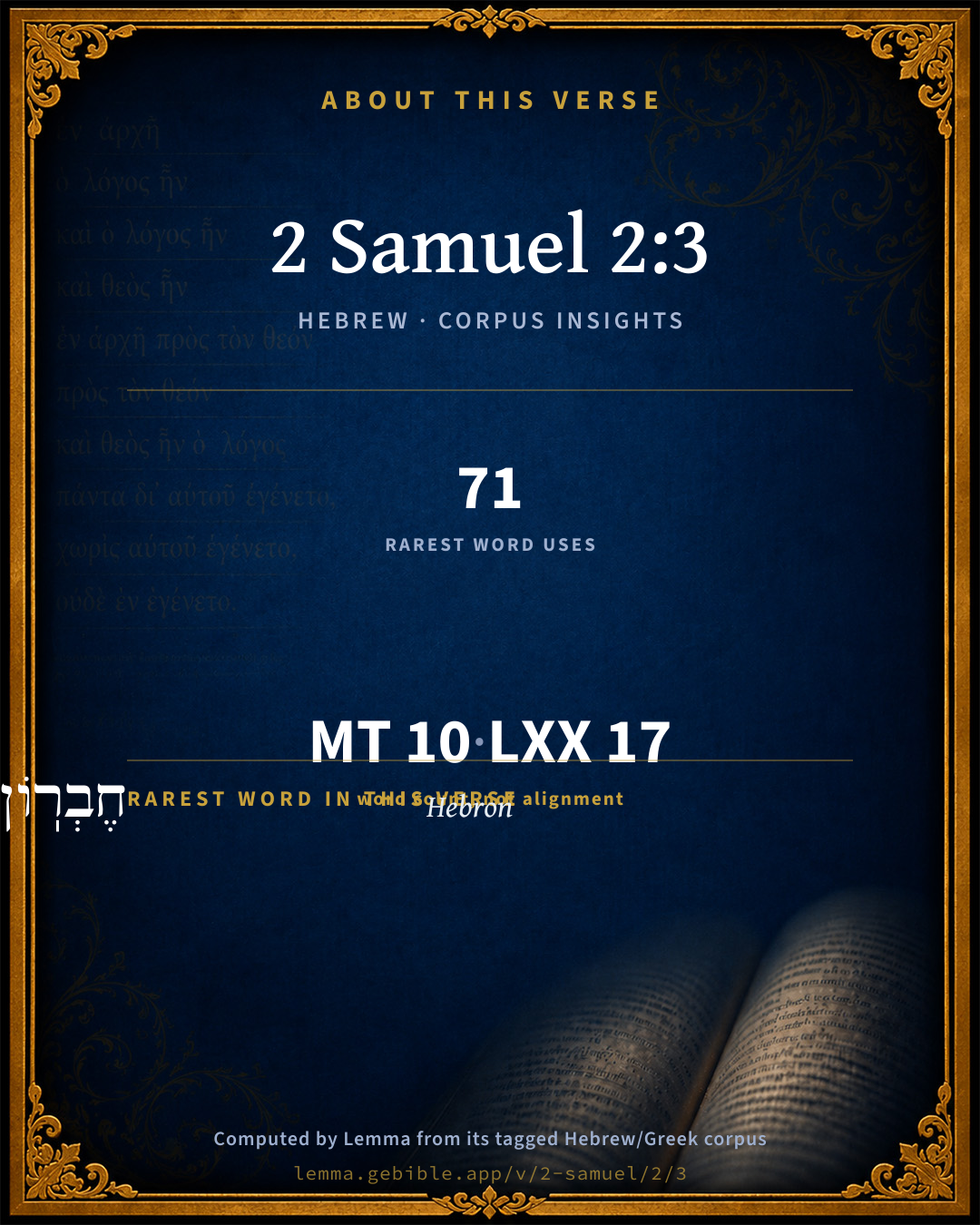
חֶבְרֽוֹן
Chebrôwn
H2275
“Hebron”
Noun, Proper
Part of Speech
Noun
Type
Proper
Full BDB Definition

Origin: from H2267

TWOT: 598i

Hebron = "association" - a city in south Judah approx 20 south of Jerusalem and approx 20 miles (30 kilometers) north of Beersheba and near where Abraham built an altar (noun proper locative) - the 3rd son of Kohath and grandson of Levi (noun proper masculine) - a descendant of Caleb (noun proper masculine)
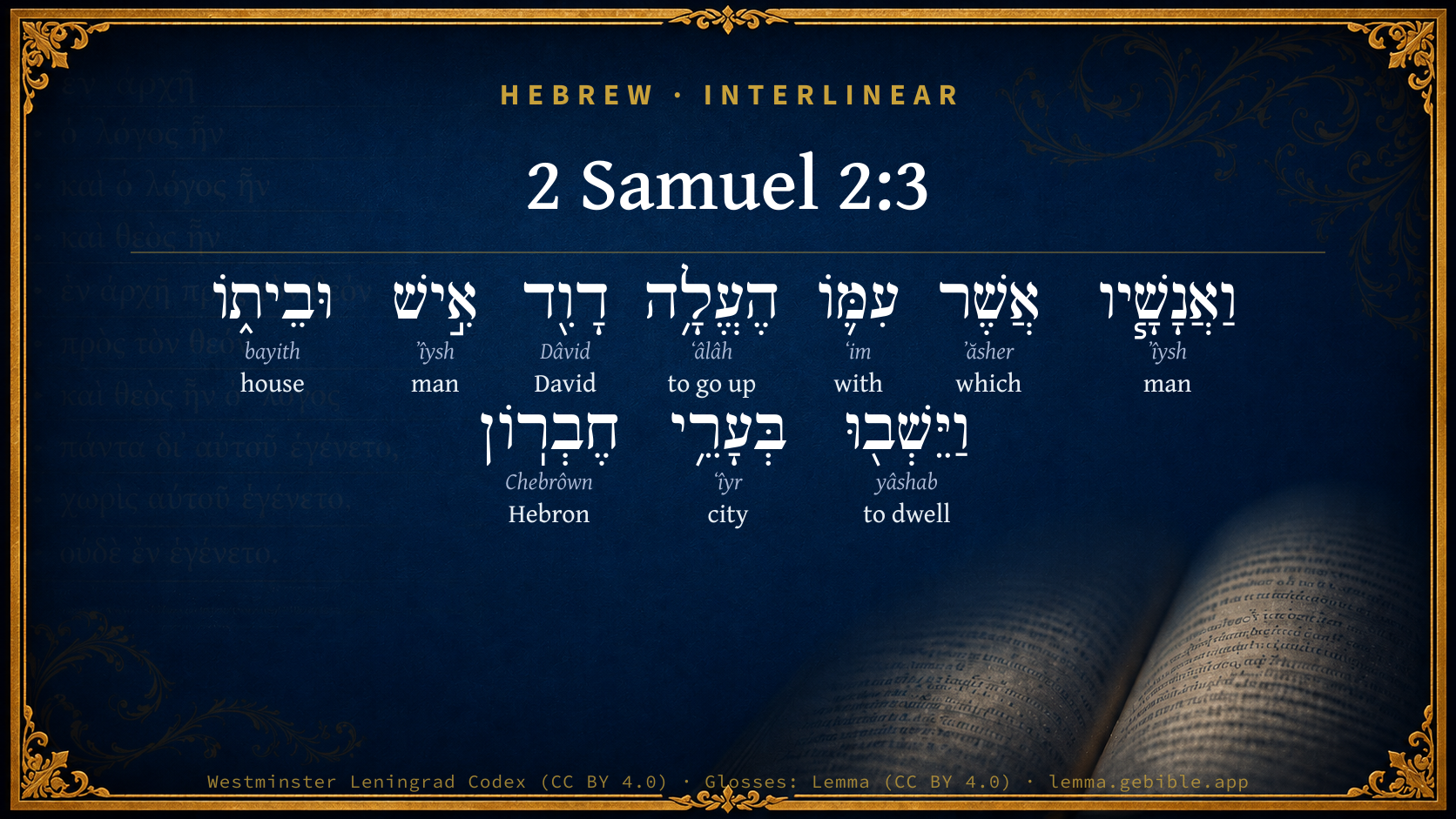
  1. וַאֲנָשָׁ֧יו ʼîysh H376 “and · men · his” Conjunction + Noun, Common, Masculine, Plural, Construct + Suffix, Personal, 3rd Person, Masculine, Singular
  2. אֲשֶׁר ʼăsher H834 “which” Particle, Relative
  3. עִמּ֛וֹ ʻim H5973 “with · him” Preposition + Suffix, Personal, 3rd Person, Masculine, Singular
  4. הֶעֱלָ֥ה ʻâlâh H5927 “to go up” Verb, Hiphil, Perfect, 3rd Person, Masculine, Singular
  5. דָוִ֖ד Dâvid H1732 “David” Noun, Proper
  6. אִ֣ישׁ ʼîysh H376 “man” Noun, Common, Masculine, Singular, Absolute
  7. וּבֵית֑וֹ bayith H1004 “and · house · his” Conjunction + Noun, Common, Masculine, Singular, Construct + Suffix, Personal, 3rd Person, Masculine, Singular
  8. וַיֵּשְׁב֖וּ yâshab H3427 “and · to dwell” Conjunction + Verb, Qal, Sequential Imperfect, 3rd Person, Masculine, Plural
  9. בְּעָרֵ֥י ʻîyr H5892 “in/at · cities of” Preposition + Noun, Common, Feminine, Plural, Construct

About this verse

These counts appear in no published source. They are computed here, from the morphology-tagged text and Lemma’s own curated glosses. What Lemma adds →

10
words
9
distinct lemmas
Historical
section

Grammatical profile

  • 2 verbs
  • 6 nouns
  • 1 preposition
  • 1 particle

Verb forms

  • הֶעֱלָ֥ה Hiphil · Perfect
  • וַיֵּשְׁב֖וּ Qal · Sequential Imperfect

Repetition

A word recurs within this verse — often emphatic in Hebrew:

  • וַאֲנָשָׁ֧יו man H376 ×2

Hebrew & Septuagint length

In English translation the verse runs 23 words from the Hebrew and 20 from the Septuagint (LXX English) — closely comparable.

A rough comparison of the two English renderings, which tokenize alike — not a word-level alignment.

Word counts can differ between the Hebrew and the Greek without any difference in meaning — e.g. the Hebrew direct-object marker אֵת has no separate Greek word, and Greek often adds the article ὁ.

In the original languages it is 10 Hebrew tokens and 17 Greek tokens — but the two are counted differently (Hebrew bundles its prefixes and suffixes into one token; the Greek is in lemma form), so that isn’t a like-for-like length.

Cross-references

6

Topical passages linked to 2 Samuel 2:3 in the Treasury of Scripture Knowledge — connected by theme and wording, ordered by reader-vote popularity; previews shown in the World English Bible.

  • 1 Samuel 27:2–3 David arose, and passed over, he and the six hundred men who were with him, to Achish the son of Maoch, king of Gath.
  • 1 Samuel 30:1 It happened, when David and his men were come to Ziklag on the third day, that the Amalekites had made a raid on the South, and on Ziklag, and had struck Ziklag, and burned it with fire,
  • 1 Chronicles 12:1–7 Now these are those who came to David to Ziklag, while he yet kept himself close because of Saul the son of Kish; and they were among the mighty men, his helpers in war.
  • Joshua 21:11–12 They gave them Kiriath Arba, [which Arba was] the father of Anak (the same is Hebron), in the hill-country of Judah, with the suburbs of it round about it.
  • 1 Samuel 22:2 Everyone who was in distress, and everyone who was in debt, and everyone who was discontented, gathered themselves to him; and he became captain over them: and there were with him about four hundred men.
  • 1 Samuel 30:9–10 So David went, he and the six hundred men who were with him, and came to the brook Besor, where those who were left behind stayed.

Cross-references courtesy of OpenBible.info (CC BY 4.0).

Hebrew and Greek witnesses Masoretic Hebrew ↔ Greek Septuagint

The same verse in the two great witnesses to the Old Testament, shown verse-for-verse.

These are two independent witnesses, not word-aligned to each other, and the Septuagint is shown in lemma (dictionary) form.

Hebrew 2 Samuel 2:3 Masoretic · Westminster Leningrad Codex

וַאֲנָשָׁ֧יו אֲשֶׁר עִמּ֛וֹ הֶעֱלָ֥ה דָוִ֖ד אִ֣ישׁ וּבֵית֑וֹ וַיֵּשְׁב֖וּ בְּעָרֵ֥י חֶבְרֽוֹן

His men who were with him did David bring up, every man with his household: and they lived in the cities of Hebron.

World English Bible · Public Domain

Greek LXX 2 Samuel 2:3 Septuagint · lemma form

καί ὁ ἀνήρ ὁ μετά αὐτός ἕκαστος καί ὁ οἶκος αὐτός καί καταοἰκέω ἐν ὁ πόλις χεβρων

and the men that were with him, every one and his family; and they lived in the cities of Chebron.

LXX2012 (modern English Septuagint) · Public Domain

Hebrew: Westminster Leningrad Codex (CC BY 4.0). Greek: Septuagint (public domain); English from LXX2012 (modern English Septuagint) (Public Domain). How the Septuagint differs from the Hebrew →

Targum (Aramaic paraphrase)

1

The Targum is the ancient Jewish Aramaic paraphrase of the Hebrew Scriptures — an interpretive translation, not the Hebrew text itself. Onkelos (literal) and Pseudo-Jonathan (expansive) render the Torah, and Jonathan the Prophets. Coverage is partial: where no permissively-licensed English translation exists for a verse, only the Aramaic is shown. This is verse-level text, not a word-by-word alignment to the Hebrew.

  1. Targum Jonathan Prophets (Joshua–Malachi)
    וְגַבְרוֹהִי דְעִמֵיהּ אַסֵיק דָוִד גְבַר וֶאֱנַשׁ בֵּיתֵיהּ וִיתָבוּ בְּקִרְוֵי חֶבְרוֹן:

    (no public-domain English translation for this verse)

    Targum Jonathan — Aramaic: “Mikraot Gedolot” (public domain). English: “Sefaria Community Translation” (CC0 1.0 (public-domain dedication)); “London "Chaldee Paraphrase," 1871” (public domain). Text via Sefaria.

Commentary

Notes on 2 Samuel 2:3 from classic Christian and Jewish commentators (each source and its license shown beneath its notes). The classic Christian expositions comment on the surrounding passage and are grouped to its opening verse, so a note may address several verses; the Jewish commentaries on the Tanakh (Rashi and others) are per-verse, so they appear only where the commentator wrote on this verse.

Lemma curates 59 commentaries, every one of them public domain or Creative Commons licensed, each selected and text-cleaned for this edition rather than reprinted as found. About our sources →

Trapp's Complete Commentary

John Trapp

2Sa 2:3 And his men that [were] with him did David bring up, every man with his household: and they dwelt in the cities of Hebron.

Ver. 3. And his men that were with him did David bring up.] Those that came to him, {1Sa 22:2} and continued with him in all his troubles. He cashiereth them not for all their recent rebellion at Ziklag, which was yet fresh, and but a few days since: but pardoning their rebellions, he maketh them partakers of his good success. Thus doth our heavenly Leader, whom David prefigured, take us to reign with him, who have suffered with him.

And they dwelt in the cities of Hebron.] They were billeted up and down in the neighbouring towns and villages, called daughters, {Jos 21:11-12} lest he should be burdensome to his Hebronites, by quartering upon them sa great a company.

John Trapp, A Commentary or Exposition upon All the Books of the Old and New Testament (1647–1656) — public domain. Text from a community e-Sword module.

The Biblical Illustrator

Joseph S. Exell

2Sa_2:3-4

And they dwelt in the cities of Hebron, and the men of Judah came, and there they anointed David.

David's reign at Hebron

The death of Saul did not end David's domestic troubles, and did not leave him free, for a considerable number of years, to employ his energies for the good of the whole kingdom. It appears that his chastisement for allying himself with Achish was not yet exhausted. The more remote fruits of that step were now only beginning to emerge, and years elapsed before its evil influence ceased to be felt. The close alliance which had subsisted between him and the great enemy of his country, arid author of its disasters, could hardly fail to render him an object of distrust and suspicion to many of his countrymen. All his former achievements against the Philistines--the cruel injustice of Saul which had driven him in despair to Achish--his recent services against the Amalekites--the generous use he had made of the spoil--and the influence of his high personal character, however powerfully they might tell is his immediate neighbourhood, would have but little weight in his favour in the more distant parts of the kingdom. For after a great disaster, the public mind is often exasperated, and ready to lay an enormous amount of blame on any one who can be assailed with any plausibility. Beyond all doubt, David would come in for his full share of such attacks. It was, therefore, in every way the most expedient course for David to establish his quarters immediately in one of the cities of Judah. But in the admirable frame of mind in which he now was, he declined taking this step, indispensable though it seemed, until he had obtained Divine direction regarding it The form in which he made the inquiry shows how clear the expediency of going up to one of the cities of Judah was to his own mind. The city of Hebron, situated about eighteen miles to the south of Jerusalem, was the place to which he was directed to go. In was a spot abounding in holy and elevating associations. It was among the first, if not the very first haunt of civilised men in the land--so ancient, that it is said to have been built seven years before Zoan in Egypt (Num_13:22). The Father of the Faithful had often pitched his tent under its spreading oaks, and among its olive groves and vine-clad hills the gentle Isaac had meditated at eventide. There, Abraham had watched the last breath of his beloved Sarah, the companion of his wanderings and the partner of his faith; and there, from the sons of Heth, he had purchased the sepulchre where so much holy and venerable dust was deposited, in the hope of a glorious resurrection. Thither Joseph and his brethren had brought up the body of Jacob, laying it, in fulfilment of his dying command, beside the bones of Leah. It had been s, halting-place of the twelve spies, when they went up to search the land; and the cluster of grapes which they carried back was cut from the neighbouring valley, where the finest grapes of the country are still found. The sight of its venerable cave had doubtless elevated the faith and courage of Joshua and Caleb, when the other spies became so faithless and fearful. In the division of the land it had been assigned to Caleb, one of the noblest spirits the nation ever produced; and afterwards it had been made one of the Levitical cities of refuge. No place could have recalled more vividly the lessons of departed worth, and the victories of early faith, or abounded more in memorials of the blessedness of following the Lord. It was a token of God's kindness to David that He directed him to make Hebron his headquarters. And it was a further token of His goodness, that no sooner had David gone to Hebron, than the men of Judah came and anointed him king over the house of Judah. (W. G. Blaikie, M. A.)

Fresh anointing

Anointed first by Samuel in the secrecy of his lather's house, he was now anointed king over his own people; just as the Lord Jesus, of whom he was the great exemplar and type, was anointed first by the banks of the Jordan, and again as the representative of His people, when He ascended for them into the presence of the Father, and was set as King on the holy hill of Zion. We cannot turn from this second anointing without emphasising the obvious lesson that at each great crisis of our life, and especially when standing on the threshold of some new and enlarged sphere of service, we should seek and receive a fresh anointing to fit us to fulfil its fresh demands. There should be successive and repeated anointings in our life-history as our opportunities widen out in ever-increasing circles. (F. B. Meyer, B. A.)

The Biblical Illustrator, edited by Joseph S. Exell (c. 1880s–1900s) — public domain. Text from a community e-Sword module.

Joseph Benson's Commentary

2Sa 2:3. They dwelt in the cities of Hebron — That is, the cities or towns belonging to Hebron, which was the metropolis. For in Hebron itself there was not space for them all, because it was filled with priests, and with David’s court.

Joseph Benson's Commentary on the Old and New Testaments (1811–1818) — public domain. Text from a community e-Sword module.

Geneva Bible (1599)

Geneva Bible translators

In the time of his persecution.

Geneva Bible (1599) marginal notes — public domain. Text via Bolls.life.

Ellicott's Commentary for English Readers

(3) Dwelt in the cities of Hebron.—David’s whole force of 600 men, with their families, accompanied him, and made their permanent settlement in the towns of the district to which Hebron gave its name

A Bible Commentary for English Readers, edited by Charles John Ellicott (1878–1897) — public domain. Text from a community e-Sword module.

The Cambridge Bible for Schools and Colleges

gen. ed. J. J. S. Perowne

3. in the cities of Hebron] The towns and villages of the district round Hebron.

The Cambridge Bible for Schools and Colleges (gen. ed. J. J. S. Perowne; Cambridge University Press, 1878–1918) — public domain. Text from a community e-Sword module.

John Gill's Exposition

And his men that were with him did David bring up, every man with his household,.... They and their families, and no doubt provided well for them when he was settled on the throne, who had shown themselves to be his faithful friends, closely attached to his interest, and had run the risk of their all on his account. See Mat 19:28.

And they dwelt in the cities of Hebron; in the towns and villages about it; for that itself being a city of refuge, and inhabited by priests, there was not room enough for all David's men, who were now increasing, persons from various tribes flocking to him. See Ch1 12:1.

John Gill's Exposition of the Whole Bible (1746–1763) — public domain (CC PDM 1.0). Text via the HelloAO Bible API.

Haydock's Catholic Bible Commentary

Towns, villages, and dependencies of Hebron.

George Leo Haydock (1774–1849), Haydock's Catholic Family Bible and Commentary, 1859 edition — public domain. Excludes Psalms (Douay-Rheims chapter numbering differs from Protestant) and Deuterocanonical books (Catholic canon only).

Matthew Poole's English Annotations

i.e. The cities or towns belonging and subject to Hebron, which was the metropolis, Jos 21:11,12; for in Hebron itself there was not space for them all, because it was filled with priests, and with David’s court.

Matthew Poole's English Annotations on the Holy Bible (1683–1685) — public domain. Text from a community e-Sword/MySword module.

Whedon's Commentary on the Bible

Daniel D. Whedon

3. Cities of Hebron — Cities situated round about Hebron; dependent towns. He took care, says Patrick, to provide for his followers and their families, according to every one’s merit.

Daniel D. Whedon (gen. ed.), Commentary on the Old and New Testaments (1874–1909) — public domain. Text from a community e-Sword module.

The Pulpit Commentary

They dwelt in the cities of Hebron. Not only had David wives, whom he took with him to Hebron, but many of his warriors were married, and thus they and their households formed a numerous body of people, for whom Hebron could scarcely find accommodation. Moreover they had flocks and herds captured from the Amalekites, for which they needed pasturage. And therefore David dispersed them in the towns and villages of which Hebron was the capital, posting them in such a manner as to render it easy for him to summon them together, while taking care that they did not injure his tribesmen, or dispossess them of their lauds. We may feel sure that he consulted the chief men of Hebron as to these arrangements, and obtained their approval.

The Pulpit Commentary (1880–1919), ed. H.D.M. Spence-Jones & Joseph S. Exell — public domain. Text from a community e-Sword module.

John Wesley's Explanatory Notes

Dwelt in - That is, the cities or towns belonging to Hebron, which was the Metropolis. For in Hebron itself there was not space for them all, because it was filled with priests, and with David's court.

John Wesley, Explanatory Notes Upon the Whole Bible (1754–1765) — public domain. Text via the GEBible commentary corpus.

Lesson kit

Teaching starters — assembled from the data on this page, not authored interpretation. Every prompt links to the verse data it draws on. Edit before teaching.

2 Samuel, in the Historical, opens this verse with 10 words (9 distinct Hebrew lemmas). Its most distinctive word is Chebrôwn (“Hebron”). A historical commentator’s framing appears above. Read the whole chapter for the surrounding context.

Discussion questions

  1. What does “Hebron” (Chebrôwn) contribute to the verse as a whole?
  2. 1 Samuel 27:2–3 shares this passage’s theme. How do the two illuminate each other?
  3. “man” occurs 2× in this one verse. What is the effect of the repetition?
  4. These translations render this verse differently. What is at stake in choosing one wording over another?
  5. The verb «הֶעֱלָ֥ה» is Hiphil Perfect. How does its form color the action?
  6. Reading how Trapp's Complete Commentary and The Biblical Illustrator read this verse, where do the two commentators agree and where do they part?

Things to notice

Reading settings

Reading text

Shown beneath each verse's original-language words.

Old Testament
Old Testament edition

Read the OT as the Masoretic Hebrew (MT) or the Greek Septuagint (LXX).

English shown for the Greek Septuagint (in the Hebrew ↔ Greek comparison).

Comparing translations? Open the Compare panel on any verse page to stack up to four side by side.