Acts 2:3

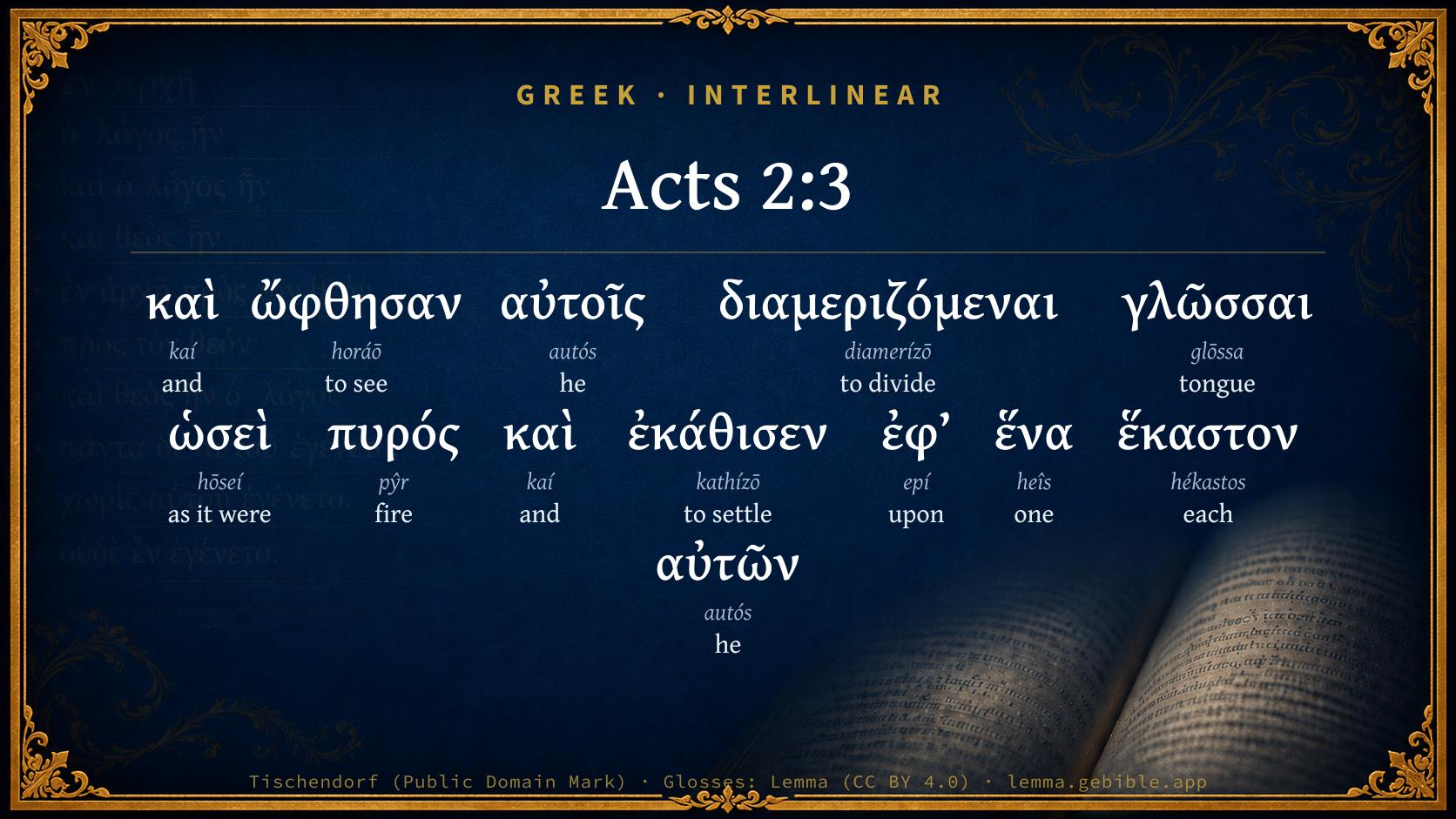
Greek (Tischendorf 8th ed.) Acts 2:3 appears in the Greek New Testament. The text above is from the Tischendorf 8th edition. Each word links to its Strong’s number and a concise gloss. Click any word for its full Thayer’s Greek Lexicon entry.
Download image
Cite this verse

Acts 2:3 (World English Bible). Public Domain. Lemma interlinear Bible study tool, https://lemma.gebible.app/v/acts/2/3.

Show BibTeX & RIS
BibTeX
RIS
English Translation
Tongues like fire appeared and were distributed to them, and one sat on each of them.
World English Bible · Public Domain
Download a study sheet

One document with this verse’s original text, its word-by-word gloss line, the meaning frame, cross-references with their text, attributed commentary, and full source and license credits — printable, and it pastes into notes with its structure intact.

This verse Autodidact and up

Study sheet (.html) Plain text (.txt)

A passage Seminary Student

Up to 50 verses in one chapter. A passage sheet keeps up to 6 commentary sources and 12 cross-references per verse, in the order this page ranks them, and says so on the sheet whenever that leaves anything out. Ask for a single verse and you get the Autodidact verse sheet above.

Everything on this page stays free to read, with no account — the sheet is a download of what is already on screen, not access to it.

Want to remove ads? Support Godless Engineer
Compare translations 3

The same verse in 3 English versions, stacked beneath the original-language interlinear above. Click any original word for its lexicon entry.

Each is an independent rendering of the whole verse — the interlinear is not word-aligned to these translations.

Highlighted words mark where these versions differ — a whole-verse word diff, not a word-by-word alignment.

  • World English Bible Public Domain
    Tongues like fire appeared and were distributed to them, and one sat on each of them.
  • King James Version Public Domain
    And there appeared unto them cloven tongues like as of fire, and it sat upon each of them.
  • unfoldingWord Literal Text CC BY-SA 4.0
    And tongues as if of fire appeared to them, distributing themselves, and they sat upon each one of them.

unfoldingWord Literal Text — © unfoldingWord, licensed CC BY-SA 4.0. Word-aligned USFM3 via Door43 (git.door43.org/unfoldingWord/en_ult).

Versions to compare (up to 4)

3 of 4 selected

Show all 19 translations

Every available English version of this verse, each an independent rendering of the whole verse.

  • World English Bible Public Domain
    Tongues like fire appeared and were distributed to them, and one sat on each of them.
  • Berean Standard Bible Public Domain
    They saw tongues like flames of fire that separated and came to rest on each of them.
  • Majority Standard Bible Public Domain
    They saw tongues like flames of fire that separated and came to rest on each of them.
  • King James Version Public Domain
    And there appeared unto them cloven tongues like as of fire, and it sat upon each of them.
  • American Standard Version (1901) Public Domain
    And there appeared unto them tongues parting asunder, like as of fire; and it sat upon each one of them.
  • Revised Version (1885) Public Domain
    And there appeared unto them tongues parting asunder, like as of fire; and it sat upon each one of them.
  • Geneva Bible (1599) Public Domain
    And there appeared vnto them clouen tongues, like fire, and it sate vpon eche of them.
  • Douay-Rheims (1899) Public Domain
    And there appeared to them parted tongues as it were of fire, and it sat upon every one of them:
  • Young's Literal Translation Public Domain
    and there appeared to them divided tongues, as it were of fire; it sat also upon each one of them,
  • Literal Standard Version CC BY-SA 4.0
    and there appeared to them divided tongues, as it were of fire; it also sat on each one of them,
  • Unlocked Literal Bible CC BY-SA 4.0
    There appeared to them tongues like fire that were distributed, and they sat upon each one of them.
  • unfoldingWord Literal Text CC BY-SA 4.0
    And tongues as if of fire appeared to them, distributing themselves, and they sat upon each one of them.
  • Darby Bible Public Domain
    And there appeared to them parted tongues, as of fire, and it sat upon each one of them.
  • World Messianic Bible Public Domain
    Tongues like fire appeared and were distributed to them, and one sat on each of them.
  • Webster's Bible Public Domain
    And there appeared to them, cloven tongues as of fire, and it sat upon each of them.
  • Free Bible Version CC BY-SA 4.0
    They saw what looked like separate tongue-shaped flames that settled on each of them.
  • Bible in Basic English Public Domain
    And they saw tongues, like flames of fire, coming to rest on every one of them.
  • Text-Critical English NT CC BY 4.0
    Divided tongues that looked like fire appeared to them and rested on each one of them.
  • Tyndale New Testament (1534) Public Domain
    And ther appered vnto them cloven tonges lyke as they had bene fyre and it sate vpon eache of them:

Literal Standard Version (2020), Covenant Press — licensed CC BY-SA 4.0. Text via the HelloAO Bible API (eBible.org). Unlocked Literal Bible (unfoldingWord) — licensed CC BY-SA 4.0. Text via the HelloAO Bible API (eBible.org). unfoldingWord Literal Text — © unfoldingWord, licensed CC BY-SA 4.0. Word-aligned USFM3 via Door43 (git.door43.org/unfoldingWord/en_ult). Free Bible Version, Dr. Jonathan Gallagher — licensed CC BY-SA 4.0. Text via the HelloAO Bible API (eBible.org).

Word by word

More ways to search: Search by grammar → Find every occurrence → Compare this word →

Practice this passage: Drill this verse → Learn its vocabulary →

διαμεριζόμεναι
diamerízō
G1266
“to divide”
Verb, Present, Middle or Passive, Participle, Nominative, Plural, Feminine
Part of Speech
Verb
Tense
Present
Voice
Middle or Passive
Mood
Participle
Case
Nominative
Number
Plural
Gender
Feminine
Full Thayer's Definition

Origin: from G1223 and G3307

TDNT: None

1. to cleave asunder, cut in pieces 2. to be divided into opposing parts, to be at variance, in dissension 3. to distribute
  1. καὶ kaí G2532 “and” Conjunction
  2. ὤφθησαν horáō G3708 “to see” Verb, Aorist, Passive, Indicative, 3rd person, Plural
  3. αὐτοῖς autós G846 “he” Personal pronoun, Dative, Plural, Masculine
  4. γλῶσσαι glōssa G1100 “tongue” Noun, Nominative, Plural, Feminine
  5. ὡσεὶ hōseí G5616 “as it were” Adverb
  6. πυρός pŷr G4442 “fire” Noun, Genitive, Singular, Neuter
  7. καὶ kaí G2532 “and” Conjunction
  8. ἐκάθισεν kathízō G2523 “to settle” Verb, Aorist, Active, Indicative, 3rd person, Singular
  9. ἐφ’ epí G1909 “upon” Preposition
  10. ἕνα heîs G1520 “one” Adjective, Accusative, Singular, Masculine
  11. ἕκαστον hékastos G1538 “each” Adjective, Accusative, Singular, Masculine
  12. αὐτῶν autós G846 “he” Personal pronoun, Genitive, Plural, Masculine

About this verse

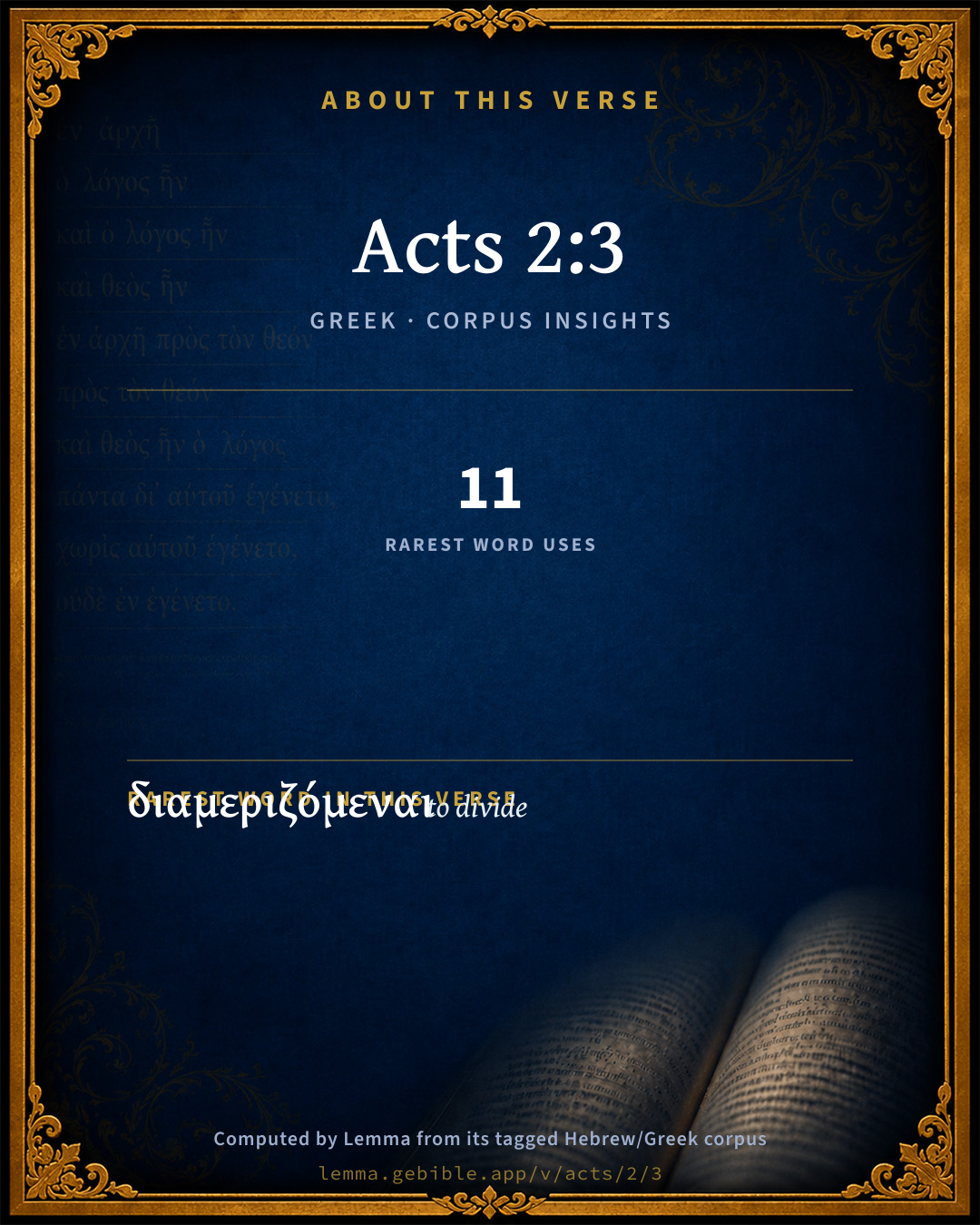
These counts appear in no published source. They are computed here, from the morphology-tagged text and Lemma’s own curated glosses. What Lemma adds →

13
words
11
distinct lemmas
Acts
section

Notable vocabulary

The rarest word here is διαμεριζόμεναι to divide G1266 — appearing just 11 times in the whole Greek New Testament.

Shared distinctive vocabulary

διαμεριζόμεναι to divide G1266 occurs in 11 verses of the Greek New Testament. Also found in:

Repetition

Words recur within this verse:

  • καὶ and G2532 ×2
  • αὐτοῖς he G846 ×2

Cross-references

11

Topical passages linked to Acts 2:3 in the Treasury of Scripture Knowledge — connected by theme and wording, ordered by reader-vote popularity; previews shown in the World English Bible.

  • Matthew 3:11 I indeed baptize you in water for repentance, but he who comes after me is mightier than I, whose shoes I am not worthy to carry. He will baptize you in the Holy Spirit.
  • John 1:32–33 John testified, saying, "I have seen the Spirit descending like a dove out of heaven, and it remained on him.
  • Jeremiah 23:29 Isn't my word like fire? says Yahweh; and like a hammer that breaks the rock in pieces?
  • Acts 2:4 They were all filled with the Holy Spirit, and began to speak with other languages, as the Spirit gave them the ability to speak.
  • Isaiah 11:2–3 The Spirit of Yahweh shall rest on him, the spirit of wisdom and understanding, the spirit of counsel and might, the spirit of knowledge and of the fear of Yahweh.
  • Luke 24:32 They said one to another, "Weren't our hearts burning within us, while he spoke to us along the way, and while he opened the Scriptures to us?"
  • Genesis 11:6 Yahweh said, "Behold, they are one people, and they have all one language; and this is what they begin to do. Now nothing will be withheld from them, which they intend to do.
  • Malachi 3:2–3 "But who can endure the day of his coming? And who will stand when he appears? For he is like a refiner's fire, and like launderer's soap;
  • Acts 2:11 Cretans and Arabians: we hear them speaking in our languages the mighty works of God!"
  • 1 Corinthians 12:10 and to another workings of miracles; and to another prophecy; and to another discerning of spirits; to another different kinds of languages; and to another the interpretation of languages.
  • Revelation 14:6 I saw an angel flying in mid heaven, having an eternal Gospel to proclaim to those who dwell on the earth, and to every nation, tribe, language, and people.

Cross-references courtesy of OpenBible.info (CC BY 4.0).

Commentary

Notes on Acts 2:3 from classic Christian and Jewish commentators (each source and its license shown beneath its notes). The classic Christian expositions comment on the surrounding passage and are grouped to its opening verse, so a note may address several verses; the Jewish commentaries on the Tanakh (Rashi and others) are per-verse, so they appear only where the commentator wrote on this verse.

Lemma curates 59 commentaries, every one of them public domain or Creative Commons licensed, each selected and text-cleaned for this edition rather than reprinted as found. About our sources →

Bengel's Gnomon

Johann Albrecht Bengel

Act 2:3. Αὐτοῖς, to them) Construe this with ὤφθησαν, there appeared, but in such a way as that the force of the pronoun may extend also to being shared, or parted [among them], διαμεριζόμεναι. And this is tantamount to distributed, but in the present: with which comp. Act 2:45, διεμέριζον αὐτὰ πᾶσιν, “they parted them to all men.” The expression used is not σχιζόμεναι, as if the tongues in their mouths were cloven or split; nor διαιρούμεναι, divided, as if it was only a different kind of fiery eloquence or utterance that was given to different persons. An intermediate verb is used, viz. διαμεριζόμεναι.—γλῶσσαι, tongues) The word is taken here in a metaphorical sense, as לשון everywhere, and לְשׁוֹן אֵשׁ, Isa 5:24, the tongue of fire, that there may be denoted, as it were fiery tongues. Yet a considerable part of the literal (unfigurative) meaning remains, because speaking is the subject in hand. There were little tongue-like flames resting on the heads of the disciples individually, not coming forth out of their mouths; for there follows, and sat, viz. the Holy Spirit (see foll. ver.), which “came upon” them, ch. Act 1:8, under the appearance of the tongues. There is not added the article αἱ, which would denote the natural tongues in the apostles’ mouths, which were now miraculously affected.—ἐκάθισέ τε, and sat) viz. ὁ καθίζων, the sitter. Comp. ἐκάθισαν, “I saw thrones, and they sat upon them,” Rev 20:4. An appropriate ellipsis: for not immediately, but only after a little time, it was evident that the Sitter was the Holy Spirit.—ἐφʼ ἓνα ἓκαστον, upon each one) Comp. by all means ἐπὶ, upon, Joh 1:32-33, “The Spirit—abode—remaining—upon Him.” [This was the baptism of the Holy Ghost and of fire.—V. g.]

Bengel's Gnomon of the New Testament — English translation (T&T Clark, Edinburgh, 1860) — public domain. Text from a community e-Sword module.

Meyer's Critical & Exegetical Commentary

Heinrich August Wilhelm Meyer

Act_2:3. After the audible σημεῖον immediately follows the visible. Incorrectly Luther: there were seen on them the tongues divided as if they were of fire.[113] The words mean: There appeared to them, i.e. there were seen by them, tongues becoming distributed, fire-like, i.e. tongues which appeared like little flames of fire, and were distributed (Act_2:45; Luk_22:17; Luk_23:34) upon those present (see the following ἐκάθισε κ.τ.λ.). They were thus appearances of tongues, which were luminous, but did not burn; not really consisting of fire, but only ὡσεὶ πυρός; and not confluent into one, but distributing themselves severally on the assembled. As only similar to fire, they bore an analogy to electric phenomena; their tongue-shape referred as a σημεῖον to that miraculous λαλεῖν which ensued immediately after, and the fire-like form to the divine presence (comp. Exo_3:2), which was here operative in a manner so entirely peculiar. The whole phenomenon is to be understood as a miraculous operation of God manifesting Himself in the Spirit, by which, as by the preceding sound from heaven, the effusion of the Spirit was made known as divine, and His efficacy on the minds of those who were to receive Him was enhanced. A more special physiological definition of the ΣΗΜΕῖΑ, Act_2:2-3, is impossible. Lange, Apost. Zeitalt. II. p. 19, fancifully supposes that the noise of the wind was a streaming of the heavenly powers from above, audible to the opened visionary sense, and that the tongues of fire were a disengaging of the solar fire-power of the earth and its atmosphere (?). The attempts, also, to convert this appearance of fire-like tongues into an accidental electric natural occurrence (Paulus, Thiess, and others) are in vain; for these flames, which make their appearance, during an accumulation of electric matter, on towers, masts, and even on men, present far too weak resemblances; and besides, the room of a house, where the phenomenon exclusively occurred, was altogether unsuited for any such natural development. The representation of the text is monstrously altered by Heinrichs: Fulgura cellam vere pervadebant, sed in inusitatas imagines ea effinxit apostolorum commota mens; as also by Heumann: that they believed that they saw the fiery tongues merely in the ecstatic state; and not less so by Eichhorn, who says that they saw flames signifies in rabbinical usus loquendi: they were transported into ecstatic excitement. The passages adduced by Eichhorn from Schoettgen contain no merely figurative modes of expression, but fancies of the later Rabbins to be understood literally in imitation of the phenomena at Sinai,of which phenomena, we may add, a real historical analogue is to be recognised in our passage.

ἐκάθισέ τε] namely, not an indefinite subject, something (Hildebrand, comp. Buttm. neut. Gr. p. 118 [E. T. 134]), but such a γλῶσσα ὡσεὶ πυρός. If Luke had written ἘΚΆΘΙΣΑΝ (see the critical remarks), the notion that one ΓΛῶΣΣΑ sat upon each would not have been definitely expressed. Comp. Winer, p. 481 [E. T. 648]. Oecumenius, Beza, Castalio, Schoettgen, Kuinoel, incorrectly take ΠῦΡ as the subject, since, in fact, there was no fire at all, but only something resembling fire; ὩΣΕῚ ΠΥΡΌς serves only for comparison, and consequently ΠῦΡ cannot be the subject of the continued narrative. Others, as Chrysostom, Theophylact, Luther, Calvin, Wolf, Bengel, Heinrichs et al., consider the πνεῦμα ἅγιον as subject. In that case it would have to be interpreted, with Fritzsche (Conject. I. p. 13): ΚΑΘΊΣΑΝΤΟς ἘΦʼ ἝΝΑ ἝΚΑΣΤΟΝ ΑὐΤῶΝ ἘΠΛΉΣΘΗΣΑΝ ἍΠΑΝΤΕς ΠΝΕΎΜΑΤΟς ἉΓΊΟΥ, and Mat_17:18 would be similar. Very harsh, seeing that the ΠΝΕῦΜΑ ἍΓΙΟΥ, in so far as it sat on the assembled, would appear as identical with its symbol, the fiery tongues; but in so far as it filled the assembled, as the ΠΝΕῦΜΑ itself, different from the symbol.

The ΤΈ joining on to the preceding (Lachm. reads ΚΑΊ, following insufficient testimony) connects ἘΚΆΘΙΣΕ Κ.Τ.Λ. with ὬΦΘΗΣΑΝ Κ.Τ.Λ. into an unity, so that the description divides itself into the three acts: ὤφθησαν κ.τ.λ., ἐπλήσθησαν κ.τ.λ., and ἤρξαντο κ.τ.λ., as is marked by the thrice recurring καί.

[113] Therefore the expression is not to be explained from Isa_5:24, for there לְשׁוֹן אֵשׁ is a representation of that which consumes.

Meyer — Critical and Exegetical Commentary on the New Testament — English translation by Peter Christie, edited by Frederick Crombie (T&T Clark, 1880) — public domain. Text from a community e-Sword module.

Expositor's Greek Testament

ed. W. Robertson Nicoll

Act 2:3 . διαμεριζόμ . γλῶσσαι : the audible σημεῖον is followed by a visible: γλῶσσαι the organs of speech by which the wonderful works of God were to be proclaimed, so that the expression cannot be explained from Isa 5:24 , where the tongue of fire is represented as an organ of destruction (Wendt, note, in loco ). ὡσεὶ πυρός in their appearance and brightness. The words themselves therefore forbid reference to a natural phenomenon, to say nothing of the fact of the spiritual transformation of the Apostles which followed. Fire like wind was symbolic of the divine Presence, Exo 3:2 , and of the Spirit who purifies and sanctifies, Eze 1:13 , Mal 3:2-3 (see Wetstein for classical instances of fire symbolical of the presence of the deity; cf., e.g. , Homer, Iliad , xviii., 214; Virgil, Æn. , ii., 683). διαμεριζ ., lit [116] , dividing or parting themselves off. R.V. “tongues parting asunder,” so that originally they were one, as one mighty flame of fire. This rendering is strictly in accordance with the meaning of the verb. Vulgate dispertitæ (the word used by Blass). διαμερίζω is used once again in Act 2:45 in the active voice, and once only by St. Matthew and St. Mark (once by St. John as a quotation) in the middle voice, but six times by St. Luke in his Gospel; frequently in the LXX. ἐκάθισε (not - αν ), sc. , γλῶσσα (not πῦρ or πνεῦμα ἅγιον ), although the latter is advocated by Chrysostom, Theophylact, Bengel: “it sat,” R.V. The singular best expresses the result of the tongues parting asunder, and of the distribution to each and all. So too ἐφʼ ἕνα ἕκαστον αὐτῶν , “upon each one of them,” R.V., cf. Act 2:6 εἷς ἕκαστος (and Act 2:8 ). The resting of a flame of fire upon the head as a token of the favour of Heaven may be illustrated from classical sources (see above and instances in Wetstein), but the thought here is not so much of fire as the token of divine favour, as of the tongue (as of fire) conferring a divine power to utter in speech divine things.

[116] literal, literally.

The Expositor's Greek Testament, edited by W. Robertson Nicoll (1897–1910) — public domain. Text from a community e-Sword module.

Jamieson, Fausset & Brown

Robert Jamieson, A. R. Fausset & David Brown

cloven tongues, like as of fire, &c.--"disparted tongues," that is, tongue-shaped, flame-like appearances, rising from a common center or root, and resting upon each of that large company:--beautiful visible symbol of the burning energy of the Spirit now descending in all His plenitude upon the Church, and about to pour itself through every tongue, and over every tribe of men under heaven!

Jamieson, Fausset & Brown — Commentary Critical and Explanatory on the Whole Bible (1871) — public domain (CC PDM 1.0). Text via the HelloAO Bible API.

Adam Clarke's Commentary

Verse 3. Cloven tongues like as of fire] The tongues were the emblem of the languages they were to speak. The cloven tongues pointed out the diversity of those languages; and the fire seemed to intimate that the whole would be a spiritual gift, and be the means of bringing light and life to the souls who should hear them preach the everlasting Gospel in those languages.

Sat upon each of them.] Scintillations, coruscations, or flashes of fire, were probably at first frequent through every part of the room where they were sitting; at last these flashes became defined, and a lambent flame, in the form of a cloven tongue, became stationary on the head of each disciple; a proof that the Spirit of God had made each his temple or residence. That unusual appearances of fire were considered emblems of the presence and influence of God, both the Scriptures and the Jewish writings amply prove. Thus God manifested himself to Moses, when he appointed him to deliver Israel, Ex 3:2-3; and thus he manifested himself when he delivered the law on Mount Sinai, Ex 19:16-20. The Jews, in order to support the pretensions of their rabbins, as delivering their instructions by Divine authority and influence, represent them as being surrounded with fire while they were delivering their lectures; and that their words, in consequence, penetrated and exhilarated the souls of their disciples. Some of the Mohammedans represent Divine inspiration in the same way. In a fine copy of a Persian work, entitled Ajaceb al Makhlookat, or Wonders of Creation, now before me, where a marred account of Abraham's sacrifice, mentioned Ge 15:9-17, is given, instead of the burning lamp passing between the divided pieces of the victim, Ge 15:17, Abraham is represented standing between four fowls, the cock, the peacock, the duck, and the crow, with his head almost wrapped in a flame of lambent fire, as the emblem of the Divine communication made to him of the future prosperity of his descendants. The painting in which this is represented is most exquisitely finished. This notion of the manner in which Divine intimations were given was not peculiar to the Jews and Arabians; it exists in all countries; and the glories which appear round the heads of Chinese, Hindoo, and Christian saints, real or supposed, were simply intended to signify that they had especial intercourse with God, and that his Spirit, under the emblem of fire, sat upon them and became resident in them. There are numerous proofs of this in several Chinese and Hindoo paintings in my possession; and how frequently this is to be met with in legends, missals, and in the ancient ecclesiastical books of the different Christian nations of Europe, every reader acquainted with ecclesiastical antiquity knows well. See the dedication of Solomon's temple, 2Ch 7:1-3.

The Greek and Roman heathens had similar notions of the manner in which Divine communications were given: strong wind, loud and repeated peals of thunder, coruscations of lightning, and lambent flames resting on those who were objects of the Deities regard, are all employed by them to point out the mode in which their gods were reported to make their will known to their votaries. Every thing of this kind was probably borrowed from the account given by Moses of the appearance on Mount Sinai; for traditions of this event were carried through almost every part of the habitable world, partly by the expelled Canaanites, partly by the Greek sages travelling through Asiatic countries in quest of philosophic truth: and partly by means of the Greek version of the Septuagint, made nearly three hundred years before the Christian aera.

"A flame of fire seen upon the head of any person was, among the heathens, considered as an omen from their gods that the person was under the peculiar care of a supernatural power, and destined to some extraordinary employment. Many proofs of this occur in the Roman poets and historians. Wetstein, in his note on this place, has made an extensive collection of them. I shall quote but one, which almost every reader of the AEneid of Virgil will recollect: -

Talia vociferans gemitu tectum omne replebat:

Cum subitum, dictuque oritur mirabile monstrum.

Namque manus inter, maestorumque ora parentum.

Ecce levis summo de vertice visus Iuli

Fundere lumen apex, tactuque innoxia molli

Lambere flamma comas, et circum tempora pasci.

Nos pavidi trepidare metu, crinemque flagrantem

Excutere, et sanctos restinguere fontibus ignes.

At pater Anchises oculos ad sidera laetus

Extulit, et coelo palamas cum voce tetendit:

Jupiter omnipotens ___

Da auxilium, pater, atque haec omina firma.

VIRG. AEN. ii. v. 679.

While thus she fills the house with clamorous cries,

Our hearing is diverted by our eyes;

For while I held my son, in the short space

Betwixt our kisses and our last embrace,

Strange to relate! from young Iulus' head, )

A lambent flame arose, which gently spread >

Around his brows, and on his temples fed. )

Amazed, with running water, we prepare

To quench the sacred fire, and slake his hair;

But old Anchises, versed in omens, rear'd

His hands to heaven, and this request preferr'd:

If any vows almighty Jove can bend,

Confirm the glad presage which thou art pleased to send.

DRYDEN.

There is nothing in this poetic fiction which could be borrowed from our sacred volume; as Virgil died about twenty years before the birth of Christ.

It may be just necessary to observe, that tongue of fire may be a Hebraism: for in Isa 5:24, לשון אש leshon esh, which we render simply fire, is literally a tongue of fire, as the margin very properly has it. The Hebrews give the name of tongue to most things which terminate in a blunt point: so a bay is termed in Jos 15:2, לשן lashon, a tongue. And in Jos 15:5, what appears to have been a promontory is called לשון הים leshon hayam, a tongue of the sea.

It sat upon each] That is, one of those tongues, like flames, sat upon the head of each disciple; and the continuance of the appearance, which is indicated by the word sat, shows that there could be no illusion in the case. I still think that in all this case the agent was natural, but supernaturally employed.

Adam Clarke's Commentary on the Bible (1810–1826) — public domain. Text from a community e-Sword/MySword module.

Ellicott's Commentary for English Readers

(3) Lastly, the Feast of Pentecost had—traditionally, at least—also a commemorative character. On that day—so it was computed by the later Rabbis, though the Book of Exodus (Exo_19:1) seems to leave the matter in some uncertainty—the Israelites had encamped round Sinai, and there had been thunders and darkness and voices, and the great Laws had been proclaimed. It was, that is, an epoch-making day in the religious history of Israel. It was fit that it should be chosen for another great epoch-making day, which, seeming at first to be meant for Israel only, was intended ultimately for mankind.

Was fully come.—Literally, was being accomplished. The word seems chosen to express the fact that the meeting of the disciples was either on the vigil of the Feast-day, or in the early dawn. Assuming the Passover to have occurred on the night of the Last Supper, the Day of Pentecost would fall on the first day of the week, beginning, of course, at the sunset of the Sabbath. So the Churches of East and West have commemorated the day as on the eighth Sunday after Easter. In the Latin nations the name of Pentecost remains scarcely altered. The Pfingst of the Germans shows it still surviving in a very contracted form. Some eminent scholars have thought that our Whitsun-day represents it after a still more altered form, and that this is a more probable etymology of the word than those which connect it with the white garments worn on that day by newly-baptised converts, or with the gift of “wit, or wisdom.”

With one accord in one place.—Probably in the same large upper room as in Act_1:13. We may reasonably think of the same persons as being present. The hour, we may infer from Act_2:15, was early in the morning, and probably followed on a night of prayer. It is said, indeed, that devout Jews used to solemnise the vigil of Pentecost by a special thanksgiving to God for giving His Law to Israel; and this may well have been the occasion that brought the disciples together (Schöttgen, Hor. Hebr. in Act_2:1). It was, in the mystic language of the Rabbis, the night on which the Law, as the Bride, was espoused to Israel, as the Bridegroom. The frequent occurrence of the Greek word for “with one accord” (Act_1:14; Act_2:46; Act_4:24; Act_5:12) is significant as showing the impression made on the writer by the exceptional unity of the new society. Outside the Acts it is found only in Rom_15:16.

(3) There appeared unto them cloven tongues like as of fire.—Better, and tongues as of fire were seen by them, parted among them. The word translated “cloven” cannot possibly have that meaning. It is not uncommon (e.g., Act_2:45; Mat_27:35; Luk_22:17; and Joh_19:24), and is always used in the sense of dividing or distributing. What the disciples saw would, perhaps, be best described in modern phrase as a shower of fiery tongues, coming they knew not whence, lighting for a moment on each head, and then vanishing. The verb “it (sc., a tongue of fire) sat upon” is in the tense which expresses momentary, not continuous, action.

A Bible Commentary for English Readers, edited by Charles John Ellicott (1878–1897) — public domain. Text from a community e-Sword module.

The Cambridge Bible for Schools and Colleges

gen. ed. J. J. S. Perowne

3. cloven tongues like as of fire] Better, tongues like as of fire parting asunder; cf. Isa_5:24, where the Hebrew has “tongue of fire” while the A. V. gives only “fire.” It is also to be noticed that the appearance is not called fire, but only compared unto fire. The idea conveyed by the verb is that the flamelike tongues were distributing themselves throughout the assembly, and the result is expressed by what follows; and it sat upon each of them. The intention of the writer is to describe something far more persistent than meteoric light or flashes of electricity. The sound which is heard fills the house, and the flames rest for some time on the heads of the disciples. (See Act_2:33.)

The Cambridge Bible for Schools and Colleges (gen. ed. J. J. S. Perowne; Cambridge University Press, 1878–1918) — public domain. Text from a community e-Sword module.

John Gill's Exposition

And there appeared unto them cloven tongues like as of fire,.... An emblem of the various tongues and languages, in which they were to preach the Gospel; these appearances were like flames of fire parted, and these parted flames looked like tongues; so, a flame of fire is with, the Jews called, , "a tongue of fire", Isa 5:24 hence the Apostle James compares a tongue to fire, Jam 3:6 this was the baptism with fire, John the Baptist speaks of; see Gill on Mat 3:11; and the Jews say (t),

"the holy blessed God baptizeth with fire, and the wise shall understand.

Through this baptism of the Holy Ghost and fire, the apostles became more knowing, and had a greater understanding of the mysteries of the Gospel, and were more qualified to preach it to people of all nations and languages. The Holy Spirit, in his gifts and graces, is compared to fire, because of its purity, light, and heat, as well as consuming nature; the Spirit sanctifies, and makes men pure and holy, purges from the dross of sin, error and superstition; and enlightens the minds of men, and gives them knowledge of divine and spiritual things; and fills them with zeal and fervour for the glory of God and Christ, and the good of his church and interest, and for the doctrines and ordinances of the Gospel; as well as fortifies them against their enemies, whom he consumes, according to Zac 2:5 a passage of Scripture the Jews make use of in an uncommon sense; for they say (u), that as

"Jerusalem was destroyed by fire, "by fire it shall be built again"; as it is said, Zac 2:5 "For I, saith the Lord, will be unto her a wall of fire round about".

The pouring forth of the Spirit upon the apostles, in this form of cloven tongues, as of fire, was indeed the means of rebuilding Jerusalem, in a spiritual sense; or of founding the Gospel church state in the world:

and it sat upon each of them; the fire, or the Holy Ghost in the appearance of fire. The Syriac and Arabic versions read, "and they sat upon each of them"; and so Beza's most ancient copy; that is, the cloven tongues sat on them; either one upon one of them and another upon another, or many upon each of them: where they sat, whether on their lips, or on their heads, it not certain, probably on the latter; nor how long they sat; however, their sitting upon them may denote the continuance of the gifts and graces of the Spirit with them. These cloven tongues cannot but bring to mind the division and confusion of the tongues or languages at Babel; which gave rise to different nations, and different religions; but these divided tongues gave rise to the spreading of the Gospel, and settling the true religion among the nations of the world. The Jews (w) seem to have respect to this account, when they tell us of.

"lights from above, that came forth and dwelt in the synagogues, "on the heads" of those that prayed, and the lights "were divided" upon their heads.

(t) R. Menachem in Lev. viii. apud Ainsworth in Gen. xvii. 12. (u) T. Hieros. Taaniot, fol. 65. 3. Seder Tepillot, fol. 23. 2. Ed. Basil. (w) Zohar in Num. fol. 79. 2.

John Gill's Exposition of the Whole Bible (1746–1763) — public domain (CC PDM 1.0). Text via the HelloAO Bible API.

Trapp's Complete Commentary

John Trapp

3 And there appeared unto them cloven tongues like as of fire, and it sat upon each of them.

Ver. 3. Cloven tongues] Teaching them both ορθοτομειν, to divide the word aright, and also ορθοποδειν, as some will have it; their tongues being cloven, as their feet were into toes, teaching them too to foot it aright. Diodorus Siculus tells us of a certain island beyond Arabia, the inhabitants whereof have cloven tongues, so that therewith they can alter their speech at their pleasure, imitate the tunes of various birds, and (which is more strange) they can perfectly speak to two persons and to two purposes at once; to one with one part of their tongue and to another with the other part; Sed fides sit penes Authorem, believe it who will.

John Trapp, A Commentary or Exposition upon All the Books of the Old and New Testament (1647–1656) — public domain. Text from a community e-Sword module.

Albert Barnes' Notes on the Bible

And there appeared unto them - There were seen by them, or they saw. The fire was first seen by them in the room before it rested in the form of tongues on the heads of the disciples. Perhaps the fire appeared at first as scintillations or coruscations, until it became fixed on their heads.

Tongues - γλῶσσαι glōssai. The word “tongue” occurs often in the Scriptures to denote the member which is the instrument of taste and speech, and also to denote “language” or “speech” itself. It is also used, as with us, to denote what in shape resembles the tongue. Thus, Jos 7:21, Jos 7:24 (in Hebrew), “a tongue of gold,” that is, a wedge of gold; Jos 15:5; Jos 18:19; Isa 11:15, “The tongue of the sea,” that is, a bay or gulf. Thus also we say “a tongue of land.” The phrase “tongue of fire” occurs once, and once only, in the Old Testament Isa 5:24, “Therefore as the fire devoureth the stubble (Hebrew: tongue of fire), and the flame consumeth,” etc. In this place the name tongue is given from the resemblance of a pointed flame to the human tongue. Anything long, narrow, and tending to a point is thus in the Hebrew called “a tongue.” The word here means, therefore, “slender and pointed appearances” of flame, perhaps at first moving irregularly around the room.

cloven - Divided, separated - διαμεριζόμεναι diamerizomenai - from the verb διαμερίζω diamerizō, “to divide, or distribute into parts.” Mat 27:35, “they parted his garments”; Luk 22:17, “Take this (the cup) and divide it among yourselves.” Probably the common opinion is, that these tongues or flames were, each one of them split, or forked, or cloven. But this is not the meaning of the expression. The idea is that they were separated or divided one from another; it was not one great flame, but was broken up, or cloven into many parts, and probably these parts were moving without order in the room. In the Syriac it is, “And there appeared unto them tongues which divided themselves like fire, and sat upon each of them.” The old Ethiopic version reads it, “And fire, as it were, appeared to them and sat on them.”

And it sat upon each of them - Or “rested,” in the form of a lambent or gentle flame, upon the head of each one. This showed that the prodigy was directed to them, and was a very significant emblem of the promised descent of the Holy Spirit. After the rushing sound and the appearance of the flames, they could not doubt that here was some remarkable interposition of God. The appearance of fire, or flame, has always been regarded as a most striking emblem of the Divinity. Thus, Exo 3:2-3, God is said to have manifested himself to Moses in a bush which was burning, yet not consumed. Thus, Exo 19:16-20, God descended on Mount Sinai in the midst of thunders, and lightnings, and smoke, and fire, striking emblems of his presence and power. See also Gen 15:17. Thus, Deu 4:24, God is said to be “a consuming fire.” Compare Heb 12:29. See Eze 1:4; Psa 18:12-14. The Classic reader will also instantly recall the beautiful description in Virgil (Aeneid, b. 2:680-691). Other instances of a similar prodigy are also recorded in profane writers (Pliny, H. N., 2:37; Livy, 1:39). These appearances to the apostles were emblematic, doubtless:

Of the promised Holy Spirit, as a Spirit of purity and of power. The prediction of John the Immerser, “He shall baptize with the Holy Spirit and with fire” Mat 3:11 would probably be recalled at once to their memory. The unique appearance, that of tongues, was an emblem of the diversity of languages which they were about to be able to utter. Any form of fire would have denoted the presence and power of God; but a form was adopted expressive of “what was to occur.” Thus, “any divine appearance” or “manifestation” at the baptism of Jesus might have denoted the presence and approbation of God; but the form chosen was that of a dove descending - expressive of the mild and gentle virtues with which he was to be imbued. So in Eze 1:4, any form of flame might have denoted the presence of God; but the appearance actually chosen was one that was strikingly emblematical of his providence. In the same way, the appearance here symbolized their special endowments for entering on their great work - the ability to speak with new tongues.

Albert Barnes' Notes on the Bible (1834–1885) — public domain. Text from a community e-Sword/MySword module.

Haydock's Catholic Bible Commentary

Tongues ... of fire. The Hebrews use the name tongue, for almost any thing pointed. Thus they say, a tongue of the earth, for a promontory. (Josue xv. 5.) A fiery tongue for a flame in shape of a tongue. (Isaias v. 24.) The expression, therefore, in this place, may mean noting more than sparks, or rather flames, which appeared above all who were in the house. --- Sed et Latinis quod extremum et acutum est lingua dicitur, quare scopulos summos & invios linguas dixit Cæsar. (Pastorini) --- By the fiery tongues is signified the efficacy of the apostles’ preaching, and the gift of tongues bestowed upon them. (Menochius)

George Leo Haydock (1774–1849), Haydock's Catholic Family Bible and Commentary, 1859 edition — public domain. Excludes Psalms (Douay-Rheims chapter numbering differs from Protestant) and Deuterocanonical books (Catholic canon only).

Matthew Poole's English Annotations

Cloven tongs; to signify the variety of languages which the apostles should be enabled to speak, to qualify them to preach the gospel unto all nations, and to remove the obstacle which the confusion of tongues caused.

Like as of fire; which represented,

1. The light that the apostles should impart;

2. The fervent heat and zeal which they should be endowed with;

3. The gospel’s spreading in the world, and carrying all before it, prevailing over all errors;

4. The purity and holiness which they and all that preach the gospel ought to appear withal.

And it sat upon each of them; remained, as far as was necessary for the founding of the Christian religion; and was not, as the gift of prophecy, bestowed only occasionally, as on Nathan, Samuel.

Matthew Poole's English Annotations on the Holy Bible (1683–1685) — public domain. Text from a community e-Sword/MySword module.

Whedon's Commentary on the Bible

Daniel D. Whedon

3. Unto them—To the “about one hundred and twenty” present.

Cloven tongues—The tongues appeared, then settled one upon the head of each person; each tongue being cloven, that is, undivided at the root, but flaring into several points at the extremity. By this terminal division was beautifully symbolized the variety of dialect spoken by each tongue.

Most commentators at the present day construe the Greek word rendered cloven to signify distributed; that is, distributed a single tongue to each individual. But the word usually signifies, not the distribution of several wholes, but the distribution of one whole into several parts; as, for instance, a pile of garments into the several articles. But here there is no one common whole or single mass of tongues to be distributed; nor is there any common mass of fire back of the tongues to be divided or distributed off into single tongues; but each tongue being a whole is distributed into terminal parts. The other rendering destroys the symbol by which the divided or terminally distributed tongues indicate the miraculous variety of languages.

Like as of fire—Not literal fire, but like as fire. It was the phenomenal emblem of the invisible Spirit; its divine essence, as it were, made visible. As Alford says, the sound was the Spirit’s symbol to the ear, as the fire (and we may add the “shape like a dove,” Luk_3:22) to the eye.

It sat—What sat? Not the tongues, for that is plural; but plainly the quasi-fire just mentioned, in the tongue shape. What Luke means to say is that the Spirit itself sat upon each head and gave them utterance. The fire sat upon their heads; and, as if it burned down into the depths of their souls, they were filled with the Holy Ghost.

Daniel D. Whedon (gen. ed.), Commentary on the Old and New Testaments (1874–1909) — public domain. Text from a community e-Sword module.

The Pulpit Commentary

Tongues parting asunder for cloven tongues, A.V.; each one for each, A.V. There appeared. They had heard the sound, now they see the tongues of fire, and then they feel the Spirit working in them (see ver. 34). Tongues parting asunder. The idea of the cloven tongue, i.e. a tongue parted into two, which is thought to have been the origin of the miter, is not suggested either by the Greek or by the circumstances, and is clearly a mistaken one. Diamerizomenai means distributing themselves or being distributed. From the central apparition, or rather place of sound, they saw issuing forth many several tongues, looking like small flames of fire, and one such tongue sat upon each one of the brethren or disciples present. Each one. That Chrysostom is right ("Hom."4.) in interpreting the each one of this verse of the hundred and twenty, and not of the twelve, and the ell in ver. 4 of all present besides the apostles, may be demonstrated. For not only must the all of ver. 1 refer to the same company as was described in the preceding chapter (vers. 15-26), but it is quite clear in ver. 15 of this chapter that Peter and the eleven (ver. 14), standing up separate from the body of the disciples, say of them, "These are not drunken, as ye suppose;" which is a demonstration that those of whom they thus spoke had been speaking with tongues. (see also Act_10:44) St. Augustine, too, says that the hundred and twenty all received the Holy Spirit. To the same effect Meyer, Wordsworth, Alford (who adds, "Not the hundred and twenty only, but all the believers in Christ then congregated at Jerusalem;" so also Lange). Farrar well remarks, "It was the consecration of a whole Church to be all of them a chosen generation, a royal priesthood, a holy nation, a peculiar people" ("Life of St. Paul," Ac 5). Lange says, "Not only the apostles, but all the disciples, were filled with the Holy Ghost. There is a universal priesthood of all believers, and the Holy Ghost is the anointing which consecrates and qualifies for this priesthood" ("On the Acts," Clark"s edit., p. 67).

The Pulpit Commentary (1880–1919), ed. H.D.M. Spence-Jones & Joseph S. Exell — public domain. Text from a community e-Sword module.

John Wesley's Explanatory Notes

And there appeared distinct tongues, as of fire - That is, small flames of fire. This is all which the phrase, tongues of fire, means in the language of the seventy. Yet it might intimate God's touching their tongues as it were (together with their hearts) with Divine fire: his giving them such words as were active and penetrating, even as flaming fire.

John Wesley, Explanatory Notes Upon the Whole Bible (1754–1765) — public domain. Text via the GEBible commentary corpus.

Scofield Reference Notes

C. I. Scofield

cloven tongues tongues, as of fire, parting and sitting upon each of them.

The Scofield Reference Bible (1917 edition), notes by C. I. Scofield — public domain. Text from a community e-Sword module.

Godbey's Commentary on the New Testament

William B. Godbey

TONGUES OF FIRE

3. The tongue symbolizes the gospel whose dispensation is here and now inaugurated. God has never given but one definition of His minister, — “a flame of fire” (Heb 1:7). Satan is the great counterfeiter. He counterfeits everything that God does, in that way fooling the people till he can dump them into hell. The world is to-day chock full of the devil’s religion, in which he deceives people by millions, Pagans, Moslems, Papists and Protestants, making them believe he is God. Despite all the chicanery of hell, honest Bible readers, illuminated by the Holy Ghost, have no trouble to detect the devil’s counterfeit. The way to heaven is so plain “that wayfaring men, though fools, shall not err therein” (Isaiah 35). God’s gospel is all fire. We need two tongues to preach it, corresponding with the two great works of grace in the plan of salvation.

As we see here, both these tongues are flames of fire; the one to preach hell- fire to alarm them, bring them to repentance and keep them out of hell; and the other to preach heavenly fire to Christians to sanctify them wholly with the real fiery baptism, burning out of them everything that will not do for heaven, and thus sanctifying them wholly to dwell in the glorified presence of God, world without end. The most stupid ignoramus can discriminate between fire and ice. It is equally easy for honest people to distinguish between God’s religion and Satan’s. The former burns up all sin and fills you with heavenly fire, while the latter freezes you into an iceberg. The devil’s religion freezes you here and burns you in hell through all eternity. Good Lord, have mercy on the north-pole churches, with their icebergy members and their cultured pastors. Who can contemplate the wholesale delusions of the devil in the icebergy churches and not recognize the awful fulfillment of the latter-day prophecies of our blessed Savior? “Because iniquity doth abound the love of many shall wax cold.

William B. Godbey, Commentary on the New Testament (1896–1900) — public domain. Text from a community e-Sword module.

McGarvey & Pendleton's Commentaries

J. W. McGarvey

3, 4. Simultaneous with the sound, (3) " There appeared to them tongues, distributed, as of fire, and it sat upon each one of them. (4) And they were all filled with the Holy Spirit, and began to speak in other tongues, as the Spirit gave them utterance. " This is the immersion in the Holy Spirit which had been promised by Jesus, and for which the apostles had been waiting since his ascension. It is highly important that we should understand in which it consisted, and the necessity for its occurrence.

There is not, in the New Testament, a definition of the immersion in the Holy Spirit, but we have here what is possibly better, a living instance of its occurrence. The historian gives us a distinct view of men in the act of being immersed in the Spirit, so that, in order to understand it, we have to look on, and tell what we see and hear. We see, then, flaming tongues, like flames of fire, distributed so that one rests upon each of the twelve apostles. In the clause, "it sat upon each of them," the singular pronoun it is used after the plural tongues, to indicate that not all, but only one of the tongues sat upon each apostle, the term distributed having already suggested the contemplation of them singly. We see this, and we hear all twelve at once speaking in languages to them unknown. We see a divine power present with these men, for to no other power can we attribute these tongues. We hear the unmistakable effects of a divine power acting upon their minds; for no other power could give them an instantaneous knowledge of language which they had never studied. The immersion, therefore, consists in their being so filled with the Holy Spirit as to be attended by a miraculous physical power, and to exercise a miraculous intellectual power. If there is any other endowment conferred upon them, the historian is silent in reference to it, and we have no right to assume it. Their ability to speak in other languages is not an effect upon their tongues directly, but merely a result of the knowledge imparted to them. Neither are we to regard the nature of the sentiments uttered by them as proof of any miraculous moral endowment; for pious sentiments are the only kind which the Spirit of God would dictate, and they are such as these men, who had been for some time "continually in the temple, praising and blessing God," and "continuing with one consent in prayer and supplication," would be expected to utter, if they spoke in public at all.

We have already said something of the necessity of this event; but, at the risk of some repetition, we must here advert to the subject again. What the apostles needed, at this point in their history, was not moral courage, or devoutness of spirit; for they had already recovered from the alarm produced by the crucifixion, and were now boldly entering the temple together every day, and spending their whole time in devout worship. Their defects were such as no degree of courage or of piety could supply. It was power that they wanted-power to remember all that Jesus had taught them; to understand the full meaning of all his words; of his death; of his resurrection; to pierce the heavens, and declare with certainty things which had transpired there; and to know the whole truth concerning the will of God and the duty of men. There is only one source from which this power could be derived, and this the Savior had promised them, when he said, "You shall receive power ( dunamin ,) when the Holy Spirit comes upon you." This power they now received, and upon the exercise of it depends the entire authority of apostolic teaching.

But power to establish the kingdom and to proselyte the world involved not merely the possession of the miraculous mental power above named, but the ability to prove that they did not possess it. This could best be done by an indisputable exercise of it. To exercise it, however, by merely beginning to speak the truth infallibly, would not answer the purpose, for men would inquire, How can you assure us that this which you speak is the truth? To answer this question satisfactorily, they gave such an exhibition of the superhuman knowledge which they possessed as could be tested by their hearers. They might have done this by penetrating the minds of the auditors, and declaring to them their secret thoughts or past history; but this would have addressed itself to only one individual at a time. Or they might, like the prophets of old, have foretold some future event, the occurrence of which would prove their inspiration; but this would have required some considerable lapse of time, and would not, therefore, have answered the purpose of immediate conviction. There is, indeed, but one method conceivable, by which they could exhibit this power to the immediate conviction of a multitude, and that is the method adopted on this occasion, speaking in other tongues, as the Spirit gave them utterance. If any man doubts this, let him imagine and state, if he can, some other method. True, they might have wrought miracles of healing, but this would have been no exhibition of miraculous mental endowments. If wrought in confirmation of the claim that they were inspired, it would have proved it; still, the proof would have been indirect, requiring the minds of the audience to pass through a course of reasoning before reaching the conclusion. The proof, in this case, is direct, being an exhibition of the power which they claimed. By the only method, then, of which we can conceive, the apostles, as soon as they became possessed of the promised power, exhibited to the multitude an indisputable exercise of it.

It should be observed, that this exhibition could be available to its purpose only when individuals were present who understood the languages spoken. Otherwise, they would have no means of testing the reality of the miracle. Hence, to serve the purpose of proof where this circumstance did not exist, the apostles were supplied with the power of working physical miracles; and inasmuch as this circumstance did not often exist in the course of their ministry, they had resort almost uniformly to the indirect method of proof by a display of miraculous physical power.

J. W. McGarvey (with Philip Y. Pendleton), Commentaries on the New Testament (The Fourfold Gospel, 1914; Acts; and the epistles) — public domain. Text from a community e-Sword/MySword module.

The People's New Testament

B. W. Johnson

3. There appeared unto them cloven tongues. Luminous tongues sat on each of them, “parting asunder” (Revision), or “distributing themselves” (margin). Meyer says that the idea is that they parted and distributed themselves on those present. These tongues symbolized the fact that the kingdom now inaugurated was to conquer by the spoken word, by the sword of the Spirit.

B. W. Johnson's The People's New Testament with Notes (1889–1891) — public domain. Electronic text from the Christian Classics Ethereal Library (CCEL) ThML edition.

Cambridge Greek Testament for Schools and Colleges

3. διαμεριζόμεναι γλῶσσαι ὡσεὶ πυρός, tongues like as of fire distributed among them. Cf. Isa 5:24, where the Hebrew has ‘tongue of fire’ (see margin) while the A.V. gives only ‘fire.’ It is also to be noticed that the appearance is not called fire, but only compared to fire. The idea conveyed by the verb is that the flamelike tongues were distributing themselves throughout the assembly (the Vulg. has ‘dispertitæ’), and the result is expressed by what follows; and it sat upon each of them. The intention of the writer is to describe something far more persistent than meteoric light or flashes of electricity. The sound which is heard fills the house, and the flame rests for some time on the heads of the disciples. (See Act 2:33.)

Cambridge Greek Testament for Schools and Colleges (Cambridge University Press, 1896; 21 vols, various authors incl. Carr, Maclear, Plummer, Farrar, Lumby, Moule, M. R. James, Simcox) — public domain. Text from a community e-Sword module.

Alford’s Greek Testament

Henry Alford

3. ὤφθ. αὐτοῖς]—not, ‘there were seen on them,’ as Luther; but, as E. V., there appeared unto them.

διαμεριζόμεναι] not, ‘distributed,’ as μερισμοῖς in Heb 2:4: from the construction, διαμ. must refer to something characteristic, not of the manner of apportionment, but of the appearance itself.

ὡσεὶ πυρός] see reff. They were not πυρός, as not possessing the burning power of fire, but only ὡσεὶ πυρός, in appearance like that element.

ἐκάθισεν] viz. τὸ φαινόμενον: not τὸ πνεῦμα, nor ἡ γλῶσσα, but the appearance described in the preceding clause. I understand ἐκάθ. as usually interpreted, lighted on their heads. This also was no effect of natural cause, either ordinarily or extraordinarily employed: see on ver. 2.

Henry Alford, The Greek Testament (1849–1861) — public domain. Text from a community e-Sword module.

Vincent's Word Studies in the New Testament

Marvin R. Vincent

There appeared. See on Luk 22:43.

Cloven tongues [διαμεριζομεναι γλωσσαι] . Many prefer to render tongues distributing themselves, or being distributed among the disciples, instead of referring it to the cloven appearance of each tongue. Rev., tongues parting asunder.

Like as of fire. Not consisting of fire, but resembling [ωσει] .

It sat. Note the singular. One of these luminous appearances sat upon each.

Marvin R. Vincent, Word Studies in the New Testament (1887–1900) — public domain. Text from a community e-Sword/MySword module.

Lesson kit

Teaching starters — assembled from the data on this page, not authored interpretation. Every prompt links to the verse data it draws on. Edit before teaching.

Acts, in the Acts, opens this verse with 13 words (11 distinct Greek lemmas). Its most distinctive word is diamerízō (“to divide”). A historical commentator’s framing appears above. Read the whole chapter for the surrounding context.

Discussion questions

  1. How does “to divide” (diamerízō) shape what this verse is saying?
  2. Matthew 27:35 shares the word «to divide» with this verse. How do the two illuminate each other?
  3. “and” occurs 2× in this one verse. What is the effect of the repetition?
  4. These translations render this verse differently; the difference is in the English rendering, not the original. What questions does that raise?
  5. Reading how Bengel's Gnomon and Meyer's Critical & Exegetical Commentary read this verse, where do the two commentators agree and where do they part?

Things to notice

Reading settings

Reading text

Shown beneath each verse's original-language words.

Old Testament
Old Testament edition

Read the OT as the Masoretic Hebrew (MT) or the Greek Septuagint (LXX).

English shown for the Greek Septuagint (in the Hebrew ↔ Greek comparison).

Comparing translations? Open the Compare panel on any verse page to stack up to four side by side.