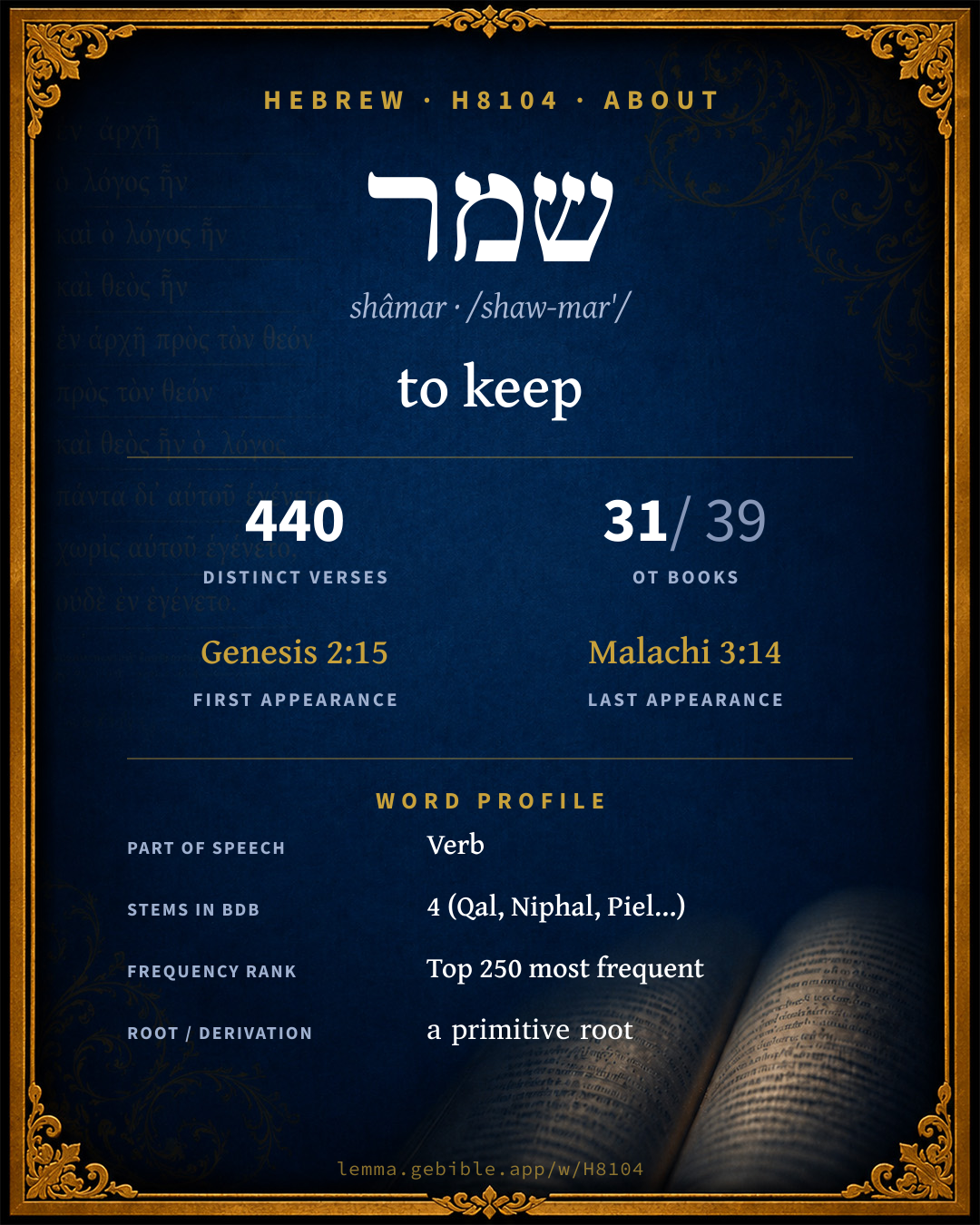
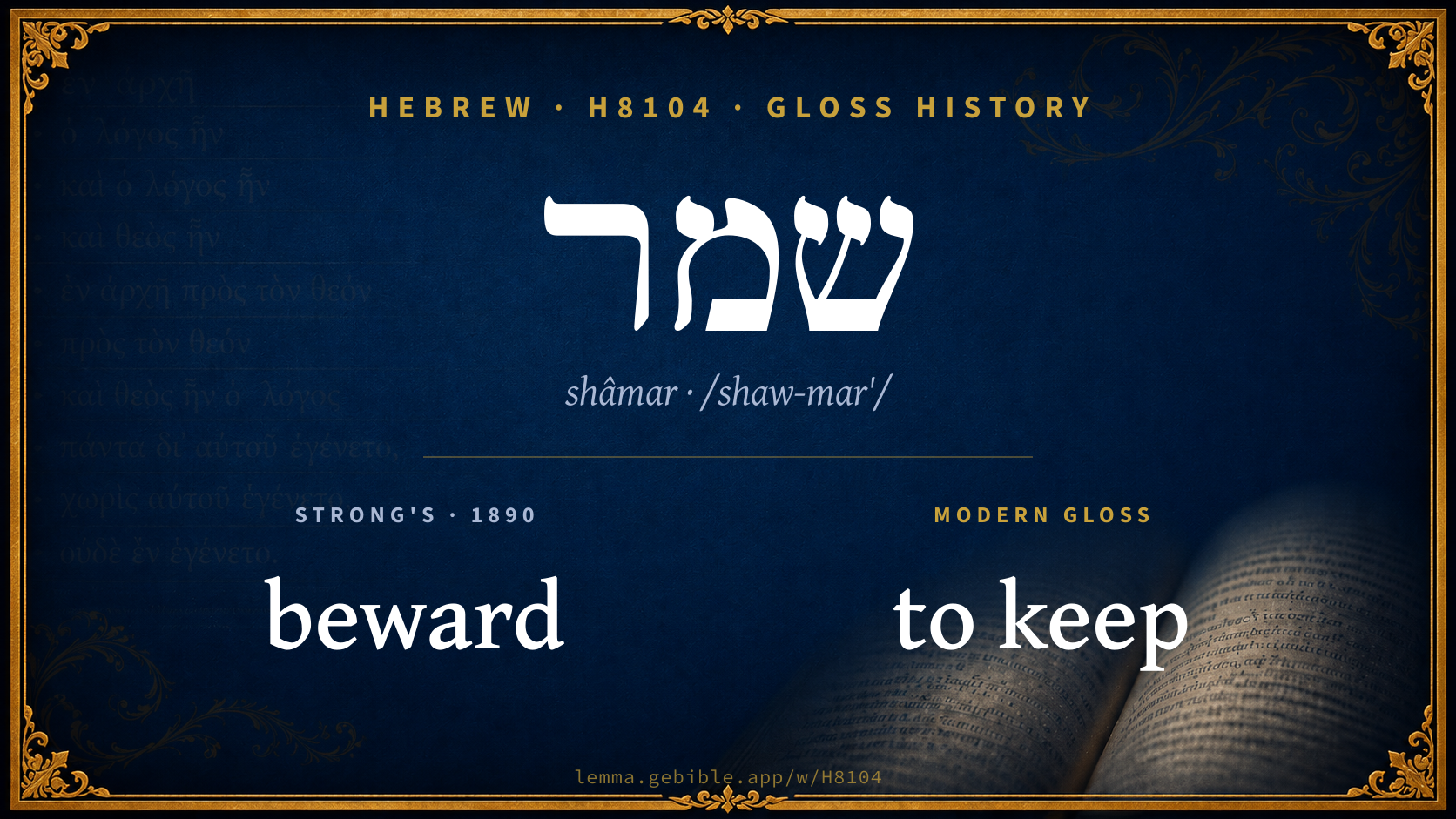
שָׁמַר
to keep
also: guard, observe, give heed fuller range ↓
Full lexicon entry — Brown-Driver-Briggs (BDB)
From Brown-Driver-Briggs (BDB)
Where this word appears
Grammar key — what these labels mean
Part of speech
- Verb
- An action or state-of-being word.
Stem
- Qal
- The basic, simple active stem — the plain form of the verb (“he wrote”). Here: ‘keep’
- Niphal
- Usually the simple passive or reflexive of the Qal (“he was written”). Here: ‘be on one’s guard’
- Hithpael
- The reflexive or reciprocal stem (the subject acts on itself).
- Piel
- An intensive or resultative active stem. Here: ‘pl.’
Form
- Infinitive Construct
- A bound verbal noun, frequently with prepositions (“to write / in writing”).
- Participle Active
- A verbal adjective expressing ongoing or characteristic action (“writing / one who writes”).
- Sequential Perfect
- A perfect with prefixed waw continuing a preceding imperfect or command (waw-consecutive perfect).
- Imperfect
- An incomplete, ongoing, or future action (“he will / would write”).
- Imperative
- A direct command (“write!”).
- Perfect
- A completed action or state — Hebrew marks aspect (completeness) more than strict tense (“he wrote”).
- Cohortative
- A first-person volitional form expressing wish or resolve (“let me / let us write”).
- Infinitive Absolute
- An unbound verbal noun, often intensifying or standing in for a finite verb.
- Sequential Imperfect
- An imperfect with prefixed waw — the standard past-narrative form (waw-consecutive imperfect).
- Participle Passive
- A verbal adjective expressing action received (“written”).
- Jussive
- A third- or second-person volitional form expressing wish or command (“let him write”).
State
- Absolute
- The independent form of a noun, not bound to a following word.
- Construct
- A noun bound to a following noun in a possessive / “of” relationship (the construct chain).
Person
- 2nd Person
- The one addressed (“you”).
- 3rd Person
- The one spoken about (“he / she / it / they”).
- 1st Person
- The speaker (“I / we”).
Gender
- Masculine
- Grammatically masculine.
- Common
- Either gender — not distinguished for this form.
- Feminine
- Grammatically feminine.
Number
- Singular
- One.
- Plural
- More than one (in Hebrew, generally three or more).
Every verse where H8104 appears in the Book of 1 Kings — 21 distinct verses. Click any verse to open its interlinear word-by-word view. Verse text shown in the World English Bible for context — . Each verse’s Hebrew form is shown with its reference; the English is not keyword-highlighted, since the data carries no word-level English alignment. Use “Compare translations” on any verse to read it across multiple English versions. This concordance covers the Hebrew Bible; Septuagint (Greek Old Testament) occurrences are not indexed here.
1 Kings
- 1 Kings 2:3 וְ/שָׁמַרְתָּ֞ לִ/שְׁמֹ֨ר conj + Qal wpf 2ms prep + Qal inf.cs and keep the charge of Yahweh your God, to walk in his ways, to keep his statutes, [and] his commandments, and his ordinances, and his testimonies, according to that which is written in the law of Moses, that you may prosper in all that you do, and wherever you turn yourself.
- 1 Kings 2:4 יִשְׁמְר֨וּ Qal impf 3mp That Yahweh may establish his word which he spoke concerning me, saying, If your children take heed to their way, to walk before me in truth with all their heart and with all their soul, there shall not fail you (said he) a man on the throne of Israel.
- 1 Kings 2:43 שָׁמַ֔רְתָּ Qal pf 2ms Why then have you not kept the oath of Yahweh, and the commandment that I have charged you with?
- 1 Kings 3:6 וַ/תִּשְׁמָר conj + Qal wimpf 2ms Solomon said, You have shown to your servant David my father great loving kindness, according as he walked before you in truth, and in righteousness, and in uprightness of heart with you; and you have kept for him this great loving kindness, that you have given him a son to sit on his throne, as it is this day.
- 1 Kings 3:14 לִ/שְׁמֹ֤ר prep + Qal inf.cs If you will walk in my ways, to keep my statutes and my commandments, as your father David did walk, then I will lengthen your days.
- 1 Kings 6:12 וְ/שָׁמַרְתָּ֥ conj + Qal wpf 2ms Concerning this house which you are building, if you will walk in my statutes, and execute my ordinances, and keep all my commandments to walk in them; then will I establish my word with you, which I spoke to David your father.
- 1 Kings 8:23 שֹׁמֵ֤ר Qal ptcp.act ms and he said, Yahweh, the God of Israel, there is no God like you, in heaven above, or on earth beneath; who keep covenant and loving kindness with your servants, who walk before you with all their heart;
- 1 Kings 8:24 שָׁמַ֗רְתָּ Qal pf 2ms who have kept with your servant David my father that which you did promise him: yes, you spoke with your mouth, and have fulfilled it with your hand, as it is this day.
- 1 Kings 8:25 שְׁ֠מֹר יִשְׁמְר֨וּ Qal impv 2ms Qal impf 3mp Now therefore, Yahweh, the God of Israel, keep with your servant David my father that which you have promised him, saying, There shall not fail you a man in my sight to sit on the throne of Israel, if only your children take heed to their way, to walk before me as you have walked before me.
- 1 Kings 8:58 וְ/לִ/שְׁמֹ֨ר conj + prep + Qal inf.cs that he may incline our hearts to him, to walk in all his ways, and to keep his commandments, and his statutes, and his ordinances, which he commanded our fathers.
- 1 Kings 8:61 וְ/לִ/שְׁמֹ֥ר conj + prep + Qal inf.cs Let your heart therefore be perfect with Yahweh our God, to walk in his statutes, and to keep his commandments, as at this day.
- 1 Kings 9:4 תִּשְׁמֹֽר Qal impf 2ms As for you, if you will walk before me, as David your father walked, in integrity of heart, and in uprightness, to do according to all that I have commanded you, and will keep my statutes and my ordinances;
- 1 Kings 9:6 תִשְׁמְרוּ֙ Qal impf 2mp But if you shall turn away from following me, you or your children, and not keep my commandments and my statutes which I have set before you, but shall go and serve other gods, and worship them;
- 1 Kings 11:10 שָׁמַ֔ר Qal pf 3ms and had commanded him concerning this thing, that he should not go after other gods: but he didn't keep that which Yahweh commanded.
- 1 Kings 11:11 שָׁמַ֨רְתָּ֙ Qal pf 2ms Therefore Yahweh said to Solomon, Because this is done of you, and you have not kept my covenant and my statutes, which I have commanded you, I will surely tear the kingdom from you, and will give it to your servant.
- 1 Kings 11:34 שָׁמַ֖ר Qal pf 3ms However I will not take the whole kingdom out of his hand; but I will make him prince all the days of his life, for David my servant's sake whom I chose, who kept my commandments and my statutes;
- 1 Kings 11:38 לִ/שְׁמ֤וֹר prep + Qal inf.cs It shall be, if you will listen to all that I command you, and will walk in my ways, and do that which is right in my eyes, to keep my statutes and my commandments, as David my servant did; that I will be with you, and will build you a sure house, as I built for David, and will give Israel to you.
- 1 Kings 13:21 שָׁמַ֨רְתָּ֙ Qal pf 2ms and he cried to the man of God who came from Judah, saying, Thus says Yahweh, Because you have been disobedient to the mouth of Yahweh, and have not kept the commandment which Yahweh your God commanded you,
- 1 Kings 14:8 שָׁמַ֨ר Qal pf 3ms and tore the kingdom away from the house of David, and gave it you; and yet you have not been as my servant David, who kept my commandments, and who followed me with all his heart, to do that only which was right in my eyes,
- 1 Kings 14:27 הַ/שֹּׁ֣מְרִ֔ים ptcl def.art + Qal ptcp.act mp King Rehoboam made in their place shields of brass, and committed them to the hands of the captains of the guard, who kept the door of the king's house.
- 1 Kings 20:39 שְׁמֹר֙ Qal impv 2ms As the king passed by, he cried to the king; and he said, Your servant went out into the midst of the battle; and, behold, a man turned aside, and brought a man to me, and said, Keep this man: if by any means he be missing, then shall your life be for his life, or else you shall pay a talent of silver.
About this entry
At a glance — auto-summarized from this page’s data, not written by a person. Every figure links to its source below. This summary describes the numbers; it doesn’t interpret them.
שמר — transliterated shâmar — is a Hebrew verb carrying the sense “to keep.” As a verb its force shifts by stem, across 4 stems (Qal, Niphal, and more). With 440 verses in 31 books, it is a common word in the Hebrew Bible. Debuting at Genesis 2:15, it then recurs through the corpus. Sharing its root, it stands alongside אשמרה, משמר and שמיר. Each statement above links to its evidence; the full detail follows below.
Gloss history
Strong's 1890 vs modern scholarship
About this word
Strong's H8104 catalogs a Hebrew word from the Hebrew Old Testament.
These counts are not copied from any lexicon or concordance. They are computed here, from the morphology-tagged Hebrew Old Testament. What Lemma adds →
- 440
- distinct verses
- The word appears in 440 distinct verses.
- 31 / 39
- OT books
- The word appears in 31 of 39 Old Testament books.
- #106
- by frequency
- Top 250 most frequent Hebrew words (rank 106 of 8,640 Hebrew words by occurrence).
View all 440 occurrences in the concordance →
Most concentrated in
- Psalms 67 verses 15%
- Deuteronomy 65 verses 15%
- Proverbs 29 verses 7%
By section of the Old Testament
By traditional corpus
Conventional, traditional groupings — biblical authorship is debated, so this is a traditional corpus grouping, not an authorship claim. Each share is this word’s portion of its verses in that division of the Hebrew canon. Each figure is a share of the word’s 440 distinct verses.
- Writings (Ketuvim) 161 verses · 37%
- Prophets (Nevi'im) 140 verses · 32%
- Torah (Pentateuch) 139 verses · 32%
How translations render this word
Counts come from each version’s own published word-to-Strong’s tagging or interlinear alignment — an approximate guide to how each version renders this word, not a word-level alignment the data otherwise carries. Because each total is that version’s own tagged count, the per-version totals vary from one another and need not match the appearance or distinct-verse counts above. These counts may also differ from a printed concordance because Lemma counts each distinctly tagged rendering and does not collapse phrase taggings into a single head-word total. This is a fixed set of word-tagged versions (KJV, ASV, BSB, ULT) and does not change with the reading translation you choose elsewhere. Each version’s license is shown beside its name below (and on Sources).
- King James Version: Keep 94×, Kept 19×, Take heed 16×
- American Standard Version: Keep 74×, Observe 18×, Kept 17×
- Berean Standard Bible: Keep 76×, Be careful 26×, Kept 16×
- unfoldingWord Literal Text: Keep 96×, You shall keep 40×, Keeping 18×
King James Version Public Domain
Renders H8104 across 468 tagged occurrences — most commonly:
Plus other, less common renderings. Plus 136 renderings that appear only once — usually multi-word phrases or single function words the recovered tagging swept in, not distinct renderings.
American Standard Version Public Domain
Renders H8104 across 468 tagged occurrences — most commonly:
Plus other, less common renderings. Plus 135 renderings that appear only once — usually multi-word phrases or single function words the recovered tagging swept in, not distinct renderings. Not rendered by a distinct English word in 1 further occurrence.
Berean Standard Bible Public Domain
Renders H8104 across 462 tagged occurrences — most commonly:
Plus other, less common renderings. Plus 161 renderings that appear only once — usually multi-word phrases or single function words the recovered tagging swept in, not distinct renderings. Not rendered by a distinct English word in 6 further occurrences.
unfoldingWord Literal Text CC BY-SA 4.0
Renders H8104 across 528 tagged occurrences — most commonly:
Plus other, less common renderings. Plus 151 renderings that appear only once — usually multi-word phrases or single function words the recovered tagging swept in, not distinct renderings.
21 senses and sub-senses in the full BDB
Hebrew verbs can shift meaning by stem (binyan): Qal is the basic action, Niphal is often passive or reflexive, Piel often intensifies or makes it factitive, and Hiphil is typically causative. The senses below are grouped under the stem BDB assigns to each. This entry also uses Hithpael (reflexive or reciprocal).
What do BDB’s symbols mean?
BDB uses these scholarly abbreviations:
| Symbol | Meaning |
|---|---|
| 𝔊 | the Septuagint (the ancient Greek translation, LXX) |
| 𝔙 | the Vulgate (the Latin translation) |
| 𝔖 | the Syriac version (the Peshitta) |
| 𝔗 | the Targum (the Aramaic translation) |
| ψ | the Psalms |
| √ | root (the underlying root or stem) |
| ‖ | parallel passage (a synonymous or contrasted parallel) |
| † | the dagger: every passage where the word occurs is cited |
The 21 senses and sub-senses the full Brown-Driver-Briggs lexicon distinguishes for this word, in lexicon order (not ranked by frequency), with BDB’s own verbatim wording and sub-sense lettering. Shown in Hebrew script with BDB’s own scholarly abbreviations. The condensed entry is in the Lexicon Entry tab. See also the Forms in the corpus table below.
Qal
- Pf. 3 ms. שׁ׳ Gn 37:11 +, etc.; Impf. 3 ms. יִשְׁמֹר 1 S 2:9 +, יִשְׁמָר־ Je 5:24 +, sf. 3 ms. יִשְׁמְרֶנּוּ Ex 21:29, 36; 3 fs. sf. תִּשְׁמוּרֵ֑ם Pr 14:3 (read תִּשְׁמְרוּם, v. Ges§ 47 g Toy), etc.; Imv. ms. שְׁמֹר Jb 2:6 +, שָׁמְרָה 1 Ch 29:18 +; mpl. שִׁמְרוּ Jos 6:18 +, etc.; Inf. abs. שָׁמוֹר Dt 5:12 +; cstr. שְׁמֹר Gn 3:24 +, sf. שָׁמְרָהּ 2:15, etc.; Pt. act. שֹׁמֵר 1 S 1:12 +, etc.; pass. שָׁמוּר Ec 5:12 (1 S 9:24 v. infr.), etc.;—[Synon. I. נָצַר, נָטַר, q.v.]: e.g. Genesis 37:11
- 1.
- a. keep, have charge of, garden Gn 2:15 (J), ark 1 S 7:1, property in trust Ex 22:6, 9 (E), cf. 1 S 25:21; tend flock Gn 30:31 (E), cf. Zc 3:7 Nu 3:8 (P); so perhaps (obj. om.) Ho 12:13 (where שׁ׳ chosen for parallelism Now Marti al.); Pt. הֲשֹׁמֵר אָחִי אָנֹ֑כִי Gn 4:9 (J), שׁ׳ of sheep 1 S 17:20, שׁ׳ הַכֵּלִים v 22, שׁ׳ הַבְּגָדִים 2 K 22:14 2 Ch 34:22, שׁ׳ הַנָּשִׁים Est 2:3, 8, 15, cf. v 14, etc. e.g. Genesis 2:15
- b. keep, guard, captives Jos 10:18 (J), 1 K 20:39, דֶּרֶךְ Gn 3:24 (J); keep watch and ward, אֶל pers. over whom 1 S 26:15 (ψ 59:10 v. 3 end), עַל pers. v 16 Pr 6:22; בַּנַּעַר 2 S 18:12 have a care of (read לִי for מִי 𝔊), cf. 2 K 9:14; in hostile sense, אֶל הָעִיר (in siege) 2 S 11:16, עַל חַטָּאתִי Jb 14:16 (but read תַּעֲבֹר c. 𝔊 Ew Di Du al. [not Hi Bu]); abs. c. מֵעַל Ec 5:7 watcheth above, etc. (v. p. 759 a d); keep one’s mouth, be prudent of speech †Pr 21:23, cf. Mi 7:5; keep = protect, save, one’s life, נֶפֶשׁ †Pr 13:3; 16:17; 19:16; 22:5, another’s Jb 2:6; in Pr, acc. pers., subj. wisdom, 4:6 she shall preserve thee, cf. (+ מִן of evil) 6:24; 7:5; especially Pt. watch, watchman, of city Is 21:11(×2), 12; 62:5 (fig.), Ct 3:3; 5:7(×2) ψ 127:1; שׁ׳ הַסַּף (in temple) Je 35:4 + (v. סַף), הַשּׁ׳ פֶּתַח בֵּית הַמֶּלֶךְ 1 K 14:27 = 2 Ch 12:10, שׁ׳ הַשְּׁעָרִים Ne 13:22, שֹׁמְרֵי הַבַּיִת (fig.) Ec 12:3; שׁ׳ הַבַּיִת keep the house (of David’s concubines) †2 S 15:16; 16:21; 20:3; שֹׁמֵר הַכֵּלִים 1 S 17:22, שׁ׳ הַבְּגָדִים 2 K 22:14, שׁ׳ הַפַּרְדֵּס Ne 2:8, שׁ׳ הַנָּשִׁים Est 2:3, 14, 15, שֹׁמְרִים abs. Ju 7:19 Je 51:12. e.g. Joshua 10:18
- c. hence watch for, wait for, acc. pers. 1 S 19:11 (to kill him), cf. ψ 59:1 (title; acc. הַבַּיִת); c. עֲקֵבַי ψ 56:7 = dog my steps, 71:10 Je 20:10; = watch (suspiciously) Jb 10:14; 13:27; 33:11; abs. הַשֹּׁמְרִים Ju 1:24; wait for, נֶשֶׁף Jb 24:15, לַבֹּקֶר ψ 130:6(×2). e.g. 1 Samuel 19:11
- d. watch, observe, acc. rei 1 S 1:12 Ec 11:4 Jb 39:1 Je 8:7 (of birds), with intelligence Is 42:20 ψ 107:43; acc. pers. 37:37 (‖ ראה), Zc 11:11; acc. of sin ψ 31:7; 130:3; acc. rei, for the purpose of avoiding, 17:4. e.g. 1 Samuel 1:12
- 2.
- a. keep, retain, of storing up (food) Gn 41:35 (E); abs. Ec 3:6 (opp. הִשְׁלִיךְ); treasure up (in memory) Gn 37:11 (E), cf. Mal 2:7 1 Ch 29:18 Pr 4:21 (בְּתוֹךְ לְבָבֶ֑ךָ), 22:18 (בְּבִטְנֶ֑ךָ); retain wrath Am 1:11 (read שָׁמַר לָנֶצַח We Now GASm Marti; v. also נָטַר 1) + (anger om.) Je 3:5 (‖ נטר). e.g. Genesis 41:35
- b. keep within bounds, restrain, obj. שׁוֹר Ex 21:29, 36 (E); c. acc. hand, מִן of evil Is 56:2; fig. keep thy foot, c. cl. temp. Ec. 4:17; אֶשׁ׳־לְפִי מַחְסוֹם ψ (39:2 𝔊 Du al. אָשִׂימָה); appar. reflex. (= Niph.), †Jos 6:18 (+ מִן־הַחֵרֶם), poss. sc. נַפְשְׁכֶם Di. e.g. Exodus 21:29
- 3.
- a. observe, celebrate, acc. of festival, etc., Ex 23:15 (E), 34:18 (J), 12:17, of day v 17 (P), of month Dt 16:1. e.g. Exodus 23:15
- b. keep sabbath †Dt 5:12 Lv 19:3, 30; 26:2 (all H), Ex 31:13, 14, 16 (P), Is 56:4, also (+ מֵחַלְּלוֹ) v 2, 6. e.g. Deuteronomy 5:12
- c. of other obligations: keep covenant Ez 17:14, especially covenant of י׳ Dt 29:8; 1 K 11:11 + 5 times, שְׁבֻעַת י׳ 1 K 2:43, perform vow Dt 23:24; keep commands Je 35:18; Ez 20:18; especially מִצְוֹת, חֻקִּים, עֲבֹדָה, etc., of י׳ (sometimes ‖ נצר), Ex 20:6 = Dt 5:10; Am 2:4; 1 K 2:3 ψ 119:8, 17, 34 + very often (c. 120 times); שׁ׳ דֶּרֶךְ י׳ Gn 18:19 (J) + 4 times, דַּרְכֵי י׳ 2 S 22:22 = ψ 18:22, ד׳ י׳ om. Ju 2:22b; שׁ׳ אָרְחוֹת צַדִּיקִים Pr 2:20 (‖ תֵּלֵךְ בְּדֶרֶךְ טוֹבִים), שׁ׳ דְּרָכַי (ways of wisdom) 8:32 (ψ 17:4 v. 1 d); keep, discharge an office, כְּהֻנָּה Nu 3:10; 18:7 (both P), abs. 2 Ch 5:11; a function or duty, especially שׁ׳ מִשְׁמֶרֶת Lv 8:35; Nu 1:53 + c. 32 times (v. מ׳ infr.); acc. of obligation often om., especially D (and RD) keep and do Dt 4:6; 7:12 + 8 times; to do 5:1, 29 + 16 times D + 3 times, etc. e.g. Ezekiel 17:14
- d. observe = follow dictates of (prudence, justice, kindness, wisdom) Ho 12:7 (חֶסֶד וּמִשְׁפָּט), Is 56:1; Pr 4:4; 5:2; 7:1, 2; bad sense, observe vanities ψ 31:7.—Doubtful are: לִשְׁמֹר abs. Ho 4:10, very strange (conj. in We Now Marti); שָׁמוּר 1 S 9:24, HPS אֵחַרְנוּ, cf. Now BuComm.; ψ 59:10 read עֻוִּי אֵלֶיךָ אֲוַמֵּ֑רָה (as v 18, 𝔖 Che Bae). e.g. Hosea 12:7
- 4. sometimes י׳ subj.:
- a. keep, preserve, protect, acc. pers., + ב of way, etc., Gn 28:15, 20 (J), Ex 23:20 (E; of מַלְאָךְ), ψ 91:11 (מ׳), Jos 24:17 (E); acc. pers. (or נפשׁ) only: 1 S 30:23; Je 31:9; Nu 6:24 (P), Jb 29:2 ψ 16:1 + 10 times ψψ; + מִן ψ 121:7 + 2 times; acc. רַגְלַי 1 S 2:9, cf. Pr 3:26 (מִן); Pt. שֹׁמְרֶ֑ךָ ψ 121:3, 5, cf. v 4, etc.; acc. of city 127:1. e.g. Genesis 28:15
- b. c. acc. בְּרִית, ל pers. Dt 7:12, + חֶסֶד v 7 + 5 times, הַשּׁ׳ אֱמֶת לְעוֹלָם ψ 146:6; הַשְּׁבֻעָה Dt 7:8, etc.; pass. of covenant (י׳ agent) עֲרוּכָה בַכֹּל וּשְׁמֻרָה 2 S 23:5 (legal terminology, Dr). e.g. Deuteronomy 7:12
- 5. keep, reserve, weeks of harvest Je 5:24 (ל pers.). e.g. Jeremiah 5:24
Niphal
- Pf. 3 ms. נִשְׁמַר 2 S 20:10, etc.; Impf. 3 fs. תִּשָּׁמֵר Ju 13:13; 2 mpl. תִּשָּׁמִ֑רוּ Ex 23:13; Imv. ms. הִשָּׁמֵר Is 7:4 (לְךָ) הִשָּׁ֫מֶר Gn 24:6 +; fs. הִשָּֽׁמְרִי Ju 13:4, etc.;— e.g. 2 Samuel 20:10
- 1. be on one’s guard, c. בַּחֶרֶב 2 S 20:10 by reason of the sword, i.e. against it; c. ב temp. 1 S 19:2, שָׁם 2 K 6:10; take heed Ex 23:13 (E) Dt 2:4; c. מִן pers. Ex 23:21 (E), Je 9:3; מִן rei Ju 13:13; Dt 23:10; מִן inf. take care not to, etc. Gn 31:29 (E), 2 K 6:9; inf. without מִן Ex 19:12 (J), but read prob. מֵעֲלוֹת; sq. פֶּן lest Gn 24:6 (J) + 11 times (especially Dt); c. (וְ)אַל juss. Ex 10:28 (J), Ju 13:4; Jb 36:21, c. Imv. coörd. Is 7:4.—Very often Imv. (24 times), especially in phr. הִשָּׁמֶר־לְךָ (12 times), הִשָּׁמְרוּ לִכֶם (3 times); + לְנַפְשֹׁתֵיכֶם Dt 4:15; Jos 23:11 (RD; + inf.); + בְּנַפ׳ Je 17:21 appar. ב pret. on peril of your life (cf. ב III. 3 a), so perhaps also בְּרוּחֲכֶם Mal 2:15, 16 (We Now). e.g. 2 Samuel 20:10
- 2. keep oneself, refrain, abstain, מֵאִשָּׁה 1 S 21:5. e.g. 1 Samuel 21:5
- 3. be kept, guarded, Ho 12:14 (cf. שׁ׳ of Jacob v 13); be preserved (by י׳) ψ 37:28 (לִעוֹלָם), but read prob. נִשְׁמָ֑דוּ (לְעוֹלָם) עַוָּלִים Hup-Ri (Now) Che Bae Du Dr. e.g. Hosea 12:14
Piel
- Pt. pl. מְשַׁמְּרִים הַבְלֵי־שָׁוְא Jon 2:9 those paying regard to false vanities (cf. Qal ψ 31:7). e.g. Jonah 2:9
Hithpael
- Impf. 1 s. וָאֶשְׁתַּמֵּר מֵעֲוֹנִי ψ 18:24 I kept myself from, etc. = 2 S 22:24 (vb. cohort.); 3 ms. וְיִשְׁתַּמֵּר חֻקּוֹת עָמְרִי Mi 6:16, but read וְתִשְׁמֹר thou keepest, observest, We Now GASm. e.g. Psalms 18:24
Senses from the full Brown-Driver-Briggs lexicon (Brown, Driver, Briggs; Oxford 1906 — public domain), digitized via Sefaria, supplemented by the OpenScriptures HebrewLexicon (CC BY 4.0). Full attribution on Sources.
Word origin
vb. keep, watch, preserve (NH id.; Ph. שמר in n.pr. and (Pun.) = watchman; TelAm. šimiru is perhaps overseer (Canaanism), WklNo. 80, 1, 23; Mand. סמירא preserved NöM 46; cf. Arabic سَمَرَ converse by night, stay awake (v. LagBN 105); BaNB 175 f.; ES 43 infers from ܬܶܡܪܳܐ eyelid (cf. [שְׁמֻרָה] infr.), and Arabicثَمَلَ support, aid, protect (l = r), that two √ √ are combined in Heb.; but proof insuff.);—
— Brown-Driver-Briggs (Oxford 1906, public domain), digitized via Sefaria, supplemented by the OpenScriptures HebrewLexicon (CC BY 4.0). See Sources.
Origin: a primitive root
Jastrow Dictionary
A second Hebrew/Aramaic lexicon for comparison, covering Aramaic and post-biblical (Talmudic, Targumic, Midrashic) usage that the biblical-Hebrew BDB does not. Matched by lemma rather than by Strong’s number, so a lemma may carry more than one Jastrow headword (shown separately below), and the entries cover usage well beyond the Bible.
שָׁמַר
- (b. h.) [to be still,] to watch, guard, wait; to observe; to keep. Snh. 63ᵇ לא … שְׁמוֹר לי וכ׳ one should not say to his neighbor, wait for me at such and such an idolatrous statue (or temple). B. Mets. 58ᵃ השוכר … לִשְׁמוֹר את וכ׳ if one hires a workingman to guard a cow, a child &c. Sabb. 118ᵇ אלמלי שָׁמְרוּ ישראל וכ׳ if Israel had observed the first Sabbath &c.; a v. fr.—Part. pass. שָׁמוּר; f. שְׁמוּרָה &c. Ib. XXII, 4 נותנין … בשביל שיהא ש׳ you may put a dish into the well that it be kept (cool); a. e.
- 1. same. Ib. 118ᵇ אילמלי מְשַׁמְּרִין ישראל וכ׳ if Israel would observe two Sabbaths as they ought do, they would at once be redeemed. Keth. 62ᵇ ענייה זו לשוא שִׁימְּרָה the poor woman has in vain waited (for her husband). Ab. Zar. IV, 11 אין … יושב ומְשַׁמֵּר וכ׳ the watchman (guarding wine against idolatrous defilement) need not sit and watch &c. Y. Kidd. I, 58ᵈ top המקום משמר וכ׳ God has watched, and such a case has never occurred. Y. M. Kat. III, 82ᶜ שי׳ הקב"ה … שבעה the Lord observed the seven days of mourning for his world (before the flood, ref. to Gen. VII, 10); a. fr. e.g. Genesis 7:10
- 2. (denom. of שְׁמָרִים) to clear wine from lees, filter, strain (v. מְשַׁמֶּרֶת). Sabb. 138ᵃ שי׳ חייב וכ׳ if one filtered wine (on the Sabbath), he is bound to bring a sin-offering; Y. ib. XX, 17ᶜ; VII, 10ᵇ, a. e. המשמר חייב שום בורר he who filters is guilty &c., v. בָּרַר. Ib. המשמר יין למטן וכ׳ when one filters, the wine goes down, and the lees remain above (in the filter); a. fr.—Bab. ib. 146ᵇ מקום העשוי לְשַׁמֵּר a place in the keg where a hole has been made for the purpose of letting the wine off, clear of lees (and has been closed again; Ar. s. v. חזק; Rashi: where the hole has been closed in order to preserve the flavor).—Part. pass. מְשׁוּמָּר a) guarded. Pes. 109ᵇ (ref. to שמרים, Ex. XII, 42) ליל המש׳ ובא מן המזיקין a night which is for all time guarded against dangers (v. מַזִּיק); R. Hash. 11ᵇ.—b) kept, preserved, designated. Ib. ליל המש׳ ובא מששת וכ׳ a night which has been designated for redemption since the six days of creation. Snh. 99ᵃ; Ber. 34ᵇ יין המש׳ וכ׳, v. עֵנָב; a. e. e.g. Exodus 12:42
- 1. to be on one’s guard, be observant. Mekh. Bo, s. 14 (ref. to שמרים, v. supra) מגיד … צריכין להִשְׁתַּמֵּר בו this intimates that all Israelites must be careful in it (to observe its ceremonies); Yalk. Ex. 210; Tanḥ. Bo 9.
- 2. to be guarded. B. Mets. 11ᵃ המִשְׁתַּמֶּרֶת, v. חָצֵר. Erub. 54ᵇ אם ראשון … מִשְׁתַּמֵּר וכ׳ if the fowler breaks the wings of each bird as he catches it, it is kept (from flying off) &c. Men. 99ᵇ כל המשמר … נשמתוֹ משתמרת who guards the Law (takes care not to forget it), his soul is guarded; a. e.
- same, to be on one’s guard. Ib. כל מקום שנאמר הִשָּׁמֶר פן ואל וכ׳ wherever the Scripture has the words, ‘be on thy guard, lest’, or ‘be on thy guard that not’, it is a prohibitive law; ib. השמר ופן וכ׳ ‘be on thy guard’ and ‘lest’ make two prohibitions. Ib. 36ᵇ השמר דלאו לאו hishshamer followed by a negative is a prohibitory law; השמר דעשה עשה hishshamer connected with a positive order, is a positive command (v. עָשָׂה).—[Tanḥ. Vayḥi 13 ומשמירין, v. שָׁפַר.]
שְׁמַר
- Ithpa. אִשְׁתַּמַּר, v. סְמַר II. Targ. Is. VII, 4 some ed.
שֶׁמֶר
- (preced.) sediment, lees. Sabb. 146ᵇ שניקבה למטה מן הש׳ when the jug has a hole below the line of the lees. B. Bath. 96ᵇ שִׁמְרֵי יין wine lees. Ib. ש׳ … טעם יין lees which have a taste (or flavor) of wine. B. Mets. IV, 11 אין מערבין שמרי … שְׁמָרָיו you dare not mix wine lees (left of one jug) with wine, but you may give the purchaser the lees belonging to the wine sold; a. fr.
A Dictionary of the Targumim, the Talmud Babli and Yerushalmi, and the Midrashic Literature (Marcus Jastrow; London, Luzac, 1903) — Public Domain. Digitized via Sefaria. Digitized via Sefaria. Full attribution on Sources.
Forms in the corpus
The 298 distinct written forms H8104 takes in the Hebrew Bible, most frequent first — each parse links to that stem’s occurrences in the concordance. Hebrew forms include their vowel points and cantillation, so a single lemma takes many written forms.
The 60 most common forms are shown; 238 rarer forms follow in the full concordance.
Same root — word family
Other BDB entries built from the same root as H8104, grouped by Strong’s listed origin. These share a root / origin per the lexicon — not necessarily a shared meaning. Each links to that word’s own entry.
Derived from this word
- אשמרה ʼashmurâh H821 watch
- משמר mishmâr H4929 guard
- שמיר shâmîyr H8068 thorn
- שמר shemer H8105 dregs
- שמר shimmur H8107 night watch
- שמרה shomrâh H8108 watch
- שמרה shᵉmurâh H8109 eyelid
Proper names from this root
People and places named from this root — a name, not an additional meaning of the word.
- ישמרי Yishmᵉray H3461 Ishmerai
- שומר Shôwmêr H7763 Shomer
- שמרון Shômᵉrôwn H8111 Samaria
- שמריה Shᵉmaryâh H8114 Shemariah
- שמרת Shimrâth H8119 Shimrath
Compare all same-root words → Showing 4 of 13 — not the complete family. 5 of the same-root words are proper names (people or places). They share a root, not necessarily a meaning.
Septuagint verse parallels
This word appears in 386 verses that also exist in the Greek Old Testament (Septuagint), out of the 440 Hebrew verses it occurs in. You can read those verses in Greek by switching the Old Testament edition to the Septuagint.
Read these verses in the Septuagint
- Genesis 2:15
- Exodus 10:28
- Leviticus 8:35
- Numbers 1:53
- Deuteronomy 2:4
- Joshua 1:7
- Judges 1:24
- 1 Samuel 1:12
- 2 Samuel 11:16
- 1 Kings 2:3
- 2 Kings 6:9
- 1 Chronicles 9:19
This is a verse-level parallel only — the same verses exist in both the Hebrew and Greek Old Testaments. No word-level Hebrew↔Greek correspondence is claimed: the data carries no such alignment, so no Greek word is shown as this Hebrew word’s translation. Coverage is not total — the Septuagint omits the deuterocanon and renumbers the Psalms, so some Hebrew verses have no direct Greek parallel.