
Proverbs 15:5

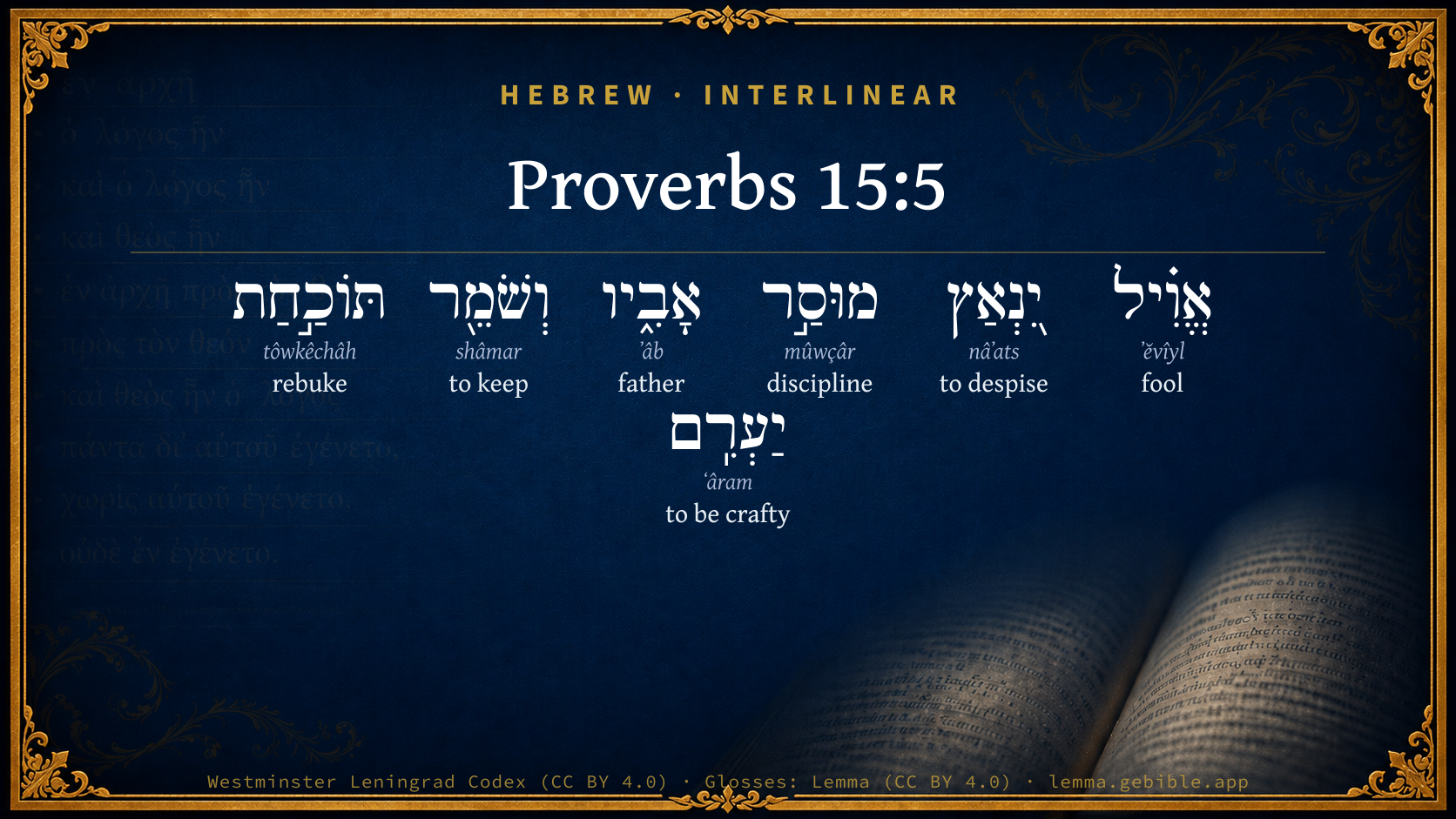
Hebrew (Westminster Leningrad Codex) Proverbs 15:5 appears in the Hebrew Old Testament. The text above is from the Westminster Leningrad Codex. Each word links to its Strong’s number, a concise gloss, and parsing drawn from the Open Scriptures Hebrew Bible morphology. Click any word for its full Brown-Driver-Briggs (BDB) entry.
Download image
Cite this verse

Proverbs 15:5 (World English Bible). Public Domain. Lemma interlinear Bible study tool, https://lemma.gebible.app/v/proverbs/15/5.

Show BibTeX & RIS
BibTeX
RIS
English Translation
A fool despises his father's correction, But he who heeds reproof shows prudence.
World English Bible · Public Domain
Download a study sheet

One document with this verse’s original text, its word-by-word gloss line, the meaning frame, cross-references with their text, attributed commentary, and full source and license credits — printable, and it pastes into notes with its structure intact.

This verse Autodidact and up

Study sheet (.html) Plain text (.txt)

A passage Seminary Student

Up to 50 verses in one chapter. A passage sheet keeps up to 6 commentary sources and 12 cross-references per verse, in the order this page ranks them, and says so on the sheet whenever that leaves anything out. Ask for a single verse and you get the Autodidact verse sheet above.

Everything on this page stays free to read, with no account — the sheet is a download of what is already on screen, not access to it.

Want to remove ads? Support Godless Engineer
Compare translations 3

The same verse in 3 English versions, stacked beneath the original-language interlinear above. Click any original word for its lexicon entry.

Each is an independent rendering of the whole verse — the interlinear is not word-aligned to these translations.

Highlighted words mark where these versions differ — a whole-verse word diff, not a word-by-word alignment.

  • World English Bible Public Domain
    A fool despises his father's correction, But he who heeds reproof shows prudence.
  • King James Version Public Domain
    A fool despiseth his father's instruction: but he that regardeth reproof is prudent.
  • unfoldingWord Literal Text CC BY-SA 4.0
    A fool despises the correction of his father, but one who keeps rebuke is prudent.

unfoldingWord Literal Text — © unfoldingWord, licensed CC BY-SA 4.0. Word-aligned USFM3 via Door43 (git.door43.org/unfoldingWord/en_ult).

Versions to compare (up to 4)

3 of 4 selected

Show all 18 translations

Every available English version of this verse, each an independent rendering of the whole verse.

  • World English Bible Public Domain
    A fool despises his father's correction, But he who heeds reproof shows prudence.
  • Berean Standard Bible Public Domain
    A fool rejects his father’s discipline, but whoever heeds correction is prudent.
  • Majority Standard Bible Public Domain
    A fool rejects his father’s discipline, but whoever heeds correction is prudent.
  • King James Version Public Domain
    A fool despiseth his father's instruction: but he that regardeth reproof is prudent.
  • American Standard Version (1901) Public Domain
    A fool despiseth his father's correction; But he that regardeth reproof getteth prudence.
  • Revised Version (1885) Public Domain
    A fool despiseth his father’s correction: but he that regardeth reproof getteth prudence.
  • Geneva Bible (1599) Public Domain
    A foole despiseth his fathers instruction: but he that regardeth correction, is prudent.
  • Douay-Rheims (1899) Public Domain
    A fool laugheth at the instruction of his father: but he that regardeth reproofs shall become prudent. In abundant justice there is the greatest strength: but the devices of the wicked shall be rooted out.
  • Young's Literal Translation Public Domain
    A fool despiseth the instruction of his father, And whoso is regarding reproof is prudent.
  • Literal Standard Version CC BY-SA 4.0
    A fool despises the instruction of his father, || And whoever is regarding reproof is prudent.
  • Unlocked Literal Bible CC BY-SA 4.0
    A fool has contempt for his father's instruction, but he who learns from correction is prudent.
  • unfoldingWord Literal Text CC BY-SA 4.0
    A fool despises the correction of his father, but one who keeps rebuke is prudent.
  • Darby Bible Public Domain
    A fool despiseth his father's instruction; but he that regardeth reproof becometh prudent.
  • World Messianic Bible Public Domain
    A fool despises his father’s correction, but he who heeds reproof shows prudence.
  • Webster's Bible Public Domain
    A fool despiseth his father's instruction: but he that regardeth reproof is prudent.
  • Free Bible Version CC BY-SA 4.0
    Only a foolish son despises his father's instruction, but one who accepts correction is sensible.
  • Bible in Basic English Public Domain
    A foolish man puts no value on his father's training; but he who has respect for teaching has good sense.
  • JPS Tanakh (1917) Public Domain
    A fool despiseth his father's correction; but he that regardeth reproof is prudent.

Literal Standard Version (2020), Covenant Press — licensed CC BY-SA 4.0. Text via the HelloAO Bible API (eBible.org). Unlocked Literal Bible (unfoldingWord) — licensed CC BY-SA 4.0. Text via the HelloAO Bible API (eBible.org). unfoldingWord Literal Text — © unfoldingWord, licensed CC BY-SA 4.0. Word-aligned USFM3 via Door43 (git.door43.org/unfoldingWord/en_ult). Free Bible Version, Dr. Jonathan Gallagher — licensed CC BY-SA 4.0. Text via the HelloAO Bible API (eBible.org).

Word by word

More ways to search: Search by grammar → Find every occurrence → Compare this word →

Practice this passage: Drill this verse → Learn its vocabulary →

About this verse

These counts appear in no published source. They are computed here, from the morphology-tagged text and Lemma’s own curated glosses. What Lemma adds →

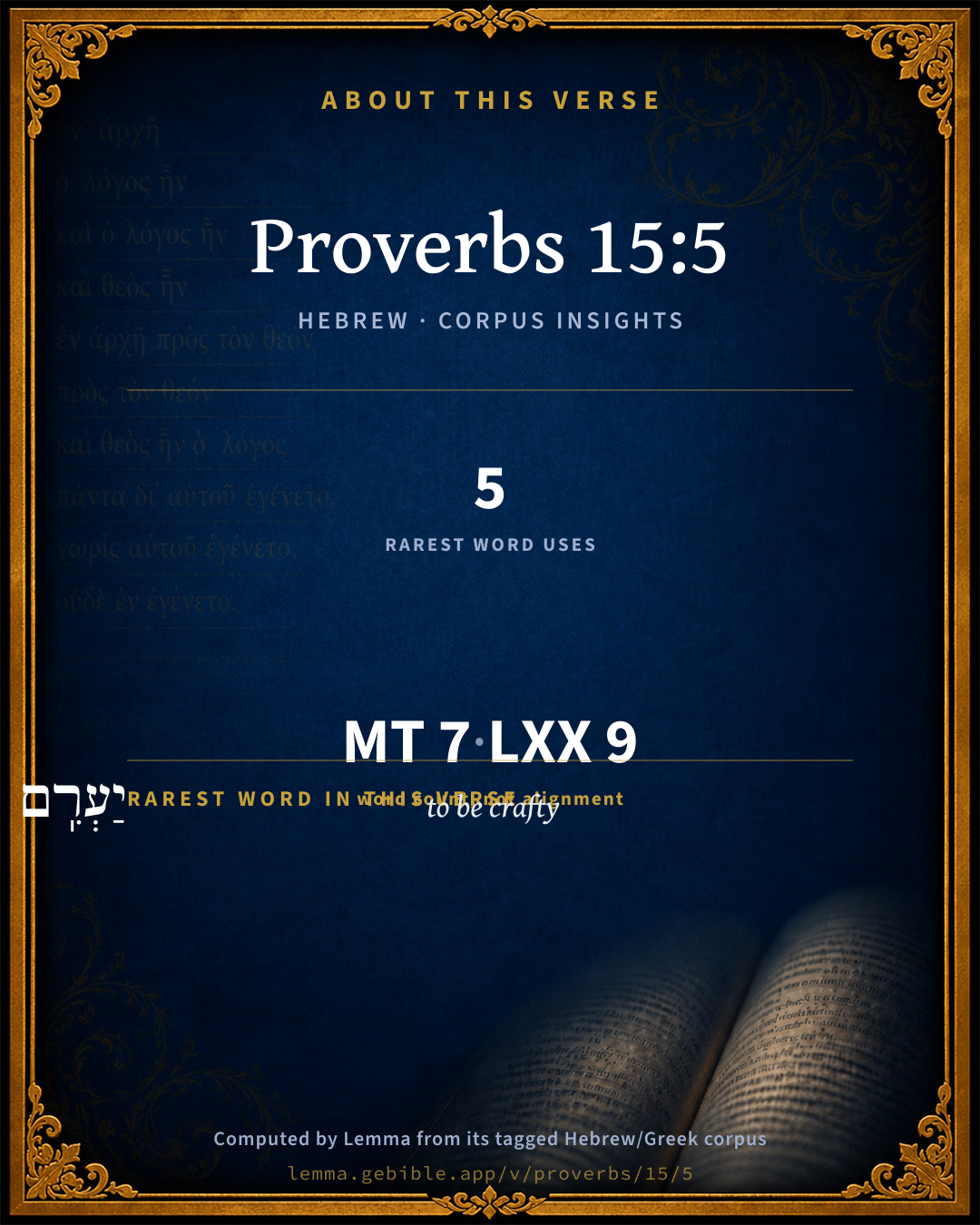
7
words
7
distinct lemmas
Wisdom
section

Notable vocabulary

The rarest word here is יַעְרִֽם to be crafty H6191 — appearing just 5 times in the whole Hebrew Bible.

Shared distinctive vocabulary

יַעְרִֽם to be crafty H6191 occurs in 4 verses of the Hebrew Bible. Also found in:

Grammatical profile

  • 3 verbs
  • 3 nouns
  • 1 adjective

Verb forms

  • יִ֭נְאַץ Qal · Imperfect
  • וְשֹׁמֵ֖ר Qal · Participle Active
  • יַעְרִֽם Qal · Imperfect

Hebrew & Septuagint length

In English translation the verse runs 13 words from the Hebrew and 30 from the Septuagint (LXX English) — the Septuagint runs noticeably longer here. See the side-by-side →

A rough comparison of the two English renderings, which tokenize alike — not a word-level alignment.

Word counts can differ between the Hebrew and the Greek without any difference in meaning — e.g. the Hebrew direct-object marker אֵת has no separate Greek word, and Greek often adds the article ὁ.

In the original languages it is 7 Hebrew tokens and 9 Greek tokens — but the two are counted differently (Hebrew bundles its prefixes and suffixes into one token; the Greek is in lemma form), so that isn’t a like-for-like length.

Cross-references

15

Topical passages linked to Proverbs 15:5 in the Treasury of Scripture Knowledge — connected by theme and wording, ordered by reader-vote popularity; previews shown in the World English Bible.

  • Proverbs 15:31–32 The ear that listens to reproof lives, And will be at home among the wise.
  • Proverbs 13:18 Poverty and shame come to him who refuses discipline, But he who heeds correction shall be honored.
  • Proverbs 13:1 A wise son listens to his father's instruction, But a scoffer doesn't listen to rebuke.
  • Proverbs 19:20 Listen to counsel and receive instruction, That you may be wise in your latter end.
  • 1 Chronicles 28:20 David said to Solomon his son, Be strong and of good courage, and do it: don't be afraid, nor be dismayed; for Yahweh God, even my God, is with you; he will not fail you, nor forsake you, until all the work for the service of the house of Yahweh is finished.
  • Titus 2:15 Say these things and exhort and reprove with all authority. Let no man despise you.
  • 1 Chronicles 22:11–13 Now, my son, Yahweh be with you; and prosper you, and build the house of Yahweh your God, as he has spoken concerning you.
  • 1 Chronicles 28:9 You, Solomon my son, know the God of your father, and serve him with a perfect heart and with a willing mind; for Yahweh searches all hearts, and understands all the imaginations of the thoughts: if you seek him, he will be found of you; but if you forsake him, he will cast you off forever.
  • Psalms 141:5 Let the righteous strike me, it is kindness; Let him reprove me, it is like oil on the head; Don't let my head refuse it; Yet my prayer is always against evil deeds.
  • Titus 1:13 This testimony is true. For this cause, reprove them sharply, that they may be sound in the faith,
  • 1 Samuel 2:23–25 He said to them, Why do you such things? for I hear of your evil dealings from all this people.
  • 2 Samuel 15:1–6 It happened after this, that Absalom prepared him a chariot and horses, and fifty men to run before him.
  • Proverbs 1:23 Turn at my reproof. Behold, I will pour out my spirit on you. I will make known my words to you.
  • Proverbs 6:23 For the commandment is a lamp, And the law is light. Reproofs of instruction are the way of life,
  • Proverbs 10:1 The proverbs of Solomon. A wise son makes a glad father; But a foolish son brings grief to his mother.

Cross-references courtesy of OpenBible.info (CC BY 4.0).

Hebrew and Greek witnesses Masoretic Hebrew ↔ Greek Septuagint

The same verse in the two great witnesses to the Old Testament, shown verse-for-verse.

Here the Septuagint runs noticeably longer than the Hebrew — LXX2012 (modern English Septuagint) 30 words vs World English Bible 13. A rough length comparison of the two English translations, not a word-level alignment — read both below.

These are two independent witnesses, not word-aligned to each other, and the Septuagint is shown in lemma (dictionary) form.

Hebrew Proverbs 15:5 Masoretic · Westminster Leningrad Codex

אֱוִ֗יל יִ֭נְאַץ מוּסַ֣ר אָבִ֑יו וְשֹׁמֵ֖ר תּוֹכַ֣חַת יַעְרִֽם

A fool despises his father's correction, But he who heeds reproof shows prudence.

World English Bible · Public Domain

Greek LXX Proverbs 15:5 Septuagint · lemma form

ἄφρων μυκτηρίζω παιδεία πατήρ ὁ δέ φυλάσσω ἐντολή πανοῦργος

A fool scorns his father's instruction; but he that keeps his commandments is more prudent. In abounding righteousness is great strength: but the ungodly shall utterly perish from the earth.

LXX2012 (modern English Septuagint) · Public Domain

On this verse, The Pulpit Commentary discusses the Septuagint’s reading. Read the note in Commentary ↓

Hebrew: Westminster Leningrad Codex (CC BY 4.0). Greek: Septuagint (public domain); English from LXX2012 (modern English Septuagint) (Public Domain). How the Septuagint differs from the Hebrew →

Commentary

Notes on Proverbs 15:5 from classic Christian and Jewish commentators (each source and its license shown beneath its notes). The classic Christian expositions comment on the surrounding passage and are grouped to its opening verse, so a note may address several verses; the Jewish commentaries on the Tanakh (Rashi and others) are per-verse, so they appear only where the commentator wrote on this verse.

Lemma curates 59 commentaries, every one of them public domain or Creative Commons licensed, each selected and text-cleaned for this edition rather than reprinted as found. About our sources →

Trapp's Complete Commentary

John Trapp

Pro 15:5 A fool despiseth his father’s instruction: but he that regardeth reproof is prudent.

Ver. 5. A fool despiseth his father’s instruction.] Heb., Entertains it with contumelious and opprobrious language; as a madman doth a potion offered him for his health. Jerome oft renders the word, "to blaspheme"; and indeed to reject good counsel, of a father especially, with scorn and reproach, is blasphemy in the second table.

But he that regardeth reproof, is prudent.] Wise he is, and wiser he will be. This made David prize and pray for a reprover. {Psa 141:5} And it is said of Gerson, that great and wise chancellor of Paris, that he took pleasure in nothing more, quam si ab aliquo fraterne et charitative redargueretur, {a} than in a friendly reproof. The like is reported of Sir Anthony Cope, by Dr Harris, who preached his funeral; {b} and of that famous man of God, Mr William Wheatly, by Mr Scudder, who writes his life. He was glad, saith he, when any of the righteous smote him, and would take it well, not from his superiors only, but from his equals, and far inferiors. {c}

{a} In vita Gers.

{b} Samuel’s Fun. Epist.

{c} Mr Wheatly’s Archetyp., Pref.

John Trapp, A Commentary or Exposition upon All the Books of the Old and New Testament (1647–1656) — public domain. Text from a community e-Sword module.

Joseph Benson's Commentary

Pro 15:5. A fool despiseth — Doth not regard nor obey; (which is an evidence of contempt;) his father’s instruction — Who hath both love to him and authority over him, which greatly aggravates his folly; but he that regardeth reproof — That is, is willing to receive, and duly regard the reproof of any person whatsoever, and much more of a father; is prudent — Hath already attained a great degree of wisdom, and prudently consults his own welfare and happiness.

Joseph Benson's Commentary on the Old and New Testaments (1811–1818) — public domain. Text from a community e-Sword module.

Tyndale Open Study Notes

Tyndale Open Resources

15:5 Wisdom requires learning from correction.

Tyndale Open Study Notes — © Tyndale Open Resources, licensed CC BY-SA 4.0. Text via the HelloAO Bible API.

Matthew Henry's Commentary

Hence, 1. Let superiors be admonished to give instruction and reproof to those that are under their charge, as they will answer it in the day of account. They must not only instruct with the light of knowledge, but reprove with the heat of zeal; and both these must be done with the authority and affection of a father, and must be continued, though the desired effect be not immediately perceived. If the instruction be despised, give reproof, and rebuke sharply. It is indeed against the grain with good-humoured men to find fault, and make those about them uneasy; but better so than to suffer them to go on undisturbed in the way to ruin. 2. Let inferiors be admonished, not only to submit to instruction and reproof (even hardships must be submitted to), but to value them as favours and not despise them, to make use of them for their direction, and always to have a regard to them; this will be an evidence that they are wise and a means of making them so; whereas he that slights his good education is a fool and is likely to live and die one.

Matthew Henry's Commentary on the Whole Bible (1708–1710) — public domain (CC PDM 1.0). Text via the HelloAO Bible API.

Jamieson, Fausset & Brown

Robert Jamieson, A. R. Fausset & David Brown

(Compare Pro 4:1; Pro 10:17; Pro. 13:1-18).

is prudent--acts discreetly.

Jamieson, Fausset & Brown — Commentary Critical and Explanatory on the Whole Bible (1871) — public domain (CC PDM 1.0). Text via the HelloAO Bible API.

Ellicott's Commentary for English Readers

(5) A fool (’evîl).—See above, on Pro_1:7.

A Bible Commentary for English Readers, edited by Charles John Ellicott (1878–1897) — public domain. Text from a community e-Sword module.

The Cambridge Bible for Schools and Colleges

gen. ed. J. J. S. Perowne

5. is prudent] Rather, becometh prudent, by “regarding reproof.”

The Cambridge Bible for Schools and Colleges (gen. ed. J. J. S. Perowne; Cambridge University Press, 1878–1918) — public domain. Text from a community e-Sword module.

John Gill's Exposition

A fool despiseth his father's instruction,.... They are fools that despise any instruction that is wise, good, and profitable; and especially a father's instruction, whose love, tender affection, and care, will not suffer him, knowingly, to give any but what is good and wholesome: wherefore to despise it is not only a contempt of his authority, but a slight of his love; which are both very aggravating, and sufficiently demonstrate his folly; and of which he may be himself convinced when it is too late, and say, "how have I hated instruction and despised reproof?" Pro 5:12. He is a fool that despises the instruction of anyone superior to him in years and experience; of ministers of the word; and especially of our Father which is in heaven, declared in the sacred Scriptures, which are written for instruction in righteousness;

but he that regardeth reproof is prudent; the reproof of a father, whose corrections are to be submitted to, and received with reverence; and especially of the Father of spirits, whose rebukes are in love, and for profit and advantage; yea, he is a wise man that regards the reproof of the word of God, and the ministers of it; and indeed of any Christian, whether his superior, equal, or inferior, as David did, Psa 141:5.

John Gill's Exposition of the Whole Bible (1746–1763) — public domain (CC PDM 1.0). Text via the HelloAO Bible API.

Haydock's Catholic Bible Commentary

In abundant, &c. Is omitted in Hebrew, Chaldean, and many Greek and Latin copies. The same idea is expressed in the following verse.

George Leo Haydock (1774–1849), Haydock's Catholic Family Bible and Commentary, 1859 edition — public domain. Excludes Psalms (Douay-Rheims chapter numbering differs from Protestant) and Deuterocanonical books (Catholic canon only).

Matthew Poole's English Annotations

A fool despiseth, doth not regard nor obey, which is an evidence of contempt,

his father’s instruction; who hath both love to him, and authority over him; which greatly aggravates his folly.

Reproof; the reproof of any person whatsoever, and much more of a father.

Matthew Poole's English Annotations on the Holy Bible (1683–1685) — public domain. Text from a community e-Sword/MySword module.

Whedon's Commentary on the Bible

Daniel D. Whedon

5. A fool despiseth… instruction — The sense is: He that rejects the restraint placed upon him by his father, who loves him, is a fool.

But he that regardeth reproof is prudent — Acts discreetly. Comp. Pro_10:1.

Daniel D. Whedon (gen. ed.), Commentary on the Old and New Testaments (1874–1909) — public domain. Text from a community e-Sword module.

The Pulpit Commentary

A fool despiseth his father"s instruction: (Pro_10:1) but he that regardeth reproof is prudent. (Pro_19:25) The son who attends to his father"s reproof dealeth prudently, or becomes wiser. Astutior fiet, Vulgate; panourgoterov , Septuagint. The Vulgate has here a distich which is not in the Hebrew, but a similar paragraph is found in the Septuagint. Thus Vulgate, "In the abundance of righteousness virtue is greatest; but the imaginations of the wicked shall be rooted up;" Septuagint, "In the abundance of righteousness is much strength; but the impious shall be destroyed from the very root." The addition seems to have been an explanation of the following verse, which has been foisted into the text here.

Contempt and respect for instruction.

The fool is as a "wild ass"s colt", (Job_11:12) recalcitrant, stubborn; while he who early shows a willingness to listen to good advice has the germ of prudence, the prophecy of a safe career.

I A MURMURING TEMPER, A RELUCTANCE TO SUBMIT TO NECESSITY AND THE COURSE OF LIFE, IS IN REALITY A CONTEMPT OF GOD.

II SUBMISSION TO THE INEVITABLE, COMPLIANCE TO THE LAWS OF LIVING, IS DOCILITY TO GOD. J.

The Pulpit Commentary (1880–1919), ed. H.D.M. Spence-Jones & Joseph S. Exell — public domain. Text from a community e-Sword module.

Bridges on Proverbs

Charles Bridges

Alas! we cannot wonder at this folly. Remember the birth of the fool, "as a wild ass’s colt" (Job 11:12 ), despising discipline and restraint. Yet subjection to parents is the law of nature, recognized by the most uncivilized nations. Much more is it the law of God.†1 The authority of parents is the authority of God. ’The wayward resistance of the ungodly will be fearfully scourged.’ (1Sa 2:22-25 .) And even the Christian penitent has felt the smart of the rod to the end of life.†2 If example would put this folly to shame, do we not read of One child, able to teach, yea to command, his parents, who yet exhibited the lovely pattern of filial subjection?†3 But pride must be broken down, and the "clothing of humility" worn (1Pe 5:5 ), before the child will see that his parents know better than himself, and that to count their word law, — to "bear the yoke in his youth" (Lam 3:27 ), — and to regard reproof, is the path of prudence (Pro 15:31-32 ; Pro 19:20 ), no less than of honour. (Pro 13:18 .) Solomon’s wisdom, though the special gift of God, was doubtless connected with is filial regard to his father’s instruction. (1Ch 22:11-13 ; 1Ch 28:9, 1Ch 28:20 .) Will those, who despise their earthly father’s instruction, listen to their Heavenly Father? How surely therefore will this untractable spirit exclude from the Kingdom of God! (Mat 18:3-4 .)

Footnotes:

†1 Exo 20:12. Eph 6:1-2 . Compare Deu 21:18-21 . Greek words here. Arist. Eth. ix. 12. Pro 8:14 . Plato De Leg. Lib. iv.

†2 See Memoirs of Mrs. Hawkes, p. 524. — A most instructive biography.

†3 Luk 2:49-51. ’Who was subject? And to whom? God to men.’ Bernard, Homily i.

Charles Bridges, An Exposition of the Book of Proverbs (1846) — public domain. Text from a community e-Sword module.

Kretzmann's Popular Commentary

Paul E. Kretzmann

v. 5. A fool despiseth his father’s instruction, he reveals his folly by refusing to be corrected; but he that regardeth reproof, always willing to accept correction, is prudent, shows the proper discretion. cf Pro 19:25; 1Sa 23:22.

Paul E. Kretzmann, Popular Commentary of the Bible (1921–1924) — public domain. Text from a community e-Sword module.

unfoldingWord translationNotes

Door43 World Missions Community

he who learns from correction

The word "correction" can be translated as a verb. AT: "he who learns when someone corrects him" (See: Abstract Nouns)

is prudent

"is wise"

the earnings of the wicked person give

The word "earnings" can be translated as a verbal phrase. AT: "the wealth that a wicked person earns gives" (See: Abstract Nouns)

translationWords

fool

contempt

discipline

house

evil

trouble

unfoldingWord translationNotes — © Distant Shores Media and the Door43 World Missions Community, licensed CC BY-SA 4.0. Source: git.door43.org/Door43/en_tn.

Lesson kit

Teaching starters — assembled from the data on this page, not authored interpretation. Every prompt links to the verse data it draws on. Edit before teaching.

Proverbs, in the Wisdom, opens this verse with 7 words (7 distinct Hebrew lemmas). Its most distinctive word is ʻâram (“to be crafty”). The Greek Septuagint runs longer here. A historical commentator’s framing appears above. Read the whole chapter for the surrounding context.

Discussion questions

  1. How does “to be crafty” (ʻâram) shape what this verse is saying?
  2. 1 Samuel 23:22 shares the word «to be crafty» with this verse. How do the two illuminate each other?
  3. Compared with the Hebrew, the Septuagint runs longer here. What questions does that raise?
  4. These translations render this verse differently; the difference is in the English rendering, not the original. What questions does that raise?
  5. The verb «יִ֭נְאַץ» is Qal Imperfect. How does its form color the action?
  6. Reading how Trapp's Complete Commentary and Joseph Benson's Commentary read this verse, where do the two commentators agree and where do they part?

Things to notice

Reading settings

Reading text

Shown beneath each verse's original-language words.

Old Testament
Old Testament edition

Read the OT as the Masoretic Hebrew (MT) or the Greek Septuagint (LXX).

English shown for the Greek Septuagint (in the Hebrew ↔ Greek comparison).

Comparing translations? Open the Compare panel on any verse page to stack up to four side by side.