Jonah 2:9

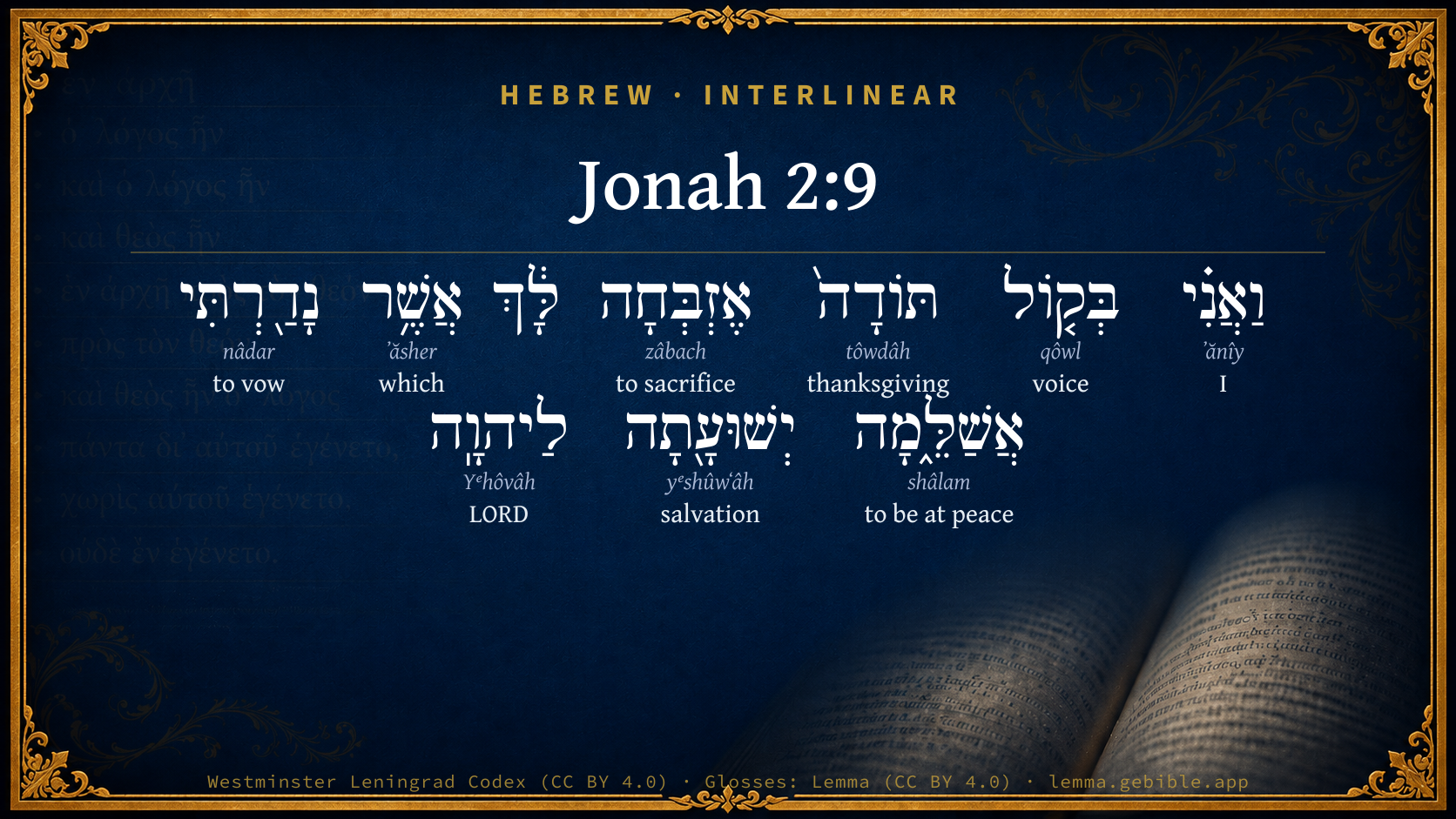
Hebrew (Westminster Leningrad Codex) Jonah 2:9 appears in the Hebrew Old Testament. The text above is from the Westminster Leningrad Codex. Each word links to its Strong’s number, a concise gloss, and parsing drawn from the Open Scriptures Hebrew Bible morphology. Click any word for its full Brown-Driver-Briggs (BDB) entry.
Download image
Cite this verse

Jonah 2:9 (World English Bible). Public Domain. Lemma interlinear Bible study tool, https://lemma.gebible.app/v/jonah/2/9.

Show BibTeX & RIS
BibTeX
RIS
English Translation
But I will sacrifice to you with the voice of thanksgiving. I will pay that which I have vowed. Salvation belongs to Yahweh."
World English Bible · Public Domain
Download a study sheet

One document with this verse’s original text, its word-by-word gloss line, the meaning frame, cross-references with their text, attributed commentary, and full source and license credits — printable, and it pastes into notes with its structure intact.

This verse Autodidact and up

Study sheet (.html) Plain text (.txt)

A passage Seminary Student

Up to 50 verses in one chapter. A passage sheet keeps up to 6 commentary sources and 12 cross-references per verse, in the order this page ranks them, and says so on the sheet whenever that leaves anything out. Ask for a single verse and you get the Autodidact verse sheet above.

Everything on this page stays free to read, with no account — the sheet is a download of what is already on screen, not access to it.

Want to remove ads? Support Godless Engineer
Compare translations 3

The same verse in 3 English versions, stacked beneath the original-language interlinear above. Click any original word for its lexicon entry.

Each is an independent rendering of the whole verse — the interlinear is not word-aligned to these translations.

Highlighted words mark where these versions differ — a whole-verse word diff, not a word-by-word alignment.

  • World English Bible Public Domain
    But I will sacrifice to you with the voice of thanksgiving. I will pay that which I have vowed. Salvation belongs to Yahweh."
  • King James Version Public Domain
    But I will sacrifice unto thee with the voice of thanksgiving; I will pay that that I have vowed. Salvation is of the LORD.
  • unfoldingWord Literal Text CC BY-SA 4.0
    But I, I will sacrifice to you with a voice of thanksgiving; I will fulfill what I have vowed. Salvation belongs to Yahweh!”

unfoldingWord Literal Text — © unfoldingWord, licensed CC BY-SA 4.0. Word-aligned USFM3 via Door43 (git.door43.org/unfoldingWord/en_ult).

Versions to compare (up to 4)

3 of 4 selected

Show all 18 translations

Every available English version of this verse, each an independent rendering of the whole verse.

  • World English Bible Public Domain
    But I will sacrifice to you with the voice of thanksgiving. I will pay that which I have vowed. Salvation belongs to Yahweh."
  • Berean Standard Bible Public Domain
    But I, with the voice of thanksgiving, will sacrifice to You. I will fulfill what I have vowed. Salvation is from the LORD!”
  • Majority Standard Bible Public Domain
    But I, with the voice of thanksgiving, will sacrifice to You. I will fulfill what I have vowed. Salvation is from the LORD!”
  • King James Version Public Domain
    But I will sacrifice unto thee with the voice of thanksgiving; I will pay that that I have vowed. Salvation is of the LORD.
  • American Standard Version (1901) Public Domain
    But I will sacrifice unto thee with the voice of thanksgiving; I will pay that which I have vowed. Salvation is of Jehovah.
  • Revised Version (1885) Public Domain
    But I will sacrifice unto thee with the voice of thanksgiving; I will pay that which I have vowed. Salvation is of the LORD.
  • Geneva Bible (1599) Public Domain
    But I will sacrifice vnto thee with the voice of thankesgiuing, and will pay that that I haue vowed: saluation is of the Lord.
  • Douay-Rheims (1899) Public Domain
    They that are vain observe vanities, forsake their own mercy.
  • Young's Literal Translation Public Domain
    And I -- with a voice of thanksgiving -- I sacrifice to Thee, That which I have vowed I complete, Salvation `is' of Jehovah.
  • Literal Standard Version CC BY-SA 4.0
    And I—with a voice of thanksgiving—I sacrifice to You, || That which I have vowed I complete, || Salvation [is] of YHWH.”
  • Unlocked Literal Bible CC BY-SA 4.0
    But as for me, I will sacrifice to you with a voice of thanksgiving; I will fulfill that which I have vowed. Salvation comes from Yahweh!”
  • unfoldingWord Literal Text CC BY-SA 4.0
    But I, I will sacrifice to you with a voice of thanksgiving; I will fulfill what I have vowed. Salvation belongs to Yahweh!”
  • Darby Bible Public Domain
    But I will sacrifice unto thee with the voice of thanksgiving; I will pay that which I have vowed. Salvation is of Jehovah.
  • World Messianic Bible Public Domain
    But I will sacrifice to you with the voice of thanksgiving. I will pay that which I have vowed. Salvation belongs to the LORD.”
  • Webster's Bible Public Domain
    \\2:8\\They that observe lying vanities forsake their own mercy.
  • Free Bible Version CC BY-SA 4.0
    But I will offer you sacrifices, shouting out my thanks. I will keep my promises to you, for salvation comes from the Lord.”
  • Bible in Basic English Public Domain
    The worshippers of false gods have given up their only hope.
  • JPS Tanakh (1917) Public Domain
    (2-10) But I will sacrifice unto Thee with the voice of thanksgiving; that which I have vowed I will pay. Salvation is of the LORD.

Literal Standard Version (2020), Covenant Press — licensed CC BY-SA 4.0. Text via the HelloAO Bible API (eBible.org). Unlocked Literal Bible (unfoldingWord) — licensed CC BY-SA 4.0. Text via the HelloAO Bible API (eBible.org). unfoldingWord Literal Text — © unfoldingWord, licensed CC BY-SA 4.0. Word-aligned USFM3 via Door43 (git.door43.org/unfoldingWord/en_ult). Free Bible Version, Dr. Jonathan Gallagher — licensed CC BY-SA 4.0. Text via the HelloAO Bible API (eBible.org).

Word by word

More ways to search: Search by grammar → Find every occurrence → Compare this word →

Practice this passage: Drill this verse → Learn its vocabulary →

About this verse

These counts appear in no published source. They are computed here, from the morphology-tagged text and Lemma’s own curated glosses. What Lemma adds →

10
words
9
distinct lemmas
Prophets
section

Shared distinctive vocabulary

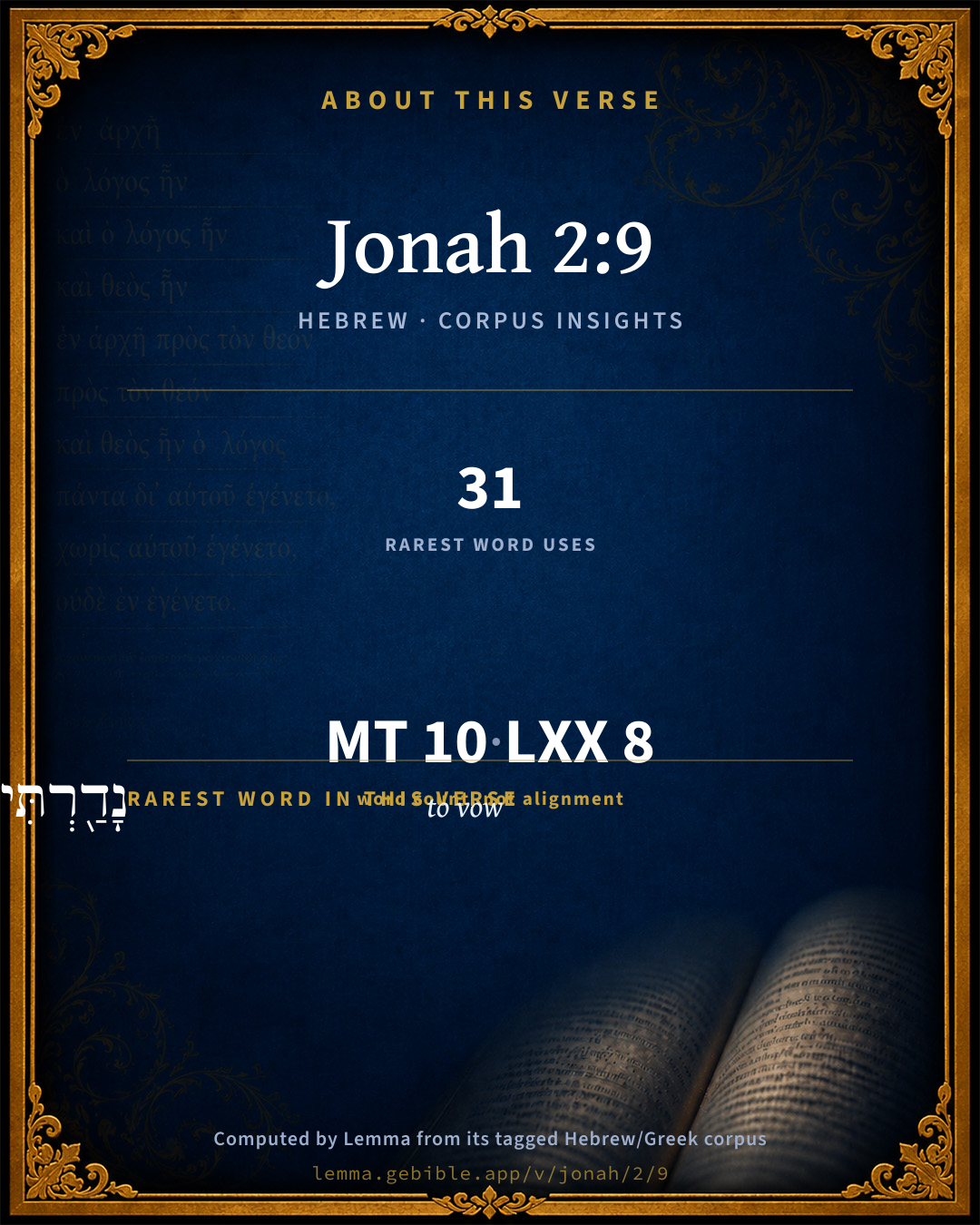
נָדַ֖רְתִּי to vow H5087 occurs in 28 verses of the Hebrew Bible. Also found in:

Grammatical profile

  • 3 verbs
  • 4 nouns
  • 1 pronoun
  • 1 preposition
  • 1 particle

Verb forms

  • אֶזְבְּחָה Qal · Cohortative
  • נָדַ֖רְתִּי Qal · Perfect
  • אֲשַׁלֵּ֑מָה Piel · Cohortative

Hebrew & Septuagint length

In English translation the verse runs 23 words from the Hebrew and 11 from the Septuagint (LXX English) — the Septuagint runs noticeably shorter here. See the side-by-side →

A rough comparison of the two English renderings, which tokenize alike — not a word-level alignment.

Word counts can differ between the Hebrew and the Greek without any difference in meaning — e.g. the Hebrew direct-object marker אֵת has no separate Greek word, and Greek often adds the article ὁ.

In the original languages it is 10 Hebrew tokens and 8 Greek tokens — but the two are counted differently (Hebrew bundles its prefixes and suffixes into one token; the Greek is in lemma form), so that isn’t a like-for-like length.

Cross-references

21

Topical passages linked to Jonah 2:9 in the Treasury of Scripture Knowledge — connected by theme and wording, ordered by reader-vote popularity; previews shown in the World English Bible.

  • Psalms 3:8 Salvation belongs to Yahweh. Your blessing be on your people. Selah.
  • Psalms 50:14 Offer to God the sacrifice of thanksgiving. Pay your vows to the Most High.
  • Ecclesiastes 5:4–5 When you vow a vow to God, don't defer to pay it; for he has no pleasure in fools. Pay that which you vow.
  • Hebrews 13:15 Through him, then, let us offer up a sacrifice of praise to God continually, that is, the fruit of lips which make confession to his name.
  • Psalms 50:23 Whoever offers the sacrifice of thanksgiving glorifies me, And prepares his way so that I will show God's salvation to him."
  • Psalms 68:20 God is to us a God of deliverance. To Yahweh, the Lord, belongs escape from death.
  • Psalms 116:17–18 I will offer to you the sacrifice of thanksgiving, And will call on the name of Yahweh.
  • Hosea 14:2 Take words with you, and return to Yahweh. Tell him, "Forgive all our sins, And accept that which is good: So we offer like bulls our lips.
  • Psalms 37:39–40 But the salvation of the righteous is from Yahweh. He is their stronghold in the time of trouble.
  • Isaiah 45:17 [But] Israel shall be saved by Yahweh with an everlasting salvation: you shall not be disappointed nor confounded world without end.
  • Romans 12:1 Therefore I urge you, brothers, by the mercies of God, to present your bodies a living sacrifice, holy, acceptable to God, which is your spiritual service.
  • Genesis 35:3 Let us arise, and go up to Bethel. I will make there an altar to God, who answered me in the day of my distress, and was with me in the way which I went."
  • Job 22:27 You shall make your prayer to him, and he will hear you. You shall pay your vows.
  • Jeremiah 33:11 the voice of joy and the voice of gladness, the voice of the bridegroom and the voice of the bride, the voice of those who say, Give thanks to Yahweh of Hosts, for Yahweh is good, for his loving kindness endures forever; [and of them] who bring [sacrifices of] thanksgiving into the house of Yahweh. For I will cause the captivity of the land to return as at the first, says Yahweh.
  • John 4:22 You worship that which you don't know. We worship that which we know; for salvation is from the Jews.
  • Revelation 7:10 They cried with a loud voice, saying, "Salvation be to our God, who sits on the throne, and to the Lamb!"
  • Psalms 66:13–15 I will come into your temple with burnt offerings. I will pay my vows to you,
  • Psalms 107:22 Let them offer the sacrifices of thanksgiving, And declare his works with singing.
  • Acts 4:12 There is salvation in none other, for neither is there any other name under heaven, that is given among men, by which we must be saved!"
  • Deuteronomy 23:18 You shall not bring the hire of a prostitute, or the wages of a dog, into the house of Yahweh your God for any vow: for even both these are an abomination to Yahweh your God.
  • 2 Samuel 15:7 It happened at the end of forty years, that Absalom said to the king, please let me go and pay my vow, which I have vowed to Yahweh, in Hebron.

Cross-references courtesy of OpenBible.info (CC BY 4.0).

Hebrew and Greek witnesses Masoretic Hebrew ↔ Greek Septuagint

The same verse in the two great witnesses to the Old Testament, shown verse-for-verse.

Here the Septuagint runs noticeably shorter than the Hebrew — LXX2012 (modern English Septuagint) 11 words vs World English Bible 23. A rough length comparison of the two English translations, not a word-level alignment — read both below.

These are two independent witnesses, not word-aligned to each other, and the Septuagint is shown in lemma (dictionary) form.

Hebrew Jonah 2:9 Masoretic · Westminster Leningrad Codex

וַאֲנִ֗י בְּק֤וֹל תּוֹדָה֙ אֶזְבְּחָה לָּ֔ךְ אֲשֶׁ֥ר נָדַ֖רְתִּי אֲשַׁלֵּ֑מָה יְשׁוּעָ֖תָה לַיהוָֽה

But I will sacrifice to you with the voice of thanksgiving. I will pay that which I have vowed. Salvation belongs to Yahweh."

World English Bible · Public Domain

Greek LXX Jonah 2:9 Septuagint · lemma form

φυλάσσω μάταιος καί ψευδής ἔλεος αὐτός ἐν καταλείπω

They that observe vanities and lies have forsaken their own mercy.

LXX2012 (modern English Septuagint) · Public Domain

On this verse, The Pulpit Commentary discusses the Septuagint’s reading. Read the note in Commentary ↓

Hebrew: Westminster Leningrad Codex (CC BY 4.0). Greek: Septuagint (public domain); English from LXX2012 (modern English Septuagint) (Public Domain). How the Septuagint differs from the Hebrew →

Targum (Aramaic paraphrase)

1

The Targum is the ancient Jewish Aramaic paraphrase of the Hebrew Scriptures — an interpretive translation, not the Hebrew text itself. Onkelos (literal) and Pseudo-Jonathan (expansive) render the Torah, and Jonathan the Prophets. Coverage is partial: where no permissively-licensed English translation exists for a verse, only the Aramaic is shown. This is verse-level text, not a word-by-word alignment to the Hebrew.

  1. Targum Jonathan Prophets (Joshua–Malachi)
    לָא כְּעַמְמַיָא פַּלְחֵי טַעֲוָתָא מֵאֲתַר דְאִתּוֹטַב לְהוֹן לֵית אִינוּן יָדְעוּן:

    Not like the nations worshipping falsehoods; of the place of goodness none of them know.

    Targum Jonathan — Aramaic: “Mikraot Gedolot” (public domain). English: “Sefaria Community Translation” (CC0 1.0 (public-domain dedication)); “London "Chaldee Paraphrase," 1871” (public domain). Text via Sefaria.

Commentary

Notes on Jonah 2:9 from classic Christian and Jewish commentators (each source and its license shown beneath its notes). The classic Christian expositions comment on the surrounding passage and are grouped to its opening verse, so a note may address several verses; the Jewish commentaries on the Tanakh (Rashi and others) are per-verse, so they appear only where the commentator wrote on this verse.

Lemma curates 59 commentaries, every one of them public domain or Creative Commons licensed, each selected and text-cleaned for this edition rather than reprinted as found. About our sources →

Trapp's Complete Commentary

John Trapp

Jon 2:9 But I will sacrifice unto thee with the voice of thanksgiving; I will pay [that] that I have vowed. Salvation [is] of the LORD.

Ver. 9. But I will sacrifice unto thee with the voice of thanksgiving] q.d. Let others do as they think good; let them make a match with mischief till they have enough of it; let them walk till they have wearied themselves in the ways of their hearts and in the sight of their eyes; but let them know (I speak it by woeful experience) that for all these things God will bring them to judgment, Ecc 11:9. The best that can come of sin is repentance: and that is not in man’s power but in God’s gift, 2Ti 2:25. If he had not melted my hard heart, and brought me back to himself with a strong hand, I had pined away in mine iniquities, and perished for ever. But now having been so miraculously delivered from so great a death, "I will sacrifice unto the Lord with the voice of thanksgiving"; I will set up my note and sing aloud unto God my Saviour, who hath thus beyond all desert delivered such a miserable wretch, rebel, and regegade as myself.

I will sacrifice] Heb. I will slay, sc. those birds and beasts in use for feasts and sacrifices at Jerusalem,

with the voice of thanksgiving] Heb. of confession, that is, I will confess and acknowledge God to be what he is, to do what he doth, and to give what he giveth. Now to offer a sacrifice at such a confession or thanksgiving added much to the solemnity thereof; and made it more honourable in itself, and more acceptable to God. To these gratulatory sacrifices the word slaying is attributed, as hero, to show that even in gratulation expiation must be made; and that by the blood and sacrifice of Christ all our offerings are accepted in heaven.

I will pay that I have vowed] Not my general vow only as a covenanter, to devote myself to his fear and service all my days; but those particular, personal, voluntary vows made in my distress; such as was that of Jacob, Gen 28:20; Hannah, 1Sa 1:11; David, Psa 132:1-2, &c. In affliction men are wondrously apt to promise great matters, if they may but be delivered. See Psa 78:36. Pliny, in an epistle to one of his friends, that desired rules from him how to order his life aright; I will, saith he, give you one rule, that shall be instead of a thousand: Ut tales esse perseveremus sani, quales nos futuros esse profitemur infirmi: That you be sure to be the same when well that you vowed to be when you were sick. But this is few men’s care. See Jer 34:10-11. Sons of Belial break these bonds as Samson did the green withes, and cast away those cords from them; if they could, at least; being worse herein than those mariners, Jon 1:16, than Saul, that made great conscience of violating his vow, 1Sa 14:21, than Turks and Papists, who are superstitiously strict this way. Jonah knew it to be as bad, if not worse, than perjury, to vow and not to perform, Num 30:3, and that God is the avenger of all such, Deu 23:21. He therefore, not merely for fear of punishment, but chiefly for hatred of that sin, saith,

I will pay that I have vowed] The Hebrew word Ashallemah seemeth to imply two things. First, that his vow till paid was incomplete, it was an imperfect thing; the better part of it was yet wanting. Next, that till that chare were done he could not be at peace within himself, he could not be quiet; for vows are debts; and debts, till they be paid, are a burden to an honest mind, and do much disease it.

Salvation is of the Lord] Salus omnimoda, as the Hebrew word Jeshugnathah (having one letter more than ordinary in it) importeth; {Hebrew Text Note} all manner of salvation, full and plentiful deliverance, "is of the Lord"; who is therefore called, the "God of salvation," unto whom belong the issues from death, Psa 68:20. A quo vera salus non aliunde venit. This Jonah speaketh, as he doth all else in this holy canticle, not by reading, or by rote, but out of his own feeling and good experience; his whole discourse was dug out of his own breast, as it is said of that most excellent 119th Psalm, that it is made up altogether of experiments; and it therefore hath verba non legenda sed vivenda, words not so much to be read as lived, as one said once of it. Dives thought that if one went from the dead to warn his wicked brethren they would never be able to resist such powerful rhetoric. Behold, here is Jonah raised from the dead, as it were, and warning people to arise, and stand up from dead courses and companies, that Christ may give them light; why do they not then get up and be doing at it, that the Lord may be with them? Shall not the men of Nineveh rise up in judgment with this evil generation, and condemn them, because they repented at the preaching of Jonah, Mat 12:41, but these do not, though they have may Jonahs, that both preach and practise, non verbis solum praedicantes sed et exemplis, as Eusebius saith Origen did, that live sermons, and not teach them only?

John Trapp, A Commentary or Exposition upon All the Books of the Old and New Testament (1647–1656) — public domain. Text from a community e-Sword module.

The Biblical Illustrator

Joseph S. Exell

Jon_2:9

I will pay that that I have vowed.

A forgotten vow

I heard of a sea-captain who had been wrecked, and with whose ship most of the crew and passengers were lost. He himself had only saved his life by holding on to a plank, and had for a considerable time been completely at the mercy of the waves, but fortunately had been rescued, and was then travelling in the stage-coach to rejoin his family. He told his fellow-passengers his sad story, and all of them pitied him, but wondered why a man so recently saved from imminent danger should end almost every sentence with an oath. The coach stopped to change horses, and one of the passengers proposed to the captain that they should walk on and let the coach overtake them. As they walked together the gentleman said, You said last night you lost your ship? Yes. And your life was saved by clinging to a plank? When you were hanging on to that plank, did you not vow that if God delivered you, you would lead a very different life from that which you had formerly done? That is no concern of yours, angrily responded the captain. At the end of the days journey, as the travellers were about to take supper together, the captain was obliged to decline, saying he had no money. The gentleman who had spoken to him on the way offered him a goodly sum. The captain refused it at first, but eventually, rather ungraciously, accepted the gift. Next morning the captain surprised the gentleman by holding out his hand and saying, I did, while on that plank, promise God that I would lead a different life if He would, in His mercy, save me. I had forgotten my vow, but with Gods help I shall keep it from this day forth! Do not many sinners so treat God? They call upon Him in the day of trouble, but when they are delivered they forget all about Him. (J. Hamilton.)

Salvation is of the Lord.

Jonahs praise of God

In his words we have a particular favour acknowledged. Jonah evidently had an eye to the wonderful and extraordinary deliverance that God had wrought for him; and indeed the hand of God did so eminently appear in it, that it could not be ascribed to any other. And there is a general truth asserted, Salvation is of the Lent. This is certainly true in the most extensive sense. Whether the salvation be of a temporal or spiritual nature, it is of the Lord.

I. What salvation is of the Lord.

1. The salvation of the soul, salvation from sin, and from all that misery which is consequential to it There is a salvation by purchase and a salvation by power, and both are of the Lord.

2. Temporal salvation is of the Lord. God Wrought a temporal as well as a spiritual deliverance for Jonah, and to Him Jonah ascribes the praise of both.

II. In what respects salvation is of the Lord.

1. In what respects spiritual salvation is of the Lord.

(1) In respect of contrivance.

(2) In respect of purchase.

(3) In respect of the revelation, exhibition, and offer of it.

(4) In respect of the application of it.

(5) In respect of the progress of it.

(6) In respect of the consummation of it.

2. Temporal salvation, or deliverance from outward troubles and afflictions, is of the Lord, as it is He alone who works it; and whatever the distress is, He is able to work it.

Learn--

1. Believers in the most afflicted condition have no reason to be cast down, as if their case were altogether hopeless.

2. Sinners, however guilty and wretched, have no reason to despair of salvation.

3. Believers are wholly indebted to the grace of God for their salvation, for every spiritual and every temporal deliverance wrought for them.

4. That when any deliverance wrought for persons has been wrought for them in mercy, they will eye and acknowledge the hand of God in it. (D. Wilson.)

Salvation is of God

Observe what happens when the cry rises at sea, A man overboard! With others on deck, you rush to the side; and leaning over the bulwarks, with beating heart you watch the place where the rising air-bells and boiling deep tell that he has gone down. After some moments of breathless anxiety you see his head emerge from the wave. Now that man, I shall suppose, is no swimmer; he has never learnt to breast the billows; yet with the first breath he draws he begins to beat the water; with violent efforts he attempts to shake off the grasp of death, and by the play of limbs and arms to keep his head from sinking. It may be that these struggles but exhaust his strength, and sink him all the sooner; nevertheless, that drowning one makes instinctive and convulsive efforts to save himself. So, when first brought to feel and cry, I perish! when the horrible conviction rushes into the soul that we are lost, when we feel ourselves going down beneath a load of guilt into the depth of the wrath of God, our first effort is to save ourselves. Like a drowning man, who will clutch at straws and twigs, we seize on anything, however worthless, that promises salvation. Thus, alas! many poor souls toil, and spend weary, unprofitable years in the attempt to establish a righteousness of their own, and find in the deeds of the law protection from its curse. (J. Maclaurin.)

Salvation is of the Lord

Take the word salvation in its highest and in its lower senses.

I. In the deliverance of a soul. Comment upon our state of ruin. Salvation is--

1. Of the Father. In its origin proceeding from the eternal love of God, even before all time.

2. Of the Son. In its meritorious cause. An obstacle to be removed; justice to be satisfied; our need of an atoning sacrifice. Note the willingness of Christ to offer Himself; and the fulness and sufficiency of Christs sacrifice.

3. Of the Spirit. In its personal application. Our aversion to God to be taken away--in conversion, sanctification, perseverance.

II. In the lesser deliverances of the children of God.

1. From outward difficulties. Such as Jonahs case. Jonathan and the Philistines. Children of Israel in the wilderness. David overtaken by Saul. Asa and the Ethiopians. Jehoshaphat and the Moabites.

2. From bodily afflictions. Hezekiahs sickness. Psa_102:17; Job_32:19.

3. From soul troubles. Temptation. Desertion. Backsliding. What are the legitimate deductions?

(1) The subject checks the pride and vainglory of man.

(2) Raises the hopes of the desponding. (John D. Lawe, M. A.)

What is salvation?

Let us try to see what salvation means. I take it to be summed up in four things. First, knowledge that God is our Father; second, knowledge of the kind of life we are expected to live; third, reconciliation with ourselves, with our own consciences; fourth, a sense of pardon and communion with God, and knowledge of eternal life within us. If you test these things you will find how true it is that they are not found in any other name or person than Jesus Christ. (R. F. Horton, D. D.)

Salvation is of the Lord

This text announces, in general terms, a truth encroached upon by almost all systems of false doctrine, and repugnant to the natural heart.

I. Salvation is wholly of God in its origin with the Father.

1. In the will and decree of the Father (see Eph_1:4).

2. The Fathers purpose and decree can be referred to nothing but His sovereign pleasure (see Eph_1:11).

3. He was under no obligation to save man.

4. In order to receive salvation we must take the position in which it contemplates us. Condemned, as guilty. Hateful, through sin. The enemies of God, against whom sin is. Powerless to atone or obey.

5. We must further acknowledge Gods absolute sovereignty in electing to salvation, and providing a Saviour, and in now saving us.

II. Salvation is wholly of God in its execution by Christ.

1. Had man been equal to his own salvation, then had Christ not come (Gal_3:21).

2. Christ had to meet human opposition. Man opposed his own salvation, according to Gods plan, as soon as practicable.

III. Salvation is wholly of God in its application by the Spirit. Man is dependent on the Spirit for having the truth presented; for being able to understand the truth; for rendering him willing; for faith to receive and rest on Christ; for regeneration; for sanctification; for perseverance unto the end of life in Divine grace. Learn to pray for and rely on the Spirit. (James Stewart.)

The Christians rejoicing and glory

In the former part of the verse the prophet expresses his determination to bless and praise the Lord. The ground of his doing so was what the Lord had done for him, notwithstanding his grievous crimes and rebellion. That again embraced a twofold mercy, namely, what had been done, or what was about to be done, for his body and for his soul. The prophet had now been taught a lesson which it would be his wisdom never to forget, and which would the better enable him for the arduous work he was called to perform. Some indisputable facts in Christian experience.

1. That no one knows what salvation means but they who have seen their need of it.

2. That no one can praise the Lord for salvation but they who have experienced its blessing and power.

3. That no one can be insensible to the holy feeling of gratitude and praise to whom the grace of God hath brought salvation.

4. That it is generally through a variety of humiliating and painful discipline we are conducted to such an experience, and formed to such a confession and acknowledgment. This then is the subject of our discourse. Considered in every possible point of view, in its origin, source, revelation, execution, grant, efficiency, continuance, and consummation, Salvation is of the Lord.

I. What does the term salvation mean?

1. What the Lord had done, or was about to do, for Jonah in respect of his body. In this Jonah was a striking type of Christ.

2. What the Lord had done for him in respect of his soul, in preserving him from hell, and granting him repentance unto life. The word salvation, as applied to souls, does not mean

(1) Profession.

(2) Privileges.

(3) Attainments.

(4) Names, sects, or parties.

To see what it does mean we must ask, What is the state of man? He is lost, as being guilty, condemned, polluted, and depraved, exposed to many enemies, from which, by his own will and power, be can never escape. Salvation means deliverance from this state of wretchedness and misery, together with an investiture of all the blessings needful for his present peace and everlasting welfare.

II. Whence does this salvation flow, and by whom is it carried into effect? It does not originate with man. It is not effected by man. It is altogether of the Lord. Consider from Scripture--

1. The source of salvation.

2. The provision of the Saviour.

3. The assignment of His mediating work as the surety of His Church and people.

4. Look at the execution of this great work.

So it is clear that salvation is altogether of the Lord. Consider how, and by whom, the time when, and the manner in which this gracious provision is carried into effect in the sinners conversion.

1. The regeneration of the soul.

2. The sinners pardon and justification.

3. The believers sanctification and adoption.

4. The believers succour, support, and safety.

5. The believers perseverance unto the end, his safe death, and triumphant glory.

III. Wherein does it appear that it is indeed the salvation of the Lord?

1. What hath the Lord spoken on this subject?

2. What does the state of the case absolutely require?

3. What does the experience of the people of God abundantly testify and confirm?

4. If salvation be not of the Lord, then how dark, how cheerless is the prospect set before us!

(1) Take a word of instruction. Lay down this doctrine as a fundamental truth.

(2) Take a word of discovery. How much error, delusion, and false doctrine does this subject bring to light!

(3) Take a word of inquiry. In what way are you seeking your salvation?

(4) Take a word of alarm. Is it not sad to consider how the Lord is slighted by some, and dishonoured by others, in this great work of salvation?

(5) Take a word of encouragement. Can anything be more cheering than this assurance, Salvation is of the Lord?

(6) Take a word of gratitude and joy. Is the Lord my Saviour? (R. Shittler.)

The Biblical Illustrator, edited by Joseph S. Exell (c. 1880s–1900s) — public domain. Text from a community e-Sword module.

Jamieson, Fausset & Brown

Robert Jamieson, A. R. Fausset & David Brown

I will sacrifice . . . thanksgiving--In the believing anticipation of sure deliverance, he offers thanksgivings already. So Jehoshaphat () appointed singers to praise the Lord in front of the army before the battle with Moab and Ammon, as if the victory was already gained. God honors such confidence in Him. There is also herein a mark of sanctified affliction, that he vows amendment and thankful obedience ().

Jamieson, Fausset & Brown — Commentary Critical and Explanatory on the Whole Bible (1871) — public domain (CC PDM 1.0). Text via the HelloAO Bible API.

Adam Clarke's Commentary

Verse 9. But I will sacrifice unto thee] I will make a sincere vow, which, as soon as my circumstances will permit, I will faithfully execute; and therefore he adds, "I will pay that which I have vowed."

Salvation is of the Lord.] All deliverance from danger, preservation of life, recovery from sickness, and redemption of the soul from the power, guilt, and pollution of sin, is from Jehovah. He alone is the Saviour, he alone is the Deliverer; for all salvation is from the Lord.

Adam Clarke's Commentary on the Bible (1810–1826) — public domain. Text from a community e-Sword/MySword module.

John Calvin's Commentaries

Jonah therefore rightly adds, But I, with the voice of praise, will sacrifice to thee; as though he said While men as it were banish themselves from God, by giving themselves up to errors, I will sacrifice to thee and to thee alone, O Lord. And this ought to be observed by us; for as our minds are prone to falsehood and vanity, any new superstition will easily lay hold so us, except we be restrained by this bond, except we be fully persuaded, — that true salvation dwells in God alone, and every aid and help that can be expected by us: but when this conviction is really and thoroughly fixed in our hearts, then true religion cannot be easily lost by us: though Satan should on every side spread his allurements, we shall yet continue in the true and right worship of God. And the more carefully it behaves us to consider this passage, because Jonah no doubt meant here to strengthen himself in the right path of religion; for he knew that like all mortals he was prone to what was false; he therefore encouraged himself to persevere: and this he does, when he declares that whatever superstition men devise, is a deprivation of the chief good, even of life and salvation. It will hence follow, that we shall abominate every error when we are fully persuaded that we forsake the true God whenever we obey not his word, and that we at the same time cast away salvation, and every thing good that can be desired. Then Jonah says, I will sacrifice to thee with the voice of praise.

It must be noticed here farther, that the worship of God especially consists in praises, as it is said in Psalm 1:1: for there God shows that he regards as nothing all sacrifices, except they answer this end — to set forth the praise of his name. It was indeed his will that sacrifices should be offered to him under the law; but it was for the end just stated: for God cares not for calves and oxen, for goats and lambs; but his will was that he should be acknowledged as the Giver of all blessings. Hence he says there, ‘Sacrifice to me the sacrifice of praise.’ So also Jonah now says, I will offer to thee the sacrifice of praise, and he might have said with still more simplicity, “Lord, I ascribe to thee my preserved life.” But if this was the case under the shadows of the law, how much more ought we to attend to this, that is, — to strive to worship God, not in a gross manner, but spiritually, and to testify that our life proceeds from him, that it is in his hand, that we owe all things to him, and, in a word, that he is the Source and Author of salvation, and not only of salvation, but also of wisdom, of righteousness, of power?

And he afterwards mentions his vows, I will pay, he says, my vows. We have stated elsewhere in what light we are to consider vows. The holy Fathers did not vow to God, as the Papists of this day are wont to do, who seek to pacify God by their frivolous practices; one abstains for a certain time from meat, another puts on sackcloth, another undertakes a pilgrimage, and another obtrudes on God some new ceremony. There was nothing of this kind in the vows of the holy Fathers; but a vow was the mere act of thanksgiving, or a testimony of gratitude: and so Jonah joins his vows here with the sacrifice of praise. We hence learn that they were not two different things; but he repeats the same thing twice. Jonah, then, had declared his vow to God for no other purpose but to testify his gratitude.

And hence he adds, To Jehovah is, or belongs, salvation; that is, to save is the prerogative of God alone; Jehovah is here in the dative case, for prefixed to it is ל, lamed. It is then to Jehovah that salvation belongs; the work of saving appertains to no other but to the Supreme God. Since it is so, we see how absurd and insane men are, when they transfer praises to another, as every one does who invents an idol for himself. As, then, there is but the one true God who saves, it behaves us to ascribe to him alone all our praises, that we may not deprive him of his right. This is the import of the whole. It follows —

John Calvin's Commentaries (1540-1563) — public domain. Text from the Calvin Translation Society English edition (1840s-50s) via the Christian Classics Ethereal Library (ccel.org). Calvin's coverage is partial (roughly two-thirds of the Bible); uncommented books and verses are honest gaps, never fabricated. The 19th-century editor's footnotes and remarks are omitted so the notes are faithfully Calvin's own voice.

Ellicott's Commentary for English Readers

(9) But I will.—The prophet, however, is not among such. He has sinned, but is still a member of the covenant people, and by sacrifice can be formally restored to that favour which repentance has regained.

Salvation is of the Lord.—Or, Deliverance is Jehovah’s. (Comp. Psa_3:8.)

A Bible Commentary for English Readers, edited by Charles John Ellicott (1878–1897) — public domain. Text from a community e-Sword module.

The Cambridge Bible for Schools and Colleges

gen. ed. J. J. S. Perowne

9. But I] in contrast to my former self, and to the whole body of those of whom I then was one, will humbly claim and gratefully acknowledge my share in “my Mercy.” “I will sacrifice unto Thee,” &c.

Salvation is of the Lord] Comp. Psa_3:8, Rev_7:10. This is at once confession and praise, a Creed and a Te Deum. It is the sum of his canticle, the outcome of all he has passed through. Deliverance in its fullest sense is already his in faith and confident anticipation. But God alone is the Author of it, and to Him alone shall the praise for it be ascribed. This point reached, Jonah’s punishment has done its work, his discipline is at an end.

The Cambridge Bible for Schools and Colleges (gen. ed. J. J. S. Perowne; Cambridge University Press, 1878–1918) — public domain. Text from a community e-Sword module.

Albert Barnes' Notes on the Bible

But (And) with the voice of thanksgiving will I (would I fain) sacrifice unto Thee; what I have vowed, I would pay - He does not say, I will, for it did not depend upon him. Without a further miracle of God, he could do nothing. But he says, that he would nevermore forsake God. The law appointed sacrifices of thanksgiving; Lev 7:12-15. these he would offer, not in act only, but with words of praise. He would “pay what he had vowed,” and chiefly himself, his life which God had given back to him, the obedience of his remaining life, in all things. For (Ecclesiasticus 35:1) “he that keepeth the law bringeth offerings enough; he that taketh heed to the commandments offereth a peace-offering.” Jonah neglects neither the outward nor the inward part, neither the body nor the soul of the commandment.

Salvation is of (literally to) the Lord - It is wholly His; all belongs to Him, so that none can share in bestowing it; none can have any hope, save from Him. He uses an intensive form, as though he would say, strong “mighty salvation” . God seems often to wait for the full resignation of the soul, all its powers and will to Him. Then He can show mercy healthfully, when the soul is wholly surrendered to Him. So, on this full confession, Jonah is restored, The prophet’s prayer ends almost in promising the same as the mariners. They “made vows;” Jonah says, “I will pay that I have vowed.” Devoted service in the creature is one and the same, although diverse in degree; and so, that Israel might not despise the pagan, he tacitly likens the act of the new pagan converts and that of the prophet.

Albert Barnes' Notes on the Bible (1834–1885) — public domain. Text from a community e-Sword/MySword module.

Haydock's Catholic Bible Commentary

Mercy. He alludes to the sailors. (Theodoret) --- Hebrew also, "let them forsake their worship," (Drusius, Leviticus xx. 17.) or they are guilty of impiety. They neglect their vows, ver. 10., and chap. i. 16. (Calmet)

George Leo Haydock (1774–1849), Haydock's Catholic Family Bible and Commentary, 1859 edition — public domain. Excludes Psalms (Douay-Rheims chapter numbering differs from Protestant) and Deuterocanonical books (Catholic canon only).

Matthew Poole's English Annotations

Jonah here doth intimate his adherence to God, his assurance that he should find God to be a. fountain of mercy to him, that God would hear his prayer.

I will sacrifice; in most solemn manner recognize the mercy I receive; I shall have just ground to do it, and I will certainly be just to the mercy of my God and do it. Who wait on gods that cannot deliver shall never have cause to sacrifice to them; if they do the thing, they do sacrilegiously rob God.

Unto thee; excluding all others, who shall have as little share in the praise as they had in the thing for which praise is offered.

With the voice of thanksgiving; including the heart also; for such is the sacrifice with which God is best pleased, Psa 50:14,23; 116:17; Hos 14:2; Heb 13:15.

I will pay: vows are, when made, debts we owe to God, and must, as just debts, be paid.

That I have vowed: it is not said what it was he had vowed, probably it was a more obedient heart and deportment, likely he resolveth to go to Nineveh and preach what God commandeth him; he will perform his promise to the Lord in all things he did engage to do.

Salvation; power to save, and actual deliverance from all dangers, in all distresses: when none of the gods the marine is invoked, neither any one apart nor yet all together, could quiet the tempest, and save from the danger of the sea, Jonah’s God could do both, he could by his own single power deliver Jonah out of the belly of hell.

Is of the Lord; he only can save, none else can as he can, Psa 3:8; 68:20.

Matthew Poole's English Annotations on the Holy Bible (1683–1685) — public domain. Text from a community e-Sword/MySword module.

The Pulpit Commentary

But I who know better than idolaters, and who have learned a new lesson of trust in GodI will sacrifice. Pusey notes that the Hebrew denotes rather, "I fain would sacrifice," as it depended, not on him, but on God, whether he was able to worship again in the Holy Land. His sacrifice of thanksgiving (Lev_7:12, etc.) should be offered with prayer and praise. (Psa_42:5) That which I have vowed. (Psa_1:1-4 Psa_66:13) Salvation is of the Lord. This is the conclusion to which his trial has brought him, the moral of the whole canticle. (Psa_3:8 Psa_118:14, 21 Rev_7:10) The LXX and the Vulgate join this clause to the preceding, thus: "That which I have vowed I will pay to the Lord for my salvation." This is tame, and not in strict accordance with the Hebrew.

Piety triumphant.

The remarkable fact connected with this sublime hymn of confidence and adoration is this it was uttered while deliverance was yet in the future. The prophet sings of God"s goodness while he is still experiencing God"s chastisement, and promises offerings whilst the favour which they are to acknowledge is as yet in the future. In these closing words of the hymn there is a tone of exultation and of triumph, which evinces singular confidence and singular hope.

I THANKSGIVING. There are some circumstances which render gratitude natural and easy. But it is a triumph of faith when the afflicted can acknowledge the good hand of God, when they can discern mercy in chastening, when they can see the hand of a Father in the hand that smites. One thing is certain whatever be our position, our experience, we owe gratitude as a debt due to him who is ever forbearing and gracious.

II SACRIFICE. According to the religious customs of his country and his age, the prophet vowed to offer an outward expression of his loyalty and gratitude to God, by presenting a sacrifice in the temple or at some consecrated altar. His life had been spared; his deliverance was near; he looked forward to an opportunity of "offering burnt offerings" upon the altar of Jehovah. The spiritual reality of which such an act is the symbol is the consecration of heart and life unto the God of all grace and salvation.

III PRAISE. Thanksgiving looks mainly to the benefits received; praise, to the Bestower. "Salvation unto the Lord!" such is the joyful and adoring cry with which this hymn is brought to a close. It is well, when we have acknowledged favour and long suffering enjoyed, to turn away from ourselves, and to fix our thoughts, our sentiments of affectionate and adoring devotion, upon him whose attribute is mercy, and whose work is salvation.

Thankfulness.

"Thankfulness opens the door of mercy, sets God"s goodness free to be good to us, prepares us to receive blessing." It should be cultivated. It should be expressed. "The voice of thanksgiving." Jonah was thankful. He had strong reason indeed to be. He paid the vows he had made. "Be ye thankful." Every mercy is an incentive to thankfulness. And God"s mercies, "new every morning and repeated every evening," and pauseless in their coming, "cannot be reckoned up." And all crowned by the gift of Christ. "Thanks be unto God for his unspeakable Gift." "Thanksgiving is thanksliving." "Let never day nor night unhallow"d pass, But still remember what the Lord hath done, G.T.C.

The Pulpit Commentary (1880–1919), ed. H.D.M. Spence-Jones & Joseph S. Exell — public domain. Text from a community e-Sword module.

John Wesley's Explanatory Notes

Vowed - Which probably was to go to Nineveh, and preach what God commanded him. The Lord - He only can save.

John Wesley, Explanatory Notes Upon the Whole Bible (1754–1765) — public domain. Text via the GEBible commentary corpus.

unfoldingWord translationNotes

Door43 World Missions Community

General Information:

This is a continuation of Jonah's prayer that started in Jonah 2:2.

But as for me, I

This expression in English shows that there is a contrast between the people Jonah had just spoken about and himself. They paid attention to useless gods, but he would worship Yahweh. AT: "But I"

I will sacrifice to you with a voice of thanksgiving

This means that Jonah would thank God while he offered a sacrifice to him. It is not clear whether Jonah planned to thank God by singing or shouting joyfully.

Salvation comes from Yahweh

This can be reworded so that the abstract noun "salvation" is expressed as the verb "save." "Yahweh is the one who saves people" (See: Abstract Nouns)

upon the dry land

"upon the ground" or "onto the shore"

translationWords

sacrifice

vow

save

Yahweh

unfoldingWord translationNotes — © Distant Shores Media and the Door43 World Missions Community, licensed CC BY-SA 4.0. Source: git.door43.org/Door43/en_tn.

Rashi

Rabbi Shlomo Yitzchaki (Rashi)

Those who keep worthless futilities—The nations of the world, who worship idols.

abandon their kindness—The fear of the Holy One, blessed be He, from Whom all their kindness and benefit emanate, they abandon; but I am not so, but “with a voice of thanks will I sacrifice to You.” In this manner did Jonathan render it. But in Pirké d’Rabbi Eliezer (ch. 10), they expounded this as an allusion to the sailors who abandoned their kindness that they were bestowing upon the idols and proselytized.

Rashi on the Tanakh — English translations: “The Judaica Press complete Tanach with Rashi, translated by A. J. Rosenberg” (CC BY 4.0); “Pentateuch with Rashi's commentary by M. Rosenbaum and A.M. Silbermann, 1929-1934” (public domain); “The Metsudah Tanach series, Lakewood, N.J” (CC BY 4.0); and “The Book of Joshua, Metsudah Publications, 1997” (CC BY 4.0). Text via Sefaria.

Lesson kit

Teaching starters — assembled from the data on this page, not authored interpretation. Every prompt links to the verse data it draws on. Edit before teaching.

Jonah, in the Prophets, opens this verse with 10 words (9 distinct Hebrew lemmas). Its most distinctive word is nâdar (“to vow”). The Greek Septuagint runs shorter here. A historical commentator’s framing appears above. Read the whole chapter for the surrounding context.

Discussion questions

  1. How does “to vow” (nâdar) shape what this verse is saying?
  2. How does Genesis 28:20, which shares the word «to vow», read alongside this verse?
  3. The Septuagint runs shorter here than the Hebrew. What might account for the difference?
  4. The translations on this page render this verse differently — a whole-verse word diff, not a word-by-word alignment. What might account for the different wordings?
  5. «אֶזְבְּחָה» is a Qal Cohortative verb. How does that grammatical form shape the action described?
  6. Compare how Trapp's Complete Commentary and The Biblical Illustrator read this verse. Where do they agree or differ?

Things to notice

Reading settings

Reading text

Shown beneath each verse's original-language words.

Old Testament
Old Testament edition

Read the OT as the Masoretic Hebrew (MT) or the Greek Septuagint (LXX).

English shown for the Greek Septuagint (in the Hebrew ↔ Greek comparison).

Comparing translations? Open the Compare panel on any verse page to stack up to four side by side.