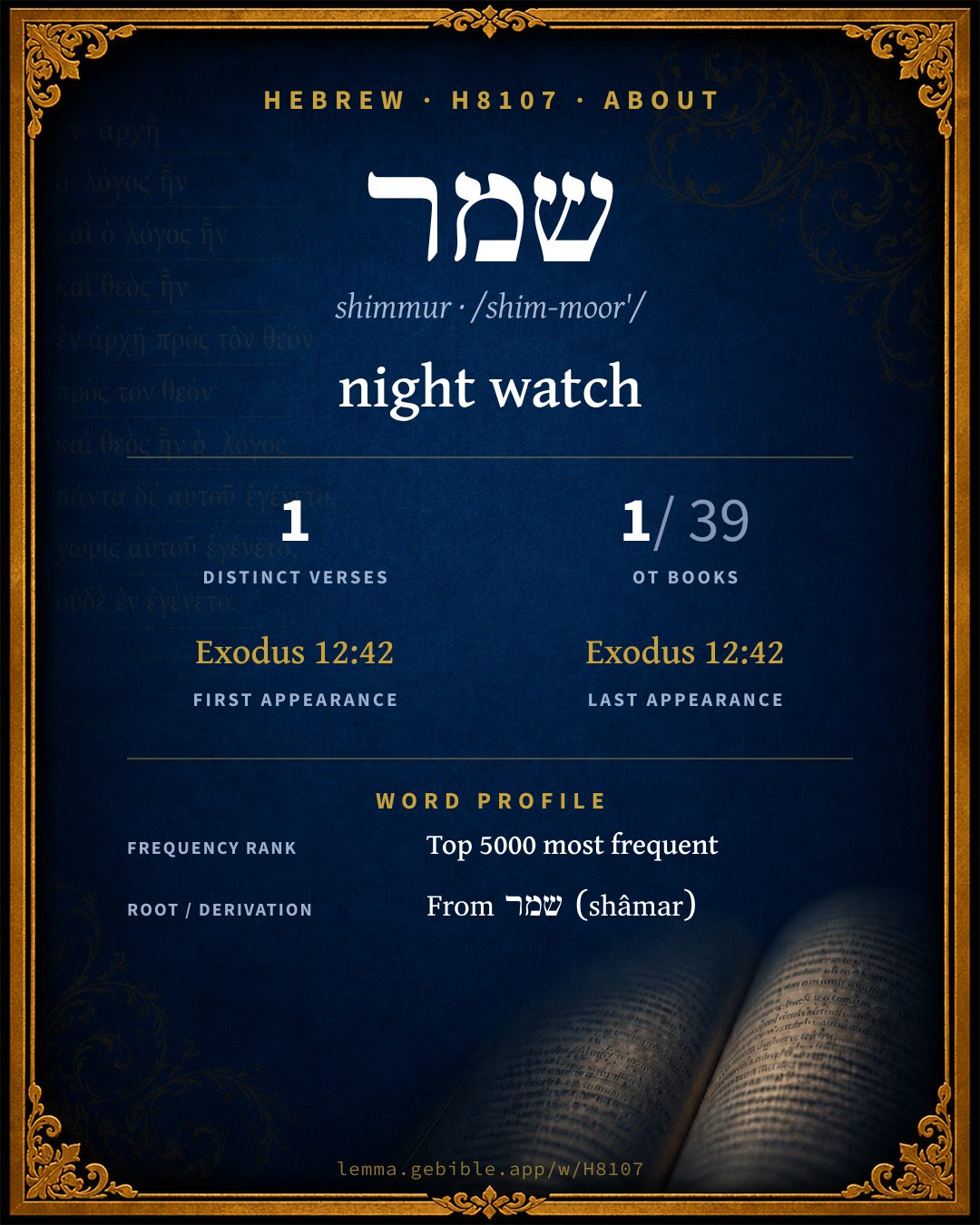
שִׁמֻּר
night watch
Full lexicon entry — Brown-Driver-Briggs (BDB)
From Brown-Driver-Briggs (BDB)
Where this word appears
Grammar key — what these labels mean
Part of speech
- Noun
- A naming word — a person, place, thing, or idea.
Noun type
- Common
- A common noun — a general class of person, place, or thing (“king,” “city,” “water”), not a specific name.
State
- Absolute
- The independent form of a noun, not bound to a following word.
Gender
- Masculine
- Grammatically masculine.
Number
- Plural
- More than one (in Hebrew, generally three or more).
Every verse where H8107 appears — 1 distinct verse across 1 book. Click any verse to open its interlinear word-by-word view. Verse text shown in the World English Bible for context — . Each verse’s Hebrew form is shown with its reference; the English is not keyword-highlighted, since the data carries no word-level English alignment. Use “Compare translations” on any verse to read it across multiple English versions. This concordance covers the Hebrew Bible; Septuagint (Greek Old Testament) occurrences are not indexed here.
Exodus 1 verse
About this entry
At a glance — auto-summarized from this page’s data, not written by a person. Every figure links to its source below. This summary describes the numbers; it doesn’t interpret them.
At its core, שמר (shimmur) means “night watch.” A scarce word — 1 verse in all of the Hebrew Bible. Its uses cluster heavily in Exodus (100% of all occurrences). Its lone occurrence is Exodus 12:42. From the same root come שמר, אשמרה and משמר. Dig into 1-verse concordance and the renderings breakdown below.
Gloss history
Strong's 1890 vs modern scholarship
About this word
Strong's H8107 catalogs a Hebrew word from the Hebrew Old Testament.
These counts are not copied from any lexicon or concordance. They are computed here, from the morphology-tagged Hebrew Old Testament. What Lemma adds →
- 1
- distinct verses
- The word appears in 1 distinct verse.
- 1 / 39
- OT books
- The word appears in 1 of 39 Old Testament books.
- #4,807
- by frequency
- Top 5000 most frequent Hebrew words (rank 4,807 of 8,640 Hebrew words by occurrence).
View all 1 occurrence in the concordance →
Most concentrated in
- Exodus 1 verse 100%
By section of the Old Testament
By traditional corpus
Conventional, traditional groupings — biblical authorship is debated, so this is a traditional corpus grouping, not an authorship claim. Each share is this word’s portion of its verses in that division of the Hebrew canon. Each figure is a share of the word’s 1 distinct verse.
- Torah (Pentateuch) 1 verse · 100%
How translations render this word
Counts come from each version’s own published word-to-Strong’s tagging or interlinear alignment — an approximate guide to how each version renders this word, not a word-level alignment the data otherwise carries. Because each total is that version’s own tagged count, the per-version totals vary from one another and need not match the appearance or distinct-verse counts above. These counts may also differ from a printed concordance because Lemma counts each distinctly tagged rendering and does not collapse phrase taggings into a single head-word total. This is a fixed set of word-tagged versions (KJV, ASV, BSB, ULT) and does not change with the reading translation you choose elsewhere. Each version’s license is shown beside its name below (and on Sources).
- King James Version: Be much observed 1×, Be observed 1×
- American Standard Version: Be much observed 2×
- Berean Standard Bible: Be observed 1×, Kept a vigil 1×
- unfoldingWord Literal Text: Observe 1×, Observing 1×
King James Version Public Domain
Renders H8107 across 2 tagged occurrences — most commonly:
American Standard Version Public Domain
Renders H8107 across 2 tagged occurrences — most commonly:
Berean Standard Bible Public Domain
Renders H8107 across 2 tagged occurrences — most commonly:
unfoldingWord Literal Text CC BY-SA 4.0
Renders H8107 across 2 tagged occurrences — most commonly:
Senses in BDB
The 1 sense BDB distinguishes for this word, in lexicon order (not ranked by frequency or importance). The full entry — with sub-senses — is in the Lexicon Entry tab.
- night watch, watching, vigil
Word origin
[ שִׁמֻּר ] n.[m.] watching, vigil (so Di; > observance )
— Brown-Driver-Briggs (Oxford 1906, public domain), digitized via Sefaria, supplemented by the OpenScriptures HebrewLexicon (CC BY 4.0). See Sources.
Derived from שמר (shâmar) (H8104) — to keep.
Jastrow Dictionary
A second Hebrew/Aramaic lexicon for comparison, covering Aramaic and post-biblical (Talmudic, Targumic, Midrashic) usage that the biblical-Hebrew BDB does not. Matched by lemma rather than by Strong’s number, so a lemma may carry more than one Jastrow headword (shown separately below), and the entries cover usage well beyond the Bible.
שָׁמַר
- (b. h.) [to be still,] to watch, guard, wait; to observe; to keep. Snh. 63ᵇ לא … שְׁמוֹר לי וכ׳ one should not say to his neighbor, wait for me at such and such an idolatrous statue (or temple). B. Mets. 58ᵃ השוכר … לִשְׁמוֹר את וכ׳ if one hires a workingman to guard a cow, a child &c. Sabb. 118ᵇ אלמלי שָׁמְרוּ ישראל וכ׳ if Israel had observed the first Sabbath &c.; a v. fr.—Part. pass. שָׁמוּר; f. שְׁמוּרָה &c. Ib. XXII, 4 נותנין … בשביל שיהא ש׳ you may put a dish into the well that it be kept (cool); a. e.
- 1. same. Ib. 118ᵇ אילמלי מְשַׁמְּרִין ישראל וכ׳ if Israel would observe two Sabbaths as they ought do, they would at once be redeemed. Keth. 62ᵇ ענייה זו לשוא שִׁימְּרָה the poor woman has in vain waited (for her husband). Ab. Zar. IV, 11 אין … יושב ומְשַׁמֵּר וכ׳ the watchman (guarding wine against idolatrous defilement) need not sit and watch &c. Y. Kidd. I, 58ᵈ top המקום משמר וכ׳ God has watched, and such a case has never occurred. Y. M. Kat. III, 82ᶜ שי׳ הקב"ה … שבעה the Lord observed the seven days of mourning for his world (before the flood, ref. to Gen. VII, 10); a. fr. e.g. Genesis 7:10
- 2. (denom. of שְׁמָרִים) to clear wine from lees, filter, strain (v. מְשַׁמֶּרֶת). Sabb. 138ᵃ שי׳ חייב וכ׳ if one filtered wine (on the Sabbath), he is bound to bring a sin-offering; Y. ib. XX, 17ᶜ; VII, 10ᵇ, a. e. המשמר חייב שום בורר he who filters is guilty &c., v. בָּרַר. Ib. המשמר יין למטן וכ׳ when one filters, the wine goes down, and the lees remain above (in the filter); a. fr.—Bab. ib. 146ᵇ מקום העשוי לְשַׁמֵּר a place in the keg where a hole has been made for the purpose of letting the wine off, clear of lees (and has been closed again; Ar. s. v. חזק; Rashi: where the hole has been closed in order to preserve the flavor).—Part. pass. מְשׁוּמָּר a) guarded. Pes. 109ᵇ (ref. to שמרים, Ex. XII, 42) ליל המש׳ ובא מן המזיקין a night which is for all time guarded against dangers (v. מַזִּיק); R. Hash. 11ᵇ.—b) kept, preserved, designated. Ib. ליל המש׳ ובא מששת וכ׳ a night which has been designated for redemption since the six days of creation. Snh. 99ᵃ; Ber. 34ᵇ יין המש׳ וכ׳, v. עֵנָב; a. e. e.g. Exodus 12:42
- 1. to be on one’s guard, be observant. Mekh. Bo, s. 14 (ref. to שמרים, v. supra) מגיד … צריכין להִשְׁתַּמֵּר בו this intimates that all Israelites must be careful in it (to observe its ceremonies); Yalk. Ex. 210; Tanḥ. Bo 9.
- 2. to be guarded. B. Mets. 11ᵃ המִשְׁתַּמֶּרֶת, v. חָצֵר. Erub. 54ᵇ אם ראשון … מִשְׁתַּמֵּר וכ׳ if the fowler breaks the wings of each bird as he catches it, it is kept (from flying off) &c. Men. 99ᵇ כל המשמר … נשמתוֹ משתמרת who guards the Law (takes care not to forget it), his soul is guarded; a. e.
- same, to be on one’s guard. Ib. כל מקום שנאמר הִשָּׁמֶר פן ואל וכ׳ wherever the Scripture has the words, ‘be on thy guard, lest’, or ‘be on thy guard that not’, it is a prohibitive law; ib. השמר ופן וכ׳ ‘be on thy guard’ and ‘lest’ make two prohibitions. Ib. 36ᵇ השמר דלאו לאו hishshamer followed by a negative is a prohibitory law; השמר דעשה עשה hishshamer connected with a positive order, is a positive command (v. עָשָׂה).—[Tanḥ. Vayḥi 13 ומשמירין, v. שָׁפַר.]
שְׁמַר
- Ithpa. אִשְׁתַּמַּר, v. סְמַר II. Targ. Is. VII, 4 some ed.
שֶׁמֶר
- (preced.) sediment, lees. Sabb. 146ᵇ שניקבה למטה מן הש׳ when the jug has a hole below the line of the lees. B. Bath. 96ᵇ שִׁמְרֵי יין wine lees. Ib. ש׳ … טעם יין lees which have a taste (or flavor) of wine. B. Mets. IV, 11 אין מערבין שמרי … שְׁמָרָיו you dare not mix wine lees (left of one jug) with wine, but you may give the purchaser the lees belonging to the wine sold; a. fr.
A Dictionary of the Targumim, the Talmud Babli and Yerushalmi, and the Midrashic Literature (Marcus Jastrow; London, Luzac, 1903) — Public Domain. Digitized via Sefaria. Digitized via Sefaria. Full attribution on Sources.
Forms in the corpus
The 2 distinct written forms H8107 takes in the Hebrew Bible, most frequent first — each parse links to that state’s occurrences in the concordance. Hebrew forms include their vowel points and cantillation, so a single lemma takes many written forms.
| Form | Parsing | Example | Uses |
|---|---|---|---|
| שִׁמֻּרִ֛ים | Noun, Common, Masculine, Plural, Absolute | Exodus 12:42 | 1 |
| שִׁמֻּרִ֥ים | Noun, Common, Masculine, Plural, Absolute | Exodus 12:42 | 1 |
Same root — word family
Other BDB entries built from the same root as H8107, grouped by Strong’s listed origin. These share a root / origin per the lexicon — not necessarily a shared meaning. Each links to that word’s own entry.
Derives from
Shares the same root
- אשמרה ʼashmurâh H821 watch
- משמר mishmâr H4929 guard
- שמיר shâmîyr H8068 thorn
- שמר shemer H8105 dregs
- שמרה shomrâh H8108 watch
- שמרה shᵉmurâh H8109 eyelid
Proper names from this root
People and places named from this root — a name, not an additional meaning of the word.
- ישמרי Yishmᵉray H3461 Ishmerai
- שומר Shôwmêr H7763 Shomer
- שמרון Shômᵉrôwn H8111 Samaria
- שמריה Shᵉmaryâh H8114 Shemariah
- שמרת Shimrâth H8119 Shimrath
Compare all same-root words → Showing 4 of 13 — not the complete family. 5 of the same-root words are proper names (people or places). They share a root, not necessarily a meaning.
Septuagint verse parallels
This word appears in 1 verse that also exists in the Greek Old Testament (Septuagint), out of the 1 Hebrew verse it occurs in. You can read those verses in Greek by switching the Old Testament edition to the Septuagint.
Read these verses in the Septuagint
This is a verse-level parallel only — the same verses exist in both the Hebrew and Greek Old Testaments. No word-level Hebrew↔Greek correspondence is claimed: the data carries no such alignment, so no Greek word is shown as this Hebrew word’s translation. Coverage is not total — the Septuagint omits the deuterocanon and renumbers the Psalms, so some Hebrew verses have no direct Greek parallel.