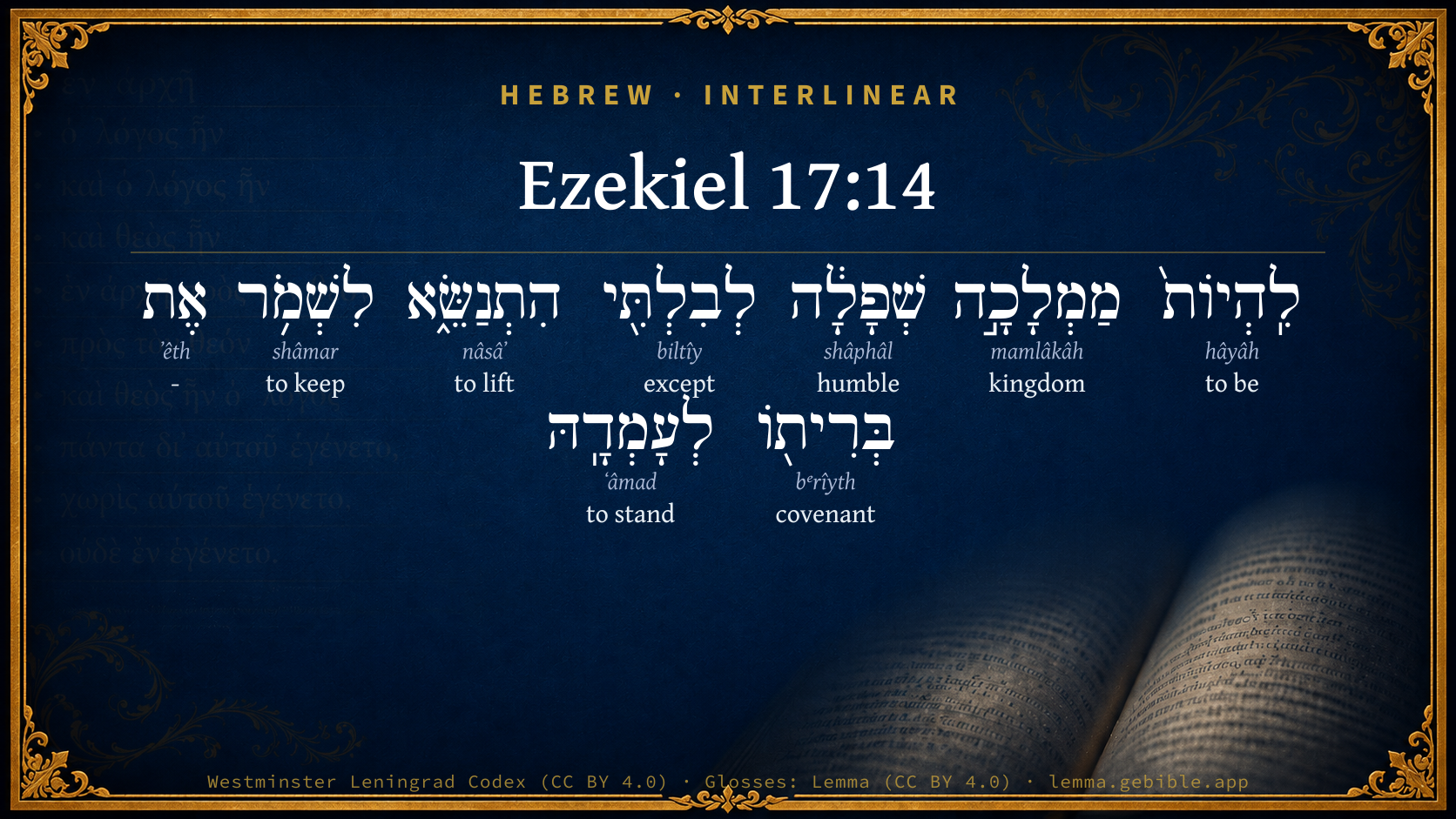
Ezekiel 17:14

Hebrew (Westminster Leningrad Codex) Ezekiel 17:14 appears in the Hebrew Old Testament. The text above is from the Westminster Leningrad Codex. Each word links to its Strong’s number, a concise gloss, and parsing drawn from the Open Scriptures Hebrew Bible morphology. Click any word for its full Brown-Driver-Briggs (BDB) entry.
Download image
Cite this verse

Ezekiel 17:14 (World English Bible). Public Domain. Lemma interlinear Bible study tool, https://lemma.gebible.app/v/ezekiel/17/14.

Show BibTeX & RIS
BibTeX
RIS
English Translation
that the kingdom might be base, that it might not lift itself up, but that by keeping his covenant it might stand.
World English Bible · Public Domain
Download a study sheet

One document with this verse’s original text, its word-by-word gloss line, the meaning frame, cross-references with their text, attributed commentary, and full source and license credits — printable, and it pastes into notes with its structure intact.

This verse Autodidact and up

Study sheet (.html) Plain text (.txt)

A passage Seminary Student

Up to 50 verses in one chapter. A passage sheet keeps up to 6 commentary sources and 12 cross-references per verse, in the order this page ranks them, and says so on the sheet whenever that leaves anything out. Ask for a single verse and you get the Autodidact verse sheet above.

Everything on this page stays free to read, with no account — the sheet is a download of what is already on screen, not access to it.

Want to remove ads? Support Godless Engineer
Compare translations 3

The same verse in 3 English versions, stacked beneath the original-language interlinear above. Click any original word for its lexicon entry.

Each is an independent rendering of the whole verse — the interlinear is not word-aligned to these translations.

Highlighted words mark where these versions differ — a whole-verse word diff, not a word-by-word alignment.

  • World English Bible Public Domain
    that the kingdom might be base, that it might not lift itself up, but that by keeping his covenant it might stand.
  • King James Version Public Domain
    That the kingdom might be base, that it might not lift itself up, but that by keeping of his covenant it might stand.
  • unfoldingWord Literal Text CC BY-SA 4.0
    so the kingdom might become lowly and not lift itself up. By keeping his covenant the land will survive.

unfoldingWord Literal Text — © unfoldingWord, licensed CC BY-SA 4.0. Word-aligned USFM3 via Door43 (git.door43.org/unfoldingWord/en_ult).

Versions to compare (up to 4)

3 of 4 selected

Show all 18 translations

Every available English version of this verse, each an independent rendering of the whole verse.

  • World English Bible Public Domain
    that the kingdom might be base, that it might not lift itself up, but that by keeping his covenant it might stand.
  • Berean Standard Bible Public Domain
    so that the kingdom would be brought low, unable to lift itself up, surviving only by keeping his covenant.
  • Majority Standard Bible Public Domain
    so that the kingdom would be brought low, unable to lift itself up, surviving only by keeping his covenant.
  • King James Version Public Domain
    That the kingdom might be base, that it might not lift itself up, but that by keeping of his covenant it might stand.
  • American Standard Version (1901) Public Domain
    that the kingdom might be base, that it might not lift itself up, but that by keeping his covenant it might stand.
  • Revised Version (1885) Public Domain
    that the kingdom might be base, that it might not lift itself up, but that by keeping of his covenant it might stand.
  • Geneva Bible (1599) Public Domain
    That the kingdome might be in subiection, and not lift it selfe vp, but keepe their couenant, and stand to it.
  • Douay-Rheims (1899) Public Domain
    That it may be a low kingdom and not lift itself up, but keep his covenant, and observe it.
  • Young's Literal Translation Public Domain
    That the kingdom may be humble, That it may not lift itself up, To keep his covenant -- that it may stand.
  • Literal Standard Version CC BY-SA 4.0
    That the kingdom may be humble, || That it may not lift itself up, || To keep his covenant—that it may stand.
  • Unlocked Literal Bible CC BY-SA 4.0
    so the kingdom might become lowly and not lift itself up. By keeping his covenant the land will survive.
  • unfoldingWord Literal Text CC BY-SA 4.0
    so the kingdom might become lowly and not lift itself up. By keeping his covenant the land will survive.
  • Darby Bible Public Domain
    that the kingdom might be abased, that it might not lift itself up, that it might keep his covenant in order to stand.
  • World Messianic Bible Public Domain
    that the kingdom might be brought low, that it might not lift itself up, but that by keeping his covenant it might stand.
  • Webster's Bible Public Domain
    That the kingdom might be base, that it might not lift itself up, but that by keeping his covenant it might stand.
  • Free Bible Version CC BY-SA 4.0
    so that the kingdom would be kept in subjection and wouldn't be strong enough to rebel—it would only survive by keeping its agreement with him.
  • Bible in Basic English Public Domain
    So that the kingdom might be made low with no power of lifting itself up, but might keep his agreement to be his servants.
  • JPS Tanakh (1917) Public Domain
    that his might be a lowly kingdom, that it might not lift itself up, but that by keeping his covenant it might stand.

Literal Standard Version (2020), Covenant Press — licensed CC BY-SA 4.0. Text via the HelloAO Bible API (eBible.org). Unlocked Literal Bible (unfoldingWord) — licensed CC BY-SA 4.0. Text via the HelloAO Bible API (eBible.org). unfoldingWord Literal Text — © unfoldingWord, licensed CC BY-SA 4.0. Word-aligned USFM3 via Door43 (git.door43.org/unfoldingWord/en_ult). Free Bible Version, Dr. Jonathan Gallagher — licensed CC BY-SA 4.0. Text via the HelloAO Bible API (eBible.org).

Word by word

More ways to search: Search by grammar → Find every occurrence → Compare this word →

Practice this passage: Drill this verse → Learn its vocabulary →

About this verse

These counts appear in no published source. They are computed here, from the morphology-tagged text and Lemma’s own curated glosses. What Lemma adds →

9
words
9
distinct lemmas
Prophets
section

Notable vocabulary

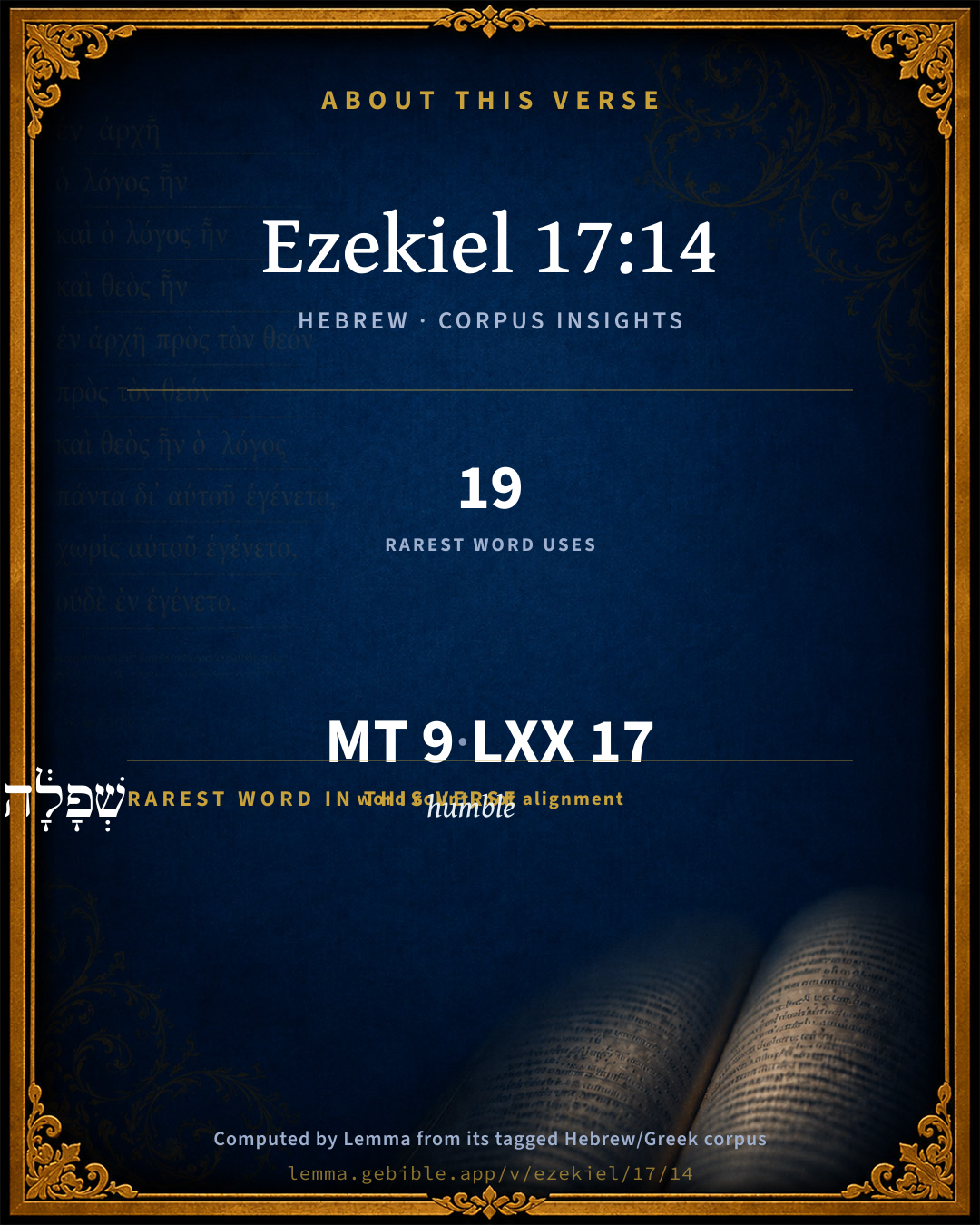
The rarest word here is שְׁפָלָ֔ה humble H8217 — appearing just 19 times in the whole Hebrew Bible.

Shared distinctive vocabulary

שְׁפָלָ֔ה humble H8217 occurs in 18 verses of the Hebrew Bible. Also found in:

Grammatical profile

  • 4 verbs
  • 2 nouns
  • 1 adjective
  • 1 conjunction
  • 1 particle

Verb forms

  • לִֽהְיוֹת֙ Qal · Infinitive Construct
  • הִתְנַשֵּׂ֑א Hithpael · Infinitive Construct
  • לִשְׁמֹ֥ר Qal · Infinitive Construct
  • לְעָמְדָֽהּ Qal · Infinitive Construct

Hebrew & Septuagint length

In English translation the verse runs 22 words from the Hebrew and 23 from the Septuagint (LXX English) — closely comparable.

A rough comparison of the two English renderings, which tokenize alike — not a word-level alignment.

Word counts can differ between the Hebrew and the Greek without any difference in meaning — e.g. the Hebrew direct-object marker אֵת has no separate Greek word, and Greek often adds the article ὁ.

In the original languages it is 9 Hebrew tokens and 17 Greek tokens — but the two are counted differently (Hebrew bundles its prefixes and suffixes into one token; the Greek is in lemma form), so that isn’t a like-for-like length.

Cross-references

10

Topical passages linked to Ezekiel 17:14 in the Treasury of Scripture Knowledge — connected by theme and wording, ordered by reader-vote popularity; previews shown in the World English Bible.

  • Ezekiel 29:14 and I will bring back the captivity of Egypt, and will cause them to return into the land of Pathros, into the land of their birth; and they shall be there a base kingdom.
  • Deuteronomy 28:43 The foreigner who is in the midst of you shall mount up above you higher and higher; and you shall come down lower and lower.
  • 1 Samuel 2:7 Yahweh makes poor, and makes rich: He brings low, he also lifts up.
  • 1 Samuel 2:30 Therefore Yahweh, the God of Israel, says, I said indeed that your house, and the house of your father, should walk before me forever: but now Yahweh says, Be it far from me; for those who honor me I will honor, and those who despise me shall be lightly esteemed.
  • Nehemiah 9:36–37 Behold, we are servants this day, and as for the land that you gave to our fathers to eat the fruit of it and the good of it, behold, we are servants in it.
  • Jeremiah 27:12–17 I spoke to Zedekiah king of Judah according to all these words, saying, Bring your necks under the yoke of the king of Babylon, and serve him and his people, and live.
  • Jeremiah 38:17 Then said Jeremiah to Zedekiah, Thus says Yahweh, the God of hosts, the God of Israel: If you will go forth to the king of Babylon's princes, then your soul shall live, and this city shall not be burned with fire; and you shall live, and your house.
  • Lamentations 5:10 Our skin is black like an oven, Because of the burning heat of famine.
  • Ezekiel 17:6 It grew, and became a spreading vine of low stature, whose branches turned toward him, and the roots of it were under him: so it became a vine, and brought forth branches, and shot forth sprigs.
  • Matthew 22:17–21 Tell us therefore, what do you think? Is it lawful to pay taxes to Caesar, or not?"

Cross-references courtesy of OpenBible.info (CC BY 4.0).

Hebrew and Greek witnesses Masoretic Hebrew ↔ Greek Septuagint

The same verse in the two great witnesses to the Old Testament, shown verse-for-verse.

These are two independent witnesses, not word-aligned to each other, and the Septuagint is shown in lemma (dictionary) form.

Hebrew Ezekiel 17:14 Masoretic · Westminster Leningrad Codex

לִֽהְיוֹת֙ מַמְלָכָ֣ה שְׁפָלָ֔ה לְבִלְתִּ֖י הִתְנַשֵּׂ֑א לִשְׁמֹ֥ר אֶת בְּרִית֖וֹ לְעָמְדָֽהּ

that the kingdom might be base, that it might not lift itself up, but that by keeping his covenant it might stand.

World English Bible · Public Domain

Greek LXX Ezekiel 17:14 Septuagint · lemma form

ὁ γίγνομαι εἰς βασιλεία ἀσθενής ὁ καθόλου μή ἐπιαἴρω ὁ φυλάσσω ὁ διαθήκη αὐτός καί ἵστημι αὐτός

that it may become a weak kingdom, so as never to lift itself up, that he may keep his covenant, and establish it.

LXX2012 (modern English Septuagint) · Public Domain

Hebrew: Westminster Leningrad Codex (CC BY 4.0). Greek: Septuagint (public domain); English from LXX2012 (modern English Septuagint) (Public Domain). How the Septuagint differs from the Hebrew →

Targum (Aramaic paraphrase)

1

The Targum is the ancient Jewish Aramaic paraphrase of the Hebrew Scriptures — an interpretive translation, not the Hebrew text itself. Onkelos (literal) and Pseudo-Jonathan (expansive) render the Torah, and Jonathan the Prophets. Coverage is partial: where no permissively-licensed English translation exists for a verse, only the Aramaic is shown. This is verse-level text, not a word-by-word alignment to the Hebrew.

  1. Targum Jonathan Prophets (Joshua–Malachi)
    לְמֶהֱוֵי מַלְכוּ חַלָשָׁא בְּדִיל דְלָא לְאִתְרַבְרְבָא לְמִטַר יַת קְיָמַהּ לְמִפְלְחֵהּ:

    (no public-domain English translation for this verse)

    Targum Jonathan — Aramaic: “Mikraot Gedolot” (public domain). English: “Sefaria Community Translation” (CC0 1.0 (public-domain dedication)); “London "Chaldee Paraphrase," 1871” (public domain). Text via Sefaria.

Commentary

Notes on Ezekiel 17:14 from classic Christian and Jewish commentators (each source and its license shown beneath its notes). The classic Christian expositions comment on the surrounding passage and are grouped to its opening verse, so a note may address several verses; the Jewish commentaries on the Tanakh (Rashi and others) are per-verse, so they appear only where the commentator wrote on this verse.

Lemma curates 59 commentaries, every one of them public domain or Creative Commons licensed, each selected and text-cleaned for this edition rather than reprinted as found. About our sources →

Trapp's Complete Commentary

John Trapp

Eze 17:14 That the kingdom might be base, that it might not lift itself up, [but] that by keeping of his covenant it might stand.

Ver. 14. That the kingdom might be base.] The mighty of the land being taken away, {as Eze 17:13} and the spirits of the vest imbased by burdens and oppressions in their estates and liberties.

But that by keeping of his covenant.] The breach whereof was the break neck of the state, as it hath been of many others, and will be shortly of the Turks - who hold that there is no faith to be kept with dogs, that is, with Christians - and of the Popes, who hold that there is no faith to be kept with heretics, that is, with Protestants; and for all others, it is written by an Italian, no stranger to the court of Rome, that their proverb is, Mercatorum eat, non regum, stare iuramentis, that it is for merchants, and not for monarchs, to stand to their oaths. Shall such stand? shall they thus escape by iniquity?

John Trapp, A Commentary or Exposition upon All the Books of the Old and New Testament (1647–1656) — public domain. Text from a community e-Sword module.

Jamieson, Fausset & Brown

Robert Jamieson, A. R. Fausset & David Brown

That the kingdom might be base--that is, low as to national elevation by being Nebuchadnezzar's dependent; but, at the same time, safe and prosperous, if faithful to the "oath." Nebuchadnezzar dealt sincerely and openly in proposing conditions, and these moderate ones; therefore Zedekiah's treachery was the baser and was a counterpart to their treachery towards God.

Jamieson, Fausset & Brown — Commentary Critical and Explanatory on the Whole Bible (1871) — public domain (CC PDM 1.0). Text via the HelloAO Bible API.

Adam Clarke's Commentary

Verse 14. That the kingdom might be base] Have no political consequence, and at last sink into a miserable government under Gedaliah.

Adam Clarke's Commentary on the Bible (1810–1826) — public domain. Text from a community e-Sword/MySword module.

John Calvin's Commentaries

He now adds, that the kingdom might be humbled. Zedekiah then could not pretend error, nor turn his back, as if he had been outwitted by the cunning and secret counsels of the king of Babylon: for Nebuchadnezzar dealt with him openly, and proscribed the conditions on which he wished him to reign. Since, then, the king of Babylon showed Zedekiah openly and sincerely what he wished him to do, that wretched man could not say that he was imposed upon, and not made sufficiently aware of the cunning of the king of Babylon: no such excuse was left to him. And therefore the Prophet clearly expresses that Nebuchadnezzar imposed conditions upon Zedekiah, that his kingdom should be lowly, so as not to lift itself up, but that it should keep the agreement. This was most equitable: for when he appointed a king, he might have imposed upon him very hard conditions, but he was content with moderation, which was surely tolerable even among the best friends. For he made a treaty with him, and then he wished the kingdom to be lowly for its preservation. For it is just as if the Prophet had said, that Nebuchadnezzar thought of nothing else than that Zedekiah might reign in peace; and since he saw it to be useful to the king and the whole people to be restrained within some bounds, he followed that plan. Since, then, Nebuchadnezzar consulted the public advantage by this method of action, Zedekiah was the more wicked in not allowing his own safety to be consulted, since nothing was better or more desirable than for him to remain humble, and not to raise himself up to his own destruction, as afterwards happened. It now follows, that he rebelled by sending his messengers into Egypt, that they might give him horses and much people. These points ought to be mutually compared; that the contrast might correspond: Nebuchadnezzar regarded nothing else but the peace of the country, for he wished to prevent all fears and disturbances. What, then, was Zedekiah? a rebel. And why? for sending messengers to Egypt to fetch many troops of both horse and foot to succor Judea against Nebuchadnezzar. After the conclusion of the war he had done nothing hostile, for it was a part of his paternal anxiety to give them a king of their own nation, and so to set the whole country at rest, that there should be no occasion for tumult. Why, then, should Zedekiah seek help from the Egyptians? Thus we see that the Prophet is removing from him all excuses for self-defense. He now adds, shall he prosper? shall he who has acted thus escape? The Prophet asks with emphasis; because, as I have said, this persuasion was engraved on the minds of all, that vengeance must overtake all the perfidious, especially if they had violated their oath in treaties. The Prophet, therefore, does not simply pronounce that Zedekiah should perish through violating the treaty, but he rises more confidently, and inquires, as of a thing settled and undoubted, Shall he prosper? shall he who has planned such a crime escape? He now adds, shall he who has violated a treaty escape? This repetition is not superfluous: he had formerly said, shall he who has done this escape? he immediately repeats, shall he who has violated a treaty escape? There was nothing obscure in the first clause: but the Prophet added this, not for the sake of perspicuity, but to give more weight. to the sentence. The conclusion is, that it was not possible to escape God’s vengeance for such perfidy, as we shall treat the point more at length tomorrow.

John Calvin's Commentaries (1540-1563) — public domain. Text from the Calvin Translation Society English edition (1840s-50s) via the Christian Classics Ethereal Library (ccel.org). Calvin's coverage is partial (roughly two-thirds of the Bible); uncommented books and verses are honest gaps, never fabricated. The 19th-century editor's footnotes and remarks are omitted so the notes are faithfully Calvin's own voice.

Ellicott's Commentary for English Readers

(14) That the kingdom might be base.—(See the Notes on Eze_17:6.)

A Bible Commentary for English Readers, edited by Charles John Ellicott (1878–1897) — public domain. Text from a community e-Sword module.

The Cambridge Bible for Schools and Colleges

gen. ed. J. J. S. Perowne

14. might be base] i.e. humble, and without pretension; cf. ch. Eze_29:14. It was with this purpose that Nebuchadnezzar carried away the mighty of the land. He also hoped that the kingdom would “stand;” it was no doubt his policy to have a dependent, friendly state on the frontier of Egypt. The word “stand,” however, may refer to the covenant: to keep his covenant, that it might stand.

The Cambridge Bible for Schools and Colleges (gen. ed. J. J. S. Perowne; Cambridge University Press, 1878–1918) — public domain. Text from a community e-Sword module.

John Gill's Exposition

As I live, saith the Lord God,.... This is the form of an oath, as Kimchi and Ben Melech observe; the Lord swears, in his wrath, by himself, by his life; this shows how much he resented, what Zedekiah had done, and how sure and certain his ruin was:

surely in the place where the king dwelleth that made him king; in Babylon, where Nebuchadnezzar dwelt, that made Zedekiah king of Judah; which is mentioned, to point out the ingratitude of that prince to the king of Babylon:

whose oath he despised, whose covenant he broke; the oath of fealty and, allegiance, which Zedekiah took to Nebuchadnezzar; and the covenant entered into between them, by which the former held the kingdom of Judea of the latter: the oath he made light of, though solemn, one made by the God of Israel; and the covenant he broke, though ratified by an oath; in which things were given to him he could not claim, at least possess, but by the courtesy of the conqueror; these sins were displeasing to God: oaths and covenants, though made with conquerors, and with Heathen princes, are to be kept:

even with him; that is, with Nebuchadnezzar:

in the midst of Babylon he shall die; when first taken he was had to Riblah, and there his eyes were put out; and after that he was carried to Babylon, and put in prison, and there died, Jer 52:9.

John Gill's Exposition of the Whole Bible (1746–1763) — public domain (CC PDM 1.0). Text via the HelloAO Bible API.

Matthew Poole's English Annotations

So plainly and openly did Nebuchadnezzar deal with the Jews.

The kingdom; the tributary kingdom, whereof Zedekiah is roitelet.

Base; low in power.

Lift itself up; rise up into rebellion, or be so considerable as to encourage any neighbour king to assist and confederate with them against Babylon.

That by continuing faithful, and performing the conditions of his covenant, either Nebuchadnezzar’s, by imposing, or Zedekiah’s, by submitting to it, and obliging himself by it, the kingdom of the Jews might continue and flourish.

Matthew Poole's English Annotations on the Holy Bible (1683–1685) — public domain. Text from a community e-Sword/MySword module.

Whedon's Commentary on the Bible

Daniel D. Whedon

14. Might be base — Humble, and without pretension. (Compare 1Ch_29:14.) It was with this purpose that Nebuchadnezzar carried away the mighty of the land. — Davidson. The Babylonian king wanted to keep this little kingdom which was so near to Egypt wholly dependent upon himself, but was prepared if it kept its covenant with him to protect it from harm that it might continue to stand as one of the “powers.”

Daniel D. Whedon (gen. ed.), Commentary on the Old and New Testaments (1874–1909) — public domain. Text from a community e-Sword module.

Rashi

Rabbi Shlomo Yitzchaki (Rashi)

that it might stand That it might endure.

Rashi on the Tanakh — English translations: “The Judaica Press complete Tanach with Rashi, translated by A. J. Rosenberg” (CC BY 4.0); “Pentateuch with Rashi's commentary by M. Rosenbaum and A.M. Silbermann, 1929-1934” (public domain); “The Metsudah Tanach series, Lakewood, N.J” (CC BY 4.0); and “The Book of Joshua, Metsudah Publications, 1997” (CC BY 4.0). Text via Sefaria.

Lesson kit

Teaching starters — assembled from the data on this page, not authored interpretation. Every prompt links to the verse data it draws on. Edit before teaching.

Ezekiel, in the Prophets, opens this verse with 9 words (9 distinct Hebrew lemmas). Its most distinctive word is shâphâl (“humble”). A historical commentator’s framing appears above. Read the whole chapter for the surrounding context.

Discussion questions

  1. The word shâphâl carries the sense “humble.” How does it shape the verse?
  2. Leviticus 13:20 shares the word «humble» with this verse. How do the two illuminate each other?
  3. These translations render this verse differently; the difference is in the English rendering, not the original. What questions does that raise?
  4. The verb «לִֽהְיוֹת֙» is Qal Infinitive Construct. How does its form color the action?
  5. Reading how Trapp's Complete Commentary and Jamieson, Fausset & Brown read this verse, where do the two commentators agree and where do they part?

Things to notice

Reading settings

Reading text

Shown beneath each verse's original-language words.

Old Testament
Old Testament edition

Read the OT as the Masoretic Hebrew (MT) or the Greek Septuagint (LXX).

English shown for the Greek Septuagint (in the Hebrew ↔ Greek comparison).

Comparing translations? Open the Compare panel on any verse page to stack up to four side by side.