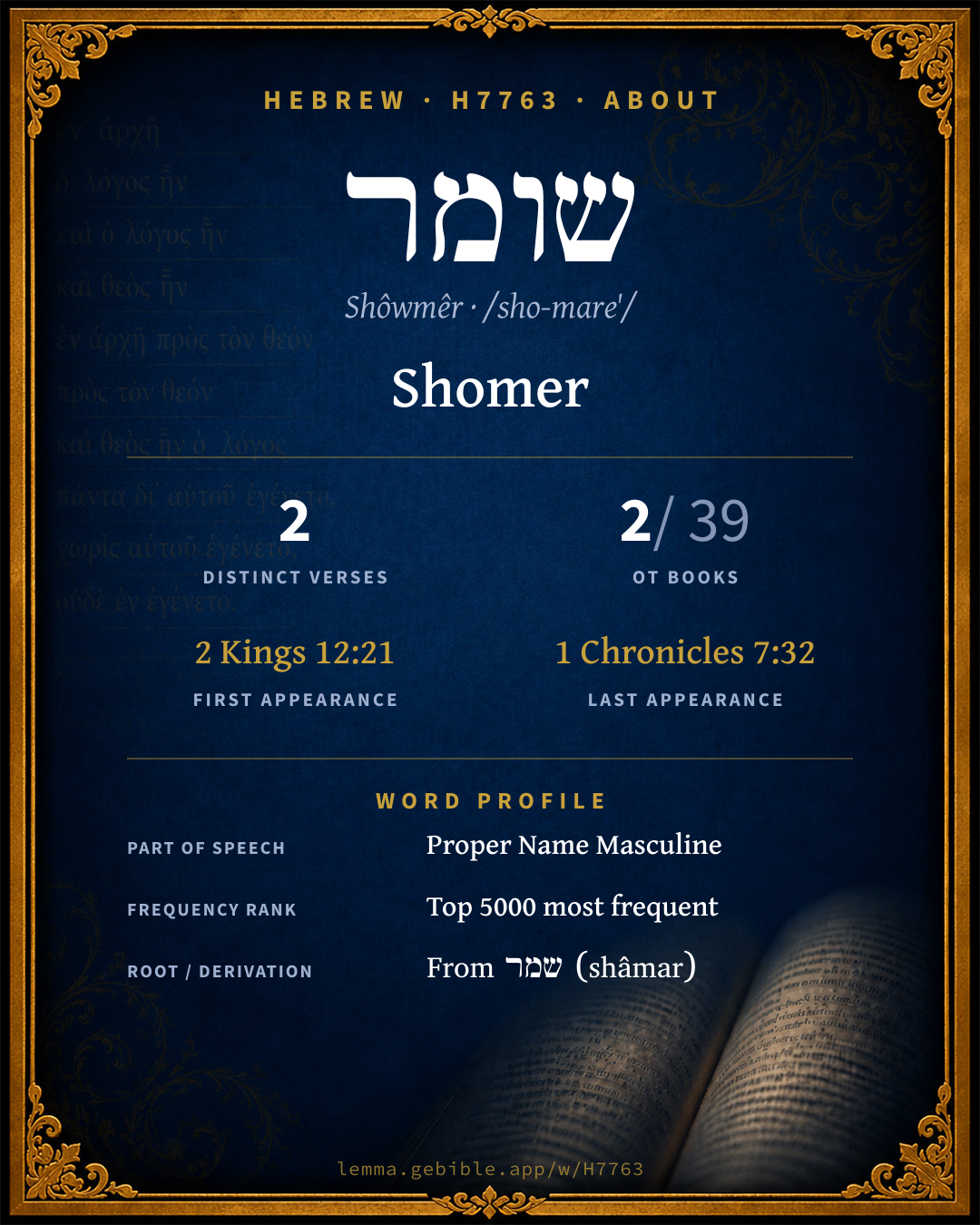
שֹׁמֵר
Shomer
BDB lists 3 entries for ‘Shomer’ fuller range ↓
Full lexicon entry — Brown-Driver-Briggs (BDB)
From Brown-Driver-Briggs (BDB)
Where this word appears
Grammar key — what these labels mean
Part of speech
- Noun
- A naming word — a person, place, thing, or idea.
Noun type
- Proper
- A name of a specific person, place, or people (e.g. Abraham, Zion, Israel).
Every verse where H7763 appears — 2 distinct verses across 2 books. Click any verse to open its interlinear word-by-word view. Verse text shown in the World English Bible for context — . Each verse’s Hebrew form is shown with its reference; the English is not keyword-highlighted, since the data carries no word-level English alignment. Use “Compare translations” on any verse to read it across multiple English versions. This concordance covers the Hebrew Bible; Septuagint (Greek Old Testament) occurrences are not indexed here.
2 Kings 1 verse
1 Chronicles 1 verse
About this entry
At a glance — auto-summarized from this page’s data, not written by a person. Every figure links to its source below. This summary describes the numbers; it doesn’t interpret them.
שומר (Shôwmêr) is a Hebrew name most often rendered “Shomer.” It occurs a mere 2 verses across Scripture. It clusters heavily in 2 Kings, which alone accounts for 50% of its uses. It first appears in 2 Kings 12:21. For the data behind this summary, explore 2-verse concordance and the renderings breakdown below.
Gloss history
Strong's 1890 vs modern scholarship
About this word
Strong's H7763 catalogs a Hebrew word from the Hebrew Old Testament.
These counts are not copied from any lexicon or concordance. They are computed here, from the morphology-tagged Hebrew Old Testament. What Lemma adds →
- 2
- distinct verses
- The word appears in 2 distinct verses.
- 2 / 39
- OT books
- The word appears in 2 of 39 Old Testament books.
- #4,807
- by frequency
- Top 5000 most frequent Hebrew words (rank 4,807 of 8,640 Hebrew words by occurrence).
View all 2 occurrences in the concordance →
Most concentrated in
- 2 Kings 1 verse 50%
- 1 Chronicles 1 verse 50%
By section of the Old Testament
By traditional corpus
Conventional, traditional groupings — biblical authorship is debated, so this is a traditional corpus grouping, not an authorship claim. Each share is this word’s portion of its verses in that division of the Hebrew canon. Each figure is a share of the word’s 2 distinct verses.
- Prophets (Nevi'im) 1 verse · 50%
- Writings (Ketuvim) 1 verse · 50%
How translations render this word
Counts come from each version’s own published word-to-Strong’s tagging or interlinear alignment — an approximate guide to how each version renders this word, not a word-level alignment the data otherwise carries. Because each total is that version’s own tagged count, the per-version totals vary from one another and need not match the appearance or distinct-verse counts above. These counts may also differ from a printed concordance because Lemma counts each distinctly tagged rendering and does not collapse phrase taggings into a single head-word total. This is a fixed set of word-tagged versions (KJV, ASV, BSB, ULT) and does not change with the reading translation you choose elsewhere. Each version’s license is shown beside its name below (and on Sources).
- King James Version: Shomer 2×
- American Standard Version: Shomer 2×
- Berean Standard Bible: Shomer 2×
- unfoldingWord Literal Text: Shomer 2×
King James Version Public Domain
Renders H7763 across 2 tagged occurrences — most commonly:
American Standard Version Public Domain
Renders H7763 across 2 tagged occurrences — most commonly:
Berean Standard Bible Public Domain
Renders H7763 across 2 tagged occurrences — most commonly:
unfoldingWord Literal Text CC BY-SA 4.0
Renders H7763 across 2 tagged occurrences — most commonly:
Senses in the full BDB
What do BDB’s symbols mean?
BDB uses these scholarly abbreviations:
| Symbol | Meaning |
|---|---|
| 𝔊 | the Septuagint (the ancient Greek translation, LXX) |
| 𝔙 | the Vulgate (the Latin translation) |
| 𝔖 | the Syriac version (the Peshitta) |
| 𝔗 | the Targum (the Aramaic translation) |
| ψ | the Psalms |
| √ | root (the underlying root or stem) |
| ‖ | parallel passage (a synonymous or contrasted parallel) |
| † | the dagger: every passage where the word occurs is cited |
The 2 senses and sub-senses the full Brown-Driver-Briggs lexicon distinguishes for this word, in lexicon order (not ranked by frequency), with BDB’s own verbatim wording and sub-sense lettering. Shown in Hebrew script with BDB’s own scholarly abbreviations. The condensed entry is in the Lexicon Entry tab. See also the Forms in the corpus table below.
- 1. father of one of Joash’s murderers 2 K 12:21, Σωμηρ, 𝔊L Σεμμηρ (called שִׁמְרִית q.v., a Moabitess, ‖ 2 Ch 24:26). e.g. 2 Kings 12:21
- 2. Asherite 1 Ch 7:32, Σαμηρ, Σωμηρ; = שֶׁמֵר 2 b. e.g. 1 Chronicles 7:32
Senses from the full Brown-Driver-Briggs lexicon (Brown, Driver, Briggs; Oxford 1906 — public domain), digitized via Sefaria, supplemented by the OpenScriptures HebrewLexicon (CC BY 4.0). Full attribution on Sources.
Word origin
Derived from שמר (shâmar) (H8104) — to keep.
Jastrow Dictionary
A second Hebrew/Aramaic lexicon for comparison, covering Aramaic and post-biblical (Talmudic, Targumic, Midrashic) usage that the biblical-Hebrew BDB does not. Matched by lemma rather than by Strong’s number, so a lemma may carry more than one Jastrow headword (shown separately below), and the entries cover usage well beyond the Bible.
שׁוֹמֵר
- watchman, guard, keeper. Y. Taan. I, 64ᵃ top (expl. Is. XXI, 11) מה מילל ש׳ העולמים what did the keeper of the world say? Lev. R. s. 36 מה גפן זו הש׳ שלה עומד למעלה וֹכ׳ as the guard of the grape vine (vineyard) stands high (in the שׁוֹמֵרָה), so is Israel’s guard above. Ḥag. 15ᵇ אפי׳ ש׳ הפתח וכ׳ even the gate-keeper (of Gehenna) could not stand before thee; a. fr.—Esp. one in whose charge an object is given, bailee, ש׳ חנם an unpaid bailee; ש׳ שכר a paid trustee. B. Mets. 93ᵇ; a. fr.—[Shebu. VIII, 1; B. Mets. VII, 8 נושא שכר, sub. שומר].—Trnsf. that part of a plant or of a body which serves as a protection (e.g. leaves, skin). Ber. 36ᵇ היכא אמרינן דנעשה ש׳ לפירי וכ׳ we call a part of a plant a guard of the fruit only, if the plant dies when the guard is removed. Ukts. I, 1. Ḥull. 119ᵇ בשדרה משום ש׳ it refers to the stem of an ear, and because it is ‘a guard’; a. fr.—Pl. שׁוֹמְרִים, שׁוֹמְרִין. B. Mets. l. c. שׁוֹמְרֵי פירות וכ׳ watchmen of fruits may eat (of them) by local usage, but not by Biblical law. Ib.; Shebu. l. c. ארבעה ש׳ הן וכ׳ these are four classes of bailees. Ib. 49ᵇ שבועת ש׳ the oath required of bailees (Ex. XXII, 9 sq.); a. fr. e.g. Isaiah 21:11
שׁוּמָּר
- fennel (v. Löw Pfl., p. 382 sq.). Y. Kil. I, 27ᵃ bot. ש׳ וכרפס מה נפיק מנהון פיטרוסילינון quot. in R. S. to Kil. I, 4 (ed. corrupt) what comes out of mixed seeds of fennel and parsley? Rock-parsley.
A Dictionary of the Targumim, the Talmud Babli and Yerushalmi, and the Midrashic Literature (Marcus Jastrow; London, Luzac, 1903) — Public Domain. Digitized via Sefaria. Digitized via Sefaria. Full attribution on Sources.
Forms in the corpus
The 2 distinct written forms H7763 takes in the Hebrew Bible, most frequent first — each parse links to that state’s occurrences in the concordance. Hebrew forms include their vowel points and cantillation, so a single lemma takes many written forms.
| Form | Parsing | Example | Uses |
|---|---|---|---|
| שֹׁמֵ֤ר | Noun, Proper | 2 Kings 12:21 | 1 |
| שׁוֹמֵ֖ר | Noun, Proper | 1 Chronicles 7:32 | 1 |
Same root — word family
Other BDB entries built from the same root as H7763, grouped by Strong’s listed origin. These share a root / origin per the lexicon — not necessarily a shared meaning. Each links to that word’s own entry.
Derives from
Shares the same root
- אשמרה ʼashmurâh H821 watch
- משמר mishmâr H4929 guard
- שמיר shâmîyr H8068 thorn
- שמר shemer H8105 dregs
- שמר shimmur H8107 night watch
- שמרה shomrâh H8108 watch
- שמרה shᵉmurâh H8109 eyelid
Proper names from this root
People and places named from this root — a name, not an additional meaning of the word.
- ישמרי Yishmᵉray H3461 Ishmerai
- שמרון Shômᵉrôwn H8111 Samaria
- שמריה Shᵉmaryâh H8114 Shemariah
- שמרת Shimrâth H8119 Shimrath
Compare all same-root words → Showing 4 of 13 — not the complete family. 4 of the same-root words are proper names (people or places). They share a root, not necessarily a meaning.
Bible dictionary
Public-domain dictionary articles matched to this entry by name (Shomer). A biblical name can be shared by more than one person or place, so an article may treat several.
Easton's Bible Dictionary · M. G. Easton, 1897
Watchman. (1.) The mother of Jehozabad, who murdered Joash (2 Kings 12:21); called also Shimrith, a Moabitess (2 Chr. 24:26).
(2.) A man of Asher (1 Chr. 7:32); called also Shamer (34).
Smith's Bible Dictionary · William Smith, 1863
(keeper).
+ An Asherite, (1 Chronicles 7:32) also called Shamer. ver. (1 Chronicles 7:34) + The father (mother ?) of Jehozabad who slew King Joash. (2 Kings 12:21) In the parallel passage in (2 Chronicles 24:26) the name is converted into the feminine form Shimrith, who is further described as a Moabitess. [Shimrith] (B.C. 839.)
Hitchcock's Bible Names Dictionary · Roswell D. Hitchcock, 1869
keeper; dregs
Classic public-domain reference works; full attribution on Sources.
Septuagint verse parallels
This word appears in 2 verses that also exist in the Greek Old Testament (Septuagint), out of the 2 Hebrew verses it occurs in. You can read those verses in Greek by switching the Old Testament edition to the Septuagint.
Read these verses in the Septuagint
This is a verse-level parallel only — the same verses exist in both the Hebrew and Greek Old Testaments. No word-level Hebrew↔Greek correspondence is claimed: the data carries no such alignment, so no Greek word is shown as this Hebrew word’s translation. Coverage is not total — the Septuagint omits the deuterocanon and renumbers the Psalms, so some Hebrew verses have no direct Greek parallel.