
Ecclesiastes 8:2

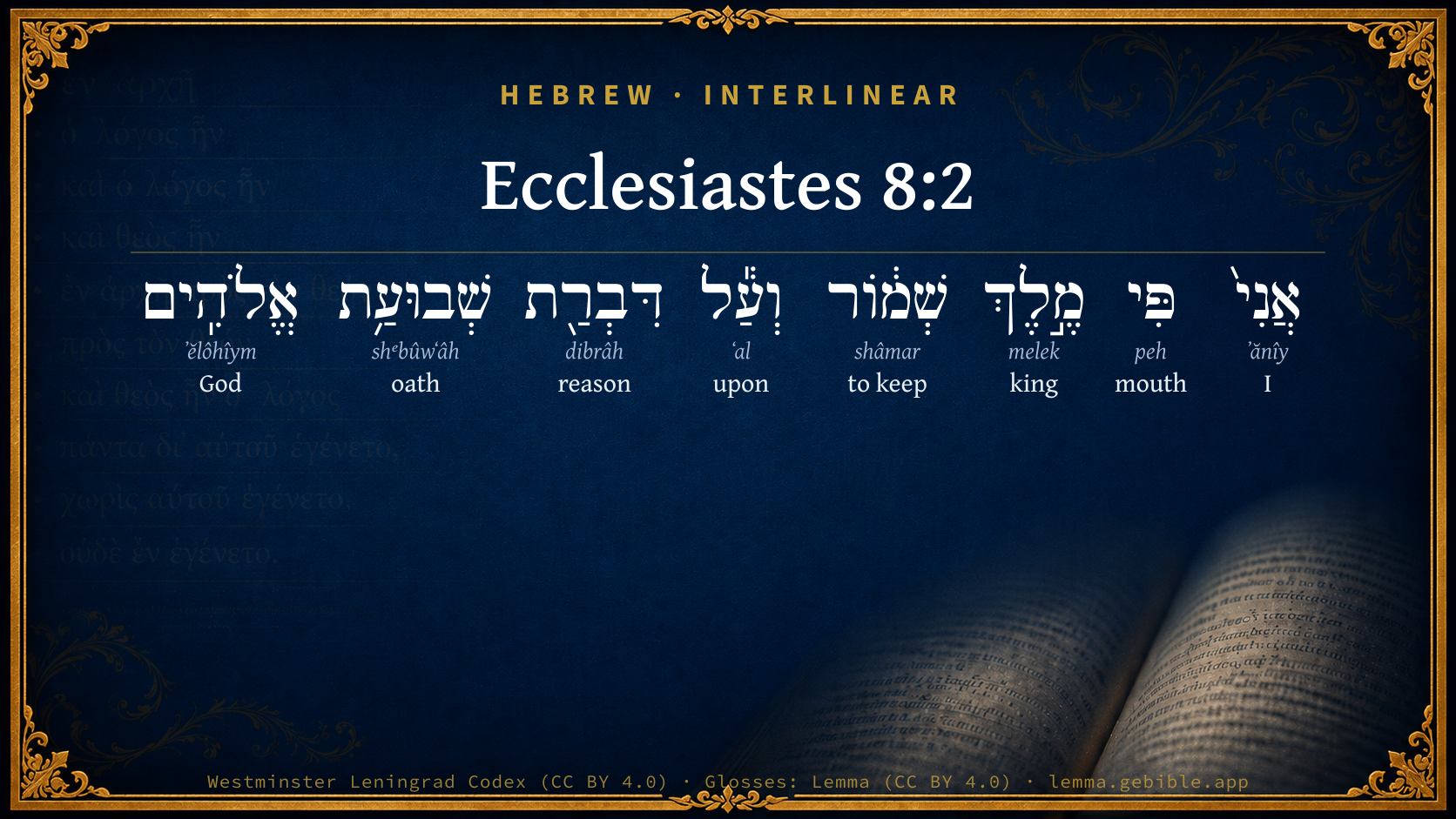
Hebrew (Westminster Leningrad Codex) Ecclesiastes 8:2 appears in the Hebrew Old Testament. The text above is from the Westminster Leningrad Codex. Each word links to its Strong’s number, a concise gloss, and parsing drawn from the Open Scriptures Hebrew Bible morphology. Click any word for its full Brown-Driver-Briggs (BDB) entry.
Download image
Cite this verse

Ecclesiastes 8:2 (World English Bible). Public Domain. Lemma interlinear Bible study tool, https://lemma.gebible.app/v/ecclesiastes/8/2.

Show BibTeX & RIS
BibTeX
RIS
English Translation
I say, "Keep the king's command!" because of the oath to God.
World English Bible · Public Domain
Download a study sheet

One document with this verse’s original text, its word-by-word gloss line, the meaning frame, cross-references with their text, attributed commentary, and full source and license credits — printable, and it pastes into notes with its structure intact.

This verse Autodidact and up

Study sheet (.html) Plain text (.txt)

A passage Seminary Student

Up to 50 verses in one chapter. A passage sheet keeps up to 6 commentary sources and 12 cross-references per verse, in the order this page ranks them, and says so on the sheet whenever that leaves anything out. Ask for a single verse and you get the Autodidact verse sheet above.

Everything on this page stays free to read, with no account — the sheet is a download of what is already on screen, not access to it.

Want to remove ads? Support Godless Engineer
Compare translations 3

The same verse in 3 English versions, stacked beneath the original-language interlinear above. Click any original word for its lexicon entry.

Each is an independent rendering of the whole verse — the interlinear is not word-aligned to these translations.

Highlighted words mark where these versions differ — a whole-verse word diff, not a word-by-word alignment.

  • World English Bible Public Domain
    I say, "Keep the king's command!" because of the oath to God.
  • King James Version Public Domain
    I counsel thee to keep the king's commandment, and that in regard of the oath of God.
  • unfoldingWord Literal Text CC BY-SA 4.0
    me—listen the mouth of a king, that is, on account of the oath of God.

unfoldingWord Literal Text — © unfoldingWord, licensed CC BY-SA 4.0. Word-aligned USFM3 via Door43 (git.door43.org/unfoldingWord/en_ult).

Versions to compare (up to 4)

3 of 4 selected

Show all 18 translations

Every available English version of this verse, each an independent rendering of the whole verse.

  • World English Bible Public Domain
    I say, "Keep the king's command!" because of the oath to God.
  • Berean Standard Bible Public Domain
    Keep the king’s command, I say, because of your oath before God.
  • Majority Standard Bible Public Domain
    Keep the king’s command, I say, because of your oath before God.
  • King James Version Public Domain
    I counsel thee to keep the king's commandment, and that in regard of the oath of God.
  • American Standard Version (1901) Public Domain
    I `counsel thee', Keep the king's command, and that in regard of the oath of God.
  • Revised Version (1885) Public Domain
    I counsel thee, Keep the king’s command, and that in regard of the oath of God.
  • Geneva Bible (1599) Public Domain
    I aduertise thee to take heede to ye mouth of the King, and to the worde of the othe of God.
  • Douay-Rheims (1899) Public Domain
    I observe the mouth of the king, and the commandments of the oath of God.
  • Young's Literal Translation Public Domain
    I pray thee, the commandment of a king keep, even for the sake of the oath of God.
  • Literal Standard Version CC BY-SA 4.0
    I [counsel]: keep the command of a king, even for the sake of an oath [to] God.
  • Unlocked Literal Bible CC BY-SA 4.0
    I advise you to obey the king's command because of God's oath to protect him.
  • unfoldingWord Literal Text CC BY-SA 4.0
    me—listen the mouth of a king, that is, on account of the oath of God.
  • Darby Bible Public Domain
    I [say], Keep the king's commandment, and [that] on account of the oath of God.
  • World Messianic Bible Public Domain
    I say, “Keep the king’s command!” because of the oath to God.
  • Webster's Bible Public Domain
    I counsel thee to keep the king's commandment, and that in regard of the oath of God.
  • Free Bible Version CC BY-SA 4.0
    My advice is to do what the king says, since that's what you promised God.
  • Bible in Basic English Public Domain
    I say to you, Keep the king's law, from respect for the oath of God.
  • JPS Tanakh (1917) Public Domain
    I counsel thee: keep the king's command, and that in regard of the oath of God.

Literal Standard Version (2020), Covenant Press — licensed CC BY-SA 4.0. Text via the HelloAO Bible API (eBible.org). Unlocked Literal Bible (unfoldingWord) — licensed CC BY-SA 4.0. Text via the HelloAO Bible API (eBible.org). unfoldingWord Literal Text — © unfoldingWord, licensed CC BY-SA 4.0. Word-aligned USFM3 via Door43 (git.door43.org/unfoldingWord/en_ult). Free Bible Version, Dr. Jonathan Gallagher — licensed CC BY-SA 4.0. Text via the HelloAO Bible API (eBible.org).

Word by word

More ways to search: Search by grammar → Find every occurrence → Compare this word →

Practice this passage: Drill this verse → Learn its vocabulary →

About this verse

These counts appear in no published source. They are computed here, from the morphology-tagged text and Lemma’s own curated glosses. What Lemma adds →

8
words
8
distinct lemmas
Wisdom
section

Notable vocabulary

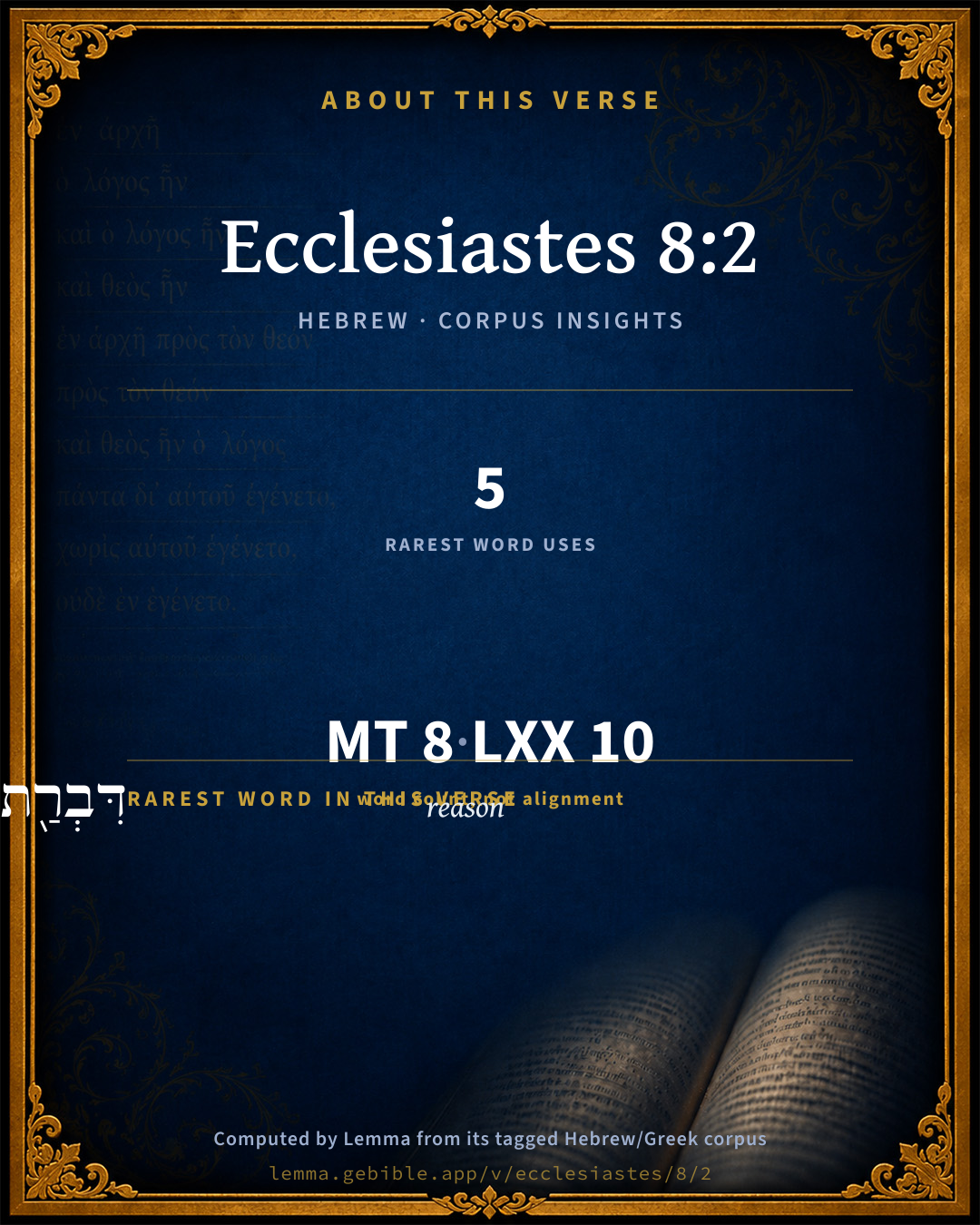
The rarest word here is דִּבְרַ֖ת reason H1700 — appearing just 5 times in the whole Hebrew Bible.

Shared distinctive vocabulary

דִּבְרַ֖ת reason H1700 occurs in 5 verses of the Hebrew Bible. Also found in:

Grammatical profile

  • 1 verb
  • 5 nouns
  • 1 pronoun
  • 1 preposition

Verb forms

  • שְׁמ֔וֹר Qal · Imperative

Hebrew & Septuagint length

In English translation the verse runs 12 words from the Hebrew and 17 from the Septuagint (LXX English) — the Septuagint runs noticeably longer here. See the side-by-side →

A rough comparison of the two English renderings, which tokenize alike — not a word-level alignment.

Word counts can differ between the Hebrew and the Greek without any difference in meaning — e.g. the Hebrew direct-object marker אֵת has no separate Greek word, and Greek often adds the article ὁ.

In the original languages it is 8 Hebrew tokens and 10 Greek tokens — but the two are counted differently (Hebrew bundles its prefixes and suffixes into one token; the Greek is in lemma form), so that isn’t a like-for-like length.

Cross-references

9

Topical passages linked to Ecclesiastes 8:2 in the Treasury of Scripture Knowledge — connected by theme and wording, ordered by reader-vote popularity; previews shown in the World English Bible.

  • Proverbs 24:21 My son, fear Yahweh and the king. Don't join those who are rebellious:
  • Titus 3:1 Remind them to be in subjection to rulers and to authorities, to be obedient, to be ready for every good work,
  • 1 Kings 2:43 Why then have you not kept the oath of Yahweh, and the commandment that I have charged you with?
  • Romans 13:1–5 Let every soul be in subjection to the higher authorities, for there is no authority except from God, and those who exist are ordained by God.
  • 1 Peter 2:13–17 Therefore subject yourselves to every ordinance of man for the Lord's sake: whether to the king, as supreme;
  • Exodus 22:11 the oath of Yahweh shall be between them both, whether he hasn't put his hand to his neighbor's goods; and the owner of it shall accept it, and he shall not make restitution.
  • 2 Samuel 21:7 But the king spared Mephibosheth, the son of Jonathan the son of Saul, because of Yahweh's oath that was between them, between David and Jonathan the son of Saul.
  • 1 Chronicles 29:24 All the princes, the mighty men, and also all of the sons of king David submitted themselves to Solomon the king.
  • Ezekiel 17:13–20 and he took of the seed royal, and made a covenant with him; he also brought him under an oath, and took away the mighty of the land;

Cross-references courtesy of OpenBible.info (CC BY 4.0).

Hebrew and Greek witnesses Masoretic Hebrew ↔ Greek Septuagint

The same verse in the two great witnesses to the Old Testament, shown verse-for-verse.

Here the Septuagint runs noticeably longer than the Hebrew — LXX2012 (modern English Septuagint) 17 words vs World English Bible 12. A rough length comparison of the two English translations, not a word-level alignment — read both below.

These are two independent witnesses, not word-aligned to each other, and the Septuagint is shown in lemma (dictionary) form.

Hebrew Ecclesiastes 8:2 Masoretic · Westminster Leningrad Codex

אֲנִי֙ פִּי מֶ֣לֶךְ שְׁמ֔וֹר וְעַ֕ל דִּבְרַ֖ת שְׁבוּעַ֥ת אֱלֹהִֽים

I say, "Keep the king's command!" because of the oath to God.

World English Bible · Public Domain

Greek LXX Ecclesiastes 8:2 Septuagint · lemma form

στόμα βασιλεύς φυλάσσω καί περί λόγος ὅρκος θεός μή σπουδάζω

Observe the commandment of the king, and that because of the word of the oath of God.

LXX2012 (modern English Septuagint) · Public Domain

On this verse, The Pulpit Commentary discusses the Septuagint’s reading. Read the note in Commentary ↓

Hebrew: Westminster Leningrad Codex (CC BY 4.0). Greek: Septuagint (public domain); English from LXX2012 (modern English Septuagint) (Public Domain). How the Septuagint differs from the Hebrew →

Commentary

Notes on Ecclesiastes 8:2 from classic Christian and Jewish commentators (each source and its license shown beneath its notes). The classic Christian expositions comment on the surrounding passage and are grouped to its opening verse, so a note may address several verses; the Jewish commentaries on the Tanakh (Rashi and others) are per-verse, so they appear only where the commentator wrote on this verse.

Lemma curates 59 commentaries, every one of them public domain or Creative Commons licensed, each selected and text-cleaned for this edition rather than reprinted as found. About our sources →

Trapp's Complete Commentary

John Trapp

Ecc 8:2 I [counsel thee] to keep the king’s commandment, and [that] in regard of the oath of God.

Ver. 2. To keep the king’s commandment.] Heb., Mouth - i.e., the express word of command. Go not here by guess or good intention, lest you speed as that Scotch captain did, who, not expecting orders from his superiors, took an advantage offered him of taking a fort of the enemy’s; for which good service he was knighted in the morning, but hanged in the afternoon of the same day for acting without orders. {a}

And that in regard of the oath of God.] Thine oath of allegiance to thy prince. This Papists make nothing of. Pascenius scoffs King James for the invention of it. They can swear with their mouths, and keep their hearts unsworn, as she in the comedy. {b} Mercatorum est stare iuramentis, say they at Rome. They can assoil men of their allegiance at pleasure, and slip their solemn oaths as easily as monkeys do their collars. And I would this were the sin of Papists only, and that there were not those found even amongst us that keep no oaths further than makes for their own turn, like as the Jews keep none, unless they swear upon their own Torah, brought out of their synagogues. {c}

{a} Speed, 688.

{b} H γλωττ ωμομοχεν, φρην ανωμοτος μενει.

{c} Weems.

John Trapp, A Commentary or Exposition upon All the Books of the Old and New Testament (1647–1656) — public domain. Text from a community e-Sword module.

The Biblical Illustrator

Joseph S. Exell

Ecc_8:2

I counsel thee to keep the kings commandment, and that in regard of the oath of God.

Obedience to the civil government

Notwithstanding men differ so much in their several opinions concerning human authority, and entertain such various notions about the rise and original foundation of civil government: yet it is generally agreed upon by all sides that it is absolutely necessary that there should be such a thing as government; and the common voice of reason (as well as the practice of all ages) plainly declares that the universal good of mankind can in no wise be carried on without it. From hence it appears to be the interest of mankind in general that government should be kept up and maintained; but because men are so partial to themselves, as through pride, ambition, or revenge, to overlook and disregard the public good, when it stands in competition with their own private advantage: God in His wisdom has thought fit not to leave us to the guidance and direction of natural reason only, but has also by His revealed will more strongly enforced our obligation to contribute in our several capacities towards promoting the public good and common welfare of society. In discoursing upon which words I propose to consider them--

I. As they related particularly to the people of Israel. They may admit of this paraphrase: I advise and counsel you to pay all dutiful submission to your king and governor, to obey his commands in all instances which are not contrary to Gods laws; and thus I counsel thee to observe the kings commandment, not only in point of prudence and humane policy, because he can do whatsoever pleaseth him, and has an absolute power to inflict punishment upon such as shall dare to disobey his commands; but upon a more weighty and religious account, because your disobedience will not only render you obnoxious to the wrath and displeasure of a powerful earthly prince, but provoke to anger the great God of heaven and earth, in whose presence you have obliged yourself by an oath to bear true allegiance to your sovereign; and who (as you very well know) has denounced severe threatenings against all such as shall presume to swear falsely by his name, and has positively declared that he will not hold him guiltless who is not careful to perform unto the Lord his oath.

II. As containing the ground and reason of our obedience to government. That obedience is due from subjects to their governors is a truth fairly deducible from natural reason; and that it is the duty of all men to comply with the laws of the particular constitution of the place where they live, the Scriptures evidently declare. They acquaint us that governors are the ministers of God, appointed for the common good of society, that whosoever resisteth the power resisteth the ordinance of God. As for the grounds and reasons upon which our obedience to government is founded, they are many and various; some take their force from those laws which the voice of reason dictates; some from those precepts and commands which are contained in the books of Scripture; some from that personal security which it has been the custom among many nations for the supreme authority to require of the several members which are under its jurisdiction; and from those engagements and promises which subjects have given the government to which they belong, that they will obediently submit to such rules and orders as the legislative power shall think fit to enjoin them to observe. An oath is a solemn appeal to Almighty God, as a Witness and Avenger. As a Witness to the truth of what we affirm, and the sincerity of our resolution to perform and do what we promise. As an Avenger in case we deliver for a truth what we know or believe to be false, and do not actually design to perform what we promise. It is therefore a most shameful and abominable practice to play fast and loose with things of so sacred a nature: it is one of the vilest as well as most dangerous sins a man can commit, one of the greatest indignities he can offer to his Creator; it is in a manner as enormous a crime as the calling in question Gods infinite truth and knowledge, and near as hazardous a provocation as that of bidding defiance to His almighty power. (T. Payne, M. A.)

The Biblical Illustrator, edited by Joseph S. Exell (c. 1880s–1900s) — public domain. Text from a community e-Sword module.

Joseph Benson's Commentary

Ecc 8:2-4. I counsel thee to keep the king’s commandment — All his commands which are not contrary to the will of God, who must be obeyed rather than any man, even rather than a king. In regard of the oath of God — Because of that oath which thou hast taken to keep all God’s laws, whereof this of obedience to superiors is one. Be not hasty to go out of his sight — Hebrew, to go from his face or presence, namely, in dislike or discontent to withdraw thyself from the king’s service, or from obedience to him: stand not in an evil thing — If thou hast offended him, persist not to do so but humbly acknowledge thine offence, and beg his pardon; for he doth whatsoever pleaseth him — His power is uncontrollable. Where the word of a king is, there is power — Whatsoever he commands he wants not power nor instruments to execute, and therefore can easily punish thee as he pleases. And who may say unto him — Hebrew, who shall say? who will presume, or dare to say so? He does not affirm that it is unlawful to say so; for Samuel spoke in that manner to Saul, and Nathan to David, and several other prophets to the kings of Judah and Israel; but only that it is difficult and dangerous.

Joseph Benson's Commentary on the Old and New Testaments (1811–1818) — public domain. Text from a community e-Sword module.

Tyndale Open Study Notes

Tyndale Open Resources

8:2 since you vowed to God that you would: Cp. 5:2-6; 1 Kgs 2:41-43.

Tyndale Open Study Notes — © Tyndale Open Resources, licensed CC BY-SA 4.0. Text via the HelloAO Bible API.

Geneva Bible (1599)

Geneva Bible translators

That is, that thou obey the king and keep the oath that thou hast made for the same cause.

Geneva Bible (1599) marginal notes — public domain. Text via Bolls.life.

Jamieson, Fausset & Brown

Robert Jamieson, A. R. Fausset & David Brown

the king's--Jehovah, peculiarly the king of Israel in the theocracy; Ecc 8:3-4, prove it is not the earthly king who is meant.

the oath of God--the covenant which God made with Abraham and renewed with David; Solomon remembered Psa 89:35, "I have sworn," &c. (Psa 89:36), and the penalties if David's children should forsake it (Psa 89:30-32); inflicted on Solomon himself; yet God not "utterly" forsaking him (Psa 89:33-34).

Jamieson, Fausset & Brown — Commentary Critical and Explanatory on the Whole Bible (1871) — public domain (CC PDM 1.0). Text via the HelloAO Bible API.

Adam Clarke's Commentary

Verse 2. To keep the king's commandment] This sentence would be better translated, I keep the mouth of the king; I take good heed not to meddle with state secrets; and if I know, to hide them. Or, I am obedient to the commands of the laws; I feel myself bound by whatever the king has decreed.

In regard of the oath of God.] You have sworn obedience to him; keep your oath, for the engagement was made in the presence of God. It appears that the Jewish princes and chiefs took an oath of fidelity to their kings. This appears to have been done to David, 2Sa 5:1-3; to Joash, 2Kg 11:17; and to Solomon, 1Ch 29:24.

Adam Clarke's Commentary on the Bible (1810–1826) — public domain. Text from a community e-Sword/MySword module.

Ellicott's Commentary for English Readers

(2) The unconnected “I” with which this verse begins, indicates that some word has early dropped out of the text. The italics with which our translators fill the gap no doubt give the right sense. It may be mentioned that Ecclesiastes is characterised by a superfluous use of the pronoun “I” after the verb, just as if in Latin we constantly had, instead of “dixi,” “dixi ego.” The counsels given here and Ecc_10:4 are not what we should expect from Solomon, but rather from one who had himself lived under a despotism.

In regard of.—The words so translated are found again Ecc_3:18; Ecc_7:14; see also Psa_45:5; Psa_79:9; Psa_110:4.

The oath of God.—Unsuccessful attempts have been made to find in these words a definite historic reference. It is idle to quote the fact recorded by Josephus that Ptolemy Lagus secured the allegiance of his Jewish subjects by exacting an oath from them. This book has no connection with Egypt, and we need not look beyond the Bible for proof that an oath of vassalage was imposed on the Jews by their foreign masters, and that the breach of such an oath was regarded by the prophets as sin (2Ch_36:13; Eze_17:13; Eze_17:16; Eze_17:18). And there is reason to think that similar pledges had been given to native kings (1Sa_10:3; 1Ch_29:24; 2Ch_23:3).

Of God.—2Sa_21:7; 1Ki_2:43.

A Bible Commentary for English Readers, edited by Charles John Ellicott (1878–1897) — public domain. Text from a community e-Sword module.

The Cambridge Bible for Schools and Colleges

gen. ed. J. J. S. Perowne

2. I counsel thee to keep the king’s commandment] The words in Italics “counsel thee,” have nothing answering to them in the Hebrew, and the grammar of the sentence does not allow us to translate with the Vulgate, “I keep the king’s commandment.” The pronoun on the other hand is emphatic and it introduces a series of precepts. We have therefore to supply a verb, I, for my part, say, which is practically equivalent to the English Version. The reference to the king is not without its bearing on the political surroundings of the writer and therefore on the date of the book. It is a natural inference from it that the writer, whether living in Palestine or elsewhere, was actually under a kingly government and not under that of a Satrap or Governor under the Persian King, and that the book must therefore have been written after the Persian rule had become a thing of the past. On this view Ptolemy Philopator has been suggested by one writer (Hitzig); Herod the Great by another (Grätz). See Introduction, ch. ii. The interpretation which explains the word as referring to the Divine King must be rejected as allegorising and unreal. The whole tone of the passage, it may be added, is against the Solomonic authorship of the book. The writer speaks as an observer studying the life of courts from without, not as a king asserting his own prerogative. Even on the assumption that Pro_25:2-6 came from the lips of Solomon, they are pitched in a very different key from that which we find here.

and that in regard of the oath of God] It is not without significance as bearing on the question of the date and authorship of the book, that Josephus relates (Ant. xii. 1) that Ptolemy Soter, the Son of Lagus, carried into Egypt a large number of captives from Judæa and Samaria, and settled them at Alexandria, and knowing their scrupulous reverence for oaths, bound them by a solemn covenant to obey him and his successors. Such an oath the Debater bids men observe, as St Paul bade Christians obey the Emperor, “not only for wrath but also for conscience’ sake” (Rom_13:5). Submission was the part of a wise man seeking for tranquillity, however bad the government might be. Of such covenants between a people and their king we have an example in 1Ch_29:24.

The Cambridge Bible for Schools and Colleges (gen. ed. J. J. S. Perowne; Cambridge University Press, 1878–1918) — public domain. Text from a community e-Sword module.

John Gill's Exposition

I counsel thee to keep the king's commandment,.... Or, "to observe the mouth of the king" (w); what he says, and do according to it when it is agreeably to the law of God, and according to the laws of the kingdom, by which he is to govern; for kings are to be honoured, obeyed, and submitted to, in the lawful discharge of their office: and such counsel and advice as this is wholesome; and, being taken, contributes much, as to the honour of kings, so to the good of kingdoms and states, and to a man's own peace and comfort. Aben Ezra supplies it,

"I command thee, or I admonish thee;''

for it may be either a charge, or art advice, respecting this and what follows. Jarchi supplies and paraphrases it thus,

"I have need, and am prepared, to observe the mouth (or keep the commandment) of the King of the world;''

and so Alshech,

"observe that which goes out of the mouth of the King of the world.''

And indeed, to understand it, not of an earthly king, but of the King of kings, as it is understood by other interpreters also, suits better with what is said of this King in the following verses; whose commandments, which are not grievous, but to be loved above fine gold, should be kept from a principle of love, without mercenary and selfish views, as they are delivered out by him, and to his glory; and such a charge as this should be attended to, and such counsel be received;

and that in regard of the oath of God; who has swore, that if his children forsake his law, and walk not in his statutes, he will visit their transgressions with a rod, and their iniquities with stripes; and therefore should be careful to keep his commandments, Psa 89:30. Those who interpret this of an earthly king, by the oath of God understand the oath of allegiance and fidelity to him, taken in the name and presence of God, and therefore for conscience's sake should obey him: or render it, "but so that thou observest the manner of the oath of God" (x); or takest care to obey him; or do nothing in obedience to kings, which is contrary to the will of God; for God is to be obeyed rather than men, Act 4:19; especially, and above all things, that is to be regarded.

(w) "os regis observes", Tigurine version, Pagninus, Mercerus; "observa", Montanus, Vatablus, Junius & Tremellius, Piscator, Cocceius, Gejerus, Rambachius. (x) "sed, ita quod ad Deum attinent, observes rationem juramenti Dei", Varenius; "attamen, supra serve verbum juramenti Dei", Gussetius, p. 605.

John Gill's Exposition of the Whole Bible (1746–1763) — public domain (CC PDM 1.0). Text via the HelloAO Bible API.

Albert Barnes' Notes on the Bible

Oath - A reference to the oath of allegiance taken to Solomon at his accession to the throne (the margin of 1Ch 29:24).

Albert Barnes' Notes on the Bible (1834–1885) — public domain. Text from a community e-Sword/MySword module.

Haydock's Catholic Bible Commentary

I. Protestants add, "counsel thee, to keep, &c. "Obey the king and God." (Haydock) (1 Peter ii. 17.) --- Solomon proposes his own example, or speaks in the name of the just. --- God. The law of Moses, confirmed with an oath, or the engagement to be faithful to the king, 2 Kings vi. 3., and 1 Paralipomenon xxix. 24.

George Leo Haydock (1774–1849), Haydock's Catholic Family Bible and Commentary, 1859 edition — public domain. Excludes Psalms (Douay-Rheims chapter numbering differs from Protestant) and Deuterocanonical books (Catholic canon only).

Matthew Poole's English Annotations

I counsel thee; which verb is necessarily understood to make the sense full and complete. See the like defects of speech, Psa 120:7; Isa 5:9, &c.

To keep the king’s commandment; observe and obey all his commands; which is not to be understood universally, as if the king should have commanded them to deny or blaspheme God, or to worship idols, in which case every Christian man who reads and believes the Bible must needs confess that the Israelites especially were obliged to obey God rather than man, but only of such commands as are not contrary to the will of God.

In regard of the oath of God; either,

1. Because of that oath which thou hast taken to keep all God’s laws, whereof this of obedience to superiors is one; or,

2. Because of that covenant or oath of fealty and allegiance whereby thou hast engaged thyself to him, of which see 1Ch 11:3; 29:24; Eze 17:16,18. Though this may also be understood, and is by some learned interpreters taken, as a limitation of their obedience to kings, the words being thus rendered, as the Hebrew will very well bear, but according to the word of the oath of God; obey the king’s commands, with this caution, that they be agreeable and not contrary to the laws of God, which thou art obliged by thy own and by thy parents’ oaths oft renewed to observe in the first place.

Matthew Poole's English Annotations on the Holy Bible (1683–1685) — public domain. Text from a community e-Sword/MySword module.

Whedon's Commentary on the Bible

Daniel D. Whedon

2. I — Would better be followed by say, therefore. To keep, is imperative — “keep.”

The oath of God — An allusion to the oath of fealty sometimes sworn by subjects to rulers, as was done by the Jews who settled in Egypt under Ptolemy Lagos. This verse has a logical connexion with the previous one. Use, then, this excellent prudence in your relation to the ruler who has a sworn and vested right to govern you.

Daniel D. Whedon (gen. ed.), Commentary on the Old and New Testaments (1874–1909) — public domain. Text from a community e-Sword module.

The Pulpit Commentary

I counsel thee to keep the king"s commandment. The pronoun I stands in the Hebrew without a verb (the Vulgate, Ego os regis observo, is not warranted by the grammar of the clause), and some take it as the answer to the question in ver. 1, "Who is like the wise man?" I, who am now teaching you. But it is better to regard the pronoun as emphasizing the following rule, supplying some verb (which may possibly have dropped out of the text), as, "Say, advise I, for my part, whatever others may do or advise, I counsel thee;" the injunction being given in the imperative mood. The Septuagint and Syriac omit the pronoun altogether. The warning implies that the writer was living under kingly, and indeed despotic, government, and it was the part of a wise man to exhibit cheerful obedience. Ben-Sira observes that wise men teach us how to serve great men (Ecc_8:8). Such conduct is not only prudent, but really a religious-duty, even as the prophets counsel submission to Assyrian and Chaldean rulers. (see Jer_27:12 Jer_29:7; Eze_17:15) The liege lord, being God"s vicegerent, must be reverenced and obeyed. St. Paul, though he does not quote Ecclesiastes, may have had this passage in mind when he, (Rom_13:1) "Let every soul be subject unto the higher powers. For there is no power but of God: the powers that be are ordained of God," etc.; and (ver. 5), "Ye must needs be subject, not only for wrath, but also for conscience" sake." The "king" in the text is understood by some to mean God, but the following clause renders this improbable, and it is wisdom in its political aspect that is here regarded. And that in regard of the oath of God. The ray is explicative; "in regard of," or "because of," Ecc_3:18. "The oath of God" is the oath of allegiance to the king, taken in the name of God, under his invocation. (comp. 1Ki_2:43) So we read (2Ki_11:17) of a covenant between king and people, and people and king, in the time of Jehoiada; Nebuchadnezzar made Zedekiah swear by God to be his vassal; (2Ch_36:13) and Josephus ("Ant.," 12:1; 11:8. 3) relates that Ptolemy Soter, son of Lagus (following herein the example of Darius), exacted an oath from the Jews in Egypt to be true to him and his successors. We know that both Babylonian and Persian monarchs exacted an oath of fealty from conquered nations, making them swear by the gods whom they worshipped, the selection of deities being left to them,

Vers. 2-6.

Honor the king.

I THE SUBJECT"S DUTY TOWARDS THE KING.

1. To keep the king"s command. Unless conscience interposes with a clear and distinct veto, as in the cases of Moses" parents, (Heb_11:23) Daniel and his companions in Babylon, (Ecc_1:8 Ecc_3:16-18 Ecc_6:10) and the apostles before the Sanhedrin (Act_4:19, Act_4:20) it is the duty of all to render obedience to the civil power, kingly or magisterial, even though the doing of this should entail suffering and hardship (Rom_13:1-7; Tit_3:1; 1Pe_2:13-15)

1. To abide in the king"s service. The subject should not be hasty "to go out of the king"s presence," in the sense of either renouncing allegiance to the king"s throne, or deserting the post of duty he has received from the king. The obligation to preserve one"s loyalty, however, is not absolute. Times may come when insurrection is a duty, as in the revolution which overthrew Athaliah (2Ch_23:15; 2Ki_11:16) Nor can it be maintained that statesmen should never desert their sovereigns. When these embark on projects the consciences of their ministers cannot approve, it is incumbent on these ministers to leave them. Only nations should not resort to revolutionary practices without due consideration, and statesmen should not resign their portfolios in a fit of haste.

2. To preserve the king"s favor. This the subject will usually do, if he persist not in an evil thing," i.e. if he take no part in conspiracies against the king"s power or person; as he certainly will lose the king"s favor by acting otherwise.

II THE GROUNDS ON WHICH THE SUBJECT"S DUTY RESTS.

1. The sanctions of religion. These as much bind the subject as if the subject had individually sworn an oath in God"s presence. The relationship existing between king and people being of Divine appointment, the subject is practically bound as by a solemn covenant in God"s sight to render obedience and loyalty to his sovereign (cf. 2Ch_23:16 2Ch_36:13) Nor does religion exempt the subject from such obligation even when the king is unworthy and his rule oppressive (Jer_29:7; Mat_22:21)

2. The power of the king. This also a reason why the subject should not raise the standard of rebellion without just cause, or offer unreasonable resistance to the carrying out of royal commands, that the king, as representative of the supreme power of the state, is usually able to enforce obedience and loyalty at least of an external kind. "The king doeth whatsoever pleaseth him," etc. (vers. 3, 4). The language applies to Oriental despots more than to constitutional monarchs.

3. The safety of the subject. Under arbitrary rule such as the Preacher alluded to, the way of submission was the way of safety. It might not, indeed, promise much good to the individual quietly to submit to a power he could not resist; but at least it would largely protect him against evil. Ideal rulers should be a fountain of blessing to their loyal as well as a force of repression to their disloyal subjects. (Rom_13:3)

4. The dictates of wisdom. The subject who might feel impelled to rebellion and disobedience perceives that, as "to every purpose there is a time and judgment" (i.e. a boundary beyond which it cannot pass, and a judicial decision upon its character which it cannot evade), since otherwise man"s misery beneath the whips and scorns of time would become intolerable, so the oppression under which he groans will one day exhaust itself, come to an end, and be called up for judgment at the bar of the Supreme, if not in time and on earth, at least at the world"s close, and in the unseen; and, perceiving this, the wise subject deems it better to keep the king"s commandment, and maintain allegiance to the king"s throne, than to enter on the dubious paths of insurrection and revolt.

Learn:

1. The superior honor due from man to him who is the King of kings.

2. The loftier grounds on which the Christian soul"s allegiance to God and Jesus Christ is claimed.

3. The blessedness of those who are faithful subjects of the heavenly King.

4. The folly of attempting to elude God"s presence, and the danger of persisting in an evil thing.

5. The high argument for patience supplied by the certain prospect of a future judgment.

Vers. 2-5.

The ruler and the subject.

It is possible that some persons, living under a form of government very different from that presumed in the admonitions of this passage under a limited monarchy or a republic instead of under an absolute monarchy of a special theocratic kind may fancy that these verses have no special significance for them, no applicability to the practical conduct of their actual life. But reflection may show us that this is not so, that there are valuable principles of interest and import for the civil life of all men.

I CIVIL AUTHORITY IS IN ITSELF OF DIVINE ORIGIN, AND POSSESSES DIVINE SANCTIONS. The king, the king"s word, commandment, and pleasure, are all significant of order in society, of that great reality and power in human affairs the state. "Order is Heaven"s first law." Right does not, indeed, grow out of civil authority, but it is its Divine basis. That kingship has often become tyranny, and democracy mob-rule, that every form of government may be abused, is known to every student of history, to every reader of the newspapers. But law in itself is good, and its maintenance is the only security for public liberty. One of the first duties of a religious teacher is to impress upon the people the sacredness of civil authority, to inculcate reverence for law, to encourage to good citizenship. He is not called upon to flatter the great and powerful, to repress discussion, to enjoin servility. But that freedom which is the condition of the true development of national life, and which can only be preserved by reverence for rightful authority, for constitutional government, should be dear to every Christian, and should be held in honor by every Christian teacher and preacher. "The powers that be are ordained of God.

II WISE PATRIOTISM LEADS TO CHEERFUL OBEDIENCE AND SUBMISSION TO AUTHORITY. Law for the most part is designed to repress crime, to maintain peace and tranquility, to afford protection to the honest, industrious, and law-abiding. Therefore to commit wrong of any kind, whether theft, or slander, or violence, is both evil in itself and is transgression of the law. A man who simply contents himself with breaking no civil law may indeed be a villain, for civil law is not all; there is a Divine Law which the civil ruler is not bound to enforce. But the bad citizen cannot be a good Christian; to break the laws of the state is not likely to lead to obedience to the commandments of the King of kings. It is, indeed, not to be expected that a man should approve of every command of the king, of every law which is enforced in his country. But if every man were to refuse to obey every statute of which he disapproved, how could government be carried on? The wonderful word of Christ is decisive, "Render unto Caesar the things that are Caesar"s." Where no Divine ordinance is violated by conforming to civil law, the duty of the subject, the citizen, is plain; be should obey. He is, of course, at liberty under a constitutional government to use means of an honorable kind to secure a change of law. It is a grand word of the Preacher, "Whoso keepeth the commandment shall know no evil thing.

III LOYALTY TO EARTHLY, HUMAN AUTHORITY IS SUGGESTIVE OF LOYALTY TO GOD. When submission is enjoined, it is supported by a religious motive that in regard of the oath of God." It is evident that the authority of a parent or a ruler, the subjection of a child or a citizen, are intended to symbolize the even higher facts of the spiritual kingdom the empire of the "King, eternal, immortal, and invisible," and the loyalty of those who by the new birth have entered "the kingdom of heaven. T.

Vers. 2-5.

Allegiance of subjects.

It is scarcely to be denied that the wisdom which the Preacher exhorts his readers to exemplify in their relations as subjects with their kings, has something very like a servile tone about it. "There is not a trace of the enthusiastic loyalty of a Hebrew to a native sovereign, " whose power loveth righteousness, who judgeth God"s people with righteousness; in whose days the righteous flourish, and abundance of peace so long as the moon endureth". (Psa_72:7) Nor do we find the freeman"s boldness, with which an Elijah could confront an apostate or a tyrant king. That fire is spout! The counsels here, as where he recurs to the same subject in the last five verses of Ecclesiastes 10., are those of submission, forbearance, self-control, prudence in dealing with a power irresistible, overbearing, often oppressive, yet which carries within itself the seeds of decay. Such advice may well have been needed by a generation of Jews, proud, intractable, detesting foreign rule, and groaning under the tyranny of an alien monarch" (Bradley). Loyal obedience to a duly constituted authority is declared to be

(1) a matter of conscience (ver. 2);

(2) a prudent course (vers. 3, 4, 5a);

because by it we escape the punishment incurred by rebellion, and enjoy some tranquility even under the worst rule. And as a consolation to those who are indignant at a tyrannous use of power, the reminder is given (5b) that punishment for evil deeds will be meted out in due time by a higher hand than ours.

II OBEDIENCE A MATTER OF CONSCIENCE. (Ver. 2.) "I counsel thee to keep the king"s commandment, and that in regard of the oath of God. Though the words "counsel thee" are not in the Hebrew text, no better have been suggested to fill up the gap. But the emphasis which is laid upon the I by the omission of the verb may be interpreted to mean that the writer is giving a personal opinion, and not speaking authoritatively on a matter concerning which different men might form very diverse judgments. And we may compare with it St. Paul"s manner of speaking, "But to the rest say, not the Lord", (1Co_7:12, Revised Version) as contrasted with "I command, yet not I , but the Lord". (1Co_7:10) If we interpret the words in this way, a considerable measure of what I have called the servility of their tone is taken away. The writer is giving us prudential counsels, but of course the question still remains open whether there are not in certain emergencies higher considerations than those of prudence. He tells how tranquility may be preserved even under the rule of a tyrant; but it is for us to decide whether higher blessings than that of tranquility are not to be striven for. The great cautiousness with which he speaks is not unreasonable when we remember how ready men are to make use of passages of Scripture to justify even questionable conduct, and how many errors have sprung from an ignorant and self-willed misinterpretation of isolated texts. The advice, then, given is "to keep the king"s commandment" out of regard to the oath of allegiance taken to him or imposed by him. No hasty or ill-advised breach of such an oath is justifiable. It would seem that this passage was in St. Paul"s mind, though he does not directly quote from it, when he says, "Wherefore ye must needs be subject, not only for wrath, but also for conscience sake". (Rom_13:5) As is well known, both the words of the Preacher, and the teaching of St. Paul in the thirteenth chapter of Romans, have been taken as laying down the rule of passive obedience for all subjects in all circumstances. However cruel the despot, the duty of subjects to obey him implicitly, and to make no attempt to deprive him of his power, has been held by many to be clearly laid down by the Word of God. And great stress has been laid upon the fact that the ruler of the civilized world, when St. Paul wrote the Epistle to the Romans, was Nero, one of the most infamous and cruel tyrants who ever wore the purple. In our own country during the seventeenth century, when the question of the prerogative of the sovereign and the rights and duties of subjects engaged the attention of all, these portions of Scripture were often interpreted to teach that the king"s will was by right, and by the authority of God"s Word, above all charters and statutes and acts of parliament, and that no misuse of his power could justify rebellion against him. But those who took up this ground forgot or ignored the fact that kings gave duties towards their subjects, that coronation oaths bind them to keep the laws; and that St. Paul, in the very same place in which he commands subjects to obey, describes the kind of rule which has an absolute claim upon their allegiance. "For rulers are not a terror to good works, but to evil.... Do that which is good, and thou shalt have praise of the same: for he is the minister of God to thee for good a revenger to execute wrath upon him that doeth evil." It must surely be evident to all whose minds have not been blinded by a grotesque and monstrous theory, that a ruler who is a terror to good works, who rewards vice and punishes virtue, and uses the sword of justice to enforce his own selfish and cruel purposes, cannot claim from subjects the obedience which the apostle commands them to render to one of the very opposite character. But though passive obedience to tyrannical government cannot be commended on any higher ground than that of prudence, there can be no doubt that in ordinary circumstances the faithfulness of subjects to their rulers is a religious duty. And so we find in many passages of Scripture blame attached to those who thought that rebellion against the authority even of heathen kings, to whom the chosen people might be in subjection, was justifiable. (Isa_28:15 Isa_30:1; Eze_17:15; Jer_27:12; of Mat_22:21)

II A PRUDENT COURSE. (Vers. 3, 4, 5a.) In these verses the Preacher "seeks to dissuade his readers from casting off their allegiance to the king, or taking part with the enemies of the monarch under any hasty impulse whatever." "Do not lightly forsake the post of duty, join in no conspiracy against the king"s throne or life," the words might be paraphrased. His power is absolute; he is above courts of law, and therefore any action against him must be attended with great risk. Of course, as I have said, the course recommended is a prudential one, and there are circumstances in which many will think that the oppressiveness of a tyrannical government has reached a pitch justifying rebellion against it. But those who seek tranquility will bear a great deal, and not be eager to enter on any such undertaking. In ordinary circumstances, those who obey the king"s commandment will experience no evil thing (5a), cases being left out of view in which the king requires obedience to decrees contrary to the Divine laws; (Dan_3:6) while the risk of failure in attempts to overthrow his power, and the anarchy and crime that generally attend insurrection against constituted authority, are calculated to make the wise man pause before he resolves to become a rebel. The advice given by the Preacher is so carefully stated, and based on such reasonable grounds, that perhaps one should not term it servile. And this impression is strengthened by a consideration of what is implied rather than expressed in the latter part of ver. 5. There is hope of a beneficial change even for those who submit in silence to the worst evils of despotism. It is to be found in the conviction of there being a power higher than that of earthly sovereigns, which will in its own time mete out punishment to all transgressors. The wise man"s heart "discerneth both time and judgment;" he will wait patiently for the "time and season of judgment which God hath put in his own power" (Lam_3:26; Ecc_3:1, Ecc_3:11, Ecc_3:17) Evil doing cannot escape punishment; however exalted in station the offender may be, the time will come round when his deeds will be weighed in an unerring balance, and receive the chastisement they deserve. His high-handed disregard of equity and mercy may prevail up to a certain point, but retribution will come when the measure of his iniquity has been filled up. And the knowledge that this is so will help to console and strengthen the wise in the dark and evil day. J.W.

The Pulpit Commentary (1880–1919), ed. H.D.M. Spence-Jones & Joseph S. Exell — public domain. Text from a community e-Sword module.

John Wesley's Explanatory Notes

The oath - Because of that oath which thou hast taken to keep all God's laws, whereof this of obedience to superiors is one.

John Wesley, Explanatory Notes Upon the Whole Bible (1754–1765) — public domain. Text via the GEBible commentary corpus.

Keil & Delitzsch

C. F. Keil & F. Delitzsch

"Who is like the wise? and who understandeth the interpretation of things? The wisdom of a man maketh his face bright, and the rudeness of his face is changed." Unlike this saying: "Who is like the wise?" are the formulas חכם מי, Hos 14:9, Jer 11:11, Psa 107:43, which are compared by Hitzig and others. "Who is like the wise?" means: Who is equal to him? and this question, after the scheme מי־כמכה, Exo 15:11, presents him as one who has not his like among men. Instead of כּה the word כּחכם might be used, after לחכם, Ecc 2:16, etc. The syncope is, as at Eze 40:25, omitted, which frequently occurs, particularly in the more modern books, Eze 47:22; Ch2 10:7; Ch2 25:10; Ch2 29:27; Neh 9:19; Neh 12:38. The regular giving of Dagesh to כ after מי, with Jethib, not Mahpach, is as at Ecc 8:7 after כּי; Jethib is a disjunctive. The second question is not כּיודע, but יודע וּמי, and thus does not mean: who is like the man of understanding, but: who understands, viz., as the wise man does; thus it characterizes the incomparably excellent as such. Many interpreters (Oetinger, Ewald, Hitz., Heiligst., Burg., Elst., Zckl.) persuade themselves that דּבר פּשׁר is meant of the understanding of the proverb, 8b. The absence of the art., says Hitzig, does not mislead us: of a proverb, viz., the following; but in this manner determinate ideas may be made from all indeterminate ones. Rightly, Gesenius: explicationem ullius rei; better, as at Ecc 7:8 : cujusvis rei. Ginsburg compares נבון דּבר, Sa1 16:18, which, however, does not mean him who has the knowledge of things, but who is well acquainted with words. It is true that here also the chief idea פּשׁר first leads to the meaning verbum (according to which the lxx, Jer., the Targ., and Syr. translate; the Venet.: ἑρμηνείαν λόγου); but since the unfolding or explaining (pēshěr) refers to the actual contents of the thing spoken, verbi and rei coincide. The wise man knows how to explain difficult things, to unfold mysterious things; in short, he understands how to go to the foundation of things.

Keil & Delitzsch — Biblical Commentary on the Old Testament (1861–1891) — public domain (CC PDM 1.0). Text via the HelloAO Bible API. (Old Testament only.)

unfoldingWord translationNotes

Door43 World Missions Community

God's oath to protect him

"the oath you made before God to protect him"

Do not hurry out of his presence

Possible meanings are 1) not to be hasty to physically leave the king's presence or 2) This is a metaphor that speaks of being loyal to the king as being in his presence. AT: "Do not abandon the king" (See: Metaphor)

The king's word rules

"What the king says is the law"

who will say to him

This rhetorical question emphasizes that no one will ask the king the following question. This question can be written as a statement. AT: "no one can say to him" (See: Rhetorical Question)

What are you doing?

This rhetorical question is a rebuke. This question can be written as as statement. AT: "You should not be doing what you are doing." (See: Rhetorical Question)

translationWords

advice

obey

king

command

God

oath

word

rule

unfoldingWord translationNotes — © Distant Shores Media and the Door43 World Missions Community, licensed CC BY-SA 4.0. Source: git.door43.org/Door43/en_tn.

Rashi

Rabbi Shlomo Yitzchaki (Rashi)

I...observe the commandment Therefore, I need to and I am prepared to observe the commandment of the King of the Universe, which is the best of them all [i.e., better than all intrigues.]

and concerning the oath of God which we swore to Him on Horeb, to keep His commandments. [See Ecc. Rabbah.] Another explanation: I am prepared to observe the command of the kings of the nations who rule us with head taxes and property taxes.

and alongside the oath of God provided that they do not cause us to transgress the oath that we swore to the Omnipresent.

And alongside the oath of God, I will keep the command of the kings. And so we find with Hananiah, Mishael and Azariah, who said to Nehuchadnezzar, (Dan. 9:16): “to you they say: O King Nebuchadnezzar (sic), we do not care to answer you about this matter.” If he was king, why did they call him Nehuchadnezzar, and if Nebuchadnezzar, why did they call him king? However, this is what they said to him: To you we say that you are king over us regarding work and regarding the head tax, but concerning your ordering us to worship idols, you are [merely] Nebuchadnezzar, and not a king.

Rashi on the Tanakh — English translations: “The Judaica Press complete Tanach with Rashi, translated by A. J. Rosenberg” (CC BY 4.0); “Pentateuch with Rashi's commentary by M. Rosenbaum and A.M. Silbermann, 1929-1934” (public domain); “The Metsudah Tanach series, Lakewood, N.J” (CC BY 4.0); and “The Book of Joshua, Metsudah Publications, 1997” (CC BY 4.0). Text via Sefaria.

Lesson kit

Teaching starters — assembled from the data on this page, not authored interpretation. Every prompt links to the verse data it draws on. Edit before teaching.

Ecclesiastes, in the Wisdom, opens this verse with 8 words (8 distinct Hebrew lemmas). Its most distinctive word is dibrâh (“reason”). The Greek Septuagint runs longer here. A historical commentator’s framing appears above. Read the whole chapter for the surrounding context.

Discussion questions

  1. The word dibrâh carries the sense “reason.” How does it shape the verse?
  2. Job 5:8 shares the word «reason» with this verse. How do the two illuminate each other?
  3. Compared with the Hebrew, the Septuagint runs longer here. What questions does that raise?
  4. The translations on this page render this verse differently — a whole-verse word diff, not a word-by-word alignment. What might account for the different wordings?
  5. The verb «שְׁמ֔וֹר» is Qal Imperative. How does its form color the action?
  6. Reading how Trapp's Complete Commentary and The Biblical Illustrator read this verse, where do the two commentators agree and where do they part?

Things to notice

Reading settings

Reading text

Shown beneath each verse's original-language words.

Old Testament
Old Testament edition

Read the OT as the Masoretic Hebrew (MT) or the Greek Septuagint (LXX).

English shown for the Greek Septuagint (in the Hebrew ↔ Greek comparison).

Comparing translations? Open the Compare panel on any verse page to stack up to four side by side.