

Psalms 18:24

Hebrew (Westminster Leningrad Codex) Psalms 18:24 appears in the Hebrew Old Testament. The text above is from the Westminster Leningrad Codex. Each word links to its Strong’s number, a concise gloss, and parsing drawn from the Open Scriptures Hebrew Bible morphology. Click any word for its full Brown-Driver-Briggs (BDB) entry.
Download image
Cite this verse

Psalms 18:24 (World English Bible). Public Domain. Lemma interlinear Bible study tool, https://lemma.gebible.app/v/psalms/18/24.

Show BibTeX & RIS
BibTeX
RIS
English Translation
Therefore Yahweh has rewarded me according to my righteousness, According to the cleanness of my hands in his eyesight.
World English Bible · Public Domain
Download a study sheet

One document with this verse’s original text, its word-by-word gloss line, the meaning frame, cross-references with their text, attributed commentary, and full source and license credits — printable, and it pastes into notes with its structure intact.

This verse Autodidact and up

Study sheet (.html) Plain text (.txt)

A passage Seminary Student

Up to 50 verses in one chapter. A passage sheet keeps up to 6 commentary sources and 12 cross-references per verse, in the order this page ranks them, and says so on the sheet whenever that leaves anything out. Ask for a single verse and you get the Autodidact verse sheet above.

Everything on this page stays free to read, with no account — the sheet is a download of what is already on screen, not access to it.

Want to remove ads? Support Godless Engineer
Compare translations 3

The same verse in 3 English versions, stacked beneath the original-language interlinear above. Click any original word for its lexicon entry.

Each is an independent rendering of the whole verse — the interlinear is not word-aligned to these translations.

Highlighted words mark where these versions differ — a whole-verse word diff, not a word-by-word alignment.

  • World English Bible Public Domain
    Therefore Yahweh has rewarded me according to my righteousness, According to the cleanness of my hands in his eyesight.
  • King James Version Public Domain
    Therefore hath the LORD recompensed me according to my righteousness, according to the cleanness of my hands in his eyesight.
  • unfoldingWord Literal Text CC BY-SA 4.0
    And Yahweh has given back to me according to my righteousness, according to the cleanness of my hands before his eyes.

unfoldingWord Literal Text — © unfoldingWord, licensed CC BY-SA 4.0. Word-aligned USFM3 via Door43 (git.door43.org/unfoldingWord/en_ult).

Versions to compare (up to 4)

3 of 4 selected

Show all 18 translations

Every available English version of this verse, each an independent rendering of the whole verse.

  • World English Bible Public Domain
    Therefore Yahweh has rewarded me according to my righteousness, According to the cleanness of my hands in his eyesight.
  • Berean Standard Bible Public Domain
    So the LORD has repaid me according to my righteousness, according to the cleanness of my hands in His sight.
  • Majority Standard Bible Public Domain
    So the LORD has repaid me according to my righteousness, according to the cleanness of my hands in His sight.
  • King James Version Public Domain
    Therefore hath the LORD recompensed me according to my righteousness, according to the cleanness of my hands in his eyesight.
  • American Standard Version (1901) Public Domain
    Therefore hath Jehovah recompensed me according to my righteousness, According to the cleanness of my hands in his eyesight.
  • Revised Version (1885) Public Domain
    Therefore hath the LORD recompensed me according to my righteousness, according to the cleanness of my hands in his eyesight.
  • Geneva Bible (1599) Public Domain
    Therefore the Lord rewarded me according to my righteousnesse, and according to the purenes of mine hands in his sight.
  • Douay-Rheims (1899) Public Domain
    And I shall be spotless with him: and shall keep myself from my iniquity.
  • Young's Literal Translation Public Domain
    And Jehovah doth return to me, According to my righteousness, According to the cleanness of my hands, Over-against his eyes.
  • Literal Standard Version CC BY-SA 4.0
    And YHWH returns to me, || According to my righteousness, || According to the cleanness of my hands, || Before His eyes.
  • Unlocked Literal Bible CC BY-SA 4.0
    Therefore Yahweh has restored me because of my righteousness, because my hands were clean before his eyes.
  • unfoldingWord Literal Text CC BY-SA 4.0
    And Yahweh has given back to me according to my righteousness, according to the cleanness of my hands before his eyes.
  • Darby Bible Public Domain
    And Jehovah hath recompensed me according to my righteousness, according to the cleanness of my hands in his sight.
  • World Messianic Bible Public Domain
    Therefore the LORD has rewarded me according to my righteousness, according to the cleanness of my hands in his eyesight.
  • Webster's Bible Public Domain
    \\18:23\\I was also upright before him, and I kept myself from my iniquity.
  • Free Bible Version CC BY-SA 4.0
    The Lord rewarded me for doing what's right. I am innocent in his sight.
  • Bible in Basic English Public Domain
    Because of this the Lord has given me the reward of my righteousness, because my hands are clean in his eyes.
  • JPS Tanakh (1917) Public Domain
    (18-25) Therefore hath the LORD recompensed me according to my righteousness, according to the cleanness of my hands in His eyes.

Literal Standard Version (2020), Covenant Press — licensed CC BY-SA 4.0. Text via the HelloAO Bible API (eBible.org). Unlocked Literal Bible (unfoldingWord) — licensed CC BY-SA 4.0. Text via the HelloAO Bible API (eBible.org). unfoldingWord Literal Text — © unfoldingWord, licensed CC BY-SA 4.0. Word-aligned USFM3 via Door43 (git.door43.org/unfoldingWord/en_ult). Free Bible Version, Dr. Jonathan Gallagher — licensed CC BY-SA 4.0. Text via the HelloAO Bible API (eBible.org).

Word by word

More ways to search: Search by grammar → Find every occurrence → Compare this word →

Practice this passage: Drill this verse → Learn its vocabulary →

About this verse

These counts appear in no published source. They are computed here, from the morphology-tagged text and Lemma’s own curated glosses. What Lemma adds →

8
words
7
distinct lemmas
Wisdom
section

Notable vocabulary

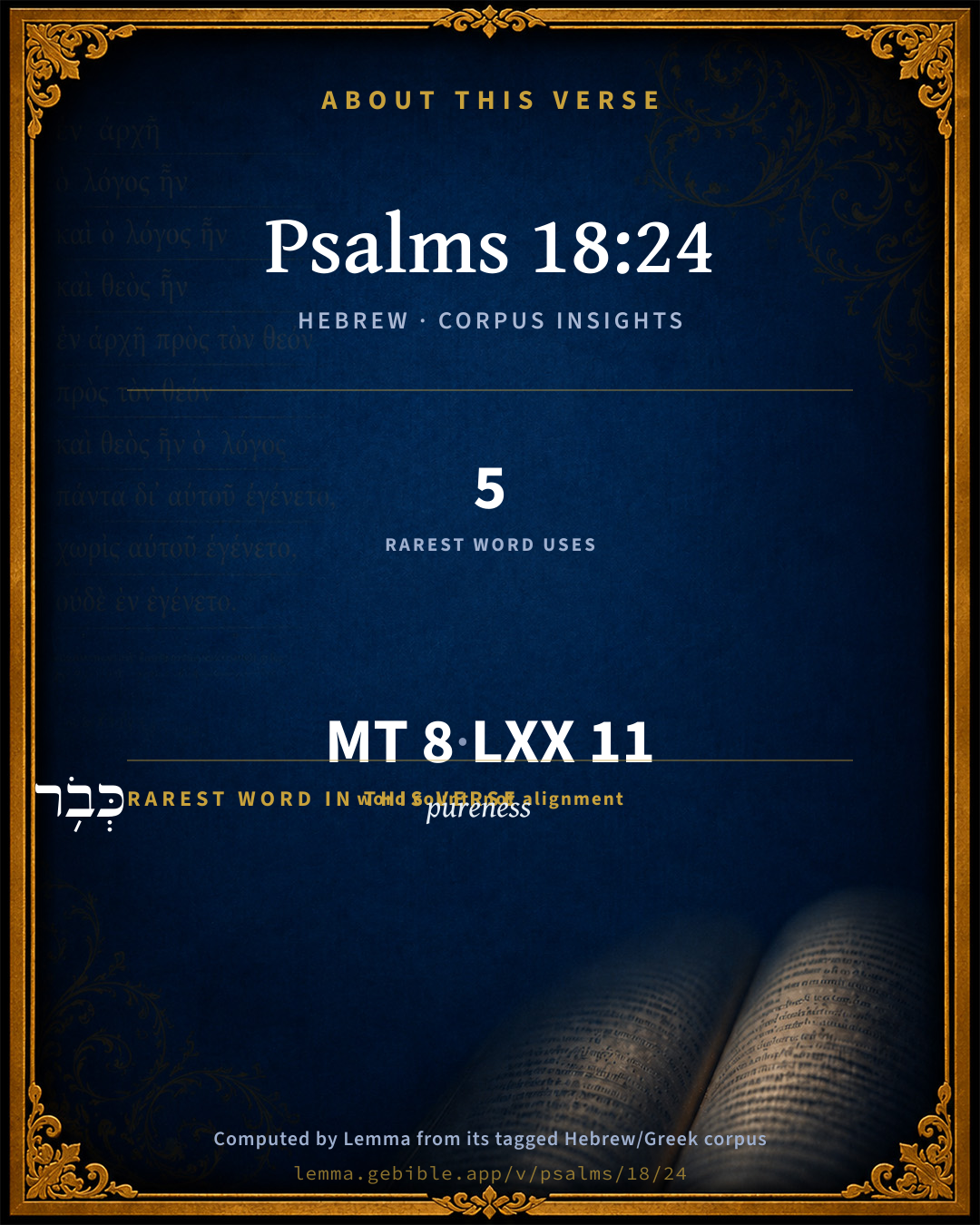
The rarest word here is כְּבֹ֥ר pureness H1252 — appearing just 5 times in the whole Hebrew Bible.

Shared distinctive vocabulary

כְּבֹ֥ר pureness H1252 occurs in 5 verses of the Hebrew Bible. Also found in:

Grammatical profile

  • 1 verb
  • 5 nouns
  • 2 prepositions

Verb forms

  • וַיָּֽשֶׁב Hiphil · Sequential Imperfect

Hebrew & Septuagint length

In English translation the verse runs 19 words from the Hebrew and 21 from the Septuagint (LXX English) — closely comparable.

A rough comparison of the two English renderings, which tokenize alike — not a word-level alignment.

Word counts can differ between the Hebrew and the Greek without any difference in meaning — e.g. the Hebrew direct-object marker אֵת has no separate Greek word, and Greek often adds the article ὁ.

In the original languages it is 8 Hebrew tokens and 11 Greek tokens — but the two are counted differently (Hebrew bundles its prefixes and suffixes into one token; the Greek is in lemma form), so that isn’t a like-for-like length.

Cross-references

5

Topical passages linked to Psalms 18:24 in the Treasury of Scripture Knowledge — connected by theme and wording, ordered by reader-vote popularity; previews shown in the World English Bible.

  • Ruth 2:12 Yahweh recompense your work, and a full reward be given you of Yahweh, the God of Israel, under whose wings you are come to take refuge.
  • Matthew 10:41–42 He who receives a prophet in the name of a prophet will receive a prophet's reward: and he who receives a righteous man in the name of a righteous man will receive a righteous man's reward.
  • 1 Samuel 26:23 Yahweh will render to every man his righteousness and his faithfulness; because Yahweh delivered you into my hand today, and I wouldn't put forth my hand against Yahweh's anointed.
  • Hebrews 6:16 For men indeed swear by a greater one, and in every dispute of theirs the oath is final for confirmation.
  • 2 Thessalonians 1:6–7 Since it is a righteous thing with God to repay affliction to those who afflict you,

Cross-references courtesy of OpenBible.info (CC BY 4.0).

Hebrew and Greek witnesses Masoretic Hebrew ↔ Greek Septuagint

The same verse in the two great witnesses to the Old Testament, shown verse-for-verse.

You’re reading Greek Psalm 17 (Hebrew Psalm 18). The Septuagint counts the superscription, so verse numbers can differ from the Hebrew — chapter-level alignment, not verse-by-verse. Numbering follows Rahlfs.

These are two independent witnesses, not word-aligned to each other, and the Septuagint is shown in lemma (dictionary) form.

Hebrew Psalms 18:24 Masoretic · Westminster Leningrad Codex

וַיָּֽשֶׁב יְהוָ֣ה לִ֣י כְצִדְקִ֑י כְּבֹ֥ר יָ֝דַ֗י לְנֶ֣גֶד עֵינָֽיו

Therefore Yahweh has rewarded me according to my righteousness, According to the cleanness of my hands in his eyesight.

World English Bible · Public Domain

Greek LXX Greek Psalm 17:24 Septuagint · lemma form

καί εἰμί ἄμωμος μετά αὐτός καί φυλάσσω ἀπό ὁ ἀνομία ἐγώ

And the Lord shall recompense me according to my righteousness, and according to the purity of my hands before his eyes.

LXX2012 (modern English Septuagint) · Public Domain

Hebrew: Westminster Leningrad Codex (CC BY 4.0). Greek: Septuagint (public domain); English from LXX2012 (modern English Septuagint) (Public Domain). How the Septuagint differs from the Hebrew →

Commentary

Notes on Psalms 18:24 from classic Christian and Jewish commentators (each source and its license shown beneath its notes). The classic Christian expositions comment on the surrounding passage and are grouped to its opening verse, so a note may address several verses; the Jewish commentaries on the Tanakh (Rashi and others) are per-verse, so they appear only where the commentator wrote on this verse.

Lemma curates 59 commentaries, every one of them public domain or Creative Commons licensed, each selected and text-cleaned for this edition rather than reprinted as found. About our sources →

Trapp's Complete Commentary

John Trapp

Psa 18:24 Therefore hath the LORD recompensed me according to my righteousness, according to the cleanness of my hands in his eyesight.

Ver. 24. Therefore hath the Lord recompensed me] See on Psa 18:20. Reward and mercy are joined together in the second commandment; and, Psa 62:12, it is a mercy in God to reward a man according to his work.

According to the cleanness of my hands in his eyesight] i.e. Which he hath beheld in me; though mine enemies were of another judgment, Qua illo iudice praeditus sum (Vatab.).

John Trapp, A Commentary or Exposition upon All the Books of the Old and New Testament (1647–1656) — public domain. Text from a community e-Sword module.

The Treasury of David

Charles H. Spurgeon

Ver. 24. God first gives us holiness, and then rewards us for it. We are his workmanship; vessels made unto honour; and when made, the honour is not withheld from the vessel; though, in fact, it all belongs to the Potter upon whose wheel the vessel was fashioned. The prize is awarded to the flower at the show, but the gardener reared it; the child wins the prize from the schoolmaster, but the real honour of his schooling lies with the master, although instead of receiving he gives the reward.

Ver. 24-26. As you may see a proportion between sins and punishments which are the rewards of them, that you can say, Such a sin brought forth this affliction, it is so like the father; so you might see the like proportion between your prayers and your walking with God, and God's answers to you, and his dealings with you. So did David; According to the cleanness of my hands hath he recompensed me, etc. His speech notes some similitude or likeness; as, for example, the more by ends or carnal desires you had in praying, and the more you mingled of these with your holy desires, and the more want of zeal, fervency, etc., were found in your prayers, the more you shall, it may be, find of bitterness mingled with the mercy, when it is granted, and so much imperfection, and want of comfort in it. So says David in this same Ps 18:25-26, With the pure thou wilt show thyself pure. Pure prayers have pure "blessings; "ete e contra, With the froward thou wilt show thyself froward. And again, as you in praying sometimes slackened and grew cold, so you might see the business in like manner to cool, and cast backward; as, When Moses's hands were down, Amalek prevailed; but when they were lifted up, Israel had the better. Ex 17:12. God let him see a proportion, which argued his prayer was the means of prevailing. A man finds in praying that his suit sometimes sticks, and goes not on as he expected; this is because he gives not so good a fee as he was wont, and doth not ply God and solicit him; but on the contrary, when he was stirred up to pray, then still he found things to go well. By this a man may clearly see that it was the prayer which God did hear and regarded. Thus, likewise, when a man sees hills and dales in a business, fair hopes often, and then all dashed again, and the thing in the end brought to pass, let him look back upon his prayers. Didst not thou in like manner just thus deal with God? when thou hadst prayed earnestly, and thought thou hadst even carried it, then dash all again by interposing some sin, and thus again and again? Herein God would have you observe a proportion, and it may help you to discern how and when they are answered and obtained by prayer, because God deals thus with you therein in such proportion to your prayers. Thomas Goodwin.

Ver. 24-27. Even as the sun, which, unto eyes being sound and without disease, is very pleasant and wholesome, but unto the same eyes, when they are feeble, sore, and weak, is very troublesome and hurtful, yet the sun is ever all one and the selfsame that was before; so God, who hath ever shown himself benign and bountiful to those who are kind and tenderhearted towards his saints, and are merciful to those who show mercy. But unto the same men, when they fall into wickedness and grow to be full of beastly cruelty, the Lord showeth himself to be very wrathful and angry, and yet is one and the same immutable God from everlasting to everlasting. Robert Cawdray.

None.

Psalms 18:25*

Ver. 24-26. See Psalms on "Ps 18:24" for further information.

Ver. 24-27. See Psalms on "Ps 18:24" for further information.

Ver. 24-26. See Psalms on "Ps 18:24" for further information.

Ver. 24-27. See Psalms on "Ps 18:24" for further information.

Ver. 24-27. See Psalms on "Ps 18:24" for further information.

Charles H. Spurgeon's The Treasury of David (1869–1885) — public domain. Psalms only. Text from a community e-Sword/MySword module.

Whedon's Commentary on the Bible

Daniel D. Whedon

24. Recompensed me according, etc.—In Psa_18:24-26 the great principle of the divine government is clearly recognised, namely: that God will deal with men as they deal with one another. He will apply their own principles of action to themselves. See Pro_21:13; Job_22:6-10; Mat_6:15; Jas_2:13. The heaviest of all the divine judgments is the abandonment of a wicked man to his own wickedness. Rom_1:24; 2Th_2:9-12

Daniel D. Whedon (gen. ed.), Commentary on the Old and New Testaments (1874–1909) — public domain. Text from a community e-Sword module.

J. A. Alexander on Psalms

Joseph Addison Alexander

25. (Psa 18:24). And Jehovah has requited me according to my righteousness, according to the cleanness of my hands before his eyes. This verse shews clearly that the futures in Psa 18:21 (20) must be strictly understood. What he there represents himself as confidently hoping, he here professes to have really experienced. In the intervening verses he shews how he had done his part, and now acknowledges that God had faithfully performed his own.

Joseph Addison Alexander, The Psalms Translated and Explained (1850) — public domain. Text from a community e-Sword module.

The Cambridge Bible for Schools and Colleges

gen. ed. J. J. S. Perowne

24–27. The law of God’s dealings with men. The assertion of Psa_18:20 is repeated as the conclusion to be drawn from the review of David’s conduct in Psa_18:21-23, and is confirmed in Psa_18:25-27 by a statement of the general laws of God’s moral government. His attitude towards men is and must be conditioned by their attitude towards Him. Cp. 1Sa_2:30; 1Sa_15:23. There must be some moral correspondence in a man’s character to enable God to reveal Himself to Him as ‘merciful,’ ‘perfect,’ ‘pure.’

The Cambridge Bible for Schools and Colleges (gen. ed. J. J. S. Perowne; Cambridge University Press, 1878–1918) — public domain. Text from a community e-Sword module.

John Gill's Exposition

With the merciful thou wilt show thyself merciful,.... The merciful man is the good, gracious, holy, and godly man, as the word (z) here used signifies, and is sometimes rendered; one that has received grace and mercy from the Lord, and has principles of grace and goodness wrought in him, and is kind and merciful to others, both to their souls and bodies; and to such men God shows himself merciful: not that they are first merciful to others, and then he is so to them, for it is just the reverse; nor is their mercifulness the cause or condition of his, for he has mercy on whom he will have mercy; but to such he shows fresh mercy, and bestows more grace upon them; they find grace and mercy with him now, and will do hereafter; see Mat 5:7. This may be applied to Christ, all whose ways are mercy and truth; he saw the estate his people would come into; he pitied their case, and became their surety in eternity; he betrothed them to himself in loving kindness and tender mercies; and undertook to feed the flock of slaughter, even the poor of the flock; having, through his merciful lovingkindness, assumed human nature, he went about doing good to the souls and bodies of men; he healed the diseased and fed the hungry, and had compassion on the ignorant, and them that were out of the way; and, as a merciful high priest, he bore the sins and sorrows of his people; and in his love and pity redeemed them, and continues to sympathize with them in all their afflictions and temptations; and though no mercy was shown him while he was suffering for them, for God spared him not, but awoke the sword of justice against him, and used him with the utmost rigour and severity; yet satisfaction being made, he did not leave him in the grave, nor suffer his holy, good, and merciful One to see corruption; but raised him from the dead, prevented him with the blessings of his goodness, and set upon his head a crown of honour and glory;

with an upright man thou wilt show thyself upright; an upright man, as the word (a) used signifies, is a perfect man, not absolutely, but comparatively; not in himself, but in Christ; perfect with a perfection of parts, but not of degrees; he is one that is upright in heart, sincere and without hypocrisy; an Israelite indeed, whose faith, hope, and love, are undisguised; he is a man of integrity, a faithful man, faithful to God, his cause and interest, his word and ordinances, and is faithful with the saints; he walks, uprightly according to the rule of God's word, and by faith in Christ; and to such upright men God shows himself upright, or faithful, by keeping his covenant with them, fulfilling his promises to them, and not suffering one good thing to fail he has given them reason to expect from him. This may also be interpreted of Christ, who is in the highest and fullest sense perfect, upright, and sincere, and faithful to him that appointed him; and as he has been faithful in all his covenant engagements with his Father, so his Father has been faithful to him in making good all he promised him; both with respect to his own glory, and the happiness of his people; see Isa 53:10.

(z) "benigno", Vatablus, Junius & Tremellius; "bono", Gejerus, some in Vatablus; "qui bonitati studet", Tigurine version; "pio", Munster, Cocceius, Michaelis; "gracious saint", Ainsworth. (a) "perfecto", Pagninus, Montanus; so Ainsworth.

John Gill's Exposition of the Whole Bible (1746–1763) — public domain (CC PDM 1.0). Text via the HelloAO Bible API.

Albert Barnes' Notes on the Bible

Therefore hath the Lord recompensed me - By delivering me from my enemies. The divine interpositions in his behalf had been of the nature of a reward or recompense.

According to my righteousness - As if I were righteous; or, his acts of intervention have been such as are appropriate to a righteous life. The psalmist does not say that it was on account of his righteousness as if he had merited the favor of God, but that the interpositions in his behalf had been such as to show that God regarded him as righteous.

According to the cleanness of my hands - See the note at Psa 18:20.

In his eyesight - Margin, as in Hebrew, before his eyes. The idea is that God saw that he was upright.

Albert Barnes' Notes on the Bible (1834–1885) — public domain. Text from a community e-Sword/MySword module.

The Pulpit Commentary

Therefore hath the Lord recompensed me according to my righteousness, according to the cleanness of my hands in his eyesight. Having set forth the particulars of his righteousness (vers. 21-23), the psalmist returns to his previous general statement (ver. 20), and emphatically reaffirms it.

The Pulpit Commentary (1880–1919), ed. H.D.M. Spence-Jones & Joseph S. Exell — public domain. Text from a community e-Sword module.

John Wesley's Explanatory Notes

Iniquity - From that sin which I was most inclined or tempted to.

John Wesley, Explanatory Notes Upon the Whole Bible (1754–1765) — public domain. Text via the GEBible commentary corpus.

Keil & Delitzsch

C. F. Keil & F. Delitzsch

(Heb.: 18:25-28) What was said in Psa 18:21 is again expressed here as a result of the foregoing, and substantiated in Psa 18:26, Psa 18:27. חסיד is a friend of God and man, just as pius is used of behaviour to men as well as towards God. גּבר תמים the man (construct of גּבר) of moral and religious completeness (integri = integritatis, cf. Psa 15:2), i.e., of undivided devotion to God. נבר (instead of which we find בּר לבב elsewhere, Psa 24:4; Psa 73:1) not one who is purified, but, in accordance with the reflexive primary meaning of Niph., one who is purifying himself, ἁγνίζων ἑαυτόν, Jo1 3:3. עקּשׁ (the opposite of ישׂר) one who is morally distorted, perverse. Freely formed Hithpaels are used with these attributive words to give expression to the corresponding self-manifestation: התחסּד, התּמּם (Ges. 54, 2, b), התבּרר, and התפּתּל (to show one's self נפתּל or פּתלתּל). The fervent love of the godly man God requites with confiding love, the entire submission of the upright with a full measure of grace, the endeavour after purity by an unbeclouded charity (cf. Psa 73:1), moral perverseness by paradoxical judgments, giving the perverse over to his perverseness (Rom 1:28) and leading him by strange ways to final condemnation (Isa 29:14, cf. Lev 26:23.). The truth, which is here enunciated, is not that the conception which man forms of God is the reflected image of his own mind and heart, but that God's conduct to man is the reflection of the relation in which man has placed himself to God; cf. Sa1 2:30; Sa1 15:23. This universal truth is illustrated and substantiated in Psa 18:28. The people who are bowed down by affliction experience God's condescension, to their salvation; and their haughty oppressors, god's exaltation, to their humiliation. Lofty, proud eyes are among the seven things that Jahve hateth, according to Pro 6:17. The judgment of God compels them to humble themselves with shame, Isa 2:11.

Keil & Delitzsch — Biblical Commentary on the Old Testament (1861–1891) — public domain (CC PDM 1.0). Text via the HelloAO Bible API. (Old Testament only.)

Lesson kit

Teaching starters — assembled from the data on this page, not authored interpretation. Every prompt links to the verse data it draws on. Edit before teaching.

Psalms, in the Wisdom, opens this verse with 8 words (7 distinct Hebrew lemmas). Its most distinctive word is bôr (“pureness”). A historical commentator’s framing appears above. Read the whole chapter for the surrounding context.

Discussion questions

  1. How does “pureness” (bôr) shape what this verse is saying?
  2. How does 2 Samuel 22:21, which shares the word «pureness», read alongside this verse?
  3. These translations render this verse differently. What is at stake in choosing one wording over another?
  4. «וַיָּֽשֶׁב» is a Hiphil Sequential Imperfect verb. How does that grammatical form shape the action described?
  5. Compare how Trapp's Complete Commentary and The Treasury of David read this verse. Where do they agree or differ?

Things to notice

Reading settings

Reading text

Shown beneath each verse's original-language words.

Old Testament
Old Testament edition

Read the OT as the Masoretic Hebrew (MT) or the Greek Septuagint (LXX).

English shown for the Greek Septuagint (in the Hebrew ↔ Greek comparison).

Comparing translations? Open the Compare panel on any verse page to stack up to four side by side.