
Numbers 1:53

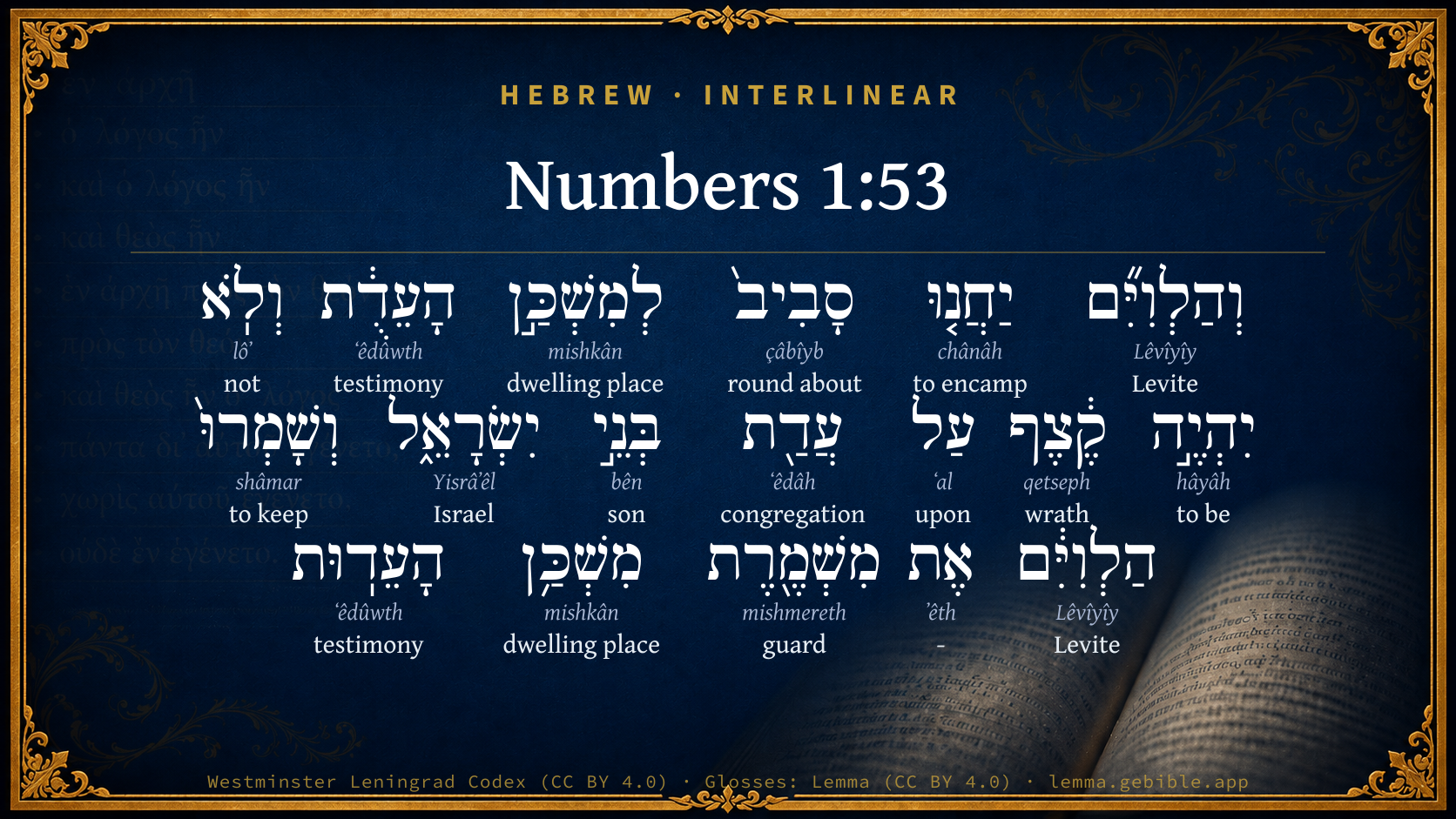
Hebrew (Westminster Leningrad Codex) Numbers 1:53 appears in the Hebrew Old Testament. The text above is from the Westminster Leningrad Codex. Each word links to its Strong’s number, a concise gloss, and parsing drawn from the Open Scriptures Hebrew Bible morphology. Click any word for its full Brown-Driver-Briggs (BDB) entry.
Download image
Cite this verse

Numbers 1:53 (World English Bible). Public Domain. Lemma interlinear Bible study tool, https://lemma.gebible.app/v/numbers/1/53.

Show BibTeX & RIS
BibTeX
RIS
English Translation
But the Levites shall encamp around the Tabernacle of the Testimony, that there may be no wrath on the congregation of the children of Israel: and the Levites shall be responsible for the Tabernacle of the Testimony."
World English Bible · Public Domain
Highlights
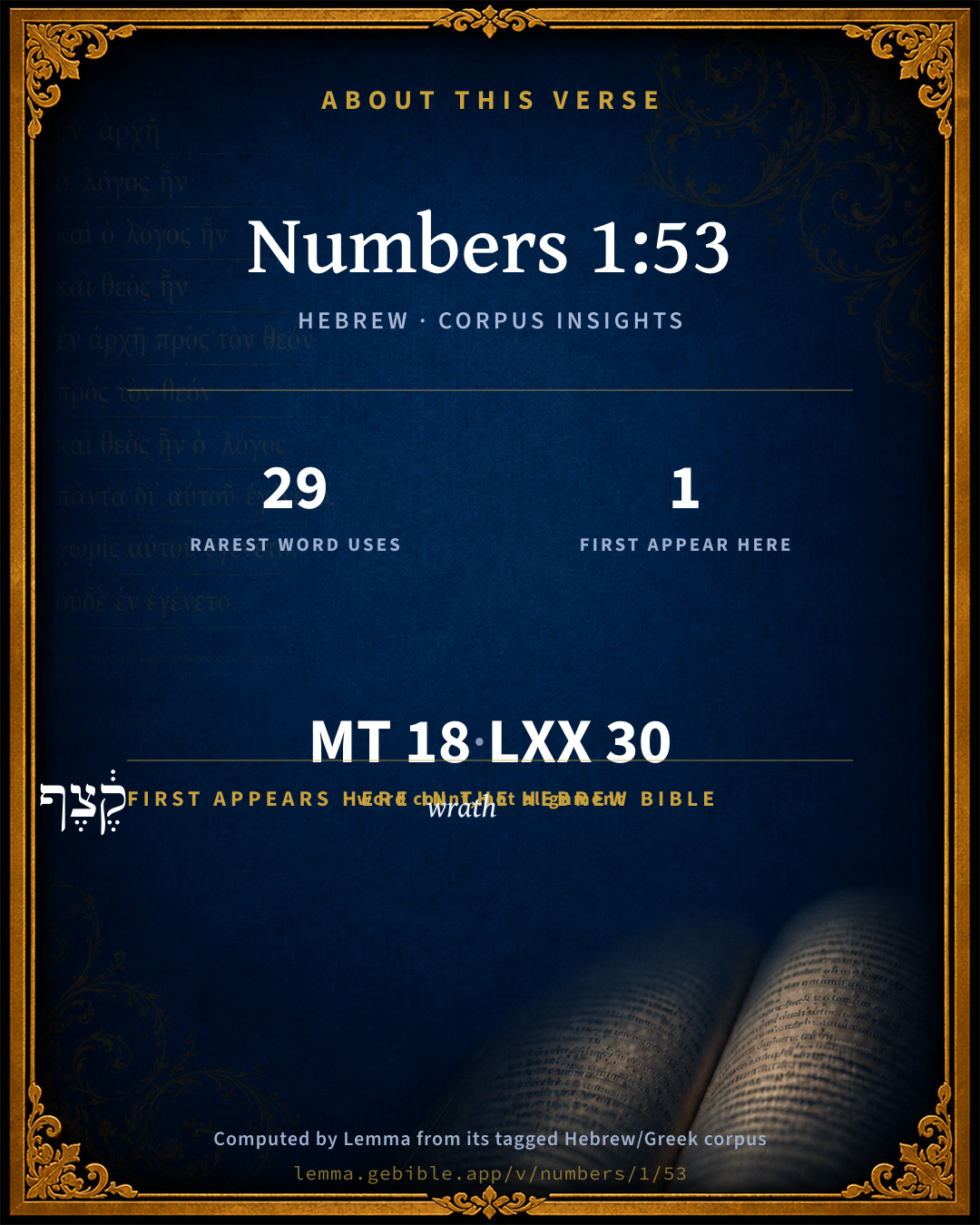
  • 1 first appearance in the Hebrew Bible
Full analysis ↓
Download a study sheet

One document with this verse’s original text, its word-by-word gloss line, the meaning frame, cross-references with their text, attributed commentary, and full source and license credits — printable, and it pastes into notes with its structure intact.

This verse Autodidact and up

Study sheet (.html) Plain text (.txt)

A passage Seminary Student

Up to 50 verses in one chapter. A passage sheet keeps up to 6 commentary sources and 12 cross-references per verse, in the order this page ranks them, and says so on the sheet whenever that leaves anything out. Ask for a single verse and you get the Autodidact verse sheet above.

Everything on this page stays free to read, with no account — the sheet is a download of what is already on screen, not access to it.

Want to remove ads? Support Godless Engineer
Compare translations 3

The same verse in 3 English versions, stacked beneath the original-language interlinear above. Click any original word for its lexicon entry.

Each is an independent rendering of the whole verse — the interlinear is not word-aligned to these translations.

Highlighted words mark where these versions differ — a whole-verse word diff, not a word-by-word alignment.

  • World English Bible Public Domain
    But the Levites shall encamp around the Tabernacle of the Testimony, that there may be no wrath on the congregation of the children of Israel: and the Levites shall be responsible for the Tabernacle of the Testimony."
  • King James Version Public Domain
    But the Levites shall pitch round about the tabernacle of testimony, that there be no wrath upon the congregation of the children of Israel: and the Levites shall keep the charge of the tabernacle of testimony.
  • unfoldingWord Literal Text CC BY-SA 4.0
    And the Levites shall camp around the Dwelling of the Testimony, and wrath will not be on the congregation of the sons of Israel. And the Levites shall keep the keeping of the Dwelling of the Testimony.”

unfoldingWord Literal Text — © unfoldingWord, licensed CC BY-SA 4.0. Word-aligned USFM3 via Door43 (git.door43.org/unfoldingWord/en_ult).

Versions to compare (up to 4)

3 of 4 selected

Show all 18 translations

Every available English version of this verse, each an independent rendering of the whole verse.

  • World English Bible Public Domain
    But the Levites shall encamp around the Tabernacle of the Testimony, that there may be no wrath on the congregation of the children of Israel: and the Levites shall be responsible for the Tabernacle of the Testimony."
  • Berean Standard Bible Public Domain
    But the Levites are to camp around the tabernacle of the Testimony and watch over it, so that no wrath will fall on the congregation of Israel. So the Levites are responsible for the tabernacle of the Testimony.”
  • Majority Standard Bible Public Domain
    But the Levites are to camp around the tabernacle of the Testimony and watch over it, so that no wrath will fall on the congregation of Israel. So the Levites are responsible for the tabernacle of the Testimony.”
  • King James Version Public Domain
    But the Levites shall pitch round about the tabernacle of testimony, that there be no wrath upon the congregation of the children of Israel: and the Levites shall keep the charge of the tabernacle of testimony.
  • American Standard Version (1901) Public Domain
    But the Levites shall encamp round about the tabernacle of the testimony, that there be no wrath upon the congregation of the children of Israel: and the Levites shall keep the charge of the tabernacle of the testimony.
  • Revised Version (1885) Public Domain
    But the Levites shall pitch round about the tabernacle of the testimony, that there be no wrath upon the congregation of the children of Israel: and the Levites shall keep the charge of the tabernacle of the testimony.
  • Geneva Bible (1599) Public Domain
    But the Leuites shall pitch rounde about the Tabernacle of the Testimonie, least vengeance come vpon the Congregation of the children of Israel, and the Leuites shall take the charge of the Tabernacle of the Testimonie.
  • Douay-Rheims (1899) Public Domain
    But the Levites shall pitch their tents round about the tabernacle, lest there come indignation upon the multitude of the children of Israel, and they shall keep watch, and guard the tabernacle of the testimony.
  • Young's Literal Translation Public Domain
    and the Levites encamp round about the tabernacle of the testimony; and there is no wrath on the company of the sons of Israel, and the Levites have kept the charge of the tabernacle of the testimony.
  • Literal Standard Version CC BY-SA 4.0
    and the Levites encamp around the Dwelling Place of the Testimony; and there is no wrath on the congregation of the sons of Israel, and the Levites have kept the charge of the Dwelling Place of the Testimony.
  • Unlocked Literal Bible CC BY-SA 4.0
    However, the Levites must set up their tents around the tabernacle of the covenant decrees so that my anger does not come upon the people of Israel. The Levites must care for the tabernacle of the covenant decrees.”
  • unfoldingWord Literal Text CC BY-SA 4.0
    And the Levites shall camp around the Dwelling of the Testimony, and wrath will not be on the congregation of the sons of Israel. And the Levites shall keep the keeping of the Dwelling of the Testimony.”
  • Darby Bible Public Domain
    but the Levites shall encamp round about the tabernacle of testimony, that there come not wrath upon the assembly of the children of Israel; and the Levites shall keep the charge of the tabernacle of testimony.
  • World Messianic Bible Public Domain
    But the Levites shall encamp around the Tabernacle of the Testimony, that there may be no wrath on the congregation of the children of Israel. The Levites shall be responsible for the Tabernacle of the Testimony.”
  • Webster's Bible Public Domain
    But the Levites shall pitch around the tabernacle of testimony; that there may be no wrath upon the congregation of the children of Israel: and the Levites shall keep the charge of the tabernacle of testimony.
  • Free Bible Version CC BY-SA 4.0
    But the Levites are to set up their camp around the Tabernacle of the Testimony to prevent anyone from making me angry with the Israelites. The Levites are responsible for looking after the Tabernacle of the Testimony.”
  • Bible in Basic English Public Domain
    But the tents of the Levites are to be round the Tent of meeting, so that wrath may not come on the children of Israel: the Tent of meeting is to be in the care of the Levites.
  • JPS Tanakh (1917) Public Domain
    But the Levites shall pitch round about the tabernacle of the testimony, that there be no wrath upon the congregation of the children of Israel; and the Levites shall keep the charge of the tabernacle of the testimony.'

Literal Standard Version (2020), Covenant Press — licensed CC BY-SA 4.0. Text via the HelloAO Bible API (eBible.org). Unlocked Literal Bible (unfoldingWord) — licensed CC BY-SA 4.0. Text via the HelloAO Bible API (eBible.org). unfoldingWord Literal Text — © unfoldingWord, licensed CC BY-SA 4.0. Word-aligned USFM3 via Door43 (git.door43.org/unfoldingWord/en_ult). Free Bible Version, Dr. Jonathan Gallagher — licensed CC BY-SA 4.0. Text via the HelloAO Bible API (eBible.org).

Word by word

More ways to search: Search by grammar → Find every occurrence → Compare this word →

Practice this passage: Drill this verse → Learn its vocabulary →

קֶ֔צֶף
qetseph
H7110
“wrath”
Noun, Common, Masculine, Singular, Absolute
Part of Speech
Noun
Type
Common
Gender
Masculine
Number
Singular
State
Absolute
Full BDB Definition

Origin: from H7107

TWOT: 2058a , 2059b

wrath, anger - of God - of man - splinter, twig, broken twig - meaning dubious
  1. וְהַלְוִיִּ֞ם Lêvîyîy H3881 “and · the · Levites” Conjunction + Particle, Definite Article + Noun, Gentilic, Masculine, Plural, Absolute
  2. יַחֲנ֤וּ chânâh H2583 “to encamp” Verb, Qal, Imperfect, 3rd Person, Masculine, Plural
  3. סָבִיב֙ çâbîyb H5439 “round about” Noun, Common, Both, Singular, Absolute
  4. לְמִשְׁכַּ֣ן mishkân H4908 “to/for · dwelling place of” Preposition + Noun, Common, Masculine, Singular, Construct
  5. הָעֵדֻ֔ת ʻêdûwth H5715 “the · testimony” Particle, Definite Article + Noun, Common, Feminine, Singular, Absolute
  6. וְלֹֽא lôʼ H3808 “and · not” Conjunction + Particle, Negative
  7. יִהְיֶ֣ה hâyâh H1961 “to be” Verb, Qal, Imperfect, 3rd Person, Masculine, Singular
  8. עַל ʻal H5921 “upon” Preposition
  9. עֲדַ֖ת ʻêdâh H5712 “congregation of” Noun, Common, Feminine, Singular, Construct
  10. בְּנֵ֣י bên H1121 “sons of” Noun, Common, Masculine, Plural, Construct
  11. יִשְׂרָאֵ֑ל Yisrâʼêl H3478 “Israel” Noun, Proper
  12. וְשָׁמְרוּ֙ shâmar H8104 “and · to keep” Conjunction + Verb, Qal, Sequential Perfect, 3rd Person, Common, Plural
  13. הַלְוִיִּ֔ם Lêvîyîy H3881 “the · Levites” Particle, Definite Article + Noun, Gentilic, Masculine, Plural, Absolute
  14. אֶת ʼêth H853 “-” Particle, Direct Object
  15. מִשְׁמֶ֖רֶת mishmereth H4931 “guard of” Noun, Common, Feminine, Singular, Construct
  16. מִשְׁכַּ֥ן mishkân H4908 “dwelling place of” Noun, Common, Masculine, Singular, Construct
  17. הָעֵדֽוּת ʻêdûwth H5715 “the · testimony” Particle, Definite Article + Noun, Common, Feminine, Singular, Absolute

About this verse

These counts appear in no published source. They are computed here, from the morphology-tagged text and Lemma’s own curated glosses. What Lemma adds →

18
words
15
distinct lemmas
Pentateuch
section

First appearance in Scripture

This word makes its first canonical appearance in the Hebrew Bible here:

  • קֶ֔צֶף wrath H7110

Shared distinctive vocabulary

קֶ֔צֶף wrath H7110 occurs in 29 verses of the Hebrew Bible. Also found in:

Grammatical profile

  • 3 verbs
  • 12 nouns
  • 1 preposition
  • 2 particles

Verb forms

  • יַחֲנ֤וּ Qal · Imperfect
  • יִהְיֶ֣ה Qal · Imperfect
  • וְשָׁמְרוּ֙ Qal · Sequential Perfect

Repetition

Words recur within this verse — often emphatic in Hebrew:

  • וְהַלְוִיִּ֞ם Levite H3881 ×2
  • לְמִשְׁכַּ֣ן dwelling place H4908 ×2
  • הָעֵדֻ֔ת testimony H5715 ×2

Hebrew & Septuagint length

In English translation the verse runs 37 words from the Hebrew and 38 from the Septuagint (LXX English) — closely comparable.

A rough comparison of the two English renderings, which tokenize alike — not a word-level alignment.

Word counts can differ between the Hebrew and the Greek without any difference in meaning — e.g. the Hebrew direct-object marker אֵת has no separate Greek word, and Greek often adds the article ὁ.

In the original languages it is 18 Hebrew tokens and 30 Greek tokens — but the two are counted differently (Hebrew bundles its prefixes and suffixes into one token; the Greek is in lemma form), so that isn’t a like-for-like length.

Cross-references

18

Topical passages linked to Numbers 1:53 in the Treasury of Scripture Knowledge — connected by theme and wording, ordered by reader-vote popularity; previews shown in the World English Bible.

  • Numbers 16:46 Moses said to Aaron, Take your censer, and put fire therein from off the altar, and lay incense thereon, and carry it quickly to the congregation, and make atonement for them: for there is wrath gone out from Yahweh; the plague is begun.
  • Leviticus 10:6 Moses said to Aaron, and to Eleazar and to Ithamar, his sons, "Don't let the hair of your heads go loose, neither tear your clothes; that you don't die, and that he not be angry with all the congregation: but let your brothers, the whole house of Israel, bewail the burning which Yahweh has kindled.
  • 1 Chronicles 23:32 and that they should keep the charge of the tent of meeting, and the charge of the holy place, and the charge of the sons of Aaron their brothers, for the service of the house of Yahweh.
  • Numbers 3:7–8 They shall keep his charge, and the charge of the whole congregation before the Tent of Meeting, to do the service of the tabernacle.
  • Numbers 8:19 I have given the Levites as a gift to Aaron and to his sons from among the children of Israel, to do the service of the children of Israel in the Tent of Meeting, and to make atonement for the children of Israel; that there be no plague among the children of Israel, when the children of Israel come near to the sanctuary."
  • Numbers 8:24–26 "This is that which belongs to the Levites: from twenty-five years old and upward they shall go in to wait on the service in the work of the Tent of Meeting;
  • Numbers 31:30 Of the children of Israel's half, you shall take one drawn out of every fifty, of the persons, of the oxen, of the donkeys, and of the flocks, [even] of all the cattle, and give them to the Levites, who keep the charge of the tent of Yahweh.
  • Numbers 31:47 even of the children of Israel's half, Moses took one drawn out of every fifty, both of man and of animal, and gave them to the Levites, who kept the charge of the tent of Yahweh; as Yahweh commanded Moses.
  • Numbers 1:50 but appoint the Levites over the Tabernacle of the Testimony, and over all its furnishings, and over all that belongs to it. They shall carry the tabernacle, and all its furnishings; and they shall take care of it, and shall encamp around it.
  • Numbers 3:38 Those who encamp before the tabernacle eastward, in front of the Tent of Meeting toward the sunrise, shall be Moses, and Aaron and his sons, keeping the charge of the sanctuary for the charge of the children of Israel. The stranger who comes near shall be put to death.
  • Numbers 18:2–5 Your brothers also, the tribe of Levi, the tribe of your father, bring you near with you, that they may be joined to you, and minister to you: but you and your sons with you shall be before the tent of the testimony.
  • 1 Samuel 6:19 He struck of the men of Beth-shemesh, because they had looked into the ark of Yahweh, he struck of the people fifty thousand seventy men; and the people mourned, because Yahweh had struck the people with a great slaughter.
  • 2 Chronicles 13:10 But as for us, Yahweh is our God, and we have not forsaken him; and [we have] priests ministering to Yahweh, the sons of Aaron, and the Levites in their work:
  • Jeremiah 5:31 the prophets prophesy falsely, and the priests bear rule by their means; and my people love to have it so: and what will you do in the end of it?
  • Jeremiah 23:15 Therefore thus says Yahweh of Hosts concerning the prophets: Behold, I will feed them with wormwood, and make them drink the water of gall; for from the prophets of Jerusalem is ungodliness gone forth into all the land.
  • Acts 20:28–31 Take heed, therefore, to yourselves, and to all the flock, in which the Holy Spirit has made you overseers, to shepherd the assembly of the Lord and God which he purchased with his own blood.
  • 1 Timothy 4:13–16 Until I come, pay attention to reading, to exhortation, and to teaching.
  • 2 Timothy 4:2 preach the word; be urgent in season and out of season; reprove, rebuke, and exhort, with all patience and teaching.

Cross-references courtesy of OpenBible.info (CC BY 4.0).

Hebrew and Greek witnesses Masoretic Hebrew ↔ Greek Septuagint

The same verse in the two great witnesses to the Old Testament, shown verse-for-verse.

These are two independent witnesses, not word-aligned to each other, and the Septuagint is shown in lemma (dictionary) form.

Hebrew Numbers 1:53 Masoretic · Westminster Leningrad Codex

וְהַלְוִיִּ֞ם יַחֲנ֤וּ סָבִיב֙ לְמִשְׁכַּ֣ן הָעֵדֻ֔ת וְלֹֽא יִהְיֶ֣ה קֶ֔צֶף עַל עֲדַ֖ת בְּנֵ֣י יִשְׂרָאֵ֑ל וְשָׁמְרוּ֙ הַלְוִיִּ֔ם אֶת מִשְׁמֶ֖רֶת מִשְׁכַּ֥ן הָעֵדֽוּת

But the Levites shall encamp around the Tabernacle of the Testimony, that there may be no wrath on the congregation of the children of Israel: and the Levites shall be responsible for the Tabernacle of the Testimony."

World English Bible · Public Domain

Greek LXX Numbers 1:53 Septuagint · lemma form

ὁ δέ λευίτης παρα ἐνβάλλω ἐναντίον κύριος κύκλος ὁ σκηνή ὁ μαρτύριον καί οὐ εἰμί ἁμάρτημα ἐν υἱός ἰσραήλ καί φυλάσσω ὁ λευίτης αὐτός ὁ φυλακή ὁ σκηνή ὁ μαρτύριον

But let the Levites encamp round about the tabernacle of witness fronting it, and so there shall be no sin among the children of Israel; and the Levites themselves shall keep the guard of the tabernacle of witness.

LXX2012 (modern English Septuagint) · Public Domain

Hebrew: Westminster Leningrad Codex (CC BY 4.0). Greek: Septuagint (public domain); English from LXX2012 (modern English Septuagint) (Public Domain). How the Septuagint differs from the Hebrew →

Targum (Aramaic paraphrase)

2

The Targum is the ancient Jewish Aramaic paraphrase of the Hebrew Scriptures — an interpretive translation, not the Hebrew text itself. Onkelos (literal) and Pseudo-Jonathan (expansive) render the Torah, and Jonathan the Prophets. Coverage is partial: where no permissively-licensed English translation exists for a verse, only the Aramaic is shown. This is verse-level text, not a word-by-word alignment to the Hebrew.

  1. Targum Onkelos Torah (Genesis–Deuteronomy)
    וְלֵוָאֵי יִשְׁרוּן סְחוֹר סְחוֹר לְמַשְׁכְּנָא דְסַהַדוּתָא וְלָא יְהֵי רוּגְזָא עַל כְּנִשְׁתָּא דִבְנֵי יִשְׂרָאֵל וְיִטְרוּן לֵוָאֵי יָת מַטְרַת מַשְׁכְּנָא דְסַהֲדוּתָא

    (no public-domain English translation for this verse)

    Targum Onkelos — Aramaic: “Onkelos Genesis” (public domain); “Onkelos Exodus” (public domain); “Onkelos Leviticus” (public domain); “Onkelos Numbers” (public domain); “Onkelos Deuteronomy” (public domain). English: “Sefaria Community Translation” (CC0 1.0 (public-domain dedication)); “J.W. Etheridge. The Targums of Onkelos and Jonathan Ben Uzziel on the Pentateuch. London: Longmans, Green, 1862” (public domain). Text via Sefaria.

  2. Targum Pseudo-Jonathan Torah (Genesis–Deuteronomy)
    וְלֵיוָאֵי יִשְׁרוּן חֲזוֹר חֲזוֹר לְמַשְׁכְּנָא דְסַהֲדוּתָא וְלָא יְהֵי רוּגְזָא עַל כְּנִישְׁתָּא דִבְנֵי יִשְרָאֵל וְיִטְרוּן לֵיוָאֵי יַת מַטְרַת מַשְׁכְּנָא דְסַהֲדוּתָא

    But the Levites shall encamp round about the tabernacle of the testimony, that there may not be wrath upon the congregation of the children of Israel; and the Levites shall keep charge of the tabernacle of testimony.

    Targum Pseudo-Jonathan — Aramaic: “Targum Jonathan on Genesis” (public domain); “Targum Jonathan on Exodus” (public domain); “Targum Jonathan on Leviticus” (public domain); “Targum Jonathan on Numbers” (public domain); “Targum Jonathan on Deuteronomy” (public domain). English: “The Targum of Jonathan ben Uzziel, trans. J. W. Etheridge, London, 1862” (public domain). Text via Sefaria.

Commentary

Notes on Numbers 1:53 from classic Christian and Jewish commentators (each source and its license shown beneath its notes). The classic Christian expositions comment on the surrounding passage and are grouped to its opening verse, so a note may address several verses; the Jewish commentaries on the Tanakh (Rashi and others) are per-verse, so they appear only where the commentator wrote on this verse.

Lemma curates 59 commentaries, every one of them public domain or Creative Commons licensed, each selected and text-cleaned for this edition rather than reprinted as found. About our sources →

Trapp's Complete Commentary

John Trapp

Num 1:53 But the Levites shall pitch round about the tabernacle of testimony, that there be no wrath upon the congregation of the children of Israel: and the Levites shall keep the charge of the tabernacle of testimony.

Ver. 53. Shall pitch round about.] As the living creatures (the ministers) are between the four and twenty eiders, the congregation of the faithful, and the throne. {Rev 4:4}

John Trapp, A Commentary or Exposition upon All the Books of the Old and New Testament (1647–1656) — public domain. Text from a community e-Sword module.

Joseph Benson's Commentary

Num 1:53. No wrath — From God, who is very tender of his worship, and will not suffer the profaners of it to go unpunished! whose wrath is called simply wrath, by way of eminence, as the most terrible kind of wrath.

Joseph Benson's Commentary on the Old and New Testaments (1811–1818) — public domain. Text from a community e-Sword module.

Geneva Bible (1599)

Geneva Bible translators

By not having due regard to the Tabernacle of the Lord.

Geneva Bible (1599) marginal notes — public domain. Text via Bolls.life.

Ellicott's Commentary for English Readers

(53) That there be no wrath upon the congregation of the children of Israel.—The word kezeph (wrath) is used to denote some immediate visitation of the hand of God, as, e.g., the plague. Thus, after the plague which broke out in consequence of the sin of Korah, Dathan, and Abiram, we read in Num_18:5 “that there be no wrath (kezeph) any more upon the children of Israel.” In Num_8:19 the word negeph (plague) is used in the same sense as kezeph is used here. (Cf. Jos_9:20; 2Ki_3:27; 1Ch_27:24.)

A Bible Commentary for English Readers, edited by Charles John Ellicott (1878–1897) — public domain. Text from a community e-Sword module.

The Cambridge Bible for Schools and Colleges

gen. ed. J. J. S. Perowne

53. that there be no wrath] i.e. Divine judgement for the violation of the sacredness of the Tabernacle; cf. Num_8:19. The Tabernacle was an outward expression of a great religious ideal—that of the dwelling of Jehovah in the midst of His people. But the religious ideal of the Jew fell short of the truth revealed in Christianity. The Jew strained every nerve to safeguard the awful unapproachableness of God, whereas the Christian knows that he can ‘draw near with boldness unto the throne of grace’ (Heb_4:16). For this purpose the Jewish writers represented the Tabernacle as surrounded by a cordon of ‘clergy,’ i.e. the sons of Aaron and the three Levitical families. And outside them the laity of Israel pitched their tents according to their tribes, in the positions specified in ch. 2. This arrangement is a counterpart of Ezekiel’s ideal description of the assignment of land to the several tribes round the Temple which should be built when Israel was restored from exile (Ezekiel 48).

The Cambridge Bible for Schools and Colleges (gen. ed. J. J. S. Perowne; Cambridge University Press, 1878–1918) — public domain. Text from a community e-Sword module.

John Gill's Exposition

But the Levites shall pitch round about the tabernacle of testimony,.... Between the tabernacle and the camps of Israel, to guard the tabernacle and preserve the things in it, and to keep persons from going into it that should not, to pollute or plunder it: these were placed in like manner as the four living creatures round the throne, Rev 4:6; where the allusion seems to be to this situation of the Levites:

that there be no wrath upon the congregation of the children of Israel; that is, from the Lord, should any of them approach too near, or meddle with and touch what they had nothing to do with, or go where they should not; such wrath as came upon Uzzah for his error and transgression before observed:

and the Levites shall keep the charge of the tabernacle of testimony; the several things in it committed to their charge; see Num 3:8.

John Gill's Exposition of the Whole Bible (1746–1763) — public domain (CC PDM 1.0). Text via the HelloAO Bible API.

Haydock's Catholic Bible Commentary

Watch. Lest any thing should offer any indecency to the tabernacle, and thus provoke God’s indignation. (Haydock)

George Leo Haydock (1774–1849), Haydock's Catholic Family Bible and Commentary, 1859 edition — public domain. Excludes Psalms (Douay-Rheims chapter numbering differs from Protestant) and Deuterocanonical books (Catholic canon only).

Matthew Poole's English Annotations

No wrath, to wit, from God, who is very tender of his worship, and will not suffer the profaners of it to go unpunished; whose wrath is called simply wrath by way of eminency, as the most terrible kind of wrath.

Shall keep the charge, i.e. shall suffer no stranger to approach through curiosity, or any other motive.

Matthew Poole's English Annotations on the Holy Bible (1683–1685) — public domain. Text from a community e-Sword/MySword module.

Whedon's Commentary on the Bible

Daniel D. Whedon

53. That there be no wrath — By the Levites encamped around the sacred tabernacle a strong guard was established for its protection, and a safeguard to keep the people from intrusion into the consecrated enclosure, and consequent destruction by the wrath of Jehovah. The spiritual lessons conveyed to us are, the great solemnity and self-examination with which we should approach the sacred mysteries of Christianity, the baptismal font and the holy eucharist, “lest we eat and drink damnation, not discerning the Lord’s body;” and also the carefulness and scrutiny of motives which should characterize every man who desires to enter the high vocation of the Christian ministry.

Daniel D. Whedon (gen. ed.), Commentary on the Old and New Testaments (1874–1909) — public domain. Text from a community e-Sword module.

The Pulpit Commentary

That there be no wrath upon the congregation that no man, not being a Levite, intrude himself through ignorance or presumption upon the sacredness of the tabernacle, and so bring death upon himself, and displeasure upon the people. The Levites shall keep the charge of the tabernacle. Out of this command grew the Levitical guard of the temple, which afterwards played a considerable part in the history of Israel. (2Ki 11)

The Pulpit Commentary (1880–1919), ed. H.D.M. Spence-Jones & Joseph S. Exell — public domain. Text from a community e-Sword module.

John Wesley's Explanatory Notes

No wrath - From God, who is very tender of his worship, and will not suffer the profaners of it go unpunished! whose wrath is called simply wrath by way of eminency, as the most terrible kind of wrath.

John Wesley, Explanatory Notes Upon the Whole Bible (1754–1765) — public domain. Text via the GEBible commentary corpus.

unfoldingWord translationNotes

Door43 World Missions Community

the tabernacle of the covenant decrees

The tabernacle was also called by this longer name because the ark with the law of God was placed inside it. See how you translated this in Numbers 1:50.

so that my anger does not come upon the people of Israel

Here Yahweh speaks of not punishing the Israelites as his anger not coming upon them. The phrase "come upon" refers to his anger being applied to them. AT: "so that in my anger I do not punish the people of Israel" (See: Metaphor)

Yahweh commanded through Moses

Yahweh had commanded Moses everything that the Israelites were to do, and then Moses had commanded the Israelites. (See: Assumed Knowledge and Implicit Information)

translationWords

Levi

anger

Yahweh

command

Moses

unfoldingWord translationNotes — © Distant Shores Media and the Door43 World Missions Community, licensed CC BY-SA 4.0. Source: git.door43.org/Door43/en_tn.

Rashi

Rabbi Shlomo Yitzchaki (Rashi)

ולא יהיה קצף THAT THERE BE NO ANGER [UPON THE CONGREGATION] — If you act according to My commands there will be no anger, but if not, — i.e., that strangers take part in this their (the Levites’) service, there will be anger, just as we find at the incident with Korah (Numbers 17:11): “for there is anger gone forth [from the Lord]”.

Rashi on the Tanakh — English translations: “The Judaica Press complete Tanach with Rashi, translated by A. J. Rosenberg” (CC BY 4.0); “Pentateuch with Rashi's commentary by M. Rosenbaum and A.M. Silbermann, 1929-1934” (public domain); “The Metsudah Tanach series, Lakewood, N.J” (CC BY 4.0); and “The Book of Joshua, Metsudah Publications, 1997” (CC BY 4.0). Text via Sefaria.

Ramban (Nachmanides)

Rabbi Moshe ben Nachman (Ramban / Nachmanides)

AND THE LEVITES SHALL PITCH ROUND ABOUT THE TABERNACLE OF THE TESTIMONY, THAT THERE BE NO WRATH UPON THE CONGREGATION OF THE CHILDREN OF ISRAEL, AND THE LEVITES SHALL KEEP THE CHARGE OF THE TABERNACLE OF THE TESTIMONY. Although this [verse] was said [specifically] about the Tabernacle set up between the standards in the desert, it constitutes a commandment for all times, [and thus applies] also to the Sanctuary [in Jerusalem], and it is on the basis of this [verse] that [David and Samuel] instituted the mishmaroth. was a twofold one: consisting of the Divisions, as explained above in Note 92, and of guards, as explained here. See my Hebrew commentary p. 200. And the meaning of [the verse before us], and the Levites shall keep the charge at the Tabernacle of the Testimony is that they should keep guard of and patrol the Tabernacle at night, just as the Rabbis have said: 116. “The priests are to keep watch within [the enclosures or the walls], and the Levites outside,” all of them constituting a kind of “guard of the king’s head.” Similarly we have been taught in the Beraitha of Thirty-two Rules: precepts of the Torah, there are thirteen basic principles of exegesis formulated by Rabbi Ishmael. For explaining the Agadic (homiletic) teachings of the Torah, there are thirty-two such rules, formulated by Rabbi Eliezer the son of Rabbi Yosei the Galilean. Ramban’s quotation here is found in Enelow’s edition of the work, page 30. See in Genesis (Vol. I, p. 437) where Ramban refers to this Tannaitic work as “the Midrash of Thirty-two Rules by which Agadah is explained.” Thus, although a wider latitude of interpretation was applied to the homiletic teachings of the Torah, they were yet guarded by a set of rules which assured all such elucidations as being authentic expressions of the Torah. “What is [an example of] a subject not explained in its [proper] place but explained elsewhere? It is written etc. Similarly, it is stated: The families of the sons of Kohath were to pitch on the side of the Tabernacle southward; The families of the Gershonites were to pitch behind the Tabernacle westward;, Verse 23. And the prince of the father’s house of the families of Merari being Zuriel the son of Abichail, they were to pitch on the side of the Tabernacle northward., Verse 35. We have not yet heard, however, that the Holy One, blessed be He, commanded [Aaron] that he should divide his sons into twenty-four Divisions. [literally: a guard] is a Division of priests and Levites for duty in the Sanctuary. According to tradition, Moses divided the priests into eight Divisions, four from the families of Eleazar and four from Ithamar, and later on when the Sanctuary was built in Jerusalem, David and Samuel sub-divided them into twenty-four Divisions. Each Division served for a period of one week, and during the three Festivals all the Divisions were in attendance simultaneously (see “The Commandments” Vol. I, pp. 46-47). See also Ramban further, Verse 53, and at Note 96, for additional aspects of this term as used by Ramban. — It should be noted that the concept of mishmaroth applied also to the Levites and Israelites, for just as the priests were divided into twenty-four Divisions, so also were the other two groups. Each week a new mishmar of priests, Levites, and Israelites would arrive in Jerusalem to attend to the Divine Services in the Sanctuary. The Israelites’ function was to “stand by” the daily offerings brought for the whole congregation of Israel, for “how can a man’s offering be offered while he does not stand by it?” (Taanith 26a). Such a group of Israelites is referred to as a ma’amad (literally: “stand by”). In the text of Ramban before us, however, reference is only to the Divisions of the priests and Levites. Where, then, have we heard it? [In the verse in I Chronicles 24: 19, following the division of the priests by David and Zadok into twenty-four Divisions, where it is stated]: These were the orderings of them in their service, to come into the House of the Eternal according to the ordinance given unto them by the hand of Aaron their father, as the Eternal, the G-d of Israel, had commanded him. We thus learn that this commandment [of dividing the priests into mishmaroth] [literally: a guard] is a Division of priests and Levites for duty in the Sanctuary. According to tradition, Moses divided the priests into eight Divisions, four from the families of Eleazar and four from Ithamar, and later on when the Sanctuary was built in Jerusalem, David and Samuel sub-divided them into twenty-four Divisions. Each Division served for a period of one week, and during the three Festivals all the Divisions were in attendance simultaneously (see “The Commandments” Vol. I, pp. 46-47). See also Ramban further, Verse 53, and at Note 96, for additional aspects of this term as used by Ramban. — It should be noted that the concept of mishmaroth applied also to the Levites and Israelites, for just as the priests were divided into twenty-four Divisions, so also were the other two groups. Each week a new mishmar of priests, Levites, and Israelites would arrive in Jerusalem to attend to the Divine Services in the Sanctuary. The Israelites’ function was to “stand by” the daily offerings brought for the whole congregation of Israel, for “how can a man’s offering be offered while he does not stand by it?” (Taanith 26a). Such a group of Israelites is referred to as a ma’amad (literally: “stand by”). In the text of Ramban before us, however, reference is only to the Divisions of the priests and Levites. was already given to Moses and Aaron.”We have also been taught in Tractate Tamid: “The priests kept watch at three places in the Sanctuary.” And in the Gemara there the Rabbis said:, 26 a. The Mishnah there explains which were the three specific places in the Temple at Jerusalem where the priests used to keep watch. “Whence do we know this? Said Abaye: Scripture states, And those that were to pitch before the Tabernacle eastward were Moses, and after him Aaron and his [two] sons, keeping the charge of the Sanctuary. [This teaches us that] Aaron was [to guard] in one place and his [two] sons in two [other] places etc.,” as is explained there. Thus we learn that these commandments apply for all times and not only at the Tabernacle, and the verses in the Book of Chronicles, Verses 20-31. Verse 19 there [quoted above in the text] states that the command to make such Divisions was already given to Moses and Aaron. See also ibid., 9:22. It remained, however, an oral tradition among the priests that they would be finally divided into such twenty-four Divisions until Ezra (the author of the Book of Chronicles) came and showed that the total number of these Divisions has been alluded to, in the Torah. explain the subject of the mishmaroth [literally: a guard] is a Division of priests and Levites for duty in the Sanctuary. According to tradition, Moses divided the priests into eight Divisions, four from the families of Eleazar and four from Ithamar, and later on when the Sanctuary was built in Jerusalem, David and Samuel sub-divided them into twenty-four Divisions. Each Division served for a period of one week, and during the three Festivals all the Divisions were in attendance simultaneously (see “The Commandments” Vol. I, pp. 46-47). See also Ramban further, Verse 53, and at Note 96, for additional aspects of this term as used by Ramban. — It should be noted that the concept of mishmaroth applied also to the Levites and Israelites, for just as the priests were divided into twenty-four Divisions, so also were the other two groups. Each week a new mishmar of priests, Levites, and Israelites would arrive in Jerusalem to attend to the Divine Services in the Sanctuary. The Israelites’ function was to “stand by” the daily offerings brought for the whole congregation of Israel, for “how can a man’s offering be offered while he does not stand by it?” (Taanith 26a). Such a group of Israelites is referred to as a ma’amad (literally: “stand by”). In the text of Ramban before us, however, reference is only to the Divisions of the priests and Levites. and the [details of the] whole institutions.

Ramban (Nachmanides) on the Tanakh — English translation: “Commentary on the Torah by Ramban (Nachmanides). Translated and annotated by Charles B. Chavel. New York, Shilo Pub. House, 1971-1976” (CC BY 4.0). Text via Sefaria.

Lesson kit

Teaching starters — assembled from the data on this page, not authored interpretation. Every prompt links to the verse data it draws on. Edit before teaching.

Numbers, in the Pentateuch, opens this verse with 18 words (15 distinct Hebrew lemmas). Its most distinctive word is qetseph (“wrath”). A historical commentator’s framing appears above. Read the whole chapter for the surrounding context.

Discussion questions

  1. What does “wrath” (qetseph) contribute to the verse as a whole?
  2. This is the first place “wrath” appears in Scripture (first appears here). What does its debut here establish?
  3. How does Numbers 16:46, which shares the word «wrath», read alongside this verse?
  4. What does the repetition of “Levite” (2× in this one verse) do in this verse?
  5. The translations on this page render this verse differently — a whole-verse word diff, not a word-by-word alignment. What might account for the different wordings?
  6. «יַחֲנ֤וּ» is a Qal Imperfect verb. How does that grammatical form shape the action described?
  7. Compare how Trapp's Complete Commentary and Joseph Benson's Commentary read this verse. Where do they agree or differ?

Things to notice

Reading settings

Reading text

Shown beneath each verse's original-language words.

Old Testament
Old Testament edition

Read the OT as the Masoretic Hebrew (MT) or the Greek Septuagint (LXX).

English shown for the Greek Septuagint (in the Hebrew ↔ Greek comparison).

Comparing translations? Open the Compare panel on any verse page to stack up to four side by side.