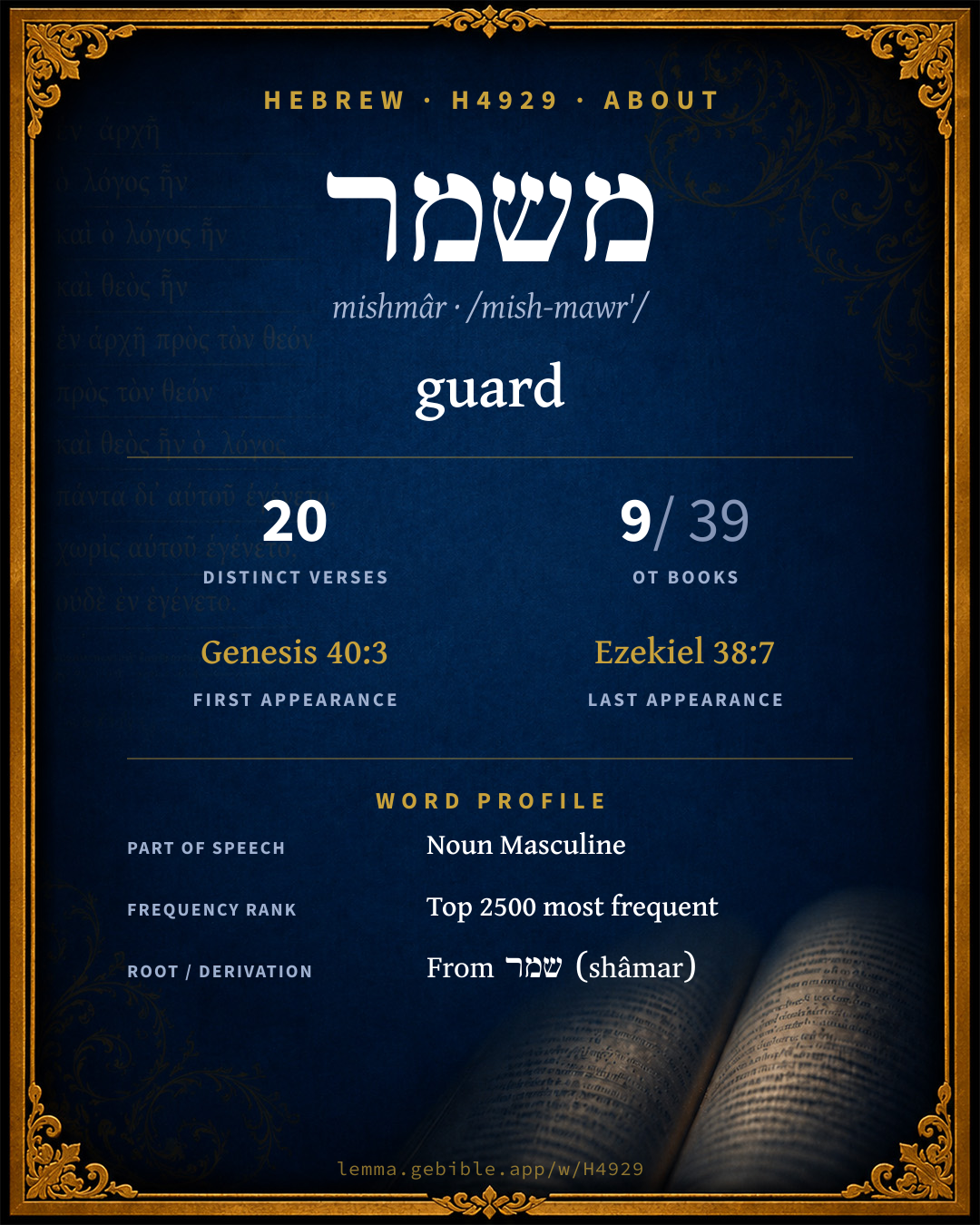
מִשְׁמָר
guard
also: place of confinement, prison, jail, guard post fuller range ↓
Full lexicon entry — Brown-Driver-Briggs (BDB)
From Brown-Driver-Briggs (BDB)
Where this word appears
See every Absolute-state word in the Hebrew Bible →
Grammar key — what these labels mean
Part of speech
- Noun
- A naming word — a person, place, thing, or idea.
Noun type
- Common
- A common noun — a general class of person, place, or thing (“king,” “city,” “water”), not a specific name.
State
- Absolute
- The independent form of a noun, not bound to a following word.
- Construct
- A noun bound to a following noun in a possessive / “of” relationship (the construct chain).
Gender
- Masculine
- Grammatically masculine.
Number
- Singular
- One.
- Plural
- More than one (in Hebrew, generally three or more).
Grammatical forms
- Noun, Common, Masculine, Singular, Absolute 16 times (73%)
- Noun, Common, Masculine, Singular, Construct 5 times (23%)
- Noun, Common, Masculine, Plural, Construct 1 time (5%)
Parsed forms decoded from the imported morphology (morphhb / Westminster Leningrad Codex — WLC text public domain, morphhb tagging CC BY 4.0), counted across 22 parsed occurrences — not distinct verses.
Every verse where H4929 appears — 20 distinct verses across 9 books. Click any verse to open its interlinear word-by-word view. Verse text shown in the World English Bible for context — . Each verse’s Hebrew form is shown with its reference; the English is not keyword-highlighted, since the data carries no word-level English alignment. Use “Compare translations” on any verse to read it across multiple English versions. This concordance covers the Hebrew Bible; Septuagint (Greek Old Testament) occurrences are not indexed here.
Genesis 6 verses
- Genesis 40:3 בְּ/מִשְׁמַ֗ר prep + n c ms cs He put them in custody in the house of the captain of the guard, into the prison, the place where Joseph was bound.
- Genesis 40:4 בְּ/מִשְׁמָֽר prep + n c ms The captain of the guard assigned them to Joseph, and he took care of them. They stayed in prison many days.
- Genesis 40:7 בְ/מִשְׁמַ֛ר prep + n c ms cs He asked Pharaoh's officers who were with him in custody in his master's house, saying, "Why do you look so sad today?"
- Genesis 41:10 בְּ/מִשְׁמַ֗ר prep + n c ms cs Pharaoh was angry with his servants, and put me in custody in the house of the captain of the guard, me and the chief baker.
- Genesis 42:17 מִשְׁמָ֖ר n c ms He put them all together into custody three days.
- Genesis 42:19 מִשְׁמַרְ/כֶ֑ם n c ms cs + sfx pers 2mp If you are honest men, then let one of your brothers be bound in your prison-house; but you go, carry grain for the famine of your houses.
Leviticus 1 verse
Numbers 1 verse
1 Chronicles 1 verse
Nehemiah 7 verses
- Nehemiah 4:9 מִשְׁמָ֧ר n c ms But we made our prayer to our God, and set a watch against them day and night, because of them.
- Nehemiah 4:22 מִשְׁמָ֖ר n c ms Likewise at the same time said I to the people, Let everyone with his servant lodge within Jerusalem, that in the night they may be a guard to us, and may labor in the day.
- Nehemiah 4:23 הַ/מִּשְׁמָר֙ ptcl def.art + n c ms So neither I, nor my brothers, nor my servants, nor the men of the guard who followed me, none of us put off our clothes, everyone [went with] his weapon [to] the water.
- Nehemiah 7:3 בְּ/מִשְׁמָר֔/וֹ prep + n c ms cs + sfx pers 3ms I said to them, Don't let the gates of Jerusalem be opened until the sun be hot; and while they stand [on guard], let them shut the doors, and bar you them: and appoint watches of the inhabitants of Jerusalem, everyone in his watch, and everyone [to be] over against his house.
- Nehemiah 12:24 מִשְׁמָ֖ר מִשְׁמָֽר n c ms n c ms The chiefs of the Levites: Hashabiah, Sherebiah, and Jeshua the son of Kadmiel, with their brothers over against them, to praise and give thanks, according to the commandment of David the man of God, watch next to watch.
- Nehemiah 12:25 מִשְׁמָ֔ר n c ms Mattaniah, and Bakbukiah, Obadiah, Meshullam, Talmon, Akkub, were porters keeping the watch at the store-houses of the gates.
- Nehemiah 13:14 וּ/בְ/מִשְׁמָרָֽי/ו conj + prep + n c mp cs + sfx pers 3ms Remember me, my God, concerning this, and don't wipe out my good deeds that I have done for the house of my God, and for the observances of it.
Job 1 verse
Proverbs 1 verse
Jeremiah 1 verse
Ezekiel 1 verse
About this entry
At a glance — auto-summarized from this page’s data, not written by a person. Every figure links to its source below. This summary describes the numbers; it doesn’t interpret them.
At its core, משמר (mishmâr) means “guard.” Its English rendering has broadened — “ward” classically, “guard” (Berean Standard Bible) and “custody” (unfoldingWord Literal Text) in modern versions; see the renderings breakdown. Spanning 20 verses in 9 books, it ranks among the uncommon words of the Hebrew Bible. Its uses concentrate in Nehemiah (35% of all occurrences). Beyond its headline sense, its full sense range takes in “place of confinement”, “prison”, and “jail”. Dig into 20-verse concordance and the renderings breakdown below.
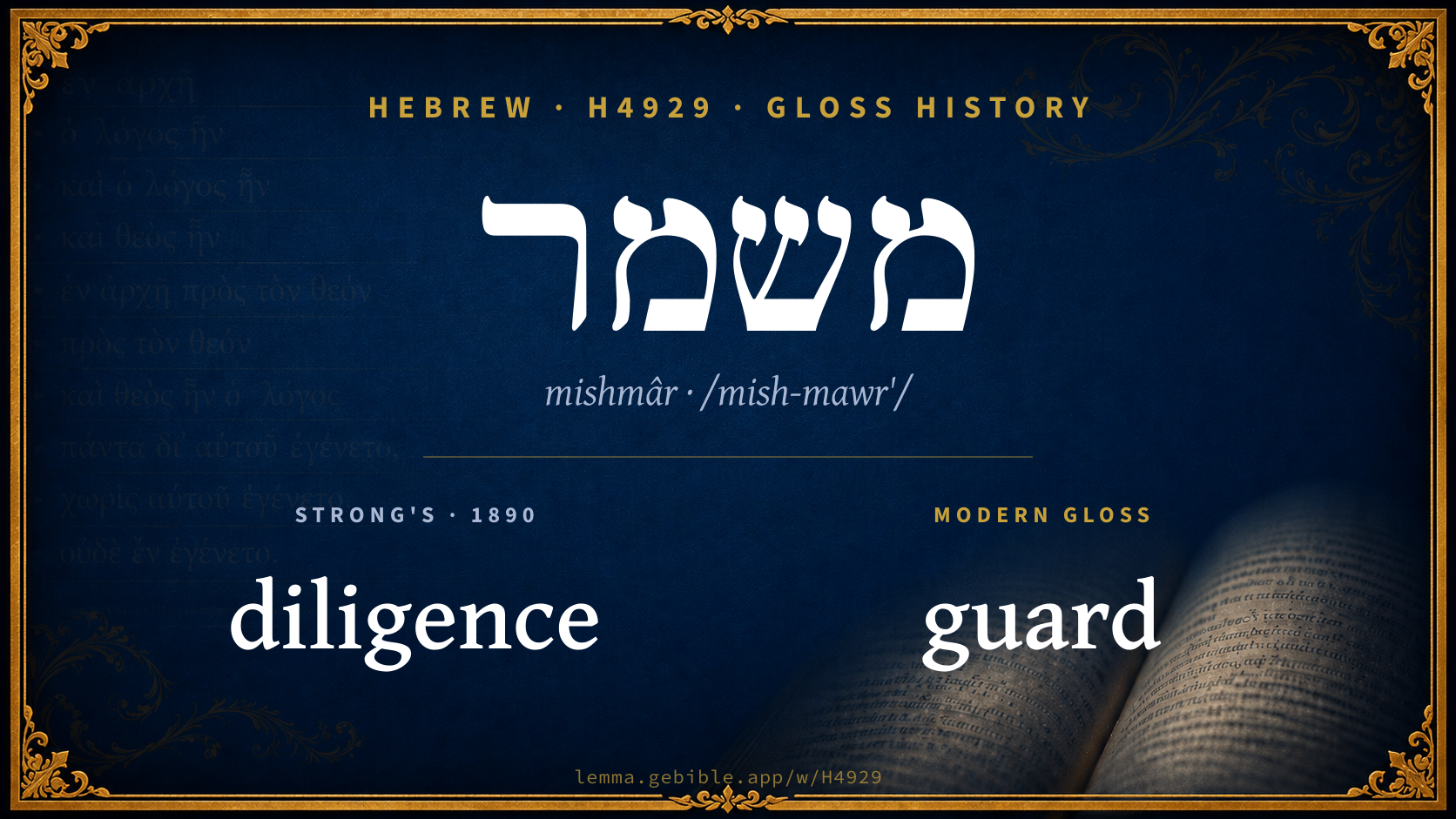
Gloss history
Strong's 1890 vs modern scholarship
About this word
Strong's H4929 catalogs a Hebrew word from the Hebrew Old Testament.
These counts are not copied from any lexicon or concordance. They are computed here, from the morphology-tagged Hebrew Old Testament. What Lemma adds →
- 20
- distinct verses
- The word appears in 20 distinct verses.
- 9 / 39
- OT books
- The word appears in 9 of 39 Old Testament books.
- #1,412
- by frequency
- Top 2500 most frequent Hebrew words (rank 1,412 of 8,640 Hebrew words by occurrence).
View all 20 occurrences in the concordance →
By section of the Old Testament
By traditional corpus
Conventional, traditional groupings — biblical authorship is debated, so this is a traditional corpus grouping, not an authorship claim. Each share is this word’s portion of its verses in that division of the Hebrew canon. Each figure is a share of the word’s 20 distinct verses.
- Writings (Ketuvim) 10 verses · 50%
- Torah (Pentateuch) 8 verses · 40%
- Prophets (Nevi'im) 2 verses · 10%
How translations render this word
Counts come from each version’s own published word-to-Strong’s tagging or interlinear alignment — an approximate guide to how each version renders this word, not a word-level alignment the data otherwise carries. Because each total is that version’s own tagged count, the per-version totals vary from one another and need not match the appearance or distinct-verse counts above. These counts may also differ from a printed concordance because Lemma counts each distinctly tagged rendering and does not collapse phrase taggings into a single head-word total. This is a fixed set of word-tagged versions (KJV, ASV, BSB, ULT) and does not change with the reading translation you choose elsewhere. Each version’s license is shown beside its name below (and on Sources).
- King James Version: Ward 11×, Watch 3×
- American Standard Version: Watch 7×, Ward 5×
- Berean Standard Bible: Guard 5×, Custody 4×
- unfoldingWord Literal Text: Custody 7×, Guard 7×, Service watch 2×
King James Version Public Domain
Renders H4929 across 22 tagged occurrences — most commonly:
Plus 8 renderings that appear only once — usually multi-word phrases or single function words the recovered tagging swept in, not distinct renderings.
American Standard Version Public Domain
Renders H4929 across 22 tagged occurrences — most commonly:
Plus 10 renderings that appear only once — usually multi-word phrases or single function words the recovered tagging swept in, not distinct renderings.
Berean Standard Bible Public Domain
Renders H4929 across 18 tagged occurrences — most commonly:
Plus 9 renderings that appear only once — usually multi-word phrases or single function words the recovered tagging swept in, not distinct renderings. Not rendered by a distinct English word in 4 further occurrences.
unfoldingWord Literal Text CC BY-SA 4.0
Renders H4929 across 21 tagged occurrences — most commonly:
Plus 5 renderings that appear only once — usually multi-word phrases or single function words the recovered tagging swept in, not distinct renderings.
Senses in the full BDB
What do BDB’s symbols mean?
BDB uses these scholarly abbreviations:
| Symbol | Meaning |
|---|---|
| 𝔊 | the Septuagint (the ancient Greek translation, LXX) |
| 𝔙 | the Vulgate (the Latin translation) |
| 𝔖 | the Syriac version (the Peshitta) |
| 𝔗 | the Targum (the Aramaic translation) |
| ψ | the Psalms |
| √ | root (the underlying root or stem) |
| ‖ | parallel passage (a synonymous or contrasted parallel) |
| † | the dagger: every passage where the word occurs is cited |
The 3 senses and sub-senses the full Brown-Driver-Briggs lexicon distinguishes for this word, in lexicon order (not ranked by frequency), with BDB’s own verbatim wording and sub-sense lettering. Shown in Hebrew script with BDB’s own scholarly abbreviations. The condensed entry is in the Lexicon Entry tab. See also the Forms in the corpus table below.
- 1. gaol, prison, מ׳ בֵּית שַׂר הַטַּבָּחִים Gn 40:3, cf. v 4 (abs.), v 7; 41:10; 42:17 (abs.), + v 30 (𝔊), בֵּית מִשְׁמַרְכֶם v 19 (all E); guard-house in camp Lv 24:12 (P), Nu 15:34 (P). e.g. Genesis 40:3
- 2. guard, Je 51:12; Ne 4:3, 16, אַנְשֵׁי הַמּ׳ v 17; guard-post 7:3; fig. of י׳ setting a guard, כִּי תָשִׂים עָלַי מ׳ Jb 7:12; band of (Levit.) guards or functionaries 1 Ch 26:16; Ne 12:24, 25 (cf. מִשְׁמֶרֶת); act of guarding, מִכָּל־מ׳ Pr 4:23 above all guarding watch thy heart.—לְמ׳ Ez 38:7 is doubtful, Hi Co Toy al. reserve; Krae לְמשֵׁל. e.g. Jeremiah 51:12
- 3. pl. observances, services, of temple Ne 13:14. e.g. Nehemiah 13:14
Senses from the full Brown-Driver-Briggs lexicon (Brown, Driver, Briggs; Oxford 1906 — public domain), digitized via Sefaria, supplemented by the OpenScriptures HebrewLexicon (CC BY 4.0). Full attribution on Sources.
Word origin
n.[m.] place of confinement, gaol, prison; late, guard, watch, observance;—abs. מ׳ Gn 42:17 +; cstr. מִשְׁמַר 40:3 +; sf. מִשְׁמָרוֹ Ne 7:3, etc.; pl. sf. -רָיו 13:14;—
— Brown-Driver-Briggs (Oxford 1906, public domain), digitized via Sefaria, supplemented by the OpenScriptures HebrewLexicon (CC BY 4.0). See Sources.
Derived from שמר (shâmar) (H8104) — to keep.
Jastrow Dictionary
A second Hebrew/Aramaic lexicon for comparison, covering Aramaic and post-biblical (Talmudic, Targumic, Midrashic) usage that the biblical-Hebrew BDB does not. Matched by lemma rather than by Strong’s number, so a lemma may carry more than one Jastrow headword (shown separately below), and the entries cover usage well beyond the Bible.
משמר
- , Y. Shebi. IV, 35ᵃ bot., v. הָאַסְטוּ
מִשְׁמָר
- 1. guard, esp. a division for duty of priests and Levites. Taan. IV, 2, v. מַעֲמָד. Hor. 13ᵃ ראש מ׳ chief of the guard. Taan. l. c. ישראל שבאותו מ׳ the Israelites attached (as מַעֲמָד) to that division; a. fr.—Pl. מִשְׁמָרוֹת. Ib. Num. R. s. 3; a. fr.
- 2. (= אַשְׁמוֹרֶת) watch, a certain portion of the day or the night. Ber. 3ᵃ על כל מ׳ ומ׳ at the beginning of every watch.—Pl. as ab. Ib.; Tosef. ib. I, 1 שלש מ׳ בלילה the night is divided into three watches.
A Dictionary of the Targumim, the Talmud Babli and Yerushalmi, and the Midrashic Literature (Marcus Jastrow; London, Luzac, 1903) — Public Domain. Digitized via Sefaria. Digitized via Sefaria. Full attribution on Sources.
Forms in the corpus
The 15 distinct written forms H4929 takes in the Hebrew Bible, most frequent first — each parse links to that state’s occurrences in the concordance. Hebrew forms include their vowel points and cantillation, so a single lemma takes many written forms.
Same root — word family
Other BDB entries built from the same root as H4929, grouped by Strong’s listed origin. These share a root / origin per the lexicon — not necessarily a shared meaning. Each links to that word’s own entry.
Derives from
Shares the same root
- אשמרה ʼashmurâh H821 watch
- שמיר shâmîyr H8068 thorn
- שמר shemer H8105 dregs
- שמר shimmur H8107 night watch
- שמרה shomrâh H8108 watch
- שמרה shᵉmurâh H8109 eyelid
Derived from this word
Proper names from this root
People and places named from this root — a name, not an additional meaning of the word.
- ישמרי Yishmᵉray H3461 Ishmerai
- שומר Shôwmêr H7763 Shomer
- שמרון Shômᵉrôwn H8111 Samaria
- שמריה Shᵉmaryâh H8114 Shemariah
- שמרת Shimrâth H8119 Shimrath
Compare all same-root words → Showing 4 of 14 — not the complete family. 5 of the same-root words are proper names (people or places). They share a root, not necessarily a meaning.
Septuagint verse parallels
This word appears in 13 verses that also exist in the Greek Old Testament (Septuagint), out of the 20 Hebrew verses it occurs in. You can read those verses in Greek by switching the Old Testament edition to the Septuagint.
Read these verses in the Septuagint
- Genesis 40:3
- Leviticus 24:12
- Numbers 15:34
- 1 Chronicles 26:16
- Job 7:12
- Proverbs 4:23
- Jeremiah 51:12
- Ezekiel 38:7
This is a verse-level parallel only — the same verses exist in both the Hebrew and Greek Old Testaments. No word-level Hebrew↔Greek correspondence is claimed: the data carries no such alignment, so no Greek word is shown as this Hebrew word’s translation. Coverage is not total — the Septuagint omits the deuterocanon and renumbers the Psalms, so some Hebrew verses have no direct Greek parallel.