Joshua 10:18

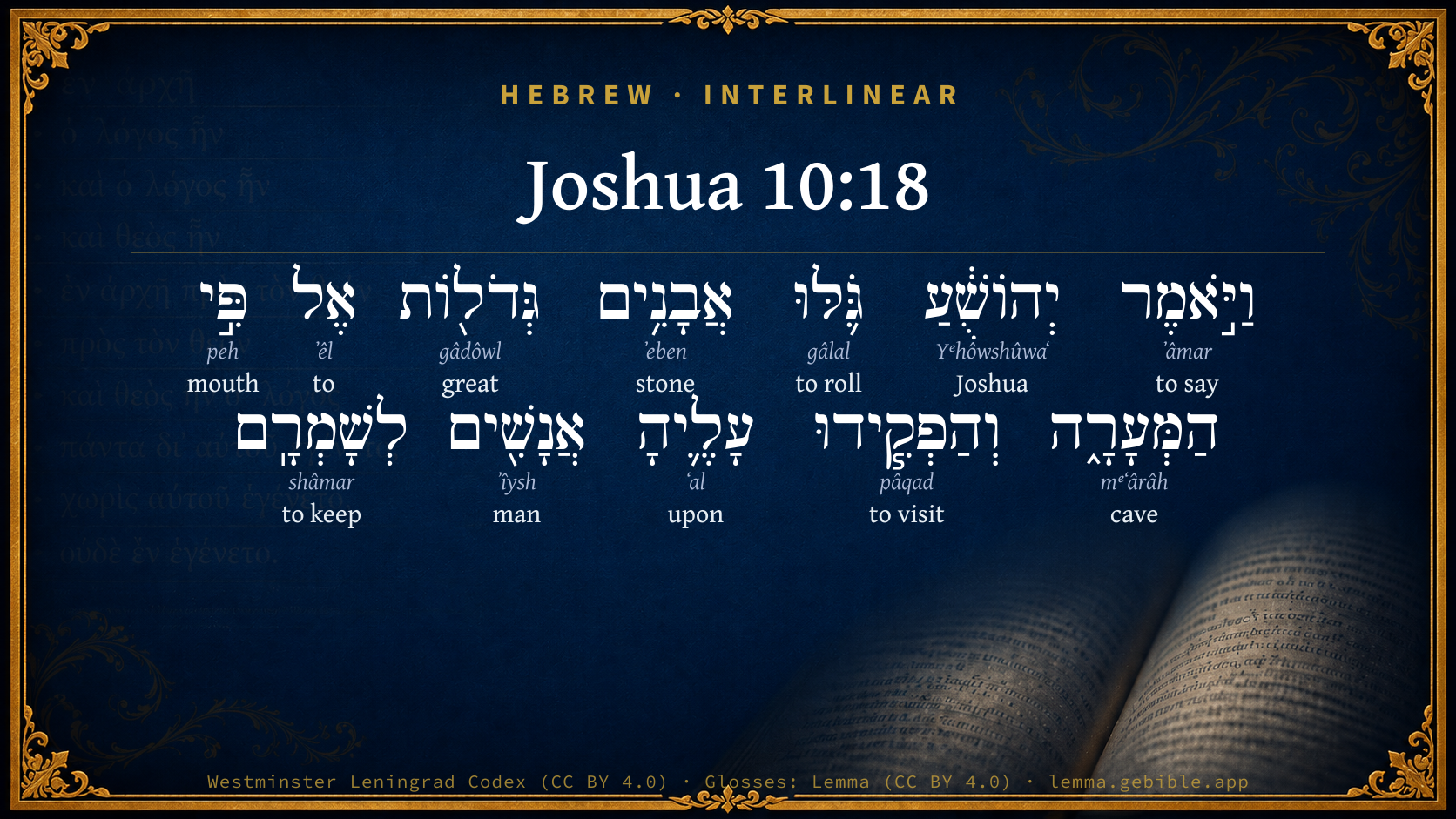
Hebrew (Westminster Leningrad Codex) Joshua 10:18 appears in the Hebrew Old Testament. The text above is from the Westminster Leningrad Codex. Each word links to its Strong’s number, a concise gloss, and parsing drawn from the Open Scriptures Hebrew Bible morphology. Click any word for its full Brown-Driver-Briggs (BDB) entry.
Download image
Cite this verse

Joshua 10:18 (World English Bible). Public Domain. Lemma interlinear Bible study tool, https://lemma.gebible.app/v/joshua/10/18.

Show BibTeX & RIS
BibTeX
RIS
English Translation
Joshua said, Roll great stones to the mouth of the cave, and set men by it to keep them:
World English Bible · Public Domain
Download a study sheet

One document with this verse’s original text, its word-by-word gloss line, the meaning frame, cross-references with their text, attributed commentary, and full source and license credits — printable, and it pastes into notes with its structure intact.

This verse Autodidact and up

Study sheet (.html) Plain text (.txt)

A passage Seminary Student

Up to 50 verses in one chapter. A passage sheet keeps up to 6 commentary sources and 12 cross-references per verse, in the order this page ranks them, and says so on the sheet whenever that leaves anything out. Ask for a single verse and you get the Autodidact verse sheet above.

Everything on this page stays free to read, with no account — the sheet is a download of what is already on screen, not access to it.

Want to remove ads? Support Godless Engineer
Compare translations 3

The same verse in 3 English versions, stacked beneath the original-language interlinear above. Click any original word for its lexicon entry.

Each is an independent rendering of the whole verse — the interlinear is not word-aligned to these translations.

Highlighted words mark where these versions differ — a whole-verse word diff, not a word-by-word alignment.

  • World English Bible Public Domain
    Joshua said, Roll great stones to the mouth of the cave, and set men by it to keep them:
  • King James Version Public Domain
    And Joshua said, Roll great stones upon the mouth of the cave, and set men by it for to keep them:
  • unfoldingWord Literal Text CC BY-SA 4.0
    And Joshua said, “Roll great stones to the mouth of the cave and appoint men by it to guard them.”

unfoldingWord Literal Text — © unfoldingWord, licensed CC BY-SA 4.0. Word-aligned USFM3 via Door43 (git.door43.org/unfoldingWord/en_ult).

Versions to compare (up to 4)

3 of 4 selected

Show all 18 translations

Every available English version of this verse, each an independent rendering of the whole verse.

  • World English Bible Public Domain
    Joshua said, Roll great stones to the mouth of the cave, and set men by it to keep them:
  • Berean Standard Bible Public Domain
    So Joshua said, “Roll large stones against the mouth of the cave, and post men there to guard them.
  • Majority Standard Bible Public Domain
    So Joshua said, “Roll large stones against the mouth of the cave, and post men there to guard them.
  • King James Version Public Domain
    And Joshua said, Roll great stones upon the mouth of the cave, and set men by it for to keep them:
  • American Standard Version (1901) Public Domain
    And Joshua said, Roll great stones unto the mouth of the cave, and set men by it to keep them:
  • Revised Version (1885) Public Domain
    And Joshua said, Roll great stones unto the mouth of the cave, and set men by it for to keep them:
  • Geneva Bible (1599) Public Domain
    Then Ioshua said, Roule great stones vpon the mouth of the caue, and set men by it for to keepe them.
  • Douay-Rheims (1899) Public Domain
    And he commanded them that were with him, saying: Roll great stones to the mouth of the cave, and set careful men, to keep them shut up:
  • Young's Literal Translation Public Domain
    And Joshua saith, `Roll great stones unto the mouth of the cave, and appoint over it men to watch them;
  • Literal Standard Version CC BY-SA 4.0
    And Joshua says, “Roll great stones to the mouth of the cave, and appoint men over it to watch them;
  • Unlocked Literal Bible CC BY-SA 4.0
    Joshua said, “Roll large stones against the mouth of the cave and place soldiers there to guard them.
  • unfoldingWord Literal Text CC BY-SA 4.0
    And Joshua said, “Roll great stones to the mouth of the cave and appoint men by it to guard them.”
  • Darby Bible Public Domain
    And Joshua said, Roll great stones before the mouth of the cave, and set men before it to keep them.
  • World Messianic Bible Public Domain
    Joshua said, “Roll large stones to cover the cave’s entrance, and set men by it to guard them;
  • Webster's Bible Public Domain
    And Joshua said, Roll great stones upon the mouth of the cave, and set men by it to keep them:
  • Free Bible Version CC BY-SA 4.0
    he gave this order, “Roll some large stones to block the entrance to the cave and have some men guard it.
  • Bible in Basic English Public Domain
    And Joshua said, Let great stones be rolled against the mouth of the hole, and let men keep watch by it:
  • JPS Tanakh (1917) Public Domain
    And Joshua said: 'Roll great stones unto the mouth of the cave, and set men by it to keep them;

Literal Standard Version (2020), Covenant Press — licensed CC BY-SA 4.0. Text via the HelloAO Bible API (eBible.org). Unlocked Literal Bible (unfoldingWord) — licensed CC BY-SA 4.0. Text via the HelloAO Bible API (eBible.org). unfoldingWord Literal Text — © unfoldingWord, licensed CC BY-SA 4.0. Word-aligned USFM3 via Door43 (git.door43.org/unfoldingWord/en_ult). Free Bible Version, Dr. Jonathan Gallagher — licensed CC BY-SA 4.0. Text via the HelloAO Bible API (eBible.org).

Word by word

More ways to search: Search by grammar → Find every occurrence → Compare this word →

Practice this passage: Drill this verse → Learn its vocabulary →

גֹּ֛לּוּ
gâlal
H1556
“roll”
Verb, Qal, Imperative, 2nd Person, Masculine, Plural
Part of Speech
Verb
Stem
Qal
Form
Imperative
Person
2nd Person
Gender
Masculine
Number
Plural
Full BDB Definition

Origin: a primitive root

TWOT: 353

to roll, roll away, roll down, roll together - (Qal) to roll - (Niphal) - to roll up - to flow down - (Pilpel) to roll - (Poal) to be rolled - (Hithpoel) to roll oneself - (Hithpalpel) to roll oneself - (Hiphil) to roll away
  1. וַיֹּ֣אמֶר ʼâmar H559 “and · to say” Conjunction + Verb, Qal, Sequential Imperfect, 3rd Person, Masculine, Singular
  2. יְהוֹשֻׁ֔עַ Yᵉhôwshûwaʻ H3091 “Joshua” Noun, Proper
  3. אֲבָנִ֥ים ʼeben H68 “stones” Noun, Common, Feminine, Plural, Absolute
  4. גְּדֹל֖וֹת gâdôwl H1419 “great” Adjective, Adjective, Feminine, Plural, Absolute
  5. אֶל ʼêl H413 “to” Preposition
  6. פִּ֣י peh H6310 “mouth of” Noun, Common, Masculine, Singular, Construct
  7. הַמְּעָרָ֑ה mᵉʻârâh H4631 “the · cave” Particle, Definite Article + Noun, Common, Feminine, Singular, Absolute
  8. וְהַפְקִ֧ידוּ pâqad H6485 “and · visit” Conjunction + Verb, Hiphil, Imperative, 2nd Person, Masculine, Plural
  9. עָלֶ֛יהָ ʻal H5921 “upon · her” Preposition + Suffix, Personal, 3rd Person, Feminine, Singular
  10. אֲנָשִׁ֖ים ʼîysh H376 “men” Noun, Common, Masculine, Plural, Absolute
  11. לְשָׁמְרָֽם shâmar H8104 “to keep · them” Preposition + Verb, Qal, Infinitive Construct + Suffix, Personal, 3rd Person, Masculine, Plural

About this verse

These counts appear in no published source. They are computed here, from the morphology-tagged text and Lemma’s own curated glosses. What Lemma adds →

12
words
12
distinct lemmas
Historical
section

Notable vocabulary

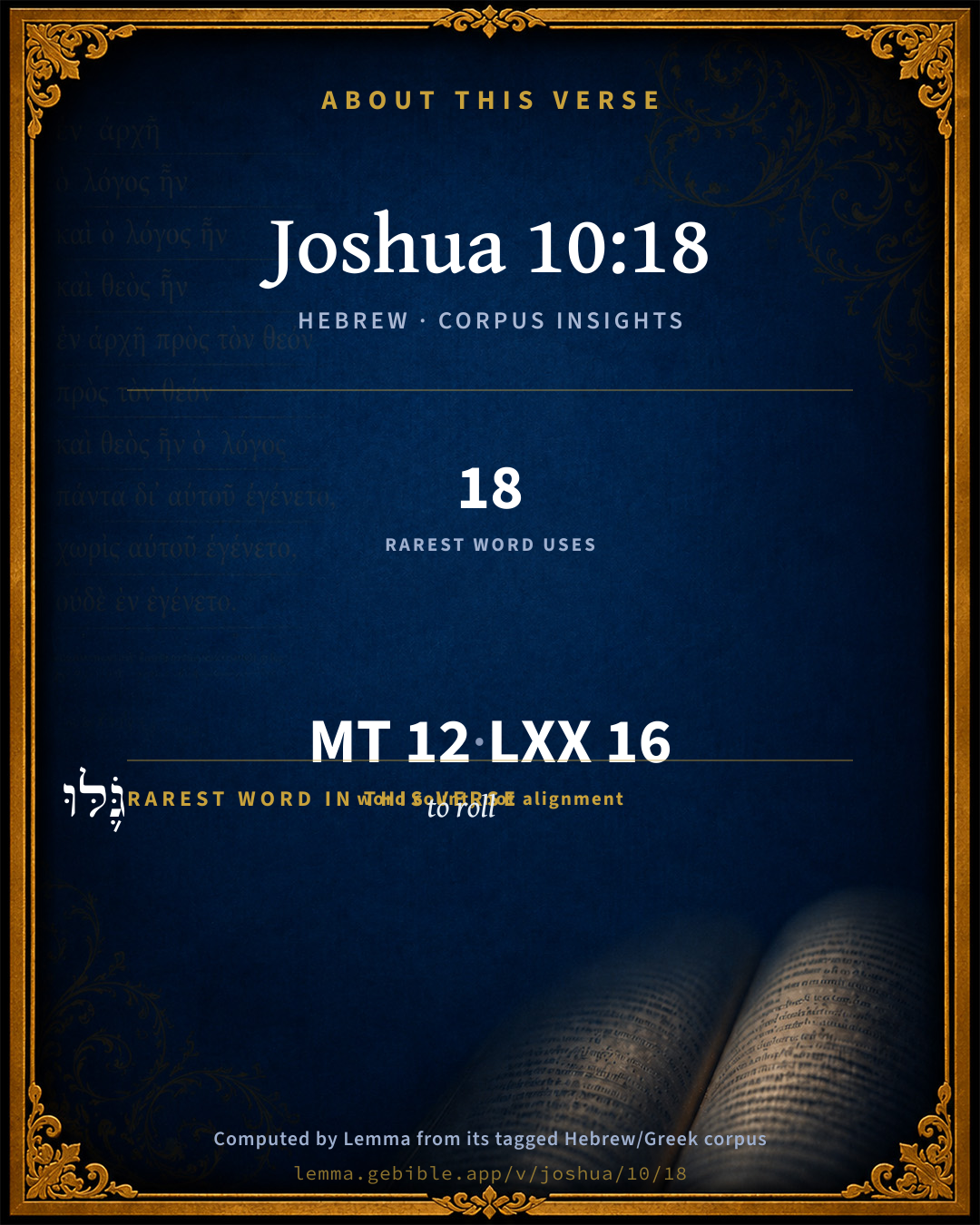
The rarest word here is גֹּ֛לּוּ to roll H1556 — appearing just 18 times in the whole Hebrew Bible.

Shared distinctive vocabulary

גֹּ֛לּוּ to roll H1556 occurs in 18 verses of the Hebrew Bible. Also found in:

Grammatical profile

  • 4 verbs
  • 5 nouns
  • 1 adjective
  • 2 prepositions

Verb forms

  • וַיֹּ֣אמֶר Qal · Sequential Imperfect
  • גֹּ֛לּוּ Qal · Imperative
  • וְהַפְקִ֧ידוּ Hiphil · Imperative
  • לְשָׁמְרָֽם Qal · Infinitive Construct

Hebrew & Septuagint length

In English translation the verse runs 19 words from the Hebrew and 18 from the Septuagint (LXX English) — closely comparable.

A rough comparison of the two English renderings, which tokenize alike — not a word-level alignment.

Word counts can differ between the Hebrew and the Greek without any difference in meaning — e.g. the Hebrew direct-object marker אֵת has no separate Greek word, and Greek often adds the article ὁ.

In the original languages it is 12 Hebrew tokens and 16 Greek tokens — but the two are counted differently (Hebrew bundles its prefixes and suffixes into one token; the Greek is in lemma form), so that isn’t a like-for-like length.

Cross-references

6

Topical passages linked to Joshua 10:18 in the Treasury of Scripture Knowledge — connected by theme and wording, ordered by reader-vote popularity; previews shown in the World English Bible.

  • Matthew 27:66 So they went with the guard and made the tomb secure, sealing the stone.
  • Joshua 10:22 Then said Joshua, Open the mouth of the cave, and bring forth those five kings to me out of the cave.
  • Job 21:30 That the evil man is reserved to the day of calamity? That they are led forth to the day of wrath?
  • Amos 5:19 As if a man fled from a lion, And a bear met him; Or he went into the house and leaned his hand on the wall, And a snake bit him.
  • Amos 9:1 I saw the Lord standing beside the altar, and he said, "Strike the tops of the pillars, that the thresholds may shake; and break them in pieces on the head of all of them; and I will kill the last of them with the sword: there shall not one of them flee away, and there shall not one of them escape.
  • Judges 9:46–49 When all the men of the tower of Shechem heard of it, they entered into the stronghold of the house of Elberith.

Cross-references courtesy of OpenBible.info (CC BY 4.0).

Hebrew and Greek witnesses Masoretic Hebrew ↔ Greek Septuagint

The same verse in the two great witnesses to the Old Testament, shown verse-for-verse.

These are two independent witnesses, not word-aligned to each other, and the Septuagint is shown in lemma (dictionary) form.

Hebrew Joshua 10:18 Masoretic · Westminster Leningrad Codex

וַיֹּ֣אמֶר יְהוֹשֻׁ֔עַ גֹּ֛לּוּ אֲבָנִ֥ים גְּדֹל֖וֹת אֶל פִּ֣י הַמְּעָרָ֑ה וְהַפְקִ֧ידוּ עָלֶ֛יהָ אֲנָשִׁ֖ים לְשָׁמְרָֽם

Joshua said, Roll great stones to the mouth of the cave, and set men by it to keep them:

World English Bible · Public Domain

Greek LXX Joshua 10:18 Septuagint · lemma form

καί εἶπον ἰησοῦς κυλίω λίθος ἐπί ὁ στόμα ὁ σπήλαιον καί καταἵστημι ἀνήρ φυλάσσω ἐπί αὐτός

And Joshua said, Roll stones to the mouth of the cave, and set men to watch over them.

LXX2012 (modern English Septuagint) · Public Domain

Hebrew: Westminster Leningrad Codex (CC BY 4.0). Greek: Septuagint (public domain); English from LXX2012 (modern English Septuagint) (Public Domain). How the Septuagint differs from the Hebrew →

Targum (Aramaic paraphrase)

1

The Targum is the ancient Jewish Aramaic paraphrase of the Hebrew Scriptures — an interpretive translation, not the Hebrew text itself. Onkelos (literal) and Pseudo-Jonathan (expansive) render the Torah, and Jonathan the Prophets. Coverage is partial: where no permissively-licensed English translation exists for a verse, only the Aramaic is shown. This is verse-level text, not a word-by-word alignment to the Hebrew.

  1. Targum Jonathan Prophets (Joshua–Malachi)
    וַאֲמַר יְהוֹשֻׁעַ קְרִיבוּ אַבְנִין רַבְרְבִין קֳדָם פּוּמָא דִמְעַרְתָּא וּמַנוֹ עֲלָהּ גַבְרִין לְמִטַרְהוֹן:

    (no public-domain English translation for this verse)

    Targum Jonathan — Aramaic: “Mikraot Gedolot” (public domain). English: “Sefaria Community Translation” (CC0 1.0 (public-domain dedication)); “London "Chaldee Paraphrase," 1871” (public domain). Text via Sefaria.

Commentary

Notes on Joshua 10:18 from classic Christian and Jewish commentators (each source and its license shown beneath its notes). The classic Christian expositions comment on the surrounding passage and are grouped to its opening verse, so a note may address several verses; the Jewish commentaries on the Tanakh (Rashi and others) are per-verse, so they appear only where the commentator wrote on this verse.

Lemma curates 59 commentaries, every one of them public domain or Creative Commons licensed, each selected and text-cleaned for this edition rather than reprinted as found. About our sources →

Trapp's Complete Commentary

John Trapp

Jos 10:18 And Joshua said, Roll great stones upon the mouth of the cave, and set men by it for to keep them:

Ver. 18. Roll great stones upon the mouth of the cave.] Where now, as in a trap, the mice might well gnaw, but get out they could not.

John Trapp, A Commentary or Exposition upon All the Books of the Old and New Testament (1647–1656) — public domain. Text from a community e-Sword module.

Tyndale Open Study Notes

Tyndale Open Resources

10:18-19 By blocking the opening of the cave, Joshua reduced the number of guards needed to keep the kings from escaping. This also eliminated danger to the guards and freed more men to pursue the fleeing people.

Tyndale Open Study Notes — © Tyndale Open Resources, licensed CC BY-SA 4.0. Text via the HelloAO Bible API.

John Calvin's Commentaries

18. And Joshua said, Roll, etc The enemy having been completely routed, Joshua is now free, and, as it were, at leisure, to inflict punishment on the kings. In considering this, the divine command must always be kept in view. But for this it would argue boundless arrogance and barbarous atrocity to trample on the necks of kings, and hang up their dead bodies on gibbets. It is certain that they had lately been raised by divine agency to a sacred dignity, and placed on a royal throne. It would therefore have been contrary to the feelings of humanity to exult in their ignominy, had not God so ordered it. But as such was his pleasure, it behooves us to acquiesce in his decision, without presuming to inquire why he was so severe.

At the same time, we must recollect, as I formerly hinted, first, that all from the least even to the greatest were deserving of death, because their iniquity had reached the highest pitch, and the kings, as more criminal than the others, deserved severer punishment; and secondly, that it was expedient to give an example of inexorable rigor in the person of the kings, whom the people, from a perverse affectation of clemency, might have been too much disposed to pardon. It was the will of God that all should be destroyed, and he had imposed the execution of this sentence on his people. Had he not stimulated them strongly to the performance of it, they might have found specious pretexts for giving pardon. But a mercy which impairs the authority of God at the will of man, is detestable. Now, however, when regal honor is not spared, all handle for humanity to the plebeians and common vulgar is cut off.

By this instance, the Lord shows us the great interest he takes in his elect people; for it was an instance of rare condescension to place kings under their feet, and allow them to insult over their dignity, as if they had been petty robbers; as it is said in the Psalm, A two-edged sword is in their hand to execute vengeance on the nations, to bind their kings with fetters, and their nobles with chains of iron; to execute the judgment written: this honor have all the saints. (Psalm 149:6-9) That fearful sight had at the same time the effect of striking terror, so as to prevent the Israelites from imitating the manners of nations whose crimes they had seen so severely punished. Accordingly, we repeatedly meet in the books of Moses with this warning, You have seen how God took vengeance on the nations who were in the land of Canaan before you. Beware, therefore, of provoking the wrath of your God by their perverse doings. In one word, that God might be worshipped with greater sanctity, he ordered the land to be purged of all pollutions, and as the inhabitants had been excessively wicked, he willed that his curse should rest upon them in a new and unwonted manner.

John Calvin's Commentaries (1540-1563) — public domain. Text from the Calvin Translation Society English edition (1840s-50s) via the Christian Classics Ethereal Library (ccel.org). Calvin's coverage is partial (roughly two-thirds of the Bible); uncommented books and verses are honest gaps, never fabricated. The 19th-century editor's footnotes and remarks are omitted so the notes are faithfully Calvin's own voice.

The Cambridge Bible for Schools and Colleges

gen. ed. J. J. S. Perowne

18. And Joshua said] The victory was not yet won. The conqueror would not be diverted from his object. The mouth of the cave was blocked with huge stones, and armed men were stationed to guard it, while the pursuit was still continued.

The Cambridge Bible for Schools and Colleges (gen. ed. J. J. S. Perowne; Cambridge University Press, 1878–1918) — public domain. Text from a community e-Sword module.

John Gill's Exposition

And stay you not, but pursue after your enemies,.... That is, do not stay at this cave, but having placed a sufficient guard there, go in pursuit of the enemy, with as much celerity as possible:

and smite the hindmost of them; their rear; or "tail" them (o), as the word is, cut off the tail of them:

suffer them not to enter their cities; where they would not only be safe themselves for a while, but would be able to hold out against a siege for some time, and give much trouble to conquer them:

for the Lord your God hath delivered them into your hands; this he said to encourage them, and quicken them to the pursuit of them with all eagerness and vehemence. According to the Samaritan Chronicle (p), the signal or watchword was,"God is strong in battle, God is his name.''

(o) "caudam eorum caedite", Pagninus, Vatablus, Masius, Drusius; "et decaudetis eos", Montanus; "decaudabitis eos", Munster. (p) Apud Hottinger. Smegma, p. 509.

John Gill's Exposition of the Whole Bible (1746–1763) — public domain (CC PDM 1.0). Text via the HelloAO Bible API.

Whedon's Commentary on the Bible

Daniel D. Whedon

18. Roll great stones — The cave when thus barricaded would require but a small guard. The rest of the men could be employed in the pursuit. The golden hour for the victor is the time when his enemies are fleeing disordered and panic-stricken. The rigorous commander in such an hour neglects even his own wounded and dying that he may make his victory decisive.

Daniel D. Whedon (gen. ed.), Commentary on the Old and New Testaments (1874–1909) — public domain. Text from a community e-Sword module.

unfoldingWord translationNotes

Door43 World Missions Community

into your hand

The phrase "your hand" here means "your control." (See: Metonymy)

translationWords

Joshua

Yahweh

unfoldingWord translationNotes — © Distant Shores Media and the Door43 World Missions Community, licensed CC BY-SA 4.0. Source: git.door43.org/Door43/en_tn.

Rashi

Rabbi Shlomo Yitzchaki (Rashi)

Roll. Roll large stones to the mouth of the cave.

Rashi on the Tanakh — English translations: “The Judaica Press complete Tanach with Rashi, translated by A. J. Rosenberg” (CC BY 4.0); “Pentateuch with Rashi's commentary by M. Rosenbaum and A.M. Silbermann, 1929-1934” (public domain); “The Metsudah Tanach series, Lakewood, N.J” (CC BY 4.0); and “The Book of Joshua, Metsudah Publications, 1997” (CC BY 4.0). Text via Sefaria.

Lesson kit

Teaching starters — assembled from the data on this page, not authored interpretation. Every prompt links to the verse data it draws on. Edit before teaching.

Joshua, in the Historical, opens this verse with 12 words (12 distinct Hebrew lemmas). Its most distinctive word is gâlal (“to roll”). A historical commentator’s framing appears above. Read the whole chapter for the surrounding context.

Discussion questions

  1. The word gâlal carries the sense “to roll.” How does it shape the verse?
  2. Genesis 29:3 shares the word «to roll» with this verse. How do the two illuminate each other?
  3. These translations render this verse differently; the difference is in the English rendering, not the original. What questions does that raise?
  4. The verb «וַיֹּ֣אמֶר» is Qal Sequential Imperfect. How does its form color the action?
  5. Reading how Trapp's Complete Commentary and Tyndale Open Study Notes read this verse, where do the two commentators agree and where do they part?

Things to notice

Reading settings

Reading text

Shown beneath each verse's original-language words.

Old Testament
Old Testament edition

Read the OT as the Masoretic Hebrew (MT) or the Greek Septuagint (LXX).

English shown for the Greek Septuagint (in the Hebrew ↔ Greek comparison).

Comparing translations? Open the Compare panel on any verse page to stack up to four side by side.